


ASTM D7815-21
(Practice)Standard Practice for Handling, Transportation, and Storage of Halon 1211, Bromochlorodifluoromethane (CF2BrCl)
Standard Practice for Handling, Transportation, and Storage of Halon 1211, Bromochlorodifluoromethane (CF<inf>2</inf>BrCl)
SIGNIFICANCE AND USE
4.1 This practice provides requirements for the handling, transportation, and storage of Halon 1211 encountered in distribution through both commercial and military channels. It is intended to ensure that Halon 1211 is handled, transported, and stored in such a way that its physical property values are not degraded. Transport may be by various means, such as, but not limited to, highway, rail, water, and air.
SCOPE
1.1 This practice covers guidance and direction to suppliers, recyclers, reclaimers, purchasers, and users in the handling, transportation, and storage of Halon 1211.
1.2 The values stated in inch-pound units are to be regarded as standard. The values given in parentheses are mathematical conversions to SI units that are provided for information only and are not considered standard.
1.3 This standard does not purport to address all of the safety concerns, if any, associated with its use. It is the responsibility of the user of this standard to establish appropriate safety, health, and environmental practices and determine the applicability of regulatory limitations prior to use.
1.4 This international standard was developed in accordance with internationally recognized principles on standardization established in the Decision on Principles for the Development of International Standards, Guides and Recommendations issued by the World Trade Organization Technical Barriers to Trade (TBT) Committee.
General Information
- Status
- Published
- Publication Date
- 31-May-2021
- Technical Committee
- D26 - Halogenated Organic Solvents and Fire Extinguishing Agents
- Drafting Committee
- D26.09 - Fire Extinguishing Agents
Relations
- Effective Date
- 01-Nov-2010
Overview
ASTM D7815-21 specifies the standard practice for the handling, transportation, and storage of Halon 1211 (bromochlorodifluoromethane, CF₂BrCl). This fire suppressant, widely used in both commercial and military settings, requires specialized procedures to maintain its chemical integrity and ensure safe distribution. The standard offers guidance for suppliers, recyclers, reclaimers, purchasers, and end users, aiming to prevent contamination, degradation, and the potential hazards associated with improper management.
Key Topics
Handling Requirements:
- Personnel must be properly trained in the safe handling of compressed gas cylinders, following guidelines from the Compressed Gas Association (CGA) and applicable federal regulations.
- Cylinders should be handled in ventilated, non-smoking, and heater-free areas to minimize accidental accumulation of Halon 1211.
- Special attention is required to prevent overfilling and to ensure fill densities remain within safe limits as defined in related standards.
- Only trained personnel should carry out Halon 1211 transfers between storage and recycling processes.
- All handling should prevent contamination from oil, water, dirt, or other foreign substances.
Transportation Guidelines:
- Transportation must comply with U.S. Department of Transportation (DOT) regulations in 49 CFR, including container marking, labeling, and shipment within approved guidelines for nonflammable compressed gases.
- Cylinders should be secured against vibration, impact, extreme temperatures, and other physical hazards during transit.
- In cases of potential exposure to high temperatures or rough conditions, additional insulation or protective measures may be necessary.
- All containers must display proper shipping names, hazard class, and UN numbers, according to federal regulations.
Storage Protocols:
- Storage areas must protect cylinders from environmental and physical damage, unauthorized access, and temperature extremes.
- Storage containers are to be fitted with proper pressure-relief devices and undergo regular inspection and hydrostatic testing per regulatory requirements.
- Clear identification and segregation of Halon 1211 cylinders are required based on product conformity to ASTM specifications.
Inspection and Reclamation:
- Reclaimed or recycled Halon 1211 must meet specification D7673/D7673M before being released for use.
- Non-conforming Halon 1211 should be treated by environmentally safe methods until compliance is achieved.
Applications
The standard is crucial for organizations involved in the fire protection and suppression industry, including:
- Commercial distributors and military entities responsible for large-scale fire suppressant logistics
- Companies specializing in the recovery, reclamation, and recycling of Halon 1211
- Facilities managing the transportation of compressed gases by road, rail, air, or sea
- Environmental and safety managers overseeing regulatory compliance for hazardous materials
- Manufacturers and purchasers of pressurized gas containers used for Halon 1211
By following ASTM D7815-21, organizations can:
- Maintain the quality and effectiveness of Halon 1211 during distribution and storage
- Comply with national and international regulations for hazardous materials
- Reduce risks to personnel, facilities, and the environment
Related Standards
- ASTM D7673/D7673M: Specification for Halon 1211, defining product purity and technical criteria
- CGA C-1, C-6, C-7, P-1, SB-1, SB-5, SB-18: Compressed Gas Association standards for cylinder pressure testing, inspection, classification, proper handling, and safety guidelines
- 40 CFR Part 82.106: EPA requirements for warning statements and environmental compliance
- 49 CFR Parts 172, 173, 178, 180: DOT regulations on hazardous material communications, container specifications, packaging, and testing requirements
By adhering to ASTM D7815-21 and its referenced standards, stakeholders can ensure the safe and compliant management of Halon 1211, supporting both regulatory adherence and operational reliability.
Buy Documents

ASTM D7815-21 - Standard Practice for Handling, Transportation, and Storage of Halon 1211, Bromochlorodifluoromethane (CF<inf>2</inf>BrCl)
REDLINE ASTM D7815-21 - Standard Practice for Handling, Transportation, and Storage of Halon 1211, Bromochlorodifluoromethane (CF<inf>2</inf>BrCl)
Get Certified
Connect with accredited certification bodies for this standard

NSF International
Global independent organization facilitating standards development and certification.

CIS Institut d.o.o.
Personal Protective Equipment (PPE) certification body. Notified Body NB-2890 for EU Regulation 2016/425 PPE.

Kiwa BDA Testing
Building and construction product certification.
Sponsored listings
Frequently Asked Questions
ASTM D7815-21 is a standard published by ASTM International. Its full title is "Standard Practice for Handling, Transportation, and Storage of Halon 1211, Bromochlorodifluoromethane (CF<inf>2</inf>BrCl)". This standard covers: SIGNIFICANCE AND USE 4.1 This practice provides requirements for the handling, transportation, and storage of Halon 1211 encountered in distribution through both commercial and military channels. It is intended to ensure that Halon 1211 is handled, transported, and stored in such a way that its physical property values are not degraded. Transport may be by various means, such as, but not limited to, highway, rail, water, and air. SCOPE 1.1 This practice covers guidance and direction to suppliers, recyclers, reclaimers, purchasers, and users in the handling, transportation, and storage of Halon 1211. 1.2 The values stated in inch-pound units are to be regarded as standard. The values given in parentheses are mathematical conversions to SI units that are provided for information only and are not considered standard. 1.3 This standard does not purport to address all of the safety concerns, if any, associated with its use. It is the responsibility of the user of this standard to establish appropriate safety, health, and environmental practices and determine the applicability of regulatory limitations prior to use. 1.4 This international standard was developed in accordance with internationally recognized principles on standardization established in the Decision on Principles for the Development of International Standards, Guides and Recommendations issued by the World Trade Organization Technical Barriers to Trade (TBT) Committee.
SIGNIFICANCE AND USE 4.1 This practice provides requirements for the handling, transportation, and storage of Halon 1211 encountered in distribution through both commercial and military channels. It is intended to ensure that Halon 1211 is handled, transported, and stored in such a way that its physical property values are not degraded. Transport may be by various means, such as, but not limited to, highway, rail, water, and air. SCOPE 1.1 This practice covers guidance and direction to suppliers, recyclers, reclaimers, purchasers, and users in the handling, transportation, and storage of Halon 1211. 1.2 The values stated in inch-pound units are to be regarded as standard. The values given in parentheses are mathematical conversions to SI units that are provided for information only and are not considered standard. 1.3 This standard does not purport to address all of the safety concerns, if any, associated with its use. It is the responsibility of the user of this standard to establish appropriate safety, health, and environmental practices and determine the applicability of regulatory limitations prior to use. 1.4 This international standard was developed in accordance with internationally recognized principles on standardization established in the Decision on Principles for the Development of International Standards, Guides and Recommendations issued by the World Trade Organization Technical Barriers to Trade (TBT) Committee.
ASTM D7815-21 is classified under the following ICS (International Classification for Standards) categories: 13.220.10 - Fire-fighting. The ICS classification helps identify the subject area and facilitates finding related standards.
ASTM D7815-21 has the following relationships with other standards: It is inter standard links to ASTM D7673/D7673M-10e2. Understanding these relationships helps ensure you are using the most current and applicable version of the standard.
ASTM D7815-21 is available in PDF format for immediate download after purchase. The document can be added to your cart and obtained through the secure checkout process. Digital delivery ensures instant access to the complete standard document.
Standards Content (Sample)
This international standard was developed in accordance with internationally recognized principles on standardization established in the Decision on Principles for the
Development of International Standards, Guides and Recommendations issued by the World Trade Organization Technical Barriers to Trade (TBT) Committee.
Designation: D7815 −21
Standard Practice for
Handling, Transportation, and Storage of Halon 1211,
Bromochlorodifluoromethane (CF BrCl)
This standard is issued under the fixed designation D7815; the number immediately following the designation indicates the year of
original adoption or, in the case of revision, the year of last revision. A number in parentheses indicates the year of last reapproval. A
superscript epsilon (´) indicates an editorial change since the last revision or reapproval.
1. Scope P-1 Standard for Safe Handling of Compressed Gases in
Containers
1.1 This practice covers guidance and direction to suppliers,
2.3 U.S. Government Standards:
recyclers, reclaimers, purchasers, and users in the handling,
40 CFR Part 82.106 Warning Statement Requirements
transportation, and storage of Halon 1211.
49 CFR Part 172 Hazardous Materials Table, Special
1.2 The values stated in inch-pound units are to be regarded
Provisions, Hazardous Materials Communications, Emer-
as standard. The values given in parentheses are mathematical
gency Response Information, Training Requirements, and
conversions to SI units that are provided for information only
Security Plans
and are not considered standard.
49 CFR Part 172.101 Purpose and Use of Hazard Materials
1.3 This standard does not purport to address all of the
Table
safety concerns, if any, associated with its use. It is the
49 CFR Part 173 Shippers—General Requirements for Ship-
responsibility of the user of this standard to establish appro-
ments and Packagings
priate safety, health, and environmental practices and deter-
49 CFR Part 178 Specifications for Packagings
mine the applicability of regulatory limitations prior to use.
49 CFR Part 180 Continuing Qualification and Maintenance
1.4 This international standard was developed in accor-
of Packagings
dance with internationally recognized principles on standard-
ization established in the Decision on Principles for the
3. Terminology
Development of International Standards, Guides and Recom-
3.1 Definitions of Terms Specific to This Standard:
mendations issued by the World Trade Organization Technical
3.1.1 containers, n—storage vessel for Halon 1211.
Barriers to Trade (TBT) Committee.
3.1.2 cylinders, n—containers of Halon 1211.
2. Referenced Documents
3.1.3 Halon 1211, n—bromochlorodifluoromethane; a com-
pound used to suppress a fire.
2.1 ASTM Standards:
D7673/D7673M Specification for Halon 1211, Bromochlo-
3.1.4 insulated, adj—placed in an isolated situation to pro-
rodifluoromethane (CF BrCl)
tect and prevent the transfer of damage.
2.2 CGA Standards:
C-1 Methods for Pressure Testing Compressed Gas Cylin- 4. Significance and Use
ders
4.1 This practice provides requirements for the handling,
C-6 Standards for Visual Inspection of Steel Compressed
transportation, and storage of Halon 1211 encountered in
Gas Cylinders
distribution through both commercial and military channels. It
C-7 Guide to Classification and Labeling of Compressed
is intended to ensure that Halon 1211 is handled, transported,
Gases
and stored in such a way that its physical property values are
not degraded. Transport may be by various means, such as, but
This practice is under the jurisdiction of ASTM Committee D26 on Haloge-
not limited to, highway, rail, water, and air.
nated Organic Solvents and Fire Extinguishing Agents and is the direct responsi-
bility of Subcommittee D26.09 on Fire Extinguishing Agents.
5. Practice
Current edition approved June 1, 2021. Published June 2021. Originally
approved in 2012. Last previous edition approved in 2017 as D7815-17. DOI:
5.1 To ensure safe handling, loading, storing, and transport-
10.1520/D7815-21.
ing of material, personnel shall be trained in the CGA
For referenced ASTM standards, visit the ASTM website, www.astm.org, or
contact ASTM Customer Service at service@astm.org. For Annual Book of ASTM
Standards volume information, refer to the standard’s Document Summary page on
the ASTM website. Code of Federal Regulations (CFR) documents are available from U.S.
Available from Compressed Gas Association (CGA), 8484 Westpark Drive, Government Publishing Office (GPO), 732 N. Capitol Street, NW, Washington, DC
Suite 220, McLean, VA 22102, https://www.cganet.com. 20401, http://www.gpo.gov.
Copyright © ASTM International, 100 Barr Harbor Drive, PO Box C700, West Conshohocken, PA 19428-2959. United States
D7815 − 21
publications, CFR regulations, and other documents, as listed 5.2.6 Handling of materials should be done in a manner that
in 2.2 and 2.3, respectively. preventscontaminationorcomminglingofmaterialsotherthan
Halon 1211.
5.2 Handling:
5.2.7 Cylinders shall be free of dirt and contamination that
5.2.1 Handling shall be in accordance with CGA Publica-
wouldcontributetoorwouldcausedeteriorationoftheproduct
tion P-1 and as specified by the manufacturer.
during shipment or storage. Precautions should be taken to
5.2.1.1 Personnel who handle or store, or both, cylinders of
prevent the entry of oil, water, or any other foreign matter into
Halon 1211 shall be trained properly to recognize and identify
the container. Unique coatings or preservatives applied prior to
the characteristics of the product and the proper methods of
shipment to protect the containers are not considered contami-
safely handling full, partly full, and empty cylinders.
nation.
5.2.2 All Halon transfers between storage containers and
recycling processes shall be performed by personnel trained in 5.3 Transportation:
handling procedures. 5.3.1 Transportationshallbeasspecifiedinaccordancewith
5.2.3 Halon 1211 recycling and transfer processes shall be DOT regulations of 49 CFR.
5.3.1.1 Shipment of materials between distributors,
in conjunction with the equipment requirements specified by
the manufacturer. collectors, recyclers, and reclaimers should be within approved
5.2.4 Halon 1211 handling shall be in nonsmoking, heater- DOT guidelines for Class 2.2, regulated materials.Any further
free, ventilated areas to preclude product accumulation. Provi- provisions for special transportation or packaging should be
sions shall be made to ensure that service areas limit Halon agreed upon between the collectors, recyclers, and reclaimers.
1211 concentrations to not exceed1%by volume for 1 min 5.3.1.2 The minimum design pressure requirements shall be
and 0.01 % by volume for a time weighted exposure of 8 h. as stated in 49 CFR Part 173.304. The pressure inside the
5.2.5 Cylinders shall not be overfilled. The liquid portion of container at 70 °F (21 °C) shall not exceed the service pressure
the liquefied gas shall not completely fill the container’s for which the container is marked. The pressure inside the
internal volume and the pressure shall not exceed five-fourths container at 130 °F (54 °C) shall not exceed five fourths the
the service pressure of the container at any temperature up to service pressure for which the container is mark
...
This document is not an ASTM standard and is intended only to provide the user of an ASTM standard an indication of what changes have been made to the previous version. Because
it may not be technically possible to adequately depict all changes accurately, ASTM recommends that users consult prior editions as appropriate. In all cases only the current version
of the standard as published by ASTM is to be considered the official document.
Designation: D7815 − 17 D7815 − 21
Standard Practice for
Handling, Transportation, and Storage of Halon 1211,
Bromochlorodifluoromethane (CF BrCl)
This standard is issued under the fixed designation D7815; the number immediately following the designation indicates the year of
original adoption or, in the case of revision, the year of last revision. A number in parentheses indicates the year of last reapproval. A
superscript epsilon (´) indicates an editorial change since the last revision or reapproval.
1. Scope
1.1 This practice covers guidance and direction to suppliers, recyclers, reclaimers, purchasers, and users in the handling,
transportation, and storage of Halon 1211.
1.2 The values stated in inch-pound units are to be regarded as standard. The values given in parentheses are mathematical
conversions to SI units that are provided for information only and are not considered standard.
1.3 This standard does not purport to address all of the safety concerns, if any, associated with its use. It is the responsibility
of the user of this standard to establish appropriate safety safety, health, and healthenvironmental practices and determine the
applicability of regulatory limitations prior to use.
1.4 This international standard was developed in accordance with internationally recognized principles on standardization
established in the Decision on Principles for the Development of International Standards, Guides and Recommendations issued
by the World Trade Organization Technical Barriers to Trade (TBT) Committee.
2. Referenced Documents
2.1 ASTM Standards:
D7673/D7673M Specification for Halon 1211, Bromochlorodifluoromethane (CF BrCl)
2.2 CGA Standards:
C-1 Methods for Pressure Testing Compressed Gas Cylinders
C-6 Standards for Visual Inspection of Steel Compressed Gas Cylinders
C-7 Guide to Classification and Labeling of Compressed Gases
P-1 Standard for Safe Handling of Compressed Gases in Containers
SB-1 Safety Bulletin: Hazards of Refilling or Reusing Compressed Refrigerant (Halogenated Hydrocarbon) Gas Cylinders
SB-5 Safety Bulletin: Hazards of Reusing Disposable Refrigerant (Halogenated Hydrocarbon) Gas Cylinders
SB-18 Safety Bulletin: Use of Refrigerant (Halogenated Hydrocarbon) Recovery Cylinders
2.3 U.S. Government Standards:
40 CFR Title 40, Part 82.106 Environmental Protection Agency, Warning Statement Requirements
This practice is under the jurisdiction of ASTM Committee D26 on Halogenated Organic Solvents and Fire Extinguishing Agents and is the direct responsibility of
Subcommittee D26.09 on Fire Extinguishing Agents.
Current edition approved Feb. 1, 2017June 1, 2021. Published February 2017June 2021. Originally approved in 2012. Last previous edition approved in 20122017 as
D7815-12.-17. DOI: 10.1520/D7815-17.10.1520/D7815-21.
For referenced ASTM standards, visit the ASTM website, www.astm.org, or contact ASTM Customer Service at service@astm.org. For Annual Book of ASTM Standards
volume information, refer to the standard’s Document Summary page on the ASTM website.
Available from Compressed Gas Association (CGA), 14501 George Carter Way, Suite 103, Chantilly, VA 20151, http://www.cganet.com.8484 Westpark Drive, Suite 220,
McLean, VA 22102, https://www.cganet.com.
Available Code of Federal Regulations (CFR) documents are available from U.S. Government Publishing Office (GPO), 732 N. Capitol Street, NW, Washington, DC
20401-0001,20401, http://www.gpo.gov.
Copyright © ASTM International, 100 Barr Harbor Drive, PO Box C700, West Conshohocken, PA 19428-2959. United States
D7815 − 21
49 CFR Title 49, Part 172 U.S. DOT, Hazardous Materials Table, Special Provisions, Hazardous Materials Communications,
Emergency Response Information, and Training RequirementsTraining Requirements, and Security Plans
49 CFR Part 172.101 Purpose and Use of Hazard Materials Table
49 CFR Title 49, Part 173 U.S. DOT, Specifications, Shippers-General Shippers—General Requirements for ShippingShipments
and Packagings
49 CFR Title 49, Part 178 U.S. DOT Specifications for Packagings
49 CFR Title 49, Part 180 U.S. DOT, Continuing Qualification and Maintenance of Packagings
3. Terminology
3.1 Definitions of Terms Specific to This Standard:
3.1.1 containers—containers, n—storage vessel for Halon 1211.
3.1.2 cylinders—cylinders, n—containers of Halon 1211.
3.1.3 Halon 1211—1211, n—bromochlorodifluoromethane; a compound used to suppress a fire.
3.1.4 insulated—insulated, adj—placed in an isolated situation to protect and prevent the transfer of damage.
4. Significance and Use
4.1 This practice provides requirements for the handling, transportation, and storage of Halon 1211 encountered in distribution
through both commercial and military channels. It is intended to ensure that Halon 1211 is handled, transported, and stored in such
a way that its physical property values are not degraded. Transport may be by various means, such as, but not limited to, highway,
rail, water, and air.
5. Practice
5.1 To ensure safe handling, loading, storing, and transporting of material, personnel shall be trained in the CGA publications,
CFR regulations, and other documents, as listed in 2.2 and 2.3, respectively.
5.2 Handling:
5.2.1 Handling shall be in accordance with CGA Publication P-1P-1 and Standard for Safe Handling of Compressed Gases in
Containers and as specified by the manufacturer.
5.2.1.1 Personnel who handle or store, or both, cylinders of Halon 1211 shall be trained properly to recognize and identify the
characteristics of the product and the proper methods of safely handling full, partly full, and empty cylinders.
5.2.2 All Halon transfers between storage containers and recycling processes shall be performed by personnel trained in handling
procedures.
5.2.3 Halon 1211 recycling and transfer processes shall be in conjunction with the equipment requirements specified by the
manufacturer.
5.2.4 Halon 1211 handling shall be in nonsmoking, heater-free, ventilated areas to preclude product accumulation. Provisions shall
be made to ensure that service areas limit Halon 1211 concentrations to not exceed 1 % by volume for 1 min and 0.01 % by volume
for a time weighted exposure of 8 h.
5.2.5 Cylinders shall not be over filled. overfilled. The liquid portion of the liquefied gas shall not completely fill the container’s
internal volume and the pressure shall not exceed five fourths five-fourths the service pressure of the container at any temperature
up to and including 130 °F (54 °C). To prevent excessive pressure in accordance with Specification D7673/D7673M, the fill
density of Type 1 product within a container should not exceed that needed to achieve complete filling of the container at the
maximum envisaged storage temperature. For example, for a U.S. DOT Department of Transportation (DOT) 4BW260 cylinder,
3 3
the nitrogen partial pressure shall not exceed 129 psig at 70 °F (9.9 bar at 21 °C) for a 100 lb/ft (1602 kg/m ) fill density, which
yields a total pressure of 150 psig at 70 °F (11.4 bar at 21 °C). For this example, the safe working pressure of the 4BW260 cylinder
is not exceeded for temperatures below 131 °F (55 °C). Filling density requirements for Type II product (pure specification) are
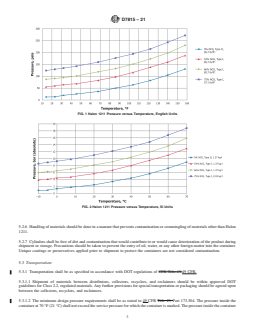
specified in 49 CFR Title 49, Part 173.304 and 49 CFR Title 49, Part 173.305. (See Figs. 1 and 2.)
D7815 − 21
FIG. 1 Halon 1211 Pressure versus Temperature, English Units
FIG. 2 Halon 121
...
Questions, Comments and Discussion
Ask us and Technical Secretary will try to provide an answer. You can facilitate discussion about the standard in here.
Loading comments...