

ASTM F3492-21
(Specification)Standard Consumer Safety Specification for Child Safety Locks and Latches for Use with Cabinet Doors and Drawers
General Information
- Abstract
SCOPE
1.1 This specification covers safety requirements, test methods, and warnings for child safety locks and latches intended to be installed by consumers to the interior of residential cabinet doors or drawers to restrict access to household cabinets by children under the age of 48 months.
1.2 Child safety locks and latches that are not covered under this specification include devices:
1.2.1 Installed on the exterior of a cabinet door or drawer,
1.2.2 Requiring installation by professionals, or
1.2.3 That are an integral part of the cabinet door or drawer system.
1.3 This specification does not cover child safety locks, latches, and straps intended for use on furniture or appliances as anchoring devices to prevent tip over.
1.4 The values stated in inch-pound units are to be regarded as the standard. The values given in parentheses are mathematical conversions to SI units that are provided for information only and are not considered standard.
1.5 The following precautionary caveat pertains only to the test methods portion, Section 7, of this specification: This standard does not purport to address all of the safety concerns, if any, associated with its use. It is the responsibility of the user of this standard to establish appropriate safety, health, and environmental practices and determine the applicability of regulatory limitations prior to use.
1.6 This international standard was developed in accordance with internationally recognized principles on standardization established in the Decision on Principles for the Development of International Standards, Guides and Recommendations issued by the World Trade Organization Technical Barriers to Trade (TBT) Committee.
- Status
- Published
- Publication Date
- 31-Jan-2021
- Technical Committee
- F15 - Consumer Products
- Drafting Committee
- F15.76 - Locks and Latches

Overview
ASTM F3492-21 is the Standard Consumer Safety Specification for Child Safety Locks and Latches for Use with Cabinet Doors and Drawers, published by ASTM International. This standard establishes safety requirements, test methods, and appropriate warnings for consumer-installed child safety locks and latches designed to restrict access to household cabinets and drawers by children under 48 months of age. ASTM F3492-21 supports manufacturers, retailers, and consumers in ensuring a safer home environment by mitigating hazards such as entrapment and accidental access to hazardous substances.
Key Topics
Scope and Applicability
- Covers interior-mounted child safety locks and latches for residential cabinet doors and drawers.
- Excludes devices installed on external surfaces, requiring professional installation, or integral to cabinet systems.
- Does not address locks, latches, or straps intended for anchoring furniture or appliances to prevent tip-overs.
Safety and Performance Requirements
- Specifies that devices must not have accessible hazardous sharp points or edges, per 16 CFR 1500.48 and 16 CFR 1500.49.
- Mandates no small parts become detached during installation or use, adhering to 16 CFR 1501.
- Sets minimum effective strength for locks and latches to resist forceful disengagement.
- Ensures surface coatings comply with 16 CFR 1303 regarding lead content.
Testing Methods
- Outlines methods for assembling, installing, and testing devices to evaluate their strength and reliability under standardized conditions.
Marking, Labeling, and Warnings
- Requires permanent manufacturer or distributor identification and date coding on each device.
- Retail packaging to display business information and compliance markings.
- Clear warning statements must be included to inform users about proper installation, use, and limitation of the devices.
- Instructional materials must be provided and retained by consumers for future reference.
Applications
Household Cabinet and Drawer Safety
ASTM F3492-21 supports parents and caregivers in safeguarding children from hazardous substances, cleaning supplies, and sharp utensils stored in cabinets and drawers. The standard is particularly critical in residential settings where toddlers and young children are present.Product Development and Certification
Manufacturers and designers reference ASTM F3492-21 to develop and test child safety locks and latches that meet recognized safety benchmarks, fostering greater market trust and regulatory compliance.Retail and Consumer Guidance
Retailers and consumers rely on ASTM F3492-21 compliance markings as an assurance of safety, performance, and durability when selecting child safety products for cabinets and drawers.
Related Standards
CPSC Regulations
- 16 CFR 1303: Ban of Lead-Containing Paint and Certain Consumer Products Bearing Lead-Containing Paint
- 16 CFR 1500.48: Requirements for sharp points in toys and other articles intended for children under 8 years
- 16 CFR 1500.49: Requirements for sharp edges
- 16 CFR 1501: Method for identifying hazardous small parts
ASTM Committee F15 on Consumer Products
This committee oversees the ongoing development and revision of child safety product standards, ensuring they reflect the latest safety research and incident data.World Trade Organization (WTO) TBT Principles
ASTM F3492-21 aligns with international standardization principles, facilitating cross-border recognition and compliance.
Keywords: ASTM F3492-21, child safety locks, child safety latches, cabinet safety, drawer safety, home safety, consumer product safety, ASTM standard, childproofing, residential cabinet locks, safety specification.
Frequently Asked Questions
ASTM F3492-21 is a technical specification published by ASTM International. Its full title is "Standard Consumer Safety Specification for Child Safety Locks and Latches for Use with Cabinet Doors and Drawers". This standard covers: SCOPE 1.1 This specification covers safety requirements, test methods, and warnings for child safety locks and latches intended to be installed by consumers to the interior of residential cabinet doors or drawers to restrict access to household cabinets by children under the age of 48 months. 1.2 Child safety locks and latches that are not covered under this specification include devices: 1.2.1 Installed on the exterior of a cabinet door or drawer, 1.2.2 Requiring installation by professionals, or 1.2.3 That are an integral part of the cabinet door or drawer system. 1.3 This specification does not cover child safety locks, latches, and straps intended for use on furniture or appliances as anchoring devices to prevent tip over. 1.4 The values stated in inch-pound units are to be regarded as the standard. The values given in parentheses are mathematical conversions to SI units that are provided for information only and are not considered standard. 1.5 The following precautionary caveat pertains only to the test methods portion, Section 7, of this specification: This standard does not purport to address all of the safety concerns, if any, associated with its use. It is the responsibility of the user of this standard to establish appropriate safety, health, and environmental practices and determine the applicability of regulatory limitations prior to use. 1.6 This international standard was developed in accordance with internationally recognized principles on standardization established in the Decision on Principles for the Development of International Standards, Guides and Recommendations issued by the World Trade Organization Technical Barriers to Trade (TBT) Committee.
SCOPE 1.1 This specification covers safety requirements, test methods, and warnings for child safety locks and latches intended to be installed by consumers to the interior of residential cabinet doors or drawers to restrict access to household cabinets by children under the age of 48 months. 1.2 Child safety locks and latches that are not covered under this specification include devices: 1.2.1 Installed on the exterior of a cabinet door or drawer, 1.2.2 Requiring installation by professionals, or 1.2.3 That are an integral part of the cabinet door or drawer system. 1.3 This specification does not cover child safety locks, latches, and straps intended for use on furniture or appliances as anchoring devices to prevent tip over. 1.4 The values stated in inch-pound units are to be regarded as the standard. The values given in parentheses are mathematical conversions to SI units that are provided for information only and are not considered standard. 1.5 The following precautionary caveat pertains only to the test methods portion, Section 7, of this specification: This standard does not purport to address all of the safety concerns, if any, associated with its use. It is the responsibility of the user of this standard to establish appropriate safety, health, and environmental practices and determine the applicability of regulatory limitations prior to use. 1.6 This international standard was developed in accordance with internationally recognized principles on standardization established in the Decision on Principles for the Development of International Standards, Guides and Recommendations issued by the World Trade Organization Technical Barriers to Trade (TBT) Committee.
ASTM F3492-21 is classified under the following ICS (International Classification for Standards) categories: 97.140 - Furniture; 97.190 - Equipment for children. The ICS classification helps identify the subject area and facilitates finding related standards.
ASTM F3492-21 is available in PDF format for immediate download after purchase. The document can be added to your cart and obtained through the secure checkout process. Digital delivery ensures instant access to the complete standard document.
Standards Content (Sample)
This international standard was developed in accordance with internationally recognized principles on standardization established in the Decision on Principles for the
Development of International Standards, Guides and Recommendations issued by the World Trade Organization Technical Barriers to Trade (TBT) Committee.
Designation:F3492 −21
Standard Consumer Safety Specification for
Child Safety Locks and Latches for Use with Cabinet Doors
and Drawers
This standard is issued under the fixed designation F3492; the number immediately following the designation indicates the year of
original adoption or, in the case of revision, the year of last revision. A number in parentheses indicates the year of last reapproval. A
superscript epsilon (´) indicates an editorial change since the last revision or reapproval.
INTRODUCTION
Thisconsumersafetyspecificationaddressesincidentsassociatedwithchildsafetylocksandlatches
for use with cabinet doors and drawers that were identified by the U.S. Consumer Product Safety
Commission (CPSC).
In response to incident data compiled by the CPSC, this specification attempts to minimize the
following hazards: entrapment and access to hazardous chemicals and materials.
This specification is intended to cover normal use and reasonably foreseeable misuse or abuse of
the product(s).
This specification is written within the current state-of-the-art of cabinet door and drawer locks and
latches technology and will be updated whenever substantive information becomes available that
necessitates additional requirements or justifies the revision of existing requirements.
1. Scope if any, associated with its use. It is the responsibility of the user
of this standard to establish appropriate safety, health, and
1.1 This specification covers safety requirements, test
environmental practices and determine the applicability of
methods, and warnings for child safety locks and latches
regulatory limitations prior to use.
intended to be installed by consumers to the interior of
1.6 This international standard was developed in accor-
residential cabinet doors or drawers to restrict access to
dance with internationally recognized principles on standard-
household cabinets by children under the age of 48 months.
ization established in the Decision on Principles for the
1.2 Child safety locks and latches that are not covered under
Development of International Standards, Guides and Recom-
this specification include devices:
mendations issued by the World Trade Organization Technical
1.2.1 Installed on the exterior of a cabinet door or drawer,
Barriers to Trade (TBT) Committee.
1.2.2 Requiring installation by professionals, or
1.2.3 That are an integral part of the cabinet door or drawer
2. Referenced Documents
system.
2.1 Federal Standards:
1.3 This specification does not cover child safety locks,
16 CFR 1303 Ban of Lead-Containing Paint and Certain
latches, and straps intended for use on furniture or appliances
Consumer Products Bearing Lead-Containing Paint
as anchoring devices to prevent tip over.
16 CFR 1500.48 Technical requirements for determining a
1.4 The values stated in inch-pound units are to be regarded sharp point in toys and other articles intended for use by
asthestandard.Thevaluesgiveninparenthesesaremathemati-
children under 8 years of age
cal conversions to SI units that are provided for information
16 CFR 1500.49 Technical requirements for determining a
only and are not considered standard.
sharp metal or glass edge in toys and other articles
intended for use by children under 8 years of age
1.5 The following precautionary caveat pertains only to the
16 CFR 1501 Method for identifying toys and other articles
test methods portion, Section 7, of this specification: This
intended for use by children under 3 years of age which
standard does not purport to address all of the safety concerns,
present choking, aspiration, or ingestion hazards because
of small parts
This test method is under the jurisdiction of ASTM Committee F15 on
Consumer Products and is the direct responsibility of Subcommittee F15.76 on
Locks and Latches. Available from U.S. Government Printing Office, Superintendent of
Current edition approved Feb. 1, 2021. Published February 2021. DOI: 10.1520/ Documents, 732 N. Capitol St., NW, Washington, DC 20401-0001, http://
F3492-21. www.access.gpo.gov.
Copyright © ASTM International, 100 Barr Harbor Drive, PO Box C700, West Conshohocken, PA 19428-2959. United States
F3492−21
3. Terminology period and having an accuracy of 60.5 % for all readings
which is maintained within calibration limits on a periodic
3.1 Definitions:
basis.
3.1.1 catch, n—mating part for a lock or latch.
3.1.2 device, n—any lock or latch product or system that
5. General Requirements
may include a catch and screws or other attachment means or
5.1 There shall be no accessible hazardous sharp points or
a separate component that can unlock the lock or latch (such as
edges as defined in 16 CFR 1500.48 and 16 CFR 1500.49
a magnetic key), or both, that is intended to be installed by
respectively, both in the “as sold” condition and after the
consumers to the interior of residential cabinet doors or
device has been tested to this specification, excluding screws
drawers to restrict access to household cabinets by children
used for installation.
under the age of 48 months.
3.1.3 double-action release system, n—mechanism requir-
5.2 There shall be no small parts, as defined by 16 CFR
ing either two consecutive actions, the first of which shall be 1501, liberated as a result of attaching the device to the
maintained while the second is carried out or two separate and mounting blocks in accordance with the manufacturer’s in-
independent simultaneous actions to release fully.
structions or testing the device to this specification.
3.1.4 effective strength, n—force required to disengage or
5.3 Magnetic key components attached to or sold with
break/damage any component of the device, including the
devicesshallcomplywiththerequirementsspecifiedin5.1and
attachment means.
5.2.
3.1.5 mounting block, n—hard wood block with smooth
5.4 All paint and surface coatings on the product shall
surfaces having sufficient length, width, and depth to provide
comply with 16 CFR 1303.
adequate attachment area for the lock, latch, or catch, as well
5.5 Openings—Holes or slots that extend entirely through a
as adequate surface area for securing the block to the tensile
wall section of any rigid material less than 0.375 in. (9.53 mm)
test machine.
thick and admit a 0.210 in. (5.33 mm) diameter rod shall also
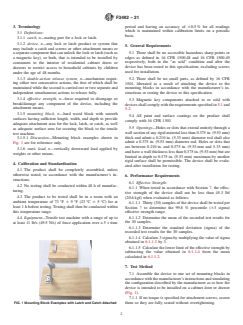
3.1.5.1 Discussion—Mounting block examples shown in
admit a 0.375 in. (9.53 mm) diameter rod. Holes or slots that
Fig. 1 are for reference only.
are between 0.210 in. and 0.375 in. (9.53 mm and 5.33 mm)
3.1.6 static load, n—vertically downward load applied by
and have a wall thickness less than 0.375 in. (9.53 mm) but are
weights or other means.
limited in depth to 0.375 in. (9.53 mm) maximum by another
rigid surface shall be permissible. The device shall be evalu-
4. Calibration and Standardization
ated after installation for testing.
4.1 The product shall be completely assembled, unless
otherwise noted, in accordance with the manufacturer’s in-
6. Performance Requirements
structions.
6.1 Effective Strength:
4.2 No testing shall be conducted within 48 h of manufac-
6.1.1 When tested in accordance with Section 7, the effec-
turing.
tive strength of the device shall not be less than 45.3 lbf
4.3 The product to be tested shall be in a room with an
(20.6 kgf) when evaluated as follows:
ambient temperature of 73 °F 6 9 °F (23 °C 6 5 °C) for at
...