

ASTM E321-20
(Test Method)Standard Test Method for Atom Percent Fission in Uranium and Plutonium Fuel (Neodymium-148 Method)
General Information
- Abstract
SIGNIFICANCE AND USE
5.1 The burnup of an irradiated nuclear fuel can be determined from the amount of a fission product formed during irradiation. Among the fission products, 148Nd has the following properties to recommend it as an ideal burnup indicator:
5.1.1 It is not volatile, does not migrate in solid fuels below their recrystallization temperature, and has no volatile precursors.
5.1.2 It is nonradioactive and requires no decay corrections.
5.1.3 It has a low destruction cross section and formation from adjacent mass chains can be corrected for.
5.1.4 It has good emission characteristics for mass analysis.
5.1.5 Its fission yield is nearly the same for 235U and 239Pu and is essentially independent of neutron energy (6).
5.1.6 It has a shielded isotope, 142Nd, which can be used for correcting natural Nd contamination.
5.1.7 It is not a normal constituent of unirradiated fuel.
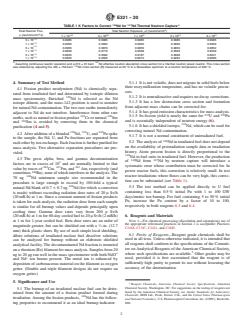
5.2 The analysis of 148Nd in irradiated fuel does not depend on the availability of preirradiation sample data or irradiation history. Atom percent fission is directly proportional to the 148Nd-to-fuel ratio in irradiated fuel. However, the production of 148Nd from 147Nd by neutron capture will introduce a systematic error whose contribution must be corrected for. In power reactor fuels, this correction is relatively small. In test reactor irradiations where fluxes can be very high, this correction can be substantial (see Table 1). (A) Assuming continuous reactor operation and a 274 ± 91 barn 1 47Nd effective neutron absorption cross section for a thermal neutron power reactor. This cross section was obtained by adjusting the 440 ± 150 barn 147Nd cross section (7) measured at 20 °C to a Maxwellian spectrum at a neutron temperature of 300 °C.
5.3 The test method can be applied directly to U fuel containing less than 0.5 % initial Pu with 1 to 100 GW days/metric ton burnup. For fuel containing 5 to 50 % initial Pu, increase the Pu content by a factor of 10 to 100, respecti...
SCOPE
1.1 This test method covers the determination of stable fission product 148Nd in irradiated uranium (U) fuel (with initial plutonium (Pu) content from 0 to 50 %) as a measure of fuel burnup (1-3).2
1.2 It is possible to obtain additional information about the uranium and plutonium concentrations and isotopic abundances on the same sample taken for burnup analysis. If this additional information is desired, it can be obtained by precisely measuring the spike and sample volumes and following the instructions in Test Method E267.
1.3 The values stated in SI units are to be regarded as standard. No other units of measurement are included in this standard.
1.4 This standard does not purport to address all of the safety concerns, if any, associated with its use. It is the responsibility of the user of this standard to establish appropriate safety, health, and environmental practices and determine the applicability of regulatory limitations prior to use.
1.5 This international standard was developed in accordance with internationally recognized principles on standardization established in the Decision on Principles for the Development of International Standards, Guides and Recommendations issued by the World Trade Organization Technical Barriers to Trade (TBT) Committee.
- Status
- Published
- Publication Date
- 30-Nov-2020
- Technical Committee
- C26 - Nuclear Fuel Cycle
- Drafting Committee
- C26.05 - Methods of Test
Buy Documents
ASTM E321-20 - Standard Test Method for Atom Percent Fission in Uranium and Plutonium Fuel (Neodymium-148 Method)
REDLINE ASTM E321-20 - Standard Test Method for Atom Percent Fission in Uranium and Plutonium Fuel (Neodymium-148 Method)
Overview
ASTM E321-20 is an internationally recognized standard developed by ASTM International for determining atom percent fission in uranium and plutonium fuel using the neodymium-148 (Nd-148) method. This test method provides a precise approach to measure fuel burnup by quantifying the stable fission product Nd-148 in irradiated nuclear fuel. The method can be applied to uranium fuels, including those with plutonium content up to 50%, and is effective for a wide range of fuel burnups, making it highly valuable for nuclear reactor operations and research facilities.
Key Topics
Neodymium-148 as Burnup Indicator:
Nd-148 is an ideal indicator for fuel burnup because it is nonvolatile, nonradioactive, and does not require decay corrections. Its fission yield remains consistent across uranium and plutonium isotopes and is largely independent of neutron energy.Advantages of Nd-148 Analysis:
- Nonvolatile and stable within irradiated fuel matrix
- No need for corrections due to radioactive decay
- Minimal formation from adjacent mass chains, with corrections possible
- Good properties for mass spectrometric analysis
- Nearly identical yield for U-235 and Pu-239
- Presence of shielded isotope Nd-142 enables correction for natural Nd contamination
- Absence in unirradiated fuel eliminates background interference
Analytical Process:
The method involves the chemical separation of Nd from fuel samples, followed by analysis using isotopic dilution mass spectrometry. This process allows for precise determination of atom percent fission by establishing the ratio of Nd-148 to fuel material.Independence from Pre-Irradiation Data:
The analysis does not require pre-irradiation sample data or detailed irradiation history, simplifying application and data interpretation for nuclear fuel cycle stakeholders.
Applications
Nuclear Power Reactor Operations:
This standard is essential for evaluating and managing the fuel burnup of uranium and mixed oxide (MOX) fuels, ensuring optimal reactor fuel utilization and supporting reactor safety analyses.Research and Test Reactors:
The method supports advanced testing and validation of new fuel designs or experimental reactor conditions by delivering accurate burnup measurement regardless of irradiation history, even where neutron fluxes are high.Nuclear Material Accountability:
By providing a direct measurement of fission product formation, ASTM E321-20 aids in nuclear safeguards, material tracking, and verifying compliance with regulatory requirements.Fuel Development and Optimization:
Fuel manufacturers and laboratories use this method to characterize experimental fuels, optimize cycles, and improve fabrication processes through precise burnup analysis.Analytical Laboratories:
Accredited labs implement this standardized approach for independent verification, quality control, and inter-laboratory comparisons of nuclear fuel samples.
Related Standards
For comprehensive nuclear fuel analysis and supporting procedures, ASTM E321-20 references several important standards, including:
- ASTM C1168 - Preparation and dissolution of plutonium materials for analysis
- ASTM C1267 - Determination of uranium by iron(II) reduction
- ASTM C1347 - Preparation and dissolution of uranium materials
- ASTM C1411 - Ion exchange separation of uranium and plutonium
- ASTM C1415 - Plutonium isotopic abundance by alpha spectrometry
- ASTM C1625, C1672, C1832 - Mass spectrometric techniques for uranium and plutonium isotopic analysis
- ASTM E267 - Uranium and plutonium concentration and isotopic abundance determination
- ASTM D1193 - Specification for reagent water
- ASTM C859 - Terminology relating to nuclear materials
Practical Value
Implementing ASTM E321-20 ensures consistent, reliable, and internationally accepted burnup measurements in uranium and plutonium fuels. Its strengths in accuracy, efficiency, and broad applicability make it a key standard for nuclear industry professionals focused on safe reactor operation, regulatory compliance, and ongoing research in fuel technology.
Keywords: ASTM E321-20, neodymium-148 method, uranium fuel, plutonium fuel, atom percent fission, nuclear fuel burnup, fuel analysis, nuclear reactor, fission product, nuclear standard, burnup measurement, mass spectrometry.
Relations
- Effective Date
- 01-Jan-2024
- Effective Date
- 01-Dec-2023
- Effective Date
- 01-Oct-2023
- Effective Date
- 01-Jul-2020
- Effective Date
- 15-Sep-2019
- Refers
ASTM C1415-18 - Standard Test Method for <sup>238</sup>Pu Isotopic Abundance By Alpha Spectrometry - Effective Date
- 01-Jun-2018
- Effective Date
- 01-Jan-2017
- Effective Date
- 01-Jun-2016
- Effective Date
- 01-Sep-2015
- Effective Date
- 15-Jun-2014
- Refers
ASTM C1415-14 - Standard Test Method for <sup>238</sup>Pu Isotopic Abundance By Alpha Spectrometry - Effective Date
- 01-Jun-2014
- Effective Date
- 15-Jan-2014
- Effective Date
- 01-Jan-2014
- Effective Date
- 01-Jan-2014
- Effective Date
- 01-Jun-2013
Buy Documents
ASTM E321-20 - Standard Test Method for Atom Percent Fission in Uranium and Plutonium Fuel (Neodymium-148 Method)
REDLINE ASTM E321-20 - Standard Test Method for Atom Percent Fission in Uranium and Plutonium Fuel (Neodymium-148 Method)
Get Certified
Connect with accredited certification bodies for this standard

DNV
DNV is an independent assurance and risk management provider.

Lloyd's Register
Lloyd's Register is a global professional services organisation specialising in engineering and technology.
DNV Energy Systems
Energy and renewable energy certification.
Sponsored listings
Frequently Asked Questions
ASTM E321-20 is a standard published by ASTM International. Its full title is "Standard Test Method for Atom Percent Fission in Uranium and Plutonium Fuel (Neodymium-148 Method)". This standard covers: SIGNIFICANCE AND USE 5.1 The burnup of an irradiated nuclear fuel can be determined from the amount of a fission product formed during irradiation. Among the fission products, 148Nd has the following properties to recommend it as an ideal burnup indicator: 5.1.1 It is not volatile, does not migrate in solid fuels below their recrystallization temperature, and has no volatile precursors. 5.1.2 It is nonradioactive and requires no decay corrections. 5.1.3 It has a low destruction cross section and formation from adjacent mass chains can be corrected for. 5.1.4 It has good emission characteristics for mass analysis. 5.1.5 Its fission yield is nearly the same for 235U and 239Pu and is essentially independent of neutron energy (6). 5.1.6 It has a shielded isotope, 142Nd, which can be used for correcting natural Nd contamination. 5.1.7 It is not a normal constituent of unirradiated fuel. 5.2 The analysis of 148Nd in irradiated fuel does not depend on the availability of preirradiation sample data or irradiation history. Atom percent fission is directly proportional to the 148Nd-to-fuel ratio in irradiated fuel. However, the production of 148Nd from 147Nd by neutron capture will introduce a systematic error whose contribution must be corrected for. In power reactor fuels, this correction is relatively small. In test reactor irradiations where fluxes can be very high, this correction can be substantial (see Table 1). (A) Assuming continuous reactor operation and a 274 ± 91 barn 1 47Nd effective neutron absorption cross section for a thermal neutron power reactor. This cross section was obtained by adjusting the 440 ± 150 barn 147Nd cross section (7) measured at 20 °C to a Maxwellian spectrum at a neutron temperature of 300 °C. 5.3 The test method can be applied directly to U fuel containing less than 0.5 % initial Pu with 1 to 100 GW days/metric ton burnup. For fuel containing 5 to 50 % initial Pu, increase the Pu content by a factor of 10 to 100, respecti... SCOPE 1.1 This test method covers the determination of stable fission product 148Nd in irradiated uranium (U) fuel (with initial plutonium (Pu) content from 0 to 50 %) as a measure of fuel burnup (1-3).2 1.2 It is possible to obtain additional information about the uranium and plutonium concentrations and isotopic abundances on the same sample taken for burnup analysis. If this additional information is desired, it can be obtained by precisely measuring the spike and sample volumes and following the instructions in Test Method E267. 1.3 The values stated in SI units are to be regarded as standard. No other units of measurement are included in this standard. 1.4 This standard does not purport to address all of the safety concerns, if any, associated with its use. It is the responsibility of the user of this standard to establish appropriate safety, health, and environmental practices and determine the applicability of regulatory limitations prior to use. 1.5 This international standard was developed in accordance with internationally recognized principles on standardization established in the Decision on Principles for the Development of International Standards, Guides and Recommendations issued by the World Trade Organization Technical Barriers to Trade (TBT) Committee.
SIGNIFICANCE AND USE 5.1 The burnup of an irradiated nuclear fuel can be determined from the amount of a fission product formed during irradiation. Among the fission products, 148Nd has the following properties to recommend it as an ideal burnup indicator: 5.1.1 It is not volatile, does not migrate in solid fuels below their recrystallization temperature, and has no volatile precursors. 5.1.2 It is nonradioactive and requires no decay corrections. 5.1.3 It has a low destruction cross section and formation from adjacent mass chains can be corrected for. 5.1.4 It has good emission characteristics for mass analysis. 5.1.5 Its fission yield is nearly the same for 235U and 239Pu and is essentially independent of neutron energy (6). 5.1.6 It has a shielded isotope, 142Nd, which can be used for correcting natural Nd contamination. 5.1.7 It is not a normal constituent of unirradiated fuel. 5.2 The analysis of 148Nd in irradiated fuel does not depend on the availability of preirradiation sample data or irradiation history. Atom percent fission is directly proportional to the 148Nd-to-fuel ratio in irradiated fuel. However, the production of 148Nd from 147Nd by neutron capture will introduce a systematic error whose contribution must be corrected for. In power reactor fuels, this correction is relatively small. In test reactor irradiations where fluxes can be very high, this correction can be substantial (see Table 1). (A) Assuming continuous reactor operation and a 274 ± 91 barn 1 47Nd effective neutron absorption cross section for a thermal neutron power reactor. This cross section was obtained by adjusting the 440 ± 150 barn 147Nd cross section (7) measured at 20 °C to a Maxwellian spectrum at a neutron temperature of 300 °C. 5.3 The test method can be applied directly to U fuel containing less than 0.5 % initial Pu with 1 to 100 GW days/metric ton burnup. For fuel containing 5 to 50 % initial Pu, increase the Pu content by a factor of 10 to 100, respecti... SCOPE 1.1 This test method covers the determination of stable fission product 148Nd in irradiated uranium (U) fuel (with initial plutonium (Pu) content from 0 to 50 %) as a measure of fuel burnup (1-3).2 1.2 It is possible to obtain additional information about the uranium and plutonium concentrations and isotopic abundances on the same sample taken for burnup analysis. If this additional information is desired, it can be obtained by precisely measuring the spike and sample volumes and following the instructions in Test Method E267. 1.3 The values stated in SI units are to be regarded as standard. No other units of measurement are included in this standard. 1.4 This standard does not purport to address all of the safety concerns, if any, associated with its use. It is the responsibility of the user of this standard to establish appropriate safety, health, and environmental practices and determine the applicability of regulatory limitations prior to use. 1.5 This international standard was developed in accordance with internationally recognized principles on standardization established in the Decision on Principles for the Development of International Standards, Guides and Recommendations issued by the World Trade Organization Technical Barriers to Trade (TBT) Committee.
ASTM E321-20 is classified under the following ICS (International Classification for Standards) categories: 27.120.30 - Fissile materials and nuclear fuel technology. The ICS classification helps identify the subject area and facilitates finding related standards.
ASTM E321-20 has the following relationships with other standards: It is inter standard links to ASTM C859-24, ASTM C1672-23, ASTM C1168-23, ASTM C1411-20, ASTM C1625-19, ASTM C1415-18, ASTM C1672-17, ASTM C1845-16, ASTM C1168-15, ASTM C859-14a, ASTM C1415-14, ASTM C859-14, ASTM C1672-07(2014), ASTM C1411-14, ASTM C859-13a. Understanding these relationships helps ensure you are using the most current and applicable version of the standard.
ASTM E321-20 is available in PDF format for immediate download after purchase. The document can be added to your cart and obtained through the secure checkout process. Digital delivery ensures instant access to the complete standard document.
Standards Content (Sample)
This international standard was developed in accordance with internationally recognized principles on standardization established in the Decision on Principles for the
Development of International Standards, Guides and Recommendations issued by the World Trade Organization Technical Barriers to Trade (TBT) Committee.
Designation: E321 − 20
Standard Test Method for
Atom Percent Fission in Uranium and Plutonium Fuel
(Neodymium-148 Method)
This standard is issued under the fixed designation E321; the number immediately following the designation indicates the year of
original adoption or, in the case of revision, the year of last revision. A number in parentheses indicates the year of last reapproval. A
superscript epsilon (´) indicates an editorial change since the last revision or reapproval.
1. Scope Materials for Analysis
C1267 Test Method for Uranium by Iron (II) Reduction in
1.1 This test method covers the determination of stable
148 PhosphoricAcid Followed by Chromium (VI) Titration in
fission product Nd in irradiated uranium (U) fuel (with
the Presence of Vanadium
initial plutonium (Pu) content from 0 to 50 %) as a measure of
2 C1347 Practice for Preparation and Dissolution of Uranium
fuel burnup (1-3).
Materials for Analysis
1.2 It is possible to obtain additional information about the
C1411 Practice for The Ion Exchange Separation of Ura-
uranium and plutonium concentrations and isotopic abun-
nium and Plutonium Prior to Isotopic Analysis
dances on the same sample taken for burnup analysis. If this 238
C1415 Test Method for Pu Isotopic Abundance By Alpha
additional information is desired, it can be obtained by pre-
Spectrometry
cisely measuring the spike and sample volumes and following
C1625 Test Method for Uranium and Plutonium Concentra-
the instructions in Test Method E267.
tions and Isotopic Abundances by Thermal Ionization
1.3 The values stated in SI units are to be regarded as
Mass Spectrometry
standard. No other units of measurement are included in this C1672 Test Method for Determination of Uranium or Pluto-
standard.
nium Isotopic Composition or Concentration by the Total
Evaporation Method Using a Thermal Ionization Mass
1.4 This standard does not purport to address all of the
Spectrometer
safety concerns, if any, associated with its use. It is the
C1832 Test Method for Determination of Uranium Isotopic
responsibility of the user of this standard to establish appro-
Composition by the Modified Total Evaporation (MTE)
priate safety, health, and environmental practices and deter-
Method Using a Thermal Ionization Mass Spectrometer
mine the applicability of regulatory limitations prior to use.
C1845 Practice for The Separation of Lanthanide Elements
1.5 This international standard was developed in accor-
from Uranium Matrices Using High Pressure Ion Chro-
dance with internationally recognized principles on standard-
matography (HPIC) for Isotopic Analyses by Inductively
ization established in the Decision on Principles for the
Coupled Plasma Mass Spectrometry (ICP-MS)
Development of International Standards, Guides and Recom-
D1193 Specification for Reagent Water
mendations issued by the World Trade Organization Technical
E180 Practice for Determining the Precision of ASTM
Barriers to Trade (TBT) Committee.
Methods for Analysis and Testing of Industrial and Spe-
2. Referenced Documents cialty Chemicals (Withdrawn 2009)
E244 Test Method forAtom Percent Fission in Uranium and
2.1 ASTM Standards:
Plutonium Fuel (Mass Spectrometric Method) (With-
C859 Terminology Relating to Nuclear Materials
drawn 2001)
C1168 PracticeforPreparationandDissolutionofPlutonium
E267 Test Method for Uranium and Plutonium Concentra-
tions and Isotopic Abundances
This test method is under the jurisdiction ofASTM Committee C26 on Nuclear
Fuel Cycle and is the direct responsibility of Subcommittee C26.05 on Methods of
3. Terminology
Test.
3.1 Definitions:
Current edition approved Dec. 1, 2020. Published January 2021. Originally
approved in 1967. Last previous edition approved in 2012 as E321 – 96 (2012).
3.1.1 For definitions of terms used in this test method but
DOI: 10.1520/E0321-20.
not defined herein, refer to Terminology C859.
The boldface numbers in parentheses refer to the list of references at the end of
this test method.
For referenced ASTM standards, visit the ASTM website, www.astm.org, or
contact ASTM Customer Service at service@astm.org. For Annual Book of ASTM
Standards volume information, refer to the standard’s Document Summary page on The last approved version of this historical standard is referenced on
the ASTM website. www.astm.org.
Copyright © ASTM International, 100 Barr Harbor Drive, PO Box C700, West Conshohocken, PA 19428-2959. United States
E321 − 20
148 147 A
TABLE 1 K Factors to Correct Nd for Nd Thermal Neutron Capture
Total Neutron Exposure, φI (neutrons/cm )
Total Neutron Flux,
20 20 21 21 21
φ (neutrons/cm /s)
1×10 3×10 1×10 2×10 3×10
3×10 0.9985 0.9985 0.9985 0.9985 0.9985
1×10 0.9956 0.9952 0.9950 0.9950 0.9950
3×10 0.9906 0.9870 0.9856 0.9853 0.9852
1×10 0.9858 0.9716 0.9598 0.9569 0.9559
3×10 0.9835 0.9592 0.9187 0.9008 0.8941
1×10 0.9826 0.9526 0.8816 0.8284 0.8006
A 147
Assuming continuous reactor operation and a 274 ± 91 barn Nd effective neutron absorption cross section for a thermal neutron power reactor. This cross section
was obtained by adjusting the 440 ± 150 barn Nd cross section (7) measured at 20 °C to a Maxwellian spectrum at a neutron temperature of 300 °C.
4. Summary of Test Method 5.1.1 It is not volatile, does not migrate in solid fuels below
their recrystallization temperature, and has no volatile precur-
4.1 Fission product neodymium (Nd) is chemically sepa-
sors.
rated from irradiated fuel and determined by isotopic dilution
150 5.1.2 It is nonradioactive and requires no decay corrections.
mass spectrometry. Enriched Nd is selected as the Nd
5.1.3 It has a low destruction cross section and formation
isotope diluent, and the mass-142 position is used to monitor
from adjacent mass chains can be corrected for.
for natural Nd contamination. The two rare earths immediately
5.1.4 It has good emission characteristics for mass analysis.
adjacent to Nd do not interfere. Interference from other rare
235 239
142 148
5.1.5 Its fission yield is nearly the same for U and Pu
earths,suchasnaturalorfissionproduct Ceornatural Sm
and is essentially independent of neutron energy (6).
and Sm is avoided by removing them in the chemical
5.1.6 It has a shielded isotope, Nd, which can be used for
purification (4 and 5).
correcting natural Nd contamination.
150 233 242
4.2 After addition of a blended Nd, U, and Pu spike
5.1.7 It is not a normal constituent of unirradiated fuel.
to the sample, the Nd, U, and Pu fractions are separated from
5.2 The analysis of Nd in irradiated fuel does not depend
eachotherbyionexchange.Eachfractionisfurtherpurifiedfor
on the availability of preirradiation sample data or irradiation
mass analysis. Two alternative separation procedures are pro-
history. Atom percent fission is directly proportional to the
vided.
Nd-to-fuel ratio in irradiated fuel. However, the production
4.3 The gross alpha, beta, and gamma decontamination
148 147
of Nd from Nd by neutron capture will introduce a
factors are in excess of 10 and are normally limited to that
systematic error whose contribution must be corrected for. In
242 147 241
value by traces of Cm, Pm, and Am, respectively (and
power reactor fuels, this correction is relatively small. In test
sometimes Ru),noneofwhichinterferesintheanalysis.The
reactor irradiations where fluxes can be very high, this correc-
70 ng Nd minimum sample size recommended in the
tion can be substantial (see Table 1).
procedure is large enough to exceed by 100-fold a typical
5.3 The test method can be applied directly to U fuel
natural Nd blank of 0.7 6 0.7 ng Nd (for which a correction
containing less than 0.5 % initial Pu with 1 to 100 GW
is made) without exceeding radiation dose rates of 20 µ Sv/h
days/metric ton burnup. For fuel containing 5 to 50 % initial
(20 mR⁄h) at 1 m. Since a constant amount of fission products
Pu, increase the Pu content by a factor of 10 to 100,
is taken for each analysis, the radiation dose from each sample
respectively in both reagents 6.3 and 6.4.
is similar for all burnup values and depends principally upon
cooling time. Gamma dose rates vary from 200 µ Sv/h
6. Reagents and Materials
(20 mR⁄h) at 1 m for 60-day cooled fuel to 20 µ Sv/h (2 mR/h)
NOTE 1—For chemical processing (dissolution and separations) use of
at 1 m for 1-year cooled fuel. Beta dose rates are an order of
the appropriate referenced practices in Section 2 is acceptable: Practices
magnitude greater, but can be shielded out with a ⁄2-in. (12.7
C1168, C1347, C1411, and C1845.
mm) thick plastic sheet. By use of such simple local shielding,
6.1 Purity of Reagents—Reagent grade chemicals shall be
dilute solutions of irradiated nuclear fuel dissolver solutions
used in all tests. Unless otherwise indicated, it is intended that
can be analyzed for burnup without an elaborate shielded
all reagents shall conform to the specifications of the Commit-
analytical facility. The decontaminated Nd fraction is mounted
tee onAnalytical Reagents of theAmerican Chemical Society,
on a rhenium (Re) filament for mass analysis. Samples from 20
+
where such specifications are available. Other grades may be
ng to 20 µg run well in the mass spectrometer with both NdO
+
used, provided it is first ascertained that the reagent is of
and Nd ion beams present. The metal ion is enhanced by
sufficiently high purity to permit its use without lessening the
deposition of carbonaceous material on the filament as oxygen
accuracy of the determination.
getter. (Double and triple filament designs do not require an
oxygen getter.)
5. Significance and Use
Reagent Chemicals, American Chemical Society Specifications, American
Chemical Society, Washington, DC. For suggestions on the testing of reagents not
5.1 The burnup of an irradiated nuclear fuel can be deter-
listed by the American Chemical Society, see Analar Standards for Laboratory
mined from the amount of a fission product formed during
Chemicals, BDH Ltd., Poole, Dorset, U.K., and the United States Pharmacopeia
irradiation. Among the fission products, Nd has the follow-
and National Formulary, U.S. Pharmacopeial Convention, Inc. (USPC), Rockville,
ing properties to recommend it as an ideal burnup indicator: MD.
E321 − 20
6.2 Purity of Water—Unless otherwise indicated, references ratios, C , S , and M . On the Nd fractions, record the
3/8 3/8 3/8
150 148
to water shall be understood to mean reagent water as defined corresponding Nd-to- Ndratios,C ,S ,andM .
50/48 50/48 50/48
in Specification D1193. Correct all average measured ratios for mass discrimination
bias (see 8.2).
148 239 238
6.3 Blended Nd, Pu, and U Calibration Standard—
148 6.4.3 Calculate the number of atoms of Nd/mL of Spike,
Prepare a solution containing about 0.0400 mg Nd/litre, 50
238 239
A , as follows:
mg U/litre, and 2.5 mg Pu/litre, in nitric acid (HNO ,
1 + 1) with 0.01 M hydrofluoric acid (HF) as follows. With a A 5 C ~M 2 C !/ 1 2 M /S (4)
@ ~ !#
50 148 50/48 50/48 50/48 50/48
new calibrated, clean, Kirk-type micropipet, add 0.500 mL of
239 6.4.4 Calculate the number of atoms of U/mL of spike,
Pu known solution (see 6.11) to a calibrated 1-litre volu-
A , as follows:
metric flask. Rinse the micropipet into the flask three times
A 5 C M 2 C / 1 2 M /S (5)
with HNO (1 + 1). In a similar manner, add 0.500 mLof U ~ !
@~ ! #
3 33 238 3/8 3/8 3/8 3/8
known solution (see 6.12) and 1.000 mL of Nd known
6.4.5 Calculatethenumberofatomsof Pu/mLspike, A ,
solution (see 6.9).Add ten drops of concentrated HF and dilute
as follows:
exactly to the 1-litre mark with HNO (1 + 1) and mix
A 5 C M 2 C / 1 2 M /S (6)
thoroughly. @~ ! ~ !#
42 239 2/9 2/9 2/9 2/9
6.3.1 From K (see 6.9), calculate the atoms of Nd/mL
6.4.6 Store in the same manner as the calibration standard
of calibration standard, C , as follows:
(see 6.3), that is, flame seal 3 to 5 mL portions in glass
mL Nd known solution
ampoules. For use, break off the tip of an ampoule, pipet
C 5 3K (1)
148 148
1000 mL calibration standard
promptly the amount required, and discard any unused solu-
238 tion. If more convenient, spike solution can be flame sealed in
6.3.2 From K (see 6.12), calculate the atoms of U/mL
a premeasured 1000 µL portions for quantitative transfer to
of calibration standard, C , as follows:
individual samples.
mL U known solution
C 5 3K (2)
6.5 Ferrous Solution (0.001 M)—Add 40 mg of reagent
23 8 238
1000 mL calibration standard
grade ferrous ammonium sulfate (Fe(NH ) (SO ) ·6H O) and
4 2 4 2 2
6.3.3 From K (see 6.11), calculate the atoms of Pu/mL
1 drop of concentrated H SO to 5 mL of redistilled water.
2 4
of calibration standard, C , as follows:
Dilute to 100 mL with water and mix. This solution does not
239 keep well. Prepare fresh daily.
mL Pu known solution
C 5 3K (3)
239 239
1000 mL calibration standard
6.6 Filament Mounting Solution—Dissolve 70 mg of su-
crose in 100 mL of water (single filament only).
6.3.4 Flame seal 3 to 5 mL portions in glass ampoules to
preventevaporationafterpreparationuntiltimeofuse.Foruse, 6.7 Hydrofluoric Acid—Reagent grade concentrated HF (28
break off the tip of an ampoule, pipet promptly the amount
M).
required, and discard any unused solution. If more convenient,
6.8 Methanol, absolute.
calibration solution can be flame-sealed in pre-measured 1000
6.9 Nd Known Solution—Heat natural Nd O (>99.9 %
µL portions for quantitative transfer when needed.
2 3
pure) in an open crucible at 900 °C for1hto destroy any
150 233 242
6.4 Blended Nd, U, and Pu Spike Solution—Prepare
carbonates present and cool in a dessicator. Weigh 0.4071 g of
150 233
a solution containing about 0.4 mg Nd/litre, 50 mg
Nd O and place it in a calibrated 500 mL volumetric flask.
242 2 3
U/litre,and2.5mg Pu/litreinHNO (1 + 1)with0.01MHF.
Dissolve the oxide in HNO (1 + 1) and dilute to the 500 mL
These isotopes are obtained in greater than 95, 99, and 99 %
mark with HNO (1 + 1) and mix thoroughly. By using the
isotopic purity, respectively, from the DOE Isotope Business
weight of Nd O in grams, and the purity, calculate the atoms
2 3
Office located at Oak Ridge National Laboratory.” Standardize
of Nd/mL of known solution, K , as follows:
the spike solution as follows:
K 5gNd O /500 mL 3% purity/100 (7)
148 2 3
6.4.1 In a 5 mL beaker, place about 0.1 mL of ferrous
solution, exactly 500 µL of calibration standard (see 6.3) and
350.38mg Nd/1 g Nd O 3 6.025
~
2 3
exactly 500 µL of spike solution (see 6.4). In a second beaker,
place about 0.1 mLof ferrous solution and 1 mLof calibration 20
310 atoms)/147.92 molecular weight
standard without any spike. In a third beaker, place about 0.1
6.10 Perchloric Acid—70 % HCIO .
mL of ferrous solution and 1 mL of spike solution without
standard. Mix well and allow to stand for 5 min to reduce Pu
6.11 Pu Known Solution—Add 10 mLof HCl (1 + 1) to a
(VI) to Pu (III) or Pu (IV).
clean calibrated 100 mL flask. Cool the flask in an ice water
6.4.2 Follow the procedure described in 9.2.4 – 9.5.8 or bath. Allow time for the acid to reach approximately 0 °C and
9.6.2 – 9.7.11. Measure the Pu, U, and Nd isotopes by surface place the flask in a glove box. Displace the air in the flask with
ionization mass spectrometry following the procedure de- inert gas (Ar, He, or N ). Within the glove box, open the U.S.
scribed in 9.8.1 – 9.8.3.2 . On the Pu fractions, record the atom National Institute of Standards and Technology Plutonium
242 239
ratios of Pu to Pu in the calibration standard, C ; in the Metal Standard Sample 949, containing about 0.5 g of Pu
2/9
spike solution, S ; and in the standard-plus-spike mixture, (actual weight individually certified), and add the metal to the
2/9
233 238
M .OntheUfractionsrecordthecorresponding U-to- U cooled HCl. After dissolution of the metal is complete, add 1
2/9
E321 − 20
dropofconcentratedHFand40mLofHNO (1 + 1)andswirl. 6.13.3 Dowex 1 Resin—Dowex 1-X4 (200 to 400 mesh)
Place the flask in a stainless-steel beaker for protection and chloride form resin.
invert a 50 mL beaker over the top and let it stand for at least
6.13.4 Ion Exchange Column (Type I)—Type I ion exchange
8 days to allow any gaseous oxidation products to escape.
columns are used whenever Dowex AG 1-X4 columns are
Dilute to the mark with HNO (1 + 1) and mix thoroughly. By
specified in the procedure. These columns are prepared from
using the individual weight of Pu in grams, the purity, and the 230 mm disposable glass capillary (Pasteur) pipets that have a
molecular weight of the Pu given on the NIST certificate, with
glass wool plug inserted to contain the resin beads. Filling this
the atom fraction, A , determined as in 10.8, calculate the column to the top is considered a 2 mL addition of reagent
239 239
atoms of Pu/mL of Pu known solution, K , as follows: solution.
6.13.5 Ion Exchange Column (Type II)—Type II ion ex-
K 5 mg Pu/100 mL solution 3 % purity/ 100 (8)
@~ ! !
change columns are used whenever AGMP-1 columns are
3 6.025 310 atoms/Pu molecular weight 3 A #
~ ! specified in the procedure. These columns are prepared from
4 mm (inside diameter) glass tubing that has been heated and
6.12 U Known Solution—Heat U O from the National
3 8
drawn, forming a long, fine tip. A coating of paraffin wax
Institute of Standards and Technology Natural Uranium Oxide
melted on the long tip keeps the methanol from climbing the
Standard Sample 950 in an open crucible at 900 °C for1hand
outside surface. A small plug of glass wool is inserted to
cool in a dessicator in accordance with the certificate accom-
contain the resin beads. The length of the column above the
panying the standard sample. Weigh about 12.0 g of U O
3 8
glass wool plug should be a little more than 22 cm. The
accurately to 0.1 mg and place it in a calibrated 100 mL
columns are carefully marked every 4 cm above the top of the
volumetric flask. Dissolve the oxide in HNO (1 + 1). Dilute to
resin bed (4 cm = 0.5 mL of solution).
the 100 mL mark with HNO (1 + 1) and mix thoroughly. By
6.13.6 Methanolic HNO Eluant—Pipet 10 mL of HNO
3 3
using the measured weight of U O in grams, the purity given
3 8
(1 + 500)intoa100 mLvolumetricflaskanddilutetothemark
on the NIST certificate, and the atom fraction U, A ,
with absolute methanol. Protect this reagent against preferen-
238 238
determined as in 10.5, calculate the atoms U/mL of U
tial evaporation of methanol by keeping it in a polyethylene
solution, K , as follows:
wash bottle. Prepare fresh daily.
K 5 g U O /100 mL solution 3 % purity/ 100 (9)
@~ ! ~
238 3 8
6.13.7 Methanolic HNO Loading Solution—Pipet 1 mL of
HNO (1 + 1) into a 10 mL volumetric flask and dilute to the
3848.0 mg U/1 g U O ) 3 6.025
~
3 8
mark with absolute methanol. Store as 6.13.6. Prepare fresh
daily.Highnitrateloadingsolutionisusedtoensureabsorption
310 atoms/238.03 molecular weight!3 A
ofNdinatightbandandtoovercomeinterferencefromsulfate
6.13 Reagents and Materials for Procedure A:
and fluoride ions.
6.13.1 Dowex AGMP-1 Resin—Convert Dowex AGMP-1
6.13.8 Methanolic HNO Wash Solution—Pipet 10 mL of
(200 to 400 mesh) chloride form resin to nitrate form by
HNO (1 + 100) into a 100 mL volumetric flask and dilute to
washing 200 mL of resin in a suitable column (for example, a
themarkwithabsolutemethanol.Storeas6.13.6.Preparefresh
250 mL buret) with HNO (1 + 1) until a drop of effluent
3 daily.
falling into an AgNO solution remains clear. Finally, rinse 8
6.13.9 Nitric Acid (8 M,4 M,3 M) —Prepare by diluting
with water, and dry overnight in a vacuum dessicator. Store the
Ultrapure concentrated HNO (15.6 M) with deionized water.
resin in an airtight container. Since the elution characteristics
6.13.10 Sodium Nitrite Stock Solution(2 M)—Dissolve 3 g
of ion exchange resins depend upon their actual percentage
of reagent grade sodium nitrite (NaNO)in20mLof0.1 M
cross linkage and particle size (surface-to-volume ratio), which
NaOH.
may vary from one lot to the next, it is most convenient to set
6.13.11 Sodium Nitrite Working Solution—Dilute 100 µL of
aside a bottle of resin to be used solely for this procedure.
stock solution from 6.13.10 to 10 mLwith 8 M HNO . Prepare
Before use on actual samples, a small amount of tracer Nd
fresh daily.
should be taken through the procedure. Collect each consecu-
tive 80 mm fraction of eluant and count for γ radioactivity. If 6.14 Reagents and Materials for Alternative Procedure B:
over80 %ofthe NdappearsintheNdfraction,theresincan
6.14.1 Eluting Solution (0.094 M HNO in 80 % CH OH)—
3 3
be used as directed; if not, small adjustments can be made in
Prepare 100 mL of 0.47 M HNO by diluting 3.00 mL of
the elution volumes collected.
15.6 M HNO to 100 mL with water in a volumetric flask.
Prepare the eluting solution just before use by pipetting
6.13.2 Hydrochloric Acid—Prepare reagent low in U and
dissolved solids by saturating redistilled water in a polyethyl- 20.0 mL of the 0.47 M HNO into a 100 mL volumetric flask
and diluting to the mark with anhydrous methanol. The
ene container to 12 M with HCl gas which has passed through
methanol must be free of aldehydes. Absence of a character-
a quartz-wool filter. Dilute 1 + 1 and 1 + 24 with redistilled
istic aldehyde odor is an adequate criterion.
water. Store each solution in a polyethylene container. One
drop of acid, when evaporated on a clean microscope slide 6.14.2 First Column Resin—Transfer a water slurry of
cover glass, must leave no visible residue. Test monthly.
analyticalgrademacroporousanionresin(AGMP-1),50to100
Commercial HCl (cp grade) in glass containers has been found mesh, chloride-form resin to a column until the settled height
to contain excessive residue (dissolved glass) which inhibits is just below the reservoir. Pass 4 mL of water through, then
ion emission. 6mLof12MHCl.Keeptheresinwetwith12MHCluntiluse.
E321 − 20
6.14.3 Hydrochloric Acid (12 M, 0.1 M)—Using plastic left untreated. Familiarization and compliance with the Safety
apparatus and an ice bath, bubble filtered HCl gas through Data Sheet is essential.”
quartz-distilled acid until it is saturated. Verify 12 M concen-
tration by titration with standard base. Prepare the 0.1 M by 8. Instrument Calibration
dilution with quartz-distilled water. NOTE 2— For the determination of isotopic distributions and elemental
assay use of the appropriate referenced test methods in Section 2 is
6.14.4 Hydrofluoric Acid (1 M)—Dilute 1 mL of concen-
acceptable: Test Methods C1267, C1415, C1625, C1672, and C1832.
trated analytical reagent grade HF to 30 mL with quartz-
8.1 In the calibration of the mass spectrometer for the
distilled water.
analysis of Nd, U, and Pu, the measurement and correction of
6.14.5 Hydroiodic Acid-Hydrochloric Acid Mixture (0.1 M
mass discrimination bias is an important factor in obtaining
HI-12MHCl)—Dilute1mLofdistilled57 %HIto74mLwith
accurate and consistent results. The mass discrimination bias
12 M HCl. Prepare fresh for each use. Store distilled HI in
can be readily measured on natural Nd where the Nd-to-
flame-sealed bottles to prevent air oxidation.
Nd ratio spans over a 5 % spread in mass. The mass
6.14.6 Hydrogen Peroxide (30 %)—Refrigerate when not in
discrimination bias factor, B, is constant for Nd, U, and Pu
use.
analysis for a given method of scanning (for example, by
6.14.7 Ion Exchange Column—Use commercial disposable
varying either acceleration voltage or magnetic field) and for a
polyethylene droppers, 6 mm inside diameter and 60 mm long,
given method of detection (for example, by pulse counting or
with a 2 mL reservoir. Cut off the top of the dropper to form a
current integration) on a given detector (for example, electron
reservoir and place a glass wool plug in the tip to support the
multiplier, scintillation detector, or d-c collector plate). Calcu-
resin bed. The reservoir of the second column can be made
late B as follows:
cylindrical to accommodate the feeder by inserting as a mold a
1-dram glass vial and heating with a hot air gun. Cool and ¯
B 5 1/c @~R /R ! 2 1# (10)
~ !
i/j s
remove the glass vial mold.
where:
6.14.8 Loading Solution (1.56 M HNO in 80 % CH OH)—
3 3
¯
R = average measured atom ratio of isotope i to isotope j.
Prepare 100 mL of 7.8 M HNO by diluting 50 mL of
i/j
¯
Forthemostaccuratedeterminationof B,let R bethe
quartz-distilled HNO to 100 mL with water. Prepare the
i/j
142 150
average measured atom ratio of Nd to Nd,
...
This document is not an ASTM standard and is intended only to provide the user of an ASTM standard an indication of what changes have been made to the previous version. Because
it may not be technically possible to adequately depict all changes accurately, ASTM recommends that users consult prior editions as appropriate. In all cases only the current version
of the standard as published by ASTM is to be considered the official document.
Designation: E321 − 96 (Reapproved 2012) E321 − 20
Standard Test Method for
Atom Percent Fission in Uranium and Plutonium Fuel
(Neodymium-148 Method)
This standard is issued under the fixed designation E321; the number immediately following the designation indicates the year of
original adoption or, in the case of revision, the year of last revision. A number in parentheses indicates the year of last reapproval. A
superscript epsilon (´) indicates an editorial change since the last revision or reapproval.
1. Scope
1.1 This test method covers the determination of stable fission product Nd in irradiated uranium (U) fuel (with initial plutonium
(Pu) content from 0 to 50 %) as a measure of fuel burnup (1-3).
1.2 It is possible to obtain additional information about the uranium and plutonium concentrations and isotopic abundances on the
same sample taken for burnup analysis. If this additional information is desired, it can be obtained by precisely measuring the spike
and sample volumes and following the instructions in Test Method E267.
1.3 The values stated in SI units are to be regarded as standard. No other units of measurement are included in this standard.
1.4 This standard does not purport to address all of the safety concerns, if any, associated with its use. It is the responsibility
of the user of this standard to establish appropriate safety safety, health, and healthenvironmental practices and determine the
applicability of regulatory limitations prior to use.
1.5 This international standard was developed in accordance with internationally recognized principles on standardization
established in the Decision on Principles for the Development of International Standards, Guides and Recommendations issued
by the World Trade Organization Technical Barriers to Trade (TBT) Committee.
2. Referenced Documents
2.1 ASTM Standards:
C859 Terminology Relating to Nuclear Materials
C1168 Practice for Preparation and Dissolution of Plutonium Materials for Analysis
C1267 Test Method for Uranium by Iron (II) Reduction in Phosphoric Acid Followed by Chromium (VI) Titration in the
Presence of Vanadium
C1347 Practice for Preparation and Dissolution of Uranium Materials for Analysis
C1411 Practice for The Ion Exchange Separation of Uranium and Plutonium Prior to Isotopic Analysis
C1415 Test Method for Pu Isotopic Abundance By Alpha Spectrometry
C1625 Test Method for Uranium and Plutonium Concentrations and Isotopic Abundances by Thermal Ionization Mass
Spectrometry
C1672 Test Method for Determination of Uranium or Plutonium Isotopic Composition or Concentration by the Total
Evaporation Method Using a Thermal Ionization Mass Spectrometer
This test method is under the jurisdiction of ASTM Committee C26 on Nuclear Fuel Cycle and is the direct responsibility of Subcommittee C26.05 on Methods of Test.
Current edition approved June 1, 2012Dec. 1, 2020. Published June 2012January 2021. Originally approved in 1967 .1967. Last previous edition approved in 20052012
as E321 – 96 (2012).(2005). DOI: 10.1520/E0321-96R12.10.1520/E0321-20.
The boldface numbers in parentheses refer to the list of references appended to at the end of this test method.
For referenced ASTM standards, visit the ASTM website, www.astm.org, or contact ASTM Customer Service at service@astm.org. For Annual Book of ASTM Standards
volume information, refer to the standard’s Document Summary page on the ASTM website.
Copyright © ASTM International, 100 Barr Harbor Drive, PO Box C700, West Conshohocken, PA 19428-2959. United States
E321 − 20
C1832 Test Method for Determination of Uranium Isotopic Composition by the Modified Total Evaporation (MTE) Method
Using a Thermal Ionization Mass Spectrometer
C1845 Practice for The Separation of Lanthanide Elements from Uranium Matrices Using High Pressure Ion Chromatography
(HPIC) for Isotopic Analyses by Inductively Coupled Plasma Mass Spectrometry (ICP-MS)
D1193 Specification for Reagent Water
E180 Practice for Determining the Precision of ASTM Methods for Analysis and Testing of Industrial and Specialty Chemicals
(Withdrawn 2009)
E244 Test Method for Atom Percent Fission in Uranium and Plutonium Fuel (Mass Spectrometric Method) (Withdrawn 2001)
E267 Test Method for Uranium and Plutonium Concentrations and Isotopic Abundances
3. Terminology
3.1 Definitions:
3.1.1 For definitions of terms used in this test method but not defined herein, refer to Terminology C859.
4. Summary of Test Method
4.1 Fission product neodymium (Nd) is chemically separated from irradiated fuel and determined by isotopic dilution mass
spectrometry. Enriched Nd is selected as the Nd isotope diluent, and the mass-142 position is used to monitor for natural Nd
contamination. The two rare earths immediately adjacent to Nd do not interfere. Interference from other rare earths, such as natural
142 148 150
or fission product Ce or natural Sm and Sm is avoided by removing them in the chemical purification (4 and 5).
150 233 242
4.2 After addition of a blended Nd, U, and Pu spike to the sample, the Nd, U, and Pu fractions are separated from each
other by ion exchange. Each fraction is further purified for mass analysis. Two alternative separation procedures are provided.
4.3 The gross alpha, beta, and gamma decontamination factors are in excess of 10 and are normally limited to that value by traces
242 147 241 106 148
of Cm, Pm, and Am, respectively (and sometimes Ru), none of which interferes in the analysis. The 70 ng Nd
minimum sample size recommended in the procedure is large enough to exceed by 100-fold a typical natural Nd blank of 0.7 6
0.7 ng Nd (for which a correction is made) without exceeding radiation dose rates of 20 μ Sv/h (20(20 mR mR/h) ⁄h) at 1 m.
Since a constant amount of fission products is taken for each analysis, the radiation dose from each sample is similar for all burnup
values and depends principally upon cooling time. Gamma dose rates vary from 200 μ Sv/h (20(20 mR mR/h) ⁄h) at 1 m for 60-day
cooled fuel to 20 μ Sv/h (2 mR/h) at 1 m for 1-year cooled fuel. Beta dose rates are an order of magnitude greater, but can be
shielded out with a ⁄2-in. (12.7-mm) (12.7 mm) thick plastic sheet. By use of such simple local shielding, dilute solutions of
irradiated nuclear fuel dissolver solutions can be analyzed for burnup without an elaborate shielded analytical facility. The
decontaminated Nd fraction is mounted on a rhenium (Re) filament for mass analysis. Samples from 20 ng to 20 μg run well in
+ +
the mass spectrometer with both NdO and Nd ion beams present. The metal ion is enhanced by deposition of carbonaceous
material on the filament as oxygen getter. (Double and triple filament designs do not require an oxygen getter.)
5. Significance and Use
5.1 The burnup of an irradiated nuclear fuel can be determined from the amount of a fission product formed during irradiation.
Among the fission products, Nd has the following properties to recommend it as an ideal burnup indicator: (1) It is not volatile,
does not migrate in solid fuels below their recrystallization temperature, and has no volatile precursors. (2) It is nonradioactive and
requires no decay corrections. (3) It has a low destruction cross section and formation from adjacent mass chains can be corrected
235 239
for. (4) It has good emission characteristics for mass analysis. (5) Its fission yield is nearly the same for U and Pu and is
essentially independent of neutron energy (6). (6) It has a shielded isotope, Nd, which can be used for correcting natural Nd
contamination. (7) It is not a normal constituent of unirradiated fuel.
5.1.1 It is not volatile, does not migrate in solid fuels below their recrystallization temperature, and has no volatile precursors.
5.1.2 It is nonradioactive and requires no decay corrections.
5.1.3 It has a low destruction cross section and formation from adjacent mass chains can be corrected for.
5.1.4 It has good emission characteristics for mass analysis.
The last approved version of this historical standard is referenced on www.astm.org.
E321 − 20
148 147 A
TABLE 1 K Factors to Correct Nd for Nd Thermal Neutron Capture
Total Neutron Exposure, φI (neutrons/cm )
Total Neutron Flux,
20 20 21 21 21
φ (neutrons/cm /s)
1 × 10 3 × 10 1 × 10 2 × 10 3 × 10
1 2
3 × 10 0.9985 0.9985 0.9985 0.9985 0.9985
1 3
1 × 10 0.9956 0.9952 0.9950 0.9950 0.9950
1 3
3 × 10 0.9906 0.9870 0.9856 0.9853 0.9852
1 4
1 × 10 0.9858 0.9716 0.9598 0.9569 0.9559
1 4
3 × 10 0.9835 0.9592 0.9187 0.9008 0.8941
1 5
1 × 10 0.9826 0.9526 0.8816 0.8284 0.8006
A 147
Assuming continuous reactor operation and a 274 ± 91 barn Nd effective neutron absorption cross section for a thermal neutron power reactor. This cross section
was obtained by adjusting the 440 ± 150 barn Nd cross section (7) measured at 20°C20 °C to a Maxwellian spectrum at a neutron temperature of 300°C.300 °C.
235 239
5.1.5 Its fission yield is nearly the same for U and Pu and is essentially independent of neutron energy (6).
5.1.6 It has a shielded isotope, Nd, which can be used for correcting natural Nd contamination.
5.1.7 It is not a normal constituent of unirradiated fuel.
5.2 The analysis of Nd in irradiated fuel does not depend on the availability of preirradiation sample data or irradiation history.
148 148
Atom percent fission is directly proportional to the Nd-to-fuel ratio in irradiated fuel. However, the production of Nd from
Nd by neutron capture will introduce a systematic error whose contribution must be corrected for. In power reactor fuels, this
correction is relatively small. In test reactor irradiations where fluxes can be very high, this correction can be substantial (see Table
1).
5.3 The test method can be applied directly to U fuel containing less than 0.5 % initial Pu with 1 to 100 GW days/metric ton
burnup. For fuel containing 5 to 50 % initial Pu, increase the Pu content by a factor of 10 to 100, respectively in both reagents
5.36.3 and 5.46.4.
6. Reagents and Materials
NOTE 1—For chemical processing (dissolution and separations) use of the appropriate referenced practices in Section 2 is acceptable: Practices C1168,
C1347, C1411, and C1845.
6.1 Purity of Reagents—Reagent grade chemicals shall be used in all tests. Unless otherwise indicated, it is intended that all
reagents shall conform to the specifications of the Committee on Analytical Reagents of the American Chemical Society, where
such specifications are available. Other grades may be used, provided it is first ascertained that the reagent is of sufficiently high
purity to permit its use without lessening the accuracy of the determination.
6.2 Purity of Water—Unless otherwise indicated, references to water shall be understood to mean reagent water as defined in
Specification D1193.
148 239 238 148
6.3 Blended Nd, Pu, and U Calibration Standard—Prepare a solution containing about 0.0400 mg Nd/litre, 50 mg
238 239
U/litre, and 2.5 mg Pu/litre, in nitric acid (HNO , 1 + 1) with 0.01 M hydrofluoric acid (HF) as follows. With a new
calibrated, clean, Kirk-type micropipet, add 0.500 mL of Pu known solution (see 5.116.11) to a calibrated 1-litre volumetric
flask. Rinse the micropipet into the flask three times with HNO (1 + 1). In a similar manner, add 0.500 mL of U known solution
(see 5.126.12) and 1.000 mL of Nd known solution (see 5.96.9). Add 10ten drops of concentrated HF and dilute exactly to the
1-litre mark with HNO (1 + 1) and mix thoroughly.
6.3.1 From K (see 5.96.9), calculate the atoms of Nd/mL of calibration standard, C , as follows:
148 148
mL Nd known solution
C 5 3K (1)
148 148
1000 mL calibration standard
Reagent Chemicals, American Chemical Society Specifications, American Chemical Society, Washington, DC. For suggestions on the testing of reagents not listed by
the American Chemical Society, see Analar Standards for Laboratory Chemicals, BDH Ltd., Poole, Dorset, U.K., and the United States Pharmacopeia and National
Formulary, U.S. Pharmacopeial Convention, Inc. (USPC), Rockville, MD.
E321 − 20
6.3.2 From K (see 5.126.12), calculate the atoms of U/mL of calibration standard, C , as follows:
238 238
mL U known solution
C 5 3K (2)
23 8 238
1000 mL calibration standard
6.3.3 From K (see 5.116.11), calculate the atoms of Pu/mL of calibration standard, C , as follows:
239 239
mL Pu known solution
C 5 3K (3)
2 39 239
1000 mL calibration standard
6.3.4 Flame seal 3 to 5-mL5 mL portions in glass ampoules to prevent evaporation after preparation until time of use. For use,
break off the tip of an ampoule, pipet promptly the amount required, and discard any unused solution. If more convenient,
calibration solution can be flame-sealed in pre-measured 1000-μL 1000 μL portions for quantitative transfer when needed.
150 233 242 150 233
6.4 Blended Nd, U, and Pu Spike Solution—Prepare a solution containing about 0.4 mg Nd/litre, 50 mg U/litre, and
2.5 mg Pu/litre in HNO (1 + 1) with 0.01 M HF. These isotopes are obtained in greater than 95, 99, and 99 % isotopic purity,
respectively, from the Isotopes Sales Department of DOE Isotope Business Office located at Oak Ridge National Laboratory-
.Laboratory.” Standardize the spike solution as follows:
6.4.1 In a 5-mL5 mL beaker, place about 0.1 mL of ferrous solution, exactly 500 μL of calibration standard (see 5.36.3) and exactly
500 μL of spike solution (see 5.46.4). In a second beaker, place about 0.1 mL of ferrous solution and 1 mL of calibration standard
without any spike. In a third beaker, place about 0.1 mL of ferrous solution and 1 mL of spike solution without standard. Mix well
and allow to stand for 5 min to reduce Pu (VI) to Pu (III) or Pu (IV).
6.4.2 Follow the procedure described in 7.2.49.2.4 – 7.5.89.5.8 or 7.6.29.6.2 – 7.7.119.7.11. Measure the Pu, U, and Nd isotopes
by surface ionization mass spectrometry following the procedure described in 7.8.19.8.1 – 7.8.3.29.8.3.2 . On the Pu fractions,
242 239
record the atom ratios of Pu to Pu in the calibration standard, C ; in the spike solution, S ; and in the standard-plus-spike
2/9 2/9
233 238
mixture, M . On the U fractions record the corresponding U-to- U ratios, C , S , and M . On the Nd fractions, record
2/9 3/8 3/8 3/8
150 148
the corresponding Nd-to- Nd ratios, C , S , and M . Correct all average measured ratios for mass discrimination bias
50/48 50/48 50/48
(see 6.28.2).
6.4.3 Calculate the number of atoms of Nd/mL of Spike, A , as follows:
A 5 C ~M 2 C !/ 12 M /S (4)
@ ~ !#
50 148 50/48 50/48 50/48 50/48
6.4.4 Calculate the number of atoms of U/mL of spike, A , as follows:
A 5 C M 2 C /~12 M /S ! (5)
@~ ! #
33 238 3/8 3/8 3/8 3/8
6.4.5 Calculate the number of atoms of Pu/mL spike, A , as follows:
A 5 C M 2 C / 12 M /S (6)
@~ ! ~ !#
42 239 2/9 2/9 2/9 2/9
6.4.6 Store in the same manner as the calibration standard (see 5.36.3), that is, flame seal 3 to 5-mL5 mL portions in glass
ampoules. For use, break off the tip of an ampoule, pipet promptly the amount required, and discard any unused solution. If more
convenient, spike solution can be flame sealed in a premeasured 1000-μL 1000 μL portions for quantitative transfer to individual
samples.
6.5 Ferrous Solution (0.001 M)—Add 40 mg of reagent grade ferrous ammonium sulfate (Fe(NH ) (SO ) ·6H O) and 1 drop of
4 2 4 2 2
concentrated H SO to 5 mL of redistilled water. Dilute to 100 mL with water and mix. This solution does not keep well. Prepare
2 4
fresh daily.
6.6 Filament Mounting Solution—Dissolve 70 mg of sucrose in 100 mL of water (single filament only).
6.7 Hydrofluoric Acid—Reagent grade concentrated HF (28 M).
E321 − 20
6.8 Methanol, absolute.
6.9 Nd Known Solution—Heat natural Nd O (>99.9 % pure) in an open crucible at 900°C900 °C for 1 h to destroy any
2 3
carbonates present and cool in a dessicator. Weigh 0.4071 g of Nd O and place it in a calibrated 500-mL 500 mL volumetric flask.
2 3
Dissolve the oxide in HNO (1 + 1) and dilute to the 500-mL500 mL mark with HNO (1 + 1) and mix thoroughly. By using the
3 3
weight of Nd O in grams, and the purity, calculate the atoms of Nd/mL of known solution, K , as follows:
2 3 148
K 5 g Nd O /500 mL 3% purity/100 (7)
148 2 3
350.38mg Nd/1 g Nd O 3 6.025
~
2 3
310 atoms)/147.92 molecular weight
6.10 Perchloric Acid—70 % HCIO .
6.11 Pu Known Solution—Add 10 mL of HCl (1 + 1) to a clean calibrated 100-mL100 mL flask. Cool the flask in an ice water
bath. Allow time for the acid to reach approximately 0°C0 °C and place the flask in a glove box. Displace the air in the flask with
inert gas (Ar, He, or N ). Within the glove box, open the U.S. National Institute of Standards and Technology Plutonium Metal
Standard Sample 949, containing about 0.5 g of Pu (actual weight individually certified), and add the metal to the cooled HCl. After
dissolution of the metal is complete, add 1 drop of concentrated HF and 40 mL of HNO (1 + 1) and swirl. Place the flask in a
stainless-steel beaker for protection and invert a 50-mL50 mL beaker over the top and let it stand for at least 8 days to allow any
gaseous oxidation products to escape. Dilute to the mark with HNO (1 + 1) and mix thoroughly. By using the individual weight
of Pu in grams, the purity, and the molecular weight of the Pu given on the NIST certificate, with the atom fraction, A , determined
239 239
as in 8.810.8, calculate the atoms of Pu/mL of Pu known solution, K , as follows:
K 5 mg Pu/100 mL solution 3 % purity/ 100 (8)
@~ ! !
3 6.025 310 atoms/Pu molecular weight 3 A #
~ !
6.12 U Known Solution—Heat U O from the National Institute of Standards and Technology Natural Uranium Oxide Standard
3 8
Sample 950 in an open crucible at 900°C900 °C for 1 h and cool in a dessicator in accordance with the certificate accompanying
the standard sample. Weigh about 12.0 g of U O accurately to 0.1 mg and place it in a calibrated 100-mL100 mL volumetric flask.
3 8
Dissolve the oxide in HNO (1 + 1). Dilute to the 100-mL100 mL mark with HNO (1 + 1) and mix thoroughly. By using the
3 3
measured weight of U O in grams, the purity given on the NIST certificate, and the atom fraction U, A , determined as in
3 8 8
238 238
8.510.5, calculate the atoms U/mL of U solution, K , as follows:
K 5 g U O /100 mL solution 3 % purity/ 100 (9)
@~ ! ~
238 3 8
3848.0 mg U/1 g U O )3~6.025
3 8
310 atoms/238.03 molecular weight! 3 A
6.13 Reagents and Materials for Procedure A:
6.13.1 Dowex AGMP-1 Resin—Convert Dowex AGMP-1 (200 to 400 mesh) chloride form resin to nitrate form by washing 200
mL of resin in a suitable column (for example, a 250-mL250 mL buret) with HNO (1 + 1) until a drop of effluent falling into an
AgNO solution remains clear. Finally, rinse with water, and dry overnight in a vacuum dessicator. Store the resin in an airtight
container. Since the elution characteristics of ion exchange resins depend upon their actual percentage cross linkage and particle
size (surface-to-volume ratio), which may vary from one lot to the next, it is most convenient to set aside a bottle of resin to be
used solely for this procedure. Before use on actual samples, a small amount of tracer Nd should be taken through the procedure.
Collect each consecutive 80 mm fraction of eluant and count for γ radioactivity. If over 80 % of the Nd appears in the Nd
fraction, the resin can be used as directed; if not, small adjustments can be made in the elution volumes collected.
6.13.2 Hydrochloric AcidAcid——Prepare reagent low in U and dissolved solids by saturating redistilled water in a polyethylene
container to 12 M with HCl gas which has passed through a quartz-wool filter. Dilute 1 + 1 and 1 + 24 with redistilled water. Store
each solution in a polyethylene container. One drop of acid, when evaporated on a clean microscope slide cover glass, must leave
no visible residue. Test monthly. Commercial HCl (cp grade) in glass containers has been found to contain excessive residue
(dissolved glass) which inhibits ion emission.
E321 − 20
6.13.3 Dowex 1 Resin—Dowex 1-X4 (200 to 400 mesh) chloride form resin.
6.13.4 Ion Exchange Column (Type I)—Type I ion exchange columns are used whenever Dowex AG 1-X4 columns are specified
in the procedure. These columns are prepared from 230-mm 230 mm disposable glass capillary (Pasteur) pipets that have a glass
wool plug inserted to contain the resin beads. Filling this column to the top is considered a 2-mL2 mL addition of reagent solution.
6.13.5 Ion Exchange Column (Type II)—Type II ion exchange columns are used whenever AGMP-1 columns are specified in the
procedure. These columns are prepared from 4-mm4 mm (inside diameter) glass tubing that has been heated and drawn, forming
a long, fine tip. A coating of paraffin wax melted on the long tip keeps the methanol from climbing the outside surface. A small
plug of glass wool is inserted to contain the resin beads. The length of the column above the glass wool plug should be a little
more than 22 cm. The columns are carefully marked every 4 cm above the top of the resin bed (4 cm = 0.5 mL of solution).
6.13.6 Methanolic HNO Eluant—Pipet 10 mL of HNO (1 + 500) into a 100-mL100 mL volumetric flask and dilute to the mark
3 3
with absolute methanol. Protect this reagent against preferential evaporation of methanol by keeping it in a polyethylene wash
bottle. Prepare fresh daily.
6.13.7 Methanolic HNO Loading Solution—Pipet 1 mL of HNO (1 + 1) into a 10-mL10 mL volumetric flask and dilute to the
3 3
mark with absolute methanol. Store as 5.13.66.13.6. Prepare fresh daily. High nitrate loading solution is used to ensure absorption
of Nd in a tight band and to overcome interference from sulfate and fluoride ions.
6.13.8 Methanolic HNO Wash Solution—Pipet 10 mL of HNO (1 + 100) into a 100-mL100 mL volumetric flask and dilute to the
3 3
mark with absolute methanol. Store as 5.13.66.13.6. Prepare fresh daily.
6.13.9 Nitric Acid (8 M, 4 M, 3 M) —Prepare by diluting Ultrapure concentrated HNO (15.6 M) with deionized water.
6.13.10 Sodium Nitrite Stock Solution(2M)—Dissolve 3 g of reagent grade sodium nitrite (NaNO ) in 20 mL of 0.1 M NaOH.
6.13.11 Sodium Nitrite Working Solution—Dilute 100 μL of stock solution from 5.13.106.13.10 to 10 mL with 8 M HNO . Prepare
fresh daily.
6.14 Reagents and Materials for Alternative Procedure B:
6.14.1 Eluting Solution (0.094 M HNO in 80 % CH OH)—Prepare 100 mL of 0.47 M HNO by diluting 3.00 mL of 15.6 15.6 M
3 3 3
HNO to 100 mL with water in a volumetric flask. Prepare the eluting solution just before use by pipetting 20.0 mL 20.0 mL of
the 0.47 M HNO into a 100-mL100 mL volumetric flask and diluting to the mark with anhydrous methanol. The methanol must
be free of aldehydes. Absence of a characteristic aldehyde odor is an adequate criterion.
6.14.2 First Column Resin—Transfer a water slurry of analytical grade macroporous anion resin (AGMP-1)(AGMP-1),, 50 to 100
mesh, chloride-form resin to a column until the settled height is just below the reservoir. Pass 4 mL of water through, then 6 mL
6 mL of 12 M HCl. Keep the resin wet with 12 M HCl until use.
6.14.3 Hydrochloric Acid (12 M, 0.1 M)M)——Using plastic apparatus and an ice bath, bubble filtered HCl gas through
quartz-distilled acid until it is saturated. Verify 12 M concentration by titration with standard base. Prepare the 0.1 M by dilution
with quartz-distilled water.
6.14.4 Hydrofluoric Acid (1 M)—Dilute 1 mL of concentrated analytical reagent grade HF to 30 mL with quartz-distilled water.
6.14.5 Hydroiodic Acid-Hydrochloric Acid Mixture (0.1 M HI-12 M HCl)—Dilute 1 mL of distilled 57 % HI to 74 mL with 12
M HCl. Prepare fresh for each use. Store distilled HI in flame-sealed bottles to prevent air oxidation.
6.14.6 Hydrogen Peroxide (30 %)—Refrigerate when not in use.
6.14.7 Ion Exchange Column—Use commercial disposable polyethylene droppers, 6 mm inside diameter and 60 mm long, with
a 2-mL2 mL reservoir. Cut off the top of the dropper to form a reservoir and place a glass wool plug in the tip to support the resin
bed. The reservoir of the second column can be made cylindrical to accommodate the feeder by inserting as a mold a 1-dram glass
vial and heating with a hot air gun. Cool and remove the glass vial mold.
E321 − 20
6.14.8 Loading Solution (1.56 M HNO in 80 % CH OH)—Prepare 100 mL of 7.8 M HNO by diluting 50 mL of quartz-distilled
3 3 3
HNO to 100 mL with water. Prepare the loading solution by diluting 20 mL of 7.8 M HNO to 100 mL with anhydrous methanol.
3 3
The methanol must be free of aldehydes. The absence of a characteristic aldehyde odor is an adequate criterion.
6.14.9 Nitric Acid (15.6 M, 2 M, 1 M) —Dilute quartz-distilled 15.6 M HNO with distilled water to prepare the 2 M HNO and
3 3
1 M HNO .
6.14.10 Perchloric Acid (6 M)—Dilute 12 M HClO with water.
6.14.11 Second Column Feeder—Use polyethylene dispensing bottles (coaxial tip) of about 30-mL30 mL capacity. Cut off the
delivery tip to a length of about 15 mm.
6.14.12 Second Column Resin—Convert AGMP-1AGMP-1, , 200 to 400 mesh, chloride-form resin to nitrate form. One
satisfactory method is to fill a 30-mm 30 mm diameter by 120-mm 120 mm high glass column with a water slurry of the resin,
then pass 160 mL of HNO (1 + 1) and 160 mL of loading solution (5.2.8) through the column. Verify the absence of chloride by
AgNO test on the final effluent. Store the resin in loading solution in a closed container until ready for use. When a sample is ready,
transfer the resin to a column to a settled height just below the reservoir and keep wet with loading solution until use. Nitrate-form
resin is not as chemically stable as chloride-form resin. For this reason it is best not to store nitrate-form resin for longer than a
few months.
7. Hazards
7.1 Hydrofluoric acid is a highly corrosive and toxic acid that can severely burn skin, eyes, and mucous membranes. Hydrofluoric
acid differs from other acids because the fluoride ion readily penetrates the skin, causing destruction of deep tissue layers. Unlike
other acids that are rapidly neutralized, hydrofluoric acid reactions with tissue may continue for days if left untreated.
Familiarization and compliance with the Safety Data Sheet is essential.”
8. Instrument Calibration
NOTE 2— For the determination
...