

ASTM E2249-19
(Test Method)Standard Test Method for Laboratory Measurement of Airborne Transmission Loss of Building Partitions and Elements Using Sound Intensity
General Information
- Abstract
SIGNIFICANCE AND USE
5.1 This test method can be used to obtain an estimate the transmission loss of building elements in a laboratory setting where the source room and the specimen mounting conditions satisfy the requirements of Test Method E90. The acceptability of the receiving room will be determined by a set of field indicators that define the quality and accuracy of the intensity estimate.
5.2 By appropriately constructing the surface over which the intensity is measured it is possible to selectively exclude the influence of sound energy paths including the effects from joints, gaps as well as flanking sound paths. This method may be particularly useful when accurate measurements of a partition can not be made in an Test Method E90 facility because the partition sound insulation is limited by flanking transmission involving facility source and receiver room surfaces, (for example, the path from the source room floor to the receiver room floor via the isolators and the slab supporting the two). Annex A3 discusses this in detail.
5.3 The discrete point method allows the mapping of the radiated sound intensity which can be used to identify defects or unique features (2) of the partition.
5.4 Current research reported in the literature indicate that there exists a bias between measures of transmission loss obtained using the intensity technique and those obtained using the conventional two room reverberation technique (for example, Test Method E90, (3) and (4)). Appendix E provides estimates of the bias that might be expected. Despite the presence of a bias, no corrections are to be applied to the measured data obtained by this test method.
SCOPE
1.1 This test method covers the measurement of airborne sound transmission loss of building partitions such as walls of all kinds, operable partitions, floor-ceiling assemblies, doors, windows, roofs, panels and other space-dividing building elements. It may also be have applications in sectors other than the building industry, although these are beyond the scope.
1.2 The primary quantity reported by this standard is Intensity Transmission Loss (ITL) and shall not be given another name. Similarly, the single-number rating Intensity Sound Transmission Class (ISTC) derived from the measured ITL shall not be given any other name.
1.3 This test method may be used to reveal the sound radiation characteristics of a partition or portion thereof.
1.4 The values stated in SI units are to be regarded as standard. No other units of measurement are included in this standard.
1.5 This standard does not purport to address all of the safety concerns, if any, associated with its use. It is the responsibility of the user of this standard to establish appropriate safety, health, and environmental practices and determine the applicability of regulatory limitations prior to use.
Note 1: The method for measuring the sound intensity radiated by the building element under test defined by this ASTM standard meets or exceeds those of ISO 15186-1. Special consideration will have to be given to requirements for the source room and specimen mounting if compliance with ISO 15186-1 is also desired as they differ from those of this standard.
1.6 This international standard was developed in accordance with internationally recognized principles on standardization established in the Decision on Principles for the Development of International Standards, Guides and Recommendations issued by the World Trade Organization Technical Barriers to Trade (TBT) Committee.
- Status
- Published
- Publication Date
- 31-Mar-2019
- Technical Committee
- E33 - Building and Environmental Acoustics
- Drafting Committee
- E33.03 - Sound Transmission
Buy Documents
ASTM E2249-19 - Standard Test Method for Laboratory Measurement of Airborne Transmission Loss of Building Partitions and Elements Using Sound Intensity
REDLINE ASTM E2249-19 - Standard Test Method for Laboratory Measurement of Airborne Transmission Loss of Building Partitions and Elements Using Sound Intensity
Overview
ASTM E2249-19 is the standard test method for the laboratory measurement of airborne transmission loss of building partitions and elements using sound intensity. Developed by ASTM International, this standard applies to the measurement of how effectively building partitions-such as walls, doors, windows, roofs, and floor-ceiling assemblies-block airborne sound transmission in a controlled laboratory environment. It directly measures the sound power radiated by partitions under test, notably differing from traditional methods that rely on receiver room pressure data. This standard is essential for the accurate determination of the Intensity Transmission Loss (ITL) and the derived Intensity Sound Transmission Class (ISTC), supporting reliable evaluation of sound isolation in building elements.
Key Topics
- Sound Transmission Loss Measurement: The method covers procedures for quantifying the airborne sound transmission loss of space-dividing building elements, based on sound intensity measurements rather than indirect pressure measurements.
- Intensity Transmission Loss (ITL): The primary metric, ITL, is a frequency-dependent measure reported in decibels, offering insight into a partition’s effectiveness at blocking sound.
- Sound Intensity Methods: The standard describes two sampling methods:
- Discrete Point Method: Allows mapping of sound intensity over partition surfaces, helpful for defect identification.
- Scanning Method: Involves sweeping an intensity probe over the measurement surface, suitable for large elements and offering faster testing.
- Flanking Transmission Exclusion: By carefully defining the measurement surface, it is possible to exclude energy paths through joints, gaps, and flanking elements, yielding more accurate results even in challenging laboratory setups.
- Field Indicators: Quality and reliability of measurements are assessed via a set of field criteria, ensuring the accuracy of the intensity data collected.
- Reporting Requirements: Data must be presented strictly as ITL and ISTC, with comprehensive documentation of specimen details, measurement methods, probe calibration, environmental conditions, and compliance statements.
Applications
- Product Development: Building material manufacturers can use ASTM E2249-19 to evaluate the airborne sound insulation properties of new wall assemblies, windows, doors, and other building components under repeatable laboratory conditions.
- Quality Control: Testing laboratories and manufacturers implement this standard for ongoing product performance verification and benchmarking against industry requirements.
- Research and Diagnostics: The method supports the identification of sound transmission paths, pinpointing weaknesses or defective areas in tested partitions, facilitating improvements in acoustic design.
- Specifications Compliance: Although ITL values obtained via sound intensity are not interchangeable with those from traditional pressure-based methods such as ASTM E90, this standard provides critical data for projects where flanking issues or non-standard laboratory configurations prevail.
Related Standards
- ASTM E90: Standard Test Method for Laboratory Measurement of Airborne Sound Transmission Loss of Building Partitions and Elements – the companion reference for pressure-based transmission loss measurement.
- ASTM E336: For measuring airborne sound attenuation between rooms in buildings, offering complementary field measurement data.
- ASTM E413: Provides the methodology for rating sound insulation performance.
- ISO 15186-1: International standard equivalent for laboratory measurement of sound insulation using sound intensity.
- ISO 9614-1, ISO 9614-2: Methods for determining sound power levels of noise sources via sound intensity.
- ANSI S1.9, ANSI S1.11: US standards covering instruments and filters for sound intensity measurement.
- IEC 1043: Instrumentation standard for measuring sound intensity.
Optimizing laboratory sound insulation testing with ASTM E2249-19 ensures accurate, repeatable evaluation of airborne sound transmission loss using advanced sound intensity techniques, supporting industry innovation and performance verification.
Relations
- Effective Date
- 01-Apr-2019
- Effective Date
- 01-Dec-2023
- Effective Date
- 01-Oct-2019
- Effective Date
- 01-Jan-2019
- Effective Date
- 15-Nov-2017
- Effective Date
- 01-Jul-2017
- Effective Date
- 01-Dec-2016
- Effective Date
- 01-Oct-2016
- Effective Date
- 01-Jan-2016
- Effective Date
- 01-Sep-2015
- Effective Date
- 15-Apr-2014
- Effective Date
- 01-Sep-2013
- Effective Date
- 01-Dec-2011
- Effective Date
- 01-Nov-2011
- Effective Date
- 01-Sep-2010
Buy Documents
ASTM E2249-19 - Standard Test Method for Laboratory Measurement of Airborne Transmission Loss of Building Partitions and Elements Using Sound Intensity
REDLINE ASTM E2249-19 - Standard Test Method for Laboratory Measurement of Airborne Transmission Loss of Building Partitions and Elements Using Sound Intensity
Get Certified
Connect with accredited certification bodies for this standard

DIBt (Deutsches Institut für Bautechnik)
German Institute for Building Technology.
DIN CERTCO
DIN Group product certification.

Aboma Certification B.V.
Specialized in construction, metal, and transport sectors.
Sponsored listings
Frequently Asked Questions
ASTM E2249-19 is a standard published by ASTM International. Its full title is "Standard Test Method for Laboratory Measurement of Airborne Transmission Loss of Building Partitions and Elements Using Sound Intensity". This standard covers: SIGNIFICANCE AND USE 5.1 This test method can be used to obtain an estimate the transmission loss of building elements in a laboratory setting where the source room and the specimen mounting conditions satisfy the requirements of Test Method E90. The acceptability of the receiving room will be determined by a set of field indicators that define the quality and accuracy of the intensity estimate. 5.2 By appropriately constructing the surface over which the intensity is measured it is possible to selectively exclude the influence of sound energy paths including the effects from joints, gaps as well as flanking sound paths. This method may be particularly useful when accurate measurements of a partition can not be made in an Test Method E90 facility because the partition sound insulation is limited by flanking transmission involving facility source and receiver room surfaces, (for example, the path from the source room floor to the receiver room floor via the isolators and the slab supporting the two). Annex A3 discusses this in detail. 5.3 The discrete point method allows the mapping of the radiated sound intensity which can be used to identify defects or unique features (2) of the partition. 5.4 Current research reported in the literature indicate that there exists a bias between measures of transmission loss obtained using the intensity technique and those obtained using the conventional two room reverberation technique (for example, Test Method E90, (3) and (4)). Appendix E provides estimates of the bias that might be expected. Despite the presence of a bias, no corrections are to be applied to the measured data obtained by this test method. SCOPE 1.1 This test method covers the measurement of airborne sound transmission loss of building partitions such as walls of all kinds, operable partitions, floor-ceiling assemblies, doors, windows, roofs, panels and other space-dividing building elements. It may also be have applications in sectors other than the building industry, although these are beyond the scope. 1.2 The primary quantity reported by this standard is Intensity Transmission Loss (ITL) and shall not be given another name. Similarly, the single-number rating Intensity Sound Transmission Class (ISTC) derived from the measured ITL shall not be given any other name. 1.3 This test method may be used to reveal the sound radiation characteristics of a partition or portion thereof. 1.4 The values stated in SI units are to be regarded as standard. No other units of measurement are included in this standard. 1.5 This standard does not purport to address all of the safety concerns, if any, associated with its use. It is the responsibility of the user of this standard to establish appropriate safety, health, and environmental practices and determine the applicability of regulatory limitations prior to use. Note 1: The method for measuring the sound intensity radiated by the building element under test defined by this ASTM standard meets or exceeds those of ISO 15186-1. Special consideration will have to be given to requirements for the source room and specimen mounting if compliance with ISO 15186-1 is also desired as they differ from those of this standard. 1.6 This international standard was developed in accordance with internationally recognized principles on standardization established in the Decision on Principles for the Development of International Standards, Guides and Recommendations issued by the World Trade Organization Technical Barriers to Trade (TBT) Committee.
SIGNIFICANCE AND USE 5.1 This test method can be used to obtain an estimate the transmission loss of building elements in a laboratory setting where the source room and the specimen mounting conditions satisfy the requirements of Test Method E90. The acceptability of the receiving room will be determined by a set of field indicators that define the quality and accuracy of the intensity estimate. 5.2 By appropriately constructing the surface over which the intensity is measured it is possible to selectively exclude the influence of sound energy paths including the effects from joints, gaps as well as flanking sound paths. This method may be particularly useful when accurate measurements of a partition can not be made in an Test Method E90 facility because the partition sound insulation is limited by flanking transmission involving facility source and receiver room surfaces, (for example, the path from the source room floor to the receiver room floor via the isolators and the slab supporting the two). Annex A3 discusses this in detail. 5.3 The discrete point method allows the mapping of the radiated sound intensity which can be used to identify defects or unique features (2) of the partition. 5.4 Current research reported in the literature indicate that there exists a bias between measures of transmission loss obtained using the intensity technique and those obtained using the conventional two room reverberation technique (for example, Test Method E90, (3) and (4)). Appendix E provides estimates of the bias that might be expected. Despite the presence of a bias, no corrections are to be applied to the measured data obtained by this test method. SCOPE 1.1 This test method covers the measurement of airborne sound transmission loss of building partitions such as walls of all kinds, operable partitions, floor-ceiling assemblies, doors, windows, roofs, panels and other space-dividing building elements. It may also be have applications in sectors other than the building industry, although these are beyond the scope. 1.2 The primary quantity reported by this standard is Intensity Transmission Loss (ITL) and shall not be given another name. Similarly, the single-number rating Intensity Sound Transmission Class (ISTC) derived from the measured ITL shall not be given any other name. 1.3 This test method may be used to reveal the sound radiation characteristics of a partition or portion thereof. 1.4 The values stated in SI units are to be regarded as standard. No other units of measurement are included in this standard. 1.5 This standard does not purport to address all of the safety concerns, if any, associated with its use. It is the responsibility of the user of this standard to establish appropriate safety, health, and environmental practices and determine the applicability of regulatory limitations prior to use. Note 1: The method for measuring the sound intensity radiated by the building element under test defined by this ASTM standard meets or exceeds those of ISO 15186-1. Special consideration will have to be given to requirements for the source room and specimen mounting if compliance with ISO 15186-1 is also desired as they differ from those of this standard. 1.6 This international standard was developed in accordance with internationally recognized principles on standardization established in the Decision on Principles for the Development of International Standards, Guides and Recommendations issued by the World Trade Organization Technical Barriers to Trade (TBT) Committee.
ASTM E2249-19 is classified under the following ICS (International Classification for Standards) categories: 91.120.20 - Acoustics in building. Sound insulation. The ICS classification helps identify the subject area and facilitates finding related standards.
ASTM E2249-19 has the following relationships with other standards: It is inter standard links to ASTM E2249-02(2016), ASTM E90-23, ASTM E336-19a, ASTM E336-19, ASTM E336-17a, ASTM E336-17, ASTM E90-09(2016), ASTM E336-16a, ASTM E336-16, ASTM E336-15, ASTM E336-14, ASTM C634-13, ASTM C634-11, ASTM E336-11, ASTM C634-10a. Understanding these relationships helps ensure you are using the most current and applicable version of the standard.
ASTM E2249-19 is available in PDF format for immediate download after purchase. The document can be added to your cart and obtained through the secure checkout process. Digital delivery ensures instant access to the complete standard document.
Standards Content (Sample)
This international standard was developed in accordance with internationally recognized principles on standardization established in the Decision on Principles for the
Development of International Standards, Guides and Recommendations issued by the World Trade Organization Technical Barriers to Trade (TBT) Committee.
Designation: E2249 − 19
Standard Test Method for
Laboratory Measurement of Airborne Transmission Loss of
Building Partitions and Elements Using Sound Intensity
This standard is issued under the fixed designation E2249; the number immediately following the designation indicates the year of
original adoption or, in the case of revision, the year of last revision.Anumber in parentheses indicates the year of last reapproval.A
superscript epsilon (´) indicates an editorial change since the last revision or reapproval.
INTRODUCTION
Thistestmethodispartofasetforevaluatingthesoundtransmissionlossofapartitionorpartition
elementunderlaboratoryconditions.ItdiffersfromTestMethodE90inthatthesoundpowerradiated
by the element under test is measured directly using an intensity probe rather than indirectly from the
space averaged receiver room sound pressure and the room reverberation time. This test method is
especially useful when the receiver room requirements of Test Method E90 can not be achieved, or
flanking sound involving the receiver room surfaces is present but its influence is to be circumvented
(1) , as discussed in Annex A3.
Others test methods to evaluate sound insulation of building elements include: Test Method E90,
airbornetransmissionlossofanisolatedpartitionelementinacontrolledlaboratoryenvironment,Test
Method E492, laboratory measurement of impact sound transmission through floors, Test Method
E336, measurement of sound isolation in buildings, Test Method E1007, measurement of impact
sound transmission in buildings, Guide E966, measurement of sound transmission through building
facades and facade elements.
1. Scope 1.5 This standard does not purport to address all of the
safety concerns, if any, associated with its use. It is the
1.1 This test method covers the measurement of airborne
responsibility of the user of this standard to establish appro-
sound transmission loss of building partitions such as walls of
priate safety, health, and environmental practices and deter-
all kinds, operable partitions, floor-ceiling assemblies, doors,
mine the applicability of regulatory limitations prior to use.
windows, roofs, panels and other space-dividing building
elements.Itmayalsobehaveapplicationsinsectorsotherthan
NOTE 1—The method for measuring the sound intensity radiated by the
building element under test defined by this ASTM standard meets or
the building industry, although these are beyond the scope.
exceedsthoseofISO15186-1.Specialconsiderationwillhavetobegiven
1.2 The primary quantity reported by this standard is Inten-
torequirementsforthesourceroomandspecimenmountingifcompliance
sity Transmission Loss (ITL) and shall not be given another withISO15186-1isalsodesiredastheydifferfromthoseofthisstandard.
name. Similarly, the single-number rating Intensity Sound
1.6 This international standard was developed in accor-
Transmission Class (ISTC) derived from the measured ITL
dance with internationally recognized principles on standard-
shall not be given any other name.
ization established in the Decision on Principles for the
Development of International Standards, Guides and Recom-
1.3 This test method may be used to reveal the sound
mendations issued by the World Trade Organization Technical
radiation characteristics of a partition or portion thereof.
Barriers to Trade (TBT) Committee.
1.4 The values stated in SI units are to be regarded as
standard. No other units of measurement are included in this
2. Referenced Documents
standard.
2.1 ASTM Standards:
C634Terminology Relating to Building and Environmental
1 Acoustics
ThistestmethodisunderthejurisdictionofASTMCommitteeE33onBuilding
and Environmental Acoustics and is the direct responsibility of Subcommittee
E33.03 on Sound Transmission.
Current edition approved April 1, 2019. Published May 2019. Originally
approved in 2002. Last previous edition approved in 2016 as E2249–02 (2016). For referenced ASTM standards, visit the ASTM website, www.astm.org, or
DOI: 10.1520/E2249-19. contact ASTM Customer Service at service@astm.org. For Annual Book of ASTM
Theboldfacenumbersinparenthesesrefertothelistofreferencesattheendof Standards volume information, refer to the standard’s Document Summary page on
this standard. the ASTM website.
Copyright © ASTM International, 100 Barr Harbor Drive, PO Box C700, West Conshohocken, PA 19428-2959. United States
E2249 − 19
E90Test Method for Laboratory Measurement of Airborne where:
Sound Transmission Loss of Building Partitions and
nW = unit normal vector directed out of the volume enclosed
Elements
by the measurement surface.
E336Test Method for Measurement of Airborne Sound
3.1.3 normal unsigned sound intensity level, L —ten
|In|
Attenuation between Rooms in Buildings
times the common logarithm of the ratio of the unsigned value
E413Classification for Rating Sound Insulation
of the normal sound intensity to the reference intensity I as
o
2.2 ANSI Standards:
given by:
S1.9Instruments for the Measurement of Sound Intensity
I
? n?
S1.11Specification for Octave-Band and Fractional Octave-
L 5 10log dB (3)
In
? ?
I
o
Band Analogue and Digital Filters
where:
2.3 ISO Standards:
ISO 140-3Acoustics—Measurement of Sound Insulation in
W
I 5 10 (4)
o 2
Buildings and of Building Elements—Part 3: Laboratory
m
Measurements of Sound Insulation of Building Elements
3.1.4 normal signed sound intensity level, L —tentimesthe
In
ISO 9614-1Acoustics—Determination of Sound Power
common logarithm of the ratio of the signed value of the
Levels of Noise Sources Using Sound Intensity—Part 1:
normalsoundintensitytothereferenceintensity I asgivenby:
o
Measurement at Discrete Points
I
? n?
ISO 9614-2Acoustics—Determination of Sound Power
L 5 sgn~I ! 10 log dB (5)
In n
I
o
Levels of Noise Sources Using Sound Intensity—Part 2:
Measurement by Scanning
where:
ISO 15186-1Acoustics—Measurement of Sound Insulation
sgn(I ) = takes the value of negative unity if the sound
n
in Buildings and of Building Elements Using Sound
intensity is directed into the measurement volume,
Intensity—Part 1: Laboratory Conditions
otherwise it is unity.
ISO 15186-2Acoustics—Measurement of Sound Insulation
3.1.5 pressure-residual intensity index, δ —the difference
pI
in Buildings and of Building Elements Using Sound o
between the sound pressure level, L , and the unsigned normal
p
Intensity—Part 2: In-Situ Conditions
sound intensity level when the intensity probe is placed and
2.4 IEC Standard:
oriented in a sound field where the sound intensity is zero,
IEC 1043Instruments for the Measurement of Sound Inten-
expressed in decibels,
sity
δ 5 L 2 L (6)
pI p In
o
? ?
3. Terminology
Additional details can be found in IEC 61043.
3.1 Definitions:The acoustical terminology used in this
3.1.6 measurement surface—surface totally enclosing the
method is intended to be consistent with the definitions in
building element under test on the receiving side, scanned or
TerminologyC634andTestMethodE90.Uniquedefinitionsof
sampled by the probe during the measurements. This surface
relevance to this test method are presented here:
has an area S expressed in m .
m
3.1.1 sound intensity, I—timeaveragedrateofflowofsound
3.1.7 measurementdistance,d —distancebetweenthemea-
m
energy per unit area in the direction of the local particle
surement surface and the building element under test in a
velocity. This is a vector quantity which is equal to:
direction normal to the element.
1 T W
W
3.1.8 measurement subarea—part of the measurement sur-
I 5 p t ·Wu t ·dt (1)
* ~ ! ~ !
T m
face being measured with the intensity probe using one
where: continuous scan or a series of discrete positions. The kth
measurement subarea has an area S expressed in m .
p(t) = instantaneous sound pressure at a point, Pascals,
mk
uW(t) = instantaneous particle velocity at the same point, m/s,
3.1.9 measurement volume—the volume that is bounded by
and
the measurement surface(s), the building element under test,
T = averaging time, s.
and any connecting non-radiating surfaces.
3.1.2 normal sound intensity, I —component of the sound
n 3.1.10 measurement array—a series of fixed intensity probe
intensity in the direction normal to a measurement surface
positions where each position represents a small subarea of the
defined by the unit normal vector nW:
sub-divided area of a measurement surface.
W 3.1.11 discrete point method—a method of integrating the
W
I 5 I·nW (2)
n 2
sound intensity over the entire measurement surface where a
m
series of stationary microphone positions are chosen to ad-
equately sample the test partition.
Available fromAmerican National Standards Institute (ANSI), 25 W. 43rd St.,
3.1.12 scanning method—a method of integrating the sound
4th Floor, New York, NY 10036, http://www.ansi.org.
intensity over the entire measurement surface whereby a series
Available from International Electrotechnical Commission (IEC), 3 rue de
of subareas are scanned by moving the intensity probe in a
Varembé, Case postale 131, CH-1211, Geneva 20, Switzerland, http://www.iec.ch.
methodical fashion to adequately sample the test partition.
E2249 − 19
3.1.13 field indicators—a series of indicators used to assess
the quality of the measurement conditions, and ultimately the
accuracy, of the intensity measurement.
3.1.13.1 dynamic capability index, L —a measure of the
d
usabledynamicrangeofanintensitymeasuringsystem(which
is a function of the phase mismatch of the system and the bias
error factor, K), expressed in decibels.
3.1.13.2 surface pressure-intensity indicator—thedifference
between the sound pressure level, and the normal sound
intensity level on the measurement surface, both being time
and surface averaged. F is used for the discrete point method
and F and for the scanning method.
pI
3.1.13.3 negative partial power indicator, F —the differ-
ence between the average sound pressure level integrated over
a measurement surface and signed (accounting for direction)
average normal intensity level.
FIG. 1 Conceptualized Testing Arrangement Showing the Source
3.1.13.4 field non-uniformity indicator, F — this measure is
and Receiving Rooms
only applicable to the discrete point method and assess the
suitability of the selected measurement array.
5. Significance and Use
NOTE 2—The field indicators and criteria used by this standard are
based on those of ISO 9614 and are a more stringent superset of those
5.1 This test method can be used to obtain an estimate the
required by ISO 15186-1. Functional definitions are given in Annex A1
transmission loss of building elements in a laboratory setting
and Annex A2.
where the source room and the specimen mounting conditions
3.1.14 flanking transmission—transmission of sound from a
satisfy the requirements ofTest MethodE90.The acceptability
source to a receiving location other than directly through the
of the receiving room will be determined by a set of field
element under consideration.
indicators that define the quality and accuracy of the intensity
3.1.15 sound transmission loss, TL—In a specified fre-
estimate.
quency band, ten times the common logarithm of the ratio of
5.2 By appropriately constructing the surface over which
the incident sound power, W, to the sound power transmitted
i
the intensity is measured it is possible to selectively exclude
though the specimen under test, W, expressed in decibels.
t
the influence of sound energy paths including the effects from
W
i
joints, gaps as well as flanking sound paths. This method may
TL 5 10log (7)
F G
W
t
be particularly useful when accurate measurements of a parti-
NOTE 3—For this standard, TL is operationally defined by Eq 13 and
tion can not be made in an Test Method E90 facility because
differs from the definitions given inTest Method E90 only in the way that
the partition sound insulation is limited by flanking transmis-
the transmitted sound power is estimated.
NOTE 4—Transmission loss is a property of the specimen and to a first sion involving facility source and receiver room surfaces, (for
approximation, is independent of the specimen area and dimension.
example, the path from the source room floor to the receiver
Nevertheless, results of specimens that have significantly different dimen-
room floor via the isolators and the slab supporting the two).
sions and aspect ratios can vary significantly, especially at low
Annex A3 discusses this in detail.
frequencies, as this will hinder comparison. It is for this reason that this
standard requires a minimum area for the test specimen.
5.3 The discrete point method allows the mapping of the
radiated sound intensity which can be used to identify defects
4. Summary of Test Method
or unique features (2) of the partition.
4.1 Thebuildingelementundertestisinstalledbetweentwo
5.4 Current research reported in the literature indicate that
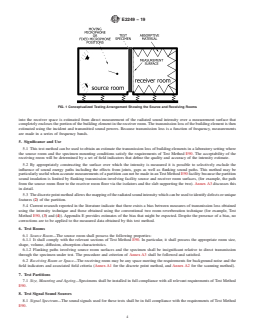
spaces creating two spaces as conceptually shown in Fig. 1.
there exists a bias between measures of transmission loss
The source space is a well-defined room satisfying the criteria
obtainedusingtheintensitytechniqueandthoseobtainedusing
of Test Method E90 while the other, the receiver room, has no
the conventional two room reverberation technique (for
specificphysicalrequirementsforsizeorabsorptioncondition.
example, Test Method E90, (3) and (4)).Appendix E provides
It is assumed that the sound field in the source room is
estimates of the bias that might be expected. Despite the
approximately diffuse since the incident sound power is
presence of a bias, no corrections are to be applied to the
estimated from the space averaged sound pressure level. The
measured data obtained by this test method.
sound power transmitted into the receiver space is estimated
from direct measurement of the radiated sound intensity over a
6. Test Rooms
measurement surface that completely encloses the portion of
the building element in the receiver room. The transmission 6.1 Source Room—The source room shall possess the fol-
lossofthebuildingelementisthenestimatedusingtheincident lowing properties:
and transmitted sound powers. Because transmission loss is a 6.1.1 It shall comply with the relevant sections of Test
function of frequency, measurements are made in a series of MethodE90.Inparticular,itshallpossesstheappropriateroom
frequency bands. size, shape, volume, diffusion, absorption characteristics.
E2249 − 19
6.1.2 Flankingpathsinvolvingsourceroomsurfacesandthe
specimen shall be insignificant relative to direct transmission
through the specimen under test. The procedure and criterion
of Annex A3 shall be followed and satisfied.
6.2 Receiving Room or Space—The receiving room may be
any space meeting the requirements for background noise and
the field indicators and associated field criteria (AnnexA1 for
the discrete point method, and Annex A2 for the scanning
method).
7. Test Partitions
Asingle measurement surface can be used when the specimen is mounted in a
niche as shown above.
7.1 Size, Mounting and Ageing—Specimens shall be in-
FIG. 2 Measurement Surface – Specimen Mounted in Niche
stalledinfullcompliancewithallrelevantrequirementsofTest
Method E90.
8. Test Signal Sound Sources
8.1 Signal Spectrum—Thesoundsignalsusedforthesetests
shall be in full compliance with the requirements of Test
Method E90.
8.2 Sound Sources—The number, characteristics, orienta-
tion and location of loudspeakers shall be in full compliance
with the requirements of Test Method E90.
8.3 Standard Test Frequencies—As a minimum, measure-
ments should be made at all of the one-third-octave bands Asingle measurement surface can be used when the specimen is bounded on
all sides as shown above.
stated in Test Method E90.
FIG. 3 Measurement Surface – Specimen Bounded on All Sides
9. Measurement Surface
9.1 The measurement surface shall define a measurement
9.2.2 Typically small building elements, such as windows,
volume that (1) completely encloses the portion of the speci-
require the use of a five-sided box as shown in Fig. 4, and the
men under test, (2) contains no extraneous or flanking sources,
measurement distance shall be no more than 0.3 m.
(3) contains no absorbing materials that are not part of the
specimen, and (4) satisfies the field indicator criteria. NOTE 7—As shown in Fig. 4, four of the five faces of the box-shaped
measurement surface intersect the perimeter of the element under test.
9.1.1 An absorptive material is defined as a material having
These side surfaces will have a depth equal to 0.1 to 0.3 m; the distance
an absorption coefficient greater than 0.1 in any of the
betweenthefrontalfaceandthespecimen.Thus,completesamplingofthe
frequency bands for which data will be reported.
side surfaces may include the effect of near-field radiation. This situation
can be avoided by providing an offset of 0.1 m for the four sides of the
NOTE 5—The measurement surface must be chosen so that all the
box-shaped measurement surface when the sound power radiated by the
radiated sound power of the portion of the building element under test
building element under test is considerably greater than that radiated by
passes through the measurement surface. Failure to do so will cause a
non-specimen surfaces contained in the measurement volume. Radiation
significant underestimation in the radiated sound power.
from the non-specimen surfaces can be viewed as being unwanted
9.2 Defineoneormoreflathypotheticalsurfacesthatsatisfy
flanking and this alternate configuration can only be deemed acceptable if
the sound power is 10 dB lower than that radiated by the partition.
the conditions of 9.1. Measurement distances shall be no less
than 0.1 m. Initially, select a distance between 0.1 and 0.3 m.
9.3 Once an appropriate measurement surface has been
Longer distances are usually undesirable since the proportion
defined, each face of the surface may be subdivided into
of direct to reverberant field decreases with increasing mea-
smaller subareas arranged in rows and columns, which estab-
surement distance. Measurement positions inside a niche shall
lish the measurement array.
be avoided.
NOTE 8—For convenience it is recommended to make each subarea of
equalareaalthoughthesubareasmaybesmalleronthesidefacesofabox
NOTE 6—Measurement points closer than 0.1 m are to be avoided
surface than the frontal face.
because of near field effects. Measurement conditions in a niche are
9.4 Whenthediscretepointmethodofmeasurementisused,
usually unfavorable due to the presence of standing waves.
the probe shall be placed in the geometric centre of each
9.2.1 The number of surfaces needed to construct the
subarea with the probe axis normal to the subarea, and
measurement surface can be reduced if the building element
transported either by mechanical means or by a human
under test is bounded by a rigid non-absorbing surface as
operator.
showninFigs.2and3.Arigidnon-radiatingsurfaceisdefined
as one having, in all frequency bands for which data are to be 9.5 When the scanning method of measurement is used, the
reported,atransmissionlossinexcessof20dB,andaradiated probe will be passed over the entire surface of each subarea,
sound power that is at least 10 dB lower than the power and transported either by mechanical means or by a human
radiated by the building element under test. operator.
E2249 − 19
A five-sided measurement surface forming a box may be used to completely enclose a small specimen that is mounted in a larger partition.
FIG. 4 Measurement Surface – Specimen Mounted in Larger Partition
10. Microphone and Intensity Probe Requirements consistent with acceptable inherent finite difference errors that
appear at high frequencies (5). Refer to manufacturer’s speci-
10.1 Bandwidth—For each test band, the overall frequency
fications for the usable frequency range for a particular
response of the electrical system, including the filter or filters
spacing. It may be necessary to perform complete measure-
in the microphone sections, shall satisfy the specifications
ments using more than one microphone spacing (usually two)
given in ANSI S1.11 for a one-third octave band filter set,
to cover the frequency range of interest.
Order 3 or higher, class 1 or better.
10.7 Probe Field Check—Before beginning measurements,
10.2 Source Room Microphones—Microphones are used to
verify proper operation of the probe. Place the probe in the
measureaveragesoundpressurelevelsinthesourceroom.The
receiving room near the center of building element under test
electrical characteristics and calibration procedures shall com-
at distance of 0.1 to 0.3 m from the surface. Fix the probe
ply with the relevant sections of Test Method E90.
position by securing it with a stand and align the longitudinal
10.3 Source Room Microphone Positions—Stationary mi-
probe axis normal to the specimen surface. With the sound
crophone positions or a moving microphone may be employed
sources turned on, measure and record the intensity level over
to determine the space-average sound pressure level in the
thefrequencyrangeofinterest.Rotatetheprobe180°aboutthe
source room. The system adopted shall comply with the
acoustic centre of the microphone pair and re-measure the
relevant sections of Test Method E90.
intensitylevel.Fortheprobeandmeasurementinstrumentation
10.4 IntensityProbe—Theintensityprobeshallcomplywith tobedeemedacceptablethefollowingshallbesatisfied:(1)the
the requirements of ANSI S1.9 and shall allow determination direction of the intensity level shall reverse sign, and (2) the
of the sound intensity in a known direction. The probe shall
magnitude of the difference in the undirected intensity mea-
consist of two pressure-sensing microphones spaced a known sured for the two probe orientations shall not be greater than
distance apart.
1.5 dB in any one-third-octave band.
NOTE 10—If this can not be attained then it is likely the field criteria
10.5 Probe Calibration—Using a sound intensity probe
will not be satisfied using the surface average values. Check probe
calibrator and following the manufacturers instructions, con-
calibration. If this fails to rectify the problem, check that Criterion 1 is
duct the following before each test:
satisfied. (Use AnnexA1 for the discrete point method, and AnnexA2 for
10.5.1 Calibrate both microphones for sound pressure. the scanning method). Add absorption if this condition is not met.
10.5.2 Calibrate the probe for sound intensity.
11. Intensity Measurement Methods
10.5.3 Measure the pressure-intensity residual index, δ .
pI
11.1 There are two acceptable sampling methods for mea-
NOTE9—δ isameasuredbyexposingthemicrophonepairtoasound
pI
field where the sound intensity is zero. Increasing values indicate
suring the average sound intensity radiated by the building
increased phase matching between the measurement channels.
element under test: the discrete point method and the scanning
10.6 Probe Microphone Spacing—The spacing between the method (5). The scanning method is often very much faster
two microphones of an intensity probe affects the usable lower than the discrete point method and is also the most suitable
and upper frequency range limits. Errors due to phase mis- method when measurement surface is large. The disadvantage
match between measurement channels increase as the spacing to the scanning method is that it is less reproducible than the
is decreased. The spacing shall be as large as possible, discrete point method.
E2249 − 19
11.2 Discrete Point Method—This method uses a set of
fixedpointstosampletheintensityfieldnormaltooneormore
measurement surfaces. (See Fig. 5). The probe may be sup-
portedbyadeviceorheldbyanoperator.Samplinguncertainty
isafunctionofthespatialvariationofthenormalintensityover
the measurement surface, the distribution of sample points and
the level of background noise in the receiving space. For the
initial measurement, the spacing between measurement points
should be equal to the probe distance. The side faces of a
five-sided box surface, as shown in Fig. 4, will often require a
Scan patterns for the first and second scans differ in orientation by 90°. The
higher density of measurement points than the frontal surface.
measured intensities are L (1) and L (2), respectively. The difference in the
In In
k k
11.3 Scanning Method—This method is based on sweeping measured intensity levels is used to determine the adequacy of the scan line
density and the measurement reproducibility.
the probe over the surface at a uniform speed so that the
FIG. 6 Scan Patterns
integration time is proportional to the area of the surface. A
typical scan pattern is a line segment that has been folded
several times to cover the subarea as shown in Fig. 6. The
ments then no results shall be given for these frequency bands.
straight portions of the scan pattern are referred to as the scan
This may prevent the single number ratings from being
lines.Theaveragedistancebetweenadjacentscanlinesshallbe
calculated and reported.
equalforallintensitymeasurementsmadeonthesamesurface.
NOTE 12—A2.5 provides guidance on how to change the scan line
The probe shall be moved continuously and at uniform speed
density to satisfy Criterion 3.
of 0.1 to 0.3 m/s along the selected scan pattern while
maintaining the probe axis perpendicular to the measurement 11.3.3 Scan each subarea according to Fig. 6.Ifabox
surface. It is acceptable to move the probe by mechanical shaped measurement surface is chosen, ensure that the sides of
means as long as extraneous noise or intensity does not the box are carefully scanned by moving the probe no closer
interfere with the measurement. than 0.1 m to the junction between the box and the building
element under test.
NOTE 11—Repeated scans are also required to ensure adequate mea-
11.3.4 During manual scanning, the operator shall not stand
surement reproducibility which my also be a function of the operator’s
infrontofthesubareabeingscannedbutshallstandtooneside
ability to maintain a constant scan speed, especially when the surface has
a non-uniform radiation pattern.
so the person’s body does not impede, reflect or diffract sound
towards the probe. Similarly, automated scanning mechanisms
11.3.1 Make two separate scans on each subarea of the
shall present a minimum of interference to the sound field.
measurement surface. The two individual scan paths shall be
orthogonal(scanpatternrotatedby90°).SeeFig.6.Recordthe
12. Measurement Procedure
intensity levels L (1) and L (2). Use Criterion 3 in Annex
In In
k k
A2 to determine the adequacy of the scan line density for 12.1 General—Measure the average sound pressure level in
frequency band. If the criterion is satisfied the intensity of the the source room. Ensure the probe is operating correctly by
subarea is given by the arithmetic mean of the two scans: calibrating it and performing the field check (see 10.7). Once
satisfactory, obtain an initial estimate of the receiving room
L 1 1L 2
~ ! ~ !
In In
k k
L 5 dB (8) conditions (see 12.2) and add treatments to the receiving room
In
k
as required. (See Annex A1 – Annex A3 for a discussion of
11.3.2 If Criterion 3 of AnnexA2 is not satisfied, repeat the
possible treatments). Check that the flanking transmission is
two scans again and check if the repeat measurements satisfy
not adversely affecting the measurement (see 12.3). If
the criterion. If it is impossible to comply with these require-
satisfactory, measure the average sound intensity level and
sound pressure level for each subarea and compute the field
indicators for the measurement method (discrete point A1.3
and scanning A2.3). If each subarea meets the background
noise criterion (see 12.5) and also meets the field criteria then
compute the average sound intensity and sound pressure levels
for the complete measurement surface (see 12.6). Compute the
field indicators for the complete measurement surface and
evaluate the field criteria. Compute the intensity transmission
loss for all frequency bands satisfying the criteria (see 12.12).
12.2 Initial Test for Receiving Room Suitability—To test the
suitability of the receiving room for intensity measurements,
switch on the sound sources and scan with the intensity probe
diagonally across the building element under test at a distance
Typical construction of the measurement grid for discrete point measurements.
of 0.1 to 0.3 m.
The dots indicate the sampling locations while the dashed lines define the area
12.2.1 Check that there is sufficient signal by using the
sampled by each point.
FIG. 5 Grid for Discrete Point Measurements background noise criterion of 12.5.
E2249 − 19
M
12.2.2 If there is sufficient signal, check that all frequency
I W
0.1L dB
¯
In
I 5 S 10 k sgn I (9)
~ ! ~ !
@ # 2
n ( m nk
k
bands Criterion 1 is satisfied. Use Annex A1 for the discrete S m
m k51
point method and Annex A2 for the scanning method.
where kindicatesthesubarea,and sgn(I )takesthevalueof
nk
NOTE13—Ifthisconditionisnotsatisfiedthenitishighlylikelythatthe
negativeunityifthesoundintensityforameasurementsubarea
field criteria will not be satisfied for surface averaged values so remedial
is directed into the measurement volume otherwise it is unity,
actions should be taken before beginning the detailed measurements.
and the total area of the measurement surface, S , is given by:
m
Annex A2 and Annex A3 provide methods to improve the measurement
M
conditions.
S 5 S (10)
m ( M
k
12.3 Flanking Transmission Check—The flanking criterion k51
of Annex A3 shall be satisfied since acoustic radiation from
¯
It is possible for I , evaluated using Eq 9, to take a negative
n
building elements adjacent to the measurement surface can
value indicating that the average intensity flow through the
adversely effect the accuracy of the measurements. Failure to
measurement surface is toward the specimen under test. In this
satisfy the flanking criterion can cause a significant underesti-
case transmission loss is not defined and shall not be reported.
mation of the sound insulation (6).
NOTE 16—A negative intensity may occur when the receiving room is
excessively reverberant or when there are extraneous noise sources (such
12.4 Measurement of the Average Sound Intensity Level on
as flanking surfaces) exterior to the measurement volume.
the Receiving Side—Measure the average sound intensity and
12.7 The surface average estimate of the signed normal
sound pressure levels for each subarea of the measurement
¯
sound intensity level of the measurement surface, L ,is
surface. For each subarea, if the background noise criterion is
In
obtained using:
satisfied, calculate the field indicators and evaluate the field
criteria according to the type of measurement (Annex A1 for
¯
I
? n?
¯ ¯
the discrete point method, AnnexA2 for the scanning method)
L 5 sgn~I ! 10logS D dB (11)
In n
I
for all frequency bands of measurement. If the field criteria are
¯ ¯
fulfilledforeachsurfaceandeachfrequencyband,computethe where (I ) takes the value of negative unity if I is negative
n n
average values for the complete measurement surface. otherwise it is unity.
12.4.1 IfthefieldcriteriaofAnnexA1forthediscretepoint
12.8 Similarly, calculate the average pressure level over the
methodorAnnexA2forthescanningmethod,arenotsatisfied
¯
measurement surface, L , using:
p
for all frequency bands of interest then take one of the
M
following alternative courses of action: ¯ 0,1L dB
p
L 5 10log S 10 k dB (12)
F G
p m
(
k
S
k51
m
12.4.1.1 Make a statement in the report to the effect that the
accuracy of the sound intensity measurements do not meet the
¯
where L is the surface averaged sound pressure level over
p
k
requirements at these frequency bands and do not report data
subarea k.
for these bands, or,
12.9 Compute the relevant field indicators for the measure-
12.4.1.2 Take remedial action according to A1.5 (discrete
ment method (discrete point Annex A1, scanning Annex A2)
point method) or A2.5 (scanning method) to increase the
using the results averaged over the complete measurement
accuracy and repeat the measurements.
surface.
NOTE 14—The single number rating ISTC can not be reported if the
Criteria of A1.4 for the discrete point method or A2.4 for the scanning
12.10 Measurement of the Average Sound Pressure Level in
method are not satisfied for all frequency bands required for the
the Source Room—Measuretheaveragesoundpressurelevelin
computation defined in Classification E413.
the source room according to the procedures given in Test
12.5 Background Noise—Sources of background noise con-
Method E90.
tained within the measurement volume will bias the intensity
12.11 Multiple Measurement Scans—When the frequency
results and can not be adequately detected by the field criteria
range of interest exceeds the frequency range for a particular
of Annex A1 and Annex A2. Consequently, average back-
probemicrophonespacing,performadditionalcompletesetsof
ground levels are determined at one or more points on each
intensity measurements at appropriate probe microphone spac-
faceofameasurementsurfacewhenthesoundsourceisturned
ing. For the frequency range where the usable ranges overlap
off but all other test conditions are maintained. The average
takethearithmeticmeanoftheintensitylevelsiftheydifferby
background level of sound pressure level and undirected
less than 1.5 dB, otherwise take the higher value.
intensity level should be more than 10 dB below the levels
obtained when the sound source is turned on at any measure- 12.12 Computing the Intensity Transmission Loss—For all
¯
ment point for each frequency band.
frequencybandsforwhich L ispositive,andtheFieldCriteria
In
NOTE15—Theserequirementsmaybetestedbyapplyingthefollowing
for the measurement method (discrete point Annex A1, scan-
procedure:Ifthecriteriaforthefieldindicatorsaresatisfiedthenlowerthe
ningAnnexA2)aresatisfiedwhenusingsurfaceaverageddata,
source level by 10 dB. If F (discrete point method) or F (scanning
2 pI
compute the transmission loss for the test partition in each
method)ischangedlessthan1dBthenthebackgroundnoiserequirement
one-third-octave band from:
is fulfilled.
12.6 Computing Average Levels from Multiple Subareas—If ¯
@ #
ITL 5 @L 2 6110 log~S !# 2 L 110log~S ! 1C (13)
I s In m 1
the measurement surface is divided into M subareas, each with
p 273.151T
the area, S , evaluate the surface averaged signed sound
mk s
C 5210 log 15 log
S D S D
¯
intensity, I , for the measurement surface from: p T
n s,0 0
E2249 − 19
where: 13.1.10 Report surface-averaged one-third octave intensity
levels and corresponding sound pressure levels accurate to one
ITL = intensity transmission loss, dB,
decimalplaceforeachtestfrequency.Whenmultiplemeasure-
L = average source room sound pressure level, dB,
I
¯
= surface averaged transmitted sound intensity normal ments have been made with different microphone spacing,
L
In
provide the intensity data for all frequencies which are used to
to the measurement surface, W/m ,
S = total area of the measurement surface, m , and
compute transmission loss.
m
S = area of the specimen, or portion thereof, contained in
13.1.11 Intensity Transmission Loss shall only be reported
s
the measurement volume, m ,
for one-third octave bands where the measured intensity and
p = static pressure, kPa,
pressure satisfy the field criteria for the measurement method
s
p = 101.325 kPa,
s,0
(discrete point Annex A1, scanning Annex A2), the signed
T = air temperature, °C,
intensity averaged over the complete measurement surface is
T = 314 K.
positive, flanking satisfies the criterion of 12.3, background
NOTE17—Thefirstbracketrepresentsanestimateoftheincidentsound
noise satisfies the criterion of 12.5, the source room require-
power on the specimen under test in the source room expressed in dB re
-12
ments satisfy the requirements of Test Method E90, and the
10 Watts assuming a diffuse field, while the second term represents an
specimen mounting conditions and aging satisfy Test Method
estimate of the total sound power radiated by the portion of the specimen
-12
in the receiving room expressed in dB re 10 Watts. The C term E90.
representsacorrectionfactorforambienttemperatureandpressureduring
13.1.11.1 Values shall be given accurate to one decimal
the measurement.
place.Valueslimitedbyflankingtransmissioninvolvingsource
room surfaces shall be clearly noted. See Annex A2.
13. Report
NOTE19—Ifresultsarepresentedingraphicalform,theabscissalength
13.1 A test report shall include the following information:
for a 10:1 frequency ratio should equal the ordinate length for 25 dB.
Whenever practicable, the scales should be 50 mm for a 10:1 frequency
13.1.1 At the bottom of each page of the test report add the
ratioand20mmfortendecibels,andtheordinatescaleshouldstartatzero
following statement. “The measurements reported herein were
decibels. Contour maps showing intensity level data in individual bands
made using the intensity method for measurement of sound
across one or more measurement faces may be included.
transmission loss ASTM E2249 and must not be used to
13.1.12 Single Number Ratings shall only be reported when
demonstratecompliancewithaspecificationcallingfortheuse
there are valid intensity transmission loss data in each third
ofASTME90(StandardTestMethodforLaboratoryMeasure-
octave band used to compute the single number ratings.
ment ofAirborne Sound Transmission Loss of Building Parti-
13.1.12.1 Intensity Sound Transmission Class—Compute
tions and Elements). Details as to the expected differences
the single number rating Intensity Sound Transmission Class
between the two standard test methods are presented inASTM
by applying Classification E413 to the measured transmission
E2249.”
loss data obtained using this standard. The single number
13.1.2 A statement, if true in every respect, that the tests
ratingshallbeidentifiedasbeingIntensitySoundTransmission
were conducted according to this test method.
Class or ISTC. It shall not be given any other name or
13.1.3 A description of the partition or test specimen in
descriptor.
accordance with Test Method E90. Report the area of the
13.1.12.2 Intensity Outdoor-Indoor Transmission Class—
specimen that is being tested.
Compute the single number rating Intensity Outdoor-Indoor
Transmission Class by applying Classification E1332 to the
NOTE 18—The specimen area is not the same as the area of the
measurement surface.
transmission loss measured using this standard. The single
number rating shall be identified as being Intensity Outdoor-
13.1.4 Indicate which sampling method was used. Include a
Indoor Transmission Class or OITC. It shall not be given any
description and dimensions of the final measurement surface
other name or descriptor.
that bounds the test partition. Report the distance from the
surface of the partition to the acoustic center of the intensity
14. Precision and Bias
probe. Report the number of measurement scans made and the
14.1 Precision—The precision of this test method has not
microphone spacing used for each scan.
been established. Since the source room and specimen mount-
13.1.5 Adescription of the type of intensity probe used and
ing requirements are identical to those Test Method E90 it is
a summary of the calibration procedure.
expected that the precision of this standard will be the same or
13.1.6 The Field Indicators determined for each test fre-
similar to Test Method E90.
quency.
NOTE20—PrecisionforISO15186-1isexpectedtobeequaltoorbetter
13.1.7 The temperature, barometric pressure and relative
than that of ISO 140-3 (the ISO laboratory two room method functionally
humidity in the rooms or spaces. similar to Test Method E90).
13.1.8 The volumes of all enclosed rooms.
14.2 Bias—The bias of this test method has not been
13.1.9 Report the average one-third octave sound pressure
thoroughlydetermined.AppendixX1providesinitialestimates
levels in the source room accurate to one decimal place for based on limited results published in the open literature and
each test frequency.
from private communications.
E2249 − 19
ANNEXES
(Mandatory Information)
A1. DISCRETE POINT METHOD—FIELD INDICATORS AND CRITERIA
N
A1.1 General—When the discrete point method is used,
S 5 S (A1.5)
m ( m
k
evaluate the following field indicators and evaluate the suit-
k51
ability of the measurement using the criteria for each measure-
where there are N subareas used to sample the measurement
ment surface and each measurement array, in each frequency
surface.
band of interest.
NOTE A1.3—This field indicator is compatible with ISO 9614-2 and
ISO 15186-1.
A1.2 ISO Compatibility—All of the field indicators and
A1.3.3 F —Thenegativepartialpowerindicatoristhelevel
criteria defined in this annex are based on those used in ISO
difference between the average pressure integrated over a
9614-1andrepresentamorestringentsupersetofthoseusedin
measurement surface and signed (accounting for direction)
ISO 15186-1. The criteria appearing here have been extended
average normal intensity level:
to allow for a non-uniform spacing of the measurement
positions. In the limit that each measurement position repre-
¯ ¯
F 5 L 2 L (A1.6)
3 p In
sents the same area, then the equations in this annex are
where:
identical to those of ISO 9614-1. Refer to 9614-1 for a list of
¯
references used to develop the material in this Annex. Refer- = is given by Eq 11.
L
In
ence (5) cited at the end of this standard contains valuable NOTEA1.4—This field indicator is compatible with ISO 9614-1, but is
not required by ISO 15186-1.
information relative to the development of the material pre-
sented in this Annex. ISO 9614-1 field indicator F1, the
A1.3.4 F —The field non-uniformity indicator is a measure
temporal variability indicator of the sound field, is not used in
of the suitability of the selected measurement array:
this test method since it is assumed that the sound source
N
1 1
operatedinthesourceroomisstationaryoverthemeasurement
¯
F 5 ΠI 2 I (A1.7)
~ !
4 ( n n
k
¯ N 2 1
k51
time. I
? n?
NOTE A1.5—This field indicator is compatible with ISO 9614-1 and
A1.3 Field Indicators—Three field indicators are used for ISO 15186-1.
the discrete point method.
A1.4 Field Criteria—Two criteria that must be satisfied for
A1.3.1 L , Dynamic Capability Index indicates the dynamic
a measurement to be considered acceptable.
d
capability of the measurement system:
A1.4.1 Adequate Dynamic Range—For a measurement ar-
L 5 δ 2 K (A1.1)
d pI ray to qualify as being suitable for the determination of sound
powerradiatingfromthereceivingsideofatestpartitionusing
where:
thediscretepointmethod,Criterion1shallbesatisfiedforeach
δ = pressure-residual intensity index, dB, and
pI
0 frequency band of measurement:
K = 10, dB.
Criterion 1:
NOTEA1.1—ThisfieldindicatoriscompatiblewithISO9614-2andISO
F < L Reflective test specimen
2 d
15186-1.
F < 6 dB Absorptive test specimen
NOTE A1.2—δ is obtained during the calibration of the intensity
pI
A1.4.1.1 Atest specimen shall be considered absorptive for
measuring system (see 10.5).
any one-third octave band if the absorption coefficient exceeds
A1.3.2 F , surface pressure-intensity indicator, is defined as
0.5.
the level difference between the average pressure integrated
NOTE A1.6—Criterion 1 is compatible with ISO 15186-1. ISO 9614-1
overameasurementsurfaceandunsigned(disregarddirection)
does not differentiate between reflective and absorptive surfaces.
average normal intensity level:
A1.4.2 Adequate Measurement Array—The number of N
¯ ¯ probe positions uniformly distributed over a chosen measure-
F 5 L 2 L (A1.2)
2 p In
? ?
ment surface is shall be sufficient if Criterion 2 is satisfied for
where: each frequency band of measurement:
N
L Criterion 2: N >CF
1 p
k
S D
¯
L 5 10 log S 10 10 (A1.3)
F G
p ( m
k
S where C, a correction factor is given in Table A1.1.
m k51
NOTE A1.7—This field indicator is compatible with ISO 9614-1 and
is the surface sound pressure level, in decibels, and ISO 15186-1.
N
L
? nk?
S D
¯ A1.5 Remedial Actions:
L 5 10 log S 10 10 (A1.4)
F G
In m
(
? ? k
S
k51
m
A1.5.1 Criterion 1—If either Criterion 1 or F − F ≤3dB
3 2
is the undirected surface normal intensity level, in decibels,
is not satisfied, perform either of the following remedial
and actions:
E2249 − 19
TABLE A1.1 Values for factorC
A1.5.1.2 Action b—Shield the measurement surface from
One-third Octave Band C
...
This document is not an ASTM standard and is intended only to provide the user of an ASTM standard an indication of what changes have been made to the previous version. Because
it may not be technically possible to adequately depict all changes accurately, ASTM recommends that users consult prior editions as appropriate. In all cases only the current version
of the standard as published by ASTM is to be considered the official document.
Designation: E2249 − 02 (Reapproved 2016) E2249 − 19
Standard Test Method for
Laboratory Measurement of Airborne Transmission Loss of
Building Partitions and Elements Using Sound Intensity
This standard is issued under the fixed designation E2249; the number immediately following the designation indicates the year of
original adoption or, in the case of revision, the year of last revision. A number in parentheses indicates the year of last reapproval. A
superscript epsilon (´) indicates an editorial change since the last revision or reapproval.
INTRODUCTION
This test method is part of a set for evaluating the sound transmission loss of a partition or partition
element under laboratory conditions. It differs from Test Method E90 in that the sound power radiated
by the element under test is measured directly using an intensity probe rather than indirectly from the
space averaged receiver room sound pressure and the room reverberation time. This test method is
especially useful when the receiver room requirements of Test Method E90 can not be achieved, or
flanking sound involving the receiver room surfaces is present but its influence is to be circumvented
(1) , as discussed in Annex A3.
Others test methods to evaluate sound insulation of building elements include: Test Method E90,
airborne transmission loss of an isolated partition element in a controlled laboratory environment, Test
Method E492, laboratory measurement of impact sound transmission through floors, Test Method
E336, measurement of sound isolation in buildings, Test Method E1007, measurement of impact
sound transmission in buildings, Guide E966, measurement of sound transmission through building
facades and facade elements.
1. Scope
1.1 This test method covers the measurement of airborne sound transmission loss of building partitions such as walls of all
kinds, operable partitions, floor-ceiling assemblies, doors, windows, roofs, panels and other space-dividing building elements. It
may also be have applications in sectors other than the building industry, although these are beyond the scope.
1.2 The primary quantity reported by this standard is Intensity Transmission Loss (ITL) and shall not be given another name.
Similarly, the single-number rating Intensity Sound Transmission Class (ISTC) derived from the measured ITL shall not be given
any other name.
1.3 This test method may be used to reveal the sound radiation characteristics of a partition or portion thereof.
1.4 The values stated in SI units are to be regarded as standard. No other units of measurement are included in this standard.
1.5 This standard does not purport to address all of the safety concerns, if any, associated with its use. It is the responsibility
of the user of this standard to establish appropriate safety safety, health, and healthenvironmental practices and determine the
applicability of regulatory limitations prior to use.
NOTE 1—The method for measuring the sound intensity radiated by the building element under test defined by this ASTM standard meets or exceeds
those of ISO 15186-1. Special consideration will have to be given to requirements for the source room and specimen mounting if compliance with ISO
15186-1 is also desired as they differ from those of this standard.
1.6 This international standard was developed in accordance with internationally recognized principles on standardization
established in the Decision on Principles for the Development of International Standards, Guides and Recommendations issued
by the World Trade Organization Technical Barriers to Trade (TBT) Committee.
This test method is under the jurisdiction of ASTM Committee E33 on Building and Environmental Acoustics and is the direct responsibility of Subcommittee E33.03
on Sound Transmission.
Current edition approved April 1, 2016April 1, 2019. Published April 2016May 2019. Originally approved in 2002. Last previous edition approved in 20082016 as
E2249 – 02 (2008).(2016). DOI: 10.1520/E2249-02R16.10.1520/E2249-19.
The boldface numbers in parentheses refer to the list of references at the end of this standard.
Copyright © ASTM International, 100 Barr Harbor Drive, PO Box C700, West Conshohocken, PA 19428-2959. United States
E2249 − 19
2. Referenced Documents
2.1 ASTM Standards:
C634 Terminology Relating to Building and Environmental Acoustics
E90 Test Method for Laboratory Measurement of Airborne Sound Transmission Loss of Building Partitions and Elements
E336 Test Method for Measurement of Airborne Sound Attenuation between Rooms in Buildings
E413 Classification for Rating Sound Insulation
2.2 ANSI Standards:
S1.9 Instruments for the Measurement of Sound Intensity
S1.11 Specification for Octave-Band and Fractional Octave-Band Analogue and Digital Filters
2.3 ISO Standards:
ISO 140-3 Acoustics—Measurement of Sound Insulation in Buildings and of Building Elements—Part 3: Laboratory
Measurements of Sound Insulation of Building Elements
ISO 9614-1 Acoustics—Determination of Sound Power Levels of Noise Sources Using Sound Intensity—Part 1: Measurement
at Discrete Points
ISO 9614-2 Acoustics—Determination of Sound Power Levels of Noise Sources Using Sound Intensity—Part 2: Measurement
by Scanning
ISO 15186-1 Acoustics—Measurement of Sound Insulation in Buildings and of Building Elements Using Sound Intensity—Part
1: Laboratory Conditions
ISO 15186-2 Acoustics—Measurement of Sound Insulation in Buildings and of Building Elements Using Sound Intensity—Part
2: In-Situ Conditions
2.4 IEC Standard:
IEC 1043 Instruments for the Measurement of Sound Intensity
3. Terminology
3.1 Definitions:The acoustical terminology used in this method is intended to be consistent with the definitions in Terminology
C634 and Test Method E90. Unique definitions of relevance to this test method are presented here:
3.1.1 sound intensity, I—time averaged rate of flow of sound energy per unit area in the direction of the local particle velocity.
This is a vector quantity which is equal to:
1 T W
W
I 5 p~t!·uW~t!·dt (1)
*
T m
where:
p(t) = instantaneous sound pressure at a point, Pascals,
Wu(t) = instantaneous particle velocity at the same point, m/s, and
T = averaging time, s.
3.1.2 normal sound intensity, I —component of the sound intensity in the direction normal to a measurement surface defined
n
by the unit normal vector Wn:
W
W
I 5 I·nW (2)
n 2
m
where:
Wn = unit normal vector directed out of the volume enclosed by the measurement surface.
3.1.3 normal unsigned sound intensity level, L —ten times the common logarithm of the ratio of the unsigned value of the
|In|
normal sound intensity to the reference intensity I as given by:
o
I
? n?
L 5 10log dB (3)
In
? ?
I
o
where:
W
I 5 10 (4)
o 2
m
3.1.4 normal signed sound intensity level, L —ten times the common logarithm of the ratio of the signed value of the normal
In
sound intensity to the reference intensity I as given by:
o
For referenced ASTM standards, visit the ASTM website, www.astm.org, or contact ASTM Customer Service at service@astm.org. For Annual Book of ASTM Standards
volume information, refer to the standard’s Document Summary page on the ASTM website.
Available from American National Standards Institute (ANSI), 25 W. 43rd St., 4th Floor, New York, NY 10036, http://www.ansi.org.
Available from International Electrotechnical Commission (IEC), 3 rue de Varembé, Case postale 131, CH-1211, Geneva 20, Switzerland, http://www.iec.ch.
E2249 − 19
I
? n?
L 5 sgn~I ! 10 log dB (5)
In n
I
o
where:
sgn(I ) = takes the value of negative unity if the sound intensity is directed into the measurement volume, otherwise it is unity.
n
3.1.5 pressure-residual intensity index, δ —the difference between the sound pressure level, L , and the unsigned normal sound
pI p
o
intensity level when the intensity probe is placed and oriented in a sound field where the sound intensity is zero, expressed in
decibels,
δ 5 L 2 L (6)
pI p In
o ? ?
Additional details can be found in IEC 61043.
3.1.6 measurement surface—surface totally enclosing the building element under test on the receiving side, scanned or sampled
by the probe during the measurements. This surface has an area S expressed in m .
m
3.1.7 measurement distance, d —distance between the measurement surface and the building element under test in a direction
m
normal to the element.
3.1.8 measurement subarea—part of the measurement surface being measured with the intensity probe using one continuous
scan or a series of discrete positions. The kth measurement subarea has an area S expressed in m .
mk
3.1.9 measurement volume—the volume that is bounded by the measurement surface(s), the building element under test, and any
connecting non-radiating surfaces.
3.1.10 measurement array—a series of fixed intensity probe positions where each position represents a small subarea of the
sub-divided area of a measurement surface.
3.1.11 discrete point method—a method of integrating the sound intensity over the entire measurement surface where a series
of stationary microphone positions are chosen to adequately sample the test partition.
3.1.12 scanning method—a method of integrating the sound intensity over the entire measurement surface whereby a series of
subareas are scanned by moving the intensity probe in a methodical fashion to adequately sample the test partition.
3.1.13 field indicators—a series of indicators used to assess the quality of the measurement conditions, and ultimately the
accuracy, of the intensity measurement.
3.1.13.1 dynamic capability index, L —a measure of the usable dynamic range of an intensity measuring system (which is a
d
function of the phase mismatch of the system and the bias error factor, K), expressed in decibels.
3.1.13.2 surface pressure-intensity indicator—the difference between the sound pressure level, and the normal sound intensity
level on the measurement surface, both being time and surface averaged. F is used for the discrete point method and F and for
2 pI
the scanning method.
3.1.13.3 negative partial power indicator, F —the difference between the average sound pressure level integrated over a
measurement surface and signed (accounting for direction) average normal intensity level.
3.1.13.4 field non-uniformity indicator, F — this measure is only applicable to the discrete point method and assess the
suitability of the selected measurement array.
NOTE 2—The field indicators and criteria used by this standard are based on those of ISO 9614 and are a more stringent superset of those required
by ISO 15186-1. Functional definitions are given in Annex A1 and Annex A2.
3.1.14 flanking transmission—transmission of sound from a source to a receiving location other than directly through the
element under consideration.
3.1.15 sound transmission loss, TL—In a specified frequency band, ten times the common logarithm of the ratio of the incident
sound power, W , to the sound power transmitted though the specimen under test, W , expressed in decibels.
i t
W
i
TL 5 10 log (7)
F G
W
t
NOTE 3—For this standard, TL is operationally defined by Eq 13 and differs from the definitions given in Test Method E90 only in the way that the
transmitted sound power is estimated.
NOTE 4—Transmission loss is a property of the specimen and to a first approximation, is independent of the specimen area and dimension. Nevertheless,
results of specimens that have significantly different dimensions and aspect ratios can vary significantly, especially at low frequencies, as this will hinder
comparison. It is for this reason that this standard requires a minimum area for the test specimen.
4. Summary of Test Method
4.1 The building element under test is installed between two spaces creating two spaces as conceptually shown in Fig. 1. The
source space is a well-defined room satisfying the criteria of Test Method E90 while the other, the receiver room, has no specific
physical requirements for size or absorption condition. It is assumed that the sound field in the source room is approximately
diffuse since the incident sound power is estimated from the space averaged sound pressure level. The sound power transmitted
E2249 − 19
FIG. 1 Conceptualized Testing Arrangement Showing the Source and Receiving Rooms
into the receiver space is estimated from direct measurement of the radiated sound intensity over a measurement surface that
completely encloses the portion of the building element in the receiver room. The transmission loss of the building element is then
estimated using the incident and transmitted sound powers. Because transmission loss is a function of frequency, measurements
are made in a series of frequency bands.
5. Significance and Use
5.1 This test method can be used to obtain an estimate the transmission loss of building elements in a laboratory setting where
the source room and the specimen mounting conditions satisfy the requirements of Test Method E90. The acceptability of the
receiving room will be determined by a set of field indicators that define the quality and accuracy of the intensity estimate.
5.2 By appropriately constructing the surface over which the intensity is measured it is possible to selectively exclude the
influence of sound energy paths including the effects from joints, gaps as well as flanking sound paths. This method may be
particularly useful when accurate measurements of a partition can not be made in an Test Method E90 facility because the partition
sound insulation is limited by flanking transmission involving facility source and receiver room surfaces, (for example, the path
from the source room floor to the receiver room floor via the isolators and the slab supporting the two). Annex A3 discusses this
in detail.
5.3 The discrete point method allows the mapping of the radiated sound intensity which can be used to identify defects or unique
features (2) of the partition.
5.4 Current research reported in the literature indicate that there exists a bias between measures of transmission loss obtained
using the intensity technique and those obtained using the conventional two room reverberation technique (for example, Test
Method E90, (3) and (4)). Appendix E provides estimates of the bias that might be expected. Despite the presence of a bias, no
corrections are to be applied to the measured data obtained by this test method.
6. Test Rooms
6.1 Source Room—The source room shall possess the following properties:
6.1.1 It shall comply with the relevant sections of Test Method E90. In particular, it shall possess the appropriate room size,
shape, volume, diffusion, absorption characteristics.
6.1.2 Flanking paths involving source room surfaces and the specimen shall be insignificant relative to direct transmission
through the specimen under test. The procedure and criterion of Annex A3 shall be followed and satisfied.
6.2 Receiving Room or Space—The receiving room may be any space meeting the requirements for background noise and the
field indicators and associated field criteria (Annex A1 for the discrete point method, and Annex A2 for the scanning method).
7. Test Partitions
7.1 Size, Mounting and Ageing—Specimens shall be installed in full compliance with all relevant requirements of Test Method
E90.
8. Test Signal Sound Sources
8.1 Signal Spectrum—The sound signals used for these tests shall be in full compliance with the requirements of Test Method
E90.
E2249 − 19
8.2 Sound Sources—The number, characteristics, orientation and location of loudspeakers shall be in full compliance with the
requirements of Test Method E90.
8.3 Standard Test Frequencies—As a minimum, measurements should be made at all of the one-third-octave bands stated in Test
Method E90.
9. Measurement Surface
9.1 The measurement surface shall define a measurement volume that (1) completely encloses the portion of the specimen under
test, (2) contains no extraneous or flanking sources, (3) contains no absorbing materials that are not part of the specimen, and (4)
satisfies the field indicator criteria.
9.1.1 An absorptive material is defined as a material having an absorption coefficient greater than 0.1 in any of the frequency
bands for which data will be reported.
NOTE 5—The measurement surface must be chosen so that all the radiated sound power of the portion of the building element under test passes through
the measurement surface. Failure to do so will cause a significant underestimation in the radiated sound power.
9.2 Define one or more flat hypothetical surfaces that satisfy the conditions of 9.1. Measurement distances shall be no less than
0.1 m. Initially, select a distance between 0.1 and 0.3 m. Longer distances are usually undesirable since the proportion of direct
to reverberant field decreases with increasing measurement distance. Measurement positions inside a niche shall be avoided.
NOTE 6—Measurement points closer than 0.1 m are to be avoided because of near field effects. Measurement conditions in a niche are usually
unfavorable due to the presence of standing waves.
9.2.1 The number of surfaces needed to construct the measurement surface can be reduced if the building element under test
is bounded by a rigid non-absorbing surface as shown in Figs. 2 and 3. A rigid non-radiating surface is defined as one having, in
all frequency bands for which data are to be reported, a transmission loss in excess of 20 dB, and a radiated sound power that is
at least 10 dB lower than the power radiated by the building element under test.
9.2.2 Typically small building elements, such as windows, require the use of a five-sided box as shown in Fig. 4, and the
measurement distance shall be no more than 0.3 m.
NOTE 7—As shown in Fig. 4, four of the five faces of the box-shaped measurement surface intersect the perimeter of the element under test. These
side surfaces will have a depth equal to 0.1 to 0.3 m; the distance between the frontal face and the specimen. Thus, complete sampling of the side surfaces
may include the effect of near-field radiation. This situation can be avoided by providing an offset of 0.1 m for the four sides of the box-shaped
measurement surface when the sound power radiated by the building element under test is considerably greater than that radiated by non-specimen
surfaces contained in the measurement volume. Radiation from the non-specimen surfaces can be viewed as being unwanted flanking and this alternate
configuration can only be deemed acceptable if the sound power is 10 dB lower than that radiated by the partition.
9.3 Once an appropriate measurement surface has been defined, each face of the surface may be subdivided into smaller
subareas arranged in rows and columns, which establish the measurement array.
NOTE 8—For convenience it is recommended to make each subarea of equal area although the subareas may be smaller on the side faces of a box
surface than the frontal face.
9.4 When the discrete point method of measurement is used, the probe shall be placed in the geometric centre of each subarea
with the probe axis normal to the subarea, and transported either by mechanical means or by a human operator.
9.5 When the scanning method of measurement is used, the probe will be passed over the entire surface of each subarea, and
transported either by mechanical means or by a human operator.
10. Microphone and Intensity Probe Requirements
10.1 Bandwidth—For each test band, the overall frequency response of the electrical system, including the filter or filters in the
microphone sections, shall satisfy the specifications given in ANSI S1.11 for a one-third octave band filter set, Order 3 or higher,
class 1 or better.
A single measurement surface can be used when the specimen is mounted in a niche as shown above.
FIG. 2 Measurement Surface – Specimen Mounted in Niche
E2249 − 19
A single measurement surface can be used when the specimen is bounded on all sides as shown above.
FIG. 3 Measurement Surface – Specimen Bounded on All Sides
10.2 Source Room Microphones—Microphones are used to measure average sound pressure levels in the source room. The
electrical characteristics and calibration procedures shall comply with the relevant sections of Test Method E90.
10.3 Source Room Microphone Positions—Stationary microphone positions or a moving microphone may be employed to
determine the space-average sound pressure level in the source room. The system adopted shall comply with the relevant sections
of Test Method E90.
10.4 Intensity Probe—The intensity probe shall comply with the requirements of ANSI S1.9 and shall allow determination of
the sound intensity in a known direction. The probe shall consist of two pressure-sensing microphones spaced a known distance
apart.
10.5 Probe Calibration—Using a sound intensity probe calibrator and following the manufacturers instructions, conduct the
following before each test:
10.5.1 Calibrate both microphones for sound pressure.
10.5.2 Calibrate the probe for sound intensity.
10.5.3 Measure the pressure-intensity residual index, δ .
pI
NOTE 9—δ is a measured by exposing the microphone pair to a sound field where the sound intensity is zero. Increasing values indicate increased
pI
phase matching between the measurement channels.
10.6 Probe Microphone Spacing—The spacing between the two microphones of an intensity probe affects the usable lower and
upper frequency range limits. Errors due to phase mismatch between measurement channels increase as the spacing is decreased.
The spacing shall be as large as possible, consistent with acceptable inherent finite difference errors that appear at high frequencies
(5). Refer to manufacturer’s specifications for the usable frequency range for a particular spacing. It may be necessary to perform
complete measurements using more than one microphone spacing (usually two) to cover the frequency range of interest.
10.7 Probe Field Check—Before beginning measurements, verify proper operation of the probe. Place the probe in the receiving
room near the center of building element under test at distance of 0.1 to 0.3 m from the surface. Fix the probe position by securing
it with a stand and align the longitudinal probe axis normal to the specimen surface. With the sound sources turned on, measure
and record the intensity level over the frequency range of interest. Rotate the probe 180° about the acoustic centre of the
microphone pair and re-measure the intensity level. For the probe and measurement instrumentation to be deemed acceptable the
following shall be satisfied: (1) the direction of the intensity level shall reverse sign, and (2) the magnitude of the difference in
the undirected intensity measured for the two probe orientations shall not be greater than 1.5 dB in any one-third-octave band.
NOTE 10—If this can not be attained then it is likely the field criteria will not be satisfied using the surface average values. Check probe calibration.
If this fails to rectify the problem, check that Criterion 1 is satisfied. (Use Annex A1 for the discrete point method, and Annex A2 for the scanning
method). Add absorption if this condition is not met.
11. Intensity Measurement Methods
11.1 There are two acceptable sampling methods for measuring the average sound intensity radiated by the building element
under test: the discrete point method and the scanning method (5). The scanning method is often very much faster than the discrete
point method and is also the most suitable method when measurement surface is large. The disadvantage to the scanning method
is that it is less reproducible than the discrete point method.
11.2 Discrete Point Method—This method uses a set of fixed points to sample the intensity field normal to one or more
measurement surfaces. (See Fig. 5). The probe may be supported by a device or held by an operator. Sampling uncertainty is a
function of the spatial variation of the normal intensity over the measurement surface, the distribution of sample points and the
level of background noise in the receiving space. For the initial measurement, the spacing between measurement points should be
equal to the probe distance. The side faces of a five-sided box surface, as shown in Fig. 4, will often require a higher density of
measurement points than the frontal surface.
E2249 − 19
A five-sided measurement surface forming a box may be used to completely enclose a small specimen that is mounted in a larger partition.
FIG. 4 Measurement Surface – Specimen Mounted in Larger Partition
Typical construction of the measurement grid for discrete point measurements. The dots indicate the sampling locations while the dashed lines define the area sampled
by each point.
FIG. 5 Grid for Discrete Point Measurements
11.3 Scanning Method—This method is based on sweeping the probe over the surface at a uniform speed so that the integration
time is proportional to the area of the surface. A typical scan pattern is a line segment that has been folded several times to cover
the subarea as shown in Fig. 6. The straight portions of the scan pattern are referred to as the scan lines. The average distance
between adjacent scan lines shall be equal for all intensity measurements made on the same surface. The probe shall be moved
continuously and at uniform speed of 0.1 to 0.3 m/s along the selected scan pattern while maintaining the probe axis perpendicular
to the measurement surface. It is acceptable to move the probe by mechanical means as long as extraneous noise or intensity does
not interfere with the measurement.
Scan patterns for the first and second scans differ in orientation by 90°. The measured intensities are L (1) and L (2), respectively. The difference in the measured
In In
k k
intensity levels is used to determine the adequacy of the scan line density and the measurement reproducibility.
FIG. 6 Scan Patterns
E2249 − 19
NOTE 11—Repeated scans are also required to ensure adequate measurement reproducibility which my also be a function of the operator’s ability to
maintain a constant scan speed, especially when the surface has a non-uniform radiation pattern.
11.3.1 Make two separate scans on each subarea of the measurement surface. The two individual scan paths shall be orthogonal
(scan pattern rotated by 90°). See Fig. 6. Record the intensity levels L (1) and L (2). Use Criterion 3 in Annex A2 to determine
In In
k k
the adequacy of the scan line density for frequency band. If the criterion is satisfied the intensity of the subarea is given by the
arithmetic mean of the two scans:
L 1 1L 2
~ ! ~ !
In In
k k
L 5 dB (8)
In
k
11.3.2 If Criterion 3 of Annex A2 is not satisfied, repeat the two scans again and check if the repeat measurements satisfy the
criterion. If it is impossible to comply with these requirements then no results shall be given for these frequency bands. This may
prevent the single number ratings from being calculated and reported.
NOTE 12—A2.5 provides guidance on how to change the scan line density to satisfy Criterion 3.
11.3.3 Scan each subarea according to Fig. 6. If a box shaped measurement surface is chosen, ensure that the sides of the box
are carefully scanned by moving the probe no closer than 0.1 m to the junction between the box and the building element under
test.
11.3.4 During manual scanning, the operator shall not stand in front of the subarea being scanned but shall stand to one side
so the person’s body does not impede, reflect or diffract sound towards the probe. Similarly, automated scanning mechanisms shall
present a minimum of interference to the sound field.
12. Measurement Procedure
12.1 General—Measure the average sound pressure level in the source room. Ensure the probe is operating correctly by
calibrating it and performing the field check (see 10.7). Once satisfactory, obtain an initial estimate of the receiving room
conditions (see 12.2) and add treatments to the receiving room as required. (See Annex A1 – Annex A3 for a discussion of possible
treatments). Check that the flanking transmission is not adversely affecting the measurement (see 12.3). If satisfactory, measure
the average sound intensity level and sound pressure level for each subarea and compute the field indicators for the measurement
method (discrete point A1.3 and scanning A2.3). If each subarea meets the background noise criterion (see 12.5) and also meets
the field criteria then compute the average sound intensity and sound pressure levels for the complete measurement surface (see
12.6). Compute the field indicators for the complete measurement surface and evaluate the field criteria. Compute the intensity
transmission loss for all frequency bands satisfying the criteria (see 12.12).
12.2 Initial Test for Receiving Room Suitability—To test the suitability of the receiving room for intensity measurements, switch
on the sound sources and scan with the intensity probe diagonally across the building element under test at a distance of 0.1 to
0.3 m.
12.2.1 Check that there is sufficient signal by using the background noise criterion of 12.5.
12.2.2 If there is sufficient signal, check that all frequency bands Criterion 1 is satisfied. Use Annex A1 for the discrete point
method and Annex A2 for the scanning method.
NOTE 13—If this condition is not satisfied then it is highly likely that the field criteria will not be satisfied for surface averaged values so remedial
actions should be taken before beginning the detailed measurements. Annex A2 and Annex A3 provide methods to improve the measurement conditions.
12.3 Flanking Transmission Check—The flanking criterion of Annex A3 shall be satisfied since acoustic radiation from building
elements adjacent to the measurement surface can adversely effect the accuracy of the measurements. Failure to satisfy the flanking
criterion can cause a significant underestimation of the sound insulation (6).
12.4 Measurement of the Average Sound Intensity Level on the Receiving Side—Measure the average sound intensity and sound
pressure levels for each subarea of the measurement surface. For each subarea, if the background noise criterion is satisfied,
calculate the field indicators and evaluate the field criteria according to the type of measurement (Annex A1 for the discrete point
method, Annex A2 for the scanning method) for all frequency bands of measurement. If the field criteria are fulfilled for each
surface and each frequency band, compute the average values for the complete measurement surface.
12.4.1 If the field criteria of Annex A1 for the discrete point method or Annex A2 for the scanning method, are not satisfied
for all frequency bands of interest then take one of the following alternative courses of action:
12.4.1.1 Make a statement in the report to the effect that the accuracy of the sound intensity measurements do not meet the
requirements at these frequency bands and do not report data for these bands, or,
12.4.1.2 Take remedial action according to A1.5 (discrete point method) or A2.5 (scanning method) to increase the accuracy
and repeat the measurements.
NOTE 14—The single number rating ISTC can not be reported if the Criteria of A1.4 for the discrete point method or A2.4 for the scanning method
are not satisfied for all frequency bands required for the computation defined in Classification E413.
12.5 Background Noise—Sources of background noise contained within the measurement volume will bias the intensity results
and can not be adequately detected by the field criteria of Annex A1 and Annex A2. Consequently, average background levels are
determined at one or more points on each face of a measurement surface when the sound source is turned off but all other test
E2249 − 19
conditions are maintained. The average background level of sound pressure level and undirected intensity level should be more
than 10 dB below the levels obtained when the sound source is turned on at any measurement point for each frequency band.
NOTE 15—These requirements may be tested by applying the following procedure: If the criteria for the field indicators are satisfied then lower the
source level by 10 dB. If F (discrete point method) or F (scanning method) is changed less than 1 dB then the background noise requirement is fulfilled.
2 pI
12.6 Computing Average Levels from Multiple Subareas—If the measurement surface is divided into M subareas, each with the
area, S , evaluate the surface averaged signed sound intensity, I¯ , for the measurement surface from:
mk n
M
I W
0.1L dB
¯
In
I 5 S 10 k sgn I (9)
~ ! ~ !
@ # 2
n ( m nk
k
S m
k51
m
where k indicates the subarea, and sgn(I ) takes the value of negative unity if the sound intensity for a measurement subarea
nk
is directed into the measurement volume otherwise it is unity, and the total area of the measurement surface, S , is given by:
m
M
S 5 S (10)
m M
( k
k51
It is possible for I¯ , evaluated using Eq 9, to take a negative value indicating that the average intensity flow through the
n
measurement surface is toward the specimen under test. In this case transmission loss is not defined and shall not be reported.
NOTE 16—A negative intensity may occur when the receiving room is excessively reverberant or when there are extraneous noise sources (such as
flanking surfaces) exterior to the measurement volume.
12.7 The surface average estimate of the signed normal sound intensity level of the measurement surface, L¯ , is obtained
In
using:
¯
I
? ?
n
¯ ¯
L 5 sgn~I ! 10logS D dB (11)
In n
I
where (I¯ ) takes the value of negative unity if I¯ is negative otherwise it is unity.
n n
12.8 Similarly, calculate the average pressure level over the measurement surface, L¯ , using:
p
M
¯ 0,1L dB
p
L 5 10log S 10 k dB (12)
F G
p m
(
k
S
m k51
where L¯ is the surface averaged sound pressure level over subarea k.
p
k
12.9 Compute the relevant field indicators for the measurement method (discrete point Annex A1, scanning Annex A2) using
the results averaged over the complete measurement surface.
12.10 Measurement of the Average Sound Pressure Level in the Source Room—Measure the average sound pressure level in the
source room according to the procedures given in Test Method E90.
12.11 Multiple Measurement Scans—When the frequency range of interest exceeds the frequency range for a particular probe
microphone spacing, perform additional complete sets of intensity measurements at appropriate probe microphone spacing. For the
frequency range where the usable ranges overlap take the arithmetic mean of the intensity levels if they differ by less than 1.5 dB,
otherwise take the higher value.
¯
12.12 Computing the Intensity Transmission Loss—For all frequency bands for which L¯L is positive, and the Field Criteria
InIn
for the measurement method (discrete point Annex A1, scanning Annex A2) are satisfied when using surface averaged data,
compute the transmission loss for the test partition in each one-third-octave band from:
¯
ITL 5 @L 2 6110 log S # 2@L 110log S # (13)
~ ! ~ !
1 s In m
¯
@ #
ITL 5 @L 2 6110 log~S !# 2 L 110log~S ! 1C (13)
I s In m 1
p 273.151T
s
C 5210 log 15 log
S D S D
p T
s,0 0
where:
ITL = intensity transmission loss, dB,
L = average source room sound pressure level, dB,
L = average source room sound pressure level, dB,
I
L¯ = surface averaged transmitted sound intensity normal to the measurement surface, W/m ,
In
¯
= surface averaged transmitted sound intensity normal to the measurement surface, W/m ,
L
In
S = total area of the measurement surface, m , and
m
S = area of the specimen, or portion thereof, contained in the measurement volume, m .
s
S = area of the specimen, or portion thereof, contained in the measurement volume, m ,
s
p = static pressure, kPa,
s
E2249 − 19
p = 101.325 kPa,
s,0
T = air temperature, °C,
T = 314 K.
-12
NOTE 17—The first bracket represents an estimate of the incident sound power on the specimen under test in the source room expressed in dB re 10
Watts assuming a diffuse field, while the second term represents an estimate of the total sound power radiated by the portion of the specimen in the
-12
receiving room expressed in dB re 10 Watts. The C term represents a correction factor for ambient temperature and pressure during the measurement.
13. Report
13.1 A test report shall include the following information:
13.1.1 At the bottom of each page of the test report add the following statement. “The measurements reported herein were made
using the intensity method for measurement of sound transmission loss ASTM E2249 and must not be used to demonstrate
compliance with a specification calling for the use of ASTM E90 (Standard Test Method for Laboratory Measurement of Airborne
Sound Transmission Loss of Building Partitions and Elements). Details as to the expected differences between the two standard
test methods are presented in ASTM E2249.”
13.1.2 A statement, if true in every respect, that the tests were conducted according to this test method.
13.1.3 A description of the partition or test specimen in accordance with Test Method E90. Report the area of the specimen that
is being tested.
NOTE 18—The specimen area is not the same as the area of the measurement surface.
13.1.4 Indicate which sampling method was used. Include a description and dimensions of the final measurement surface that
bounds the test partition. Report the distance from the surface of the partition to the acoustic center of the intensity probe. Report
the number of measurement scans made and the microphone spacing used for each scan.
13.1.5 A description of the type of intensity probe used and a summary of the calibration procedure.
13.1.6 The Field Indicators determined for each test frequency.
13.1.7 The temperature, barometric pressure and relative humidity in the rooms or spaces.
13.1.8 The volumes of all enclosed rooms.
13.1.9 Report the average one-third octave sound pressure levels in the source room accurate to one decimal place for each test
frequency.
13.1.10 Report surface-averaged one-third octave intensity levels and corresponding sound pressure levels accurate to one
decimal place for each test frequency. When multiple measurements have been made with different microphone spacing, provide
the intensity data for all frequencies which are used to compute transmission loss.
13.1.11 Intensity Transmission Loss shall only be reported for one-third octave bands where the measured intensity and pressure
satisfy the field criteria for the measurement method (discrete point Annex A1, scanning Annex A2), the signed intensity averaged
over the complete measurement surface is positive, flanking satisfies the criterion of 12.3, background noise satisfies the criterion
of 12.5, the source room requirements satisfy the requirements of Test Method E90, and the specimen mounting conditions and
aging satisfy Test Method E90.
13.1.11.1 Values shall be given accurate to one decimal place. Values limited by flanking transmission involving source room
surfaces shall be clearly noted. See Annex A2.
NOTE 19—If results are presented in graphical form, the abscissa length for a 10:1 frequency ratio should equal the ordinate length for 25 dB. Whenever
practicable, the scales should be 50 mm for a 10:1 frequency ratio and 20 mm for ten decibels, and the ordinate scale should start at zero decibels. Contour
maps showing intensity level data in individual bands across one or more measurement faces may be included.
13.1.12 Single Number Ratings shall only be reported when there are valid intensity transmission loss data in each third octave
band used to compute the single number ratings.
13.1.12.1 Intensity Sound Transmission Class—Compute the single number rating Intensity Sound Transmission Class by
applying Classification E413 to the measured transmission loss data obtained using this standard. The single number rating shall
be identified as being Intensity Sound Transmission Class or ISTC. It shall not be given any other name or descriptor.
13.1.12.2 Intensity Outdoor-Indoor Transmission Class—Compute the single number rating Intensity Outdoor-Indoor Trans-
mission Class by applying Classification E1332 to the transmission loss measured using this standard. The single number rating
shall be identified as being Intensity Outdoor-Indoor Transmission Class or OITC. It shall not be given any other name or
descriptor.
14. Precision and Bias
14.1 Precision—The precision of this test method has not been established. Since the source room and specimen mounting
requirements are identical to those Test Method E90 it is expected that the precision of this standard will be the same or similar
to Test Method E90.
NOTE 20—Precision for ISO 15186-1 is expected to be equal to or better than that of ISO 140-3 (the ISO laboratory two room method functionally
similar to Test Method E90).
14.2 Bias—The bias of this test method has not been thoroughly determined. Appendix X1 provides initial estimates based on
limited results published in the open literature and from private communications.
E2249 − 19
ANNEXES
(Mandatory Information)
A1. DISCRETE POINT METHOD—FIELD INDICATORS AND CRITERIA
A1.1 General—When the discrete point method is used, evaluate the following field indicators and evaluate the suitability of the
measurement using the criteria for each measurement surface and each measurement array, in each frequency band of interest.
A1.2 ISO Compatibility—All of the field indicators and criteria defined in this annex are based on those used in ISO 9614-1 and
represent a more stringent superset of those used in ISO 15186-1. The criteria appearing here have been extended to allow for a
non-uniform spacing of the measurement positions. In the limit that each measurement position represents the same area, then the
equations in this annex are identical to those of ISO 9614-1. Refer to 9614-1 for a list of references used to develop the material
in this Annex. Reference (5) cited at the end of this standard contains valuable information relative to the development of the
material presented in this Annex. ISO 9614-1 field indicator F1, the temporal variability indicator of the sound field, is not used
in this test method since it is assumed that the sound source operated in the source room is stationary over the measurement time.
A1.3 Field Indicators—Three field indicators are used for the discrete point method.
A1.3.1 L , Dynamic Capability Index indicates the dynamic capability of the measurement system:
d
L 5 δ 2 K (A1.1)
d pI
where:
δ = pressure-residual intensity index, dB, and
pI
K = 10, dB.
NOTE A1.1—This field indicator is compatible with ISO 9614-2and ISO 15186-1.
NOTE A1.2—δ is obtained during the calibration of the intensity measuring system (see 10.5).
pI
A1.3.2 F , surface pressure-intensity indicator, is defined as the level difference between the average pressure integrated over a
measurement surface and unsigned (disregard direction) average normal intensity level:
¯ ¯
F 5 L 2 L (A1.2)
2 p In
? ?
where:
N
L
1 p
k
S D
¯
L 5 10 log S 10 10 (A1.3)
F G
p ( m
k
S
k51
m
is the surface sound pressure level, in decibels, and
N
L
1 ? n ?
k
S D
¯
L 5 10 log S 10 10 (A1.4)
F G
In ( m
? ? k
S
m k51
is the undirected surface normal intensity level, in decibels, and
N
S 5 S (A1.5)
m m
(
k
k51
where there are N subareas used to sample the measurement surface.
NOTE A1.3—This field indicator is compatible with ISO 9614-2 and ISO 15186-1.
A1.3.3 F —The negative partial power indicator is the level difference between the average pressure integrated over a
measurement surface and signed (accounting for direction) average normal intensity level:
¯ ¯
F 5 L 2 L (A1.6)
3 p In
E2249 − 19
where:
¯
= is given by Eq 11.
L
In
NOTE A1.4—This field indicator is compatible with ISO 9614-1, but is not required by ISO 15186-1.
A1.3.4 F —The field non-uniformity indicator is a measure of the suitability of the selected measurement array:
N
1 1
¯
F 5 Π~ I 2 I ! (A1.7)
4 ( n n
k
¯ N 2 1
k51
I
? ?
n
NOTE A1.5—This field indicator is compatible with ISO 9614-1 and ISO 15186-1.
A1.4 Field Criteria—Two criteria that mu
...