

ASTM D3267-20
(Test Method)Standard Test Method for Separation and Collection of Particulate and Water-Soluble Gaseous Fluorides in the Atmosphere (Filter and Impinger Method)
General Information
- Abstract
SIGNIFICANCE AND USE
5.1 Sources of particulate and water-soluble gaseous fluorides in the atmosphere include the fertilizers, aluminum reduction plants, phosphate processors, steel mills, coal burning operations, brick and tile manufacturers, and various less significant sources (5). Gaseous fluorides can cause adverse effects when ingested or inhaled by animals or humans, or absorbed by plants. The procedures documented in this test method provide a means of determining of particulate and water soluble gaseous fluoride in atmospheres.
5.2 This test method provides a means of separation and collection of particulate and water soluble gaseous fluoride and provides samples that are convenient to analyze.
SCOPE
1.1 This test method provides a procedure for separation and collection of particulate and water-soluble gaseous fluorides from the atmosphere on a chemically treated filter and in an impinger. The sampling rate may vary from 30 L/min (1.0 ft3/min) to 15 L/min (0.5 ft3/min) for longer sampling periods depending on the atmospheric fluoride concentration. This test method is not intended to be applied to gaseous fluorine compounds that are not water-soluble.
1.2 There are several limitations of the test method:
1.2.1 Although the acid-treated, medium retentive, prefilter has been shown to allow passage of HF, it restricts passage of particulate matter only as small as about 1 μm. Thus, smaller particulate matter may pass through the filter and be collected in or pass through the impingers.
1.2.2 The maximum sample volume to be taken using this test method prior to changing the acid-treated prefilter is recommended as 12 m3. This recommendation is made to minimize any effects due to particulate matter build-up.
1.3 The values stated in SI units are to be regarded as standard. The values given in parentheses after SI units are provided for information only and are not considered standard.
1.4 This standard does not purport to address all of the safety concerns, if any, associated with its use. It is the responsibility of the user of this standard to establish appropriate safety, health, and environmental practices and determine the applicability of regulatory limitations prior to use. For specific precautionary statements, see 7.4.3.
1.5 This international standard was developed in accordance with internationally recognized principles on standardization established in the Decision on Principles for the Development of International Standards, Guides and Recommendations issued by the World Trade Organization Technical Barriers to Trade (TBT) Committee.
- Status
- Published
- Publication Date
- 30-Nov-2020
- Technical Committee
- D22 - Air Quality
- Drafting Committee
- D22.03 - Ambient Atmospheres and Source Emissions
Buy Documents
ASTM D3267-20 - Standard Test Method for Separation and Collection of Particulate and Water-Soluble Gaseous Fluorides in the Atmosphere (Filter and Impinger Method)
REDLINE ASTM D3267-20 - Standard Test Method for Separation and Collection of Particulate and Water-Soluble Gaseous Fluorides in the Atmosphere (Filter and Impinger Method)
Overview
ASTM D3267-20 is the international standard test method published by ASTM International for the separation and collection of particulate and water-soluble gaseous fluorides in the atmosphere. Utilizing a filter and impinger sampling system, this method provides an effective procedure for environmental monitoring of fluorides in ambient air. Industries such as fertilizer production, aluminum reduction, phosphate processing, steel manufacturing, coal combustion, and brick or tile manufacturing are significant sources of atmospheric particulate and water-soluble gaseous fluorides. The test method serves as a means to assess occupational and community exposure, environmental compliance, and air quality management.
Key Topics
Scope and Limitations
- Provides procedures for separating and collecting atmospheric particulate and water-soluble gaseous fluorides using chemically treated filters (to capture particulate) and impingers (to capture gaseous species).
- Flow rates for sampling range from 15 L/min for long-term sampling up to 30 L/min for short-term measurements.
- Not suitable for gaseous fluorine compounds that are not water-soluble.
- Particulate matter smaller than approximately 1 μm may not be fully captured by the filter, potentially passing into or through the impinger.
- The recommended maximum air sample per prefilter is 12 m³ to prevent overload and ensure sample integrity.
Sampling Process
- Air is drawn through an acid-treated filter to collect particulate fluorides.
- Subsequently, the air passes through an impinger containing water to collect water-soluble gaseous fluorides.
- Both filters and impinger solutions are collected for laboratory analysis, by potentiometric or photometric methods.
- Field blanks are included to ensure quality control.
Significance and Use
- Determining levels of atmospheric fluorides protects human health, animal welfare, and agriculture, since gaseous and particulate fluorides can be absorbed through inhalation or ingestion.
- Test results inform regulatory compliance, pollution abatement, and process improvements in emission-intensive industries.
Precision and Quality Assurance
- The method includes procedures for calibration, quality assurance/quality control documentation, and reporting.
- Results provide reliable, standardized data necessary for regulatory reports and long-term environmental monitoring.
Applications
Industrial Emissions Monitoring
- Used by facility operators and environmental consultants to monitor and control fluoride emissions at fertilizer plants, aluminum smelters, coal-fired power stations, and related facilities.
Air Quality Assessment
- Provides baseline and ongoing monitoring for communities near industrial sites to ensure compliance with environmental standards and public health guidelines.
Regulatory Compliance
- Accepted by regulatory agencies for evaluating ambient air concentrations of fluorides and supporting permitting, compliance, and enforcement activities.
Research and Environmental Impact Studies
- Valuable in environmental studies assessing the fate and transport of airborne fluorides and their implications for ecosystem and crop health.
Related Standards
For complete and consistent ambient atmospheric fluoride analysis, consider using ASTM D3267-20 in conjunction with related standards:
- ASTM D1071 - Volumetric Measurement of Gaseous Fuel Samples
- ASTM D1193 - Specification for Reagent Water
- ASTM D1356 - Terminology Relating to Sampling and Analysis of Atmospheres
- ASTM D1357 - Planning the Sampling of the Ambient Atmosphere
- ASTM D3268 - Collection and Separation of Atmospheric Fluorides (alternative methods)
- ASTM D3269 and D3270 - Analysis for Fluoride Content in Atmosphere and Plant Tissues
- ASTM E337 - Measurement of Humidity
Using ASTM D3267-20 within this framework enables robust, comprehensive monitoring and analysis of fluoride pollutants in the atmosphere, supporting public health, environmental protection, and regulatory compliance initiatives.
Keywords: ambient atmosphere, fluoride monitoring, gaseous fluorides, particulate fluorides, air sampling, environmental compliance, ASTM D3267-20, filter and impinger method.
Relations
- Effective Date
- 01-Sep-2020
- Effective Date
- 15-Mar-2020
- Effective Date
- 01-Aug-2019
- Effective Date
- 15-Apr-2018
- Effective Date
- 01-Apr-2017
- Effective Date
- 15-Oct-2015
- Effective Date
- 01-Jul-2015
- Effective Date
- 01-Dec-2014
- Effective Date
- 01-May-2014
- Effective Date
- 15-Jan-2014
- Effective Date
- 01-Oct-2011
- Effective Date
- 01-Oct-2011
- Effective Date
- 01-Apr-2010
- Effective Date
- 01-Dec-2008
- Effective Date
- 01-Oct-2007
Buy Documents
ASTM D3267-20 - Standard Test Method for Separation and Collection of Particulate and Water-Soluble Gaseous Fluorides in the Atmosphere (Filter and Impinger Method)
REDLINE ASTM D3267-20 - Standard Test Method for Separation and Collection of Particulate and Water-Soluble Gaseous Fluorides in the Atmosphere (Filter and Impinger Method)
Get Certified
Connect with accredited certification bodies for this standard

CIS Institut d.o.o.
Personal Protective Equipment (PPE) certification body. Notified Body NB-2890 for EU Regulation 2016/425 PPE.

Kiwa BDA Testing
Building and construction product certification.
Kmetijski inštitut Slovenije
Agricultural Institute of Slovenia. Soil testing, plant health, agricultural product analysis.
Sponsored listings
Frequently Asked Questions
ASTM D3267-20 is a standard published by ASTM International. Its full title is "Standard Test Method for Separation and Collection of Particulate and Water-Soluble Gaseous Fluorides in the Atmosphere (Filter and Impinger Method)". This standard covers: SIGNIFICANCE AND USE 5.1 Sources of particulate and water-soluble gaseous fluorides in the atmosphere include the fertilizers, aluminum reduction plants, phosphate processors, steel mills, coal burning operations, brick and tile manufacturers, and various less significant sources (5). Gaseous fluorides can cause adverse effects when ingested or inhaled by animals or humans, or absorbed by plants. The procedures documented in this test method provide a means of determining of particulate and water soluble gaseous fluoride in atmospheres. 5.2 This test method provides a means of separation and collection of particulate and water soluble gaseous fluoride and provides samples that are convenient to analyze. SCOPE 1.1 This test method provides a procedure for separation and collection of particulate and water-soluble gaseous fluorides from the atmosphere on a chemically treated filter and in an impinger. The sampling rate may vary from 30 L/min (1.0 ft3/min) to 15 L/min (0.5 ft3/min) for longer sampling periods depending on the atmospheric fluoride concentration. This test method is not intended to be applied to gaseous fluorine compounds that are not water-soluble. 1.2 There are several limitations of the test method: 1.2.1 Although the acid-treated, medium retentive, prefilter has been shown to allow passage of HF, it restricts passage of particulate matter only as small as about 1 μm. Thus, smaller particulate matter may pass through the filter and be collected in or pass through the impingers. 1.2.2 The maximum sample volume to be taken using this test method prior to changing the acid-treated prefilter is recommended as 12 m3. This recommendation is made to minimize any effects due to particulate matter build-up. 1.3 The values stated in SI units are to be regarded as standard. The values given in parentheses after SI units are provided for information only and are not considered standard. 1.4 This standard does not purport to address all of the safety concerns, if any, associated with its use. It is the responsibility of the user of this standard to establish appropriate safety, health, and environmental practices and determine the applicability of regulatory limitations prior to use. For specific precautionary statements, see 7.4.3. 1.5 This international standard was developed in accordance with internationally recognized principles on standardization established in the Decision on Principles for the Development of International Standards, Guides and Recommendations issued by the World Trade Organization Technical Barriers to Trade (TBT) Committee.
SIGNIFICANCE AND USE 5.1 Sources of particulate and water-soluble gaseous fluorides in the atmosphere include the fertilizers, aluminum reduction plants, phosphate processors, steel mills, coal burning operations, brick and tile manufacturers, and various less significant sources (5). Gaseous fluorides can cause adverse effects when ingested or inhaled by animals or humans, or absorbed by plants. The procedures documented in this test method provide a means of determining of particulate and water soluble gaseous fluoride in atmospheres. 5.2 This test method provides a means of separation and collection of particulate and water soluble gaseous fluoride and provides samples that are convenient to analyze. SCOPE 1.1 This test method provides a procedure for separation and collection of particulate and water-soluble gaseous fluorides from the atmosphere on a chemically treated filter and in an impinger. The sampling rate may vary from 30 L/min (1.0 ft3/min) to 15 L/min (0.5 ft3/min) for longer sampling periods depending on the atmospheric fluoride concentration. This test method is not intended to be applied to gaseous fluorine compounds that are not water-soluble. 1.2 There are several limitations of the test method: 1.2.1 Although the acid-treated, medium retentive, prefilter has been shown to allow passage of HF, it restricts passage of particulate matter only as small as about 1 μm. Thus, smaller particulate matter may pass through the filter and be collected in or pass through the impingers. 1.2.2 The maximum sample volume to be taken using this test method prior to changing the acid-treated prefilter is recommended as 12 m3. This recommendation is made to minimize any effects due to particulate matter build-up. 1.3 The values stated in SI units are to be regarded as standard. The values given in parentheses after SI units are provided for information only and are not considered standard. 1.4 This standard does not purport to address all of the safety concerns, if any, associated with its use. It is the responsibility of the user of this standard to establish appropriate safety, health, and environmental practices and determine the applicability of regulatory limitations prior to use. For specific precautionary statements, see 7.4.3. 1.5 This international standard was developed in accordance with internationally recognized principles on standardization established in the Decision on Principles for the Development of International Standards, Guides and Recommendations issued by the World Trade Organization Technical Barriers to Trade (TBT) Committee.
ASTM D3267-20 is classified under the following ICS (International Classification for Standards) categories: 13.040.20 - Ambient atmospheres. The ICS classification helps identify the subject area and facilitates finding related standards.
ASTM D3267-20 has the following relationships with other standards: It is inter standard links to ASTM D1356-20a, ASTM D1356-20, ASTM D1357-95(2019), ASTM D3268-91(2018), ASTM D1071-17, ASTM D1356-15a, ASTM D1356-15, ASTM D1356-14b, ASTM D1356-14a, ASTM D1356-14, ASTM D3268-91(2011), ASTM D1357-95(2011), ASTM D1356-05(2010), ASTM D1071-83(2008), ASTM E337-02(2007). Understanding these relationships helps ensure you are using the most current and applicable version of the standard.
ASTM D3267-20 is available in PDF format for immediate download after purchase. The document can be added to your cart and obtained through the secure checkout process. Digital delivery ensures instant access to the complete standard document.
Standards Content (Sample)
This international standard was developed in accordance with internationally recognized principles on standardization established in the Decision on Principles for the
Development of International Standards, Guides and Recommendations issued by the World Trade Organization Technical Barriers to Trade (TBT) Committee.
Designation: D3267 −20
Standard Test Method for
Separation and Collection of Particulate and Water-Soluble
Gaseous Fluorides in the Atmosphere (Filter and Impinger
Method)
This standard is issued under the fixed designation D3267; the number immediately following the designation indicates the year of
original adoption or, in the case of revision, the year of last revision.Anumber in parentheses indicates the year of last reapproval.A
superscript epsilon (´) indicates an editorial change since the last revision or reapproval.
1. Scope 2. Referenced Documents
1.1 This test method provides a procedure for separation 2.1 ASTM Standards:
and collection of particulate and water-soluble gaseous fluo- D1071Test Methods for Volumetric Measurement of Gas-
rides from the atmosphere on a chemically treated filter and in eous Fuel Samples
an impinger. The sampling rate may vary from 30 L⁄min D1193Specification for Reagent Water
3 3
(1.0ft /min) to 15L⁄min (0.5ft /min) for longer sampling D1356Terminology Relating to Sampling and Analysis of
periods depending on the atmospheric fluoride concentration. Atmospheres
This test method is not intended to be applied to gaseous D1357Practice for Planning the Sampling of the Ambient
fluorine compounds that are not water-soluble. Atmosphere
D2009Practice for Collection by Filtration and Determina-
1.2 There are several limitations of the test method:
tion of Mass, Number, and Optical Sizing ofAtmospheric
1.2.1 Although the acid-treated, medium retentive, prefilter
Particulates (Withdrawn 1995)
has been shown to allow passage of HF, it restricts passage of
D3268Test Method for Separation and Collection of Par-
particulate matter only as small as about 1 µm. Thus, smaller
ticulate and Gaseous Fluorides in the Atmosphere (So-
particulate matter may pass through the filter and be collected
dium Bicarbonate-Coated Glass Tube and Particulate
in or pass through the impingers.
Filter Method)
1.2.2 The maximum sample volume to be taken using this
D3269Test Methods for Analysis for Fluoride Content of
test method prior to changing the acid-treated prefilter is
3 the Atmosphere and Plant Tissues (Manual Procedures)
recommended as 12 m . This recommendation is made to
(Withdrawn 2010)
minimize any effects due to particulate matter build-up.
D3270Test Methods for Analysis for Fluoride Content of
1.3 The values stated in SI units are to be regarded as
the Atmosphere and Plant Tissues (Semiautomated
standard. The values given in parentheses after SI units are
Method)
providedforinformationonlyandarenotconsideredstandard.
E337Test Method for Measuring Humidity with a Psy-
1.4 This standard does not purport to address all of the
chrometer (the Measurement of Wet- and Dry-Bulb Tem-
safety concerns, if any, associated with its use. It is the peratures)
responsibility of the user of this standard to establish appro-
3. Terminology
priate safety, health, and environmental practices and deter-
mine the applicability of regulatory limitations prior to use.
3.1 Definitions—For definitions of terms used in this test
For specific precautionary statements, see 7.4.3. method, refer to Terminology D1356.
1.5 This international standard was developed in accor-
4. Summary of Test Method
dance with internationally recognized principles on standard-
ization established in the Decision on Principles for the
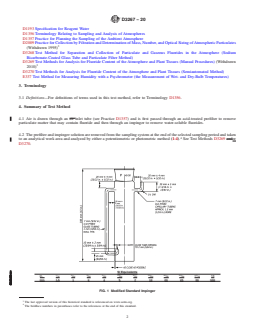
4.1 Air is drawn through an inlet tube (see Practice D1357)
Development of International Standards, Guides and Recom- and is first passed through an acid-treated prefilter to remove
mendations issued by the World Trade Organization Technical
particulate matter that may contain fluoride and then through
Barriers to Trade (TBT) Committee. an impinger to remove water-soluble fluorides.
1 2
This test method is under the jurisdiction of ASTM Committee D22 on Air For referenced ASTM standards, visit the ASTM website, www.astm.org, or
Quality and is the direct responsibility of Subcommittee D22.03 on Ambient contact ASTM Customer Service at service@astm.org. For Annual Book of ASTM
Atmospheres and Source Emissions. Standards volume information, refer to the standard’s Document Summary page on
Current edition approved Dec. 1, 2020. Published January 2021. Originally the ASTM website.
approved in 1973. Last previous edition approved in 2012 as D3267–12. DOI: The last approved version of this historical standard is referenced on
10.1520/D3267-20. www.astm.org.
Copyright © ASTM International, 100 Barr Harbor Drive, PO Box C700, West Conshohocken, PA 19428-2959. United States
D3267 − 20
SI Equivalents
1 3 5 5 13 9 25 25 63 3
in. ⁄16 ⁄64 ⁄64 ⁄32 ⁄64 ⁄32 ⁄64 ⁄32 ⁄64 1 ⁄16 13
mm 1.5 12457 10 20 25 30 330
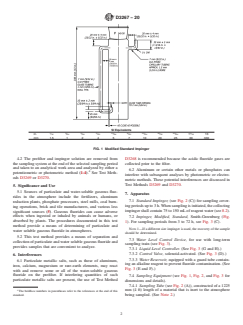
FIG. 1 Modified Standard Impinger
4.2 The prefilter and impinger solution are removed from D3268 is recommended because the acidic fluoride gases are
the sampling system at the end of the selected sampling period collected prior to the filter.
and taken to an analytical work area and analyzed by either a
6.2 Aluminum or certain other metals or phosphates can
potentiometric or photometric method (1-4). See Test Meth-
interfere with subsequent analyses by photometric or electro-
ods D3269 or D3270.
metric methods. These potential interferences are discussed in
Test Methods D3269 and D3270.
5. Significance and Use
5.1 Sources of particulate and water-soluble gaseous fluo-
7. Apparatus
rides in the atmosphere include the fertilizers, aluminum
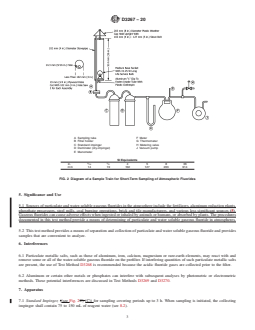
7.1 Standard Impinger, (see Fig. 2 (C)) for sampling cover-
reduction plants, phosphate processors, steel mills, coal burn-
ingperiodsupto3h.Whensamplingisinitiated,thecollecting
ing operations, brick and tile manufacturers, and various less
impingershallcontain75to150mLofreagentwater(see8.2).
significant sources (5). Gaseous fluorides can cause adverse
effects when ingested or inhaled by animals or humans, or
7.2 Impinger, Modified, Standard, Smith-Greenburg (Fig.
absorbed by plants. The procedures documented in this test
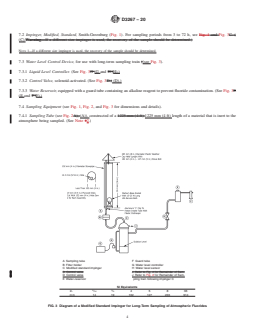
1). For sampling periods from 3 to 72 h, see Fig. 3 (C).
method provide a means of determining of particulate and
NOTE1—Ifadifferentsizeimpingerisused,therecoveryofthesample
water soluble gaseous fluoride in atmospheres.
should be determined.
5.2 This test method provides a means of separation and
7.3 Water Level Control Device, for use with long-term
collectionofparticulateandwatersolublegaseousfluorideand
sampling train (see Fig. 3).
provides samples that are convenient to analyze.
7.3.1 Liquid Level Controller. (See Fig. 3 (G and H).)
7.3.2 Control Valve, solenoid-activated. (See Fig. 3 (D).)
6. Interferences
7.3.3 Water Reservoir, equipped with a guard tube contain-
6.1 Particulate metallic salts, such as those of aluminum,
ing an alkaline reagent to prevent fluoride contamination. (See
iron, calcium, magnesium or rare-earth elements, may react
Fig. 3 (E and F).)
with and remove some or all of the water-soluble gaseous
fluoride on the prefilter. If interfering quantities of such
7.4 Sampling Equipment (see Fig. 1, Fig. 2, and Fig. 3 for
particulate metallic salts are present, the use of Test Method
dimensions and details).
7.4.1 Sampling Tube (see Fig. 2 (A)), constructed of a 1225
4 mm (4 ft) length of a material that is inert to the atmosphere
The boldface numbers in parentheses refer to the references at the end of this
standard. being sampled. (See Note 2.)
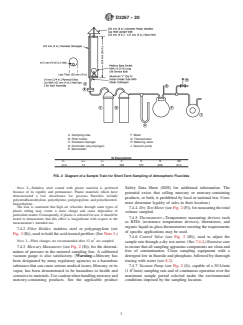
D3267 − 20
A Sampling tube F Meter
B Filter holder G Thermometer
C Standard impinger H Metering valve
D Deminster (dry-impinger) J Vacuum pump
E Manometer
SI Equivalents
9 3
in. ⁄16 ⁄4 45 8 36
mm 14 19 102 127 203 914
FIG. 2 Diagram of a Sample Train for Short-Term Sampling of Atmospheric Fluorides
NOTE 2—Stainless steel coated with plastic material is preferred
Safety Data Sheet (SDS) for additional information. The
because of its rigidity and permanence. Plastic materials which have
potential exists that selling mercury or mercury-containing
demonstrated a low absorbance for gaseous fluorides include
products, or both, is prohibited by local or national law. Users
polytetrafluoroethylene, polyethylene, polypropylene, and polychlorotrif-
must determine legality of sales in their location.)
luoroethylene.
The user is cautioned that high air velocities through some types of 7.4.4 DryTestMeter(seeFig.2(F)),formeasuringthetotal
plastic tubing may create a static charge and cause deposition of
volume sampled.
particulate matter. Consequently, if plastic is selected for use, it should be
7.4.5 Thermometer—Temperature measuring devices such
tested to demonstrate that this effect is insignificant with respect to the
as RTDs (resistance temperature devices), thermistors, and
measurement’s intended use.
organicliquid-in-glassthermometersmeetingtherequirements
7.4.2 Filter Holder, stainless steel or polypropylene (see
of specific applications may be used.
Fig.2(B)),usedtoholdtheacid-treatedprefilter.(SeeNote3.)
7.4.6 Control Valve (see Fig. 2 (H)), used to adjust the
NOTE 3—Filter changes are recommended after 12 m are sampled.
sample rate through a dry test meter. (See 7.4.4.) Exercise care
toensurethatallsamplingapparatuscomponentsarecleanand
7.4.3 Mercury Manometer (see Fig. 2 (E)), for the determi-
free of contamination. Clean sampling equipment with a
nation of pressure in the metered sampling line. A calibrated
detergent low in fluoride and phosphate, followed by thorough
vacuum gauge is also satisfactory. (Warning—Mercury has
rinsing with water (see 8.2).
been designated by many regulatory agencies as a hazardous
substancethatcancauseseriousmedicalissues.Mercury,orits 7.4.7 Vacuum Pump (see Fig. 2 (J)), capable of a 30 L/min
vapor, has been demonstrated to be hazardous to health and (1ft /min) sampling rate and of continuous operation over the
corrosivetomaterials.Usecautionwhenhandlingmercuryand maximum sample period selected under the environmental
mercury-containing products. See the applicable product conditions imposed by the sampling location.
D3267 − 20
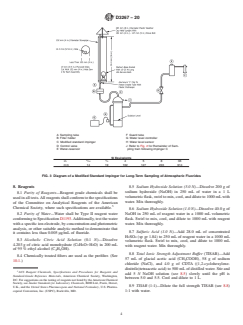
A Sampling tube F Guard tube
B Filter holder G Water level controller
C Modified standard impinger H Water level sensor
D Control valve J Refer to Fig. 2 for Remainder of Sam-
E Water-reservoir pling train following impinger C
SI Equivalents
9 3
in. ⁄16 ⁄4 45 8 36
mm 14 19 102 127 203 914
FIG. 3 Diagram of a Modified Standard Impinger for Long-Term Sampling of Atmospheric Fluorides
8. Reagents 8.5 Sodium Hydroxide Solution (5.0 N)—Dissolve 200 g of
sodium hydroxide (NaOH) in 250 mL of water ina1L
8.1 Purity of Reagents—Reagent grade chemicals shall be
volumetricflask,swirltomix,cool,anddiluteto1000mLwith
usedinalltests.Allreagentsshallconformtothespecifications
water. Mix thoroughly.
of the Committee on Analytical Reagents of the American
Chemical Society, where such specifications are available.
8.6 Sodium Hydroxide Solution (1.0 N)—Dissolve 40.0 g of
8.2 Purity of Water—Water shall be Type II reagent water NaOH in 250 mL of reagent water in a 1000 mL volumetric
conformingtoSpecificationD1193.Additionally,testthewater flask. Swirl to mix, cool, and dilute to 1000 mL with reagent
withaspecificionelectrode,byconcentrationandphotometric
water. Mix thoroughly.
analysis, or other suitable analytic method to demonstrate that
8.7 Sulfuric Acid (1.0 N)—Add 28.0 mL of concentrated
it contains less than 0.005 µg/mL of fluoride.
H SO (sp gr 1.84) to 250 mL of reagent water in a 1000 mL
2 4
8.3 Alcoholic Citric Acid Solution (0.1 N)—Dissolve
volumetric fla
...
This document is not an ASTM standard and is intended only to provide the user of an ASTM standard an indication of what changes have been made to the previous version. Because
it may not be technically possible to adequately depict all changes accurately, ASTM recommends that users consult prior editions as appropriate. In all cases only the current version
of the standard as published by ASTM is to be considered the official document.
Designation: D3267 − 12 D3267 − 20
Standard Test Method for
Separation and Collection of Particulate and Water-Soluble
Gaseous Fluorides in the Atmosphere (Filter and Impinger
Method)
This standard is issued under the fixed designation D3267; the number immediately following the designation indicates the year of
original adoption or, in the case of revision, the year of last revision. A number in parentheses indicates the year of last reapproval. A
superscript epsilon (´) indicates an editorial change since the last revision or reapproval.
1. Scope
1.1 This test method provides a procedure for separation and collection of particulate and water-soluble gaseous fluorides from
the atmosphere on a chemically treated filter and in an impinger of particulate and water-soluble gaseous fluoride in the
atmosphere. impinger. The sampling rate may vary from 30 L/min L (1.0 ft⁄min (1.0 ft /min) to 1515 L L/min (0.5 ft⁄min
(0.5 ft /min) for longer sampling periods depending on the atmospheric fluoride concentration. This test method is not intended
to be applied to gaseous fluorine compounds that are not water-solublewater-soluble.
1.2 There are several limitations of the test method:
1.2.1 Although the acid-treated, medium retentive, prefilter has been shown to allow passage of HF, it will restrict restricts passage
of particulate matter only as small as about 1 μm. Thus, smaller particulate matter may pass through the filter and be collected in
or pass through the impingers.
1.2.2 The maximum sample volume to be taken using this test method prior to changing the acid-treated prefilter is recommended
as 12 m . This recommendation is made to minimize any effects due to particulate matter build-up.
1.3 The values stated in SI units are to be regarded as the standard. The inch-pound units values given in parentheses are for
information only.after SI units are provided for information only and are not considered standard.
1.4 This standard does not purport to address all of the safety concerns, if any, associated with its use. It is the responsibility
of the user of this standard to establish appropriate safety safety, health, and healthenvironmental practices and determine the
applicability of regulatory limitations prior to use. For specific precautionary statements, see 7.27.4.3 and 7.4.6.
1.5 This international standard was developed in accordance with internationally recognized principles on standardization
established in the Decision on Principles for the Development of International Standards, Guides and Recommendations issued
by the World Trade Organization Technical Barriers to Trade (TBT) Committee.
2. Referenced Documents
2.1 ASTM Standards:
D1071 Test Methods for Volumetric Measurement of Gaseous Fuel Samples
This test method is under the jurisdiction of ASTM Committee D22 on Air Quality and is the direct responsibility of Subcommittee D22.03 on Ambient Atmospheres
and Source Emissions.
Current edition approved April 1, 2012Dec. 1, 2020. Published May 2012January 2021. Originally approved in 1973. Last previous edition approved in 20052012 as
D3267 – 91 (2005).D3267 – 12. DOI: 10.1520/D3267-12.10.1520/D3267-20.
For referenced ASTM standards, visit the ASTM website, www.astm.org, or contact ASTM Customer Service at service@astm.org. For Annual Book of ASTM Standards
volume information, refer to the standard’sstandard’s Document Summary page on the ASTM website.
Copyright © ASTM International, 100 Barr Harbor Drive, PO Box C700, West Conshohocken, PA 19428-2959. United States
D3267 − 20
D1193 Specification for Reagent Water
D1356 Terminology Relating to Sampling and Analysis of Atmospheres
D1357 Practice for Planning the Sampling of the Ambient Atmosphere
D2009 Practice for Collection by Filtration and Determination of Mass, Number, and Optical Sizing of Atmospheric Particulates
(Withdrawn 1995)
D3268 Test Method for Separation and Collection of Particulate and Gaseous Fluorides in the Atmosphere (Sodium
Bicarbonate-Coated Glass Tube and Particulate Filter Method)
D3269 Test Methods for Analysis for Fluoride Content of the Atmosphere and Plant Tissues (Manual Procedures) (Withdrawn
2010)
D3270 Test Methods for Analysis for Fluoride Content of the Atmosphere and Plant Tissues (Semiautomated Method)
E337 Test Method for Measuring Humidity with a Psychrometer (the Measurement of Wet- and Dry-Bulb Temperatures)
3. Terminology
3.1 Definitions—For definitions of terms used in this test method, refer to Terminology D1356.
4. Summary of Test Method
4.1 Air is drawn through an air inlet tube (see Practice D1357) and is first passed through an acid-treated prefilter to remove
particulate matter that may contain fluoride and then through an impinger to remove water-soluble fluorides.
4.2 The prefilter and impinger solution are removed from the sampling system at the end of the selected sampling period and taken
to an analytical work area and analyzed by either a potentiometric or photometric method (1-4). See Test Methods D3269 andor
D3270.
SI Equivalents
1 3 5 5 13 9 25 25 63 3
in. ⁄16 ⁄64 ⁄64 ⁄32 ⁄64 ⁄32 ⁄64 ⁄32 ⁄64 1 ⁄16 13
mm 1.5 1 2 4 5 7 10 20 25 30 330
FIG. 1 Modified Standard Impinger
The last approved version of this historical standard is referenced on www.astm.org.
The boldface numbers in parentheses refer to the references at the end of this standard.
D3267 − 20
A Sampling tube F Meter
B Filter holder G Thermometer
C Standard impinger H Metering valve
D Deminster (dry-impinger) J Vacuum pump
E Manometer
SI Equivalents
9 3
in. ⁄16 ⁄4 4 5 8 36
mm 14 19 102 127 203 914
FIG. 2 Diagram of a Sample Train for Short-Term Sampling of Atmospheric Fluorides
5. Significance and Use
5.1 Sources of particulate and water-soluble gaseous fluorides in the atmosphere include the fertilizers, aluminum reduction plants,
phosphate processors, steel mills, coal burning operations, brick and tile manufacturers, and various less significant sources (5).
Gaseous fluorides can cause adverse effects when ingested or inhaled by animals or humans, or absorbed by plants. The procedures
documented in this test method provide a means of determining of particulate and water soluble gaseous fluoride in atmospheres.
5.2 This test method provides a means of separation and collection of particulate and water soluble gaseous fluoride and provides
samples that are convenient to analyze.
6. Interferences
6.1 Particulate metallic salts, such as those of aluminum, iron, calcium, magnesium or rare-earth elements, may react with and
remove some or all of the water-soluble gaseous fluoride on the prefilter. If interfering quantities of such particulate metallic salts
are present, the use of Test Method D3268 is recommended because the acidic fluoride gases are collected prior to the filter.
6.2 Aluminum or certain other metals or phosphates can interfere with subsequent analyses by photometric or electrometric
methods. These potential interferences are discussed in Test Methods D3269 and D3270.
7. Apparatus
7.1 Standard Impinger, ((see Fig. 2C) (C)) for sampling covering periods up to 3 h. When sampling is initiated, the collecting
impinger shall contain 75 to 150 mL of reagent water (see 8.2).
D3267 − 20
7.2 Impinger, Modified, Standard, Smith-Greenburg (Fig. 1). For sampling periods from 3 to 72 h, see Fig. 1 and Fig. 3C. (
(C).Warning—If a different size impinger is used, the recovery of the sample should be determined.)
NOTE 1—If a different size impinger is used, the recovery of the sample should be determined.
7.3 Water Level Control Device, for use with long-term sampling train ((see Fig. 3).
7.3.1 Liquid Level Controller. (See Fig. 3G (G and H.)H).)
7.3.2 Control Valve, solenoid-activated. (See Fig. 3D.) (D).)
7.3.3 Water Reservoir, equipped with a guard tube containing an alkaline reagent to prevent fluoride contamination. (See Fig. 3E
(E and F.)F).)
7.4 Sampling Equipment (see Fig. 1, Fig. 2, and Fig. 3 for dimensions and details).
7.4.1 Sampling Tube (see Fig. 2A), (A)), constructed of a 1225-mm (4-ft) 1225 mm (4 ft) length of a material that is inert to the
atmosphere being sampled. (See Note 12.)
A Sampling tube F Guard tube
B Filter holder G Water level controller
C Modified standard impinger H Water level sensor
D Control valve J Refer to Fig. 2 for Remainder of Sam-
D Control valve J Refer to Fig. 2 for Remainder of Sam-
E Water-reservoir pling train following impinger C
SI Equivalents
9 3
in. ⁄16 ⁄4 4 5 8 36
mm 14 19 102 127 203 914
FIG. 3 Diagram of a Modified Standard Impinger for Long-Term Sampling of Atmospheric Fluorides
D3267 − 20
NOTE 2—Stainless steel coated with plastic material is preferred because of its rigidity and permanence. Plastic materials which have been shown to have
demonstrated a low absorbance for gaseous fluorides areinclude polytetrafluoroethylene, polyethylene, polypropylene, and polychlorotrifluoroethylene.
However, The user is cautioned that high air velocities through some types of plastic tubing may create a static charge and cause deposition of
particulate matter. Consequently, if plastic is selected for use, it should be tested to demonstrate that this effect does not occur to a significant degree.is
insignificant with respect to the measurement’s intended use.
7.4.2 Filter Holder, stainless steel or polypropylene, (polypropylene (see Fig. 2B), (B)), used to hold the acid-treated prefilter. (See
Note 23.)
NOTE 3—Note that filter Filter changes are recommended after 12 m are sampled.
7.4.3 Mercury Manometer ((see Fig. 2E), (E)), for the determination of pressure in the metered sampling line. A calibrated vacuum
gagegauge is also satisfactory. (Warning—Mercury has been designated by many regulatory agencies as a hazardous substance
that can cause serious medical issues. Mercury, or its vapor, has been demonstrated to be hazardous to health and corrosive to
materials. Use caution when handling mercury and mercury-containing products. See the applicable product Safety Data Sheet
(SDS) for additional information. The potential exists that selling mercury or mercury-containing products, or both, is prohibited
by local or national law. Users must determine legality of sales in their location.)
7.4.4 Dry Test Meter ((see Fig. 2F), (F)), for measuring the total volume sampled.
7.4.5 Thermometer—Temperature measuring devices such as RTDs (Resistance Temperature Devices), thermistors(resistance
temperature devices), thermistors, and organic liquid-in-glass thermometers meeting the requirements of specific applications may
be used.
7.4.6 Control Valve ((see Fig. 2H), (H)), used to adjust the sample rate through a dry test meter. (See 7.4.4.) (ExerciseWarning—
Exercise care to see that all sampling apparatus is clean and free of contamination. Clean with a detergent low in fluoride and
phosphate, followed by thorough rinsing with water (see 8.2.) care to ensure that all sampling apparatus components are clean and
free of contamination. Clean sampling equipment with a detergent low in fluoride and phosphate, followed by thorough rinsing
with water (see 8.2).
7.4.7 Vacuum Pump (see Fig. 2J), (J)), capable of a 30 L/min (1 ft(1 ft /min) sampling rate and capable of continuous operation
over the maximum sample period selected under the environmental conditions imposed by the sampling location.
8. Reagents
8.1 Purity of Reagents—Reagent grade chemicals shall be used in all tests. All reagents shall conform to the specifications of the
Committee on Analytical Reagents of the American Chemical Society, where such specifications are available.
8.2 Purity of Water—Water shall be Type II reagent water conforming to Specification D1193. Additionally, test the water with
a specific ion electrode or electrode, by concentration and photometric analysis analysis, or other suitable analytic method to
demonstrate that it contains less than 0.005 μg/mL of fluoride.
8.3 Alcoholic Citric Acid Solution (0.1 N)—Dissolve 4.203 g 4.203 g of citric acid monohydrate (C H O ·H O) in 200 mL of 95 %
6 8 7 2
ethyl alcohol.alcohol (C H OH).
2 5
8.4 Chemically treated filters are used as the prefilter. (See 10.1.)
8.5 Sodium Hydroxide Solution (5N)—(5.0 N)—Dissolve 200 g of sodium hydroxide (NaOH) in 250 mL of water in a 1-L 1 L
volumetric flask, swirl to mix, cool, and dilute to 1000 mL with water. Mix thoroughly.
Reagent Chemicals, American Chemical Society Specifications,ACS Reagent Chemicals, Specifications and Procedures for Reagents and Standard-Grade Reference
Materials, American Chemical Society, Washington, DC. For suggestions on the testing of reagents not listed by the American Chemical Society, see Analar Standards for
Laboratory Chemicals, BDH Ltd., Poole, Dorset, U.K., and the United States Pharmacopeia and National Formulary, U.S. Pharmacopeial Convention, Inc. (USPC),
Rockville, MD.
D3267 − 20
8.6 Sodium Hydroxide Solution (1.0 N)—Dissolve 40.0 g of NaOH in 250 mL of reagent water in a 1000-mL 1000 mL volumetric
flask. Swirl to mix, cool, and dilute to 1000 mL with reagent water. Mix thoroughly.
8.7 Sulfuric Acid (1.0 N)—Add 28.0 mL of concentrated H SO (sp gr 1.84) to 250 mL of reagent water in a 1000-mL 1000 mL
2 4
volumetric flask. Swirl to mix, cool, and dilute to 1000 mL with reagent w
...