

ASTM C34-23
(Specification)Standard Specification for Structural Clay Loadbearing Wall Tile
General Information
- Abstract
ABSTRACT
This specification covers structural clay loading-bearing wall tiles of the following grades: Grade LBX, suitable for general use in masonry construction and adapted for use in masonry exposed to weathering; and Grade LB, suitable for general use in masonry where not exposed to frost action, or for use in exposed masonry where protected with a facing of stone, brick, terra cotta, or other masonry. Tile covered by this specification are manufactured from clay, shale, or similar naturally occurring substances and subjected to heat treatment at elevated temperatures (firing), which must develop sufficient fired bond between the particulate constituents to provide the strength and durability requirements. Tiles shall adhere to water absorption, compressive strength, and dimensional (nominal thickness and mass) requirements specified for individual grades.
SCOPE
1.1 This specification covers structural clay loadbearing wall tile.
1.2 The property requirements of this specification apply at the time of purchase. The use of results from testing of tile extracted from masonry structures for determining conformance or non-conformance to the property requirements (Section 5) of this standard is beyond the scope of this specification.
1.3 Tile covered by this specification are manufactured from clay, shale, or similar naturally occurring earthy substances and subjected to a heat treatment at elevated temperatures (firing). The heat treatment must develop sufficient fired bond between the particulate constituents to provide the strength and durability requirements of this specification. (See firing and fired bond in Terminology C1232.)
1.4 The text of this specification references notes and footnotes which provide explanatory material. These notes and footnotes (excluding those in tables and figures) shall not be considered as requirements of the standard.
1.5 The values stated in inch-pound units are to be regarded as standard. The values given in parentheses are mathematical conversions to SI units that are provided for information only and are not considered standard.
1.6 This international standard was developed in accordance with internationally recognized principles on standardization established in the Decision on Principles for the Development of International Standards, Guides and Recommendations issued by the World Trade Organization Technical Barriers to Trade (TBT) Committee.
- Status
- Published
- Publication Date
- 31-May-2023
- Technical Committee
- C15 - Masonry – Manufactured Masonry Units, Mortars and Grouts
- Drafting Committee
- C15.02 - Brick and Structural Clay Tile


Overview
ASTM C34-23 is the internationally recognized standard specification for structural clay loadbearing wall tile. Developed by ASTM International, this standard outlines the requirements for clay and shale wall tile products designed for use as loadbearing elements in masonry construction. The specification covers two primary grades:
- Grade LBX: Suitable for general masonry use, particularly where tiles are exposed to weathering and environmental stress.
- Grade LB: Intended for use in masonry not exposed to frost action, or where protected with a suitable facing.
Tiles manufactured under ASTM C34-23 are subjected to stringent quality measures, including requirements for material composition, strength, durability, water absorption, and dimensions. This ensures reliable performance and safety in structural applications.
Key Topics
Material Composition and Manufacturing
- The tiles are produced from naturally occurring substances such as clay or shale.
- A defined heat treatment process (firing) creates a strong, durable fired bond, optimizing structural integrity.
Grades and Applications
- Grade LBX: For external, weather-exposed masonry, meeting higher durability requirements.
- Grade LB: For interior or protected applications, not exposed to direct frost cycles.
Physical Properties
- Strict guidelines for water absorption and compressive strength.
- Dimensional tolerances ensure consistency in construction.
Finish and Appearance
- Tile surfaces must be free of significant defects affecting installation or longevity.
- Optional finishes include smooth, scored, combed, or roughened. Specific color, texture, or finish needs can be specified by the purchaser.
Dimensions and Design
- Tiles are available in various modular and nonmodular sizes.
- Minimum number of cells per tile ensures quality and fire-resistance compliance.
- Requirements for shell and web thickness optimize strength while considering overall wall mass.
Testing and Sampling
- Standardized sampling and testing protocols must be followed, using referenced ASTM methodologies.
- Conformance to property requirements is verified at the time of purchase for quality assurance.
Applications
Structural Clay Loadbearing Wall Tiles are widely used in building construction due to their strength, fire resistance, and versatility. Primary applications include:
- Loadbearing walls in commercial, residential, and institutional masonry construction.
- Exterior masonry subject to weathering and freeze-thaw conditions (using Grade LBX).
- Interior partitions and protected exterior walls (using Grade LB).
- Projects requiring specific finishes for exposed or plaster-base surfaces.
- Buildings where natural clay or shale materials are desired for sustainability and aesthetics.
Contractors, architects, and engineers specify ASTM C34-23 tiles to ensure their projects meet industry standards for safety, performance, and longevity.
Related Standards
- ASTM C67/C67M: Test methods for sampling and testing brick and structural clay tile, referenced for verifying physical properties in ASTM C34-23.
- ASTM C216: Specification for facing brick, relevant to Grade LBX tile exposed to weathering.
- ASTM C1232: Terminology for masonry, provides definitions for terms used within ASTM C34-23.
- Other Masonry Standards: For comprehensive quality and compatibility, additional ASTM standards may be applicable depending on the project’s requirements.
By following ASTM C34-23, stakeholders can achieve dependable, standardized results in masonry construction, ensuring that structural clay loadbearing wall tiles deliver both performance and durability across a wide range of building projects. Use of this specification supports code compliance, project longevity, and optimal structural safety.
Relations
- Effective Date
- 15-Dec-2023
- Refers
ASTM C67/C67M-19 - Standard Test Methods for Sampling and Testing Brick and Structural Clay Tile - Effective Date
- 01-Jul-2019
- Refers
ASTM C67/C67M-18 - Standard Test Methods for Sampling and Testing Brick and Structural Clay Tile - Effective Date
- 01-Feb-2018
- Effective Date
- 01-Oct-2017
- Effective Date
- 01-Jun-2017
- Refers
ASTM C216-17 - Standard Specification for Facing Brick (Solid Masonry Units Made from Clay or Shale) - Effective Date
- 15-Mar-2017
- Refers
ASTM C216-16 - Standard Specification for Facing Brick (Solid Masonry Units Made from Clay or Shale) - Effective Date
- 01-Jun-2016
- Effective Date
- 01-Sep-2015
- Effective Date
- 01-Jun-2015
- Refers
ASTM C216-15 - Standard Specification for Facing Brick (Solid Masonry Units Made from Clay or Shale) - Effective Date
- 01-Feb-2015
- Effective Date
- 01-Feb-2014
- Refers
ASTM C216-13 - Standard Specification for Facing Brick (Solid Masonry Units Made from Clay or Shale) - Effective Date
- 15-Jun-2013
- Effective Date
- 01-Dec-2012
- Refers
ASTM C216-12 - Standard Specification for Facing Brick (Solid Masonry Units Made from Clay or Shale) - Effective Date
- 15-Aug-2012
- Effective Date
- 01-Jun-2012
Frequently Asked Questions
ASTM C34-23 is a technical specification published by ASTM International. Its full title is "Standard Specification for Structural Clay Loadbearing Wall Tile". This standard covers: ABSTRACT This specification covers structural clay loading-bearing wall tiles of the following grades: Grade LBX, suitable for general use in masonry construction and adapted for use in masonry exposed to weathering; and Grade LB, suitable for general use in masonry where not exposed to frost action, or for use in exposed masonry where protected with a facing of stone, brick, terra cotta, or other masonry. Tile covered by this specification are manufactured from clay, shale, or similar naturally occurring substances and subjected to heat treatment at elevated temperatures (firing), which must develop sufficient fired bond between the particulate constituents to provide the strength and durability requirements. Tiles shall adhere to water absorption, compressive strength, and dimensional (nominal thickness and mass) requirements specified for individual grades. SCOPE 1.1 This specification covers structural clay loadbearing wall tile. 1.2 The property requirements of this specification apply at the time of purchase. The use of results from testing of tile extracted from masonry structures for determining conformance or non-conformance to the property requirements (Section 5) of this standard is beyond the scope of this specification. 1.3 Tile covered by this specification are manufactured from clay, shale, or similar naturally occurring earthy substances and subjected to a heat treatment at elevated temperatures (firing). The heat treatment must develop sufficient fired bond between the particulate constituents to provide the strength and durability requirements of this specification. (See firing and fired bond in Terminology C1232.) 1.4 The text of this specification references notes and footnotes which provide explanatory material. These notes and footnotes (excluding those in tables and figures) shall not be considered as requirements of the standard. 1.5 The values stated in inch-pound units are to be regarded as standard. The values given in parentheses are mathematical conversions to SI units that are provided for information only and are not considered standard. 1.6 This international standard was developed in accordance with internationally recognized principles on standardization established in the Decision on Principles for the Development of International Standards, Guides and Recommendations issued by the World Trade Organization Technical Barriers to Trade (TBT) Committee.
ABSTRACT This specification covers structural clay loading-bearing wall tiles of the following grades: Grade LBX, suitable for general use in masonry construction and adapted for use in masonry exposed to weathering; and Grade LB, suitable for general use in masonry where not exposed to frost action, or for use in exposed masonry where protected with a facing of stone, brick, terra cotta, or other masonry. Tile covered by this specification are manufactured from clay, shale, or similar naturally occurring substances and subjected to heat treatment at elevated temperatures (firing), which must develop sufficient fired bond between the particulate constituents to provide the strength and durability requirements. Tiles shall adhere to water absorption, compressive strength, and dimensional (nominal thickness and mass) requirements specified for individual grades. SCOPE 1.1 This specification covers structural clay loadbearing wall tile. 1.2 The property requirements of this specification apply at the time of purchase. The use of results from testing of tile extracted from masonry structures for determining conformance or non-conformance to the property requirements (Section 5) of this standard is beyond the scope of this specification. 1.3 Tile covered by this specification are manufactured from clay, shale, or similar naturally occurring earthy substances and subjected to a heat treatment at elevated temperatures (firing). The heat treatment must develop sufficient fired bond between the particulate constituents to provide the strength and durability requirements of this specification. (See firing and fired bond in Terminology C1232.) 1.4 The text of this specification references notes and footnotes which provide explanatory material. These notes and footnotes (excluding those in tables and figures) shall not be considered as requirements of the standard. 1.5 The values stated in inch-pound units are to be regarded as standard. The values given in parentheses are mathematical conversions to SI units that are provided for information only and are not considered standard. 1.6 This international standard was developed in accordance with internationally recognized principles on standardization established in the Decision on Principles for the Development of International Standards, Guides and Recommendations issued by the World Trade Organization Technical Barriers to Trade (TBT) Committee.
ASTM C34-23 is classified under the following ICS (International Classification for Standards) categories: 81.080 - Refractories. The ICS classification helps identify the subject area and facilitates finding related standards.
ASTM C34-23 has the following relationships with other standards: It is inter standard links to ASTM C1232-23, ASTM C67/C67M-19, ASTM C67/C67M-18, ASTM C216-17a, ASTM C1232-17, ASTM C216-17, ASTM C216-16, ASTM C1232-15a, ASTM C1232-15, ASTM C216-15, ASTM C216-14, ASTM C216-13, ASTM C216-12a, ASTM C216-12, ASTM C1232-12. Understanding these relationships helps ensure you are using the most current and applicable version of the standard.
ASTM C34-23 is available in PDF format for immediate download after purchase. The document can be added to your cart and obtained through the secure checkout process. Digital delivery ensures instant access to the complete standard document.
Standards Content (Sample)
This international standard was developed in accordance with internationally recognized principles on standardization established in the Decision on Principles for the
Development of International Standards, Guides and Recommendations issued by the World Trade Organization Technical Barriers to Trade (TBT) Committee.
Designation: C34 − 23
Standard Specification for
Structural Clay Loadbearing Wall Tile
This standard is issued under the fixed designation C34; the number immediately following the designation indicates the year of original
adoption or, in the case of revision, the year of last revision. A number in parentheses indicates the year of last reapproval. A superscript
epsilon (´) indicates an editorial change since the last revision or reapproval.
This standard has been approved for use by agencies of the U.S. Department of Defense.
1. Scope* 2. Referenced Documents
2.1 ASTM Standards:
1.1 This specification covers structural clay loadbearing
C67/C67M Test Methods for Sampling and Testing Brick
wall tile.
and Structural Clay Tile
1.2 The property requirements of this specification apply at
C216 Specification for Facing Brick (Solid Masonry Units
the time of purchase. The use of results from testing of tile
Made from Clay or Shale)
extracted from masonry structures for determining confor-
C1232 Terminology for Masonry
mance or non-conformance to the property requirements (Sec-
tion 5) of this standard is beyond the scope of this specification.
3. Terminology
1.3 Tile covered by this specification are manufactured from
3.1 Definitions—For definitions relating to structural clay
clay, shale, or similar naturally occurring earthy substances and
loadbearing wall tile, refer to Terminology C1232.
subjected to a heat treatment at elevated temperatures (firing).
The heat treatment must develop sufficient fired bond between
4. Classification
the particulate constituents to provide the strength and dura-
4.1 Two grades of tile are covered, as follows:
bility requirements of this specification. (See firing and fired
4.1.1 Grade LBX—Suitable for general use in masonry
bond in Terminology C1232.)
construction and adapted for use in masonry exposed to
weathering, provided they meet the durability requirements for
1.4 The text of this specification references notes and
Grade SW of Specification C216.
footnotes which provide explanatory material. These notes and
4.1.2 Grade LB—Suitable for general use in masonry where
footnotes (excluding those in tables and figures) shall not be
not exposed to frost action, or for use in exposed masonry
considered as requirements of the standard.
where protected with a facing of 3 in. (76.2 mm) or more of
1.5 The values stated in inch-pound units are to be regarded
stone, brick, terra cotta, or other masonry.
as standard. The values given in parentheses are mathematical
NOTE 1—Color of tile varies with the type of clay used and degree of
conversions to SI units that are provided for information only
firing; hence, it cannot be taken as indicative of classification until after it
and are not considered standard.
has been related to absorption and strength by actual tests.
1.6 This international standard was developed in accor-
5. Physical Properties
dance with internationally recognized principles on standard-
ization established in the Decision on Principles for the
5.1 Tile, when test in accordance with Test Methods C67/
Development of International Standards, Guides and Recom-
C67M, shall conform to the physical properties for the grade
mendations issued by the World Trade Organization Technical
specified as prescribed in Table 1.
Barriers to Trade (TBT) Committee.
5.2 Tile of Grade LBX shall be accepted under all condi-
tions instead of Grade LB.
This specification is under the jurisdiction of ASTM Committee C15 on
Manufactured Masonry Units and is the direct responsibility of Subcommittee
C15.02 on Brick and Structural Clay Tile. For referenced ASTM standards, visit the ASTM website, www.astm.org, or
Current edition approved June 1, 2023. Published June 2023. Originally contact ASTM Customer Service at service@astm.org. For Annual Book of ASTM
approved in 1921. Last previous edition approved in 2017 as C34 – 17. DOI: Standards volume information, refer to the standard’s Document Summary page on
10.1520/C0034-23. the ASTM website.
*A Summary of Changes section appears at the end of this standard
Copyright © ASTM International, 100 Barr Harbor Drive, PO Box C700, West Conshohocken, PA 19428-2959. United States
C34 − 23
TABLE 1 Physical Properties
B
Maximum Water Minimum Compressive Strength (Based on Gross Area), psi (MPa)
A
Absorption by 1-h Boiling, % End Construction Tile Side Construction Tile
Grade
Average of Average of Average of
Individual Individual Individual
Five Tests Five Tests Five Tests
LBX 16 19 1400 (9.6) 1000 (6.8) 700 (4.8) 500 (3.4)
LB 25 28 1000 (6.8) 700 (4.8) 700 (4.8) 500 (3.4)
A
The range in percentage absorption for tile delivered to any one job shall be not more than 12.
B
Gross area of a unit shall be determined by multiplying the horizontal face dimension of the unit as placed in the wall, by its thickness.
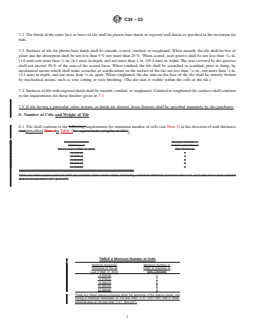
5.3 End-construction tile are tile designed to be placed in 7.4 Surfaces of tile with exposed finish shall be smooth,
the wall with axes of the cells vertical. Side-construction tile combed, or roughened. Combed or roughened tile surfaces
are tile designed to be placed in the wall with the axes of the shall conform to the requirements for these finishes given in
cells horizontal. Where end-construction tile are used on the 7.3.
side they shall conform to the requirements of side-
7.5 If tile having a particular color, texture, or finish are
construction tile and vice versa.
desired, these features shall be specified separately by the
purchaser.
5.4 Bonding tile shall be so designed as to provide recesses
for header brick courses when laid up in brick-faced walls.
8. Number of Cells and Weight of Tile
6. Dimensions and Permissible Variations
8.1 Tile shall conform to the requirements for minimum
number of cells (see Note 3) in the direction of wall thickness
6.1 No overall dimension shall vary more than 3 % over or
prescribed in Table 2.
under the specified dimension for any form or size of tile.
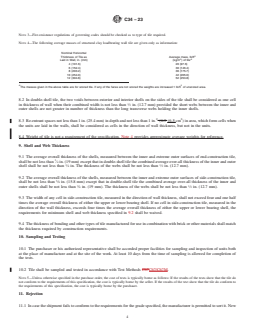
NOTE 3—Fire-resistance regulations of governing codes should be
NOTE 2—Purchasers and designers should ascertain the type and size of
checked as to type of tile required.
tile, modular or nonmodular, available in the locality under consideration
NOTE 4—The following average masses of structural clay loadbearing
and should specify accordingly, stating the size and type represented by
wall tile are given only as information:
the available tile.
Nominal Horizontal
Modular sizes are designated by the specified nominal dimensions
Thickness of Tile as Average mass, lb/ft
which are equal to the actual manufactured dimensions plus the thickness
2 A
Laid in Wall, in. (mm) (kg/m ) of tile
of one mortar joint, not to exceed ⁄2 in. (12.7 mm). For example, if the
4 (101.6) 20 (97.6)
modular, specified, or nominal dimensions of a unit are 4 by 8 by 12 in.
6 (152.4) 30 (146.4)
(101.6 by 203.2 by 304.8 mm) the actual manufactured dimensions may
8 (203.2) 36 (175.7)
1 1 1
be 3 ⁄2 by 7 ⁄2 by 11 ⁄2 in. (88.9 by 190.5 by 292.1 mm).
10 (254.0) 4
...
This document is not an ASTM standard and is intended only to provide the user of an ASTM standard an indication of what changes have been made to the previous version. Because
it may not be technically possible to adequately depict all changes accurately, ASTM recommends that users consult prior editions as appropriate. In all cases only the current version
of the standard as published by ASTM is to be considered the official document.
Designation: C34 − 17 C34 − 23
Standard Specification for
Structural Clay Loadbearing Wall Tile
This standard is issued under the fixed designation C34; the number immediately following the designation indicates the year of original
adoption or, in the case of revision, the year of last revision. A number in parentheses indicates the year of last reapproval. A superscript
epsilon (´) indicates an editorial change since the last revision or reapproval.
This standard has been approved for use by agencies of the U.S. Department of Defense.
1. Scope*
1.1 This specification covers structural clay loadbearing wall tile.
1.2 The property requirements of this specification apply at the time of purchase. The use of results from testing of tile extracted
from masonry structures for determining conformance or non-conformance to the property requirements (Section 5) of this
standard is beyond the scope of this specification.
1.3 Tile covered by this specification are manufactured from clay, shale, or similar naturally occurring earthy substances and
subjected to a heat treatment at elevated temperatures (firing). The heat treatment must develop sufficient fired bond between the
particulate constituents to provide the strength and durability requirements of this specification. (See firing and fired bond in
Terminology C1232.)
1.4 The text of this specification references notes and footnotes which provide explanatory material. These notes and footnotes
(excluding those in tables and figures) shall not be considered as requirements of the standard.
1.5 The values stated in inch-pound units are to be regarded as standard. The values given in parentheses are mathematical
conversions to SI units that are provided for information only and are not considered standard.
1.6 This international standard was developed in accordance with internationally recognized principles on standardization
established in the Decision on Principles for the Development of International Standards, Guides and Recommendations issued
by the World Trade Organization Technical Barriers to Trade (TBT) Committee.
2. Referenced Documents
2.1 ASTM Standards:
C67C67/C67M Test Methods for Sampling and Testing Brick and Structural Clay Tile
C216 Specification for Facing Brick (Solid Masonry Units Made from Clay or Shale)
C1232 Terminology for Masonry
3. Terminology
3.1 Definitions—For definitions relating to structural clay loadbearing wall tile, refer to Terminology C1232.
This specification is under the jurisdiction of ASTM Committee C15 on Manufactured Masonry Units and is the direct responsibility of Subcommittee C15.02 on Brick
and Structural Clay Tile.
Current edition approved June 1, 2017June 1, 2023. Published July 2017June 2023. Originally approved in 1921. Last previous edition approved in 20132017 as
C34 – 13.C34 – 17. DOI: 10.1520/C0034-17.10.1520/C0034-23.
For referenced ASTM standards, visit the ASTM website, www.astm.org, or contact ASTM Customer Service at service@astm.org. For Annual Book of ASTM Standards
volume information, refer to the standard’s Document Summary page on the ASTM website.
*A Summary of Changes section appears at the end of this standard
Copyright © ASTM International, 100 Barr Harbor Drive, PO Box C700, West Conshohocken, PA 19428-2959. United States
C34 − 23
4. Classification
4.1 Two grades of tile are covered, as follows:
4.1.1 Grade LBX—Suitable for general use in masonry construction and adapted for use in masonry exposed to weathering,
provided they meet the durability requirements for Grade SW of Specification C216.
4.1.2 Grade LB—Suitable for general use in masonry where not exposed to frost action, or for use in exposed masonry where
protected with a facing of 3 in. (76.2 mm) or more of stone, brick, terra cotta, or other masonry.
NOTE 1—Color of tile varies with the type of clay used and degree of firing; hence, it cannot be taken as indicative of classification until after it has been
related to absorption and strength by actual tests.
4.1.3 If tile having a particular color, texture, or finish are desired, these features shall be specified separately by the purchaser.
NOTE 1—Color of tile varies with the type of clay used and degree of firing; hence, it cannot be taken as indicative of classification until after it has been
related to absorption and strength by actual tests.
5. Physical Properties
5.1 Tile Tile, when test in accordance with Test Methods C67/C67M, shall conform to the physical properties for the grade
specified as prescribed in Table 1.
5.2 Tile of Grade LBX shall be accepted under all conditions instead of Grade LB.
5.3 End-construction tile are tile designed to be placed in the wall with axes of the cells vertical. Side-construction tile are tile
designed to be placed in the wall with the axes of the cells horizontal. Where end-construction tile are used on the side they shall
conform to the requirements of side-construction tile and vice versa.
5.4 Bonding tile shall be so designed as to provide recesses for header brick courses when laid up in brick-faced walls.
6. Dimensions and Permissible Variations
6.1 No overall dimension shall vary more than 3 % over or under the specified dimension for any form or size of tile.
NOTE 2—Purchasers and designers should ascertain the type and size of tile, modular or nonmodular, available in the locality under consideration and
should specify accordingly, stating the size and type represented by the available tile.
Modular sizes are designated by the specified nominal dimensions which are equal to the actual manufactured dimensions plus the thickness of one
mortar joint, not to exceed ⁄2 in. (12.7 mm). For example, if the modular, specified, or nominal dimensions of a unit are 4 by 8 by 12 in. (101.6 by 203.2
1 1 1
by 304.8 mm) the actual manufactured dimensions may be 3 ⁄2 by 7 ⁄2 by 11 ⁄2 in. (88.9 by 190.5 by 292.1 mm).
7. Finish and Appearance
7.1 All tile shall be reasonably free of laminations and of cracks, blisters, surface roughness, and other defects that interfere with
the proper setting of the tile or impair the strength or permanence of the construction.
TABLE 1 Physical Properties
B
Maximum Water Minimum Compressive Strength (Based on Gross Area), psi (MPa)
A
Absorption by 1-h Boiling, % End Construction Tile Side Construction Tile
Grade
Average of Average of Average of
Individual Individual Individual
Five Tests Five Tests Five Tests
LBX 16 19 1400 (9.6) 1000 (6.8) 700 (4.8) 500 (3.4)
LB 25 28 1000 (6.8) 700 (4.8) 700 (4.8) 500 (3.4)
A
The range in percentage absorption for tile delivered to any one job shall be not more than 12.
B
Gross area of a unit shall be determined by multiplying the horizontal face dimension of the unit as placed in the wall, by its thickness.
C34 − 23
7.2 The finish of the outer face or faces of tile shall be plaster-base finish or exposed wall finish as specified in the invitation for
bids.
7.3 Surfaces of tile for plaster-base finish shall be smooth, scored, combed, or roughened. When smooth, the tile shall be free of
glaze and the absorption shall be not less than 5 % nor more than 25 %. When scored, each groove shall be not less than ⁄16 in.
(1.6 mm) nor more than ⁄4 in. (6.4 mm) in depth, and not more than 1 in. (25.4 mm) in width. The area covered by the grooves
shall not exceed 50 % of the area of the scored faces. When combed, the tile shall be scratched or scarified, prior to fi
...