

ASTM C1261-22
(Specification)Standard Specification for Firebox Brick for Residential Fireplaces
General Information
- Abstract
ABSTRACT
This specification covers brick intended for use as the lining in the fireboxes of residential fireplaces. Firebox brick are manufactured from clay, fire clay, shale, or similar naturally occurring earthy substances and subjected to a heat treatment at elevated temperatures (firing). The heat treatment must develop a fired bond between the particulate constituents to provide the strength and durability requirements. Firebox brick shall be shaped during manufacture by molding, pressing, or extruding and cutting. Modulus of rupture test, pyrometric cone equivalent test, size test, and warpage test shall be performed to conform to the specified requirements.
SCOPE
1.1 This specification covers brick intended for use as the lining in the fireboxes of residential fireplaces.
1.2 The requirements of this specification apply at the time of purchase. The use of results from testing of brick extracted from masonry for determining conformance or nonconformance to the requirements of this specification is beyond the scope of this standard.
1.3 Firebox brick are manufactured from clay, fire clay, shale, or similar naturally occurring earthy substances and subjected to a heat treatment at elevated temperatures (firing). The heat treatment must develop a fired bond between the particulate constituents to provide the strength and durability requirements of this specification (see Terminology C1232).
Note 1: Firebox brick are typically installed using ground fire clay mortar or refractory mortar. Mortar joints are typically 1/8 in. (3.2 mm) thick, just thick enough to accommodate dimensional variations in the firebox brick.
1.4 The text of this specification references notes and footnotes that provide explanatory material. These notes and footnotes (excluding those in tables and figures) shall not be considered as requirements of this specification.
1.5 The values stated in inch-pound units are to be regarded as standard. The values given in parentheses are mathematical conversions to SI units that are provided for information only and are not considered standard.
1.6 This international standard was developed in accordance with internationally recognized principles on standardization established in the Decision on Principles for the Development of International Standards, Guides and Recommendations issued by the World Trade Organization Technical Barriers to Trade (TBT) Committee.
- Status
- Published
- Publication Date
- 30-Nov-2022
- Technical Committee
- C15 - Masonry – Manufactured Masonry Units, Mortars and Grouts
- Drafting Committee
- C15.02 - Brick and Structural Clay Tile
Buy Documents


ASTM C1261-22 - Standard Specification for Firebox Brick for Residential Fireplaces
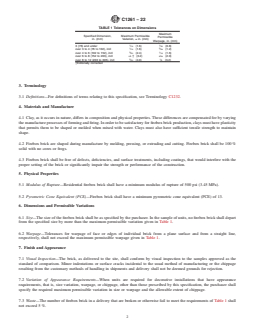


REDLINE ASTM C1261-22 - Standard Specification for Firebox Brick for Residential Fireplaces
Overview
ASTM C1261-22: Standard Specification for Firebox Brick for Residential Fireplaces sets the requirements for firebox bricks used as lining within the fireboxes of residential fireplaces. Developed by ASTM International, this standard defines essential quality and performance benchmarks for firebox bricks, ensuring safety, durability, and consistency in residential fireplace construction. The specification applies to bricks made from clay, fire clay, shale, or similar naturally occurring materials that have undergone heat treatment to achieve the necessary strength for withstanding high operating temperatures.
Key Topics
Manufacturing Materials and Methods
- Bricks must be produced from clay, fire clay, shale, or comparable earthy substances.
- The manufacturing process may involve molding, pressing, or extruding and cutting the bricks.
- Bricks are subjected to firing at elevated temperatures to develop a durable fired bond.
Physical Properties and Performance
- Firebox bricks must meet defined strength and durability standards at the time of purchase.
- Key testing methods required by the standard include:
- Modulus of rupture test to determine minimum strength.
- Pyrometric cone equivalent (PCE) test to assess heat resistance.
- Size and warpage tests to ensure dimensional accuracy.
Dimensions and Tolerances
- Specific tolerances are mandated for variations in size and warpage, ensuring uniformity in installation and performance.
- Bricks must be 100% solid, with no cores or frogs, ensuring maximum durability.
Finish and Inspection
- Bricks must be free from manufacturing defects and prohibited surface treatments.
- Visual inspection criteria are defined-allowing minor surface imperfections due to usual handling.
- For decorative installations, purchasers may specify stricter requirements for appearance.
Sampling and Testing Protocols
- Sampling must follow ASTM C67/C67M methods.
- The standard specifies who bears test costs depending on compliance results.
Applications
Residential Fireplace Construction
ASTM C1261-22 is essential in specifying firebox bricks for new fireplace installations and repair projects within homes. Compliance ensures the bricks can withstand thermal cycling and frequent exposure to direct flame, contributing to longer firebox life and enhanced safety.Quality Assurance for Suppliers and Builders
Builders, contractors, and suppliers benefit from standardized criteria when sourcing or manufacturing firebox bricks, improving project reliability and reducing the risk of failures due to improper materials.Regulatory and Inspection Compliance
Jurisdictions and inspection bodies may reference ASTM C1261-22 as a benchmark for approving residential fireplace installations, promoting uniform safety standards across the industry.
Related Standards
- ASTM C24: Test Method for Pyrometric Cone Equivalent (PCE) of Fireclay and High-Alumina Refractory Materials – Used to evaluate the heat resistance of firebox brick.
- ASTM C67/C67M: Test Methods for Sampling and Testing Brick and Structural Clay Tile – Details sampling and testing protocols for modulus of rupture, size, and warpage.
- ASTM C1232: Terminology for Masonry – Provides definitions for terms used in firebox brick specifications.
By adhering to ASTM C1261-22, manufacturers and builders ensure that firebox bricks for residential fireplaces meet stringent durability, strength, and dimensional requirements. This standard is crucial for both quality assurance and regulatory compliance in home construction and remodeling involving fireplaces.
Relations
- Effective Date
- 15-Dec-2023
- Refers
ASTM C67/C67M-19 - Standard Test Methods for Sampling and Testing Brick and Structural Clay Tile - Effective Date
- 01-Jul-2019
- Refers
ASTM C67/C67M-18 - Standard Test Methods for Sampling and Testing Brick and Structural Clay Tile - Effective Date
- 01-Feb-2018
- Effective Date
- 01-Jun-2017
- Effective Date
- 01-Sep-2015
- Effective Date
- 01-Jun-2015
- Effective Date
- 01-Sep-2013
- Effective Date
- 01-Jun-2012
- Effective Date
- 15-Dec-2010
- Effective Date
- 15-Jun-2010
- Effective Date
- 01-May-2010
- Effective Date
- 01-Jan-2010
- Effective Date
- 15-Dec-2009
- Effective Date
- 01-Jul-2009
- Effective Date
- 01-Mar-2009
Buy Documents
ASTM C1261-22 - Standard Specification for Firebox Brick for Residential Fireplaces
REDLINE ASTM C1261-22 - Standard Specification for Firebox Brick for Residential Fireplaces
Frequently Asked Questions
ASTM C1261-22 is a technical specification published by ASTM International. Its full title is "Standard Specification for Firebox Brick for Residential Fireplaces". This standard covers: ABSTRACT This specification covers brick intended for use as the lining in the fireboxes of residential fireplaces. Firebox brick are manufactured from clay, fire clay, shale, or similar naturally occurring earthy substances and subjected to a heat treatment at elevated temperatures (firing). The heat treatment must develop a fired bond between the particulate constituents to provide the strength and durability requirements. Firebox brick shall be shaped during manufacture by molding, pressing, or extruding and cutting. Modulus of rupture test, pyrometric cone equivalent test, size test, and warpage test shall be performed to conform to the specified requirements. SCOPE 1.1 This specification covers brick intended for use as the lining in the fireboxes of residential fireplaces. 1.2 The requirements of this specification apply at the time of purchase. The use of results from testing of brick extracted from masonry for determining conformance or nonconformance to the requirements of this specification is beyond the scope of this standard. 1.3 Firebox brick are manufactured from clay, fire clay, shale, or similar naturally occurring earthy substances and subjected to a heat treatment at elevated temperatures (firing). The heat treatment must develop a fired bond between the particulate constituents to provide the strength and durability requirements of this specification (see Terminology C1232). Note 1: Firebox brick are typically installed using ground fire clay mortar or refractory mortar. Mortar joints are typically 1/8 in. (3.2 mm) thick, just thick enough to accommodate dimensional variations in the firebox brick. 1.4 The text of this specification references notes and footnotes that provide explanatory material. These notes and footnotes (excluding those in tables and figures) shall not be considered as requirements of this specification. 1.5 The values stated in inch-pound units are to be regarded as standard. The values given in parentheses are mathematical conversions to SI units that are provided for information only and are not considered standard. 1.6 This international standard was developed in accordance with internationally recognized principles on standardization established in the Decision on Principles for the Development of International Standards, Guides and Recommendations issued by the World Trade Organization Technical Barriers to Trade (TBT) Committee.
ABSTRACT This specification covers brick intended for use as the lining in the fireboxes of residential fireplaces. Firebox brick are manufactured from clay, fire clay, shale, or similar naturally occurring earthy substances and subjected to a heat treatment at elevated temperatures (firing). The heat treatment must develop a fired bond between the particulate constituents to provide the strength and durability requirements. Firebox brick shall be shaped during manufacture by molding, pressing, or extruding and cutting. Modulus of rupture test, pyrometric cone equivalent test, size test, and warpage test shall be performed to conform to the specified requirements. SCOPE 1.1 This specification covers brick intended for use as the lining in the fireboxes of residential fireplaces. 1.2 The requirements of this specification apply at the time of purchase. The use of results from testing of brick extracted from masonry for determining conformance or nonconformance to the requirements of this specification is beyond the scope of this standard. 1.3 Firebox brick are manufactured from clay, fire clay, shale, or similar naturally occurring earthy substances and subjected to a heat treatment at elevated temperatures (firing). The heat treatment must develop a fired bond between the particulate constituents to provide the strength and durability requirements of this specification (see Terminology C1232). Note 1: Firebox brick are typically installed using ground fire clay mortar or refractory mortar. Mortar joints are typically 1/8 in. (3.2 mm) thick, just thick enough to accommodate dimensional variations in the firebox brick. 1.4 The text of this specification references notes and footnotes that provide explanatory material. These notes and footnotes (excluding those in tables and figures) shall not be considered as requirements of this specification. 1.5 The values stated in inch-pound units are to be regarded as standard. The values given in parentheses are mathematical conversions to SI units that are provided for information only and are not considered standard. 1.6 This international standard was developed in accordance with internationally recognized principles on standardization established in the Decision on Principles for the Development of International Standards, Guides and Recommendations issued by the World Trade Organization Technical Barriers to Trade (TBT) Committee.
ASTM C1261-22 is classified under the following ICS (International Classification for Standards) categories: 81.080 - Refractories. The ICS classification helps identify the subject area and facilitates finding related standards.
ASTM C1261-22 has the following relationships with other standards: It is inter standard links to ASTM C1232-23, ASTM C67/C67M-19, ASTM C67/C67M-18, ASTM C1232-17, ASTM C1232-15a, ASTM C1232-15, ASTM C24-09(2013), ASTM C1232-12, ASTM C1232-10c, ASTM C1232-10b, ASTM C1232-10a, ASTM C1232-10, ASTM C1232-09b, ASTM C1232-09a, ASTM C24-09. Understanding these relationships helps ensure you are using the most current and applicable version of the standard.
ASTM C1261-22 is available in PDF format for immediate download after purchase. The document can be added to your cart and obtained through the secure checkout process. Digital delivery ensures instant access to the complete standard document.
Standards Content (Sample)
This international standard was developed in accordance with internationally recognized principles on standardization established in the Decision on Principles for the
Development of International Standards, Guides and Recommendations issued by the World Trade Organization Technical Barriers to Trade (TBT) Committee.
Designation:C1261 −22
Standard Specification for
Firebox Brick for Residential Fireplaces
This standard is issued under the fixed designation C1261; the number immediately following the designation indicates the year of
original adoption or, in the case of revision, the year of last revision. A number in parentheses indicates the year of last reapproval. A
superscript epsilon (´) indicates an editorial change since the last revision or reapproval.
1. Scope* 2. Referenced Documents
1.1 This specification covers brick intended for use as the 2.1 ASTM Standards:
lining in the fireboxes of residential fireplaces. C24 Test Method for Pyrometric Cone Equivalent (PCE) of
Fireclay and High-Alumina Refractory Materials
1.2 The requirements of this specification apply at the time
C67/C67M Test Methods for Sampling and Testing Brick
of purchase. The use of results from testing of brick extracted
and Structural Clay Tile
from masonry for determining conformance or nonconfor-
C1232 Terminology for Masonry
mance to the requirements of this specification is beyond the
scope of this standard.
3. Terminology
1.3 Firebox brick are manufactured from clay, fire clay,
3.1 Definitions—For definitions of terms relating to this
shale, or similar naturally occurring earthy substances and
specification, see Terminology C1232.
subjected to a heat treatment at elevated temperatures (firing).
The heat treatment must develop a fired bond between the
4. Materials and Manufacture
particulate constituents to provide the strength and durability
requirements of this specification (see Terminology C1232). 4.1 Clay, as it occurs in nature, differs in composition and
physical properties. These differences are compensated for by
NOTE 1—Firebox brick are typically installed using ground fire clay
varying the manufacture processes of forming and firing. In
mortar or refractory mortar. Mortar joints are typically ⁄8 in. (3.2 mm)
order to be satisfactory for firebox brick production, clays must
thick, just thick enough to accommodate dimensional variations in the
firebox brick. have plasticity that permits them to be shaped or molded when
mixed with water. Clays must also have sufficient tensile
1.4 The text of this specification references notes and
strength to maintain shape.
footnotes that provide explanatory material. These notes and
footnotes (excluding those in tables and figures) shall not be
4.2 Firebox brick are shaped during manufacture by
considered as requirements of this specification.
molding,pressing,orextrudingandcutting.Fireboxbrickshall
be 100 % solid with no cores or frogs.
1.5 The values stated in inch-pound units are to be regarded
as standard. The values given in parentheses are mathematical
4.3 Firebox brick shall be free of defects, deficiencies, and
conversions to SI units that are provided for information only surface treatments, including coatings, that would interfere
and are not considered standard.
with the proper setting of the brick or significantly impair the
strength or performance of the construction.
1.6 This international standard was developed in accor-
dance with internationally recognized principles on standard-
5. Physical Properties
ization established in the Decision on Principles for the
Development of International Standards, Guides and Recom-
5.1 Modulus of Rupture—Residential firebox brick shall
mendations issued by the World Trade Organization Technical
have a minimum modulus of rupture of 500 psi (3.45 MPa).
Barriers to Trade (TBT) Committee.
5.2 PyrometricConeEquivalent(PCE)—Fireboxbrickshall
have a minimum pyrometric cone equivalent (PCE) of 13.
This specification is under the jurisdiction of ASTM Committee C15 on
Manufactured Masonry Units and is the direct responsibility of Subcommittee
C15.02 on Brick and Structural Clay Tile. For referenced ASTM standards, visit the ASTM website, www.astm.org, or
Current edition approved Dec. 1, 2022. Published December 2022. Originally contact ASTM Customer Service at service@astm.org. For Annual Book of ASTM
ɛ1
approved in 1994. Last previous edition approved in 2017 as C1261 – 17 . DOI: Standards volume information, refer to the standard’s Document Summary page on
10.1520/C1261-22. the ASTM website.
*A Summary of Changes section appears at the end of this standard
Copyright © AS
...
This document is not an ASTM standard and is intended only to provide the user of an ASTM standard an indication of what changes have been made to the previous version. Because
it may not be technically possible to adequately depict all changes accurately, ASTM recommends that users consult prior editions as appropriate. In all cases only the current version
of the standard as published by ASTM is to be considered the official document.
´1
Designation: C1261 − 13 (Reapproved 2017) C1261 − 22
Standard Specification for
Firebox Brick for Residential Fireplaces
This standard is issued under the fixed designation C1261; the number immediately following the designation indicates the year of
original adoption or, in the case of revision, the year of last revision. A number in parentheses indicates the year of last reapproval. A
superscript epsilon (´) indicates an editorial change since the last revision or reapproval.
ε NOTE—Reapproved with editorial change in Table 1 in December 2017.
1. Scope Scope*
1.1 This specification covers brick intended for use as the lining in the fireboxes of residential fireplaces.
1.2 The requirements of this specification apply at the time of purchase. The use of results from testing of brick extracted from
masonry for determining conformance or nonconformance to the requirements of this specification is beyond the scope of this
standard.
1.3 Firebox brick are manufactured from clay, fire clay, shale, or similar naturally occurring earthy substances and subjected to
a heat treatment at elevated temperatures (firing). The heat treatment must develop a fired bond between the particulate constituents
to provide the strength and durability requirements of this specification (see Terminology C1232).
NOTE 1—Firebox brick are typically installed using ground fire clay mortar or refractory mortar. Mortar joints are typically ⁄8 in. (3.2 mm) thick, just
thick enough to accommodate dimensional variations in the firebox brick.
1.4 The text of this specification references notes and footnotes that provide explanatory material. These notes and footnotes
(excluding those in tables and figures) shall not be considered as requirements of this specification.
1.5 The values stated in inch-pound units are to be regarded as standard. The values given in parentheses are mathematical
conversions to SI units that are provided for information only and are not considered standard.
1.6 This international standard was developed in accordance with internationally recognized principles on standardization
established in the Decision on Principles for the Development of International Standards, Guides and Recommendations issued
by the World Trade Organization Technical Barriers to Trade (TBT) Committee.
2. Referenced Documents
2.1 ASTM Standards:
C24 Test Method for Pyrometric Cone Equivalent (PCE) of Fireclay and High-Alumina Refractory Materials
C67C67/C67M Test Methods for Sampling and Testing Brick and Structural Clay Tile
C1232 Terminology for Masonry
This specification is under the jurisdiction of ASTM Committee C15 on Manufactured Masonry Units and is the direct responsibility of Subcommittee C15.02 on Brick
and Structural Clay Tile.
Current edition approved Dec. 1, 2017Dec. 1, 2022. Published January 2018December 2022. Originally approved in 1994. Last previous edition approved in 20132017
ɛ1
as C1261 – 13.C1261 – 17 . DOI: 10.1520/C1261-13R17E01.10.1520/C1261-22.
For referenced ASTM standards, visit the ASTM website, www.astm.org, or contact ASTM Customer Service at service@astm.org. For Annual Book of ASTM Standards
volume information, refer to the standard’s Document Summary page on the ASTM website.
*A Summary of Changes section appears at the end of this standard
Copyright © ASTM International, 100 Barr Harbor Drive, PO Box C700, West Conshohocken, PA 19428-2959. United States
C1261 − 22
TABLE 1 Tolerances on Dimensions
Maximum
Specified Dimension, Maximum Permissible
Permissible
in. (mm) Variation, ± in. (mm)
Warpage, in. (mm)
1 1
3 (76) and under ⁄16 (1.6) ⁄32 (0.8)
1 3
over 3 to 4 (76 to 102), incl ⁄16 (1.6) ⁄64 (1.2)
3 1
over 4 to 6 (102 to 152), incl ⁄32 (2.4) ⁄16 (1.6)
1 5
over 6 to 8 (152 to 203), incl ⁄8 † (3.2) ⁄64 (2.0)
5 1
over 8 to 12 (203 to 305), incl ⁄32 (4.0) ⁄8 (3.2)
†Editorially corrected
3. Terminology
3.1 Definitions—For definitions of terms relating to this specification, see Terminology C1232.
4. Materials and Manufacture
4.1 Clay, as it occurs in nature, differs in composition and physical properties. These differences are compensated for by varying
the manufacture processes of forming and firing. In order to be satisfactory for firebox brick production, clays must have plasticity
that permits them to be shaped or molded when mixed with water
...