

ASTM E2684-17
(Test Method)Standard Test Method for Measuring Heat Flux Using Surface-Mounted One-Dimensional Flat Gages
General Information
- Abstract
SIGNIFICANCE AND USE
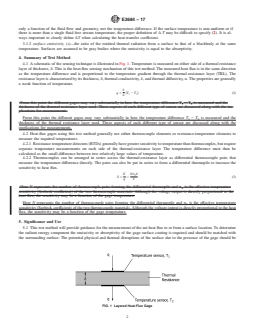
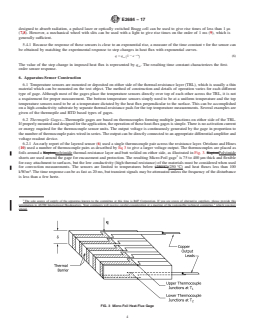
5.1 This test method will provide guidance for the measurement of the net heat flux to or from a surface location. To determine the radiant energy component the emissivity or absorptivity of the gage surface coating is required and should be matched with the surrounding surface. The potential physical and thermal disruptions of the surface due to the presence of the gage should be minimized and characterized. For the case of convection and low source temperature radiation to or from the surface it is important to consider how the presence of the gage alters the surface heat flux. The desired quantity is usually the heat flux at the surface location without the presence of the gage.
5.1.1 Temperature limitations are determined by the gage material properties and the method of application to the surface. The range of heat flux that can be measured and the time response are limited by the gage design and construction details. Measurements from 10 W/m2 to above 100 kW/m2 are easily obtained with current sensors. Time constants as low as 10 ms are possible, while thicker sensors may have response times greater than 1 s. It is important to choose the sensor style and characteristics to match the range and time response of the required application.
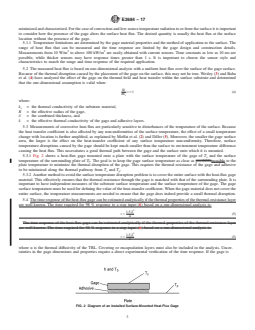
5.2 The measured heat flux is based on one-dimensional analysis with a uniform heat flux over the surface of the gage surface. Because of the thermal disruption caused by the placement of the gage on the surface, this may not be true. Wesley (3) and Baba et al. (4) have analyzed the effect of the gage on the thermal field and heat transfer within the surface substrate and determined that the one-dimensional assumption is valid when:
where:
ks = the thermal conductivity of the substrate material, R = the effective radius of the gage, δ = the combined thickness, and k = the effective thermal conductivity of the gage and adhesive layers.
5.3 Measurements of convective heat flux are part...
SCOPE
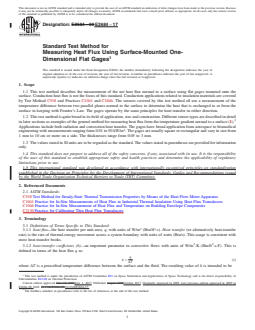
1.1 This test method describes the measurement of the net heat flux normal to a surface using flat gages mounted onto the surface. Conduction heat flux is not the focus of this standard. Conduction applications related to insulation materials are covered by Test Method C518 and Practices C1041 and C1046. The sensors covered by this test method all use a measurement of the temperature difference between two parallel planes normal to the surface to determine the heat that is exchanged to or from the surface in keeping with Fourier’s Law. The gages operate by the same principles for heat transfer in either direction.
1.2 This test method is quite broad in its field of application, size and construction. Different sensor types are described in detail in later sections as examples of the general method for measuring heat flux from the temperature gradient normal to a surface (1).2 Applications include both radiation and convection heat transfer. The gages have broad application from aerospace to biomedical engineering with measurements ranging form 0.01 to 50 kW/m 2. The gages are usually square or rectangular and vary in size from 1 mm to 10 cm or more on a side. The thicknesses range from 0.05 to 3 mm.
1.3 The values stated in SI units are to be regarded as the standard. The values stated in parentheses are provided for information only.
1.4 This standard does not purport to address all of the safety concerns, if any, associated with its use. It is the responsibility of the user of this standard to establish appropriate safety and health practices and determine the applicability of regulatory limitations prior to use.
1.5 This international standard was developed in accordance with internationally recognized principles on standardization established in the Decision on Principles for the Development of International Standards, Guides and Recommendations issued by the World Trade Organization Technical Barriers to...
- Status
- Published
- Publication Date
- 31-Aug-2017
- Technical Committee
- E21 - Space Simulation and Applications of Space Technology
- Drafting Committee
- E21.08 - Thermal Protection
Buy Documents
ASTM E2684-17 - Standard Test Method for Measuring Heat Flux Using Surface-Mounted One-Dimensional Flat Gages
REDLINE ASTM E2684-17 - Standard Test Method for Measuring Heat Flux Using Surface-Mounted One-Dimensional Flat Gages
Overview
ASTM E2684-17 is a standard test method developed by ASTM International for measuring net heat flux normal to a surface using surface-mounted one-dimensional flat gages. This method is widely utilized across industries such as aerospace, building science, and biomedical engineering for accurate assessment of heat flux due to radiation and convection. The standard enables precise quantification of surface heat transfer, supporting energy management, research, and design validation.
This methodology employs flat gages that are affixed to the surface under test, and are based on measuring the temperature difference across a defined thermal resistance layer. Understanding and minimizing the impact of gage placement on the heat transfer characteristics of the substrate is a critical aspect of this standard.
Key Topics
- Scope and Applicability: The standard focuses on non-conductive heat flux measurements and is applicable to both radiative and convective heat transfer scenarios. It explicitly excludes conduction-dominated measurements, which are covered by other ASTM methods.
- Gage Types and Sensor Construction: Includes thermopile-based and resistance temperature detector (RTD)-based sensors. These can be constructed in various sizes (from 1 mm to over 10 cm) and thicknesses (0.05 mm to 3 mm) depending on the required application sensitivity and thermal response.
- Measurement Principles: Relies on Fourier’s Law, with the gages detecting heat flux via the temperature gradient normal to the surface. The design supports both directions of heat transfer (to or from the surface).
- Calibration Requirements: Emphasizes the importance of precise calibration, taking into account the gage’s emissivity, absorptivity, and the specific characteristics of the sensor materials. Calibration may involve secondary standards and must account for expected temperature ranges.
- Minimization of Disruption: The method requires careful mounting of sensors to minimize physical and thermal disturbances to the substrate, ensuring reliable and representative heat flux measurements.
- Uncertainty Analysis: The standard mandates a comprehensive uncertainty analysis, in line with NIST recommendations, to ensure confidence in reported results.
Applications
ASTM E2684-17 finds use in a broad array of heat flux measurement scenarios, specifically where quantifying heat transfer by convection or radiation is essential:
- Aerospace: Thermal protection studies, component testing, and surface temperature monitoring under extreme conditions.
- Building and Construction: Evaluating building envelope performance by quantifying heat losses or gains through walls and roofs.
- Industrial Equipment: Monitoring heat transfer on equipment surfaces for performance optimization and predictive maintenance.
- Biomedical Engineering: Research involving thermal management of medical devices and tissue heat transfer.
- Research and Development: Experimental validation of thermal models and heat transfer phenomena in controlled laboratory settings.
These applications take advantage of the gage's flexibility, sensitivity, and rapid time response, allowing measurements from 0.01 kW/m² to above 100 kW/m² with time constants as fast as 10 milliseconds.
Related Standards
ASTM E2684-17 references and complements several other standards for heat flux measurement and calibration, including:
- ASTM C518: Test Method for Steady-State Thermal Transmission Properties by Means of the Heat Flow Meter Apparatus (for conduction-focused applications)
- ASTM C1041: Practice for In-Situ Measurements of Heat Flux in Industrial Thermal Insulation Using Heat Flux Transducers
- ASTM C1046: Practice for In-Situ Measurement of Heat Flux and Temperature on Building Envelope Components
- ASTM C1130: Practice for Calibrating Thin Heat Flux Transducers
Integration with these standards ensures comprehensive coverage of thermal measurement scenarios, supporting best practices in heat flux quantification.
Keywords: ASTM E2684-17, heat flux measurement, surface-mounted gages, thermal testing, radiative heat transfer, convective heat flux, sensor calibration, building envelope, aerospace thermal protection, thermal conductivity, one-dimensional flat gage, uncertainty analysis.
Relations
- Effective Date
- 01-Sep-2017
- Effective Date
- 15-Mar-2024
- Effective Date
- 01-Sep-2015
- Effective Date
- 01-Sep-2012
- Effective Date
- 01-Jun-2010
- Effective Date
- 01-May-2010
- Effective Date
- 01-Sep-2007
- Effective Date
- 01-May-2007
- Effective Date
- 01-May-2007
- Effective Date
- 01-May-2004
- Effective Date
- 10-Sep-2002
- Effective Date
- 01-Jan-2001
- Effective Date
- 01-Jan-2001
- Effective Date
- 01-Jan-2001
- Effective Date
- 01-Jan-2001
Buy Documents
ASTM E2684-17 - Standard Test Method for Measuring Heat Flux Using Surface-Mounted One-Dimensional Flat Gages
REDLINE ASTM E2684-17 - Standard Test Method for Measuring Heat Flux Using Surface-Mounted One-Dimensional Flat Gages
Get Certified
Connect with accredited certification bodies for this standard

BSMI (Bureau of Standards, Metrology and Inspection)
Taiwan's standards and inspection authority.
Sponsored listings
Frequently Asked Questions
ASTM E2684-17 is a standard published by ASTM International. Its full title is "Standard Test Method for Measuring Heat Flux Using Surface-Mounted One-Dimensional Flat Gages". This standard covers: SIGNIFICANCE AND USE 5.1 This test method will provide guidance for the measurement of the net heat flux to or from a surface location. To determine the radiant energy component the emissivity or absorptivity of the gage surface coating is required and should be matched with the surrounding surface. The potential physical and thermal disruptions of the surface due to the presence of the gage should be minimized and characterized. For the case of convection and low source temperature radiation to or from the surface it is important to consider how the presence of the gage alters the surface heat flux. The desired quantity is usually the heat flux at the surface location without the presence of the gage. 5.1.1 Temperature limitations are determined by the gage material properties and the method of application to the surface. The range of heat flux that can be measured and the time response are limited by the gage design and construction details. Measurements from 10 W/m2 to above 100 kW/m2 are easily obtained with current sensors. Time constants as low as 10 ms are possible, while thicker sensors may have response times greater than 1 s. It is important to choose the sensor style and characteristics to match the range and time response of the required application. 5.2 The measured heat flux is based on one-dimensional analysis with a uniform heat flux over the surface of the gage surface. Because of the thermal disruption caused by the placement of the gage on the surface, this may not be true. Wesley (3) and Baba et al. (4) have analyzed the effect of the gage on the thermal field and heat transfer within the surface substrate and determined that the one-dimensional assumption is valid when: where: ks = the thermal conductivity of the substrate material, R = the effective radius of the gage, δ = the combined thickness, and k = the effective thermal conductivity of the gage and adhesive layers. 5.3 Measurements of convective heat flux are part... SCOPE 1.1 This test method describes the measurement of the net heat flux normal to a surface using flat gages mounted onto the surface. Conduction heat flux is not the focus of this standard. Conduction applications related to insulation materials are covered by Test Method C518 and Practices C1041 and C1046. The sensors covered by this test method all use a measurement of the temperature difference between two parallel planes normal to the surface to determine the heat that is exchanged to or from the surface in keeping with Fourier’s Law. The gages operate by the same principles for heat transfer in either direction. 1.2 This test method is quite broad in its field of application, size and construction. Different sensor types are described in detail in later sections as examples of the general method for measuring heat flux from the temperature gradient normal to a surface (1).2 Applications include both radiation and convection heat transfer. The gages have broad application from aerospace to biomedical engineering with measurements ranging form 0.01 to 50 kW/m 2. The gages are usually square or rectangular and vary in size from 1 mm to 10 cm or more on a side. The thicknesses range from 0.05 to 3 mm. 1.3 The values stated in SI units are to be regarded as the standard. The values stated in parentheses are provided for information only. 1.4 This standard does not purport to address all of the safety concerns, if any, associated with its use. It is the responsibility of the user of this standard to establish appropriate safety and health practices and determine the applicability of regulatory limitations prior to use. 1.5 This international standard was developed in accordance with internationally recognized principles on standardization established in the Decision on Principles for the Development of International Standards, Guides and Recommendations issued by the World Trade Organization Technical Barriers to...
SIGNIFICANCE AND USE 5.1 This test method will provide guidance for the measurement of the net heat flux to or from a surface location. To determine the radiant energy component the emissivity or absorptivity of the gage surface coating is required and should be matched with the surrounding surface. The potential physical and thermal disruptions of the surface due to the presence of the gage should be minimized and characterized. For the case of convection and low source temperature radiation to or from the surface it is important to consider how the presence of the gage alters the surface heat flux. The desired quantity is usually the heat flux at the surface location without the presence of the gage. 5.1.1 Temperature limitations are determined by the gage material properties and the method of application to the surface. The range of heat flux that can be measured and the time response are limited by the gage design and construction details. Measurements from 10 W/m2 to above 100 kW/m2 are easily obtained with current sensors. Time constants as low as 10 ms are possible, while thicker sensors may have response times greater than 1 s. It is important to choose the sensor style and characteristics to match the range and time response of the required application. 5.2 The measured heat flux is based on one-dimensional analysis with a uniform heat flux over the surface of the gage surface. Because of the thermal disruption caused by the placement of the gage on the surface, this may not be true. Wesley (3) and Baba et al. (4) have analyzed the effect of the gage on the thermal field and heat transfer within the surface substrate and determined that the one-dimensional assumption is valid when: where: ks = the thermal conductivity of the substrate material, R = the effective radius of the gage, δ = the combined thickness, and k = the effective thermal conductivity of the gage and adhesive layers. 5.3 Measurements of convective heat flux are part... SCOPE 1.1 This test method describes the measurement of the net heat flux normal to a surface using flat gages mounted onto the surface. Conduction heat flux is not the focus of this standard. Conduction applications related to insulation materials are covered by Test Method C518 and Practices C1041 and C1046. The sensors covered by this test method all use a measurement of the temperature difference between two parallel planes normal to the surface to determine the heat that is exchanged to or from the surface in keeping with Fourier’s Law. The gages operate by the same principles for heat transfer in either direction. 1.2 This test method is quite broad in its field of application, size and construction. Different sensor types are described in detail in later sections as examples of the general method for measuring heat flux from the temperature gradient normal to a surface (1).2 Applications include both radiation and convection heat transfer. The gages have broad application from aerospace to biomedical engineering with measurements ranging form 0.01 to 50 kW/m 2. The gages are usually square or rectangular and vary in size from 1 mm to 10 cm or more on a side. The thicknesses range from 0.05 to 3 mm. 1.3 The values stated in SI units are to be regarded as the standard. The values stated in parentheses are provided for information only. 1.4 This standard does not purport to address all of the safety concerns, if any, associated with its use. It is the responsibility of the user of this standard to establish appropriate safety and health practices and determine the applicability of regulatory limitations prior to use. 1.5 This international standard was developed in accordance with internationally recognized principles on standardization established in the Decision on Principles for the Development of International Standards, Guides and Recommendations issued by the World Trade Organization Technical Barriers to...
ASTM E2684-17 is classified under the following ICS (International Classification for Standards) categories: 17.200.10 - Heat. Calorimetry. The ICS classification helps identify the subject area and facilitates finding related standards.
ASTM E2684-17 has the following relationships with other standards: It is inter standard links to ASTM E2684-09, ASTM C1130-24, ASTM C518-15, ASTM C1130-07(2012), ASTM C1041-10, ASTM C518-10, ASTM C1130-07, ASTM C1041-85(2007), ASTM C1046-95(2007), ASTM C518-04, ASTM C518-02e1, ASTM C1046-95, ASTM C1046-95(2001), ASTM C1130-90(1995)e1, ASTM C1130-90(2001). Understanding these relationships helps ensure you are using the most current and applicable version of the standard.
ASTM E2684-17 is available in PDF format for immediate download after purchase. The document can be added to your cart and obtained through the secure checkout process. Digital delivery ensures instant access to the complete standard document.
Standards Content (Sample)
This international standard was developed in accordance with internationally recognized principles on standardization established in the Decision on Principles for the
Development of International Standards, Guides and Recommendations issued by the World Trade Organization Technical Barriers to Trade (TBT) Committee.
Designation: E2684 − 17
Standard Test Method for
Measuring Heat Flux Using Surface-Mounted One-
Dimensional Flat Gages
This standard is issued under the fixed designation E2684; the number immediately following the designation indicates the year of
original adoption or, in the case of revision, the year of last revision.Anumber in parentheses indicates the year of last reapproval.A
superscript epsilon (´) indicates an editorial change since the last revision or reapproval.
1. Scope Development of International Standards, Guides and Recom-
mendations issued by the World Trade Organization Technical
1.1 This test method describes the measurement of the net
Barriers to Trade (TBT) Committee.
heatfluxnormaltoasurfaceusingflatgagesmountedontothe
surface. Conduction heat flux is not the focus of this standard.
2. Referenced Documents
Conduction applications related to insulation materials are
2.1 ASTM Standards:
coveredbyTestMethodC518andPracticesC1041andC1046.
C518Test Method for Steady-State Thermal Transmission
The sensors covered by this test method all use a measurement
Properties by Means of the Heat Flow Meter Apparatus
of the temperature difference between two parallel planes
C1041Practice for In-Situ Measurements of Heat Flux in
normaltothesurfacetodeterminetheheatthatisexchangedto
Industrial Thermal Insulation Using Heat Flux Transduc-
or from the surface in keeping with Fourier’s Law. The gages
ers
operate by the same principles for heat transfer in either
C1046Practice for In-Situ Measurement of Heat Flux and
direction.
Temperature on Building Envelope Components
1.2 Thistestmethodisquitebroadinitsfieldofapplication,
C1130Practice for Calibrating Thin Heat Flux Transducers
size and construction. Different sensor types are described in
3. Terminology
detail in later sections as examples of the general method for
measuring heat flux from the temperature gradient normal to a
3.1 Definitions of Terms Specific to This Standard:
surface (1). Applications include both radiation and convec-
3.1.1 heat flux—the heat transfer per unit area, q, with units
2 2
tion heat transfer. The gages have broad application from
of W/m (Btu/ft -s). Heat transfer (or alternatively heat-
aerospace to biomedical engineering with measurements rang-
transfer rate) is the rate of thermal-energy movement across a
ing form 0.01 to 50 kW/m . The gages are usually square or
system boundary with units of watts (Btu/s). This usage is
rectangular and vary in size from 1 mm to 10 cm or more on
consistent with most heat-transfer books.
a side. The thicknesses range from 0.05 to 3 mm.
3.1.2 heat-transfer coeffıcient, (h)—an important parameter
2 2
1.3 The values stated in SI units are to be regarded as the
inconvectiveflowswithunitsofW/m -K(Btu/ft -s-F).Thisis
standard. The values stated in parentheses are provided for
defined in terms of the heat flux q as:
information only.
q
h 5 (1)
1.4 This standard does not purport to address all of the
∆T
safety concerns, if any, associated with its use. It is the
where ∆T is a prescribed temperature difference between the
responsibility of the user of this standard to establish appro- surface and the fluid. The resulting value of h is intended to
be only a function of the fluid flow and geometry, not the
priate safety and health practices and determine the applica-
temperature difference. If the surface temperature is non-
bility of regulatory limitations prior to use.
uniform or if there is more than a single fluid free stream
1.5 This international standard was developed in accor-
temperature, the proper definition of ∆ T may be difficult to
dance with internationally recognized principles on standard-
specify (2). It is always important to clearly define ∆T when
ization established in the Decision on Principles for the
calculating the heat-transfer coefficient.
3.1.3 surfaceemissivity,(ε)—theratiooftheemittedthermal
radiation from a surface to that of a blackbody at the same
This test method is under the jurisdiction of ASTM Committee E21 on Space
temperature.Surfacesareassumedtobegraybodieswherethe
Simulation andApplications of SpaceTechnology and is the direct responsibility of
Subcommittee E21.08 on Thermal Protection. emissivity is equal to the absorptivity.
Current edition approved Sept. 1, 2017. Published October 2017. Originally
approved in 2009. Last previous edition approved in 2009 as E2684–09. DOI: 4. Summary of Test Method
10.1520/E2684-17.
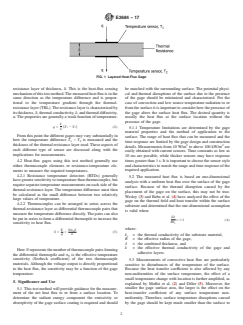
4.1 A schematic of the sensing technique is illustrated in
Theboldfacenumbersinparenthesesrefertothelistofreferencesattheendof
this test method. Fig. 1. Temperature is measured on either side of a thermal
Copyright © ASTM International, 100 Barr Harbor Drive, PO Box C700, West Conshohocken, PA 19428-2959. United States
E2684 − 17
FIG. 1 Layered Heat-Flux Gage
resistance layer of thickness, δ. This is the heat-flux sensing be matched with the surrounding surface. The potential physi-
mechanismofthistestmethod.Themeasuredheatfluxisinthe cal and thermal disruptions of the surface due to the presence
same direction as the temperature difference and is propor- of the gage should be minimized and characterized. For the
tional to the temperature gradient through the thermal- case of convection and low source temperature radiation to or
resistancelayer(TRL).Theresistancelayerischaracterizedby fromthesurfaceitisimportanttoconsiderhowthepresenceof
itsthickness, δ,thermalconductivity, k,andthermaldiffusivity, the gage alters the surface heat flux. The desired quantity is
α.Thepropertiesaregenerallyaweakfunctionoftemperature. usually the heat flux at the surface location without the
presence of the gage.
k
q 5 T 2 T (2)
~ !
1 2 5.1.1 Temperature limitations are determined by the gage
δ
material properties and the method of application to the
From this point the different gages may vary substantially in
surface. The range of heat flux that can be measured and the
how the temperature difference T − T is measured and the
1 2
time response are limited by the gage design and construction
2 2
thicknessofthethermalresistancelayerused.Theseaspectsof
details. Measurements from 10W/m to above 100 kW/m are
each different type of sensor are discussed along with the
easily obtained with current sensors. Time constants as low as
implications for measurements.
10 ms are possible, while thicker sensors may have response
timesgreaterthan1s.Itisimportanttochoosethesensorstyle
4.2 Heat-flux gages using this test method generally use
either thermocouple elements or resistance-temperature ele- and characteristics to match the range and time response of the
required application.
ments to measure the required temperatures.
4.2.1 Resistance temperature detectors (RTDs) generally
5.2 The measured heat flux is based on one-dimensional
havegreatersensitivitytotemperaturethanthermocouples,but
analysis with a uniform heat flux over the surface of the gage
require separate temperature measurements on each side of the
surface. Because of the thermal disruption caused by the
thermal-resistance layer. The temperature difference must then
placement of the gage on the surface, this may not be true.
be calculated as the small difference between two relatively
Wesley (3) and Baba et al. (4) have analyzed the effect of the
large values of temperature.
gage on the thermal field and heat transfer within the surface
4.2.2 Thermocouples can be arranged in series across the
substrate and determined that the one-dimensional assumption
thermal-resistance layer as differential thermocouple pairs that
is valid when:
measure the temperature difference directly.The pairs can also
δk
beputinseriestoformadifferentialthermopiletoincreasethe
..1 (4)
Rk
s
sensitivity to heat flux.
where:
E Nσ δ
T
S 5 5 (3)
q k k = the thermal conductivity of the substrate material,
s
R = the effective radius of the gage,
δ = the combined thickness, and
k = the effective thermal conductivity of the gage and
Here Nrepresentsthenumberofthermocouplepairsforming
adhesive layers.
the differential thermopile and σ is the effective temperature
T
sensitivity (Seebeck coefficient) of the two thermocouple
5.3 Measurements of convective heat flux are particularly
materials.Although the voltage output is directly proportional
sensitive to disturbances of the temperature of the surface.
to the heat flux, the sensitivity may be a function of the gage
Because the heat transfer coefficient is also affected by any
temperature.
non-uniformities of the surface temperature, the effect of a
small temperature change with location is further amplified, as
5. Significance and Use
explained by Moffat et al. (2) and Diller (5). Moreover, the
5.1 This test method will provide guidance for the measure- smaller the gage surface area, the larger is the effect on the
ment of the net heat flux to or from a surface location. To heat-transfer coefficient of any surface temperature non-
determine the radiant energy component the emissivity or uniformity. Therefore, surface temperature disruptions caused
absorptivity of the gage surface coating is required and should by the gage should be kept much smaller than the surface to
E2684 − 17
environment temperature difference causing the heat flux.This thin material which can be mounted on the test object. The
necessitates a good thermal path between the gage and the method of construction and details of operation varies for each
surface onto which it is mounted. different type of gage. Although most of the gages place the
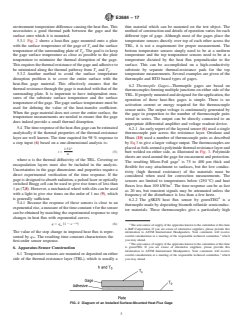
5.3.1 Fig. 2 shows a heat-flux gage mounted onto a plate temperature sensors directly over top of each other across the
with the surface temperature of the gage of T and the surface TRL, it is not a requirement for proper measurement. The
s
temperature of the surrounding plate of T .The goal is to keep bottom temperature sensors simply need to be at a uniform
p
the gage surface temperature as close as possible to the plate temperature and the top temperature sensors need to be at a
temperature to minimize the thermal disruption of the gage. temperature dictated by the heat flux perpendicular to the
Thisrequiresthethermalresistanceofthegageandadhesiveto surface. This can be accomplished on a high-conductivity
be minimized along the thermal pathway from T and T . substrate by separate thermal-resistance pads for the top
s p
5.3.2 Another method to avoid the surface temperature temperature measurements. Several examples are given of the
disruption problem is to cover the entire surface with the thermopile and RTD based types of gages.
heat-flux gage material. This effectively ensures that the
6.2 Thermopile Gages—Thermopile gages are based on
thermal resistance through the gage is matched with that of the
thermocouples forming multiple junctions on either side of the
surrounding plate. It is important to have independent mea-
TRL.Ifproperlymountedanddesignedfortheapplication,the
sures of the substrate surface temperature and the surface
operation of these heat-flux gages is simple. There is no
temperatureofthegage.Thegagesurfacetemperaturemustbe
activation current or energy required for the thermocouple
used for defining the value of the heat-transfer coefficient.
sensor units. The output voltage is continuously generated by
When the gage material does not cover the entire surface, the
the gage in proportion to the number of thermocouple pairs
temperature measurements are needed to ensure that the gage
wired in series. The output can be directly connected to an
does indeed provide a small thermal disruption.
appropriate differential amplifier and voltage readout device.
5.4 Thetimeresponseoftheheat-fluxgagecanbeestimated 6.2.1 An early report of the layered sensor (6) used a single
analytically if the thermal properties of the thermal-resistance
thermocouple pair across the resistance layer. Ortolano and
layer are well known. The time required for 98 % response to Hines (10) used a number of thermocouple pairs as described
a step input (6) based on a one-dimensional analysis is:
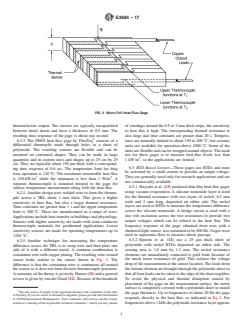
by Eq 3 to give a larger voltage output.The thermocouples are
2 placedasfoilsaroundapolyimidethermal-resistancelayerand
1.5 δ
t 5 (5)
butt welded on either side, as illustrated in Fig. 3. Polyimide
α
sheetsareusedaroundthegageforencasementandprotection.
where α is the thermal diffusivity of the TRL. Covering or
The resulting Micro-Foil gage is 75 to 400 µm thick and
encapsulation layers must also be included in the analysis.
flexible for easy attachment to surfaces, but the low conduc-
Uncertainties in the gage dimensions and properties require a
tivity (high thermal resistance) of the materials must be
direct experimental verification of the time response. If the
considered when used for convection measurements. The
gageisdesignedtoabsorbradiation,apulsedlaseroroptically
sensors are limited to temperatures below (250°C) and heat
switched Bragg cell can be used to give rise times of less than 2
fluxes less than 100 kW/m . The time response can be as fast
1µs(7,8).However,amechanicalwheelwithslitscanbeused
as 20 ms, but transient signals may be attenuated unless the
with a light to give rise times on the order of 1 ms (9), which
frequency of the disturbance is less than a few hertz.
is generally sufficient.
6.2.2 The gSKIN heat flux sensor by greenTEG is a
5.4.1 Because the response of these sensors is close to an
thermopile made by depositing bismuth telluride semiconduc-
exponentialrise,ameasureofthetimeconstant τforthesensor
tor materials. These thermocouples give a particularly high
can be obtained by matching the experimental response to step
changes in heat flux with exponential curves.
2t/τ
q 5 q ~1 2 e ! (6)
ss The sole source of supply of the apparatus known to the committee at this time
is RdF Corporation. If you are aware of alternative suppliers, please provide this
The value of the step change in imposed heat flux is repre- information to ASTM International Headquarters. Your comments will receive
careful consideration at a meeting of the responsible technical committee, which
sented by q . The resulting time constant characterizes the
ss
you may attend.
first-order sensor response.
The sole source of supply of the apparatus known to the committee at this time
is greenTEG. If you are aware of alternative suppliers, please provide this
6. Apparatus-Sensor Construction
information to ASTM International Headquarters. Your comments will receive
6.1 Temperature sensors are mounted or deposited on either 1
careful consideration at a meeting of the responsible technical committee, which
side of the thermal-resistance layer (TRL), which is usually a you may attend.
FIG. 2 Diagram of an Installed Surface-Mounted Heat-Flux Gage
E2684 − 17
FIG. 3 Micro-Foil Heat-Flux Gage
thermoelectric output. The sensors are typically encapsulated of windings around the 0.5 to 3 mm thick strips, the sensitivity
between metal sheets and have a thickness of 0.5 mm. The to heat flux is high. The corresponding thermal resistance is
resulting time response of the gage is about one second. also large and time constants are greater than 20 s. Tempera-
6.2.3 The PHFS heat flux gage by FluxTeq consists of a
tures are normally limited to about 150 to 200°C, but ceramic
differential thermopile made through holes in a sheet of units are available for operation above 1000°C. Some of the
polyimide. The resulting sensors are flexible and can be
unitsareflexibleandcanbewrappedaroundobjects.Themain
mounted on contoured shapes. They can be made in large
use for these gages is to measure heat-flux levels less than
quantities and in custom sizes and shapes up to 25 cm by 25
1kW⁄m , so the applications are limited.
cm. They are typically about 150 µm thick with a correspond-
6.3 RTD-Based Sensors—These gages use RTDs and must
ing time response of 0.6 sec. The temperature limit for long
be activated by a small current to provide an output voltage.
term operation is 120ºC. The maximum measurable heat flux
2 2 They are generally used only for research applications and are
is 150kW⁄m while the minimum is less than 1 W/m.A
not commercially available.
separate thermocouple is mounted integral to the gage for
6.3.1 Hayashi et al. (13) produced thin film heat-flux gages
surface temperature measurement along with the heat flux.
using vacuum evaporation. A silicone monoxide layer is used
6.2.4 Another design uses welded wire to form the thermo-
for the thermal resistance with two layers of nickel, 0.2 mm
pile across a TRL about 1 mm thick. This gives a higher
wide and 3 mm long, deposited on either side. The nickel
sensitivity to heat flux, but also a larger thermal resistance.
layers are used as RTDs to measure the temperature difference
Time constants are greater than 1 s and the upper temperature
across the silicone monoxide. A bridge circuit is used with a
limit is 300°C. These are manufactured in a range of sizes.
one volt excitation across the two resistances to provide two
Applicati
...
This document is not an ASTM standard and is intended only to provide the user of an ASTM standard an indication of what changes have been made to the previous version. Because
it may not be technically possible to adequately depict all changes accurately, ASTM recommends that users consult prior editions as appropriate. In all cases only the current version
of the standard as published by ASTM is to be considered the official document.
Designation: E2684 − 09 E2684 − 17
Standard Test Method for
Measuring Heat Flux Using Surface-Mounted One-
Dimensional Flat Gages
This standard is issued under the fixed designation E2684; the number immediately following the designation indicates the year of
original adoption or, in the case of revision, the year of last revision. A number in parentheses indicates the year of last reapproval. A
superscript epsilon (´) indicates an editorial change since the last revision or reapproval.
1. Scope
1.1 This test method describes the measurement of the net heat flux normal to a surface using flat gages mounted onto the
surface. Conduction heat flux is not the focus of this standard. Conduction applications related to insulation materials are covered
by Test Method C518 and Practices C1041 and C1046. The sensors covered by this test method all use a measurement of the
temperature difference between two parallel planes normal to the surface to determine the heat that is exchanged to or from the
surface in keeping with Fourier’s Law. The gages operate by the same principles for heat transfer in either direction.
1.2 This test method is quite broad in its field of application, size and construction. Different sensor types are described in detail
in later sections as examples of the general method for measuring heat flux from the temperature gradient normal to a surface (1).
Applications include both radiation and convection heat transfer. The gages have broad application from aerospace to biomedical
engineering with measurements ranging form 0.01 to 50 kW/m . The gages are usually square or rectangular and vary in size from
1 mm to 10 cm or more on a side. The thicknesses range from 0.05 to 3 mm.
1.3 The values stated in SI units are to be regarded as the standard. The values stated in parentheses are provided for information
only.
1.4 This standard does not purport to address all of the safety concerns, if any, associated with its use. It is the responsibility
of the user of this standard to establish appropriate safety and health practices and determine the applicability of regulatory
limitations prior to use.
1.5 This international standard was developed in accordance with internationally recognized principles on standardization
established in the Decision on Principles for the Development of International Standards, Guides and Recommendations issued
by the World Trade Organization Technical Barriers to Trade (TBT) Committee.
2. Referenced Documents
2.1 ASTM Standards:
C518 Test Method for Steady-State Thermal Transmission Properties by Means of the Heat Flow Meter Apparatus
C1041 Practice for In-Situ Measurements of Heat Flux in Industrial Thermal Insulation Using Heat Flux Transducers
C1046 Practice for In-Situ Measurement of Heat Flux and Temperature on Building Envelope Components
C1130 Practice for Calibrating Thin Heat Flux Transducers
3. Terminology
3.1 Definitions of Terms Specific to This Standard:
2 2
3.1.1 heat flux—the heat transfer per unit area, q, with units of W/m (Btu/ft -s). Heat transfer (or alternatively heat-transfer
rate) is the rate of thermal-energy movement across a system boundary with units of watts (Btu/s). This usage is consistent with
most heat-transfer books.
2 2
3.1.2 heat-transfer coeffıcient, (h)—an important parameter in convective flows with units of W/m -K (Btu/ft -s-F). This is
defined in terms of the heat flux q as:
q
h 5 (1)
ΔT
where ΔT is a prescribed temperature difference between the surface and the fluid. The resulting value of h is intended to be
This test method is under the jurisdiction of ASTM Committee E21 on Space Simulation and Applications of Space Technology and is the direct responsibility of
Subcommittee E21.08 on Thermal Protection.
Current edition approved June 15, 2009Sept. 1, 2017. Published August 2009October 2017. Originally approved in 2009. Last previous edition approved in 2009 as
E2684–09. DOI: 10.1520/E2684-09.10.1520/E2684-17.
The boldface numbers in parentheses refer to the list of references at the end of this test method.
Copyright © ASTM International, 100 Barr Harbor Drive, PO Box C700, West Conshohocken, PA 19428-2959. United States
E2684 − 17
only a function of the fluid flow and geometry, not the temperature difference. If the surface temperature is non-uniform or if
there is more than a single fluid free stream temperature, the proper definition of Δ T may be difficult to specify (2). It is al-
ways important to clearly define ΔT when calculating the heat-transfer coefficient.
3.1.3 surface emissivity, (ε)—the ratio of the emitted thermal radiation from a surface to that of a blackbody at the same
temperature. Surfaces are assumed to be gray bodies where the emissivity is equal to the absorptivity.
4. Summary of Test Method
4.1 A schematic of the sensing technique is illustrated in Fig. 1. Temperature is measured on either side of a thermal resistance
layer of thickness, δ. This is the heat-flux sensing mechanism of this test method. The measured heat flux is in the same direction
as the temperature difference and is proportional to the temperature gradient through the thermal-resistance layer (TRL). The
resistance layer is characterized by its thickness, δ, thermal conductivity, k, and thermal diffusivity, α. The properties are generally
a weak function of temperature.
k
q 5 T 2 T (2)
~ !
1 2
δ
From this point the different gages may vary substantially in how the temperature difference T − T is measured and the
1 2
thickness of the thermal resistance layer used. These aspects of each different type of sensor are discussed along with the im-
plications for measurements.
From this point the different gages may vary substantially in how the temperature difference T − T is measured and the
1 2
thickness of the thermal resistance layer used. These aspects of each different type of sensor are discussed along with the
implications for measurements.
4.2 Heat-flux gages using this test method generally use either thermocouple elements or resistance-temperature elements to
measure the required temperatures.
4.2.1 Resistance temperature detectors (RTDs) generally have greater sensitivity to temperature than thermocouples, but require
separate temperature measurements on each side of the thermal-resistance layer. The temperature difference must then be
calculated as the small difference between two relatively large values of temperature.
4.2.2 Thermocouples can be arranged in series across the thermal-resistance layer as differential thermocouple pairs that
measure the temperature difference directly. The pairs can also be put in series to form a differential thermopile to increase the
sensitivity to heat flux.
E Nσ δ
T
S 5 5 (3)
q k
Here N represents the number of thermocouple pairs forming the differential thermopile and σ is the effective temperature
T
sensitivity (Seebeck coefficient) of the two thermocouple materials. Although the voltage output is directly proportional to the
heat flux, the sensitivity may be a function of the gage temperature.
Here N represents the number of thermocouple pairs forming the differential thermopile and σ is the effective temperature
T
sensitivity (Seebeck coefficient) of the two thermocouple materials. Although the voltage output is directly proportional to the heat
flux, the sensitivity may be a function of the gage temperature.
5. Significance and Use
5.1 This test method will provide guidance for the measurement of the net heat flux to or from a surface location. To determine
the radiant energy component the emissivity or absorptivity of the gage surface coating is required and should be matched with
the surrounding surface. The potential physical and thermal disruptions of the surface due to the presence of the gage should be
FIG. 1 Layered Heat-Flux Gage
E2684 − 17
minimized and characterized. For the case of convection and low source temperature radiation to or from the surface it is important
to consider how the presence of the gage alters the surface heat flux. The desired quantity is usually the heat flux at the surface
location without the presence of the gage.
5.1.1 Temperature limitations are determined by the gage material properties and the method of application to the surface. The
range of heat flux that can be measured and the time response are limited by the gage design and construction details.
2 2
Measurements from 10 W/m to above 100 kW/m are easily obtained with current sensors. Time constants as low as 10 ms are
possible, while thicker sensors may have response times greater than 1 s. It is important to choose the sensor style and
characteristics to match the range and time response of the required application.
5.2 The measured heat flux is based on one-dimensional analysis with a uniform heat flux over the surface of the gage surface.
Because of the thermal disruption caused by the placement of the gage on the surface, this may not be true. Wesley (3) and Baba
et al. (4) have analyzed the effect of the gage on the thermal field and heat transfer within the surface substrate and determined
that the one-dimensional assumption is valid when:
δk
..1 (4)
Rk
s
where:
k = the thermal conductivity of the substrate material,
s
R = the effective radius of the gage,
δ = the combined thickness, and
k = the effective thermal conductivity of the gage and adhesive layers.
5.3 Measurements of convective heat flux are particularly sensitive to disturbances of the temperature of the surface. Because
the heat transfer coefficient is also affected by any non-uniformities of the surface temperature, the effect of a small temperature
change with location is further amplified, as explained by Moffat et al. (2) and Diller (5). Moreover, the smaller the gage surface
area, the larger is the effect on the heat-transfer coefficient of any surface temperature non-uniformity. Therefore, surface
temperature disruptions caused by the gage should be kept much smaller than the surface to environment temperature difference
causing the heat flux. This necessitates a good thermal path between the gage and the surface onto which it is mounted.
5.3.1 Fig. 2 shows a heat-flux gage mounted onto a plate with the surface temperature of the gage of T and the surface
s
temperature of the surrounding plate of T . The goal is to keep the gage surface temperature as close as possbiblepossible to the
p
plate temperature to minimize the thermal disruption of the gage. This requires the thermal resistance of the gage and adhesive
to be minimized along the thermal pathway from T and T .
s p
5.3.2 Another method to avoid the surface temperature disruption problem is to cover the entire surface with the heat-flux gage
material. This effectively ensures that the thermal resistance through the gage is matched with that of the surrounding plate. It is
important to have independent measures of the substrate surface temperature and the surface temperature of the gage. The gage
surface temperature must be used for defining the value of the heat-transfer coefficient. When the gage material does not cover the
entire surface, the temperature measurements are needed to ensure that the gage does indeed provide a small thermal disruption.
5.4 The time response of the heat-flux gage can be estimated analytically if the thermal properties of the thermal-resistance layer
are well known. The time required for 98 % response to a step input (6) based on a one-dimensional analysis is:
1.5 δ
t 5 (5)
α
The time response of the heat-flux gage can be estimated analytically if the thermal properties of the thermal-resistance layer
are well known. The time required for 98 % response to a step input (6) based on a one-dimensional analysis is:
1.5 δ
t 5 (5)
α
where α is the thermal diffusivity of the TRL. Covering or encapsulation layers must also be included in the analysis. Uncer-
tainties in the gage dimensions and properties require a direct experimental verification of the time response. If the gage is
FIG. 2 Diagram of an Installed Surface-Mounted Heat-Flux Gage
E2684 − 17
designed to absorb radiation, a pulsed laser or optically switched Bragg cell can be used to give rise times of less than 1 μs
(7,8). However, a mechanical wheel with slits can be used with a light to give rise times on the order of 1 ms (9), which is
generally sufficient.
5.4.1 Because the response of these sensors is close to an exponential rise, a measure of the time constant τ for the sensor can
be obtained by matching the experimental response to step changes in heat flux with exponential curves.
2t/τ
q 5 q 12 e (6)
~ !
ss
The value of the step change in imposed heat flux is represented by q . The resulting time constant characterizes the first-
ss
order sensor response.
6. Apparatus-Sensor Construction
6.1 Temperature sensors are mounted or deposited on either side of the thermal-resistance layer (TRL), which is usually a thin
material which can be mounted on the test object. The method of construction and details of operation varies for each different
type of gage. Although most of the gages place the temperature sensors directly over top of each other across the TRL, it is not
a requirement for proper measurement. The bottom temperature sensors simply need to be at a uniform temperature and the top
temperature sensors need to be at a temperature dictated by the heat flux perpendicular to the surface. This can be accomplished
on a high-conductivity substrate by separate thermal-resistance pads for the top temperature measurements. Several examples are
given of the thermopile and RTD based types of gages.
6.2 Thermopile Gages—Thermopile gages are based on thermocouples forming multiple junctions on either side of the TRL.
If properly mounted and designed for the application, the operation of these heat-flux gages is simple. There is no activation current
or energy required for the thermocouple sensor units. The output voltage is continuously generated by the gage in proportion to
the number of thermocouple pairs wired in series. The output can be directly connected to an appropriate differential amplifier and
voltage readout device.
6.2.1 An early report of the layered sensor (6) used a single thermocouple pair across the resistance layer. Ortolano and Hines
(10) used a number of thermocouple pairs as described by Eq 3 to give a larger voltage output. The thermocouples are placed as
foils around a Kaptonpolyimide thermal-resistance layer and butt welded on either side, as illustrated in Fig. 3. KaptonPolyimide
sheets are used around the gage for encasement and protection. The resulting Micro-Foil gage is 75 to 400 μm thick and flexible
for easy attachment to surfaces, but the low conductivity (high thermal resistance) of the materials must be considered when used
for convection measurements. The sensors are limited to temperatures below (250°C)(250 °C) and heat fluxes less than 100
kW/m . The time response can be as fast as 20 ms, but transient signals may be attenuated unless the frequency of the disturbance
is less than a few hertz.
The sole source of supply of the apparatus known to the committee at this time is RdF Corporation. If you are aware of alternative suppliers, please provide this
information to ASTM International Headquarters. Your comments will receive careful consideration at a meeting of the responsible technical committee, which you may
attend.
FIG. 3 Micro-Foil Heat-Flux Gage
E2684 − 17
6.2.2 Terrell (11) describes a gage design (Episensor) made with screen printing techniques of conductive inks. A copper/nickel
thermocouple pair is used with a dielectric ink for the thermal-resistance layer. The inks are printed onto anodized aluminumThe
gSKIN heat flux sensor by greenTEG shim stock for the substrate. Although the entire package is 350 μm thick, the thermal
resistance is low because of the high thermal conductivity of all of the materials. Because of the large number of thermocouple
pairs (up to 10,000), sensitivities are sufficient to measure heat fluxes as low as 0.1 W/mis a thermopile made by depositing bismuth
telluride semiconductor materials. These thermocouples give a particularly high thermoelectric output. The sensors are typically
encapsulated between metal sheets and have a thickness of 0.5 mm. The resulting time response of the gage . The thermal time
constant is about 1 s and the upper temperature limit is approximately 150°C. The aluminum base allows some limited
conformance to a surface. is about one second.
6.2.3 The thermopile connections can also be PHFS heat flux gage by FluxTeq consists of a differential thermopile made
through small holes in the TRL. Plating of copper and nickel is used to create such a gage (BF Heat Flux Transducer) from 1 cm
square to 32 cm square with a high density of junctions per area. The thickness is 200 μm which gives a time constant ofa sheet
of polyimide. The resulting sensors are flexible and can be mounted on contoured shapes. They can be made in large quantities
and in custom sizes and shapes up to 25 cm by 25 cm. They are typically about 150 μm thick with a corresponding time response
of 0.6 sec. The temperature limit for long term operation is 120 ºC. The maximum measurable heat flux is 150 kW ⁄m
approximately 1 s.while the minimum is less than 1 W/m It has limited flexibility and has a maximum operating temperature of
150°C. . A separate thermocouple is mounted integral to the gage for surface temperature measurement along with the heat flux.
6.2.4 Another design uses welded wire to form the thermopile across a TRL about 1 mm thick. This gives a higher sensitivity
to heat flux, but also a larger thermal resistance. Time constants are greater than 1 s and the upper temperature limit is
300°C.300 °C. These are manufactured in a range of sizes. Applications include heat transfer in buildings and physiology. Sensors
with higher sensitivity are made with semi-conductor thermocouple materials for geothermal applications. Lower sensitivity
sensors are made for operating temperatures up to 1250°C.1250 °C.
6.2.5 Another technique for measuring the temperature difference across the TRL is to wrap wire and then plate one side of it
with a different metal. A common combination is constantan wire with copper plating. The resulting wire-wound sensor looks
similar to the sensor shown in Fig. 3. The difference is that the constantan wire is continuous all around the sensor so it does not
form discrete thermocouple junctions. A summary of the theory is given by Hauser (1211) and a general review is given by van
der Graaf (1312). Because of the hundreds of windings around the 0.5 to 3 mm thick strips, the sensitivity to heat flux is high.
The corresponding thermal resistance is also large and time constants are greater than 20 s. Temperatures are normally limited to
about 150 to 200°C,200 °C, but ceramic units are available for operation above 1000°C.1000 °C. Some of the units are flexible
and can be wrapped around objects. The main use for these gages is to measure heat-flux levels less than 1 1 kW kW/m⁄m , so the
applications are limited.
6.3 RTD-Based Sensors—These gages use RTDs and must be activated by a small current to provide an output voltage. They
are generally used only for research applications and are not commercially available.
6.3.1 Hayashi et al. (1413) produced thin film heat-flux gages using vacuum evaporation. A silicone monoxide layer is used for
the thermal resistance with two layers of nickel, 0.2 mm wide and 3 mm long, de
...