

ASTM E511-07(2020)
(Test Method)Standard Test Method for Measuring Heat Flux Using a Copper-Constantan Circular Foil, Heat-Flux Transducer
General Information
- Abstract
SIGNIFICANCE AND USE
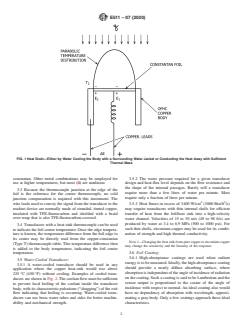
3.1 Fig. 1 is a sectional view of an example circular foil heat-flux transducer. It consists of a circular Constantan foil attached by a metallic bonding process to a heat sink of oxygen-free high conductivity copper (OFHC), with copper leads attached at the center of the circular foil and at any point on the heat-sink body. The transducer impedance is usually less than 1 V. To minimize current flow, the data acquisition system (DAS) should be a potentiometric system or have an input impedance of at least 100 000 Ω.
3.2 As noted in 2.3, an approximately linear output (versus heat flux) is produced when the body and center wire of the transducer are constructed of copper and the circular foil is constantan. Other metal combinations may be employed for use at higher temperatures, but most (4) are nonlinear.
3.3 Because the thermocouple junction at the edge of the foil is the reference for the center thermocouple, no cold junction compensation is required with this instrument. The wire leads used to convey the signal from the transducer to the readout device are normally made of stranded, tinned copper, insulated with TFE-fluorocarbon and shielded with a braid over-wrap that is also TFE-fluorocarbon-covered.
3.4 Transducers with a heat-sink thermocouple can be used to indicate the foil center temperature. Once the edge temperature is known, the temperature difference from the foil edge to its center may be directly read from the copper-constantan (Type T) thermocouple table. This temperature difference then is added to the body temperature, indicating the foil center temperature.
3.5 Water-Cooled Transducer:
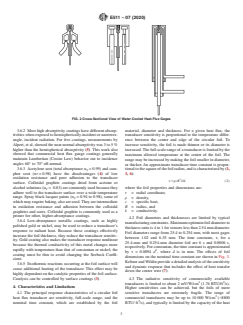
3.5.1 A water-cooled transducer should be used in any application where the copper heat-sink would rise above 235 °C (450 °F) without cooling. Examples of cooled transducers are shown in Fig. 2. The coolant flow must be sufficient to prevent local boiling of the coolant inside the transducer body, with its characteristic pulsations (“chugging”) of t...
SCOPE
1.1 This test method describes the measurement of radiative heat flux using a transducer whose sensing element (1, 2)2 is a thin circular metal foil. These sensors are often called Gardon Gauges.
1.2 The values stated in SI units are to be regarded as the standard. The values stated in parentheses are provided for information only.
1.3 This standard does not purport to address all of the safety concerns, if any, associated with its use. It is the responsibility of the user of this standard to establish appropriate safety, health, and environmental practices and determine the applicability of regulatory limitations prior to use.
1.4 This international standard was developed in accordance with internationally recognized principles on standardization established in the Decision on Principles for the Development of International Standards, Guides and Recommendations issued by the World Trade Organization Technical Barriers to Trade (TBT) Committee.
- Status
- Published
- Publication Date
- 31-Oct-2020
- Technical Committee
- E21 - Space Simulation and Applications of Space Technology
- Drafting Committee
- E21.08 - Thermal Protection
Overview
ASTM E511-07(2020): Standard Test Method for Measuring Heat Flux Using a Copper-Constantan Circular Foil, Heat-Flux Transducer provides industry-recognized procedures for evaluating radiative heat flux using a specialized transducer. Often called a Gardon Gauge, this circular foil sensor leverages thermoelectric effects between constantan foil and copper heat sinks to deliver accurate, linear heat flux measurements across a broad temperature range. This ASTM standard guides users in the correct application, calibration, and limitations of copper-constantan circular foil heat-flux transducers and promotes consistent, traceable results in a variety of engineering and fire research contexts.
Key Topics
- Transducer Construction: The circular foil heat-flux transducer features a thin, thermocouple-grade constantan foil bonded to an oxygen-free, high-conductivity copper heat sink, with copper leads attached. This design ensures a stable reference for measurement without the need for cold junction compensation.
- Measurement Principle: When exposed to heat, a parabolic temperature profile is established between the foil’s center and edge. The resulting thermoelectric potential is linearly proportional to the absorbed heat flux, especially with copper and constantan combinations.
- High Absorptivity Surface Coatings: Sensors typically use Lambertian coatings like colloidal graphite or black lacquers to maximize radiant energy absorption and measurement accuracy.
- Water Cooling Requirement: Water-cooled transducers are recommended for applications where the sensor body would otherwise exceed 235 °C (450 °F) to prevent thermal degradation and maintain measurement accuracy.
- Linearity and Sensitivity: The copper-constantan configuration provides a near-linear output over its rated temperature range and allows for direct reading of center-to-edge foil temperature differences using standard thermocouple tables.
- Calibration and Precision: The standard emphasizes proper calibration procedures-typically against blackbody sources-and documentation to minimize measurement uncertainty.
- Safety and Handling: Users must ensure safe operation by protecting the transducer surface, providing adequate cooling, and preventing damage to lead wires and coatings.
Applications
- Fire Testing and Research: Gardon Gauges measured according to ASTM E511 are widely used to quantify radiative heat flux in fire protection engineering, fire resistance assessments, and flammability studies.
- Industrial Furnace Monitoring: In high-temperature environments like furnaces, the standard allows for monitoring heat transfer rates for process control and safety.
- Thermal Protection Evaluation: Aerospace, automotive, and materials industries use these measurements to evaluate the performance of thermal barrier coatings and materials exposed to intense radiation.
- Solar and Energy Applications: The standard supports solar energy research where quantifying radiant energy transfer to surfaces is critical.
- Space Technology Testing: Reliable heat flux measurements are essential for qualifying spacecraft materials and thermal protection systems.
Related Standards
- ASTM E1354 - Standard Test Method for Heat and Visible Smoke Release Rates using an Oxygen Consumption Calorimeter.
- ASTM C1041 / C1046 - Test methods relating to heat flux measurements using other types or geometries of heat flux transducers.
- ASTM E2584 - Standard Practice for Thermal Protective Performance (TPP) of Materials for Clothing by Radiant Heat.
- ISO 14934 - Series on fire tests using heat flux meters and associated calibration/measurement practices.
Practical Value
Adhering to ASTM E511-07(2020) ensures that users obtain precise, reproducible heat flux measurements in radiative environments using copper-constantan circular foil transducers. The standard’s detailed guidance on transducer selection, installation, calibration, and operation helps laboratories, manufacturers, and safety engineers achieve reliable data necessary for product qualification, fire safety analysis, and regulatory compliance. Employing best practices from this ASTM standard minimizes errors due to improper cooling, poor calibration, or incorrect application, ensuring confidence in technical and safety-critical decisions based on heat flux data.
Keywords: ASTM heat flux standard, copper-constantan transducer, Gardon Gauge, radiative heat flux measurement, fire testing, water-cooled transducer, sensor calibration, high-temperature measurement.
Get Certified
Connect with accredited certification bodies for this standard

BSMI (Bureau of Standards, Metrology and Inspection)
Taiwan's standards and inspection authority.
Sponsored listings
Frequently Asked Questions
ASTM E511-07(2020) is a standard published by ASTM International. Its full title is "Standard Test Method for Measuring Heat Flux Using a Copper-Constantan Circular Foil, Heat-Flux Transducer". This standard covers: SIGNIFICANCE AND USE 3.1 Fig. 1 is a sectional view of an example circular foil heat-flux transducer. It consists of a circular Constantan foil attached by a metallic bonding process to a heat sink of oxygen-free high conductivity copper (OFHC), with copper leads attached at the center of the circular foil and at any point on the heat-sink body. The transducer impedance is usually less than 1 V. To minimize current flow, the data acquisition system (DAS) should be a potentiometric system or have an input impedance of at least 100 000 Ω. 3.2 As noted in 2.3, an approximately linear output (versus heat flux) is produced when the body and center wire of the transducer are constructed of copper and the circular foil is constantan. Other metal combinations may be employed for use at higher temperatures, but most (4) are nonlinear. 3.3 Because the thermocouple junction at the edge of the foil is the reference for the center thermocouple, no cold junction compensation is required with this instrument. The wire leads used to convey the signal from the transducer to the readout device are normally made of stranded, tinned copper, insulated with TFE-fluorocarbon and shielded with a braid over-wrap that is also TFE-fluorocarbon-covered. 3.4 Transducers with a heat-sink thermocouple can be used to indicate the foil center temperature. Once the edge temperature is known, the temperature difference from the foil edge to its center may be directly read from the copper-constantan (Type T) thermocouple table. This temperature difference then is added to the body temperature, indicating the foil center temperature. 3.5 Water-Cooled Transducer: 3.5.1 A water-cooled transducer should be used in any application where the copper heat-sink would rise above 235 °C (450 °F) without cooling. Examples of cooled transducers are shown in Fig. 2. The coolant flow must be sufficient to prevent local boiling of the coolant inside the transducer body, with its characteristic pulsations (“chugging”) of t... SCOPE 1.1 This test method describes the measurement of radiative heat flux using a transducer whose sensing element (1, 2)2 is a thin circular metal foil. These sensors are often called Gardon Gauges. 1.2 The values stated in SI units are to be regarded as the standard. The values stated in parentheses are provided for information only. 1.3 This standard does not purport to address all of the safety concerns, if any, associated with its use. It is the responsibility of the user of this standard to establish appropriate safety, health, and environmental practices and determine the applicability of regulatory limitations prior to use. 1.4 This international standard was developed in accordance with internationally recognized principles on standardization established in the Decision on Principles for the Development of International Standards, Guides and Recommendations issued by the World Trade Organization Technical Barriers to Trade (TBT) Committee.
SIGNIFICANCE AND USE 3.1 Fig. 1 is a sectional view of an example circular foil heat-flux transducer. It consists of a circular Constantan foil attached by a metallic bonding process to a heat sink of oxygen-free high conductivity copper (OFHC), with copper leads attached at the center of the circular foil and at any point on the heat-sink body. The transducer impedance is usually less than 1 V. To minimize current flow, the data acquisition system (DAS) should be a potentiometric system or have an input impedance of at least 100 000 Ω. 3.2 As noted in 2.3, an approximately linear output (versus heat flux) is produced when the body and center wire of the transducer are constructed of copper and the circular foil is constantan. Other metal combinations may be employed for use at higher temperatures, but most (4) are nonlinear. 3.3 Because the thermocouple junction at the edge of the foil is the reference for the center thermocouple, no cold junction compensation is required with this instrument. The wire leads used to convey the signal from the transducer to the readout device are normally made of stranded, tinned copper, insulated with TFE-fluorocarbon and shielded with a braid over-wrap that is also TFE-fluorocarbon-covered. 3.4 Transducers with a heat-sink thermocouple can be used to indicate the foil center temperature. Once the edge temperature is known, the temperature difference from the foil edge to its center may be directly read from the copper-constantan (Type T) thermocouple table. This temperature difference then is added to the body temperature, indicating the foil center temperature. 3.5 Water-Cooled Transducer: 3.5.1 A water-cooled transducer should be used in any application where the copper heat-sink would rise above 235 °C (450 °F) without cooling. Examples of cooled transducers are shown in Fig. 2. The coolant flow must be sufficient to prevent local boiling of the coolant inside the transducer body, with its characteristic pulsations (“chugging”) of t... SCOPE 1.1 This test method describes the measurement of radiative heat flux using a transducer whose sensing element (1, 2)2 is a thin circular metal foil. These sensors are often called Gardon Gauges. 1.2 The values stated in SI units are to be regarded as the standard. The values stated in parentheses are provided for information only. 1.3 This standard does not purport to address all of the safety concerns, if any, associated with its use. It is the responsibility of the user of this standard to establish appropriate safety, health, and environmental practices and determine the applicability of regulatory limitations prior to use. 1.4 This international standard was developed in accordance with internationally recognized principles on standardization established in the Decision on Principles for the Development of International Standards, Guides and Recommendations issued by the World Trade Organization Technical Barriers to Trade (TBT) Committee.
ASTM E511-07(2020) is classified under the following ICS (International Classification for Standards) categories: 17.200.10 - Heat. Calorimetry. The ICS classification helps identify the subject area and facilitates finding related standards.
ASTM E511-07(2020) is available in PDF format for immediate download after purchase. The document can be added to your cart and obtained through the secure checkout process. Digital delivery ensures instant access to the complete standard document.
Standards Content (Sample)
This international standard was developed in accordance with internationally recognized principles on standardization established in the Decision on Principles for the
Development of International Standards, Guides and Recommendations issued by the World Trade Organization Technical Barriers to Trade (TBT) Committee.
Designation: E511 − 07 (Reapproved 2020)
Standard Test Method for
Measuring Heat Flux Using a Copper-Constantan Circular
Foil, Heat-Flux Transducer
This standard is issued under the fixed designation E511; the number immediately following the designation indicates the year of
original adoption or, in the case of revision, the year of last revision.Anumber in parentheses indicates the year of last reapproval.A
superscript epsilon (´) indicates an editorial change since the last revision or reapproval.
1. Scope fine wire of the same metal as the heat sink. When the sensing
element is exposed to a heat source, most of the heat energy
1.1 Thistestmethoddescribesthemeasurementofradiative
2 absorbedatthesurfaceofthecircularfoilisconductedradially
heat flux using a transducer whose sensing element (1, 2) is a
to the heat sink. If the heat flux is uniform and heat transfer
thin circular metal foil. These sensors are often called Gardon
down the center wire is neglected, a parabolic temperature
Gauges.
profile is established between the center and edge of the foil
1.2 The values stated in SI units are to be regarded as the
under steady-state conditions. The center–perimeter tempera-
standard. The values stated in parentheses are provided for
ture difference produces a thermoelectric potential, E, that will
information only.
varyinproportiontotheabsorbedheatflux, q'.Withprescribed
1.3 This standard does not purport to address all of the
foildiameter,thickness,andmaterials,thepotential Eisalmost
safety concerns, if any, associated with its use. It is the
linearlyproportionaltotheaverageheatflux q'absorbedbythe
responsibility of the user of this standard to establish appro-
foil. This relationship is described by the following equation:
priate safety, health, and environmental practices and deter-
E 5 Kq' (1)
mine the applicability of regulatory limitations prior to use.
1.4 This international standard was developed in accor- where:
dance with internationally recognized principles on standard-
K = a sensitivity constant determined experimentally.
ization established in the Decision on Principles for the
2.3 For nearly linear response, the heat sink and the center
Development of International Standards, Guides and Recom-
wire of the transducer are made of high purity copper and the
mendations issued by the World Trade Organization Technical
foil of thermocouple grade Constantan. This combination of
Barriers to Trade (TBT) Committee.
materials produces a nearly linear output over a gauge tem-
perature range from –45 to 232°C (–50 to 450°F). The linear
2. Summary of Test Method
range results from the basically offsetting effects of
2.1 The purpose of this test method is to facilitate measure-
temperature-dependent changes in the thermal conductivity
ment of a radiant heat flux. Although the sensor will measure
and the Seebeck coefficient of the Constantan (3). All further
heat fluxes from mixed radiative – convective or pure convec-
discussion is based on the use of these two metals, since
tive sources, the uncertainty will increase as the convective
engineering practice has demonstrated they are commonly the
fraction of the total heat flux increases.
most useful.
2.2 The circular foil heat flux transducer generates a milli-
Volt output in response to the rate of thermal energy absorbed
3. Description of the Instrument
(see Fig. 1). The perimeter of the circular metal foil sensing
3.1 Fig. 1 is a sectional view of an example circular foil
element is mounted in a metal heat sink, forming a reference
heat-flux transducer. It consists of a circular Constantan foil
thermocouple junction due to their different thermoelectric
attached by a metallic bonding process to a heat sink of
potentials. A differential thermocouple is created by a second
oxygen-free high conductivity copper (OFHC), with copper
thermocouple junction formed at the center of the foil using a
leads attached at the center of the circular foil and at any point
ontheheat-sinkbody.Thetransducerimpedanceisusuallyless
than1V.Tominimizecurrentflow,thedataacquisitionsystem
This test method is under the jurisdiction of ASTM Committee E21 on Space
Simulation andApplications of SpaceTechnology and is the direct responsibility of
(DAS) should be a potentiometric system or have an input
Subcommittee E21.08 on Thermal Protection.
impedance of at least 100 000 Ω.
Current edition approved Nov. 1, 2020. Published December 2020. Originally
approvedin1973.Lastpreviouseditionapprovedin2015asE511–07(2015).DOI:
3.2 As noted in 2.3, an approximately linear output (versus
10.1520/E0511-07R20.
heat flux) is produced when the body and center wire of the
The boldface numbers in parentheses refer to the list of references at the end of
this standard. transducer are constructed of copper and the circular foil is
Copyright © ASTM International, 100 Barr Harbor Drive, PO Box C700, West Conshohocken, PA 19428-2959. United States
E511 − 07 (2020)
FIG. 1 Heat Drain—Either by Water Cooling the Body with a Surrounding Water Jacket or Conducting the Heat Away with Sufficient
Thermal Mass
constantan. Other metal combinations may be employed for 3.5.2 The water pressure required for a given transducer
use at higher temperatures, but most (4) are nonlinear. design and heat-flux level depends on the flow resistance and
the shape of the internal passages. Rarely will a transducer
3.3 Because the thermocouple junction at the edge of the
require more than a few litres of water per minute. Most
foil is the reference for the center thermocouple, no cold
require only a fraction of litres per minute.
junction compensation is required with this instrument. The
2 2
wire leads used to convey the signal from the transducer to the 3.5.3 Heat fluxes in excess of 3400 W/cm (3000 Btu/ft /s)
readout device are normally made of stranded, tinned copper, may require transducers with thin internal shells for efficient
insulated with TFE-fluorocarbon and shielded with a braid transfer of heat from the foil/heat sink into a high-velocity
over-wrap that is also TFE-fluorocarbon-covered.
water channel. Velocities of 15 to 30 m/s (49 to 98 ft/s) are
produced by water at 3.4 to 6.9 MPa (500 to 1000 psi). For
3.4 Transducers with a heat-sink thermocouple can be used
such thin shells, zirconium-copper may be used for its combi-
to indicate the foil center temperature. Once the edge tempera-
nation of strength and high thermal conductivity.
ture is known, the temperature difference from the foil edge to
its center may be directly read from the copper-constantan
NOTE 1—Changing the heat sink from pure copper to zirconium copper
(Type T) thermocouple table. This temperature difference then
may change the sensitivity and the linearity of the response.
is added to the body temperature, indicating the foil center
3.6 Foil Coating:
temperature.
3.6.1 High-absorptance coatings are used when radiant
3.5 Water-Cooled Transducer:
energyistobemeasured.Ideally,thehigh-absorptancecoating
3.5.1 A water-cooled transducer should be used in any
should provide a nearly diffuse absorbing surface, where
application where the copper heat-sink would rise above
absorptionisindependentoftheangleofincidenceofradiation
235°C (450°F) without cooling. Examples of cooled trans-
on the coating. Such a coating is said to be Lambertian and the
ducers are shown in Fig. 2.The coolant flow must be sufficient
sensor output is proportional to the cosine of the angle of
to prevent local boiling of the coolant inside the transducer
incidence with respect to normal.An ideal coating also would
body, with its characteristic pulsations (“chugging”) of the exit
have no dependency of absorption with wavelength, approxi-
flow indicating that boiling is occurring. Water-cooled trans-
mating a gray-body. Only a few coatings approach these ideal
ducers can use brass water tubes and sides for better machin-
ability and mechanical strength. characteristics.
E511 − 07 (2020)
FIG. 2 Cross-Sectional View of Water-Cooled Heat-Flux Gages
3.6.2 Most high absorptivity coatings have different absorp- material, diameter and thickness. For a given heat flux, the
tivities when exposed to hemispherically-incident or narrower- transducer sensitivity is proportional to the temperature differ-
angle, incident radiation. For five coatings, measurements by ence between the center and edge of the circular foil. To
Alpert,etal,showedthenear-normalabsorptivitywas3to5%
increase sensitivity, the foil is made thinner or its diameter is
higher than the hemispherical absorptivity (5). This work also
increased.Thefull-scalerangeofatransducerislimitedbythe
showed that commercial heat flux gauge coatings generally
maximum allowed temperature at the center of the foil. The
maintain Lambertian (Cosine Law) behavior out to incidence
rangemaybeincreasedbymakingthefoilsmallerindiameter,
angles 60° to 70º off-normal.
or thicker.An approximate transducer time constant is propor-
3.6.3 Acetylene soot (total absorptanceα =0.99) and cam-
tionaltothesquareofthefoilradius,andischaracterizedby (1,
T
phor soot (α =0.98) have the disadvantages (4) of low
3, 6):
T
oxidation resistance and poor adhesion to the transducer
τ'ρcR /4k (2)
surface. Colloidal graphite coatings dried from acetone or
where the foil properties and dimensions are:
alcoholsolutions(α = 0.83)arecommonlyusedbecausethey
T
adhere well to the transducer surface over a wide temperature
τ = radial coordinate,
range. Spray black lacquer paints (α =0.94 to 0.98), some of ρ = density,
T
whichmayrequirebaking,alsoareused.Theyareintermediate c = specific heat,
R = radius, and
in oxidation resistance and adhesion between the colloidal
k = conductivity.
graphites and soots. Colloidal graphite is commonly used as a
primer for other, higher-absorptance coatings.
4.2 Foil diameters and thicknesses are limited by typical
3.6.4 Low-absorptance metallic coatings, such as highly
manufacturingconstraints.Maximumoptimumfoildiameterto
polished gold or nickel, may be used to reduce a transducer’s
thicknessratiois4to1forsensorslessthan2.54mmdiameter.
response to radiant heat. Because these coatings effectively
Foil diameters range from 25.4 to 0.254 mm, with most gages
increase the foil thickness, they reduce the transducer sensitiv-
between 1.02 and 6.35 mm. The time constants, τ, for a
ity. Gold coating also makes the transducer response nonlinear
25.4-mm and 0.254-mm diameter foil are 6 s and 0.0006 s,
because the thermal conductivity of this metal changes more
respectively.Forconstantan,thetimeconstantisapproximated
rapidly with temperature than that of constantan or nickel; the
by τ = 0.0094 d , where d is in mm. The effects of foil
coating must be thin to avoid changing the Seebeck Coeffi-
dimensions on the nominal time constant are shown in Fig. 3.
cient.
KeltnerandWildinprovideadetailedanalysisofthesensitivity
3.6.5 Exothermic reactions occurring at the foil surface will
and dynamic response that includes the effect of heat transfer
cause additional heating of the transducer. This effect may be
down the center wire (7).
highly dependent on the catalytic properties of the foil surface.
Catalysis can be controlled by surface coatings (3). 4.3 The radiative sensitivity of commercially available
2 2
transducers is limited to about 2 mV/W/cm (1.76 BTU/ft /s).
4. Characteristics and Limitations
Higher sensitivities can be achieved, but the foils of more
4.1 The principal response characteristics of a circular foil sensitive transducers are extremely fragile. The range of
heat flux transducer are sensitivity, full-scale range, and the commercial transducers may be up to 10000 W/cm (~8800
nominal time constant, which are established by the foil BTU/ ft /s), and typically is limited by the capacity of the heat
E511 − 07 (2020)
FIG. 3 Chart for Design of Copper-Constantan Circular Foil Heat-Flow Meters (SI Units)
sink for heat removal. The full-scale range is normally speci- This will improve the effectiveness of cooling and reduce the
fied as that which produces 10 mV of output. This is the required liquid flow rate.
potential produced by a copper-constantan transducer with a
4.5 The temperature of the gage body normally is low in
temperature difference between the foil center and edge of
comparison to the heat source. The resulting heat flux mea-
190°C (374°F). These transducers may be used to measure
sured by the gage is known as a “cold wall” heat flux.
heat fluxes exceeding the full-scale (10 mV output) rating;
4.6 For measurements of purely radiant heat flux, the
however,morethan50%over-rangingwillshortenthelifeand
transducer output signal is a direct response to the energy
possibly change the transducer characteristics. If a transducer
absorbed by the foil; the absorptivity of the surface of the
is used beyond 200% of its full-scale rating, it should be
coating must be known to correctly calculate the incident
returned to the manufacturer for inspection and recalibration
radiation flux (5).
before further use. Care should be taken not to exceed
4.7 The circular foil transducer cannot be used for conduc-
recommended temperature limits to ensure linear response.
tion heat-flux measurements.
This is designed for in two ways: active cooling and by
providing a heat sink with the copper body. The effects of foil
4.8 The circular foil transducer should be used with great
dimensions on the transducer sensitivity are shown in Fig. 4.
care for convective heat-flux measurements because (a) there
Refs (7-9)providemoredetailedanalysisofthesensitivitythat
are no standardized calibration methods; (b) the uncertainty
includes the effects of heat transfer down the center wire.
increases rapidly for free-stream temperatures below 1000ºC,
although proper range selection can minimize the increase;
4.4 Water-cooled sensors are recommended for any appli-
and, (c) the uncertainty varies with the free-stream velocity
cation in which the sensor body would otherwise rise above
vector (10,11).Inshearflows,thesensorscandisplaynonlinear
235°C (450°F). When applying a liquid-cooled transducer in
response and high uncertainty (12,13).
a hot environment, it may be important to insulate the body of
the transducer from the surrounding structure if it is also hot. 4.9 Error Sources:
E511 − 07 (2020)
FIG. 4 Chart for Design of Copper-Constantan Circular Foil Heat-Flow Meters (U.S. Customary Units)
4.9.1 Radiative Heat Transfer—If there is a uniform inci- thefoil(450K)willbe2to2.5kW/m whileattheedgeofthe
dentheatfluxoverthefoil,convectiveandradiativeheatlosses
foil it is only 20% of the center level. For incident blackbody
fromthefoilsurfacesarenegligible,andheattransferdownthe
heat fluxes of 50 and 150 kW/m , the blackbody temperatures
center wire is neglected, then the foil temperature distribution
are approximately 1000 and 1300 K. For these two cases, the
is parabolic:
net radiant heat flux (absorbed–reradiation) at the center of
the foil will be lower than at the edge of the foil by 5% and
q
r
2 2
T r 5 R 2 r (3)
~ ! ~ !
1.5% respectively (12). The measured transducer output is
4kδ
based on the total net heat transfer to the foil (that is, the
where:
integral of the net heat flux from r=0to R) (6). For the 50
q = absorbed radiant heat flux, 2
r
kW/m case, the total net heat transfer to the foil is 2 to 2.5%
δ = foil thickness,
below the absorbed value. Failing to account for this variation
R = foil radius, and
betweentheabsorbedandthenetheattransferwillincreasethe
k = foil conductivity.
measurement uncertainty, especially for incident heat flux
and the center to edge temperature difference is:
calibrations. Proper calibration can reduce these errors.
q R
r
4.9.1.2 Vacuum Operation—A circular foil transducer can
∆T 5 (4)
4kδ
be used in a vacuum for radiant heat flux measurements. In
4.9.1.1 Net Radiative Heat Transfer—For calibrations of general, the back of the gauge should be vented. If maximum
transducers at low heat fluxes, the net radiant heat flux varies accuracy is desired, the transducer should be calibrated in a
with radial position on the foil due to reradiation. For a
similarvacuumtominimizedifferencesinconvectiveheatloss
nominal full-scale output of 10 mV, the center-to-edge tem-
off the exposed and unexposed surfaces of the foil. The output
perature difference is approximately 150 K. If this foil tem-
ofthetransducerwillbeslightlyhigherinavacuumbecauseof
perature variation is significant with respect to the source
asmallconductiveorconvectiveheatflowbetweenthebackof
temperature, the uncertainty will increase. For example, if the
heat sink temperature is 300 K, reradiation from the center of
E511 − 07 (2020)
the foil and the body of the transducer when it is used at 4.9.3.1 While most of the calibration systems for circular
atmospheric pressure, to a degree that depends on the foil foilgaugesuseradiantheating,therearesignificantdifferences
dimensions.
in the designs between them. The Building and Fire Research
4.9.1.3 Focused Radiant Energy—Commercial transducers Laboratory at NIST reported on a Round-Robin Calibration
are generally calibrated with sources that produce an essen- Project conducted by the FORUM for International Coopera-
tially uniform heat flux exposure over the foil area; this tion in Fire Research. Even though all of the calibration
produces a parabolic temperature profile across the foil (Fig.
methods in the round-robin were traceable to physical
1). If a transducer is used to measure a sharply focused light
standards,the95%confidenceintervalforthisinter-laboratory
source, such as a laser beam or imaging optical system, its
calibration was 69.2% (15). Because radiant calibration
calibration may not be applicable.
systems have a long history and are the most common, this
4.9.1.4 Hemispherical versus Narrow Angle Exposure—
section will focus on them.
Most coatings have different absorptivities when exposed to
4.9.3.2 Radiant calibration techniques include blackbody
hemispherical or near-normal, incident radiation. Measure-
furnaces, dual-cavity systems, graphite plates, quartz lamp
ments by Alpert, et al, showed the near-normal absorptivity
arrays,andgas-firedradiantpanels.Therearetechniquesusing
was 3 to 5% higher than the hemispherical absorptivity (5).
blackbody furnaces, dual-cavity systems, and graphite plates
Use of hemispherically incident radiation for calibration of a
that expose the sensor being calibrated to either hemispheri-
transducer for near-normal measurements will introduce an
cally incident or narrow-angle (incidence angle < 60º off-
error; the reverse is also true.
normal) radiant heating.
4.9.1.5 The field of view of a circular foil transducer used
4.9.3.3 Themethodusedtodetermine(standardize)theheat
for radiative heat flux measurements is often a hemisphere, or
flux exposure generally depends on the design of the heat
180º. Transducer sensitivity to a point source of heat flux is
source. Optical pyrometry is generally used with dual-cavity
greatest at normal incidence, and follows an approximate
systems and some blackbody furnaces. Electrically Calibrated
cosine law out to lower incidence angles (5). Off-normal
Radiometers(ECR)areusedatNISTandotherlaboratoriesfor
radiative sensitivity may also be a function of the incident
ex-cavity blackbody calibrations. Transfer Standard Gauges
wavelength and the condition of the circular foil surface.
are often used in graphite plate (greybody) and in-cavity
Measurements made with a 180º field of view circular foil
calibrations. Each offers different benefits and uncertainties.
transducer and another transducer (for example, radiometer)
4.9.3.4 Murthy, et al (16) and Murthy, et al (17) describe in
with a more limited field of view are not directly comparable
detail ex-cavity and in-cavity calibration using a dual-cavity
unless the radiant source has uniform intensity over the entire
source and a sensor which has a high-absorptivity coating only
hemisphere.
on the circular foil. Because the hemispherical sources fill the
4.9.2 Convective Heat Transfer—The sensitivity to stagna-
field-of-view of the sensor, the source temperature is lower
tion flow, convective heating is generally lower than the
than that of a narrow-angle source for the same incident heat
sensitivitytoradiativeheating (10,14).Amethodforestimating
flux. Hemispherical and narrow-angle sources produce differ-
the sensitivity in stagnation flow or mixed radiative and
ent calibration values for the same sensor. This generally
convective heating is given in Refs (4, 6, and 14). This
results from: (a) differences in the spectral absorptivity as a
correction is shown in Annex A1. There are no standardized,
function of source temperature and hemispherical versus near
convective calibration methods.
normal absorptivity of the sensor; and (b) either undefined
4.9.2.1 When the bulk flow is parallel to the sensor surface
convective heat transfer when the sensor is inserted into a
(a.k.a shear flow) the temperature distribution in the foil
black-body furnace or dual-cavity source (~3 kW/m – level
becomes asymmetric due to nonuniform heating (11,12,13).
reported in Ref (17)) (c) conductive and/or convective heat
The peak temperature moves downstream from the center of
transfer, when the cooled sensor is in close proximity to a
the foil and causes the response to become nonlinear. Exercise
heated graphite plate. Calibration results are usually best when
caution when circular foil transducers are used for measuring
the calibration method is most similar to the application.
convective heat flux in shear flows unless the free stream
4.9.4 Other Error Sources—Physical or chemical processes
temperature is high.
other than heat transfer may affect the accuracy of measure-
4.9.2.2 UnpublishedworkfromVirginiaTechhasshownthe
ments made with a circular foil heat-flux transducer.
calibration uncertainties in stagnation flow and shear flow are
2× or more higher than for pure radiation heat sources. 4.9.4.1 If the dew point of the atmosphere at the face of the
transducer is above the temperature of any portion of the
4.9.2.3 Mixed Radiative and Convective Heat Transfer—
Mixed-Mode offers the same type of challenges as convective circular foil, condensation may occur. This will release heat
energy, sensed as heat flux, resulting in errors; thus, it is
measurements due to nonuniform (radially varying) heat trans-
fer to the circular foil and the different sensitivities for radiant advisable to use a cooling water supply whose temperature is
and convective heating.As a result, a correction must be made
above the dew point of the atmosphere surrounding the
when using a radiant calibration to interpret mixed-mode heat transducer. Measurements of heat flux produced by flames in
flux measureme
...