

ASTM D3412/D3412M-13(2020)
(Test Method)Standard Test Method for Coefficient of Friction, Yarn to Yarn
General Information
- Abstract
SIGNIFICANCE AND USE
5.1 This test method for testing yarn-to-yarn friction is being used, but is not recommended, for acceptance testing of commercial shipments since between-laboratory precision is known to be poor.
5.1.1 In some cases, the purchaser and supplier may have to test a commercial shipment of one or more specific materials by the best available method even though the method has not been recommended for acceptance testing of commercial shipments. In case of a dispute arising from differences in reported test results when using Test Method D3412/D3412M for acceptance testing of commercial shipments, the purchaser and the supplier should conduct comparative tests to determine if there is a statistical bias between their laboratories. Competent statistical assistance is recommended for the investigation of bias. As a minimum, the two parties should take a group of test specimens that are as homogeneous as possible and that are from a lot of material of the type in question. The test specimens should then be randomly assigned in equal numbers to each laboratory for testing. The average results from the two laboratories should be compared using Student's t-test for unpaired data and an acceptable probability level chosen by the two parties before the testing is begun. If a bias is found, either its cause must be found and corrected or the purchaser and the supplier must agree to interpret future test results with consideration to the known bias.
5.2 This test method is intended for the determination of yarn-to-yarn boundary friction coefficients measured over a specified length of yarn.
5.3 The test method is useful for quality control, research, and the characterization of yarn boundary lubricants.
Note 3: Because the geometry of the yarns is different, Options 1 and 2 should not be expected to give the same numerical values on the same yarns.
SCOPE
1.1 This test method covers the measurement of frictional properties for both continuous filament and spun-staple yarns under boundary friction conditions.
1.2 This test method has been used with yarns having linear densities ranging from 1.5 to 400 tex, but may be used with yarns outside these ranges [15 to 3600 denier].
Note 1: For coefficient of friction, yarn to metal, see Test Method D3108/D3108M.
1.3 The values stated in either SI units or inch-pound units are to be regarded separately as standard. The values stated in each system are not necessarily exact equivalents; therefore, to ensure conformance with the standard, each system shall be used independently of the other, and values from the two systems shall not be combined.
1.4 This standard does not purport to address all of the safety concerns, if any, associated with its use. It is the responsibility of the user of this standard to establish appropriate safety, health, and environmental practices and determine the applicability of regulatory limitations prior to use.
1.5 This international standard was developed in accordance with internationally recognized principles on standardization established in the Decision on Principles for the Development of International Standards, Guides and Recommendations issued by the World Trade Organization Technical Barriers to Trade (TBT) Committee.
- Status
- Published
- Publication Date
- 31-Jan-2020
- Technical Committee
- D13 - Textiles
- Drafting Committee
- D13.58 - Yarns and Fibers
Overview
ASTM D3412/D3412M-13(2020) is an internationally recognized standard test method developed by ASTM International for determining the yarn-to-yarn coefficient of friction under boundary friction conditions. This standard is applicable to both continuous filament yarns and spun-staple yarns, covering a broad range of linear densities. The procedure provides a framework for laboratory testing to assess the frictional characteristics of yarns, which is essential for quality control, research, and the evaluation of boundary lubricants in textiles.
Although the standard is widely used for comparative and investigative purposes, it is not recommended for acceptance testing of commercial shipments due to known issues with between-laboratory precision. In cases of contractual disputes or the necessity to test commercial lots, guidance for comparative testing and statistical evaluation is provided.
Key Topics
Yarn-to-Yarn Coefficient of Friction: This test method focuses on measuring the resistance encountered when one yarn slides against another, a property critical to yarn processing performance and fabric manufacturing.
Applicability: Suitable for continuous filament and spun-staple yarns, including those with linear densities ranging from 1.5 to 400 tex (equivalent to 15 to 3600 denier), but may be used outside these ranges as required.
Testing Options:
- Twisted Strand Method
- Capstan Method
- Fixed Yarn-Body Capstan Method Each method specifies apparatus setup, wrap angles, and calculation procedures. It is important to note that because of varying yarn geometries, methods may yield different numerical values for the same yarn.
Statistical Guidance: The standard provides recommendations for resolving discrepancies between laboratory results, including comparative testing with statistical analysis (such as Student's t-test) and assessment of possible biases.
Environmental Preparation: Specimens must be conditioned in a controlled atmosphere to ensure consistency and comparability, adhering to recognized textile conditioning practices.
Applications
Organizations and laboratories use ASTM D3412/D3412M to:
- Quality Control: Monitor yarn friction properties during production to ensure consistency in textile processing and final product performance.
- Research & Development: Characterize new fibers, yarn finishes, or lubricants and understand how modifications affect yarn-to-yarn friction in various textile processes.
- Lubricant Evaluation: Assess the effectiveness and durability of boundary lubricants applied to yarns, which can impact downstream processing efficiency and material wear.
- Comparative Benchmarking: Compare yarns from different lots, manufacturers, or treatments for internal benchmarking, product development, or specification compliances.
Note: While the test method can provide valuable comparative data on frictional properties, it is not recommended as the sole basis for acceptance testing of commercial shipments unless no alternative is available and both parties agree on the testing procedure and statistical evaluation.
Related Standards
Several standards are closely linked to ASTM D3412/D3412M, providing additional terminology, sampling, and related test methods in textile testing:
- ASTM D3108/D3108M: Standard Test Method for Coefficient of Friction, Yarn to Solid Material (for yarn-to-metal friction).
- ASTM D1776: Practice for Conditioning and Testing Textiles (guidance for environmental preparation).
- ASTM D1907: Test Method for Linear Density of Yarn (skein method for yarn number).
- ASTM D2258: Practice for Sampling Yarn for Testing.
- ASTM D4849: Terminology Related to Yarns and Fibers.
- ASTM D123: Terminology Relating to Textiles.
Practical Value
Implementing ASTM D3412/D3412M-13(2020) helps textile manufacturers, material scientists, and quality assurance professionals to:
- Achieve reproducible laboratory assessments of yarn friction
- Enhance process control and product development
- Ensure reliable performance data for research and internal evaluation
- Resolve disputes over test results using recommended statistical methods
For organizations whose operations depend on consistent yarn processing-such as weaving, knitting, or high-speed yarn handling-this standard provides a valuable tool for characterizing and comparing the subtle differences in yarn-to-yarn interaction critical to product performance and manufacturing efficiency.
Keywords: ASTM D3412, coefficient of friction, yarn to yarn, textile testing, spun-staple yarn, filament yarn, friction test method, yarn lubrication, quality control, textile standards.
Relations
- Effective Date
- 01-Feb-2020
- Effective Date
- 01-Feb-2020
- Effective Date
- 01-Jul-2018
- Effective Date
- 01-Mar-2017
- Effective Date
- 15-Sep-2015
- Effective Date
- 01-Sep-2015
- Effective Date
- 01-Apr-2015
- Effective Date
- 01-Oct-2013
- Effective Date
- 01-Oct-2013
- Effective Date
- 01-Oct-2013
- Effective Date
- 01-Oct-2013
- Refers
ASTM D3108/D3108M-13 - Standard Test Method for Coefficient of Friction, Yarn to Solid Material - Effective Date
- 01-Jul-2013
- Effective Date
- 15-Jun-2013
- Effective Date
- 15-Jun-2013
- Effective Date
- 15-May-2013
Get Certified
Connect with accredited certification bodies for this standard

Control Union Certifications
Global certification for agriculture and sustainability.

Hohenstein Institut
Textile testing and certification.

Bureau Veritas Bangladesh
Bureau Veritas certification services in Bangladesh.
Sponsored listings
Frequently Asked Questions
ASTM D3412/D3412M-13(2020) is a standard published by ASTM International. Its full title is "Standard Test Method for Coefficient of Friction, Yarn to Yarn". This standard covers: SIGNIFICANCE AND USE 5.1 This test method for testing yarn-to-yarn friction is being used, but is not recommended, for acceptance testing of commercial shipments since between-laboratory precision is known to be poor. 5.1.1 In some cases, the purchaser and supplier may have to test a commercial shipment of one or more specific materials by the best available method even though the method has not been recommended for acceptance testing of commercial shipments. In case of a dispute arising from differences in reported test results when using Test Method D3412/D3412M for acceptance testing of commercial shipments, the purchaser and the supplier should conduct comparative tests to determine if there is a statistical bias between their laboratories. Competent statistical assistance is recommended for the investigation of bias. As a minimum, the two parties should take a group of test specimens that are as homogeneous as possible and that are from a lot of material of the type in question. The test specimens should then be randomly assigned in equal numbers to each laboratory for testing. The average results from the two laboratories should be compared using Student's t-test for unpaired data and an acceptable probability level chosen by the two parties before the testing is begun. If a bias is found, either its cause must be found and corrected or the purchaser and the supplier must agree to interpret future test results with consideration to the known bias. 5.2 This test method is intended for the determination of yarn-to-yarn boundary friction coefficients measured over a specified length of yarn. 5.3 The test method is useful for quality control, research, and the characterization of yarn boundary lubricants. Note 3: Because the geometry of the yarns is different, Options 1 and 2 should not be expected to give the same numerical values on the same yarns. SCOPE 1.1 This test method covers the measurement of frictional properties for both continuous filament and spun-staple yarns under boundary friction conditions. 1.2 This test method has been used with yarns having linear densities ranging from 1.5 to 400 tex, but may be used with yarns outside these ranges [15 to 3600 denier]. Note 1: For coefficient of friction, yarn to metal, see Test Method D3108/D3108M. 1.3 The values stated in either SI units or inch-pound units are to be regarded separately as standard. The values stated in each system are not necessarily exact equivalents; therefore, to ensure conformance with the standard, each system shall be used independently of the other, and values from the two systems shall not be combined. 1.4 This standard does not purport to address all of the safety concerns, if any, associated with its use. It is the responsibility of the user of this standard to establish appropriate safety, health, and environmental practices and determine the applicability of regulatory limitations prior to use. 1.5 This international standard was developed in accordance with internationally recognized principles on standardization established in the Decision on Principles for the Development of International Standards, Guides and Recommendations issued by the World Trade Organization Technical Barriers to Trade (TBT) Committee.
SIGNIFICANCE AND USE 5.1 This test method for testing yarn-to-yarn friction is being used, but is not recommended, for acceptance testing of commercial shipments since between-laboratory precision is known to be poor. 5.1.1 In some cases, the purchaser and supplier may have to test a commercial shipment of one or more specific materials by the best available method even though the method has not been recommended for acceptance testing of commercial shipments. In case of a dispute arising from differences in reported test results when using Test Method D3412/D3412M for acceptance testing of commercial shipments, the purchaser and the supplier should conduct comparative tests to determine if there is a statistical bias between their laboratories. Competent statistical assistance is recommended for the investigation of bias. As a minimum, the two parties should take a group of test specimens that are as homogeneous as possible and that are from a lot of material of the type in question. The test specimens should then be randomly assigned in equal numbers to each laboratory for testing. The average results from the two laboratories should be compared using Student's t-test for unpaired data and an acceptable probability level chosen by the two parties before the testing is begun. If a bias is found, either its cause must be found and corrected or the purchaser and the supplier must agree to interpret future test results with consideration to the known bias. 5.2 This test method is intended for the determination of yarn-to-yarn boundary friction coefficients measured over a specified length of yarn. 5.3 The test method is useful for quality control, research, and the characterization of yarn boundary lubricants. Note 3: Because the geometry of the yarns is different, Options 1 and 2 should not be expected to give the same numerical values on the same yarns. SCOPE 1.1 This test method covers the measurement of frictional properties for both continuous filament and spun-staple yarns under boundary friction conditions. 1.2 This test method has been used with yarns having linear densities ranging from 1.5 to 400 tex, but may be used with yarns outside these ranges [15 to 3600 denier]. Note 1: For coefficient of friction, yarn to metal, see Test Method D3108/D3108M. 1.3 The values stated in either SI units or inch-pound units are to be regarded separately as standard. The values stated in each system are not necessarily exact equivalents; therefore, to ensure conformance with the standard, each system shall be used independently of the other, and values from the two systems shall not be combined. 1.4 This standard does not purport to address all of the safety concerns, if any, associated with its use. It is the responsibility of the user of this standard to establish appropriate safety, health, and environmental practices and determine the applicability of regulatory limitations prior to use. 1.5 This international standard was developed in accordance with internationally recognized principles on standardization established in the Decision on Principles for the Development of International Standards, Guides and Recommendations issued by the World Trade Organization Technical Barriers to Trade (TBT) Committee.
ASTM D3412/D3412M-13(2020) is classified under the following ICS (International Classification for Standards) categories: 59.080.20 - Yarns. The ICS classification helps identify the subject area and facilitates finding related standards.
ASTM D3412/D3412M-13(2020) has the following relationships with other standards: It is inter standard links to ASTM D3412/D3412M-13, ASTM D3108/D3108M-13(2020), ASTM D4849-13(2018), ASTM D123-17, ASTM D123-15b, ASTM D123-15a, ASTM D123-15, ASTM D4849-13, ASTM D4849-13e2, ASTM D4849-13e1, ASTM D4849-13e3, ASTM D3108/D3108M-13, ASTM D123-13a, ASTM D123-13ae1, ASTM D123-13. Understanding these relationships helps ensure you are using the most current and applicable version of the standard.
ASTM D3412/D3412M-13(2020) is available in PDF format for immediate download after purchase. The document can be added to your cart and obtained through the secure checkout process. Digital delivery ensures instant access to the complete standard document.
Standards Content (Sample)
This international standard was developed in accordance with internationally recognized principles on standardization established in the Decision on Principles for the
Development of International Standards, Guides and Recommendations issued by the World Trade Organization Technical Barriers to Trade (TBT) Committee.
Designation: D3412/D3412M − 13 (Reapproved 2020)
Standard Test Method for
Coefficient of Friction, Yarn to Yarn
This standard is issued under the fixed designation D3412/D3412M; the number immediately following the designation indicates the
year of original adoption or, in the case of revision, the year of last revision. A number in parentheses indicates the year of last
reapproval. A superscript epsilon (´) indicates an editorial change since the last revision or reapproval.
1. Scope D3108/D3108M Test Method for Coefficient of Friction,
Yarn to Solid Material
1.1 This test method covers the measurement of frictional
D4849 Terminology Related to Yarns and Fibers
properties for both continuous filament and spun-staple yarns
under boundary friction conditions.
3. Terminology
1.2 This test method has been used with yarns having linear
3.1 For all terminology relating to D13.58, Yarns and
densities ranging from 1.5 to 400 tex, but may be used with
Fibers, refer to Terminology D4849.
yarns outside these ranges [15 to 3600 denier].
3.2 For all other terminology related to textiles, refer to
NOTE 1—For coefficient of friction, yarn to metal, see Test Method
Terminology D123.
D3108/D3108M.
4. Summary of Test Method
1.3 The values stated in either SI units or inch-pound units
are to be regarded separately as standard. The values stated in
4.1 A length of yarn is moved at a known speed in contact
each system are not necessarily exact equivalents; therefore, to
with itself or similar yarn at a specified wrap angle. The input
ensure conformance with the standard, each system shall be
and output tensions are measured and the coefficient of friction
used independently of the other, and values from the two
calculated. Alternatively, apparatus may be used in which the
systems shall not be combined.
ratio of input to output tension is measured allowing the
coefficient of friction to be indicated directly.
1.4 This standard does not purport to address all of the
safety concerns, if any, associated with its use. It is the
4.2 Three optional procedures are included. Option 1 is
responsibility of the user of this standard to establish appro-
based on the Twisted Strand Method, using a wrap angle of
priate safety, health, and environmental practices and deter-
15.71 rad [900°]. Option 2 is based on the Capstan Method,
mine the applicability of regulatory limitations prior to use.
using a wrap angle of 3.14 radians [180°]. Option 3 is based on
1.5 This international standard was developed in accor-
the Fixed Yarn-Body Capstan Method, using a wrap angle of
dance with internationally recognized principles on standard-
3.14 radians [180°].
ization established in the Decision on Principles for the
NOTE 2—Editions of Test Method D3412/D3412M prior to the 1986
Development of International Standards, Guides and Recom-
revision incorrectly stated the wrap angle for Option 1 to be 18.85 rad.
mendations issued by the World Trade Organization Technical
This is incorrect, since 3 turns of the swivel pulley do not result in a wrap
Barriers to Trade (TBT) Committee.
angle of 18.85 radians. This has now been corrected to 15.71 rad. This
should be taken into account in comparing with earlier results.
2. Referenced Documents
5. Significance and Use
2.1 ASTM Standards:
5.1 This test method for testing yarn-to-yarn friction is
D123 Terminology Relating to Textiles
being used, but is not recommended, for acceptance testing of
D1776 Practice for Conditioning and Testing Textiles
commercial shipments since between-laboratory precision is
D1907 Test Method for Linear Density of Yarn (Yarn Num-
known to be poor.
ber) by the Skein Method
5.1.1 In some cases, the purchaser and supplier may have to
D2258 Practice for Sampling Yarn for Testing
test a commercial shipment of one or more specific materials
by the best available method even though the method has not
This test method is under the jurisdiction ofASTM Committee D13 on Textiles
been recommended for acceptance testing of commercial
and is the direct responsibility of Subcommittee D13.58 on Yarns and Fibers.
shipments. In case of a dispute arising from differences in
Current edition approved Feb. 1, 2020. Published March 2020. Originally
reported test results when using Test Method D3412/D3412M
approved in 1975T. Last previous edition approved in 2013 as D3412 – 13. DOI:
10.1520/D3412_D3412M-13R20.
for acceptance testing of commercial shipments, the purchaser
For referenced ASTM standards, visit the ASTM website, www.astm.org, or
and the supplier should conduct comparative tests to determine
contact ASTM Customer Service at service@astm.org. For Annual Book of ASTM
if there is a statistical bias between their laboratories. Compe-
Standards volume information, refer to the standard’s Document Summary page on
the ASTM website. tent statistical assistance is recommended for the investigation
Copyright © ASTM International, 100 Barr Harbor Drive, PO Box C700, West Conshohocken, PA 19428-2959. United States
D3412/D3412M − 13 (2020)
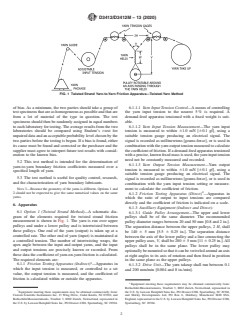
FIG. 1 Twisted Strand Yarn-to-Yarn Friction Apparatus—Twisted-Yarn Method
of bias. As a minimum, the two parties should take a group of 6.1.1.1 Yarn Input Tension Control—Ameans of controlling
testspecimensthatareashomogeneousaspossibleandthatare the yarn input tension to the nearest 5 % is required. A
from a lot of material of the type in question. The test demand-feed apparatus tensioned with a fixed weight is suit-
specimens should then be randomly assigned in equal numbers able.
to each laboratory for testing.The average results from the two 6.1.1.2 Yarn Input Tension Measurement—The yarn input
laboratories should be compared using Student’s t-test for tension is measured to within 61.0 mN [60.1 gf], using a
unpaireddataandanacceptableprobabilitylevelchosenbythe suitable tension gauge producing an electrical signal. The
two parties before the testing is begun. If a bias is found, either signal is recorded as millinewtons [grams-force], or is used in
its cause must be found and corrected or the purchaser and the combinationwiththeyarnoutputtensionmeasuredtocalculate
supplier must agree to interpret future test results with consid- thecoefficientoffriction.Ifademand-feedapparatustensioned
eration to the known bias. withaprecise,knownfixedmassisused,theyarninputtension
need not be constantly measured and recorded.
5.2 This test method is intended for the determination of
6.1.1.3 Yarn Output Tension Measurement—Yarn output
yarn-to-yarn boundary friction coefficients measured over a
tension is measured to within 61.0 mN [60.1 gf], using a
specified length of yarn.
suitable tension gauge producing an electrical signal. The
5.3 The test method is useful for quality control, research,
signal is recorded as millinewtons [grams-force], or is used in
and the characterization of yarn boundary lubricants.
combination with the yarn input tension setting or measure-
ment to calculate the coefficient of friction.
NOTE 3—Because the geometry of the yarns is different, Options 1 and
2 should not be expected to give the same numerical values on the same 6.1.2 Friction Testing Apparatus (Direct) —Apparatus in
yarns.
which the ratio of output to input tensions are compared
directly and the coefficient of friction is indicated on a scale.
6. Apparatus
6.1.3 Auxilliary Equipment (Indirect and Direct):
6.1 Option 1 (Twisted Strand Method)—A schematic dia-
6.1.3.1 Guide Pulley Arrangement—The upper and lower
gram of the elements required for twisted strand friction
pulleys shall be of the same diameter. The recommended
measurement is shown in Fig. 1. The yarn is run over upper
pulley diameter ranges between 20 and 50 mm [0.8 and 2 in.].
pulleys and under a lower pulley and is intertwisted between
The separation distance between the upper pulleys, 2 H, shall
these pulleys. One end of the yarn (output) is taken up at a
be 140 6 5 mm [5.5 6 0.25 in.]. The separation distance
controlled rate. The other end of yarn (input) is maintained at
between the axis of the lower pulley and a line connecting the
a controlled tension. The number of intertwisting wraps, the
upper pulley axes, V, shall be 280 65mm[11 6 0.25 in.].All
apex angle between the input and output yarns, and the input
pulleys shall be in the same plane. The lower pulley may
and output tensions are precisely known or recorded. From
optionallybemountedsothatitcanbeswiveledaroundanaxis
these data the coefficient of yarn-on-yarn friction is calculated.
at right angles to its axis of rotation and then fixed in position
The required elements are:
in the same plane as the upper pulleys.
6.1.1 Friction Testing Apparatus (Indirect) —Apparatus in
6.1.3.2 Drive Unit—The yarn takeup shall run between 0.1
which the input tension is measured, or controlled to a set
and 200 mm/min [0.004 and 8 in./min].
value, the output tension is measured, and the coefficient of
friction is calculated within or outside the apparatus.
Equipment meeting these requirements may be obtained commercially from:
Rothschild-Messinstruments, Traubstr 3, 8002 Zurich, Switzerland, represented in
Equipment meeting these requirements may be obtained commercially from: the U.S. by Lawson Hemphill Sales Inc, PO Drawer 6388, Spartanburg, SC 29304,
Custom Scientific Instruments Inc, 13 Wing Drive, Cedar Knolls, NJ 07292, and and Shirley Developments Ltd, PO Box 6, Didsbury, Manchester M20 8SA,
Rothschild-Messinstruments, Traubstr 3, 8002 Zurich, Switzerland, represented in England, represented in the U.S. by Lawson Hemphill Sales Inc, PO Drawer 6388,
the U.S. by Lawson Hemphill Sales Inc, PO Drawer 6388, Spartanburg, SC 29304. Spartanburg, SC 29304.
D3412/D3412M − 13 (2020)
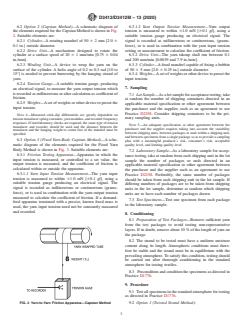
6.2 Option 2 (Capstan Method)—A schematic diagram of 6.3.1.2 Yarn Output Tension Measurement—Yarn output
the elements required for the Capstan Method is shown in Fig. tension is measured to within 61.0 mN [60.1 gf], using a
2. Suitable elements are: suitable tension gauge producing an electrical signal. The
6.2.1 Cylinder—A rotating mandrel of 50 6 2 mm [2.0 6 signal is recorded as millinewtons or centinewtons, (grams-
0.1 in.] outside diameter. force), or is used in combination with the yarn input tension
6.2.2 Drive Unit—A mechanism designed to rotate the setting or measurement to calculate the coefficient of friction.
cylinder at a surface speed of 20 6 1 mm/min [0.75 6 0.04 6.3.2 Drive Unit—The yarn takeup shall run between 0.1
in./mm]. and 200 mm/min [0.0039 and 7.9 in./min].
6.2.3 Winding Unit—A device to wrap the yarn on the 6.3.3 Cylinder—Afixed mandrel capable of fixing a bobbin
surface of the cylinder. A helix angle of 0.2 to 0.3 rad [10 to of 50 6 5 mm [2.0 6 0.25 in.] outside diameter.
15°] is needed to prevent burrowing by the hanging strand of 6.3.4 Weights—Aset of weights or other device to preset the
yarn. input tension.
6.2.4 Tension Gauge—A suitable tension gauge, producing
7. Sampling
an electrical signal, to measure the yarn output tension which
is recorded as millinewtons or after calculation as coefficient of
7.1 Lot Sample—Asalotsampleforacceptancetesting,take
friction.
at random the number of shipping containers directed in an
6.2.5 Weights—Aset of weights or other device to preset the
applicable material specification or other agreement between
input tension.
the purchaser and the supplier, such as an agreement to use
Practice D2258. Consider shipping containers to be the pri-
NOTE 4—Measured stick-slip differentials are greatly dependent on
tension transducer spring constants, yarn modulus, and recorder frequency mary sampling units.
responses. If interlaboratory checks are required, the same type of tension
NOTE 5—An adequate specification or other agreement between the
transducer and recorder should be used and the distance between the
purchaser and the supplier requires taking into account the variability
transducer and the hanging weight to center line of the mandrel must be
between shipping units, between packages or ends within a shipping unit,
specified.
and between specimens from a single package so as to provide a sampling
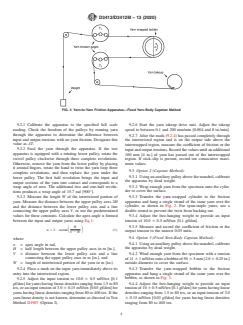
6.3 Option 3 (Fixed Yarn-Body Capstan Method)—A sche-
plan with a meaningful producer’s risk, consumer’s risk, acceptable
matic dia
...