

ASTM D8028-17
(Test Method)Standard Test Method for Measurement of Dissolved Gases Methane, Ethane, Ethylene, and Propane by Static Headspace Sampling and Flame Ionization Detection (GC/FID)
General Information
- Abstract
SIGNIFICANCE AND USE
5.1 This test method covers the determination of the dissolved gases methane, ethane, ethylene, and propane in drinking, waste, and ground waters, including domestic wells; whether naturally occurring or resulting from commercial activities, dissolved gases can be hazardous both to the environment and humans. Due to increased scrutiny of dissolved gases, developing a valid method for the testing of dissolved gases in water has become more imperative. Static headspace sampling is generally applicable for sampling these compounds. However, as these compounds are extremely volatile, a closed sampling system is recommended. This test method can be used for quantitatively determining dissolved gases in ground, waste, and drinking waters.
5.2 This test method is suitable for analysis of domestic drinking water samples from residential and commercial water supply wells prior to oil and gas exploration activities to form a baseline for monitoring potential impacts during exploration; development, including hydraulic fracturing; operation; closure; and reclamation of nearby oil and gas production and injection wells.
SCOPE
1.1 This test method covers the determination of the dissolved gases methane, ethane, ethylene, and propane in drinking, waste, and ground waters, including domestic wells whether naturally occurring or resulting from commercial activities, or both. This test method has an analytical range from 10 µg/L to 11 000 µg/L for methane, and 10 µg/L to 5000 µg/L for ethane, ethylene, and propane. If a sample has a dissolved gas concentration above the calibration range, the sample would require dilution. Other analytical ranges may be used as long as the instrument calibration encompasses the desired range and demonstrates adequate linearity.
1.2 This test method is applicable to samples collected at a nominal ambient pressure. Samples collected under high pressures, that is, above ambient pressure, may not be accurately analyzed using this method.
1.3 This test method is applicable to a variety of dissolved gases; however, for the present standard, only methane, ethane, ethylene, and propane were validated. In order to validate for a gas not listed in this method, the analyst would need to establish the saturation concentration of the new gas, and establish a valid curve, method detection limits, and demonstration of capability following the procedures outlined in this method.
1.4 It is the analyst’s responsibility to ensure the validity of this test method for dissolved gases other than methane, ethane, ethylene, and propane and other sample matrices.
1.5 Units—The values stated in SI units are to be regarded as the standard. No other units of measurement are included in this standard.
1.6 A single laboratory study was done in order to establish precision and bias for the surrogate (see Section 16).
1.7 This standard does not purport to address all of the safety concerns, if any, associated with its use. It is the responsibility of the user of this standard to establish appropriate safety, health, and environmental practices and determine the applicability of regulatory limitations prior to use.
1.8 This international standard was developed in accordance with internationally recognized principles on standardization established in the Decision on Principles for the Development of International Standards, Guides and Recommendations issued by the World Trade Organization Technical Barriers to Trade (TBT) Committee.
- Status
- Published
- Publication Date
- 31-Oct-2017
- Technical Committee
- D19 - Water
- Drafting Committee
- D19.06 - Methods for Analysis for Organic Substances in Water
Overview
ASTM D8028-17 is the internationally recognized standard test method for the measurement of dissolved gases-specifically methane, ethane, ethylene, and propane-in drinking, waste, and ground waters. Developed by ASTM International, this method utilizes static headspace sampling combined with gas chromatography equipped with flame ionization detection (GC/FID). The standard addresses the growing need for reliable and quantitative assessment of volatile dissolved gases in water, particularly in the context of environmental safety, regulatory monitoring, and industrial activities such as oil and gas exploration.
Monitoring dissolved gases is critical, as their presence-whether from natural or anthropogenic sources-can present hazards to both humans and the environment. With increased attention on water quality due to activities like hydraulic fracturing and commercial well operations, ASTM D8028-17 provides a rigorous, reproducible method for laboratories and field analysts to establish baselines and assess potential impacts.
Key Topics
Scope of Gases and Water Matrices:
The standard applies to water samples from drinking, waste, and ground water sources, including domestic wells. Methane, ethane, ethylene, and propane are specifically validated within an analytical range from 10 µg/L to 11,000 µg/L for methane and up to 5,000 µg/L for the other gases.Sampling and Handling:
Due to the volatility of target analytes, the method emphasizes closed-system, static headspace sampling to minimize analyte loss. Consistency in sample agitation and temperature control is crucial to ensure valid, reproducible results.Calibration and Quality Control:
The standard details requirements for multi-point calibration curves, quality control procedures, and the use of surrogates, calibration standards, and method blanks to verify analytical performance and data integrity. Acceptable recovery and precision are vital for method validation.Instrumentation:
GC/FID serves as a robust platform for detecting low-level concentrations of dissolved hydrocarbons. The standard includes recommendations on vial types, agitation methods, and temperature controls to achieve equilibrium in the headspace.Limitations:
The method is most suitable for samples collected at ambient pressure. High-pressure samples or those with concentrations outside the validated range may require dilution or adaptations in calibration.
Applications
ASTM D8028-17 is essential for a range of practical applications, including:
Baseline Water Quality Monitoring:
Sampling domestic and commercial water supply wells pre- and post-oil and gas exploration, including activities like hydraulic fracturing. Establishes a defensible baseline to detect operational impacts over time.Regulatory Compliance:
Ensures water utilities and environmental agencies meet local, national, and international standards for dissolved gas concentration in various water bodies.Contamination Assessment:
Used in environmental investigations to identify and quantify volatile hydrocarbon contamination in ground and surface waters associated with spills, leaks, or industrial processes.Remediation and Closure Monitoring:
Addresses ongoing monitoring during production, site closure, and land reclamation phases to ensure that dissolved gas levels remain within safe, regulated thresholds.
Related Standards
Understanding and implementing ASTM D8028-17 may require reference to the following related documents and standards:
- ASTM D1129: Terminology Relating to Water
- ASTM D1193: Specification for Reagent Water
- ASTM D8006: Guide for Sampling and Analysis of Residential and Commercial Water Supply Wells in Areas of Exploration and Production Operations
- SW-846, Method 5021: Volatile Organic Compounds in Various Sample Matrices Using Equilibrium Headspace Analysis
- Federal Standards:
- 40 CFR Part 136, Appendix B: Definition and Procedures for Determination of Method Detection Limit
- PA-DEP 3686: Light Hydrocarbons in Aqueous Samples via Headspace and GC/FID
Practical Value
By following ASTM D8028-17, laboratories and field professionals gain:
- Repeatable and Defensible Results: Thanks to its rigorous calibration and quality control requirements
- Reduced Analytical Error: Through standardized sample collection, preservation, and processing protocols
- Regulatory Confidence: Assurance of compliance with global best practices and regulatory benchmarks for dissolved gas analysis
- Comprehensive Environmental Assessment: Effective detection and quantification of volatile organic gases to protect public health and the environment
For environmental laboratories, water utilities, and regulatory bodies, ASTM D8028-17 sets a benchmark for reliable, reproducible dissolved gases analysis in water monitoring programs.
Relations
- Effective Date
- 15-Feb-2024
- Effective Date
- 01-May-2020
- Effective Date
- 01-Mar-2016
- Effective Date
- 01-May-2014
- Effective Date
- 01-May-2013
- Effective Date
- 01-May-2013
- Effective Date
- 01-Nov-2011
- Effective Date
- 01-Oct-2010
- Effective Date
- 01-Mar-2010
- Effective Date
- 01-Oct-2008
- Effective Date
- 01-Oct-2008
- Effective Date
- 01-Mar-2007
- Refers
ASTM E177-06b - Standard Practice for Use of the Terms Precision and Bias in ASTM Test Methods - Effective Date
- 15-Nov-2006
- Refers
ASTM E177-06a - Standard Practice for Use of the Terms Precision and Bias in ASTM Test Methods - Effective Date
- 01-Nov-2006
- Effective Date
- 01-Sep-2006
Get Certified
Connect with accredited certification bodies for this standard

CIS Institut d.o.o.
Personal Protective Equipment (PPE) certification body. Notified Body NB-2890 for EU Regulation 2016/425 PPE.

Kiwa BDA Testing
Building and construction product certification.
Kmetijski inštitut Slovenije
Agricultural Institute of Slovenia. Soil testing, plant health, agricultural product analysis.
Sponsored listings
Frequently Asked Questions
ASTM D8028-17 is a standard published by ASTM International. Its full title is "Standard Test Method for Measurement of Dissolved Gases Methane, Ethane, Ethylene, and Propane by Static Headspace Sampling and Flame Ionization Detection (GC/FID)". This standard covers: SIGNIFICANCE AND USE 5.1 This test method covers the determination of the dissolved gases methane, ethane, ethylene, and propane in drinking, waste, and ground waters, including domestic wells; whether naturally occurring or resulting from commercial activities, dissolved gases can be hazardous both to the environment and humans. Due to increased scrutiny of dissolved gases, developing a valid method for the testing of dissolved gases in water has become more imperative. Static headspace sampling is generally applicable for sampling these compounds. However, as these compounds are extremely volatile, a closed sampling system is recommended. This test method can be used for quantitatively determining dissolved gases in ground, waste, and drinking waters. 5.2 This test method is suitable for analysis of domestic drinking water samples from residential and commercial water supply wells prior to oil and gas exploration activities to form a baseline for monitoring potential impacts during exploration; development, including hydraulic fracturing; operation; closure; and reclamation of nearby oil and gas production and injection wells. SCOPE 1.1 This test method covers the determination of the dissolved gases methane, ethane, ethylene, and propane in drinking, waste, and ground waters, including domestic wells whether naturally occurring or resulting from commercial activities, or both. This test method has an analytical range from 10 µg/L to 11 000 µg/L for methane, and 10 µg/L to 5000 µg/L for ethane, ethylene, and propane. If a sample has a dissolved gas concentration above the calibration range, the sample would require dilution. Other analytical ranges may be used as long as the instrument calibration encompasses the desired range and demonstrates adequate linearity. 1.2 This test method is applicable to samples collected at a nominal ambient pressure. Samples collected under high pressures, that is, above ambient pressure, may not be accurately analyzed using this method. 1.3 This test method is applicable to a variety of dissolved gases; however, for the present standard, only methane, ethane, ethylene, and propane were validated. In order to validate for a gas not listed in this method, the analyst would need to establish the saturation concentration of the new gas, and establish a valid curve, method detection limits, and demonstration of capability following the procedures outlined in this method. 1.4 It is the analyst’s responsibility to ensure the validity of this test method for dissolved gases other than methane, ethane, ethylene, and propane and other sample matrices. 1.5 Units—The values stated in SI units are to be regarded as the standard. No other units of measurement are included in this standard. 1.6 A single laboratory study was done in order to establish precision and bias for the surrogate (see Section 16). 1.7 This standard does not purport to address all of the safety concerns, if any, associated with its use. It is the responsibility of the user of this standard to establish appropriate safety, health, and environmental practices and determine the applicability of regulatory limitations prior to use. 1.8 This international standard was developed in accordance with internationally recognized principles on standardization established in the Decision on Principles for the Development of International Standards, Guides and Recommendations issued by the World Trade Organization Technical Barriers to Trade (TBT) Committee.
SIGNIFICANCE AND USE 5.1 This test method covers the determination of the dissolved gases methane, ethane, ethylene, and propane in drinking, waste, and ground waters, including domestic wells; whether naturally occurring or resulting from commercial activities, dissolved gases can be hazardous both to the environment and humans. Due to increased scrutiny of dissolved gases, developing a valid method for the testing of dissolved gases in water has become more imperative. Static headspace sampling is generally applicable for sampling these compounds. However, as these compounds are extremely volatile, a closed sampling system is recommended. This test method can be used for quantitatively determining dissolved gases in ground, waste, and drinking waters. 5.2 This test method is suitable for analysis of domestic drinking water samples from residential and commercial water supply wells prior to oil and gas exploration activities to form a baseline for monitoring potential impacts during exploration; development, including hydraulic fracturing; operation; closure; and reclamation of nearby oil and gas production and injection wells. SCOPE 1.1 This test method covers the determination of the dissolved gases methane, ethane, ethylene, and propane in drinking, waste, and ground waters, including domestic wells whether naturally occurring or resulting from commercial activities, or both. This test method has an analytical range from 10 µg/L to 11 000 µg/L for methane, and 10 µg/L to 5000 µg/L for ethane, ethylene, and propane. If a sample has a dissolved gas concentration above the calibration range, the sample would require dilution. Other analytical ranges may be used as long as the instrument calibration encompasses the desired range and demonstrates adequate linearity. 1.2 This test method is applicable to samples collected at a nominal ambient pressure. Samples collected under high pressures, that is, above ambient pressure, may not be accurately analyzed using this method. 1.3 This test method is applicable to a variety of dissolved gases; however, for the present standard, only methane, ethane, ethylene, and propane were validated. In order to validate for a gas not listed in this method, the analyst would need to establish the saturation concentration of the new gas, and establish a valid curve, method detection limits, and demonstration of capability following the procedures outlined in this method. 1.4 It is the analyst’s responsibility to ensure the validity of this test method for dissolved gases other than methane, ethane, ethylene, and propane and other sample matrices. 1.5 Units—The values stated in SI units are to be regarded as the standard. No other units of measurement are included in this standard. 1.6 A single laboratory study was done in order to establish precision and bias for the surrogate (see Section 16). 1.7 This standard does not purport to address all of the safety concerns, if any, associated with its use. It is the responsibility of the user of this standard to establish appropriate safety, health, and environmental practices and determine the applicability of regulatory limitations prior to use. 1.8 This international standard was developed in accordance with internationally recognized principles on standardization established in the Decision on Principles for the Development of International Standards, Guides and Recommendations issued by the World Trade Organization Technical Barriers to Trade (TBT) Committee.
ASTM D8028-17 is classified under the following ICS (International Classification for Standards) categories: 13.060.50 - Examination of water for chemical substances. The ICS classification helps identify the subject area and facilitates finding related standards.
ASTM D8028-17 has the following relationships with other standards: It is inter standard links to ASTM D8006-24, ASTM D1129-13(2020)e2, ASTM D8006-16, ASTM E177-14, ASTM E691-13, ASTM E177-13, ASTM E691-11, ASTM E177-10, ASTM D1129-10, ASTM E177-08, ASTM E691-08, ASTM E355-96(2007), ASTM E177-06b, ASTM E177-06a, ASTM D1129-06ae1. Understanding these relationships helps ensure you are using the most current and applicable version of the standard.
ASTM D8028-17 is available in PDF format for immediate download after purchase. The document can be added to your cart and obtained through the secure checkout process. Digital delivery ensures instant access to the complete standard document.
Standards Content (Sample)
This international standard was developed in accordance with internationally recognized principles on standardization established in the Decision on Principles for the
Development of International Standards, Guides and Recommendations issued by the World Trade Organization Technical Barriers to Trade (TBT) Committee.
Designation: D8028 − 17
Standard Test Method for
Measurement of Dissolved Gases Methane, Ethane,
Ethylene, and Propane by Static Headspace Sampling and
Flame Ionization Detection (GC/FID)
This standard is issued under the fixed designation D8028; the number immediately following the designation indicates the year of
original adoption or, in the case of revision, the year of last revision. A number in parentheses indicates the year of last reapproval. A
superscript epsilon (´) indicates an editorial change since the last revision or reapproval.
1. Scope responsibility of the user of this standard to establish appro-
priate safety, health, and environmental practices and deter-
1.1 This test method covers the determination of the dis-
mine the applicability of regulatory limitations prior to use.
solved gases methane, ethane, ethylene, and propane in
1.8 This international standard was developed in accor-
drinking, waste, and ground waters, including domestic wells
dance with internationally recognized principles on standard-
whether naturally occurring or resulting from commercial
ization established in the Decision on Principles for the
activities, or both. This test method has an analytical range
Development of International Standards, Guides and Recom-
from 10 µg/Lto 11 000 µg/Lfor methane, and 10 µg/Lto 5000
mendations issued by the World Trade Organization Technical
µg/L for ethane, ethylene, and propane. If a sample has a
Barriers to Trade (TBT) Committee.
dissolved gas concentration above the calibration range, the
sample would require dilution. Other analytical ranges may be
2. Referenced Documents
used as long as the instrument calibration encompasses the
2.1 ASTM Standards:
desired range and demonstrates adequate linearity.
D1129 Terminology Relating to Water
1.2 This test method is applicable to samples collected at a
D1193 Specification for Reagent Water
nominal ambient pressure. Samples collected under high
D8006 Guide for Sampling and Analysis of Residential and
pressures, that is, above ambient pressure, may not be accu-
Commercial Water Supply Wells in Areas of Exploration
rately analyzed using this method.
and Production (E&P) Operations
1.3 This test method is applicable to a variety of dissolved
E177 Practice for Use of the Terms Precision and Bias in
gases;however,forthepresentstandard,onlymethane,ethane,
ASTM Test Methods
ethylene, and propane were validated. In order to validate for
E355 Practice for Gas ChromatographyTerms and Relation-
a gas not listed in this method, the analyst would need to
ships
establish the saturation concentration of the new gas, and
E691 Practice for Conducting an Interlaboratory Study to
establish a valid curve, method detection limits, and demon-
Determine the Precision of a Test Method
stration of capability following the procedures outlined in this
2.2 Federal Standards:
method.
40 CFR Part 136, Appendix B Definition and Procedure for
1.4 It is the analyst’s responsibility to ensure the validity of
the Determination of the Method Detection Limit, Revi-
thistestmethodfordissolvedgasesotherthanmethane,ethane,
sion 1.11
ethylene, and propane and other sample matrices.
PA-DEP 3686 Light Hydrocarbons in Aqueous Samples via
Headspace and Gas Chromatography with Flame Ioniza-
1.5 Units—The values stated in SI units are to be regarded
tion Detection (GC/FID), Revision 0, April 2012
as the standard. No other units of measurement are included in
SW-846 Test Methods for Evaluating Solid Waste: Physical/
this standard.
1.6 Asingle laboratory study was done in order to establish
precision and bias for the surrogate (see Section 16).
For referenced ASTM standards, visit the ASTM website, www.astm.org, or
contact ASTM Customer Service at service@astm.org. For Annual Book of ASTM
1.7 This standard does not purport to address all of the
Standards volume information, refer to the standard’s Document Summary page on
safety concerns, if any, associated with its use. It is the
the ASTM website.
Available from U.S. Government Printing Office, Superintendent of
This test method is under the jurisdiction of ASTM Committee D19 on Water Documents, 732 N. Capitol St., NW, Washington, DC 20401-0001, http://
andisthedirectresponsibilityofSubcommitteeD19.06onMethodsforAnalysisfor www.access.gpo.gov.
Organic Substances in Water. Available from Pennsylvania Department of Environmental Protection (PA-
Current edition approved Nov. 1, 2017. Published December 2017. DOI: DEP), Headquarters, Rachel Carson State Office Building, 400 Market Street,
10.1520/D8028-17. Harrisburg, PA 17101, http://www.dep.state.pa.us.
Copyright © ASTM International, 100 Barr Harbor Drive, PO Box C700, West Conshohocken, PA 19428-2959. United States
D8028 − 17
Chemical Methods, Update V, Chapter Four, Revision 5, 3.2.7 laboratory control standard, LCS, n—aliquot of solu-
July 2014 tion with known concentrations of method analytes.
SW-846, Method 5021 Volatile Organic Compounds inVari- 3.2.7.1 Discussion—It should be obtained from a certified
ous Sample Matrices Using Equilibrium Headspace reference material provider or prepared at the laboratory. The
Analysis, Update V, Revision 2, July 2014 LCS is analyzed using the same sample preparation, analytical
method, and QA/QC procedure used for test samples. Its
3. Terminology purpose is to determine whether method performance is within
accepted control limits.
3.1 Definitions:
3.1.1 For definitions of terms used in this standard, refer to 3.2.8 laboratory control standard duplicate, LCSD,
n—second aliquot of solution with known concentrations of
Terminology D1129 and Practice E355.
method analytes. (See 3.2.7.1, Discussion for laboratory con-
3.2 Definitions of Terms Specific to This Standard:
trol standard.)
3.2.1 batch, n—set (group) of up to 20 samples analyzed
suchthatresultsofanalysisofthequalitycontrol(QC)samples
3.2.9 matrix spike, MS, n—second aliquot of a sample to
analyzed with the batch are indicative of the quality of the
which known concentrations of target analyte(s) are added in
results of analysis of samples in the batch.
the laboratory and should be analyzed using the same sample
3.2.1.1 Discussion—The number of samples in the batch is
preparation and analytical method used for test samples.
defined by the task group responsible for the method or as
3.2.9.1 Discussion—MS should be prepared by diluting the
defined by laboratory quality assurance (QA) practices.
sample with a known concentration of prepared laboratory
3.2.2 calibration standard, n—solution containing the ana- standard.Itspurposeistodeterminewhetherthesamplematrix
lyte(s) of interest at a known concentration either purchased contributes bias to the analytical results.
from a certified reference material provider or prepared in-
3.2.10 method blank, MB, n—suitable aliquots of reagent
house from materials of known purity and concentration and
water, analyzed using the same sample preparation technique,
used to calibrate the measurement system.
analytical method, and QA/QC procedure used for test
3.2.3 calibration verification standard, CV, n—defined stan- samples.
dard used to verify the accuracy of a calibration in the 3.2.10.1 Discussion—The MB is used to determine if
measurement range of interest. method analytes or other interferences are present in the
3.2.3.1 Discussion—The CV should be obtained from a laboratory environment, the reagents, or apparatus.
certified reference material provider or prepared at the labora-
3.2.11 method detection limit, MDL, n—the minimum con-
toryfromaseparatesourcefromthecalibrationstandards.This
centration of an analyte that can be identified, measured, and
standard may not be used to perform calibrations, only cali-
reported with a 99 % confidence that the analyte concentration
bration verification.
is greater than zero.
3.2.4 field duplicates, n—two separate samples collected at
3.2.11.1 Discussion—The confidence level is determined
the same time and place under identical circumstances and
from analysis of a sample in a given matrix containing the
treated exactly the same throughout field and laboratory
analyte(s).
procedure.
3.2.12 saturation, n—point at which a solution contains
3.2.4.1 Discussion—Analysis of field duplicates gives an
enough of a dissolved solid, liquid, or gas so that no more will
indication of the precision associated with sample collection,
dissolve in the solution at a given temperature and pressure.
preservation, and storage, as well as with laboratory proce-
3.2.13 stock standard solution, n—concentrated solution
dures.
containing a single certified standard that is a test method
3.2.5 field reagent blank, n—reagent water placed in a
analyte prepared in the laboratory with an assayed reference
sample container taken to the field along with the samples and
compound.
treated as a sample in all respects, including exposure to
3.2.13.1 Discussion—Stock standard solutions are used to
sampling procedures, sampling site conditions, storage,
prepare primary dilution standards.
preservation, and all analytical procedures.
3.2.14 surrogate analyte, n—pure analyte(s), which is ex-
3.2.5.1 Discussion—The purpose of the field reagent blank
tremely unlikely to be found in any sample, and is added to the
is to determine if test method or instrument analytes, or both,
sample aliquot in known amount(s) before extraction and
or other interferences are present in the field environment.
measured with the same procedures used to measure other
3.2.6 initial calibration, ICAL, standard solutions, n—set of
sample components.
solutions containing the target analytes at concentrations that
3.3 Acronyms:
define the calibration range of the method.
3.3.1 FID, n—flame ionization detector
3.3.2 GC, n—gas chromatograph
AvailablefromUnitedStatesEnvironmentalProtectionAgency(EPA),William
3.3.3 ICAL, adj—initial calibration
Jefferson Clinton Bldg., 1200 Pennsylvania Ave., NW, Washington, DC 20460,
3.3.4 LCS, n—laboratory control standard
http://www.epa.gov.
AvailablefromUnitedStatesEnvironmentalProtectionAgency(EPA),William
3.3.5 LCSD, n—laboratory control standard duplicate
Jefferson Clinton Bldg., 1200 Pennsylvania Ave., NW, Washington, DC 20460,
http://www.epa.gov. 3.3.6 MB, n—method blank
D8028 − 17
3.3.7 MS, n—matrix spike 6.2.1 A carryover study should be done in order to deter-
mine the nominal level of analytes that will be prone to carry
3.3.8 MSD, n—matrix spike duplicate
over into subsequent samples. From this study, the laboratory
3.3.9 PLOT, adj—porous layer open tubular
shall be required to run blanks after samples containing
3.3.10 QA, adj—quality assurance
analytes above the established levels. Otherwise, if a sample is
3.3.11 QC, adj—quality control run directly after a high level sample, reference the laboratory
carryover study, and displays an analyte of interest, the sample
3.3.12 PA-DEP, n—Pennsylvania Department of Environ-
would need to be run again in order to ensure the accuracy of
mental Protection
the results.
3.3.13 RSD, n—relative standard deviation
6.3 TheFIDisanonselectivedetector.Ifmatrixinterference
3.3.14 RSK, n—Robert S. Kerr
caused by sample contamination or compound co-elution
3.3.15 UHP, adj—ultra high purity
occurs, an experienced analyst is required for proper interpre-
tation.
4. Summary of Test Method
6.4 In order to inhibit analyte loss, samples should be stored
4.1 A headspace is made in the sample vial without expos-
in 40-ml vials with polytetrafluoroethylene (PTFE)-lined chlo-
ing the sample to atmosphere. The sample is then stirred or
robutyl septa with no headspace, and placed on ice within 15
agitated and brought to constant temperature to facilitate
minutes of collection. Samples should be transported and kept
partitioning of the dissolved gases into the established head-
cooled to approximately 0 to 6°C but not frozen. If any visible
space. Once temperature control and stirring or agitation
headspace exists in a sample vial, it is to be noted in the results
parameters are established, EVERY sample, standard, and
report as analyte loss can exist with sample headspace.
blankneedstobetemperaturecontrolledandstirredoragitated
Samplesmaybepreservedwithsulfuricacidinordertoextend
in the exact same way in order to ensure reproducibility. A
the expiration date to two weeks from the sampling date.
portion of the headspace is then injected onto the head of a gas
chromatographic (GC) column for separation and analysis.
7. Apparatus
Measurementisaccomplishedusingaflameionizationdetector
7.1 Sample containers, 40-ml screw top vials sealed with
(FID).
PTFE-lined chlorobutyl septa.
5. Significance and Use
7.2 Water bath, capable of maintaining water temperature at
5.1 This test method covers the determination of the dis-
20°C (60.5°C) to prepare calibration and laboratory control
solved gases methane, ethane, ethylene, and propane in
standards. Temperatures other than 20°C may be used, as long
drinking, waste, and ground waters, including domestic wells;
as the saturated solution concentration at the temperature is
whether naturally occurring or resulting from commercial
known.
activities, dissolved gases can be hazardous both to the
7.3 Digital thermometer.
environment and humans. Due to increased scrutiny of dis-
solved gases, developing a valid method for the testing of
7.4 Gastight syringes, 10 µl to 2.5 ml.
dissolved gases in water has become more imperative. Static
7.5 Two gastight syringes fitted with removable needles and
headspace sampling is generally applicable for sampling these
Luer lock valves, 25 ml.
compounds. However, as these compounds are extremely
7.6 Glass-stoppered class A volumetric flasks, 5 to 100 ml.
volatile, a closed sampling system is recommended. This test
method can be used for quantitatively determining dissolved
7.7 Stir bars, (required only for sample agitation through
gases in ground, waste, and drinking waters.
stirring) magnetic stir bars sized to fit in the 40-ml screw-top
vials.
5.2 This test method is suitable for analysis of domestic
drinking water samples from residential and commercial water
7.8 Ultra high purity (UHP) inert gas, used to purge the
supply wells prior to oil and gas exploration activities to form
instrument headspace vial to displace any contaminants in the
a baseline for monitoring potential impacts during exploration;
vial. Acceptable gases are helium and nitrogen.
development, including hydraulic fracturing; operation; clo-
7.9 Sample Transfer Device—A transfer device capable of
sure; and reclamation of nearby oil and gas production and
transferring sample or standard from the sample 40-ml vial to
injection wells.
a separate 40-ml vial purged with an inert gas such as nitrogen
or helium (recommended) and incorporated with a stir bar and
6. Interferences
surrogate standard. (Astir bar is not needed if sample agitation
6.1 Impurities in the air, the field sample vials, vial septa,
is done by means other than stirring such as vial shaking.) It is
the preservatives, or improper sealing during transport can
recommended that sample transfer is done with a sealed
cause contamination. Field reagent blanks, recommended, and
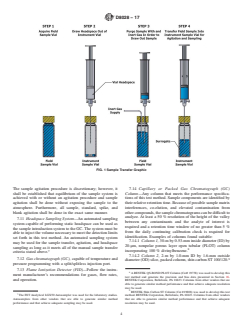
device/system. See Fig. 1.
method blanks, required, shall be used to verify proper
NOTE 1—The removable needle needs to be fitted with a Luer lock
sampling and handling procedures.
valvetoensurethesampleisnotexposedtoatmosphereduringthesample
transfer. See Fig. 1.
6.2 Contamination or carryover can occur whenever a
highly concentrated sample is run.Ablank shall be run after a 7.10 Sample Agitation—Samples can be agitated to achieve
highly concentrated sample to ensure system cleanliness. equilibrium of the dissolved gases in the headspace rapidly.
D8028 − 17
FIG. 1 Sample Transfer Graphic
The sample agitation procedure is discretionary; however, it 7.14 Capillary or Packed Gas Chromatograph (GC)
shall be established that equilibrium of the sample system is Column—Any column that meets the performance specifica-
achieved with or without an agitation procedure and sample tions of this test method. Sample components are identified by
agitation shall be done without exposing the sample to the theirrelativeretentiontime.Becauseofpossiblesamplematrix
atmosphere. Furthermore, all sample, standard, spike, and interferences, co-elution, and elevated contamination from
blank agitation shall be done in the exact same manner. othercompounds,thesamplechromatogramscanbedifficultto
analyze. At least a 50 % resolution of the height of the valley
7.11 Headspace Sampling System—An automated sampling
between any contaminants and the analyte of interest is
system capable of performing static headspace can be used as
required and a retention time window of no greater than 5 %
the sample introduction system to the GC. The system must be
from the daily continuing calibration check is required for
able to inject the volume necessary to meet the detection limits
identification. Examples of columns found suitable:
set forth in this test method. An automated sampling system
7.14.1 Column 1, 30-m by 0.53-mm inside diameter (ID) by
may be used for the sample transfer, agitation, and headspace
20-µm, nonpolar porous layer open tubular (PLOT) column
sampling as long as it meets all of the manual sample transfer
7 incorporating 100 % divinylbenzene.
criteria stated above.
7.14.2 Column 2, 2-m by 1.0-mm ID by 1.6-mm outside
7.12 Gas chromatograph (GC), capable of temperature and
diameter(OD)silco,packedcolumn,shincarbonST100/120.
pressure programming with a split/splitless injection port.
7.13 Flame Ionization Detector (FID)—Follow the instru-
A RESTEK QS-BOND PLOT Column (Cat# 19738) was used to develop this
ment manufacturer’s recommendations for gases, flow rates,
test method and generate the precision and bias data presented in Section 16.
and operation.
RESTEK Corporation, Bellefonte, PA16823. Columns from other vendors that are
able to generate similar method performance and that achieve adequate resolution
may be used.
RESTEK Shin Carbon ST Column (Cat #19808) was used to develop this test
The EST Analytical LGX50 Autosampler was used for the laboratory studies. method. RESTEK Corporation, Bellefonte, PA16823. Columns from other vendors
Autosamplers from other vendors that are able to generate similar method that are able to generate similar method performance and that achieve adequate
performance and that achieve adequate sampling may be used. resolution may be used.
D8028 − 17
8. Reagents and Materials 8.5.2.2 Ethane—62.0 mg/L.
8.5.2.3 Ethylene—149.0 mg/L.
8.1 Purity of Reagents—Reagent-grade chemicals shall be
8.5.2.4 Propane—76.7 mg/L.
used in all tests. It is intended that all reagents conform to the
8.5.3 Fill a 500-ml volumetric flask to the neck with water
specifications of the Committee on Analytical Reagents of the
and place it in the recirculating bath ensuring that the reagent
American Chemical Society where such specifications are
grade water in the flask is submerged in the recirculating bath.
available. Other grades may be used, provided it is first
Let the reagent grade water sit in the bath for long enough for
ascertained that the reagent is of sufficiently high purity to
the water to reach 20°C (60.5°C) using a calibrated digital
permit its use without lessening the accuracy of the determi-
thermometer.
nation.
8.5.4 Connect a flexible piece of tubing to the certified gas
8.2 Compressed Gases:
cylinder. Then, attach a glass pipette or a frit to the other end
8.2.1 Helium or Hydrogen—UHP grade or equivalent, for
of the tubing. Finally, place the pipette/frit at the end of the
GC system carrier gas.
tubing into the reagent water in the submerged volumetric
8.2.2 Air—Zerogradeorequivalent,foruseasFIDfuelgas.
flask. Tubing should be polyether ether ketone (PEEK), PTFE,
8.2.3 Hydrogen—UHP grade or equivalent, for use as FID
or clean copper.
fuel gas.
8.5.5 Open the valve of the certified gas cylinder enough to
8.2.4 Nitrogen—UHP grade or equivalent, for sweeping the
ensure vigorous bubbling of the gas in the water. Bubble the
instrument sample vials.
certified gas in the water for at least 30 min to ensure complete
8.3 Waters and Solvents: saturation.
8.3.1 Reagent Grade Water—Unless otherwise indicated,
NOTE 3—200 to 250-ml/min gas flow into 500 ml of water for 30 min
references to water shall be understood to mean reagent water
issufficienttoensuresaturation.Flowrate,time,andtemperatureneedsto
that meets purity specifications of Specification D1193. be documented.
8.3.2 Methanol—High purity laboratory control matrix
8.5.6 Repeat this procedure with a secondary source for the
spike (LC-MS) grade or equivalent, for preparation of surro-
secondary source stock standard solution.
gate working standard.
8.5.7 Alternative means of producing or procuring water-
based standards of the dissolved gases of known concentration
8.4 Certified Gas Cylinders—Purity of 99 % for preparation
of stock solutions. Certificate of analysis required. are acceptable provided they meet all quality assurance criteria
described in this test method.ACRM with a COAcan also be
8.4.1 Methane—Primary and secondary source.
8.4.2 Ethane—Primary and secondary source. used for the stock solution.
8.4.3 Ethylene—Primary and secondary source.
8.6 Initial Calibration (ICAL) Solutions—Prepared from the
8.4.4 Propane—Primary and secondary source.
primary stock solution standard.
8.6.1 ICAL solutions are prepared by performing serial
8.5 Stock Standard Solution—Preparation of the methane,
ethane, ethylene, and propane stock standard solutions are dilutions on the primary stock standard solution into a volu-
prepared fresh and expire after two weeks if preserved, see metric flask. The dilutions shall be performed while the stock
solution is still being purged with the analyte gas to ensure the
Appendix X1.The expiration date may be extended if alternate
storage conditions for laboratory prepared standards are dem- solution is consistently saturated. These dilutions need to be
immediately transferred to a 40-ml vial with PTFE-lined
onstrated using the process described in Appendix X1.Ifa
certified reference material (CRM) is procured with a certifi- chlorobutyl septa with no headspace until transferred to the
instrument sample vial. These solutions shall be refrigerated
cate of analysis (COA) denoting a different expiration period
specified by the manufacturer, the expiration denoted on the when not in use.
8.6.2 Alternative means of producing or procuring water-
CRM can be used.
8.5.1 Set up a recirculating bath set to 20°C 6 0.5°C at 1 based standards of the dissolved gases of known concentration
are acceptable provided they meet all quality assurance criteria
atm pressure in a laboratory fume hood.
described in this test method.ACRM with a COAcan also be
NOTE 2—The saturation concentration of the solution varies with the
used to prepare ICAL solutions.
temperature of the water and atmospheric pressure; thus, the temperature
of the water shall be controlled. Alternative saturation temperatures are
NOTE 4—The temperature of the standards during handling,
acceptable as long as the saturation concentrations are documented.
preparation, and dilution is as important as the temperature during the
equilibrium step. All steps for the solution preparation, sample transfer,
8.5.2 The saturation concentrations at 20°C and 1 atm
11,12
and dilution steps need to be done at the same approximate temperature.
pressure of the gases in this test method are as follows:
It is recommended that all standard preparation and dilution steps be
8.5.2.1 Methane—23.2 mg/L.
performed at a temperature of approximately 20 6 0.5°C to minimize the
chance for analyte loss. QC samples should be handled in the exact same
manner. Furthermore, after adding the aliquots of stock standard solution
Reagent Chemicals, American Chemical Society Specifications, American
tothevolumetricflask,thesolutionneedstobeinvertedgentlythreetimes
Chemical Society, Washington, DC. For suggestions on the testing of reagents not
in order to prevent analyte loss. Also, when transferring the standard
listed by the American Chemical Society, see Analar Standards for Laboratory
solution from the volumetric flask to the 40-ml vial, pour in such a way as
Chemicals, BDH Ltd., Poole, Dorset, U.K., and the United States Pharmacopeia
and National Formulary, U.S. Pharmacopeial Convention, Inc. (USPC), Rockville,
MD.
11 12
Dean, John A., Lange’s Handbook of Chemistry Fourteenth Edition, United Propane Gas Properties, http://encyclopedia.airliquide.com (accessed Nov. 5,
States of America, McGraw-Hill, Inc., 1972. 2011).
D8028 − 17
to prevent splashing, bubbling, or sample agitation.
based standards of the dissolved gases of known concentration
are acceptable provided they meet all quality assurance criteria
8.6.3 There must be at least five calibration points for every
described in this test method.ACRM with a COAcan also be
curve and separate ICALsolutions should be prepared for each
used to prepare CV solutions.
dissolved gas. If multi-analyte standards are available, then
multiple analytes can be combined in a single ICAL.
8.8.2 CV solutions can be stored up to one week in a 40-ml
8.6.4 ICALsolutions can be stored up to one week in 40-ml
vial with PTFE-lined chlorobutyl septa, two weeks if
vials with PTFE-lined chlorobutyl septa with no headspace at
preserved, with no headspace at a temperature range of above
temperature range of above freezing to 6°C until analysis (see
freezing to 6°C (see Appendix X1).
Appendix X1); two weeks if standard is preserved and a
8.9 Surrogate Analyte—A surrogate analyte needs to be
chlorobutyl septa is used (see Appendix X1).
added to the instrument headspace vial. The concentration for
8.7 Laboratory Control Standard (LCS) and Laboratory
the surrogate should be in an appropriate concentration of the
Control Standard Duplicate (LCSD)—LCS and LCSD solu-
calibration range and the concentration of the surrogate should
tions are prepared from the primary source stock standard
remain constant throughout the calibration.The surrogate shall
solution.
elute during the temperature ramp of the experiment with at
8.7.1 LCS and LCSD solutions are prepared by performing
least 80 % resolution of the height of the valley between the
dilutions on the primary stock standard solution. The LCS
surrogate and any analyte of interest. The surrogate is used to
solutionsneedtobepreparedwhilethesolutionispurgingwith
verify analytical performance of standards, blanks, and
the analyte to ensure the solution is saturated. LCS and LCSD
samples. An alternate surrogate compound that mimics the
need to be prepared for each analyte to be analyzed and
analyte properties may also be used.
prepared similar to 8.6.1.ACRM with a COAcan also be used
NOTE5—Forthisstudy,MTBE-d3wasusedasthesurrogate.However,
for an LCS/LCSD solution. As in 8.6.2, alternative means of
if there is a likelihood of MTBE in the sample, an alternate surrogate
producing or procuring water-based standards of the dissolved
should be used as MTBE and MTBE-d3 do not resolve chromatographi-
gases of known concentration are acceptable provided they
cally. The MTBE-d3 was procured from a certified reference supplier at a
meetallqualityassurancecriteriadescribedinthistestmethod.
concentration of 2000 µg/ml. MTBE-d3 was chosen as a surrogate due to
A CRM with a COA can also be used to prepare ICAL
the fact that it is not a naturally occurring compound, its solubility in
solutions. water, its ability to come to equilibrium quickly, and because the elution
time does not interfere with any of the analytes of interest. The MTBE-d3
8.7.2 LCSandLCSDsolutionscanbestoreduptooneweek
was diluted in purge and trap methanol to 1000 µg/ml and 10 µl of the
in a 40-ml vial with PTFE-lined chlorobutyl septa, two weeks
surrogate was added to each sample.
if preserved, with no headspace at a temperature range of
above freezing to 6°C (see Appendix X1). 8.10 Method Blank (MB)—Fill a prepared instrument
sample vial with reagent water for subsequent heads
...