

ASTM F2237-03(2020)
(Test Method)Standard Test Method for Performance of Upright Overfired Broilers
General Information
- Abstract
SIGNIFICANCE AND USE
5.1 The energy input rate test is used to confirm that the overfired broiler is operating properly prior to further testing.
5.2 Temperature uniformity of the broiler cavity may be used by food service operators to select an overfired broiler with the desired temperature gradients.
5.3 Preheat energy and time can be useful to food service operators to manage energy demands and to know how quickly the overfired broiler can be ready for operation.
5.4 Idle energy rate and pilot energy rate can be used to estimate energy consumption during non-cooking periods.
5.5 Cooking energy efficiency is a precise indicator of overfired broiler energy performance while cooking a typical food product under various loading conditions. If energy performance information is desired using a food product other than the specified test food, the test method could be adapted and applied. Energy performance information allows an end user to better understand the operating characteristics of an overfired broiler.
5.6 Production capacity can help an end user to better understand the production capabilities of an overfired broiler as it is used to cook a typical food product, helping with specification of the proper size and quantity of equipment. If production information is desired using a food product other than the specified test food, the test method could be adapted and applied.
SCOPE
1.1 This test method evaluates the energy consumption and cooking performance of overfired broilers. The food service operator can use this evaluation to select an overfired broiler and understand its performance and energy consumption.
1.2 This test method is applicable to gas and electric upright overfired broilers having input rates greater than 60,000 Btu/h (gas overfired broilers) or 10kW (electric overfired broilers).
1.3 The overfired broiler can be evaluated with respect to the following (where applicable):
1.3.1 Energy input rate (see 10.2),
1.3.2 Temperature uniformity of the broiler cavity (see 10.3),
1.3.3 Preheat energy consumption and time (see 10.4),
1.3.4 Pilot energy rate (if applicable) (see 10.5),
1.3.5 Idle energy rate (see 10.6), and
1.3.6 Cooking energy efficiency and production capacity (see 10.7).
1.4 The values stated in inch-pound units are to be regarded as standard. The values given in parentheses are mathematical conversions to SI units that are provided for information only and are not considered standard.
1.5 This test method may involve hazardous materials, operations, and equipment. This standard does not purport to address all of the safety concerns, if any, associated with its use. It is the responsibility of the user of this standard to establish appropriate safety, health, and environmental practices and determine the applicability of regulatory limitations prior to use.
1.6 This international standard was developed in accordance with internationally recognized principles on standardization established in the Decision on Principles for the Development of International Standards, Guides and Recommendations issued by the World Trade Organization Technical Barriers to Trade (TBT) Committee.
- Status
- Published
- Publication Date
- 30-Jun-2020
- Technical Committee
- F26 - Food Service Equipment
- Drafting Committee
- F26.06 - Productivity and Energy Protocol
Overview
ASTM F2237-03(2020): Standard Test Method for Performance of Upright Overfired Broilers is an internationally recognized testing methodology developed by ASTM International. The standard applies to both gas and electric upright overfired broilers-commercial cooking appliances characterized by a high-temperature radiant heat source above a heavy-duty cooking grate. This test method is specifically designed to evaluate the energy consumption and cooking performance of upright overfired broilers with input rates greater than 60,000 Btu/h (for gas units) or 10 kW (for electric units).
By establishing uniform procedures and measurement criteria, ASTM F2237-03(2020) assists food service operators, manufacturers, and commercial kitchen planners in assessing and comparing the operational characteristics and energy performance of overfired broilers.
Key Topics
This standard covers several critical aspects of overfired broiler performance, including:
- Energy Input Rate: Confirms that the broiler operates within its specified input limits before additional testing.
- Temperature Uniformity: Measures temperature gradients across the broiler cavity, which can impact food quality and evenness of cooking.
- Preheat Energy and Time: Quantifies the energy usage and time required to bring the broiler to operating temperature from ambient conditions, aiding operators in energy management and workflow planning.
- Idle Energy and Pilot Energy Rates: Estimates energy consumed during non-cooking periods-important for understanding overall appliance efficiency and operating costs.
- Cooking Energy Efficiency: Provides a precise measure of how effectively the broiler converts energy into cooking output under different loading conditions.
- Production Capacity: Evaluates the maximum throughput of the broiler, assisting in equipment selection and kitchen design.
Safety considerations-including adherence to appropriate health, environmental, and regulatory practices-are also emphasized throughout the document.
Applications
ASTM F2237-03(2020) provides significant practical value to a range of foodservice industry stakeholders:
- Restaurant and Commercial Kitchen Operators: Enables informed selection of upright overfired broilers based on energy consumption, cooking capacity, and temperature uniformity, leading to better product quality and operational efficiency.
- Facility Managers and Energy Auditors: Supplies standardized metrics for benchmarking appliance energy performance, supporting sustainability and cost-reduction initiatives.
- Equipment Manufacturers: Offers a reliable performance evaluation protocol for product development, quality assurance, and competitive comparison.
- Regulatory Compliance: Facilitates alignment with international energy efficiency and safety standards for commercial kitchen appliances.
By applying this test method, users gain detailed insights into the performance characteristics of overfired broilers under real-world conditions, ensuring that equipment investments are matched to operational needs.
Related Standards
For comprehensive evaluation and regulatory alignment, several standards and reference documents are associated with ASTM F2237-03(2020):
- ASTM A36/A36M: Specification for Carbon Structural Steel (used in test apparatus)
- ASTM D3588: Practice for Calculating Heat Value, Compressibility Factor, and Relative Density of Gaseous Fuels
- AOAC Official Action 950.46: Air Drying to Determine Moisture Content of Meat and Meat Products
- ASHRAE Handbook of Fundamentals: Thermal and Related Properties of Food and Food Materials
- ANSI Z83.11: Gas Food Service Equipment
Referencing these standards ensures the test method produces accurate, repeatable, and reliable results across different equipment and installations.
Keywords: ASTM F2237, overfired broiler performance, commercial cooking equipment, energy consumption, broiler efficiency, temperature uniformity, production capacity, food service standards, kitchen appliance testing, ASTM International
Relations
- Effective Date
- 01-Jul-2020
- Effective Date
- 01-Nov-2012
- Effective Date
- 01-Nov-2011
- Effective Date
- 15-May-2008
- Effective Date
- 01-Mar-2005
- Effective Date
- 01-Apr-2004
- Effective Date
- 10-May-2003
- Effective Date
- 10-May-2003
- Effective Date
- 10-Apr-2003
- Effective Date
- 10-Dec-2002
- Effective Date
- 10-Sep-2001
- Effective Date
- 10-Sep-2001
- Effective Date
- 10-May-1998
- Effective Date
- 01-Jul-2020
- Effective Date
- 01-Jul-2020
Frequently Asked Questions
ASTM F2237-03(2020) is a standard published by ASTM International. Its full title is "Standard Test Method for Performance of Upright Overfired Broilers". This standard covers: SIGNIFICANCE AND USE 5.1 The energy input rate test is used to confirm that the overfired broiler is operating properly prior to further testing. 5.2 Temperature uniformity of the broiler cavity may be used by food service operators to select an overfired broiler with the desired temperature gradients. 5.3 Preheat energy and time can be useful to food service operators to manage energy demands and to know how quickly the overfired broiler can be ready for operation. 5.4 Idle energy rate and pilot energy rate can be used to estimate energy consumption during non-cooking periods. 5.5 Cooking energy efficiency is a precise indicator of overfired broiler energy performance while cooking a typical food product under various loading conditions. If energy performance information is desired using a food product other than the specified test food, the test method could be adapted and applied. Energy performance information allows an end user to better understand the operating characteristics of an overfired broiler. 5.6 Production capacity can help an end user to better understand the production capabilities of an overfired broiler as it is used to cook a typical food product, helping with specification of the proper size and quantity of equipment. If production information is desired using a food product other than the specified test food, the test method could be adapted and applied. SCOPE 1.1 This test method evaluates the energy consumption and cooking performance of overfired broilers. The food service operator can use this evaluation to select an overfired broiler and understand its performance and energy consumption. 1.2 This test method is applicable to gas and electric upright overfired broilers having input rates greater than 60,000 Btu/h (gas overfired broilers) or 10kW (electric overfired broilers). 1.3 The overfired broiler can be evaluated with respect to the following (where applicable): 1.3.1 Energy input rate (see 10.2), 1.3.2 Temperature uniformity of the broiler cavity (see 10.3), 1.3.3 Preheat energy consumption and time (see 10.4), 1.3.4 Pilot energy rate (if applicable) (see 10.5), 1.3.5 Idle energy rate (see 10.6), and 1.3.6 Cooking energy efficiency and production capacity (see 10.7). 1.4 The values stated in inch-pound units are to be regarded as standard. The values given in parentheses are mathematical conversions to SI units that are provided for information only and are not considered standard. 1.5 This test method may involve hazardous materials, operations, and equipment. This standard does not purport to address all of the safety concerns, if any, associated with its use. It is the responsibility of the user of this standard to establish appropriate safety, health, and environmental practices and determine the applicability of regulatory limitations prior to use. 1.6 This international standard was developed in accordance with internationally recognized principles on standardization established in the Decision on Principles for the Development of International Standards, Guides and Recommendations issued by the World Trade Organization Technical Barriers to Trade (TBT) Committee.
SIGNIFICANCE AND USE 5.1 The energy input rate test is used to confirm that the overfired broiler is operating properly prior to further testing. 5.2 Temperature uniformity of the broiler cavity may be used by food service operators to select an overfired broiler with the desired temperature gradients. 5.3 Preheat energy and time can be useful to food service operators to manage energy demands and to know how quickly the overfired broiler can be ready for operation. 5.4 Idle energy rate and pilot energy rate can be used to estimate energy consumption during non-cooking periods. 5.5 Cooking energy efficiency is a precise indicator of overfired broiler energy performance while cooking a typical food product under various loading conditions. If energy performance information is desired using a food product other than the specified test food, the test method could be adapted and applied. Energy performance information allows an end user to better understand the operating characteristics of an overfired broiler. 5.6 Production capacity can help an end user to better understand the production capabilities of an overfired broiler as it is used to cook a typical food product, helping with specification of the proper size and quantity of equipment. If production information is desired using a food product other than the specified test food, the test method could be adapted and applied. SCOPE 1.1 This test method evaluates the energy consumption and cooking performance of overfired broilers. The food service operator can use this evaluation to select an overfired broiler and understand its performance and energy consumption. 1.2 This test method is applicable to gas and electric upright overfired broilers having input rates greater than 60,000 Btu/h (gas overfired broilers) or 10kW (electric overfired broilers). 1.3 The overfired broiler can be evaluated with respect to the following (where applicable): 1.3.1 Energy input rate (see 10.2), 1.3.2 Temperature uniformity of the broiler cavity (see 10.3), 1.3.3 Preheat energy consumption and time (see 10.4), 1.3.4 Pilot energy rate (if applicable) (see 10.5), 1.3.5 Idle energy rate (see 10.6), and 1.3.6 Cooking energy efficiency and production capacity (see 10.7). 1.4 The values stated in inch-pound units are to be regarded as standard. The values given in parentheses are mathematical conversions to SI units that are provided for information only and are not considered standard. 1.5 This test method may involve hazardous materials, operations, and equipment. This standard does not purport to address all of the safety concerns, if any, associated with its use. It is the responsibility of the user of this standard to establish appropriate safety, health, and environmental practices and determine the applicability of regulatory limitations prior to use. 1.6 This international standard was developed in accordance with internationally recognized principles on standardization established in the Decision on Principles for the Development of International Standards, Guides and Recommendations issued by the World Trade Organization Technical Barriers to Trade (TBT) Committee.
ASTM F2237-03(2020) is classified under the following ICS (International Classification for Standards) categories: 97.040.20 - Cooking ranges, working tables, ovens and similar appliances. The ICS classification helps identify the subject area and facilitates finding related standards.
ASTM F2237-03(2020) has the following relationships with other standards: It is inter standard links to ASTM F2237-03(2015), ASTM A36/A36M-12, ASTM D3588-98(2011), ASTM A36/A36M-08, ASTM A36/A36M-05, ASTM A36/A36M-04, ASTM A36/A36M-03a, ASTM D3588-98(2003), ASTM A36/A36M-03, ASTM A36/A36M-02, ASTM A36/A36M-01, ASTM A36/A36M-00a, ASTM D3588-98, ASTM F1704-12(2022), ASTM F2875-10(2020). Understanding these relationships helps ensure you are using the most current and applicable version of the standard.
ASTM F2237-03(2020) is available in PDF format for immediate download after purchase. The document can be added to your cart and obtained through the secure checkout process. Digital delivery ensures instant access to the complete standard document.
Standards Content (Sample)
This international standard was developed in accordance with internationally recognized principles on standardization established in the Decision on Principles for the
Development of International Standards, Guides and Recommendations issued by the World Trade Organization Technical Barriers to Trade (TBT) Committee.
Designation:F2237 −03 (Reapproved 2020) An American National Standard
Standard Test Method for
Performance of Upright Overfired Broilers
This standard is issued under the fixed designation F2237; the number immediately following the designation indicates the year of
original adoption or, in the case of revision, the year of last revision.Anumber in parentheses indicates the year of last reapproval.A
superscript epsilon (´) indicates an editorial change since the last revision or reapproval.
1. Scope 2. Referenced Documents
1.1 This test method evaluates the energy consumption and 2.1 ASTM Standards:
cooking performance of overfired broilers. The food service A36/A36MSpecification for Carbon Structural Steel
D3588Practice for Calculating Heat Value, Compressibility
operator can use this evaluation to select an overfired broiler
and understand its performance and energy consumption. Factor, and Relative Density of Gaseous Fuels
2.2 AOAC Document:
1.2 Thistestmethodisapplicabletogasandelectricupright
AOAC Official Action 950.46Air Drying to Determine
overfired broilers having input rates greater than 60,000 Btu/h
Moisture Content of Meat and Meat Products
(gas overfired broilers) or 10kW (electric overfired broilers).
2.3 ASHRAE Standard:
1.3 The overfired broiler can be evaluated with respect to
ASHRAE Handbook of Fundamentals“Thermal and Re-
the following (where applicable):
latedPropertiesofFoodandFoodMaterials,”Chapter30,
1.3.1 Energy input rate (see 10.2),
Table 1, 1989
1.3.2 Temperature uniformity of the broiler cavity (see
2.4 ANSI Standard:
10.3),
ANSI Z83.11Gas Food Service Equipment
1.3.3 Preheat energy consumption and time (see 10.4),
1.3.4 Pilot energy rate (if applicable) (see 10.5),
3. Terminology
1.3.5 Idle energy rate (see 10.6), and
1.3.6 Cooking energy efficiency and production capacity
3.1 Definitions:
(see 10.7). 3.1.1 broiler cavity, n—that portion of the overfired broiler
in which food products are heated or cooked.
1.4 The values stated in inch-pound units are to be regarded
3.1.2 cooking energy effıciency, n—quantity of energy im-
as standard. The values given in parentheses are mathematical
parted to the specified food product, expressed as a percentage
conversions to SI units that are provided for information only
ofenergyconsumedbytheoverfiredbroilerduringthecooking
and are not considered standard.
event.
1.5 This test method may involve hazardous materials,
3.1.3 cooking energy rate, n—average rate of energy con-
operations, and equipment. This standard does not purport to
sumption (Btu/h or kW) during the cooking energy efficiency
address all of the safety concerns, if any, associated with its
tests.
use. It is the responsibility of the user of this standard to
establish appropriate safety, health, and environmental prac-
3.1.4 grate, broiler grate, n—the platform on which food is
tices and determine the applicability of regulatory limitations
placed while cooking in an overfired broiler.
prior to use.
3.1.5 idle energy rate, n—the overfired broiler’s rate of
1.6 This international standard was developed in accor-
energy consumption (kW or Btu/h), when empty, required to
dance with internationally recognized principles on standard-
maintainthebroiler’soperatingtemperaturewhilenotcooking.
ization established in the Decision on Principles for the
Development of International Standards, Guides and Recom-
mendations issued by the World Trade Organization Technical
For referenced ASTM standards, visit the ASTM website, www.astm.org, or
Barriers to Trade (TBT) Committee.
contact ASTM Customer Service at service@astm.org. For Annual Book of ASTM
Standards volume information, refer to the standard’s Document Summary page on
the ASTM website.
Available from Association of Official Analytical Chemists, 1111 N. 19th
This test method is under the jurisdiction of ASTM Committee F26 on Food Street, Arlington, VA 22209.
Service Equipment and is the direct responsibility of Subcommittee F26.06 on Available from American Society of Heating, Refrigerating, and Air-
Productivity and Energy Protocol. Conditioning Engineers, Inc. (ASHRAE), 1791 Tullie Circle, NE, Atlanta, GA
Current edition approved July 1, 2020. Published August 2020. Originally 30329.
approved in 2003. Last previous edition approved in 2015 as F2237–03 (2015). Available fromAmerican National Standards Institute (ANSI), 25 W. 43rd St.,
DOI: 10.1520/F2237-03R20. 4th Floor, New York, NY 10036.
Copyright © ASTM International, 100 Barr Harbor Drive, PO Box C700, West Conshohocken, PA 19428-2959. United States
F2237−03 (2020)
3.1.6 overfiredbroiler,n—anappliancewithahightempera- 4.4 Thepilotenergyrateisdetermined,whenapplicable,for
ture radiant heat source above a heavy duty, sliding grate for gas overfired broilers.
cooking food, characterized by an open front cooking cavity
4.5 Idle energy rate is determined while maintaining the
and having an input rate greater than 60000 Btu/h or 10kW.
broiler cavity at its operating temperature while not cooking.
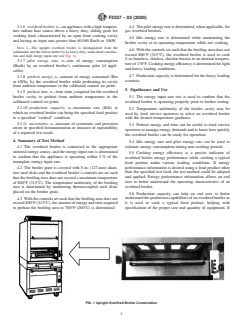
NOTE 1—The upright overfired broiler is distinguished from the
4.6 Withthecontrolssetsuchthatthebroilingareadoesnot
salamanderandthecheesemelterbyitsheavyduty,stand-aloneconstruc-
exceed 800°F (315°C), the overfired broiler is used to cook
tion and high energy input rate (see Fig. 1).
5-oz boneless, skinless, chicken breasts to an internal tempera-
3.1.7 pilot energy rate, n—rate of energy consumption
tureof170°F.Cookingenergyefficiencyisdeterminedforlight
(Btu/h) by an overfired broiler’s continuous pilot (if appli-
and heavy loading conditions.
cable).
4.7 Production capacity is determined for the heavy loading
3.1.8 preheat energy, n—amount of energy consumed (Btu
scenario.
or kWh), by the overfired broiler while preheating its cavity
from ambient temperature to the calibrated control set point.
5. Significance and Use
3.1.9 preheat time, n—time(min.)requiredfortheoverfired
broiler cavity to preheat from ambient temperature to the 5.1 The energy input rate test is used to confirm that the
calibrated control set point. overfired broiler is operating properly prior to further testing.
3.1.10 production capacity, n—maximum rate (lb/h) at
5.2 Temperature uniformity of the broiler cavity may be
which an overfired broiler can bring the specified food product
used by food service operators to select an overfired broiler
to a specified “cooked” condition.
with the desired temperature gradients.
3.1.11 uncertainty, n—measure of systematic and precision
5.3 Preheat energy and time can be useful to food service
errors in specified instrumentation or measure of repeatability
operatorstomanageenergydemandsandtoknowhowquickly
of a reported test result.
the overfired broiler can be ready for operation.
4. Summary of Test Method
5.4 Idle energy rate and pilot energy rate can be used to
estimate energy consumption during non-cooking periods.
4.1 The overfired broiler is connected to the appropriate
metered energy source,andtheenergyinputrateis determined
5.5 Cooking energy efficiency is a precise indicator of
to confirm that the appliance is operating within 5% of the
overfired broiler energy performance while cooking a typical
nameplate energy input rate.
food product under various loading conditions. If energy
performance information is desired using a food product other
4.2 The broiler grate is covered with 5-in. (127-mm) diam-
than the specified test food, the test method could be adapted
eter steel disks and the overfired broiler’s controls are set such
and applied. Energy performance information allows an end
that the broiling area does not exceed a maximum temperature
user to better understand the operating characteristics of an
of 800°F (315°C). The temperature uniformity of the broiling
overfired broiler.
area is determined by monitoring thermocoupled steel disks
placed on the broiler grate.
5.6 Production capacity can help an end user to better
4.3 Withthecontrolssetsuchthatthebroilingareadoesnot understandtheproductioncapabilitiesofanoverfiredbroileras
exceed800°F(315°C),theamountofenergyandtimerequired it is used to cook a typical food product, helping with
to preheat the broiling area to 700°F (260°C) is determined. specification of the proper size and quantity of equipment. If
FIG. 1Upright Overfired Broiler Construction
F2237−03 (2020)
production information is desired using a food product other 6.14 Watt-Hour Meter, for measuring the electrical energy
than the specified test food, the test method could be adapted consumption of an overfired broiler, shall have a resolution of
and applied. at least 10 Wh and a maximum uncertainty no greater than
1.5% of the measured value for any demand greater than 100
6. Apparatus
W. For any demand less than 100 W, the meter shall have a
6.1 Analytical Balance Scale, for measuring weights up to
resolution of at least 10 Wh and a maximum uncertainty no
20 lb, with a resolution of 0.01 lb, and an uncertainty of 0.01
greater than 10%.
lb.
7. Reagents and Materials
6.2 Barometer, for measuring absolute atmospheric
7.1 Aluminum Sheet Pans,measuring18by26by1in.(457
pressure, to be used for adjustment of measured natural gas
by 660 by 25 mm), for use in packaging chicken breasts.
volume to standard conditions. Shall have a resolution of 0.2
in. Hg and an uncertainty of 0.2 in. Hg.
7.2 Chicken Breasts,shallbenominal5-ozfrozen,boneless,
skinless, butterfly cut, chicken breasts (whole meat, not fabri-
6.3 Canopy Exhaust Hood,4ftindepth,wall-mountedwith
cated). When thawed and drained, each chicken breast shall
the lower edge of the hood 6 ft, 6 in. from the floor and with
weigh 4.8 6 0.2 oz.
the capacity to operate at a nominal exhaust ventilation rate of
300 cfm per linear foot of active hood length. This hood shall
7.3 Drip Rack, sized to fit 18 by 26 by 1 in. (457 by 660 by
extend a minimum of 6 in. past both sides and the front of the
25 mm) aluminum sheet pans, for packaging chicken breasts.
cooking appliance and shall not incorporate side curtains or
7.4 FishHooks,size1,foruseinattachingthermocouplesto
partitions.
chicken breasts.
6.4 Convection Drying Oven,withtemperaturecontrolledat
7.5 Plastic Wrap, commercial grade, 18 in. (457 mm) wide,
215 to 220°F (101 to 104°C), used to determine moisture
for use in packaging chicken breasts.
content of both the raw and cooked food product.
7.6 Tongs, commercial grade, metal construction, for han-
6.5 Data Acquisition System, for measuring energy and
dling chicken breasts.
temperatures, capable of multiple-temperature displays updat-
ing at least every 5 s.
8. Sampling and Test Units
6.6 Gas Meter, for measuring the gas consumption of an
8.1 Overfired Broiler—Select a representative production
overfired broiler, shall be a positive displacement type with a
model for performance testing.
resolution of at least 0.01 ft and a maximum uncertainty no
9. Preparation of Apparatus
greaterthan1%ofthemeasuredvalueforanydemandgreater
than 2.2 ft /h. If the meter is used for measuring the gas
9.1 Install the appliance according to the manufacturer’s
consumed by the pilot lights, it shall have a resolution of at
instructions under a canopy exhaust hood. Position the over-
least 0.01 ft and a maximum uncertainty no greater than 2%
fired broiler so that a minimum of 6 in. is maintained between
of the measured value.
the edge of the hood and the vertical plane of the front and
sides of the appliance. In addition, both sides of the overfired
6.7 Pressure Gage, for monitoring natural gas pressure.
broiler shall be a minimum of 3 ft from any side wall, side
Shall have a range of zero to 10 in. water, a resolution of 0.5
partition, or other operating appliance. The exhaust ventilation
in. water, and a maximum uncertainty of 1% of the measured
rate shall be 300 cfm per linear foot of active hood length.The
value.
associated heating or cooling system shall be capable of
6.8 Steel Disks, composed of structural-grade carbon steel
maintaining an ambient temperature of 75 6 5°F within the
in accordance with Specification A36/A36M, free of rust or
testing environment when the exhaust ventilation system is
corrosion, 5-in. (127 mm) diameter, and ⁄4-in. (6.3-mm) thick.
operating.
The disks shall be flat to within 0.010 in. (0.25 mm) over the
NOTE 2—The ambient temperature requirements are designed to simu-
diameter.
laterealworldkitchentemperaturesandaremeanttoprovideareasonable
guideline for the temperature requirements during testing. If a facility is
6.9 Stop Watch, with a 1-s resolution.
not able to maintain the required temperatures, then it is reasonable to
6.10 Strain Gage Welder,capableofweldingthermocouples expectthattheapplicationoftheproceduremaydeviatefromthespecified
requirements(ifitcannotbeavoided)aslongasthosedeviationsarenoted
to steel.
on the Results Reporting Sheets.
6.11 Temperature Sensor, for measuring natural gas tem-
9.2 Connect the overfired broiler to a calibrated energy test
perature in the range of 50 to 100°F (10 to 38°C) with an
meter. For gas installations, install a pressure regulator down-
uncertainty of 61°F (0.56°C).
stream from the meter to maintain a constant pressure of gas
6.12 Thermocouple(s),fiberglassinsulated,24gage,TypeK
for all tests. Install instrumentation to record both the pressure
thermocouple wire, peened flat at the exposed ends and spot
andtemperatureofthegassuppliedtotheoverfiredbroilerand
weldedtothecenterofthesteeldisksurfaceswithastraingage
the barometric pressure during each test so that the measured
welder.
gas flow can be corrected to standard conditions. For electric
6.13 Thermocouple(s),fiberglassinsulated,24gage,TypeK installations,avoltageregulatormayberequiredduringtestsif
thermocouplewire,weldedandcalibrated,foruseindetermin- the voltage supply is not within 62.5% of the manufacturer’s
ing the temperature of the chicken breasts. nameplate voltage.
F2237−03 (2020)
9.3 For an electric overfired broiler, confirm (while the 10.2.2 For electric overfired broilers, monitor the energy
overfired broiler elements are energized) that the supply consumption for 15 min with the controls set to achieve
voltage is within 62.5% of the operating voltage specified by maximum input.
the manufacturer. Record the test voltage for each test. 10.2.3 Calculate and record the overfired broiler’s energy
NOTE 3—It is the intent of the test procedure herein to evaluate the input rate and compare the result to the rated nameplate input.
performance of an overfired broiler at its rated gas pressure or electric
Confirm that the measured input rate (Btu/h (kJ/h)) for a gas
voltage.Ifanelectricunitisrateddualvoltage(thatis,designedtooperate
overfired broiler and kW for an electric overfired broiler) is
ateither208or240Vwithnochangeincomponents),thevoltageselected
within 5% of the rated nameplate input. If the difference is
by the manufacturer or tester, or both, shall be reported. If an overfired
greater than 5%, terminate testing and contact the manufac-
broiler is designed to operate at two voltages without a change in the
resistance of the heating elements, the performance of the unit (for
turer. The manufacturer may make appropriate changes or
example, the preheat time) may differ at the two voltages.
adjustmentstotheoverfiredbroiler,orsupplyanotheroverfired
9.4 For a gas overfired broiler, adjust (during maximum broiler for testing.
NOTE 5—For gas overfired broilers, only the burner energy consump-
energy input) the gas supply pressure downstream from the
tion is used to compare the calculated energy input rate with the rated gas
appliance’s pressure regulator to within 62.5% of the operat-
input;anyelectricalenergyuseshallbecalculatedandrecordedseparately
ing manifold pressure specified by the manufacturer. Make
as the control energy rate.
adjustments to the appliance following the manufacturer’s
10.3 Temperature Uniformity:
recommendations for optimizing combustion. Proper combus-
10.3.1 Using a strain gage welder, attach one thermocouple
tion may be verified by measuring air-free CO in accordance
to the center of one side of each 5-in (127-mm) diameter, ⁄4-in
with ANSI Z83.11.
(6.3-mm) thick steel disk. Add a strain relief to each thermo-
couple to facilitate handling of the disks.
10. Procedure
10.3.2 Determine the number of disks required for the
10.1 General:
broiler under test as follows:
10.1.1 For gas overfired broilers, record the following for 10.3.2.1 Measure the actual width and depth of the broiler
each test run: grate.
10.3.2.2 Each column of disks (from front to back) shall
10.1.1.1 Higher heating value,
have one disk for every 5 ⁄4 in. (133 mm) of grate depth.
10.1.1.2 Standard gas pressure and temperature used to
10.3.2.3 Eachrowofdisks(fromsidetoside)shallhaveone
correct measured gas volume to standard conditions,
disk for every 5 ⁄4 in. (133 mm) of grate width.
10.1.1.3 Measured gas temperature,
10.3.2.4 Record the number of disks used.
10.1.1.4 Measured gas pressure,
10.1.1.5 Barometric pressure,
NOTE 6—This determination accounts for the differences between
nominal broiler size and actual grate size. It is the intent of this test
10.1.1.6 Energy input rate during or immediately prior to
method to determine the temperature uniformity using a reasonable
test(forexample,duringthepreheatforthatday’stesting),and
number of steel disks, while still allowing for space between disks.
10.1.1.7 Ambient temperature.
10.3.3 Position the disks thermocoupled-side up on the
NOTE 4—Using a calorimeter or gas chromatograph in accordance with
broilergrate.Arrangethedisksinagridpatternandensurethat
accepted laboratory procedures is the preferred method for determining
they are evenly spaced across the broiler grate (see Fig. 2).
thehigherheatingvalueofgassuppliedtotheoverfiredbroilerundertest.
10.3.4 Set the overfired broiler controls to achieve maxi-
It is recommended that all testing be performed with gas having a higher
mum input, then adjust the controls back so that the tempera-
heating value of 1000 to 1075 Btu/ft .
ture of each disk does not exceed 800°F (412°C). Mark this
10.1.2 For gas overfired broilers, add electric energy con-
position on the control knobs.
sumption to gas energy for all tests, with the exception of the
NOTE 7—The overfired broiler should be set such that the broiling
energy input rate test (see 10.2).
temperature is as high as possible without exceeding 800°F (412°C).
10.1.3 For electric overfired broilers, record the following
NOTE 8—Be sure to stabilize the broiler for at least 60 min after any
for each test run:
control adjustment.
10.1.3.1 Voltage while elements are energized,
10.3.5 Monitor the disk temperatures for a minimum of 60
10.1.3.2 Energy input rate during or immediately prior to
min. Determine the average temperature for each disk.
test(forexample,duringthepreheatforthatday’stesting),and
10.4 Preheat Energy Consumption and Time:
10.1.3.3 Ambient temperature.
10.4.1 Place one disk from 10.3.1 in the center of each
10.1.4 For each test run, confirm that the peak input rate is
linear foot (305 mm) of broiler grate, thermocouple side up.
within 65% of the rated nameplate input. If the difference is
10.4.2 Record the disk temperature(s) and the ambient
greater than 5%, terminate testing and contact the manufac-
kitchen temperature at the start of the test (each temperature
turer. The manufacturer may make appropriate changes or
shall be 75 6 5°F (24 6 2.8°C) at start of the test).
adjustments to the overfired broiler.
10.4.3 Set the overfired broiler controls to achieve maxi-
10.2 Energy Input Rate:
mum energy input.
10.2.1 For gas overfired broilers, set the controls to achieve 10.4.4 Turnthebroileronandrecordtheenergyandtimeto
maximum input.Allow the unit to run for a period of 15 min, preheat all sections of the overfired broiler jointly. Preheat is
then monitor the time required for the overfired broiler to judged complete when the last of the disks reaches 700°F
3 3
consume 10 ft (0.28 m ) of gas. (357°C).
F2237−03 (2020)
FIG. 2Thermocouple Disk Placement
NOTE 9—Research at the Food Service Technology Center has deter-
10.7.1.3 Each light load test run shall use five chicken
mined that an overfired broiler is ready to cook when the broiler has
breasts.
reached a temperature of 700°F.
10.7.2 Thawenoughchickenbreastsforaminimumofthree
10.5 Pilot Energy Rate:
heavy load and three light load test runs, based on the number
10.5.1 For a gas overfired broiler with a standing pilot, set
of breasts determined in 10.7.1. Place thawed chicken breasts
the gas valve at the “pilot” position and set the overfired
on drip racks and drain in a refrigerator for 1 h.
broiler’s temperature control to the “off” position.
10.5.2 Light and adjust the pilot according to the manufac-
NOTE 11—It is suggested that the frozen chicken breasts be thawed in
turer’s instructions.
cold running water.
10.5.3 Monitor gas consumption for a minimum of8hof
NOTE 12—It is important that the raw chicken breasts be properly and
pilot operation. consistently thawed and drained. Excess moisture will affect the energy
efficiency calculations and make test replication difficult.
10.6 Idle Energy Rate:
NOTE 13—A minimum of three test runs is specified for each loading
10.6.1 Set the overfired broiler controls to the position
scenario, however, more test runs may be necessary if the results do not
determined in 10.3.4.Turn the overfired broiler on, preheat the
meet the uncertainty criteria specified in Annex A1.
broiler, and allow it to stabilize for 60 min.
10.7.3 Mark a sheet pan with a number for later identifica-
10.6.2 After the 60-min stabilization period, monitor the
tion. Weigh the sheet pan and record the weight. Place the
energy consumption for an additional 2 h.
numberofchickenbreastsrequiredforthetestrunonthesheet
10.7 Cooking Energy Effıciency:
pan. Weigh the pan with the chicken breasts to determine the
10.7.1 Cooking energy efficiency tests are performed for
weight of the chicken breasts. Determine the target weight
both heavy and light load scenarios. Determine the number of
rangebymultiplyingthenumberofchickenbreastsusedby0.3
chicken breasts to be used in each test run as follows:
6 0.0125 lb. If the weight of the chicken breasts is not within
10.7.1.1 Each row (left to right) of chicken breasts placed
the target weight range, thaw extra chicken breasts and
on the grate for the heavy load test shall have one breast for
substitute individual breasts as necessary to reach the target
each4in.ofgratewidth.Forexample,anoverfiredbroilerwith
weight. Repeat 10.7.3 for each test run.
a grate width of 25 in. would use six chicken breasts per row.
10.7.1.2 For heavy load test runs, there shall be one row of 10.7.4 For heavy load test runs, use the number of rows
chicken breasts for each 4 in. of grate depth, minus the row
determined in 10.7.1.2 to select an equal number of chicken
nearest the front of the broiler. For example, an overfired breasts from each load to be monitored with thermocouples.
broiler with a grate depth of 27 in. would use five rows of
For light load test runs, all five chicken breasts shall be
chicken breasts. This is determined by the following: 27 in. of
monitored. With an appropriate length of fiberglass insulated,
grate depth equals six rows, minus the front row equals five
Type K thermocouple wire, expose approximately ⁄16-in. of
rows.
barewirefromoneendandweldtogether.Insertthermocouple
into the thickest part of each chicken breast, from the side and
NOTE 10—Research at the Food Service Technology Center has
determined that the front row of an overfired broiler is much cooler than atanangleasclosetohorizontalaspossible.Thethermocouple
the rest of the broiler grate, due to design considerations and the open
wires may be secured to size 1 fish hooks, implanted in the
front configuration of the overfired broiler.As a result, food positioned on
chicken breasts near the thermocouple wire, to help prevent
the front row will not cook to a proper doneness in the same time as food
them from pulling out of position during the loading and
positioned elsewhere in the broiler. Th
...