

ASTM F2380-18(2023)
(Test Method)Standard Test Method for Performance of Conveyor Toasters
General Information
- Abstract
SIGNIFICANCE AND USE
5.1 The energy input rate test is used to confirm that the conveyor toaster is operating properly prior to further testing.
5.2 Preheat energy and time can be useful to food service operators to manage power demands and to know how quickly the conveyor toaster can be ready for operation.
5.3 Idle energy rate and pilot energy rate can be used to estimate energy consumption during non-cooking periods. In addition, a power saving mode (if applicable) will demonstrate energy savings during idle periods.
5.4 Production capacity information can help an end user to better understand the production capabilities of a conveyor toaster as it is used to cook a typical food product and this could help in specifying the proper size and quantity of equipment. If production information is desired using a food product other than the specified test food, the test method could be adapted and applied.
SCOPE
1.1 This test method evaluates the energy consumption and cooking performance of conveyor toasters including radiant and contact toasters. The food service operator can use this evaluation to select a conveyor toaster and understand its energy consumption.
1.2 This test method is applicable to gas and electric conveyor toasters.
1.3 The conveyor toaster can be evaluated with respect to the following (where applicable):
1.3.1 Energy input rate and preheat temperature profile (10.2),
1.3.2 Preheat energy consumption and time (10.3),
1.3.3 Idle energy rate (10.4),
1.3.4 Pilot energy rate (if applicable, 10.5),
1.3.5 Cooking energy rate (10.8), and
1.3.6 Production capacity (10.8).
1.4 The values stated in inch-pound units are to be regarded as standard. The SI units given in parentheses are for information only.
1.5 This test method may involve hazardous materials, operations, and equipment. This standard does not purport to address all of the safety concerns, if any, associated with its use. It is the responsibility of the user of this standard to establish appropriate safety, health, and environmental practices and determine the applicability of regulatory limitations prior to use.
1.6 This international standard was developed in accordance with internationally recognized principles on standardization established in the Decision on Principles for the Development of International Standards, Guides and Recommendations issued by the World Trade Organization Technical Barriers to Trade (TBT) Committee.
- Status
- Published
- Publication Date
- 31-May-2023
- Technical Committee
- F26 - Food Service Equipment
- Drafting Committee
- F26.06 - Productivity and Energy Protocol
Overview
ASTM F2380-18(2023) specifies the standard test method for evaluating the performance of conveyor toasters. Developed by ASTM Committee F26 on Food Service Equipment, this standard addresses both the energy consumption and cooking performance of conveyor toasters, including radiant and contact toasters powered by gas or electricity. By providing a consistent methodology, the standard enables food service operators and equipment manufacturers to assess, compare, and select conveyor toasters based on verified energy efficiency, production capacity, and overall operational effectiveness.
Key Topics
- Energy Input Rate
Confirms that the conveyor toaster is operating at or near its rated input, ensuring the equipment’s integrity before in-depth testing. - Preheat Energy and Time
Measures how much energy and time is required to bring the toaster to an operational state from ambient temperature. This helps operators plan for electrical and gas load as well as kitchen workflow. - Idle and Pilot Energy Rate
Assesses energy consumption during non-cooking periods, including pilot flame use in gas models, allowing for accurate estimation of standby costs. If equipped, the power saving mode is evaluated for additional energy savings. - Cooking Energy Rate
Quantifies the energy used during active cooking, supporting calculation of throughput efficiency. - Production Capacity
Evaluates how many food items (typically bread slices) the toaster can process per hour under test conditions, helping end users determine appropriate equipment sizing.
Applications
ASTM F2380-18(2023) is valuable for food service professionals, appliance manufacturers, third-party testing laboratories, and procurement specialists. Key applications include:
- Equipment Selection and Sizing
Provides objective data to compare conveyor toasters, ensuring selection of equipment that matches the volume and operational needs of a commercial kitchen. - Operational Efficiency
Helps operators understand energy demands for both peak and off-peak periods, supporting cost management and sustainable kitchen practices. - Energy Consumption Forecasting
By capturing idle, pilot, and cook-time energy rates, the standard supports accurate utility budgeting and analysis of appliance cost-of-ownership. - Regulatory and Specification Compliance
Enables manufacturers to demonstrate their products’ compliance with recognized international standards and aids buyers in specifying equipment in compliance with sustainability and energy codes.
Related Standards
- ASTM D3588 - Practice for Calculating Heat Value, Compressibility Factor, and Relative Density of Gaseous Fuels: Used for gas-related calculations in toaster performance testing.
- ASHRAE Guideline 2 (RA90) - Engineering Analysis of Experimental Data: Provides methods for determining uncertainty and confidence intervals in test results.
- UL 1026 - Electric Household Cooking and Food Serving Appliances: Referenced for standard food color measurement and safety parameters.
Conclusion
Adhering to ASTM F2380-18(2023) ensures that conveyor toasters are tested for both energy efficiency and production performance in a consistent, reliable manner. Utilizing this standard supports better purchasing decisions, efficient kitchen operation, and compliance with international best practices in commercial food service equipment. By focusing on measurable energy use and production capacity, the standard helps drive improvements in sustainability, operational planning, and equipment ROI.
Keywords: ASTM F2380-18(2023), conveyor toasters, energy consumption, food service equipment, production capacity, performance testing, kitchen efficiency, standards compliance
Relations
- Effective Date
- 01-Nov-2011
- Effective Date
- 10-May-2003
- Effective Date
- 10-May-1998
Frequently Asked Questions
ASTM F2380-18(2023) is a standard published by ASTM International. Its full title is "Standard Test Method for Performance of Conveyor Toasters". This standard covers: SIGNIFICANCE AND USE 5.1 The energy input rate test is used to confirm that the conveyor toaster is operating properly prior to further testing. 5.2 Preheat energy and time can be useful to food service operators to manage power demands and to know how quickly the conveyor toaster can be ready for operation. 5.3 Idle energy rate and pilot energy rate can be used to estimate energy consumption during non-cooking periods. In addition, a power saving mode (if applicable) will demonstrate energy savings during idle periods. 5.4 Production capacity information can help an end user to better understand the production capabilities of a conveyor toaster as it is used to cook a typical food product and this could help in specifying the proper size and quantity of equipment. If production information is desired using a food product other than the specified test food, the test method could be adapted and applied. SCOPE 1.1 This test method evaluates the energy consumption and cooking performance of conveyor toasters including radiant and contact toasters. The food service operator can use this evaluation to select a conveyor toaster and understand its energy consumption. 1.2 This test method is applicable to gas and electric conveyor toasters. 1.3 The conveyor toaster can be evaluated with respect to the following (where applicable): 1.3.1 Energy input rate and preheat temperature profile (10.2), 1.3.2 Preheat energy consumption and time (10.3), 1.3.3 Idle energy rate (10.4), 1.3.4 Pilot energy rate (if applicable, 10.5), 1.3.5 Cooking energy rate (10.8), and 1.3.6 Production capacity (10.8). 1.4 The values stated in inch-pound units are to be regarded as standard. The SI units given in parentheses are for information only. 1.5 This test method may involve hazardous materials, operations, and equipment. This standard does not purport to address all of the safety concerns, if any, associated with its use. It is the responsibility of the user of this standard to establish appropriate safety, health, and environmental practices and determine the applicability of regulatory limitations prior to use. 1.6 This international standard was developed in accordance with internationally recognized principles on standardization established in the Decision on Principles for the Development of International Standards, Guides and Recommendations issued by the World Trade Organization Technical Barriers to Trade (TBT) Committee.
SIGNIFICANCE AND USE 5.1 The energy input rate test is used to confirm that the conveyor toaster is operating properly prior to further testing. 5.2 Preheat energy and time can be useful to food service operators to manage power demands and to know how quickly the conveyor toaster can be ready for operation. 5.3 Idle energy rate and pilot energy rate can be used to estimate energy consumption during non-cooking periods. In addition, a power saving mode (if applicable) will demonstrate energy savings during idle periods. 5.4 Production capacity information can help an end user to better understand the production capabilities of a conveyor toaster as it is used to cook a typical food product and this could help in specifying the proper size and quantity of equipment. If production information is desired using a food product other than the specified test food, the test method could be adapted and applied. SCOPE 1.1 This test method evaluates the energy consumption and cooking performance of conveyor toasters including radiant and contact toasters. The food service operator can use this evaluation to select a conveyor toaster and understand its energy consumption. 1.2 This test method is applicable to gas and electric conveyor toasters. 1.3 The conveyor toaster can be evaluated with respect to the following (where applicable): 1.3.1 Energy input rate and preheat temperature profile (10.2), 1.3.2 Preheat energy consumption and time (10.3), 1.3.3 Idle energy rate (10.4), 1.3.4 Pilot energy rate (if applicable, 10.5), 1.3.5 Cooking energy rate (10.8), and 1.3.6 Production capacity (10.8). 1.4 The values stated in inch-pound units are to be regarded as standard. The SI units given in parentheses are for information only. 1.5 This test method may involve hazardous materials, operations, and equipment. This standard does not purport to address all of the safety concerns, if any, associated with its use. It is the responsibility of the user of this standard to establish appropriate safety, health, and environmental practices and determine the applicability of regulatory limitations prior to use. 1.6 This international standard was developed in accordance with internationally recognized principles on standardization established in the Decision on Principles for the Development of International Standards, Guides and Recommendations issued by the World Trade Organization Technical Barriers to Trade (TBT) Committee.
ASTM F2380-18(2023) is classified under the following ICS (International Classification for Standards) categories: 97.040.20 - Cooking ranges, working tables, ovens and similar appliances. The ICS classification helps identify the subject area and facilitates finding related standards.
ASTM F2380-18(2023) has the following relationships with other standards: It is inter standard links to ASTM D3588-98(2011), ASTM D3588-98(2003), ASTM D3588-98. Understanding these relationships helps ensure you are using the most current and applicable version of the standard.
ASTM F2380-18(2023) is available in PDF format for immediate download after purchase. The document can be added to your cart and obtained through the secure checkout process. Digital delivery ensures instant access to the complete standard document.
Standards Content (Sample)
This international standard was developed in accordance with internationally recognized principles on standardization established in the Decision on Principles for the
Development of International Standards, Guides and Recommendations issued by the World Trade Organization Technical Barriers to Trade (TBT) Committee.
Designation: F2380 − 18 (Reapproved 2023) An American National Standard
Standard Test Method for
Performance of Conveyor Toasters
This standard is issued under the fixed designation F2380; the number immediately following the designation indicates the year of
original adoption or, in the case of revision, the year of last revision. A number in parentheses indicates the year of last reapproval. A
superscript epsilon (´) indicates an editorial change since the last revision or reapproval.
1. Scope 2. Referenced Documents
2.1 ASTM Standards:
1.1 This test method evaluates the energy consumption and
D3588 Practice for Calculating Heat Value, Compressibility
cooking performance of conveyor toasters including radiant
Factor, and Relative Density of Gaseous Fuels
and contact toasters. The food service operator can use this
2.2 ASHRAE Document:
evaluation to select a conveyor toaster and understand its
ASHRAE Guideline 2 (RA90) Engineering Analysis of Ex-
energy consumption.
perimental Data
1.2 This test method is applicable to gas and electric
2.3 UL Document:
conveyor toasters.
UL 1026 Electric Household Cooking and Food Service
Appliances
1.3 The conveyor toaster can be evaluated with respect to
the following (where applicable):
3. Terminology
1.3.1 Energy input rate and preheat temperature profile
3.1 Definitions:
(10.2),
3.1.1 contact toaster, n—toaster that cooks product primar-
1.3.2 Preheat energy consumption and time (10.3),
ily by conduction via contact with a heated surface.
1.3.3 Idle energy rate (10.4),
3.1.2 conveyor toaster, n—an appliance for caramelizing
1.3.4 Pilot energy rate (if applicable, 10.5),
bread products that carries the bread product on a belt or chain
into and through a heated chamber. The chamber may be
1.3.5 Cooking energy rate (10.8), and
heated by gas or electric forced convection, radiants, or quartz
1.3.6 Production capacity (10.8).
tubes. Top and bottom heat may be independently controlled.
1.4 The values stated in inch-pound units are to be regarded
3.1.3 cooking energy rate, n—average rate of energy con-
as standard. The SI units given in parentheses are for informa-
sumption (Btu/h or kW) during the production capacity tests.
tion only.
3.1.4 energy input rate, n—peak rate at which a conveyor
1.5 This test method may involve hazardous materials,
toaster consumes energy (Btu/h or kW).
operations, and equipment. This standard does not purport to
3.1.5 idle energy rate, n—the conveyor toaster’s rate of
address all of the safety concerns, if any, associated with its
energy consumption (kW or Btu/h), when empty, required to
use. It is the responsibility of the user of this standard to
maintain its cavity temperature at the predetermined tempera-
establish appropriate safety, health, and environmental prac-
ture set point.
tices and determine the applicability of regulatory limitations
3.1.6 pilot energy rate, n—rate of energy consumption
prior to use.
(Btu/h) by a conveyor toaster’s continuous pilot (if applicable).
1.6 This international standard was developed in accor-
3.1.7 preheat energy, n—amount of energy consumed (Btu
dance with internationally recognized principles on standard-
or kWh), by the conveyor toaster while preheating its cavity
ization established in the Decision on Principles for the
from ambient temperature to the determined steady state
Development of International Standards, Guides and Recom-
temperature.
mendations issued by the World Trade Organization Technical
Barriers to Trade (TBT) Committee.
For referenced ASTM standards, visit the ASTM website, www.astm.org, or
contact ASTM Customer Service at service@astm.org. For Annual Book of ASTM
Standards volume information, refer to the standard’s Document Summary page on
This test method is under the jurisdiction of ASTM Committee F26 on Food the ASTM website.
Service Equipment and is the direct responsibility of Subcommittee F26.06 on Available from American Society of Heating, Refrigerating, and Air-
Productivity and Energy Protocol. Conditioning Engineers, Inc. (ASHRAE), 1791 Tullie Circle, NE, Atlanta, GA
Current edition approved June 1, 2023. Published July 2023. Originally approved 30329, http://www.ashrae.org.
in 2004. Last previous edition approved in 2018 as F2380 – 18. DOI: 10.1520/ Available from Underwriters Laboratories (UL), 333 Pfingsten Rd.,
F2380-18R23. Northbrook, IL 60062-2096, http://www.ul.com.
Copyright © ASTM International, 100 Barr Harbor Drive, PO Box C700, West Conshohocken, PA 19428-2959. United States
F2380 − 18 (2023)
3.1.8 preheat time, n—time (min) required for the conveyor 6.3 Gas Meter, for measuring the gas consumption of a
toaster cavity to preheat from ambient temperature to the conveyor toaster, shall be a positive displacement type with a
specified set point. resolution of at least 0.1 ft and a maximum uncertainty no
greater than 1 % of the measured value for any demand greater
3.1.9 production capacity, n—maximum rate (slices/h) at
than 2.2 ft /h. If the meter is used for measuring the gas
which a conveyor toaster can bring the specified bread product
consumed by the pilot lights, it shall have a resolution of at
to a specified “toasted” condition.
least 0.1 ft and a maximum uncertainty no greater than 2 % of
3.1.10 production rate, n—rate (slices/h) at which a con-
the measured value.
veyor toaster brings the specified food product to a specified
6.4 Pressure Gage, for monitoring natural gas pressure. It
“toasted” condition. This does not necessarily refer to maxi-
shall have a range of zero to 10 in. water, a resolution of 0.5 in.
mum rate. Production rate varies with the amount of food being
water, and a maximum uncertainty of 3 % of the measured
toasted.
value.
3.1.11 radiant toaster, n—toaster that cooks product primar-
6.5 Stop Watch, with a 1-s resolution.
ily by radiation.
3.1.12 toaster cavity, n—that portion of the conveyor toaster 6.6 Temperature Sensor, for measuring natural gas tempera-
in which bread products are heated or toasted. ture in the range of 50 to 100°F with an uncertainty of 61°F.
3.1.13 uncertainty, n—measure of systematic and precision
6.7 Thermocouple, high temperature glass insulated, 24
errors in specified instrumentation or measure of repeatability
gage, type K thermocouple wire, connected at the exposed ends
of a reported test result.
by tightly twisting or soldering the two wires together.
6.8 Watt-Hour Meter, for measuring the electrical energy
4. Summary of Test Method
consumption of a conveyor toaster, shall have a resolution of at
4.1 Energy input rate is determined to confirm that the
least 10 Wh and a maximum uncertainty no greater than 1.5 %
conveyor toaster is operating within 5 % of the nameplate
of the measured value for any demand greater than 100 W. For
energy input rate. For gas conveyor toaster, the pilot energy
any demand less than 100 W, the meter shall have a resolution
rate and the fan and control energy rates are also determined.
of at least 10 Wh and a maximum uncertainty no greater than
10 %.
4.2 Preheat energy and time are determined.
4.3 Idle energy rate is determined.
7. Reagents and Materials
4.4 Production rate is determined using sliced bread as a
7.1 Bread for Toasting shall be a generic grocery store
food product.
brand, 1.5 6 0.1 lb white loaf with a crown, consisting of 20
slices (not including the ends) measuring approximately 4.5 by
5. Significance and Use
4.5 by 0.5 in. per slice. Each slice must weigh 0.065 6 0.01 lb.
The bread shall be stored at room temperature 75 6 5°F.
5.1 The energy input rate test is used to confirm that the
conveyor toaster is operating properly prior to further testing.
7.2 Buns for Toasting shall be 5 in. in diameter consisting of
a crown and a heel without sesame seeds and weigh 0.125 6
5.2 Preheat energy and time can be useful to food service
0.02 lb for both crown and heel. Toasters that have the
operators to manage power demands and to know how quickly
capability for toasting clubs (center piece of the bun) shall be
the conveyor toaster can be ready for operation.
toasted with a three-piece bun consisting of a crown, club and
5.3 Idle energy rate and pilot energy rate can be used to
a heel and weigh 0.16 6 0.02 lb for all three pieces. The buns
estimate energy consumption during non-cooking periods. In
shall be stored at room temperature 75 6 5°F.
addition, a power saving mode (if applicable) will demonstrate
NOTE 1—The bread is not to have any type of topping such as a butter
energy savings during idle periods.
top, flour top, or any seed/nut topping. Sandwich type bread is not to be
used because it does not have a crown. In addition, loaves of bread that
5.4 Production capacity information can help an end user to
only have 19 slices (not including the heals) typically have too high of
better understand the production capabilities of a conveyor
individual slice weight. The 1.5 lb of generic store brand white bread that
toaster as it is used to cook a typical food product and this
has 20 slices (not including the heals) more often than not consists of
individual slices that weigh approximately 0.065 lb which is specified for
could help in specifying the proper size and quantity of
this test method.
equipment. If production information is desired using a food
product other than the specified test food, the test method could
8. Sampling and Test Units
be adapted and applied.
8.1 Conveyor Toaster—Select a representative production
model for performance testing.
6. Apparatus
6.1 Analytical Balance Scale, for measuring weights up to 9. Preparation of Apparatus
20 lb, with a resolution of 0.01 lb and an uncertainty of 0.01 lb.
9.1 Install the appliance according to the manufacturer’s
6.2 Barometer, for measuring absolute atmospheric instructions. The associated heating or cooling system shall be
pressure, to be used for adjustment of measured natural gas capable of maintaining an ambient temperature of 75 6 5°F
volume to standard conditions. It shall have a resolution of 0.2 (24 6 3°C) within the testing environment when the exhaust
in. Hg and an uncertainty of 0.2 in. Hg. ventilation system is operating.
F2380 − 18 (2023)
NOTE 2—The ambient temperature requirements are designed to simu-
10.1.3.2 Energy input rate during or immediately prior to
late real world kitchen temperatures and are meant to provide a reasonable
test (for example, during the preheat for that day’s testing), and
guideline for the temperature requirements during testing. If a facility is
10.1.3.3 Ambient temperature.
not able to maintain the required temperatures, then it is reasonable to
expect that the application of the procedure may deviate from the specified
10.1.4 For each test run, confirm that the peak input rate is
requirements (if it cannot be avoided) as long as those deviations are noted
within 65 % of the rated nameplate input. If the difference is
on the Results Reporting Sheets.
greater than 5 %, terminate testing and contact the manufac-
9.2 Connect the conveyor toaster to a calibrated energy test
turer. The manufacturer may make appropriate changes or
meter. For gas installations, install a pressure regulator down-
adjustments to the conveyor toaster.
stream from the meter to maintain a constant pressure of gas
10.2 Energy Input Rate and Preheat Temperature Profile:
for all tests. Install instrumentation to record both the pressure
10.2.1 For radiant toasters, install a thermocouple ⁄4 in.
and temperature of the gas supplied to the conveyor toaster and
above the conveyor, at the center of the toaster cavity (side to
the barometric pressure during each test so that the measured
side and front to back).
gas flow can be corrected to standard conditions. For electric
installations, a voltage regulator may be required during tests if
NOTE 5—When placing the thermocouple wire in the toaster cavity
the voltage supply is not within 62.5 % of the manufacturer’s
above the conveyor belt, it is highly suggested to feed the thermocouple
nameplate voltage. wire in from the front of the unit, in the same direction as the belt travels.
This will prevent the toast from fouling the thermocouple wire, which
9.3 For an electric conveyor toaster, confirm (while the
could get tangled in the conveyor belt. In addition, having the thermo-
conveyor toaster elements are energized) that the supply
couple wire visible will serve as a reminder as not to place the bread over
voltage is within 62.5 % of the operating voltage specified by the thermocouple when loading the toaster during the testing.
the manufacturer. Record the test voltage for each test.
10.2.1.1 For contact toasters, install a thermocouple in
NOTE 3—It is the intent of the testing procedure herein to evaluate the
contact with heating plate underneath the non stick sheets. The
performance of a conveyor toaster at its rated gas pressure or electric
thermocouple shall not interfere with the toasting capability of
voltage. If an electric unit is rated dual voltage (that is, designed to operate
the unit. The thermocouple can be either welded to the contact
at either 240 or 480 V with no change in components), the voltage selected
by the manufacturer or tester, or both, shall be reported. If a conveyor
plate or adhered with high temperature tape. Attach a separate
toaster is designed to operate at two voltages without a change in the
thermocouple for each heated plate.
resistance of the heating elements, the performance of the unit (for
10.2.2 Turn the conveyor toaster on, and set the temperature
example, preheat time) may differ at the two voltages.
controls to their maximum settings (if applicable). Record the
9.4 For a gas conveyor toaster, adjust (during maximum
time, temperature, and energy consumption for one hour. At
energy input) the gas supply pressure downstream from the
this time the conveyor toaster should have reached a steady
appliance’s pressure regulator to within 62.5 % of the operat-
state temperature as described in Section 10.2.3.
ing manifold pressure specified by the manufacturer. Make
10.2.3 At the end of that hour, create a temperature plot (see
adjustments to the appliance following the manufacturer’s
Fig. 1). On that plot, when the temperature reaches a steady
recommendations for optimizing combustion.
state (a steady state temperature is when the cavity temperature
is neither rising nor falling, but instead holding a consistent
10. Procedure
temperature). This consistent temperature or “steady state”
10.1 General:
temperature idle will be used to determine when the unit is
10.1.1 For gas appliances, record the following for each test
preheated. The toaster is considered preheated when the
run:
temperature reaches 95 % of its steady state temperature. If the
10.1.1.1 Higher heating value,
unit has not reached a steady state temperature within an hour,
10.1.1.2 Standard gas pressure and temperature used to
repeat 10.2.2 and increase the monitoring time from 1 h to 2 h,
correct measured gas volume to standard conditions,
or until a steady state temperature is reached.
10.1.1.3 Measured gas temperature,
NOTE 6—Research at the Food Service Technology Center indicates
10.1.1.4 Measured gas pressure,
that a conveyor toaster is sufficiently preheated and ready to cook/toast
10.1.1.5 Barometric pressure,
when the toaster’s cavity temperature reaches 95 % of the toaster’s steady
10.1.1.6 Energy input rate during or immediately prior to
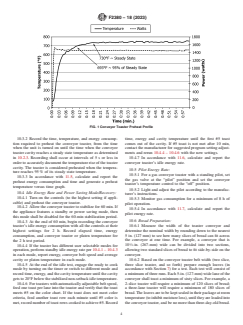
state temperature. In Fig. 1, the steady state temperature is 730°F, and
test (for example, during the preheat for that day’s testing), and
95 % of that steady state temperature is 693°F. The unit then can be
considered preheated when it reaches 693°F and ready to toast.
10.1.1.7 Ambient temperature.
NOTE 4—Using a calorimeter or gas chromatograph in accordance with 10.2.4 In accordance with 11.4, calculate and record the
accepted laboratory procedures is the preferred method for determining
conveyor toaster’s energy input rate and compare the result to
the higher heating value of gas supplied to the conveyor toaster under test.
the rated nameplate input. For gas conveyor toasters, only the
It is recommended that all testing be performed with gas having a higher
burner energy consumption is used to compare the calculated
heating value of 1000 to 1075 Btu/ft .
energy input rate with the rated gas input. Any electrical energy
10.1.2 For gas conveyor toasters, add electric energy con-
use shall be calculated and recorded separately as the control
sumption to gas energy for all tests, with the exception of the
energy rate.
energy input rate test (see 10.3).
10.3 Preheat Energy Consumption and Time:
10.1.3 For electric conveyor toasters, record the following
for each test run:
10.3.1 Verify that the conveyor toaster cavity temperature is
10.1.3.1 Voltage while elements are energized, 75 6 5°F (24 6 3°C) and turn the conveyor toaster on.
F2380 − 18 (2023)
FIG. 1 Conveyor Toaster Preheat Profile
10.3.2 Record the time, temperature, and energy consump- time, energy and cavity temperature until the first #5 toast
tion required to preheat the conveyor toaster, from the time comes out of the cavity. If #5 toast is not met after 10 min,
when the unit is turned on until the time when the conveyor contact the manufacturer for suggested program setting adjust-
toaster cavity reaches a steady state temperature as determined ments and rerun 10.4.4 – 10.4.6 with the new settings.
in 10.2.3. Recording shall occur at intervals of 5 s or less in
10.4.7 In accordance with 11.6, calculate and report the
order to accurately document the temperature rise of the toaster
conveyor toaster’s idle energy rate.
cavity. The toaster is considered preheated when the tempera-
10.5 Pilot Energy Rate:
ture reaches 95 % of its steady state temperature.
10.5.1 For a gas conveyor toaster with a standing pilot, set
10.3.3 In accordance with 11.5, calculate and report the
the gas valve at the “pilot” position and set the conveyor
preheat energy consumption and time and generate a preheat
toaster’s temperature control to the “off” position.
temperature versus time graph.
10.5.2 Light and adjust the pilot according to the manufac-
10.4 Idle Energy Rate and Power Saving Mode/Recovery:
turer’s instructions.
10.4.1 Turn on the controls (to the highest setting if appli-
10.5.3 Monitor gas consumption for a minimum of 8 h of
cable) and preheat the conveyor toaster.
pilot operation.
10.4.2 Allow the conveyor toaster to stabilize for 60 min. If
10.5.4 In accordance with 11.7, calculate and report the
the appliance features a standby or power saving mode, then
pilot energy rate.
this mode shall be disabled for the 60-min stabilization period.
10.6 Bread Preparation:
10.4.3 At the end of 60 min, begin recording the conveyor
toaster’s idle energy consumption with all the controls at their 10.6.1 Measure the width of the toaster conveyor and
determine the nominal width by rounding down to the nearest
highest settings for 2 h. Record elapsed time, energy
consumption, and conveyor toaster or platen temperature for 5 in. (127 mm) to see how many slices of bread can fit across
the conveyor at one time. For example, a conveyor that is
the 2 h test period.
10 ⁄2-in. (267-mm) wide can be divided into two sections,
10.4.4 If the toaster has different user selectable modes for
allowing two standard slices of bread to fit side-by-side on the
operation, perform standby idle energy rate per 10.4.1 – 10.4.3
conveyor.
in each mode, report energy, conveyor belt speed and average
cavity or platen temperature in each mode. 10.6.2 Based on the conveyor toaster belt width (two slice,
10.4.5 At the end of the idle test, engage the ready to cook three slice toaster, and so forth) prepare enough loaves (in
mode by turning on the timer or switch to different mode and accordance with Section 7) for a test. Each test will consist of
record time, energy, and the cavity temperature until the cavity a minimum of three runs. Each 5-in. (127-mm) wide lane of the
gets to 20°F below the stabilized non-setback idle temperature. conveyor shall toast a minimum of sixty slices. For example, a
10.4.6 For toasters with automatically adjustable belt speed, 2-slice toaster will require a minimum of 120 slices of bread;
feed one toast per lane into the toaster and verify that the toast a three-lane toaster will require a minimum of 180 slices of
meets #5 on the color chart. If the toast does not meet color bread. The loaves are to be kept sealed in their package at room
criteria, feed another toast row each minute until #5 color is temperature (to inhibit moisture loss), until they are loaded into
met, record number of toast rows cooked to achieve #5. Record the conveyor toaster, and be no more than three-day-old bread.
F2380 − 18 (2023)
Heals are not to be used in either the stabilization test period or Note how many slices of bread it takes to stabilize the toaster
the production test period. and round up to the nearest ten slices. This will be the amount
used for the stabilization period of the production capacity test.
10.6.3 The loaves included in the first portion of the test run
are used to stabilize the toaster and are referred to as the 10.7.7 Contact toaster belt speed shall be set according to
manufacturer’s recommendations, contact plate compression
“stabilization” loaves and the loaves included in the second
half of the test run are used for production capacity and are shall be set to accommodate the thickness of the bun per
manufacturer’s recommendation. Conveyor speed, temperature
referred to as the “test” loaves.
10.6.4 Prepare an additional ten loaves of bread for deter- settings and thickness adjustment setting for both crown and
heel shall be recorded.
mination of the cook time. The actual number of loaves needed
for the cook time determination will vary with the number of
10.8 Production Capacity:
trials needed to establish a cooking time/conveyor belt speed
10.8.1 The production capacity test is to be run a minimum
which consistently yields a #5 color on the Food Color Chart
of three times. Additional test runs may be necessary to obtain
in Appendix B of UL 1026.
the required precision for the reported test results (see Annex
10.6.5 For contact toasters, buns shall be used instead of
A1).
bread slices, with each part of the bun treated the same way as
10.8.2 Set the conveyor speed as determined in 10.7,
a slice of toast in 10.6.1 – 10.6.4. A two lane (designed to toast
preheat the conveyor toaster, and allow it to stabilize for 60
two buns side by side) contact bun toaster shall require 120
min. Do not activate the power saving mode (if applicable).
buns (120 crowns, 120 heels) for the three test replicates.
10.8.3 Separate the total number of loaves required for each
test run into stabilization loaves and test loaves. For example,
10.7 Cook Time Determination:
a two-slice toaster with a nominal 10-in. (254-mm) wide
10.7.1 Turn the conveyor toaster on, and set the temperature
conveyor will require a minimum of 20 slices per lane (two
controls to the maximum settings (if applicable). Preheat the
loaves) for the stabilization period, and 40 slices per lane (four
conveyor toaster and allow it to idle for 60 min (with the power
loaves) for the production capacity test for a total of 120 slices
saving mode disabled, if applicable).
of bread. At no time are heals of the bread to be used for any
10.7.2 Estimate a cook time for the test and set the conveyor
portion of the testing. The actual amount needed for the
in motion. The cook time is the time that it takes the entire slice
stabilization period is determined in 10.7.
of bread to pass completely though the toaster cavity, starting
from the point where the leading edge of the slice enters the
NOTE 9—During each test run, the loaves are divided into two groups,
toaster cavity until the point where the trailing edge of the slice
stabilization loaves and test loaves. The stabilization loaves will go into
exits the toaster cavity falling into
...