


ASTM B966-10
(Test Method)Standard Test Method for Permeability of Powder Metallurgy (PM) Bearings Using Nitrogen Gas (Withdrawn 2015)
Standard Test Method for Permeability of Powder Metallurgy (PM) Bearings Using Nitrogen Gas (Withdrawn 2015)
SIGNIFICANCE AND USE
In service, there is a space between a shaft and a self-lubricating PM bearing that contains an oil film when the bearing is operating properly. In the event the oil film is disrupted or fails to form the bearing will exhibit increased wear and possibly fail. Therefore the ability for oil to flow through the porosity of a PM bearing is critical to the performance of the bearing.
The porosity of the bearing must be open to the surface and interconnected within the bearing. This allows the oil in a self-lubricating PM bearing to flow during operation to the space between the bearing and the shaft to form an oil film and protect the shaft from wear.
The ability of a gas to flow through the bearing reflects the openness and interconnected properties of the porosity in the bearing.
Data from this test can be used as an internal quality tool and can be reported to buyers of bearings.
A number of other factors also affect the performance of the bearing and the movement of oil; factors such as the oil viscosity, operating temperature, load, shaft speed, surface area, surface finishes and others. This test provides information on only one property and cannot be the sole consideration in the design and testing of a bearing application.
SCOPE
1.1 This test method covers the determination of the permeability of a PM bearing when subjected to pressurized nitrogen under controlled conditions.
1.2 The values stated in SI units are to be regarded as the standard with the exception of flow rate for which the cm3/min unit is the industry standard.
1.3 This standard does not purport to address all of the safety concerns, if any, associated with its use. It is the responsibility of the user of this standard to establish appropriate safety and health practices and determine the applicability of regulatory limitations prior to use.
WITHDRAWN RATIONALE
Formerly under the jurisdiction of Committee B09 on Metal Powders and Metal Powder Products, this test method was withdrawn in October 2015. This standard is being withdrawn without replacement due to its limited use by industry.
This test method covers the determination of the permeability of a PM bearing when subjected to pressurized nitrogen under controlled conditions.
General Information
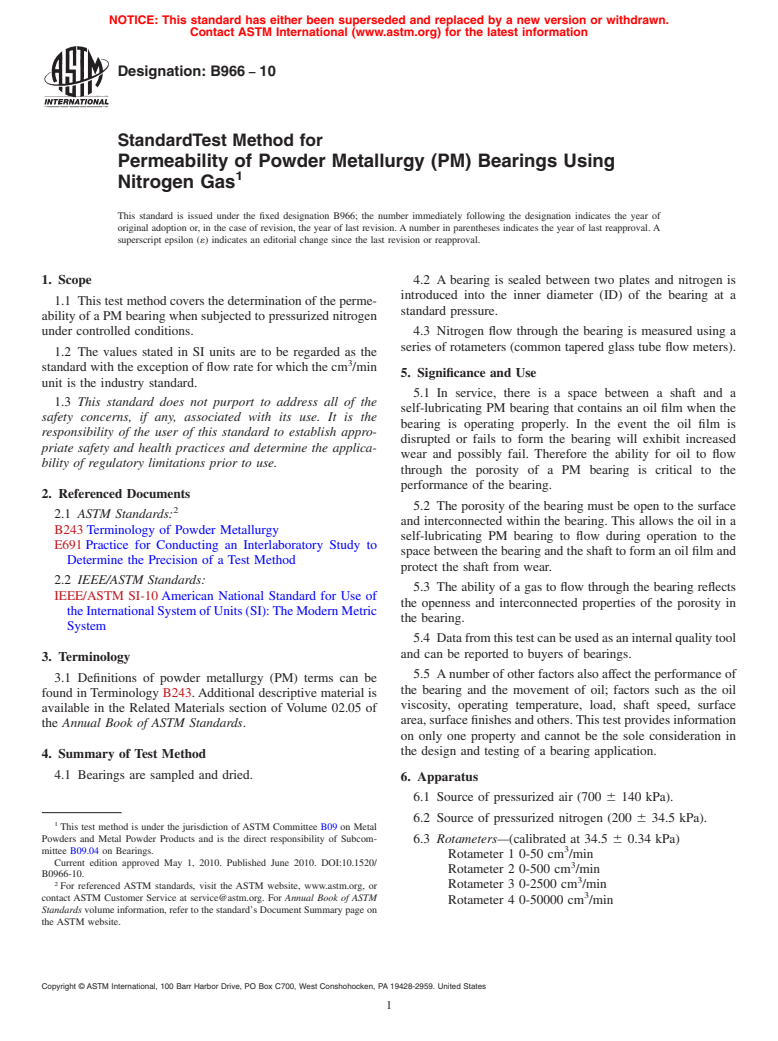

Standards Content (Sample)
NOTICE: This standard has either been superseded and replaced by a new version or withdrawn.
Contact ASTM International (www.astm.org) for the latest information
Designation: B966 − 10
StandardTest Method for
Permeability of Powder Metallurgy (PM) Bearings Using
Nitrogen Gas
This standard is issued under the fixed designation B966; the number immediately following the designation indicates the year of
original adoption or, in the case of revision, the year of last revision. A number in parentheses indicates the year of last reapproval. A
superscript epsilon (´) indicates an editorial change since the last revision or reapproval.
1. Scope 4.2 A bearing is sealed between two plates and nitrogen is
introduced into the inner diameter (ID) of the bearing at a
1.1 This test method covers the determination of the perme-
standard pressure.
ability of a PM bearing when subjected to pressurized nitrogen
under controlled conditions. 4.3 Nitrogen flow through the bearing is measured using a
series of rotameters (common tapered glass tube flow meters).
1.2 The values stated in SI units are to be regarded as the
standard with the exception of flow rate for which the cm /min
5. Significance and Use
unit is the industry standard.
5.1 In service, there is a space between a shaft and a
1.3 This standard does not purport to address all of the
self-lubricating PM bearing that contains an oil film when the
safety concerns, if any, associated with its use. It is the
bearing is operating properly. In the event the oil film is
responsibility of the user of this standard to establish appro-
disrupted or fails to form the bearing will exhibit increased
priate safety and health practices and determine the applica-
wear and possibly fail. Therefore the ability for oil to flow
bility of regulatory limitations prior to use.
through the porosity of a PM bearing is critical to the
performance of the bearing.
2. Referenced Documents
5.2 The porosity of the bearing must be open to the surface
2.1 ASTM Standards:
and interconnected within the bearing. This allows the oil in a
B243 Terminology of Powder Metallurgy
self-lubricating PM bearing to flow during operation to the
E691 Practice for Conducting an Interlaboratory Study to
space between the bearing and the shaft to form an oil film and
Determine the Precision of a Test Method
protect the shaft from wear.
2.2 IEEE/ASTM Standards:
5.3 The ability of a gas to flow through the bearing reflects
IEEE/ASTM SI-10 American National Standard for Use of
the openness and interconnected properties of the porosity in
theInternationalSystemofUnits(SI):TheModernMetric
the bearing.
System
5.4 Datafromthistestcanbeusedasaninternalqualitytool
and can be reported to buyers of bearings.
3. Terminology
5.5 Anumber of other factors also affect the performance of
3.1 Definitions of powder metallurgy (PM) terms can be
the bearing and the movement of oil; factors such as the oil
found in Terminology B243.Additional descriptive material is
viscosity, operating temperature, load, shaft speed, surface
available in the Related Materials section of Volume 02.05 of
area, surface finishes and others.This test provides information
the Annual Book of ASTM Standards.
on only one property and cannot be the sole consideration in
the design and testing of a bearing application.
4. Summary of Test Method
4.1 Bearings are sampled and dried.
6. Apparatus
6.1 Source of pressurized air (700 6 140 kPa).
6.2 Source of pressurized nitrogen (200 6 34.5 kPa).
This test method is under the jurisdiction of ASTM Committee B09 on Metal
Powders and Metal Powder Products and is the direct responsibility of Subcom-
6.3 Rotameters—(calibrated at 34.5 6 0.34 kPa)
mittee B09.04 on Bearings.
Rotameter 1 0-50 cm /min
Current edition approved May 1, 2010. Published June 2010. DOI:10.1520/
Rotameter 2 0-500 cm /min
B0966-10.
For referenced ASTM standards, visit the ASTM website, www.astm.org, or Rotameter 3 0-2500 cm /min
contact ASTM Customer Service at service@astm.org. For Annual Book of ASTM
Rotameter 4 0-50000 cm /min
Standards volume information, refer to the standard’s Document Summary page on
the ASTM website.
Copyright ©ASTM International, 100 Barr Harbor Drive, PO Box C700, West Conshohocken, PA19428-2959. United States
B966 − 10
6.3.1 Readability at maximum flow: 7. Sample Preparation
Rotameter12cm /min
7.1 Thirty sample bearings shall be obtained randomly from
Rotameter25cm /min
the lot of bearings being tested. Each lot of bearings shall be
Rotameter 3 25 cm /min
tested separately.
Rotameter 4 200 cm /min
7.2 Test pieces shall be dry; remove any impregnated fluids.
NOTE 1—Rotameters are manufactured using specific conditions and
Take care not to change the structure or quantity of the porosity
gases resulting in flows and readability that differ slightly from those
when removing the fluids. Remove volatile fluids by heating to
found when performing an actual test.Acalibration done at the conditions
150°C in air for ten minutes. Remove oils using a Soxhlet
used in the actual testing will yield either a calculation or a conversion
apparatus followed by heating to remove the solvent 150°C in
chart to correct the readings to the actual flows.
air for ten minutes.
6.4 Pressure gauges/regulators and suggested capacities.
6.4.1 Incoming air regulator (minimum capacity 830 kPa).
8. Procedure
6.4.2 Nitrogen regulator (minimum capacity 100
...
Questions, Comments and Discussion
Ask us and Technical Secretary will try to provide an answer. You can facilitate discussion about the standard in here.