

ASTM E1918-21
(Test Method)Standard Test Method for Measuring Solar Reflectance of Horizontal and Low-Sloped Surfaces in the Field
General Information
- Abstract
SIGNIFICANCE AND USE
5.1 Solar reflectance is an important factor affecting the temperature of a sunlit surface and that of the near-surface ambient air temperature. The test method described herein measures the solar reflectance of surfaces in natural sunlight.
SCOPE
1.1 This test method covers the measurement of solar reflectance of various horizontal and low-sloped surfaces and materials in the field, using an albedometer or pyranometer. The test method is intended for use when the sun angle to the normal from a surface is less than 45°.
1.2 This international standard was developed in accordance with internationally recognized principles on standardization established in the Decision on Principles for the Development of International Standards, Guides and Recommendations issued by the World Trade Organization Technical Barriers to Trade (TBT) Committee.
- Status
- Published
- Publication Date
- 30-Sep-2021
- Technical Committee
- D08 - Roofing and Waterproofing
- Drafting Committee
- D08.20 - Roofing Membrane Systems
Buy Documents
ASTM E1918-21 - Standard Test Method for Measuring Solar Reflectance of Horizontal and Low-Sloped Surfaces in the Field
REDLINE ASTM E1918-21 - Standard Test Method for Measuring Solar Reflectance of Horizontal and Low-Sloped Surfaces in the Field
Overview
ASTM E1918-21 is the international standard test method for measuring the solar reflectance of horizontal and low-sloped surfaces in the field. Developed by ASTM International, this method addresses the importance of solar reflectance as a critical property influencing the temperature of sunlit surfaces and the near-surface ambient air. The standard utilizes an albedometer or pyranometer to provide reliable, field-based measurements under natural sunlight conditions for surfaces that are predominantly horizontal or gently sloped.
Solar reflectance-sometimes called albedo-is the fraction of solar energy reflected by a surface. Materials with high solar reflectance stay cooler under sunlight, potentially reducing cooling energy requirements and mitigating urban heat island effects. E1918-21 supports informed choices for building materials and infrastructure by enabling accurate onsite measurement of solar reflectance.
Key Topics
- Test Scope
- Applicable to flat or low-sloped (tilt angle ≤ 9.5°) surfaces at least 4 meters in diameter or on each side.
- Suitable for roofs, streets, parking lots, and other large, homogeneous exterior surfaces.
- Field Measurement Methodology
- Performed when the sun angle to the normal surface is less than 45°, usually between 9 a.m. and 3 p.m. local standard time.
- Measurements are made under clear, sunny conditions with minimal cloud cover or haze.
- Instruments: precision albedometer or pyranometer with appropriate calibration.
- Reproducible readings obtained by repeatedly measuring incoming and reflected solar flux.
- Apparatus and Setup
- The sensor is positioned 50 cm above the test surface to minimize shading.
- The minimum offset from the test surface edge is 2 meters.
- Pyranometer or albedometer must be accurately aligned parallel to the surface while reading both incoming and reflected radiation.
- Data Reporting
- Documentation includes test location, time, surface description, weather conditions, and all measurement values.
- The average solar reflectance is calculated for each surface, with statistical analysis when multiple surfaces are tested.
Applications
ASTM E1918-21 is widely used in the following contexts:
- Building and Roofing Materials
- Evaluating and comparing roofing product solar reflectance to support energy-efficient building envelope design.
- Assisting in compliance with green building standards and codes that require cool roofs or reflective pavements.
- Urban Planning
- Measuring pavement and exterior surface reflectance to inform heat island mitigation strategies.
- Supporting the selection of surface materials in public works projects to enhance urban cooling.
- Research and Development
- Field testing new materials, coatings, or surface treatments for their solar reflectance properties.
- Validating laboratory results through real-world sun exposure data.
- Quality Control and Specification
- Ensuring product performance meets project and regulatory requirements for solar reflectance.
- Providing reliable data for manufacturers, architects, and facility managers.
Related Standards
For comprehensive material evaluation and field measurement of solar properties, the following ASTM standards are commonly referenced alongside ASTM E1918-21:
- ASTM E177 - Practice for Use of the Terms Precision and Bias in ASTM Test Methods
- ASTM E691 - Practice for Conducting an Interlaboratory Study to Determine the Precision of a Test Method
Additional related documents and international standards may cover laboratory measurement methods, energy efficiency requirements, and solar reflectance specifications for various applications.
Keywords: ASTM E1918-21, solar reflectance, albedo, pyranometer, albedometer, field measurement, cool roofs, energy efficiency, urban heat island, roofing materials, surface reflectance, ASTM standards, building materials testing, solar energy.
Relations
- Effective Date
- 01-May-2014
- Effective Date
- 01-May-2013
- Effective Date
- 01-May-2013
- Effective Date
- 01-Nov-2011
- Effective Date
- 01-Oct-2010
- Effective Date
- 01-Oct-2008
- Effective Date
- 01-Oct-2008
- Refers
ASTM E177-06b - Standard Practice for Use of the Terms Precision and Bias in ASTM Test Methods - Effective Date
- 15-Nov-2006
- Refers
ASTM E177-06a - Standard Practice for Use of the Terms Precision and Bias in ASTM Test Methods - Effective Date
- 01-Nov-2006
- Effective Date
- 01-Nov-2005
- Refers
ASTM E177-04e1 - Standard Practice for Use of the Terms Precision and Bias in ASTM Test Methods - Effective Date
- 01-Nov-2004
- Effective Date
- 01-Nov-2004
- Effective Date
- 01-Nov-2004
- Refers
ASTM E177-90a(2002) - Standard Practice for Use of the Terms Precision and Bias in ASTM Test Methods - Effective Date
- 10-Jan-2002
- Effective Date
- 10-May-1999
Buy Documents
ASTM E1918-21 - Standard Test Method for Measuring Solar Reflectance of Horizontal and Low-Sloped Surfaces in the Field
REDLINE ASTM E1918-21 - Standard Test Method for Measuring Solar Reflectance of Horizontal and Low-Sloped Surfaces in the Field
Get Certified
Connect with accredited certification bodies for this standard

BSMI (Bureau of Standards, Metrology and Inspection)
Taiwan's standards and inspection authority.
Sponsored listings
Frequently Asked Questions
ASTM E1918-21 is a standard published by ASTM International. Its full title is "Standard Test Method for Measuring Solar Reflectance of Horizontal and Low-Sloped Surfaces in the Field". This standard covers: SIGNIFICANCE AND USE 5.1 Solar reflectance is an important factor affecting the temperature of a sunlit surface and that of the near-surface ambient air temperature. The test method described herein measures the solar reflectance of surfaces in natural sunlight. SCOPE 1.1 This test method covers the measurement of solar reflectance of various horizontal and low-sloped surfaces and materials in the field, using an albedometer or pyranometer. The test method is intended for use when the sun angle to the normal from a surface is less than 45°. 1.2 This international standard was developed in accordance with internationally recognized principles on standardization established in the Decision on Principles for the Development of International Standards, Guides and Recommendations issued by the World Trade Organization Technical Barriers to Trade (TBT) Committee.
SIGNIFICANCE AND USE 5.1 Solar reflectance is an important factor affecting the temperature of a sunlit surface and that of the near-surface ambient air temperature. The test method described herein measures the solar reflectance of surfaces in natural sunlight. SCOPE 1.1 This test method covers the measurement of solar reflectance of various horizontal and low-sloped surfaces and materials in the field, using an albedometer or pyranometer. The test method is intended for use when the sun angle to the normal from a surface is less than 45°. 1.2 This international standard was developed in accordance with internationally recognized principles on standardization established in the Decision on Principles for the Development of International Standards, Guides and Recommendations issued by the World Trade Organization Technical Barriers to Trade (TBT) Committee.
ASTM E1918-21 is classified under the following ICS (International Classification for Standards) categories: 17.180.20 - Colours and measurement of light. The ICS classification helps identify the subject area and facilitates finding related standards.
ASTM E1918-21 has the following relationships with other standards: It is inter standard links to ASTM E177-14, ASTM E691-13, ASTM E177-13, ASTM E691-11, ASTM E177-10, ASTM E691-08, ASTM E177-08, ASTM E177-06b, ASTM E177-06a, ASTM E691-05, ASTM E177-04e1, ASTM E177-04, ASTM E177-06, ASTM E177-90a(2002), ASTM E691-99. Understanding these relationships helps ensure you are using the most current and applicable version of the standard.
ASTM E1918-21 is available in PDF format for immediate download after purchase. The document can be added to your cart and obtained through the secure checkout process. Digital delivery ensures instant access to the complete standard document.
Standards Content (Sample)
This international standard was developed in accordance with internationally recognized principles on standardization established in the Decision on Principles for the
Development of International Standards, Guides and Recommendations issued by the World Trade Organization Technical Barriers to Trade (TBT) Committee.
Designation: E1918 − 21
Standard Test Method for
Measuring Solar Reflectance of Horizontal and Low-Sloped
Surfaces in the Field
This standard is issued under the fixed designation E1918; the number immediately following the designation indicates the year of
original adoption or, in the case of revision, the year of last revision. A number in parentheses indicates the year of last reapproval. A
superscript epsilon (´) indicates an editorial change since the last revision or reapproval.
1. Scope 3.1.2 inhomogeneous test site—a test site of nonuniform
solar reflectance.
1.1 This test method covers the measurement of solar
3.1.3 low-sloped surface—a surface with a tilt angle not
reflectance of various horizontal and low-sloped surfaces and
exceeding 9.5°. The roofing industry has widely accepted a
materials in the field, using an albedometer or pyranometer.
slope of less than 2:12 (16.7 %) as characteristic of a low-
The test method is intended for use when the sun angle to the
sloped roof. This corresponds to a tilt angle of approximately
normal from a surface is less than 45°.
9.5°.
1.2 This standard does not purport to address all of the
3.1.4 pyranometer—a radiometric instrument used to mea-
safety concerns, if any, associated with its use. It is the
sure the hemispherical (beam plus diffuse) solar radiant energy
responsibility of the user of this standard to establish appro-
incident upon a surface per unit time and unit surface area.
priate safety, health, and environmental practices and deter-
mine the applicability of regulatory limitations prior to use.
3.1.5 solar energy—the radiant energy originating from the
1.3 This international standard was developed in accor-
sun. Approximately 99 % of terrestrial solar energy arrives at
dance with internationally recognized principles on standard-
wavelengths between 0.3 and 2.5 μm.
ization established in the Decision on Principles for the
3.1.6 solar flux—for these measurements, the beam and
Development of International Standards, Guides and Recom-
diffuse radiance (radiative power per unit area) from the sun
mendations issued by the World Trade Organization Technical
received at ground level, expressed in watts per square meter.
Barriers to Trade (TBT) Committee.
3.1.7 solar reflectance—the fraction of solar flux reflected
by a surface.
2. Referenced Documents
3.1.8 test site—a location that contains one or more test
2.1 ASTM Standards:
surfaces.
E177 Practice for Use of the Terms Precision and Bias in
ASTM Test Methods 3.1.9 test surface—a surface whose solar reflectance is to be
E691 Practice for Conducting an Interlaboratory Study to measured with a pyranometer.
Determine the Precision of a Test Method
4. Summary of Test Method
3. Terminology
4.1 An albedometer or pyranometer is used to measure
3.1 Definitions:
incoming and reflected solar radiation for a uniform horizontal
3.1.1 albedometer—an instrument consisting of two anti-
or low-sloped surface. The solar reflectance is the ratio of the
parallel (back-to-back) pyranometers, where the upper pyra-
reflected radiation to the incoming radiation.
nometer measures incoming solar radiation and the lower
pyranometer measures solar radiation reflected from the test
5. Significance and Use
surface.
5.1 Solar reflectance is an important factor affecting the
temperature of a sunlit surface and that of the near-surface
ambient air temperature. The test method described herein
This test method is under the jurisdiction of ASTM Committee D08 on Roofing
measures the solar reflectance of surfaces in natural sunlight.
and Waterproofing and is the direct responsibility of Subcommittee D08.20 on
Roofing Membrane Systems.
Current edition approved Oct. 1, 2021. Published October 2021. Originally
6. Apparatus
approved in 1997. Last previous edition approved in 2016 as E1918 – 16. DOI:
10.1520/E1918-21.
6.1 Sensor—A precision spectral pyranometer (PSP) sensi-
For referenced ASTM standards, visit the ASTM website, www.astm.org, or
tive to radiant energy in the 0.28 to 2.8 μm band is recom-
contact ASTM Customer Service at service@astm.org. For Annual Book of ASTM
mended. A typical pyranometer yields a linear output of
Standards volume information, refer to the standard’s Document Summary page on
–2
the ASTM website. 60.5 % between 0 and 1400 W·m and a response time of 1 s.
Copyright © ASTM International, 100 Barr Harbor Drive, PO Box C700, West Conshohocken, PA 19428-2959. United States
E1918 − 21
Specific characteristics can be obtained based on calibration by brate the instrument at the manufacturer-specified interval,
the manufacturer of the pyranometer. Other suitable pyranom- typically once every year or two years. Recalibration is
eters are discussed in Zerlaut. The double-dome design of the performed by the manufacturer.
PSP minimizes the effects of internal convection resulting from
9. Procedure
tilting the pyranometer at different angles. For this reason, the
9.1 Cloud cover and haze significantly affect the measure-
PSP is especially suitable for this test, since measurement of
solar reflectivity requires the apparatus to alternatively face up ments. The tests shall be conducted on a clear, sunny day with
no cloud cover or haze during the individual measurements.
and down.
See Annex A1 for guidelines on determination of the suitability
6.2 Readout Instrument—The analog output from the pyra-
of the atmospheric conditions for conducting the tests.
nometer is converted to digital output with a readout meter
(such as EPLAB Model 455 Instantaneous Solar Radiation 9.2 The test shall be done in conditions where the angle of
the sun to the normal from the test surface of interest is less
Meter) that has an accuracy of better than 60.5 % and a
–2
resolution of 1 W·m . The meter shall be scaled to the
than 45° (cosine of solar incidence angle is greater than ≈
sensitivity of the specific PSP by the manufacturer of the
=2
0.707). For horizontal and low-sloped surfaces, this generally
pyranometer. Alternatively, a precision voltmeter can be used.
limits the test to between the hours of 9 a.m. and 3 p.m. local
6.3 Albedometer or Pyranometer Support—The albedom-
standard time; this is when solar radiation is at least 70 % of
eter (Fig. 1) or pyranometer (Fig. 2) shall be mounted on an
the value obtained at solar noon for that day. In winter months
arm and a stand that centers the sensor at a height of 500 mm
(when solar incidence angle is low), perform the tests between
above the target surface to minimize the effects of sensor, arm,
hours of 10 a.m. and 2 p.m.
and stand shadows on measured reflected radiation. The
NOTE 1—Solar elevation angle, solar azimuth angle, and the cosine of
horizontal distance from the center of the albedometer or
the solar incidence angle based on time and location may be obtained from
pyranometer to the edge of the test surface shall be at least 2 m.
a tool such as the NREL Solar Position and Intensity Calculator (https://
The arm and stand shall be strong and cast the smallest possible midcdmz.nrel.gov/solpos/solpos.html).
shadow. If using a pyranometer, the support must allow the
9.3 Align the support such that the arm points toward the
pyranometer to be turned upward and downward easily as
sun; this eliminates the shadow of the people conducting the
shown in Fig. 2.
test and minimizes the effect of the shadow from equipment.
There shall be no other shadow on the measurement area other
7. Sampling, Test Specimens, and Test Units
than the minimal shadow cast by the pyranometer and its
7.1 This test method applies to low-sloped test surfaces that
support. The pyranometer shall be parallel to the test surface
are at least 4 m in diameter (if circular) or at least 4 m on each
where measurement is conducted. The horizontal distance from
side (if rectangular). Examples of sites that may contain test
the pyranometer sensor to the nearest edge of the test surface
surfaces include roofs, streets, and parking lots.
must be at least 2 m.
9.4 The measurement practices for a dual-sensor albedom-
8. Calibration and Standardization
eter (9.4.1) and a single-sensor pyranometer (9.4.2) are as
8.1 The albedometer or pyranometer shall be checked to
follows:
ensure its accuracy. A radiometric instrument is usually pre-
9.4.1 Albedometers will read both the incoming solar radia-
calibrated by its manufacturer. It is a good practice to recali-
tion and the reflected solar radiation simultaneously. Make sure
each reading is constant for at least 10 s before recording its
value. The albedometer shall be parallel to the test surface.
Zerlaut, G., “Solar Radiation Instrumentation,” Solar Resources, R. L.
Measure at least three pairs of incoming and reflected radiation
Hulstrom, ed., MIT Press, Cambridge, MA, 1989, pp. 173–308.
FIG. 1 Schematic of the Albedometer and Its Support
E1918 − 21
FIG. 2 Schematic of the Pyranometer and Its Support
within 2 min. The calculated solar reflectance (the ratio of the 10.1.4 The incoming solar radiation, the reflected solar
reflected radiation to incoming radiation) from all the measure- radiation, and the calculated solar reflectance for all three pairs
ments shall agree to within 0.01 in a reflectivity scale of 0.00 of acceptable measurements at each test surface.
to 1.00. 10.1.5 The solar reflectance of each test surface, which is
the average of the calculated solar reflectances at that surface.
NOTE 2—Since it is challenging to align the albedometer parallel to a
tilted test surface, it is simpler and preferable to characterize a horizontal
NOTE 4—A tool to aid in reporting of results in 10.1 is available from
test surface.
Lawrence Berkeley National Laboratory (https://HeatIsland.LBL.gov/
resources/technical-resources).
9.4.2 To use a pyranometer, face the pyranometer upward
and parallel to the test surface to read incoming solar radiation. 10.2 If the measurement site includes more than one test
Flip the pyranometer downward and parallel to the test surface surface, the report shall also include the mean and standard
to read reflected solar radiation. Make sure each reading is deviation of the solar reflectances of the test surfaces.
constant for
...
This document is not an ASTM standard and is intended only to provide the user of an ASTM standard an indication of what changes have been made to the previous version. Because
it may not be technically possible to adequately depict all changes accurately, ASTM recommends that users consult prior editions as appropriate. In all cases only the current version
of the standard as published by ASTM is to be considered the official document.
Designation: E1918 − 16 E1918 − 21
Standard Test Method for
Measuring Solar Reflectance of Horizontal and Low-Sloped
Surfaces in the Field
This standard is issued under the fixed designation E1918; the number immediately following the designation indicates the year of
original adoption or, in the case of revision, the year of last revision. A number in parentheses indicates the year of last reapproval. A
superscript epsilon (´) indicates an editorial change since the last revision or reapproval.
1. Scope
1.1 This test method covers the measurement of solar reflectance of various horizontal and low-sloped surfaces and materials in
the field, using a an albedometer or pyranometer. The test method is intended for use when the sun angle to the normal from a
surface is less than 45°.
1.2 This international standard was developed in accordance with internationally recognized principles on standardization
established in the Decision on Principles for the Development of International Standards, Guides and Recommendations issued
by the World Trade Organization Technical Barriers to Trade (TBT) Committee.
2. Referenced Documents
2.1 ASTM Standards:
E177 Practice for Use of the Terms Precision and Bias in ASTM Test Methods
E691 Practice for Conducting an Interlaboratory Study to Determine the Precision of a Test Method
3. Terminology
3.1 Definitions:
3.1.1 albedometer—an instrument consisting of two anti-parallel (back-to-back) pyranometers, where the upper pyranometer
measures incoming solar radiation and the lower pyranometer measures solar radiation reflected from the test surface.
3.1.2 inhomogeneous test site—a test site of nonuniform solar reflectance.
3.1.3 low-sloped surfaces—surface—surfaces a surface with a slope smaller than tilt angle not exceeding 9.5°. The roofing
industry has widely accepted a slope of 2:12 or less as a definition of low-sloped roofs.less than 2:12 (16.7 %) as characteristic
of a low-sloped roof. This corresponds to a slope tilt angle of approximately 9.5° (16.7 %).9.5°.
3.1.4 pyranometer—an a radiometric instrument (radiometer) used to measure the total hemispherical (beam plus diffuse) solar
radiant energy incident upon a surface per unit time and unit surface area.
3.1.5 solar energy—the radiant energy originating from the sun. Approximately 99 % of terrestrial solar energy lies betweenarrives
at wavelengths ofbetween 0.3 to 3.5and 2.5 μm.
This test method is under the jurisdiction of ASTM Committee D08 on Roofing and Waterproofing and is the direct responsibility of Subcommittee D08.18 on
Nonbituminous Organic Roof Coverings.
Current edition approved Nov. 1, 2016Oct. 1, 2021. Published January 2017October 2021. Originally approved in 1997. Last previous edition approved in 20152016 as
E1918 – 06 (2015).E1918 – 16. DOI: 10.1520/E1918-16.10.1520/E1918-21.
For referenced ASTM standards, visit the ASTM website, www.astm.org, or contact ASTM Customer Service at service@astm.org. For Annual Book of ASTM Standards
volume information, refer to the standard’s Document Summary page on the ASTM website.
Copyright © ASTM International, 100 Barr Harbor Drive, PO Box C700, West Conshohocken, PA 19428-2959. United States
E1918 − 21
3.1.6 solar flux—for these measurements, the directbeam and diffuse radiation radiance (radiative power per unit area) from the
sun received at ground level over the solar spectrum, level, expressed in watts per square metre.meter.
3.1.7 solar reflectance—the fraction of solar flux reflected by a surface.
3.1.8 test site—a location that contains one or more test surfaces.
3.1.9 test surface—a surface whose solar reflectance is to be measured with a pyranometer.
3.2 Definitions of Terms Specific to This Standard:
3.2.1 solar spectrum—the solar spectrum at ground level extending from wavelength 0.3 to 3.5 μm.
4. Summary of Test Method
4.1 A An albedometer or pyranometer is used to measure incoming and reflected solar radiation for a uniform horizontal or
low-sloped surface. The solar reflectance is the ratio of the reflected radiation to the incoming radiation.
5. Significance and Use
5.1 Solar reflectance is an important factor affecting surface and the temperature of a sunlit surface and that of the near-surface
ambient air temperature. Surfaces with low solar reflectance (typically 30 % or lower), absorb a high fraction of the incoming solar
energy which is either conducted into buildings or convected to air (leading to higher air temperatures). Use of materials with high
solar reflectance may result in lower air-conditioning energy use and cooler cities and communities. The test method described
hereherein measures the solar reflectance of surfaces in the field.natural sunlight.
6. Apparatus
6.1 Sensor—A precision spectral pyranometer (PSP) sensitive to radiant energy in the 0.28–2.8 0.28 to 2.8 μm band is
–2
recommended. A typical pyranometer yields a linear output of 60.5 % between 0 and 1400 W·m and a response time of one s.
1 s. Specific characteristics can be obtained based on calibration by the manufacturer of the pyranometer. Other suitable
pyranometers are discussed in Zerlaut. The double-dome design of the PSP minimizes the effects of internal convection resulting
from tilting the pyranometer at different angles. For this reason, the PSP is especially suitable for this test, since measurement of
solar reflectivity requires the apparatus to alternatively face up and down.
6.2 Read-OutReadout Instrument—The analog output from the pyranometer is converted to digital output with a readout meter
(such as EPLAB Model 455 Instantaneous Solar Radiation Meter) that has an accuracy of better than 60.5 % and a resolution of
–2
1 W·m1 W·m . The meter shall be scaled to the sensitivity of the specific PSP by the manufacturer of the pyranometer.
Alternatively, a precision voltmeter can be used.
6.3 Albedometer or Pyranometer Stand—Support—The albedometer (Fig. 1) or pyranometer (Fig. 2) shall be mounted on an arm
and a stand that placescenters the sensor at a height of 50 cm500 mm above the target surface to minimize the effect of the shadow
effects of sensor, arm, and stand shadows on measured reflected radiation. The horizontal distance from the center of the
albedometer or pyranometer to the edge of the test surface shall be at least 2 m. The arm and stand shall be strong, strong and cast
the smallest possible shadow, and shadow. If using a pyranometer, the support must allow the pyranometer to be turned upward
and downward easily as shown in Fig. 12.
7. Sampling, Test Specimens, and Test Units
7.1 TheThis test method described here applies to large (circles with low-sloped test surfaces that are at least four metres 4 m in
diameter or squares four metres on a side), homogeneous, low-sloped surfaces, such as roofs, streets, and parking lots. The
measurements shall be performed on dry surfaces.(if circular) or at least 4 m on each side (if rectangular). Examples of sites that
may contain test surfaces include roofs, streets, and parking lots.
Zerlaut, G., “Solar Radiation Instrumentation,” Solar Resources, R.L. R. L. Hulstrom, ed., MIT Press, Cambridge, MA, 1989, pp. 173–308.
E1918 − 21
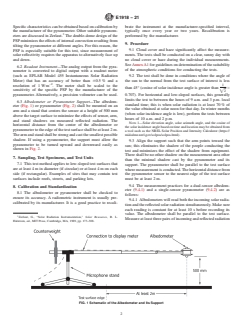
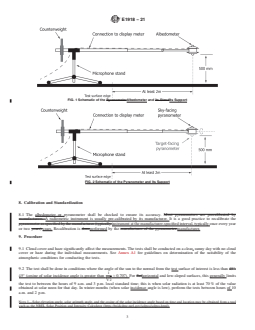
FIG. 1 Schematic of the PyranometerAlbedometer and its StandIts Support
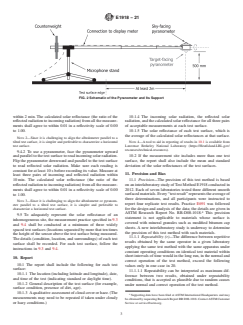
FIG. 2 Schematic of the Pyranometer and Its Support
8. Calibration and Standardization
8.1 The albedometer or pyranometer shall be checked to ensure its accuracy. Most pyranometers are precalibrated by
manufacturers. A radiometric instrument is usually pre-calibrated by its manufacturer. It is a good practice to recalibrate the
pyranometer as specified by the manufacturer (typically instrument at the manufacturer-specified interval, typically once every year
or two years).years. Recalibration is doneperformed by the manufacturer of the pyranometer.manufacturer.
9. Procedure
9.1 Cloud cover and haze significantly affect the measurements. The tests shall be conducted on a clear, sunny day with no cloud
cover or haze during the individual measurements. See Annex A1 for guidelines on determination of the suitability of the
atmospheric conditions for conducting the tests.
9.2 The test shall be done in conditions where the angle of the sun to the normal from the test surface of interest is less than 45°.
45° (cosine of solar incidence angle is greater than ≈ 0.707). For flathorizontal and low-sloped surfaces, this generally limits
=2
the test to between the hours of 9 a.m. and 3 p.m. local standard time; this is when solar radiation is at least 70 % of the value
obtained at solar noon for that day. In winter months (when solar incidence angle is low), perform the tests between hours of 10
a.m. and 2 p.m.
NOTE 1—Solar elevation angle, solar azimuth angle, and the cosine of the solar incidence angle based on time and location may be obtained from a tool
such as the NREL Solar Position and Intensity Calculator (https://midcdmz.nrel.gov/solpos/solpos.html).
E1918 − 21
9.3 Align the standsupport such that the arm points toward the sun (thissun; this eliminates the shadow of the people conducting
the test and minimizes the effect of the shadow from equipment).equipment. There shall be no other shadow on the measurement
area other than the minimal shadow cast by the pyranometer and the stand.its support. The pyranometer shall be parallel to the test
surface where measurement is conducted. The horizontal distance from the pyranometer sensor to the nearest edge of the test
surface must be at least 2 m.
9.4 Face the pyranometer upward (that is, looking directly away from the surface) to read incoming solar radiation. Flip the
pyranometer downward to read reflected solar radiation. Make sure the readings are constant for at least 10 s. The measurements
of incoming and reflected radiation shall be performed in a time interval notThe measurement practices for a dual-sensor
albedometer (9.4.1 to exceed 2 min. Solar reflectance is the ratio of the reflected radiation to incoming radiation. Repeat the pairs
of incoming and reflected measurements at least three times. The calculated solar reflectance from all the measurements shall agree
within 0.01 in a reflectivity scale of) and a single-sensor pyranometer (9.4.2 0.00 to 1.00.) are as follows:
9.4.1 Albedometers will read both the incoming solar radiation and the reflected solar radiation simultaneously. Make sure each
reading is constant for at least 10 s before recording its value. The albedometer shall be parallel to the test surface. Measure at least
three pairs of incoming and reflected radiation within 2 min. The calculated solar reflectance (the ratio of the reflected radiation
to incoming radiation) from all the measurements shall agree to within 0.01 in a reflectivity scale of 0.00 to 1.00.
NOTE 2—Since it is challenging to align the albedometer parallel to a tilted test surface, it is simpler and preferable to characterize a horizontal test surface.
9.4.2 To use a pyranometer, face the pyranometer upward and parallel to the test surface to read incoming solar radiation. Flip
the pyranometer downward and parallel to the test surface to read reflected solar radiation. Make sure each reading is constant for
at least 10 s before recording its value. Measure at least three pairs of incoming and reflected radiat
...