


ASTM D3162-21
(Test Method)Standard Test Method for Carbon Monoxide in the Atmosphere (Continuous Measurement by Nondispersive Infrared Spectrometry)
Standard Test Method for Carbon Monoxide in the Atmosphere (Continuous Measurement by Nondispersive Infrared Spectrometry)
SIGNIFICANCE AND USE
5.1 Determination of carbon monoxide is essential to evaluation of many air pollution concerns and pollution control strategies. This test method derives significance from providing such determination.
5.2 Carbon monoxide is formed in the process of incomplete combustion of hydrocarbon fuels, and is a constituent of the exhaust of gasoline engines. The Environmental Protection Agency (EPA) has set primary and secondary air quality standards for CO that are designed to protect the public health and welfare (3, 4).
5.3 This test method is suitable for measurements appropriate for the purposes noted in 5.1 and 5.2.
SCOPE
1.1 This test method is applicable to the determination of the carbon monoxide (CO) concentration of the atmosphere between 0.6 mg/m3 (0.5 ppm(v)) and 115 mg/m3 (100 ppm(v)). The measuring principle is based on the absorption of infrared radiation by CO in the 4.7 μm region (1).2
1.2 The test method has a limit of detection of about 0.6 mg/m3 (0.5 ppm(v)) carbon monoxide in air.
1.3 The values stated in SI units are to be regarded as standard. The values and units in parentheses are provided for information only and are not considered standard.
1.4 This standard does not purport to address all of the safety concerns, if any, associated with its use. It is the responsibility of the user of this standard to establish appropriate safety, health, and environmental practices and determine the applicability of regulatory limitations prior to use. See Section 9 for additional precautions.
1.5 This international standard was developed in accordance with internationally recognized principles on standardization established in the Decision on Principles for the Development of International Standards, Guides and Recommendations issued by the World Trade Organization Technical Barriers to Trade (TBT) Committee.
General Information
- Status
- Published
- Publication Date
- 31-Oct-2021
- Technical Committee
- D22 - Air Quality
- Drafting Committee
- D22.03 - Ambient Atmospheres and Source Emissions
Relations
- Effective Date
- 01-Sep-2020
- Effective Date
- 15-Mar-2020
- Effective Date
- 01-Oct-2019
- Effective Date
- 01-Aug-2019
- Effective Date
- 01-Mar-2017
- Effective Date
- 15-Oct-2015
- Effective Date
- 01-Jul-2015
- Effective Date
- 01-Dec-2014
- Effective Date
- 01-May-2014
- Effective Date
- 15-Jan-2014
- Effective Date
- 01-May-2013
- Effective Date
- 01-Oct-2011
- Effective Date
- 01-Oct-2011
- Effective Date
- 01-Oct-2011
- Effective Date
- 01-Apr-2010
Overview
ASTM D3162-21: Standard Test Method for Carbon Monoxide in the Atmosphere (Continuous Measurement by Nondispersive Infrared Spectrometry) is an internationally recognized method published by ASTM International. This standard specifies a reliable methodology for the continuous measurement of carbon monoxide (CO) concentrations in ambient air using nondispersive infrared spectrometry (NDIR).
The standard is vital for assessing air pollution levels and evaluating the effectiveness of pollution control strategies by providing a scientifically robust approach. Regulatory bodies, environmental agencies, and industries use this method to meet air quality guidelines and legal requirements, especially those set by the Environmental Protection Agency (EPA).
Key Topics
Scope and Applicability: Suitable for measuring atmospheric carbon monoxide concentrations ranging from 0.6 mg/m³ (0.5 ppm(v)) to 115 mg/m³ (100 ppm(v)), ensuring relevance in a variety of air quality monitoring scenarios.
Measurement Principle: Utilizes the absorption of infrared radiation by CO at 4.7 μm as the basic analytical principle. This continuous monitoring approach allows accurate and real-time CO detection.
Calibration and Precision:
- Multipoint calibration procedures ensure reliable and traceable results.
- Daily zero and span calibrations are required for ongoing accuracy.
- The method’s stated limits of detection and quantification ensure sensitivity at low ambient concentrations.
- Emphasis on operational checks, calibration gases, and equipment maintenance.
Interferences:
- Addresses common interferences such as water vapor and carbon dioxide, providing guidance on how to minimize their impact through sample conditioning and the use of corrections or filters.
Safety and Quality Assurance:
- Highlights the need for robust safety, health, and environmental practices, especially when handling pressurized gases and electrical equipment.
- Recommends regular quality assurance checks to maintain ongoing method validity.
Applications
The ASTM D3162-21 test method is applied in a wide range of sectors where monitoring of ambient carbon monoxide is critical:
Regulatory Air Quality Monitoring: Used by government agencies and environmental laboratories to comply with air quality standards and reporting requirements.
Industrial Emissions Monitoring: Essential for facilities with combustion processes (e.g., power plants, refineries, manufacturing), where CO is a byproduct.
Environmental Impact Assessments: Key in project planning and permitting to understand air quality baselines and the potential impact of new developments.
Health and Safety Compliance: Utilized in occupational health programs to ensure workplace environments remain below hazardous CO levels.
Research and Development: Valuable for scientific studies investigating urban pollution, atmospheric chemistry, and control technologies.
The continuous measurement capability makes this test method ideal for long-term monitoring stations, real-time reporting systems, and early warning networks.
Related Standards
For users seeking broader coverage or supporting information, the following related ASTM standards and references are recommended:
- ASTM D1356: Terminology Relating to Sampling and Analysis of Atmospheres.
- ASTM D1357: Practice for Planning the Sampling of the Ambient Atmosphere.
- ASTM D1914: Practice for Conversion Units and Factors Relating to Sampling and Analysis of Atmospheres.
- ASTM D3249: Practice for General Ambient Air Analyzer Procedures.
- ASTM D3631: Test Methods for Measuring Surface Atmospheric Pressure.
- ASTM E1: Specification for ASTM Liquid-in-Glass Thermometers.
- EPA Air Quality Standards (40 CFR Part 50)
Practical Value
ASTM D3162-21 provides a standardized, validated pathway for the accurate continuous measurement of atmospheric CO. By following this method, organizations ensure data integrity, regulatory compliance, and improved public health and environmental protection through dependable air quality monitoring.
Buy Documents
ASTM D3162-21 - Standard Test Method for Carbon Monoxide in the Atmosphere (Continuous Measurement by Nondispersive Infrared Spectrometry)
REDLINE ASTM D3162-21 - Standard Test Method for Carbon Monoxide in the Atmosphere (Continuous Measurement by Nondispersive Infrared Spectrometry)
Get Certified
Connect with accredited certification bodies for this standard

NSF International
Global independent organization facilitating standards development and certification.

CIS Institut d.o.o.
Personal Protective Equipment (PPE) certification body. Notified Body NB-2890 for EU Regulation 2016/425 PPE.

Kiwa BDA Testing
Building and construction product certification.
Sponsored listings
Frequently Asked Questions
ASTM D3162-21 is a standard published by ASTM International. Its full title is "Standard Test Method for Carbon Monoxide in the Atmosphere (Continuous Measurement by Nondispersive Infrared Spectrometry)". This standard covers: SIGNIFICANCE AND USE 5.1 Determination of carbon monoxide is essential to evaluation of many air pollution concerns and pollution control strategies. This test method derives significance from providing such determination. 5.2 Carbon monoxide is formed in the process of incomplete combustion of hydrocarbon fuels, and is a constituent of the exhaust of gasoline engines. The Environmental Protection Agency (EPA) has set primary and secondary air quality standards for CO that are designed to protect the public health and welfare (3, 4). 5.3 This test method is suitable for measurements appropriate for the purposes noted in 5.1 and 5.2. SCOPE 1.1 This test method is applicable to the determination of the carbon monoxide (CO) concentration of the atmosphere between 0.6 mg/m3 (0.5 ppm(v)) and 115 mg/m3 (100 ppm(v)). The measuring principle is based on the absorption of infrared radiation by CO in the 4.7 μm region (1).2 1.2 The test method has a limit of detection of about 0.6 mg/m3 (0.5 ppm(v)) carbon monoxide in air. 1.3 The values stated in SI units are to be regarded as standard. The values and units in parentheses are provided for information only and are not considered standard. 1.4 This standard does not purport to address all of the safety concerns, if any, associated with its use. It is the responsibility of the user of this standard to establish appropriate safety, health, and environmental practices and determine the applicability of regulatory limitations prior to use. See Section 9 for additional precautions. 1.5 This international standard was developed in accordance with internationally recognized principles on standardization established in the Decision on Principles for the Development of International Standards, Guides and Recommendations issued by the World Trade Organization Technical Barriers to Trade (TBT) Committee.
SIGNIFICANCE AND USE 5.1 Determination of carbon monoxide is essential to evaluation of many air pollution concerns and pollution control strategies. This test method derives significance from providing such determination. 5.2 Carbon monoxide is formed in the process of incomplete combustion of hydrocarbon fuels, and is a constituent of the exhaust of gasoline engines. The Environmental Protection Agency (EPA) has set primary and secondary air quality standards for CO that are designed to protect the public health and welfare (3, 4). 5.3 This test method is suitable for measurements appropriate for the purposes noted in 5.1 and 5.2. SCOPE 1.1 This test method is applicable to the determination of the carbon monoxide (CO) concentration of the atmosphere between 0.6 mg/m3 (0.5 ppm(v)) and 115 mg/m3 (100 ppm(v)). The measuring principle is based on the absorption of infrared radiation by CO in the 4.7 μm region (1).2 1.2 The test method has a limit of detection of about 0.6 mg/m3 (0.5 ppm(v)) carbon monoxide in air. 1.3 The values stated in SI units are to be regarded as standard. The values and units in parentheses are provided for information only and are not considered standard. 1.4 This standard does not purport to address all of the safety concerns, if any, associated with its use. It is the responsibility of the user of this standard to establish appropriate safety, health, and environmental practices and determine the applicability of regulatory limitations prior to use. See Section 9 for additional precautions. 1.5 This international standard was developed in accordance with internationally recognized principles on standardization established in the Decision on Principles for the Development of International Standards, Guides and Recommendations issued by the World Trade Organization Technical Barriers to Trade (TBT) Committee.
ASTM D3162-21 is classified under the following ICS (International Classification for Standards) categories: 13.040.20 - Ambient atmospheres. The ICS classification helps identify the subject area and facilitates finding related standards.
ASTM D3162-21 has the following relationships with other standards: It is inter standard links to ASTM D1356-20a, ASTM D1356-20, ASTM D3249-95(2019), ASTM D1357-95(2019), ASTM D3631-99(2017), ASTM D1356-15a, ASTM D1356-15, ASTM D1356-14b, ASTM D1356-14a, ASTM D1356-14, ASTM E1-13, ASTM D3249-95(2011), ASTM D1357-95(2011), ASTM D3631-99(2011), ASTM D1356-05(2010). Understanding these relationships helps ensure you are using the most current and applicable version of the standard.
ASTM D3162-21 is available in PDF format for immediate download after purchase. The document can be added to your cart and obtained through the secure checkout process. Digital delivery ensures instant access to the complete standard document.
Standards Content (Sample)
This international standard was developed in accordance with internationally recognized principles on standardization established in the Decision on Principles for the
Development of International Standards, Guides and Recommendations issued by the World Trade Organization Technical Barriers to Trade (TBT) Committee.
Designation: D3162 − 21
Standard Test Method for
Carbon Monoxide in the Atmosphere (Continuous
Measurement by Nondispersive Infrared Spectrometry)
This standard is issued under the fixed designation D3162; the number immediately following the designation indicates the year of
original adoption or, in the case of revision, the year of last revision. A number in parentheses indicates the year of last reapproval. A
superscript epsilon (´) indicates an editorial change since the last revision or reapproval.
This standard has been approved for use by agencies of the U.S. Department of Defense.
1. Scope D1357 Practice for Planning the Sampling of the Ambient
Atmosphere
1.1 This test method is applicable to the determination of
D1914 PracticeforConversionUnitsandFactorsRelatingto
the carbon monoxide (CO) concentration of the atmosphere
3 3 Sampling and Analysis of Atmospheres
between0.6mg/m (0.5ppm(v))and115mg/m (100ppm(v)).
D3249 Practice for General Ambient Air Analyzer Proce-
The measuring principle is based on the absorption of infrared
2 dures
radiation by CO in the 4.7 µm region (1).
D3631 Test Methods for Measuring Surface Atmospheric
1.2 The test method has a limit of detection of about 0.6
Pressure
mg/m (0.5 ppm(v)) carbon monoxide in air.
E1 Specification for ASTM Liquid-in-Glass Thermometers
E180 Practice for Determining the Precision of ASTM
1.3 The values stated in SI units are to be regarded as
standard. The values and units in parentheses are provided for Methods for Analysis and Testing of Industrial and Spe-
cialty Chemicals (Withdrawn 2009)
information only and are not considered standard.
1.4 This standard does not purport to address all of the
3. Terminology
safety concerns, if any, associated with its use. It is the
3.1 Definitions:
responsibility of the user of this standard to establish appro-
3.1.1 For definitions of terms used in this test method, refer
priate safety, health, and environmental practices and deter-
to Terminology D1356 and Practice D3249.
mine the applicability of regulatory limitations prior to use.
3.2 Definitions of Terms Specific to This Standard:
See Section 9 for additional precautions.
3.2.1 fall time, n—the time interval between initial response
1.5 This international standard was developed in accor-
and 90 % of final response after a step decrease in input
dance with internationally recognized principles on standard-
concentrations.
ization established in the Decision on Principles for the
Development of International Standards, Guides and Recom-
4. Summary of Test Method
mendations issued by the World Trade Organization Technical
Barriers to Trade (TBT) Committee. 4.1 An atmospheric sample is introduced into a sample
conditioning system and then into a nondispersive infrared
spectrometer (NDIR). The spectrometer measures the absorp-
2. Referenced Documents
tionbyCOat4.7µmusingeitherasinglepathmonitorcapable
2.1 ASTM Standards:
of distinguishing between sample and reference gases, or two
D1356 Terminology Relating to Sampling and Analysis of
parallel infrared beams through a sample and a reference cell
Atmospheres
and a selective detector. The detector signal is conducted to an
amplifier control section, and the analyzer output measured on
a meter and recording system (2).
This test method is under the jurisdiction of ASTM Committee D22 on Air
4.1.1 Some instruments use gas filter correlation to compare
Quality and is the direct responsibility of Subcommittee D22.03 on Ambient
the IR absorption spectrum between the measured gas and
Atmospheres and Source Emissions.
othergasespresentinthegasbeingsampled,inasinglesample
Current edition approved Nov. 1, 2021. Published May 2022. Originally
approved in 1973. Last previous edition approved in 2020 as D3162 – 12 (2020).
cell. These instruments use a concentrated sample of CO as a
DOI: 10.1520/D3162-21.
filter for the IR transmitted through the sample cell to produce
The boldface numbers in parentheses refer to the list of references at the end of
a beam that cannot be further attenuated by the CO in the
the standard.
For referenced ASTM standards, visit the ASTM website, www.astm.org, or
contact ASTM Customer Service at service@astm.org. For Annual Book of ASTM
Standards volume information, refer to the standard’s Document Summary page on The last approved version of this historical standard is referenced on
the ASTM website. www.astm.org.
Copyright © ASTM International, 100 Barr Harbor Drive, PO Box C700, West Conshohocken, PA 19428-2959. United States
D3162 − 21
sample, and thus produces the reference beam. The broadband 7. Apparatus
radiation that passes through the sample cell and the CO filter
7.1 NDIR Carbon Monoxide in Air Analyzer, complete with
is filtered again by a narrow-band-pass filter that allows only
voltagetransformer,analyzersection,amplifier/controlsection,
theCO-sensitiveportionofthebandtopasstothedetector.The
meter, and recording system. Analyzer must meet or exceed
removal of wavelengths sensitive to other gases reduces
performance specifications described in Annex A1.
interferences.
7.2 Sample Conditioning System, consisting of pump, flow
4.2 The concentration of CO in the sample is determined
control valve, pressure relief valve, flowmeter, filter, and
from a calibration curve prepared using standard calibration
moisture control.
gases.
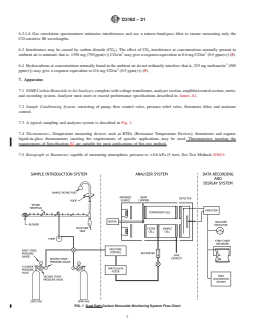
7.3 A typical sampling and analyzer system is described in
Fig. 1.
5. Significance and Use
7.4 Thermometer—Temperature measuring devices such as
5.1 Determination of carbon monoxide is essential to evalu-
RTDs (Resistance Temperature Devices), thermistors and or-
ation of many air pollution concerns and pollution control
ganic liquid-in-glass thermometers meeting the requirements
strategies. This test method derives significance from provid-
of specific applications may be used. Thermometers meeting
ing such determination.
the requirements of Specification E1 are suitable for most
5.2 Carbon monoxide is formed in the process of incom-
applications of this test method.
plete combustion of hydrocarbon fuels, and is a constituent of
7.5 Barograph or Barometer, capable of measuring atmo-
the exhaust of gasoline engines. The Environmental Protection
sphericpressureto 60.6kPa(5torr).SeeTestMethodsD3631.
Agency (EPA) has set primary and secondary air quality
standards for CO that are designed to protect the public health
8. Reagents and Materials
and welfare (3, 4).
8.1 Zero Gas—A pressurized cylinder of pure nitrogen
5.3 This test method is suitable for measurements appropri-
containing less than 0.1 mg/m CO (0.09 ppm(v)) and having
ate for the purposes noted in 5.1 and 5.2.
a regulated flow supply.
6. Interferences
8.2 Up-Scale Span Gas—A pressurized cylinder containing
a span gas mixture consisting of CO in air or nitrogen
6.1 Degree of interference varies among individual instru-
corresponding to 80 % of full scale. A regulated flow system
ments. Consult manufacturer’s specifications for the particular
must be provided.
analyzer to determine whether interferences render the instru-
ment unsuitable for the proposed use.
8.3 Calibration Gases—Pressured cylinders with regulated
flow control are required. These should contain concentrations
6.2 The primary interferents are water vapor and carbon
of CO in air or nitrogen corresponding to the instrument
dioxide. Without correction, the error may be as high as 11 mg
operating range. In order to establish a calibration curve, zero
CO/m (10 ppm(v)) (5).
air from an air cleanup panel or generator, certified zero air
6.2.1 Water vapor interference can be minimized by using
cylinder, or nitrogen with CO in amounts of 0, 10 to 20, 40 to
one of the following steps:
60, and 80 to 100 % of full scale are needed.
6.2.1.1 Passing the air sample through silica gel or similar
drying agent.
8.4 Calibration Certificate—The span and calibration gases
6.2.1.2 Maintaining constant humidity in the sample and
shouldbecertifiedtobebetween 62 %ofthestatedvalue,and
calibration gases by refrigeration.
be supplied in high-pressure cylinders with inside surfaces of a
6.2.1.3 Saturating the air sample and calibration gases to
chromium-molybdenum alloy of low iron content, or alumi-
maintain constant humidity.
num cylinders internally coated. Replacement cylinders should
6.2.1.4 Using narrow-band optical filters in combination
be verified by procedures in Annex A3.
with some of the above measures.
6.2.1.5 Where a sample is dried or humidified a volume
9. Precautions
correction may be necessary.
9.1 Operate analyzer system in nonexplosive areas unless
6.2.1.6 Gas correlation spectrometers minimize interfer-
equipment is explosion-proof.
ences and use a narrow-band-pass filter to ensure measuring
9.2 The handling and storage of compressed gas cylinders,
only the CO-sensitive IR wavelengths.
and the installation and use of the analyzer shall follow
6.3 Interference may be caused by carbon dioxide (CO ).
Practice D3249. Cylinders shall not be exposed to direct
The effect of CO interference at concentrations normally
sunlight.
present in ambient air is minimal; that is, 1350 mg (750
9.3 Maintain the same sample cell pressure during sampling
ppm(v)) CO /m may give a response equivalent to 0.6 mg
CO/m (0.5 ppm(v)) (5). and calibration. Use the same sample pump.
6.4 Hydrocarbons at concentrations normally found in the
10. Sampling
ambient air do not ordinarily interfere; that is, 325 mg
methane/m (500 ppm(v)) may give a response equivalent to 10.1 General—For planning sampling programs, refer to
0.6 mg CO/m (0.5 ppm(v)) (5). Practices D1357 and D3249.
D3162 − 21
FIG. 1 Dual Path Carbon Monoxide Monitoring System Flow Chart
10.2 When sampling outside ambient atmosphere from an 11.3.1 When the analyzer is purchased.
enclosure, a sampling line or probe shall be utilized. It shall 11.3.2 At6-monthintervals,byperformanceofathreepoint
extend at least1m(3ft) from the enclosure and shall be check. If results indicate the monitor has drifted, then perform
protected against the entry of precipitation. a full multipoint calibration.
11.3.3 When the gauge shows a change larger than 6.9 kPa
10.3 Since the analyzer may be temperature-sensitive, it
(1 psi) during a sampling period in which the flow rate did not
shall be placed in an enclosure with atmosphere control so the
3 3
change more than 60.014 m /h (0.5 ft /h).
temperature remains constant within 63°C(65 °F).
12. Procedure
10.4 Recordthetemperatureandpressureoftheatmosphere
sample.
12.1 After calibration has been established, check all ana-
lyzersystemoperatingparametersandsetthesampleflowrate.
11. Calibration and Standardization
12.2 When the analyzer output has stabilized, take the
11.1 For calibration procedures, refer to Annex A2.
recorder readout and determine the concentration of CO
11.2 Frequency of Calibration:
directly from the calibration curve in ppm(v).
11.2.1 Multipoint Calibration—A multipoint calibration is
12.3 Perform the operational checks described in AnnexA4
required when:
daily, or during each sampling period (6).
11.2.1.1 The analyzer is first purchased.
11.2.1.2 The analyzer has had maintenance that could affect 13. Calculation
its response characteristics.
13.1 To convert ppm(v) to mg/m , refer to Practice D1914.
11.2.1.3 When the analyzer shows drift in excess of speci-
14. Precision and Bias
fications as determined when the zero and span calibration is
NOTE1—Theprecisionstatementsarebasedonaninterlaboratorystudy
performed (see 11.2.2).
conducted by Southwest Research Institute, SanAntonio, TX, in 1972 on
11.2.2 Zero and Span Calibration—A zero and span cali-
threesamplesofcarbonmonoxid
...
This document is not an ASTM standard and is intended only to provide the user of an ASTM standard an indication of what changes have been made to the previous version. Because
it may not be technically possible to adequately depict all changes accurately, ASTM recommends that users consult prior editions as appropriate. In all cases only the current version
of the standard as published by ASTM is to be considered the official document.
Designation: D3162 − 12 (Reapproved 2020) D3162 − 21
Standard Test Method for
Carbon Monoxide in the Atmosphere (Continuous
Measurement by Nondispersive Infrared Spectrometry)
This standard is issued under the fixed designation D3162; the number immediately following the designation indicates the year of
original adoption or, in the case of revision, the year of last revision. A number in parentheses indicates the year of last reapproval. A
superscript epsilon (´) indicates an editorial change since the last revision or reapproval.
This standard has been approved for use by agencies of the U.S. Department of Defense.
1. Scope
1.1 This test method is applicable to the determination of the carbon monoxide (CO) concentration of the atmosphere between 0.6
3 3
mg/m (0.5 ppm(v)) and 115 mg/m (100 ppm(v)). The measuring principle is based on the absorption of infrared radiation by CO
in the 4.7 μm region (1).
1.2 The test method has a limit of detection of about 0.6 mg/m (0.5 ppm(v)) carbon monoxide in air.
1.3 The values stated in SI units are to be regarded as standard. The values and units in parentheses are provided for information
only and are not considered standard.
1.4 This standard does not purport to address all of the safety concerns, if any, associated with its use. It is the responsibility
of the user of this standard to establish appropriate safety, health, and environmental practices and determine the applicability of
regulatory limitations prior to use. See Section 9 for additional precautions.
1.5 This international standard was developed in accordance with internationally recognized principles on standardization
established in the Decision on Principles for the Development of International Standards, Guides and Recommendations issued
by the World Trade Organization Technical Barriers to Trade (TBT) Committee.
2. Referenced Documents
2.1 ASTM Standards:
D1356 Terminology Relating to Sampling and Analysis of Atmospheres
D1357 Practice for Planning the Sampling of the Ambient Atmosphere
D1914 Practice for Conversion Units and Factors Relating to Sampling and Analysis of Atmospheres
D3249 Practice for General Ambient Air Analyzer Procedures
D3631 Test Methods for Measuring Surface Atmospheric Pressure
E1 Specification for ASTM Liquid-in-Glass Thermometers
E180 Practice for Determining the Precision of ASTM Methods for Analysis and Testing of Industrial and Specialty Chemicals
(Withdrawn 2009)
This test method is under the jurisdiction of ASTM Committee D22 on Air Quality and is the direct responsibility of Subcommittee D22.03 on Ambient Atmospheres
and Source Emissions.
Current edition approved Sept. 1, 2020Nov. 1, 2021. Published September 2020May 2022. Originally approved in 1973. Last previous edition approved in 20122020 as
D3162 – 12.D3162 – 12 (2020). DOI: 10.1520/D3162-12R20.10.1520/D3162-21.
The boldface numbers in parentheses refer to the list of references at the end of the standard.
For referenced ASTM standards, visit the ASTM website, www.astm.org, or contact ASTM Customer Service at service@astm.org. For Annual Book of ASTM Standards
volume information, refer to the standard’s Document Summary page on the ASTM website.
The last approved version of this historical standard is referenced on www.astm.org.
Copyright © ASTM International, 100 Barr Harbor Drive, PO Box C700, West Conshohocken, PA 19428-2959. United States
D3162 − 21
3. Terminology
3.1 Definitions:
3.1.1 For definitions of terms used in this test method, refer to Terminology D1356 and Practice D3249.
3.2 Definitions of Terms Specific to This Standard:
3.2.1 fall time, n—the time interval between initial response and 90 % of final response after a step decrease in input
concentrations.
4. Summary of Test Method
4.1 An atmospheric sample is introduced into a sample conditioning system and then into a nondispersive infrared spectrometer
(NDIR). The spectrometer measures the absorption by CO at 4.7 μm using either a single path monitor capable of distinguishing
between sample and reference gases, or two parallel infrared beams through a sample and a reference cell and a selective detector.
The detector signal is conducted to an amplifier control section, and the analyzer output measured on a meter and recording system
(2).
4.1.1 Some instruments use gas filter correlation to compare the IR absorption spectrum between the measured gas and other gases
present in the gas being sampled, in a single sample cell. These instruments utilizeuse a concentrated sample of CO as a filter for
the IR transmitted through the sample cell to produce a beam that cannot be further attenuated by the CO in the sample, and thus
produces the reference beam. The broadband radiation that passes through the sample cell and the CO filter is filtered again by
a narrow-band-pass filter that allows only the CO-sensitive portion of the band to pass to the detector. The removal of wavelengths
sensitive to other gases reduces interferences.
4.2 The concentration of CO in the sample is determined from a calibration curve prepared using standard calibration gases.
5. Significance and Use
5.1 Determination of carbon monoxide is essential to evaluation of many air pollution complexes. concerns and pollution control
strategies. This test method derives significance from providing such determination.
5.2 Carbon monoxide is formed in the process of incomplete combustion of hydrocarbon fuels, and is a constituent of the exhaust
of gasoline engines. The Environmental Protection Agency (EPA) has set primary and secondary air quality standards for CO that
are designed to protect the public health and welfare (3, 4).
5.3 This test method is suitable for measurements appropriate for the purposes noted in 5.1 and 5.2.
6. Interferences
6.1 Degree of interference varies among individual instruments. Consult manufacturer’s specifications for the particular analyzer
to determine whether interferences render the instrument unsuitable for the proposed use.
6.2 The primary interferent is water vapor. With no interferents are water vapor and carbon dioxide. Without correction, the error
may be as high as 11 mg CO/m map edit n (10 (10 ppm(v)) (5).
6.2.1 Water vapor interference can be minimized by using one of the following steps:
6.2.1.1 Passing the air sample through silica gel or similar drying agent.
6.2.1.2 Maintaining constant humidity in the sample and calibration gases by refrigeration.
6.2.1.3 Saturating the air sample and calibration gases to maintain constant humidity.
6.2.1.4 Using narrow-band optical filters in combination with some of the above measures.
6.2.1.5 Where a sample is dried or humidified a volume correction may be necessary.
D3162 − 21
6.2.1.6 Gas correlation spectrometers minimize interferences and use a narrow-band-pass filter to ensure measuring only the
CO-sensitive IR wavelengths.
6.3 Interference may be caused by carbon dioxide (CO ). The effect of CO interference at concentrations normally present in
2 2
3 3
ambient air is minimal; that is, 1350 mg (750 ppm(v)) CO /m may give a response equivalent to 0.6 mg CO/m (0.5 ppm(v)) (5).
6.4 Hydrocarbons at concentrations normally found in the ambient air do not ordinarily interfere; that is, 325 mg methane/m (500
ppm(v)) may give a response equivalent to 0.6 mg CO/m (0.5 ppm(v)) (5).
7. Apparatus
7.1 NDIR Carbon Monoxide in Air Analyzer, complete with voltage transformer, analyzer section, amplifier/control section, meter,
and recording system. Analyzer must meet or exceed performance specifications described in Annex A1.
7.2 Sample Conditioning System, consisting of pump, flow control valve, pressure relief valve, flowmeter, filter, and moisture
control.
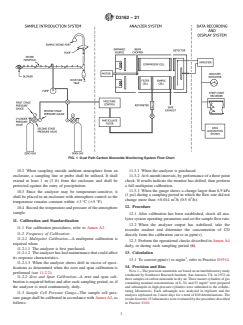
7.3 A typical sampling and analyzer system is described in Fig. 1.
7.4 Thermometer—Temperature measuring devices such as RTDs (Resistance Temperature Devices), thermistors and organic
liquid-in-glass thermometers meeting the requirements of specific applications may be used. Thermometers meeting the
requirements of Specification E1 are suitable for most applications of this test method.
7.5 Barograph or Barometer, capable of measuring atmospheric pressure to 60.6 kPa (5 torr). See Test Methods D3631.
FIG. 1 Dual Path Carbon Monoxide Monitoring System Flow Chart
D3162 − 21
8. Reagents and Materials
8.1 Zero Gas—A pressurized cylinder of pure nitrogen containing less than 0.1 mg/m CO (0.09 ppm(v)) and having a regulated
flow supply.
8.2 Up-Scale Span Gas—A pressurized cylinder containing a span gas mixture consisting of CO in air or nitrogen corresponding
to 80 % of full scale. A regulated flow system must be provided.
8.3 Calibration Gases—Pressured cylinders with regulated flow control are required. These should contain concentrations of CO
in air or nitrogen corresponding to the instrument operating range. In order to establish a calibration curve, zero air from an air
cleanup panel or generator, certified zero air cylinder, or nitrogen with CO in amounts of 10, 20, 40, and 80 % 0, 10 to 20, 40 to
60, and 80 to 100 % of full scale are needed.
8.4 Calibration Certificate—The span and calibration gases should be certified to be between 62 % of the stated value, and be
supplied in high-pressure cylinders with inside surfaces of a chromium-molybdenum alloy of low iron content. Replacement
cylindercontent, or aluminum cylinders internally coated. Replacement cylinders should be verified by procedures in Annex A3.
9. Precautions
9.1 Operate analyzer system in nonexplosive areas unless equipment is explosion-proof.
9.2 The handling and storage of compressed gas cylinders, and the installation and use of the analyzer shall follow Practice D3249.
Cylinders shall not be exposed to direct sunlight.
9.3 Maintain the same sample cell pressure during sampling and calibration. Use the same sample pump.
10. Sampling
10.1 General—For planning sampling programs, refer to Practices D1357 and D3249.
10.2 When sampling the outside ambient atmosphere from an enclosure, a sampling line or probe shall be utilized. It shall extend
at least 1 m [3 ft](3 ft) from the enclosure,enclosure and shall be protected against the entry of precipitation.
10.3 Since the analyzer may be temperature-sensitive, it shall be placed in an enclosure with atmosphere control so the
temperature remains constant within 63°C [65°F].63 °C (65 °F).
10.4 Record the temperature and pressure of the atmosphere sample.
11. Calibration and Standardization
11.1 For calibration procedures, refer to Annex A2.
11.2 Frequency of Calibration:
11.2.1 Multipoint Calibration—A multipoint calibration is required when:
11.2.1.1 The analyzer is first purchased.
11.2.1.2 The analyzer has had maintenance that could affect its response characteristics.
11.2.1.3 When the analyzer shows drift in excess of specifications as determined when the zero and span calibration is performed
(see 11.2.2).
11.2.2 Zero and Span Calibration—A zero and span calibration is required before and after each sampling period, or, if the
analyzer is used continuously, daily.
D3162 − 21
11.3 Sample Cell Pressure Gauge—The sample cell pressure gauge shall be calibrated in accordance with Annex A2, as follows:
11.3.1 When the analyzer is purchased.
11.3.2 At 6-month intervals.intervals, by performance of a three point check. If results indicate the monitor has drifted, then
perform a full multipoint calibration.
11.3.3 When the gauge shows a change larger than 6.9 kPa [1 psi](1 psi) during a sampling period in which the flow rate did not
3 3
change more than 60.014 m /h [0.5(0.5 ft /h]/h).
12. Procedure
12.1 After proper calibration has been established, check all analyzer system operating parameters and set the sample flow rate.
12.2 When the analyzer output has stabilized, take the recorder readout and determine the concentration of CO directly from the
calibration curve in ppm(v).
12.3 Perform the operational checks described in Annex A4 daily, or during each sampl
...
Questions, Comments and Discussion
Ask us and Technical Secretary will try to provide an answer. You can facilitate discussion about the standard in here.
Loading comments...