


ASTM F1064-11(2016)
(Practice)Standard Practice for Sampling and Inspection of Complete and Incomplete Alpine Ski/Binding/Boot Systems in Rental Applications
Standard Practice for Sampling and Inspection of Complete and Incomplete Alpine Ski/Binding/Boot Systems in Rental Applications
SIGNIFICANCE AND USE
5.1 The purpose of this practice is to aid in providing the end user with an appropriate functioning system and release/retention value by providing the rental facility with an ongoing program for monitoring the appropriateness of functional characteristics of the system. It is assumed that these procedures are integrated into the maintenance and operating procedures specified by the equipment manufacturers. This practice is not intended to create additional or redundant requirements for the rental facility. However, this practice should be the basis for the development of rental procedures if the equipment manufacturer's maintenance and operating procedures do not specifically state that they are in compliance with this practice. This practice will aid the rental facility in providing the end user with an appropriate release/retention value.
5.2 This practice is applicable to rental facilities that use releasable Alpine ski bindings. It is not intended as a method for evaluating equipment design.
SCOPE
1.1 This practice establishes a uniform method for the sampling and inspection of complete and incomplete Alpine ski/binding/boot systems used in rental operations. This practice is appropriate for use in rental applications in which all or part of the functional components of the system are supplied by the rental facility.
1.2 This practice should be followed by any facility that rents complete or incomplete Alpine ski/binding/boot systems to an end user.
Note 1: Refer to Practice F1063 for equivalent procedures and tolerances for retail systems.
General Information
Buy Standard
Standards Content (Sample)
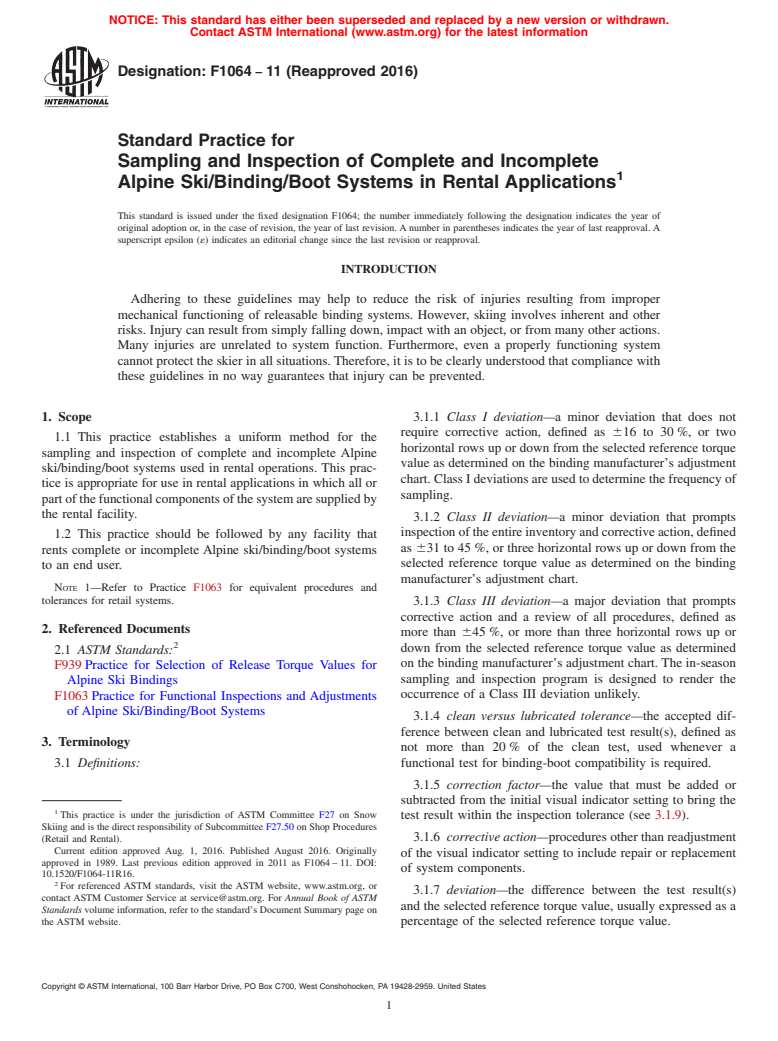
NOTICE: This standard has either been superseded and replaced by a new version or withdrawn.
Contact ASTM International (www.astm.org) for the latest information
Designation: F1064 − 11 (Reapproved 2016)
Standard Practice for
Sampling and Inspection of Complete and Incomplete
Alpine Ski/Binding/Boot Systems in Rental Applications
This standard is issued under the fixed designation F1064; the number immediately following the designation indicates the year of
original adoption or, in the case of revision, the year of last revision. A number in parentheses indicates the year of last reapproval. A
superscript epsilon (´) indicates an editorial change since the last revision or reapproval.
INTRODUCTION
Adhering to these guidelines may help to reduce the risk of injuries resulting from improper
mechanical functioning of releasable binding systems. However, skiing involves inherent and other
risks. Injury can result from simply falling down, impact with an object, or from many other actions.
Many injuries are unrelated to system function. Furthermore, even a properly functioning system
cannot protect the skier in all situations. Therefore, it is to be clearly understood that compliance with
these guidelines in no way guarantees that injury can be prevented.
1. Scope 3.1.1 Class I deviation—a minor deviation that does not
require corrective action, defined as 616 to 30 %, or two
1.1 This practice establishes a uniform method for the
horizontal rows up or down from the selected reference torque
sampling and inspection of complete and incomplete Alpine
value as determined on the binding manufacturer’s adjustment
ski/binding/boot systems used in rental operations. This prac-
chart. Class I deviations are used to determine the frequency of
tice is appropriate for use in rental applications in which all or
sampling.
partofthefunctionalcomponentsofthesystemaresuppliedby
the rental facility.
3.1.2 Class II deviation—a minor deviation that prompts
inspectionoftheentireinventoryandcorrectiveaction,defined
1.2 This practice should be followed by any facility that
as 631 to 45 %, or three horizontal rows up or down from the
rents complete or incomplete Alpine ski/binding/boot systems
selected reference torque value as determined on the binding
to an end user.
manufacturer’s adjustment chart.
NOTE 1—Refer to Practice F1063 for equivalent procedures and
tolerances for retail systems.
3.1.3 Class III deviation—a major deviation that prompts
corrective action and a review of all procedures, defined as
2. Referenced Documents
more than 645 %, or more than three horizontal rows up or
down from the selected reference torque value as determined
2.1 ASTM Standards:
on the binding manufacturer’s adjustment chart. The in-season
F939 Practice for Selection of Release Torque Values for
sampling and inspection program is designed to render the
Alpine Ski Bindings
occurrence of a Class III deviation unlikely.
F1063 Practice for Functional Inspections and Adjustments
of Alpine Ski/Binding/Boot Systems
3.1.4 clean versus lubricated tolerance—the accepted dif-
ference between clean and lubricated test result(s), defined as
3. Terminology
not more than 20 % of the clean test, used whenever a
3.1 Definitions: functional test for binding-boot compatibility is required.
3.1.5 correction factor—the value that must be added or
subtracted from the initial visual indicator setting to bring the
This practice is under the jurisdiction of ASTM Committee F27 on Snow
test result within the inspection tolerance (see 3.1.9).
Skiing and is the direct responsibility of Subcommittee F27.50 on Shop Procedures
(Retail and Rental). 3.1.6 corrective action—procedures other than readjustment
Current edition approved Aug. 1, 2016. Published August 2016. Originally
of the visual indicator setting to include repair or replacement
approved in 1989. Last previous edition approved in 2011 as F1064 – 11. DOI:
of system components.
10.1520/F1064-11R16.
For referenced ASTM standards, visit the ASTM website, www.astm.org, or
3.1.7 deviation—the difference between the test result(s)
contact ASTM Customer Service at service@astm.org. For Annual Book of ASTM
and the selected reference torque value, usually expressed as a
Standards volume information, refer to the standard’s Document Summary page on
the ASTM website. percentage of the selected reference torque value.
Copyright © ASTM International, 100 Barr Harbor Drive, PO Box C700, West Conshohocken, PA 19428-2959. United States
F1064 − 11 (2016)
3.1.8 initial visual indicator setting—the visual indicator 3.1.21 seasonal rental—a rental system that is rented for the
setting derived from the binding manufacturer’s release/ entire or majority of a season, that will not return to the rental
retention adjustment chart. inventory until the end of the season. Such system will follow
the practice as provided in Practice F1063.
3.1.9 inspection tolerance—theaccepteddifferencebetween
3.1.22 system—a group of interacting components, usually
the reference torque value and the test result. Defined as
comprised of a ski, binding, and boot.
615 % of the reference torque value, or 63 Nm for twist and
610 Nm for forward lean, whichever is greater, or one 3.1.23 test result—the middle quantitative value of three
horizontal row up or down from the selected reference torque
repetitions of the same test.
value determined on the binding manufacturer’s adjustment
3.1.24 troubleshooting—the binding manufacturer’s recom-
chart. Use as the criteria for prompting consultation of the
mendations or procedures for analyzing system failure.
binding manufacturer’s troubleshooting procedures or applica-
3.1.25 visual indicator setting—the setting displayed on the
tion of a correction factor, should procedures not be available.
binding’s release/retention adjustment scale.
3.1.9.1 Discussion—In the case when an algorithm or table
is used to provide a value, either may be used (differences may
4. Summary of Practice
be insignificant).
4.1 Prior to the beginning of each season, boots and
3.1.10 interchangeable—applies to the free exchange of
bindings are inspected for compatibility and interchangeability
boots within a rental inventory without testing each new
using a testing device as defined in Annex A1 of Practice
combination of system components.
F1063.
3.1.11 clockwise versus counterclockwise tolerance—the
4.2 At specified intervals throughout the operating season
accepted difference between test results about an axis perpen-
samples are taken from rental inventory and inspected. Test
dicular to the plane of the ski, usually from the toe piece
results are used to determine sampling frequency and prompt
component, and defined as within the inspection tolerance (see
corrective action when specified tolerances are exceeded.
3.1.9).
5. Significance and Use
3.1.12 limit for correction—the accepted difference between
5.1 The purpose of this practice is to aid in providing the
the reference torque value and the test result(s), defined as
end user with an appropriate functioning system and release/
630 % of the reference torque value, or 65 Nm for twist and
retention value by providing the rental facility with an ongoing
620 Nm for forward lean, whichever is greater, or two
program for monitoring the appropriateness of functional
horizontal rows up or down from the selected reference torque
characteristics of the system. It is assumed that these proce-
value determined on the binding manufacturer’s adjustment
dures are integrated into the maintenance and operating pro-
chart. Used as the upper and lower limit for application of a
cedures specified by the equipment manufacturers. This prac-
correction factor.
tice is not intended to create additional or redundant
3.1.13 measured release value—release torque value deter-
requirements for the rental facility. However, this practice
mined by the use of a testing device of the type defined in
should be the basis for the development of rental procedures if
Annex A1 (see 3.1.23).
the equipment manufacturer’s maintenance and operating pro-
3.1.14 non-interchangeable—appliestotheestablishmentof
cedures do not specifically state that they are in compliance
specific binding-boot combinations that are tested each time a
with this practice. This practice will aid the rental facility in
new combination is created.
providing the end user with an appropriate release/retention
value.
3.1.15 random sampling—a procedure in which every sam-
pling unit in the inventory has an equal chance of being 5.2 This practice is applicable to rental facilities that use
included in the sample. releasable Alpine ski bindings. It is not intended as a method
for evaluating equipment design.
3.1.16 reference binding—a unit that is typical of the bind-
ings in inventory.
6. Test Device
3.1.17 reference boot—a boot that is typical of the boots in
6.1 Alltestsspecifiedinthispracticearemadewithadevice
inventory and satisfies the requirements of A1.1.3.
that indicates torque. Such a device should be inspected by the
rental facility in accordance with Annex A2.
3.1.18 reference torque value—the nominal release torque
value derived from a document compatible with Practice F939
7. Equipment Inspection Requirements
such as Annex A3 or information supplied by the binding or
7.1 Preseason Inspection—Prior to the beginning of each
test device manufacturer.
season and whenever new inventory is added, an inspection
3.1.19 rental skier days—the number of rental skiers pro-
should be made of the components of the release/retention
cessed through a ski rental facility in a 24-h period.
system. Units that do not meet the specified tolerances are
3.1.20 rental unit—hereinafter unit(s), a half pair of ski repaired, modified, or replaced.
equipment (ski-binding-boot system), consisting of a boot, a 7.1.1 Avisual inspection for compatibility and interchange-
binding, and a ski or any individual system components (for ability is performed on all boots in accordance with the
example, a single boot or a single ski-binding). procedures recommended by the binding manufacturer.
F1064 − 11 (2016)
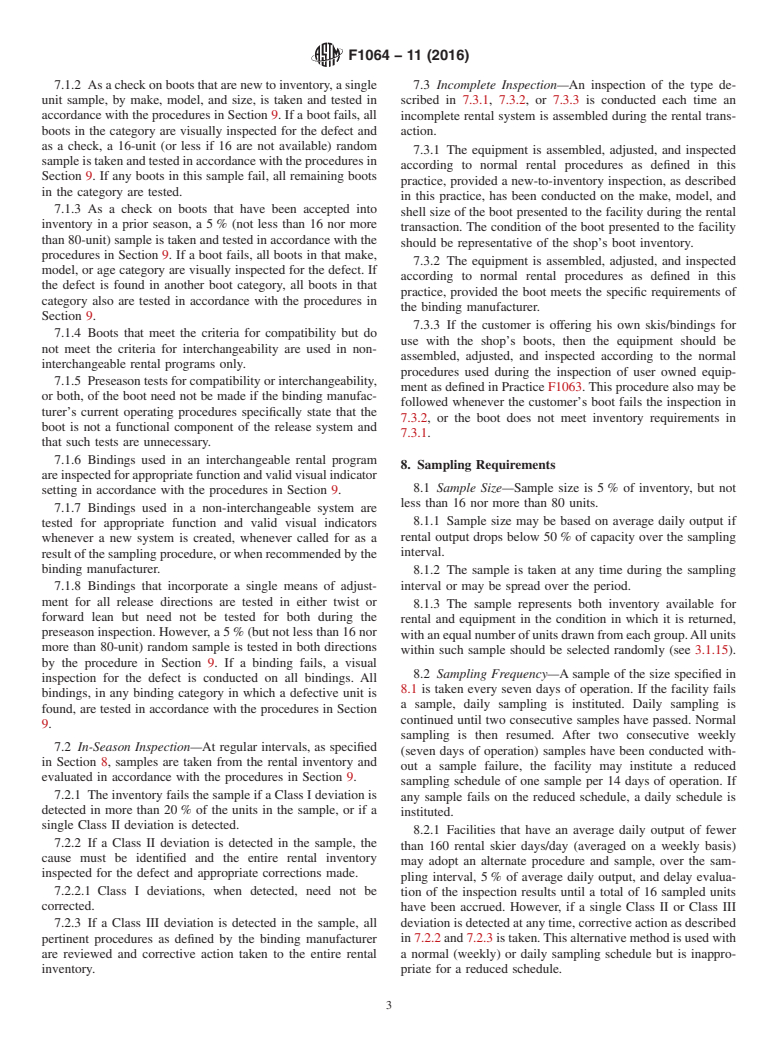
7.1.2 As a check on boots that are new to inventory, a single 7.3 Incomplete Inspection—An inspection of the type de-
unit sample, by make, model, and size, is taken and tested in scribed in 7.3.1, 7.3.2,or 7.3.3 is conducted each time an
accordance with the procedures in Section 9. If a boot fails, all
incomplete rental system is assembled during the rental trans-
boots in the category are visually inspected for the defect and action.
as a check, a 16-unit (or less if 16 are not available) random
7.3.1 The equipment is assembled, adjusted, and inspected
sampleistakenandtestedinaccordancewiththeproceduresin
according to normal rental procedures as defined in this
Section 9. If any boots in this sample fail, all remaining boots
practice, provided a new-to-inventory inspection, as described
in the category are tested.
in this practice, has been conducted on the make, model, and
7.1.3 As a check on boots that have been accepted into
shell size of the boot presented to the facility during the rental
inventory in a prior season, a 5 % (not less than 16 nor more
transaction. The condition of the boot presented to the facility
than 80-unit) sample is taken and tested in accordance with the
should be representative of the shop’s boot inventory.
procedures in Section 9. If a boot fails, all boots in that make,
7.3.2 The equipment is assembled, adjusted, and inspected
model, or age category are visually inspected for the defect. If
according to normal rental procedures as defined in this
the defect is found in another boot category, all boots in that
practice, provided the boot meets the specific requirements of
category also are tested in accordance with the procedures in
the binding manufacturer.
Section 9.
7.3.3 If the customer is offering his own skis/bindings for
7.1.4 Boots that meet the criteria for compatibility but do
use with the shop’s boots, then the equipment should be
not meet the criteria for interchangeability are used in non-
assembled, adjusted, and inspected according to the normal
interchangeable rental programs only.
procedures used during the inspection of user owned equip-
7.1.5 Preseason tests for compatibility or interchangeability,
ment as defined in Practice F1063. This procedure also may be
or both, of the boot need not be made if the binding manufac-
followed whenever the customer’s boot fails the inspection in
turer’s current operating procedures specifically state that the
7.3.2, or the boot does not meet inventory requirements in
boot is not a functional component of the release system and
7.3.1.
that such tests are unnecessary.
7.1.6 Bindings used in an interchangeable rental program
8. Sampling Requirements
areinspectedforappropriatefunctionandvalidvisualindicator
8.1 Sample Size—Sample size is 5 % of inventory, but not
setting in accordance with the procedures in Section 9.
less than 16 nor more than 80 units.
7.1.7 Bindings used in a non-interchangeable system are
8.1.1 Sample size may be based on average daily output if
tested for appropriate function and valid visual indicators
rental output drops below 50 % of capacity over the sampling
whenever a new system is created, whenever called for as a
interval.
result of the sampling procedure, or when recommended by the
binding manufacturer.
8.1.2 The sample is taken at any time during the sampling
interval or may be spread over the period.
7.1.8 Bindings that incorporate a single means of adjust-
ment for all release directions are tested in either twist or
8.1.3 The sample represents both inventory available for
forward lean but need not be tested for both during the
rental and equipment in the condition in which it is returned,
preseason inspection. However, a 5 % (but not less than 16 nor
withanequalnumberofunitsdrawnfromeachgroup.Allunits
more than 80-unit) random sample is tested in both directions
within such sample should be selected randomly (see 3.1.15).
by the procedure in Section 9. If a binding fails, a visual
8.2 Sampling Frequency—A sample of the size specified in
inspection for the defect is conducted on all bindings. All
8.1 is taken every seven days of operation. If the facility fails
bindings, in any binding category in which a defective unit is
a sample, daily sampling is instituted. Daily sampling is
found, are tested in accordance with the procedures in Section
continued until two consecutive samples have passed. Normal
9.
sampling is then resumed. After two consecutive weekly
7.2 In-Season Inspection—At regular intervals, as specified
(seven days of operation) samples have been conducted with-
in Section 8, samples are taken from the rental inventory and
out a sample failure, the facility may institute a reduced
evaluated in accordance with the procedures in Section 9.
sampling schedule of one samp
...
This document is not an ASTM standard and is intended only to provide the user of an ASTM standard an indication of what changes have been made to the previous version. Because
it may not be technically possible to adequately depict all changes accurately, ASTM recommends that users consult prior editions as appropriate. In all cases only the current version
of the standard as published by ASTM is to be considered the official document.
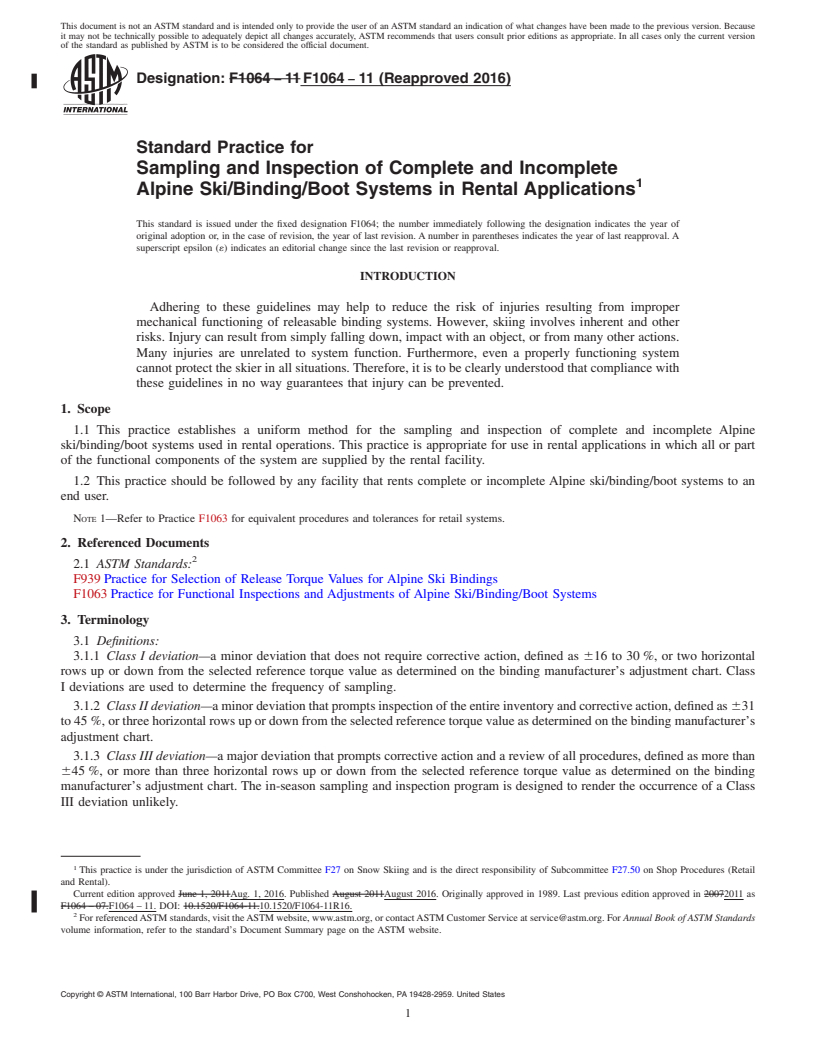
Designation: F1064 − 11 F1064 − 11 (Reapproved 2016)
Standard Practice for
Sampling and Inspection of Complete and Incomplete
Alpine Ski/Binding/Boot Systems in Rental Applications
This standard is issued under the fixed designation F1064; the number immediately following the designation indicates the year of
original adoption or, in the case of revision, the year of last revision. A number in parentheses indicates the year of last reapproval. A
superscript epsilon (´) indicates an editorial change since the last revision or reapproval.
INTRODUCTION
Adhering to these guidelines may help to reduce the risk of injuries resulting from improper
mechanical functioning of releasable binding systems. However, skiing involves inherent and other
risks. Injury can result from simply falling down, impact with an object, or from many other actions.
Many injuries are unrelated to system function. Furthermore, even a properly functioning system
cannot protect the skier in all situations. Therefore, it is to be clearly understood that compliance with
these guidelines in no way guarantees that injury can be prevented.
1. Scope
1.1 This practice establishes a uniform method for the sampling and inspection of complete and incomplete Alpine
ski/binding/boot systems used in rental operations. This practice is appropriate for use in rental applications in which all or part
of the functional components of the system are supplied by the rental facility.
1.2 This practice should be followed by any facility that rents complete or incomplete Alpine ski/binding/boot systems to an
end user.
NOTE 1—Refer to Practice F1063 for equivalent procedures and tolerances for retail systems.
2. Referenced Documents
2.1 ASTM Standards:
F939 Practice for Selection of Release Torque Values for Alpine Ski Bindings
F1063 Practice for Functional Inspections and Adjustments of Alpine Ski/Binding/Boot Systems
3. Terminology
3.1 Definitions:
3.1.1 Class I deviation—a minor deviation that does not require corrective action, defined as 616 to 30 %, or two horizontal
rows up or down from the selected reference torque value as determined on the binding manufacturer’s adjustment chart. Class
I deviations are used to determine the frequency of sampling.
3.1.2 Class II deviation—a minor deviation that prompts inspection of the entire inventory and corrective action, defined as 631
to 45 %, or three horizontal rows up or down from the selected reference torque value as determined on the binding manufacturer’s
adjustment chart.
3.1.3 Class III deviation—a major deviation that prompts corrective action and a review of all procedures, defined as more than
645 %, or more than three horizontal rows up or down from the selected reference torque value as determined on the binding
manufacturer’s adjustment chart. The in-season sampling and inspection program is designed to render the occurrence of a Class
III deviation unlikely.
This practice is under the jurisdiction of ASTM Committee F27 on Snow Skiing and is the direct responsibility of Subcommittee F27.50 on Shop Procedures (Retail
and Rental).
Current edition approved June 1, 2011Aug. 1, 2016. Published August 2011August 2016. Originally approved in 1989. Last previous edition approved in 20072011 as
F1064 – 07.F1064 – 11. DOI: 10.1520/F1064-11.10.1520/F1064-11R16.
For referenced ASTM standards, visit the ASTM website, www.astm.org, or contact ASTM Customer Service at service@astm.org. For Annual Book of ASTM Standards
volume information, refer to the standard’s Document Summary page on the ASTM website.
Copyright © ASTM International, 100 Barr Harbor Drive, PO Box C700, West Conshohocken, PA 19428-2959. United States
F1064 − 11 (2016)
3.1.4 clean versus lubricated tolerance—the accepted difference between clean and lubricated test result(s), defined as not more
than 20 % of the clean test, used whenever a functional test for binding-boot compatibility is required.
3.1.5 correction factor—the value that must be added or subtracted from the initial visual indicator setting to bring the test result
within the inspection tolerance (see 3.1.9).
3.1.6 corrective action—procedures other than readjustment of the visual indicator setting to include repair or replacement of
system components.
3.1.7 deviation—the difference between the test result(s) and the selected reference torque value, usually expressed as a
percentage of the selected reference torque value.
3.1.8 initial visual indicator setting—the visual indicator setting derived from the binding manufacturer’s release/retention
adjustment chart.
3.1.9 inspection tolerance—the accepted difference between the reference torque value and the test result. Defined as 615 %
of the reference torque value, or 63 Nm for twist and 610 Nm for forward lean, whichever is greater, or one horizontal row up
or down from the selected reference torque value determined on the binding manufacturer’s adjustment chart. Use as the criteria
for prompting consultation of the binding manufacturer’s troubleshooting procedures or application of a correction factor, should
procedures not be available.
3.1.9.1 Discussion—In the case when an algorithm or table is used to provide a value, either may be used (differences may be
insignificant).
3.1.10 interchangeable—applies to the free exchange of boots within a rental inventory without testing each new combination
of system components.
3.1.11 clockwise versus counterclockwise tolerance—the accepted difference between test results about an axis perpendicular
to the plane of the ski, usually from the toe piece component, and defined as within the inspection tolerance (see 3.1.9).
3.1.12 limit for correction—the accepted difference between the reference torque value and the test result(s), defined as 630 %
of the reference torque value, or 65 Nm for twist and 620 Nm for forward lean, whichever is greater, or two horizontal rows up
or down from the selected reference torque value determined on the binding manufacturer’s adjustment chart. Used as the upper
and lower limit for application of a correction factor.
3.1.13 measured release value—release torque value determined by the use of a testing device of the type defined in Annex A1
(see 3.1.23).
3.1.14 non-interchangeable—applies to the establishment of specific binding-boot combinations that are tested each time a new
combination is created.
3.1.15 random sampling—a procedure in which every sampling unit in the inventory has an equal chance of being included in
the sample.
3.1.16 reference binding—a unit that is typical of the bindings in inventory.
3.1.17 reference boot—a boot that is typical of the boots in inventory and satisfies the requirements of A1.1.3.
3.1.18 reference torque value—the nominal release torque value derived from a document compatible with Practice F939 such
as Annex A3 or information supplied by the binding or test device manufacturer.
3.1.19 rental skier days—the number of rental skiers processed through a ski rental facility in a 24-h period.
3.1.20 rental unit—hereinafter unit(s), a half pair of ski equipment (ski-binding-boot system), consisting of a boot, a binding,
and a ski or any individual system components (for example, a single boot or a single ski-binding).
3.1.21 seasonal rental—a rental system that is rented for the entire or majority of a season, that will not return to the rental
inventory until the end of the season. Such system will follow the practice as provided in Practice F1063.
3.1.22 system—a group of interacting components, usually comprised of a ski, binding, and boot.
3.1.23 test result—the middle quantitative value of three repetitions of the same test.
3.1.24 troubleshooting—the binding manufacturer’s recommendations or procedures for analyzing system failure.
3.1.25 visual indicator setting—the setting displayed on the binding’s release/retention adjustment scale.
4. Summary of Practice
4.1 Prior to the beginning of each season, boots and bindings are inspected for compatibility and interchangeability using a
testing device as defined in Annex A1 of Practice F1063.
4.2 At specified intervals throughout the operating season samples are taken from rental inventory and inspected. Test results
are used to determine sampling frequency and prompt corrective action when specified tolerances are exceeded.
F1064 − 11 (2016)
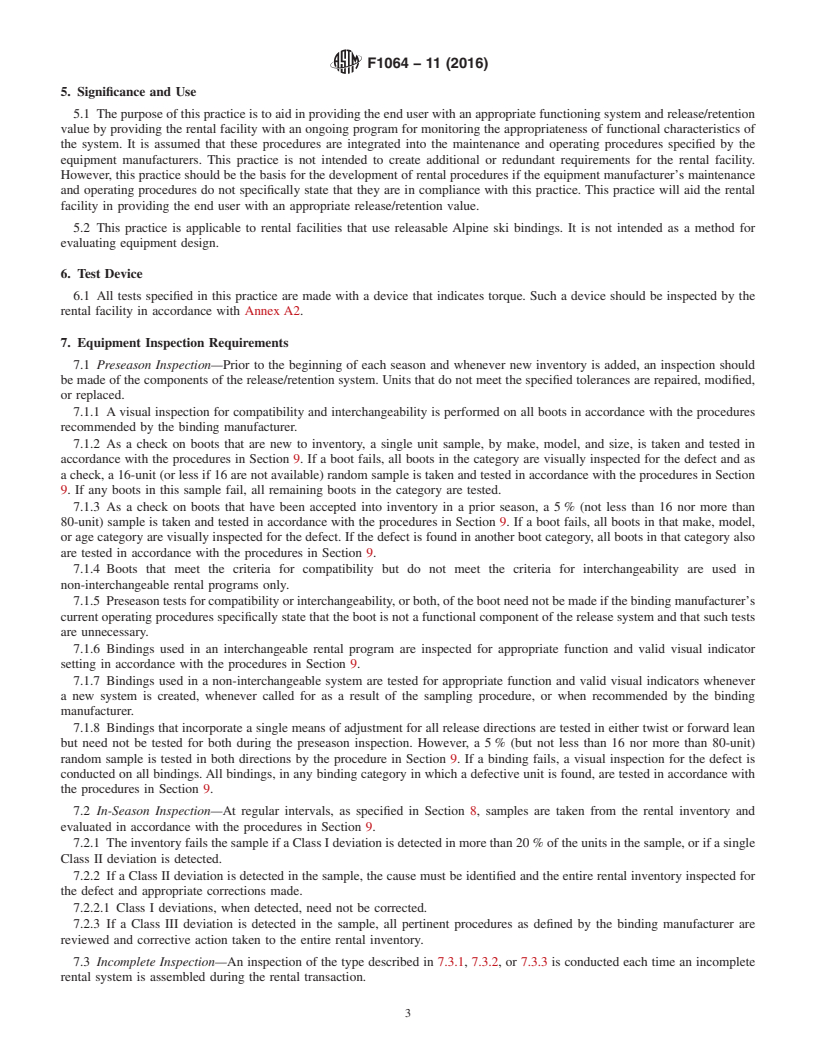
5. Significance and Use
5.1 The purpose of this practice is to aid in providing the end user with an appropriate functioning system and release/retention
value by providing the rental facility with an ongoing program for monitoring the appropriateness of functional characteristics of
the system. It is assumed that these procedures are integrated into the maintenance and operating procedures specified by the
equipment manufacturers. This practice is not intended to create additional or redundant requirements for the rental facility.
However, this practice should be the basis for the development of rental procedures if the equipment manufacturer’s maintenance
and operating procedures do not specifically state that they are in compliance with this practice. This practice will aid the rental
facility in providing the end user with an appropriate release/retention value.
5.2 This practice is applicable to rental facilities that use releasable Alpine ski bindings. It is not intended as a method for
evaluating equipment design.
6. Test Device
6.1 All tests specified in this practice are made with a device that indicates torque. Such a device should be inspected by the
rental facility in accordance with Annex A2.
7. Equipment Inspection Requirements
7.1 Preseason Inspection—Prior to the beginning of each season and whenever new inventory is added, an inspection should
be made of the components of the release/retention system. Units that do not meet the specified tolerances are repaired, modified,
or replaced.
7.1.1 A visual inspection for compatibility and interchangeability is performed on all boots in accordance with the procedures
recommended by the binding manufacturer.
7.1.2 As a check on boots that are new to inventory, a single unit sample, by make, model, and size, is taken and tested in
accordance with the procedures in Section 9. If a boot fails, all boots in the category are visually inspected for the defect and as
a check, a 16-unit (or less if 16 are not available) random sample is taken and tested in accordance with the procedures in Section
9. If any boots in this sample fail, all remaining boots in the category are tested.
7.1.3 As a check on boots that have been accepted into inventory in a prior season, a 5 % (not less than 16 nor more than
80-unit) sample is taken and tested in accordance with the procedures in Section 9. If a boot fails, all boots in that make, model,
or age category are visually inspected for the defect. If the defect is found in another boot category, all boots in that category also
are tested in accordance with the procedures in Section 9.
7.1.4 Boots that meet the criteria for compatibility but do not meet the criteria for interchangeability are used in
non-interchangeable rental programs only.
7.1.5 Preseason tests for compatibility or interchangeability, or both, of the boot need not be made if the binding manufacturer’s
current operating procedures specifically state that the boot is not a functional component of the release system and that such tests
are unnecessary.
7.1.6 Bindings used in an interchangeable rental program are inspected for appropriate function and valid visual indicator
setting in accordance with the procedures in Section 9.
7.1.7 Bindings used in a non-interchangeable system are tested for appropriate function and valid visual indicators whenever
a new system is created, whenever called for as a result of the sampling procedure, or when recommended by the binding
manufacturer.
7.1.8 Bindings that incorporate a single means of adjustment for all release directions are tested in either twist or forward lean
but need not be tested for both during the preseason inspection. However, a 5 % (but not less than 16 nor more than 80-unit)
random sample is tested in both directions by the procedure in Section 9. If a binding fails, a visual inspection for the defect is
conducted on all bindings. All bindings, in any binding category in which a defective unit is found, are tested in accordance with
the procedures in Section 9.
7.2 In-Season Inspection—At regular intervals, as specified in Section 8, samples are taken from the rental inventory and
evaluated in accordance with the procedures in Section 9.
7.2.1 The inventory fails the sample if a Class I deviation is detected in more than 20 % of the units in the sample, or if a single
Class II deviation is detected.
7.2.2 If a Class II deviation is detected in the sample, the cause must be identified and the entire rental inventory inspected for
the defect and appropriate corrections made.
7.2.2.1 Class I deviations, when detected, need not be corrected.
7.2.3 If a Class III deviation is detected in the sample, all pertinent procedures as defined by the binding manufacturer are
reviewed and corrective action taken to the entire rental inventory.
7.3 Incomplete Inspection—An inspection of the type described in 7.3.1, 7.3.2, or 7.3.3 is conducted each time an incomplete
rental system is assembled during the rental transaction.
F1064 − 11 (2016)
7.3.1 The equipment is assembled, adjusted, and inspected according to normal rental procedures as defined in this practice,
provided a new-to-inventory inspection, as described in this practice, has been conducted on the make, model, and shell size of
the boot presented to the facility during the rental transaction. The condition of the boot presented to the facility should be
representative of the shop’s boot inventory.
7.3.2 The equipment is assembled, adjusted, and inspected according to normal rental procedures as defined in this practice,
provided the boot meets the specific requirements of the binding manufacturer.
7.3.3 If the customer is offering his own skis/bindings for use with the shop’s boots, then the equipment should be assembled,
adjusted, and inspected according to the normal procedures used during the inspection of user owned equipment as defined in
Practice F1063. This procedure also may be followed whenever the customer’s boot fails the inspection in 7.3.2, or the boot does
not meet inventory requiremen
...
Questions, Comments and Discussion
Ask us and Technical Secretary will try to provide an answer. You can facilitate discussion about the standard in here.