

ASTM D6801-07(2021)
(Test Method)Standard Test Method for Measuring Maximum Spontaneous Heating Temperature of Art and Other Materials
General Information
- Abstract
SIGNIFICANCE AND USE
5.1 This test method provides a means of accelerating the tendency of a material toward spontaneous heating that may eventually lead to a fire. It is applicable to liquids and pastes.
5.2 The spontaneous heating behavior of an oil-based material is affected by such factors as the availability of oxygen, the amount of driers present, the degree of polymerization of oils, the surface area of the cellulose material, measures to prevent heat dissipation, and the amount of oil in contact with cellulose material. The degree of spontaneous heating bears little relationship to the type of cellulose material to which an oil-based material comes in contact or whether or not oil soaked materials are first air dried. Small amounts of contaminants, such as oil paint, quartz dust, dirt or drier (for example, materials that might be found on a dirty, oil-soaked rag), can act as catalysts for this reaction.4
SCOPE
1.1 This test method covers a small-scale laboratory procedure to determine the self heating tendency of oil-based materials by exposure to elevated temperatures in air in a controlled semi-adiabatic system.
1.2 This test method has been developed to address an urgent need to identify oil-based materials that may require labeling for spontaneous heating tendency. Studies based on this test method may allow the development of a practice to identify such oil-based materials.
1.3 The values stated in SI units are to be regarded as standard. The values given in parentheses are for information only.
1.4 This standard does not purport to address all of the safety concerns, if any, associated with its use. It is the responsibility of the user of this standard to establish appropriate safety, health, and environmental practices and determine the applicability of regulatory limitations prior to use. For safety concerns specific to disposal of solvent-soaked rags, see Appendix X1.
1.5 This international standard was developed in accordance with internationally recognized principles on standardization established in the Decision on Principles for the Development of International Standards, Guides and Recommendations issued by the World Trade Organization Technical Barriers to Trade (TBT) Committee.
- Status
- Published
- Publication Date
- 31-Oct-2021
- Technical Committee
- D01 - Paint and Related Coatings, Materials, and Applications
- Drafting Committee
- D01.57 - Artist Paints and Related Materials

Overview
ASTM D6801-07(2021), titled Standard Test Method for Measuring Maximum Spontaneous Heating Temperature of Art and Other Materials, establishes a laboratory procedure to determine the self-heating tendency of oil-based materials. This test method is especially crucial for identifying materials, such as artist paints and related substances, that may pose a spontaneous heating or combustion risk under certain conditions. The standard is developed according to internationally recognized principles for standardization, supporting safety and compliance in material handling and labeling.
Key Topics
- Spontaneous Heating and Combustion Risks: This method measures the maximum spontaneous heating temperature, offering a reliable way to predict the risk of self-heating that could eventually lead to fire, especially when materials are exposed to elevated temperatures.
- Applicable Materials: The standard applies primarily to liquids and pastes containing seed or nut oils, such as those often found in art materials, oil paints, and similar substances.
- Test Method Summary:
- A sample, typically a non-woven paper cloth saturated with the test material and manganese drier, is placed in a controlled, semi-adiabatic environment.
- The assembly is heated in air, and the temperature rise is monitored using a K thermocouple and a maximum temperature recorder.
- The main result is the difference between the maximum spontaneous heating temperature and the control temperature, indicating self-heating propensity.
- Influencing Factors:
- Oxygen availability
- Presence and amount of metallic driers
- Degree of oil polymerization
- Surface area of the cellulose substrate
- Methods preventing or enabling heat dissipation
- Quantity of oil in contact with the cellulose
- Presence of contaminants (such as oil paint residues, dust, and driers), which may catalyze spontaneous heating
Applications
Implementing ASTM D6801-07(2021) offers significant practical benefits for various industries:
- Art Materials and Paint Manufacturing: Essential for manufacturers and suppliers who need to classify or label oil-based products according to their spontaneous heating tendency, supporting regulatory compliance and promoting user safety.
- Fire Safety and Prevention: Helps identify materials at risk for self-ignition, guiding the development of safe storage, handling, and disposal protocols-particularly important for substances like solvent- or oil-soaked rags, which can pose substantial fire hazards.
- Materials Research and Product Testing: Laboratories and quality assurance professionals use this standard to compare new oil-based formulations or additives in terms of flammability and spontaneous combustion risk.
- Workplace Safety: Supports safe practices in studios, workshops, and industrial settings where oil-based materials are prevalent, informing housekeeping routines and the design of ventilation or containment systems.
Related Standards
- ASTM E633: Guide for Use of Thermocouples in Elevated-Temperature Mechanical Testing
- (Withdrawn) ASTM E771: Test Method for Spontaneous Heating Tendency of Materials
- Labeling and Regulatory Standards: The method supports compliance with relevant fire and chemical safety labeling regulations and international trade requirements.
Practical Value
ASTM D6801-07(2021) is essential for industries dealing with oil-based materials by providing an objective, reproducible assessment of the spontaneous heating risk. It enables proper classification, safe handling, and disposal-the latter being particularly important for contaminated rags, which should either be water-dampened and stored in airtight metal containers or thoroughly washed prior to discarding. Adhering to this standard helps meet international safety expectations, reduces liability, and fosters confidence in safe product use and distribution.
Keywords: spontaneous heating, self-heating, oil-based materials, art materials, fire risk, ASTM D6801, spontaneous combustion, flammability, maximum spontaneous heating temperature.
Relations
- Effective Date
- 01-May-2005
- Effective Date
- 10-May-2000
- Effective Date
- 01-Jan-1996
Frequently Asked Questions
ASTM D6801-07(2021) is a standard published by ASTM International. Its full title is "Standard Test Method for Measuring Maximum Spontaneous Heating Temperature of Art and Other Materials". This standard covers: SIGNIFICANCE AND USE 5.1 This test method provides a means of accelerating the tendency of a material toward spontaneous heating that may eventually lead to a fire. It is applicable to liquids and pastes. 5.2 The spontaneous heating behavior of an oil-based material is affected by such factors as the availability of oxygen, the amount of driers present, the degree of polymerization of oils, the surface area of the cellulose material, measures to prevent heat dissipation, and the amount of oil in contact with cellulose material. The degree of spontaneous heating bears little relationship to the type of cellulose material to which an oil-based material comes in contact or whether or not oil soaked materials are first air dried. Small amounts of contaminants, such as oil paint, quartz dust, dirt or drier (for example, materials that might be found on a dirty, oil-soaked rag), can act as catalysts for this reaction.4 SCOPE 1.1 This test method covers a small-scale laboratory procedure to determine the self heating tendency of oil-based materials by exposure to elevated temperatures in air in a controlled semi-adiabatic system. 1.2 This test method has been developed to address an urgent need to identify oil-based materials that may require labeling for spontaneous heating tendency. Studies based on this test method may allow the development of a practice to identify such oil-based materials. 1.3 The values stated in SI units are to be regarded as standard. The values given in parentheses are for information only. 1.4 This standard does not purport to address all of the safety concerns, if any, associated with its use. It is the responsibility of the user of this standard to establish appropriate safety, health, and environmental practices and determine the applicability of regulatory limitations prior to use. For safety concerns specific to disposal of solvent-soaked rags, see Appendix X1. 1.5 This international standard was developed in accordance with internationally recognized principles on standardization established in the Decision on Principles for the Development of International Standards, Guides and Recommendations issued by the World Trade Organization Technical Barriers to Trade (TBT) Committee.
SIGNIFICANCE AND USE 5.1 This test method provides a means of accelerating the tendency of a material toward spontaneous heating that may eventually lead to a fire. It is applicable to liquids and pastes. 5.2 The spontaneous heating behavior of an oil-based material is affected by such factors as the availability of oxygen, the amount of driers present, the degree of polymerization of oils, the surface area of the cellulose material, measures to prevent heat dissipation, and the amount of oil in contact with cellulose material. The degree of spontaneous heating bears little relationship to the type of cellulose material to which an oil-based material comes in contact or whether or not oil soaked materials are first air dried. Small amounts of contaminants, such as oil paint, quartz dust, dirt or drier (for example, materials that might be found on a dirty, oil-soaked rag), can act as catalysts for this reaction.4 SCOPE 1.1 This test method covers a small-scale laboratory procedure to determine the self heating tendency of oil-based materials by exposure to elevated temperatures in air in a controlled semi-adiabatic system. 1.2 This test method has been developed to address an urgent need to identify oil-based materials that may require labeling for spontaneous heating tendency. Studies based on this test method may allow the development of a practice to identify such oil-based materials. 1.3 The values stated in SI units are to be regarded as standard. The values given in parentheses are for information only. 1.4 This standard does not purport to address all of the safety concerns, if any, associated with its use. It is the responsibility of the user of this standard to establish appropriate safety, health, and environmental practices and determine the applicability of regulatory limitations prior to use. For safety concerns specific to disposal of solvent-soaked rags, see Appendix X1. 1.5 This international standard was developed in accordance with internationally recognized principles on standardization established in the Decision on Principles for the Development of International Standards, Guides and Recommendations issued by the World Trade Organization Technical Barriers to Trade (TBT) Committee.
ASTM D6801-07(2021) is classified under the following ICS (International Classification for Standards) categories: 97.195 - Items of art and handicrafts. Cultural property and heritage. The ICS classification helps identify the subject area and facilitates finding related standards.
ASTM D6801-07(2021) has the following relationships with other standards: It is inter standard links to ASTM E633-00(2005), ASTM E633-00, ASTM E771-90(1996). Understanding these relationships helps ensure you are using the most current and applicable version of the standard.
ASTM D6801-07(2021) is available in PDF format for immediate download after purchase. The document can be added to your cart and obtained through the secure checkout process. Digital delivery ensures instant access to the complete standard document.
Standards Content (Sample)
This international standard was developed in accordance with internationally recognized principles on standardization established in the Decision on Principles for the
Development of International Standards, Guides and Recommendations issued by the World Trade Organization Technical Barriers to Trade (TBT) Committee.
Designation: D6801 − 07 (Reapproved 2021)
Standard Test Method for
Measuring Maximum Spontaneous Heating Temperature of
Art and Other Materials
This standard is issued under the fixed designation D6801; the number immediately following the designation indicates the year of
original adoption or, in the case of revision, the year of last revision. A number in parentheses indicates the year of last reapproval. A
superscript epsilon (´) indicates an editorial change since the last revision or reapproval.
1. Scope E771 Test Method for Spontaneous Heating Tendency of
Materials (Withdrawn 2001)
1.1 This test method covers a small-scale laboratory proce-
dure to determine the self heating tendency of oil-based
3. Terminology
materials by exposure to elevated temperatures in air in a
3.1 Definitions:
controlled semi-adiabatic system.
3.1.1 maximum spontaneous heating temperature,
1.2 This test method has been developed to address an
n—maximum temperature reached during spontaneous heating
urgent need to identify oil-based materials that may require
under the specified test conditions.
labeling for spontaneous heating tendency. Studies based on
3.1.2 oil-based materials, n—seed and nut oils or materials
this test method may allow the development of a practice to
that contain such oils.
identify such oil-based materials.
3.1.3 spontaneous heating, n—exothermic reaction of a
1.3 The values stated in SI units are to be regarded as
material due to slow or incomplete reaction that results in a
standard. The values given in parentheses are for information
temperature rise above that of its surroundings (see Test
only.
Method E771); also called self heating.
1.4 This standard does not purport to address all of the
3.2 Symbols:
safety concerns, if any, associated with its use. It is the
3.2.1 T —difference between maximum spontaneous heat-
D
responsibility of the user of this standard to establish appro-
ing temperature and control temperature.
priate safety, health, and environmental practices and deter-
3.2.2 T —maximum spontaneous heating temperature.
mine the applicability of regulatory limitations prior to use.
S
For safety concerns specific to disposal of solvent-soaked rags,
3.2.3 T —control temperature or maximum spontaneous
C
see Appendix X1.
temperature measured over 1 h immediately preceding the
1.5 This international standard was developed in accor-
beginning of an experiment.
dance with internationally recognized principles on standard-
4. Summary of Test Method
ization established in the Decision on Principles for the
Development of International Standards, Guides and Recom-
4.1 A non-woven paper cloth is covered uniformly in
mendations issued by the World Trade Organization Technical
9.0 mL of test material mixed with 0.25 mL of 6 to 10 %
Barriers to Trade (TBT) Committee.
manganese drier. This covered pad is then put in a small
stainless steel holder with air holes in the sides. This holder is
2. Referenced Documents
placed in a larger chamber, which is opened to the air from the
top and heated until peak temperature is reached. The maxi-
2.1 ASTM Standards:
mum spontaneous heating temperature inside the soaked paper
E633 Guide for Use of Thermocouples in Elevated-
cloth is recorded with a K thermocouple and maximum
Temperature Mechanical Testing
temperature recorder with the base temperature adjusted to 70
6 2°C.
This test method is under the jurisdiction of ASTM Committee D01 on Paint
5. Significance and Use
and Related Coatings, Materials, andApplications and is the direct responsibility of
Subcommittee D01.57 on Artist Paints and Related Materials.
5.1 This test method provides a means of accelerating the
Current edition approved Nov. 1, 2021. Published November 2021. Originally
tendency of a material toward spontaneous heating that may
approved in 2000. Last previous edition approved in 2015 as D6801 – 07 (2015).
eventually lead to a fire. It is applicable to liquids and pastes.
DOI: 10.1520/D6801-07R21.
For referenced ASTM standards, visit the ASTM website, www.astm.org, or
contact ASTM Customer Service at service@astm.org. For Annual Book of ASTM
Standards volume information, refer to the standard’s Document Summary page on The last approved version of this historical standard is referenced on
the ASTM website. www.astm.org.
Copyright © ASTM International, 100 Barr Harbor Drive, PO Box C700, West Conshohocken, PA 19428-2959. United States
D6801 − 07 (2021)
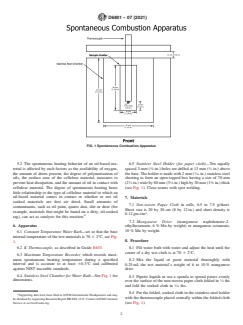
FIG. 1 Spontaneous Combustion Apparatus
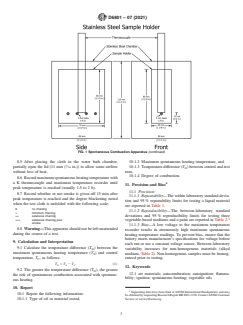
5.2 The spontaneous heating behavior of an oil-based ma- 6.5 Stainless Steel Holder (for paper cloth)—Ten equally
1 1
terial is affected by such factors as the availability of oxygen, spaced 3-mm ( ⁄8-in.) holes are drilled at 13 mm ( ⁄2 in.) above
the amount of driers present, the degree of polymerization of the base. The holder is made with 2 mm ( ⁄16 in.) stainless steel
oils, the surface area of the cellulose material, measures to sheeting to form an open-topped box having a size of 70 mm
3 1 2
prevent heat dissipation, and the amount of oil in contact with (2 ⁄4in.)wideby80mm(3 ⁄8in.)highby30mm(1 ⁄8in.)thick
cellulose material. The degree of spontaneous heating bears (see Fig. 1). Close seams with spot welding.
little relationship to the type of cellulose material to which an
oil-based material comes in contact or whether or not oil 7. Materials
soaked materials are first air dried. Small amounts of
7.1 Non-woven Paper Cloth in rolls, 6.5 to 7.5 g/sheet.
contaminants, such as oil paint, quartz dust, dirt or drier (for
Sheet size is 20 by 30 cm (8 by 12 in.) and sheet density is
example, materials that might be found on a dirty, oil-soaked
0.12 gm⁄cm .
rag), can act as catalysts for this reaction.
7.2 Manganese Drier (manganese naphthenate-2-
6. Apparatus
ethylhexanoate, 6 % Mn by weight) or manganese octanoate,
10 % Mn by weight.
6.1 Constant Temperature Water Bath—set so that the base
internal temperature of the test materials is 70 6 2°C, see Fig.
8. Procedure
1.
8.1 Fill water bat
...