

ASTM D5463-18
(Guide)Standard Guide for Use of Test Kits to Measure Inorganic Constituents in Water
General Information
- Abstract
SIGNIFICANCE AND USE
5.1 Inorganic constituents in water and wastewater must be identified and measured to support effective water quality monitoring and control programs. Currently, one of the simplest, most practical and cost effective means of accomplishing this is through the use of chemical test kits and refills. A more detailed discussion is presented in ASTM STP 1102.5
5.2 Test kits have been accepted for many applications, including routine monitoring, compliance reporting, rapid screening, trouble investigation, and tracking contaminant source.
5.3 Test kits offer time-saving advantages to the user. They are particularly appropriate for field use and usually are easy to use. Users do not need to have a high level of technical expertise. Relatively unskilled staff can be trained to make accurate determinations using kits that include a premixed liquid reagent, premeasured reagent (tablets, powders, or glass ampoules), and premeasured sample (evacuated glass ampoules).
SCOPE
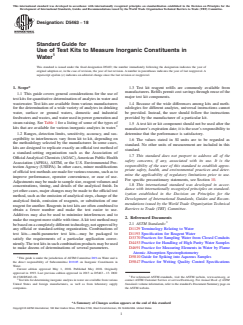
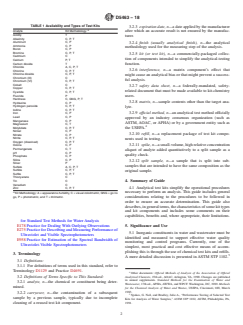
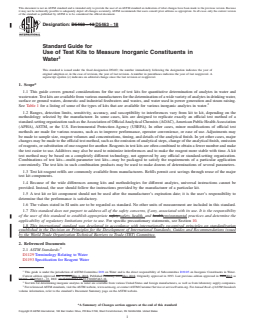
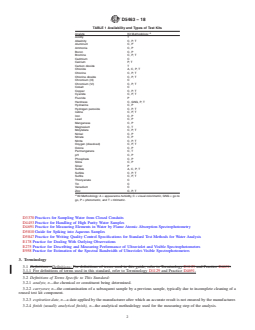
1.1 This guide covers general considerations for the use of test kits for quantitative determination of analytes in water and wastewater. Test kits are available from various manufacturers for the determination of a wide variety of analytes in drinking water, surface or ground waters, domestic and industrial feedwaters and wastes, and water used in power generation and steam raising. See Table 1 for a listing of some of the types of kits that are available for various inorganic analytes in water.2 (A) Kit Methodology: A = appearance/turbidity, C = visual colorimetric, GNG = go no go, P = photometric, and T = titrimetric.
1.2 Ranges, detection limits, sensitivity, accuracy, and susceptibility to interferences vary from kit to kit, depending on the methodology selected by the manufacturer. In some cases, kits are designed to replicate exactly an official test method of a standard-setting organization such as the Association of Official Analytical Chemists (AOAC), American Public Health Association (APHA), ASTM, or the U.S. Environmental Protection Agency (USEPA). In other cases, minor modifications of official test methods are made for various reasons, such as to improve performance, operator convenience, or ease of use. Adjustments may be made to sample size, reagent volumes and concentrations, timing, and details of the analytical finish. In yet other cases, major changes may be made to the official test method, such as the omission of analytical steps, change of the analytical finish, omission of reagents, or substitution of one reagent for another. Reagents in test kits are often combined to obtain a fewer number and make the test easier to use. Additives may also be used to minimize interferences and to make the reagent more stable with time. A kit test method may be based on a completely different technology, not approved by any official or standard-setting organization. Combinations of test kits—multi-parameter test kits—may be packaged to satisfy the requirements of a particular application conveniently. The test kits in such combination products may be used to make dozens of determinations of several parameters.
1.3 Test kit reagent refills are commonly available from manufacturers. Refills permit cost savings through reuse of the major test kit components.
1.4 Because of the wide differences among kits and methodologies for different analytes, universal instructions cannot be provided. Instead, the user should follow the instructions provided by the manufacturer of a particular kit.
1.5 A test kit or kit component should not be used after the manufacturer's expiration date; it is the user's responsibility to determine that the performance is satisfactory.
1.6 The values stated in SI units are to be regarded as standard. No other units of measurement are included in this standard.
1.7 This standard does not purport to address all of the safety concerns, if any, associated with its use. It is the respons...
- Status
- Published
- Publication Date
- 30-Apr-2018
- Technical Committee
- D19 - Water
- Drafting Committee
- D19.05 - Inorganic Constituents in Water
Overview
ASTM D5463-18: Standard Guide for Use of Test Kits to Measure Inorganic Constituents in Water provides comprehensive guidance on the use of chemical test kits for the quantitative determination of inorganic analytes in water and wastewater. This guide outlines general considerations for selecting, operating, and maintaining test kits, which are widely used due to their practicality, cost-effectiveness, and suitability for field applications. Test kits support effective water quality monitoring by enabling the rapid, on-site analysis of numerous inorganic substances without the need for advanced technical expertise.
Key Topics
- Inorganic Constituent Measurement: The guide focuses on measuring a range of inorganic constituents such as metals, ions, and other inorganic compounds in water and wastewater.
- Test Kit Methodologies: This standard covers several test kit methods including appearance/turbidity, visual colorimetric, photometric, titrimetric, and go-no-go techniques. Each methodology offers different benefits in terms of ease of use, sensitivity, and accuracy.
- Applicability: Test kits are intended for use with drinking water, surface and ground waters, industrial feedwaters, domestic wastewater, and water used in power generation.
- User Guidance: The guide emphasizes following manufacturer instructions, periodic quality control, proper sample handling, and storage conditions for maintaining kit performance.
- Safety Considerations: Operators must follow appropriate safety protocols, including the use of personal protective equipment and compliance with chemical handling regulations.
Applications
ASTM D5463-18 is widely relied upon by water treatment professionals, utility operators, industrial facilities, and environmental laboratories for the following purposes:
- Routine Monitoring: Test kits provide a convenient and timely means for regular assessment of water and wastewater quality.
- Compliance Reporting: Regulatory agencies and industries use test kits to perform analyses in accordance with environmental compliance monitoring requirements.
- Field Analysis: Their simplicity and portability make test kits ideal for on-site testing, reducing the need for sample preservation and transportation.
- Rapid Screening and Troubleshooting: Kits are valuable tools for quickly identifying water quality issues, investigating sources of contamination, and screening for out-of-specification analyte levels.
- Training and Education: Test kits allow operators with minimal technical backgrounds to accurately carry out water analysis, provided they receive proper instruction on the relevant procedures.
Related Standards
Several ASTM and industry standards complement the use of test kits for water analysis:
- ASTM D1129: Terminology Relating to Water
- ASTM D1193: Specification for Reagent Water
- ASTM D3370: Practices for Sampling Water from Closed Conduits
- ASTM D4453: Practice for Handling High Purity Water Samples
- ASTM D4691: Practice for Measuring Elements in Water by Flame Atomic Absorption Spectrophotometry
- ASTM D5810: Guide for Spiking into Aqueous Samples
- ASTM D5847: Practice for Writing Quality Control Specifications for Standard Test Methods for Water Analysis
These referenced documents ensure that water quality testing is standardized, allowing end users to achieve reliable and comparable results across a broad range of applications.
Practical Value
By following ASTM D5463-18, organizations benefit from:
- Cost-effective water quality monitoring using readily available test kits and refills.
- Time savings due to straightforward, on-site testing methods.
- Improved data reliability through quality control and adherence to prescribed methodologies.
- Reduced technical barriers by enabling relatively unskilled personnel to perform accurate water analyses safely.
Compliance with this ASTM standard ensures responsible, efficient, and effective measurement of inorganic constituents in water, supporting the broader goal of maintaining and improving water quality for public health and environmental protection.
Relations
- Replaces
ASTM D5463-13 - Standard Guide for Use of Test Kits to Measure Inorganic Constituents in Water - Effective Date
- 01-May-2018
- Effective Date
- 01-May-2020
- Effective Date
- 01-Feb-2017
- Effective Date
- 01-Jun-2016
- Effective Date
- 15-Feb-2016
- Effective Date
- 01-Sep-2011
- Effective Date
- 01-May-2011
- Effective Date
- 01-Feb-2011
- Effective Date
- 01-Dec-2010
- Effective Date
- 01-Mar-2010
- Refers
ASTM E275-08 - Describing and Measuring Performance of Ultraviolet and Visible Spectrophotometers - Effective Date
- 15-Oct-2008
- Effective Date
- 01-Oct-2008
- Effective Date
- 01-Oct-2008
- Effective Date
- 01-Dec-2007
- Effective Date
- 15-Jun-2007
Get Certified
Connect with accredited certification bodies for this standard

CIS Institut d.o.o.
Personal Protective Equipment (PPE) certification body. Notified Body NB-2890 for EU Regulation 2016/425 PPE.

Kiwa BDA Testing
Building and construction product certification.
Kmetijski inštitut Slovenije
Agricultural Institute of Slovenia. Soil testing, plant health, agricultural product analysis.
Sponsored listings
Frequently Asked Questions
ASTM D5463-18 is a guide published by ASTM International. Its full title is "Standard Guide for Use of Test Kits to Measure Inorganic Constituents in Water". This standard covers: SIGNIFICANCE AND USE 5.1 Inorganic constituents in water and wastewater must be identified and measured to support effective water quality monitoring and control programs. Currently, one of the simplest, most practical and cost effective means of accomplishing this is through the use of chemical test kits and refills. A more detailed discussion is presented in ASTM STP 1102.5 5.2 Test kits have been accepted for many applications, including routine monitoring, compliance reporting, rapid screening, trouble investigation, and tracking contaminant source. 5.3 Test kits offer time-saving advantages to the user. They are particularly appropriate for field use and usually are easy to use. Users do not need to have a high level of technical expertise. Relatively unskilled staff can be trained to make accurate determinations using kits that include a premixed liquid reagent, premeasured reagent (tablets, powders, or glass ampoules), and premeasured sample (evacuated glass ampoules). SCOPE 1.1 This guide covers general considerations for the use of test kits for quantitative determination of analytes in water and wastewater. Test kits are available from various manufacturers for the determination of a wide variety of analytes in drinking water, surface or ground waters, domestic and industrial feedwaters and wastes, and water used in power generation and steam raising. See Table 1 for a listing of some of the types of kits that are available for various inorganic analytes in water.2 (A) Kit Methodology: A = appearance/turbidity, C = visual colorimetric, GNG = go no go, P = photometric, and T = titrimetric. 1.2 Ranges, detection limits, sensitivity, accuracy, and susceptibility to interferences vary from kit to kit, depending on the methodology selected by the manufacturer. In some cases, kits are designed to replicate exactly an official test method of a standard-setting organization such as the Association of Official Analytical Chemists (AOAC), American Public Health Association (APHA), ASTM, or the U.S. Environmental Protection Agency (USEPA). In other cases, minor modifications of official test methods are made for various reasons, such as to improve performance, operator convenience, or ease of use. Adjustments may be made to sample size, reagent volumes and concentrations, timing, and details of the analytical finish. In yet other cases, major changes may be made to the official test method, such as the omission of analytical steps, change of the analytical finish, omission of reagents, or substitution of one reagent for another. Reagents in test kits are often combined to obtain a fewer number and make the test easier to use. Additives may also be used to minimize interferences and to make the reagent more stable with time. A kit test method may be based on a completely different technology, not approved by any official or standard-setting organization. Combinations of test kits—multi-parameter test kits—may be packaged to satisfy the requirements of a particular application conveniently. The test kits in such combination products may be used to make dozens of determinations of several parameters. 1.3 Test kit reagent refills are commonly available from manufacturers. Refills permit cost savings through reuse of the major test kit components. 1.4 Because of the wide differences among kits and methodologies for different analytes, universal instructions cannot be provided. Instead, the user should follow the instructions provided by the manufacturer of a particular kit. 1.5 A test kit or kit component should not be used after the manufacturer's expiration date; it is the user's responsibility to determine that the performance is satisfactory. 1.6 The values stated in SI units are to be regarded as standard. No other units of measurement are included in this standard. 1.7 This standard does not purport to address all of the safety concerns, if any, associated with its use. It is the respons...
SIGNIFICANCE AND USE 5.1 Inorganic constituents in water and wastewater must be identified and measured to support effective water quality monitoring and control programs. Currently, one of the simplest, most practical and cost effective means of accomplishing this is through the use of chemical test kits and refills. A more detailed discussion is presented in ASTM STP 1102.5 5.2 Test kits have been accepted for many applications, including routine monitoring, compliance reporting, rapid screening, trouble investigation, and tracking contaminant source. 5.3 Test kits offer time-saving advantages to the user. They are particularly appropriate for field use and usually are easy to use. Users do not need to have a high level of technical expertise. Relatively unskilled staff can be trained to make accurate determinations using kits that include a premixed liquid reagent, premeasured reagent (tablets, powders, or glass ampoules), and premeasured sample (evacuated glass ampoules). SCOPE 1.1 This guide covers general considerations for the use of test kits for quantitative determination of analytes in water and wastewater. Test kits are available from various manufacturers for the determination of a wide variety of analytes in drinking water, surface or ground waters, domestic and industrial feedwaters and wastes, and water used in power generation and steam raising. See Table 1 for a listing of some of the types of kits that are available for various inorganic analytes in water.2 (A) Kit Methodology: A = appearance/turbidity, C = visual colorimetric, GNG = go no go, P = photometric, and T = titrimetric. 1.2 Ranges, detection limits, sensitivity, accuracy, and susceptibility to interferences vary from kit to kit, depending on the methodology selected by the manufacturer. In some cases, kits are designed to replicate exactly an official test method of a standard-setting organization such as the Association of Official Analytical Chemists (AOAC), American Public Health Association (APHA), ASTM, or the U.S. Environmental Protection Agency (USEPA). In other cases, minor modifications of official test methods are made for various reasons, such as to improve performance, operator convenience, or ease of use. Adjustments may be made to sample size, reagent volumes and concentrations, timing, and details of the analytical finish. In yet other cases, major changes may be made to the official test method, such as the omission of analytical steps, change of the analytical finish, omission of reagents, or substitution of one reagent for another. Reagents in test kits are often combined to obtain a fewer number and make the test easier to use. Additives may also be used to minimize interferences and to make the reagent more stable with time. A kit test method may be based on a completely different technology, not approved by any official or standard-setting organization. Combinations of test kits—multi-parameter test kits—may be packaged to satisfy the requirements of a particular application conveniently. The test kits in such combination products may be used to make dozens of determinations of several parameters. 1.3 Test kit reagent refills are commonly available from manufacturers. Refills permit cost savings through reuse of the major test kit components. 1.4 Because of the wide differences among kits and methodologies for different analytes, universal instructions cannot be provided. Instead, the user should follow the instructions provided by the manufacturer of a particular kit. 1.5 A test kit or kit component should not be used after the manufacturer's expiration date; it is the user's responsibility to determine that the performance is satisfactory. 1.6 The values stated in SI units are to be regarded as standard. No other units of measurement are included in this standard. 1.7 This standard does not purport to address all of the safety concerns, if any, associated with its use. It is the respons...
ASTM D5463-18 is classified under the following ICS (International Classification for Standards) categories: 13.060.50 - Examination of water for chemical substances. The ICS classification helps identify the subject area and facilitates finding related standards.
ASTM D5463-18 has the following relationships with other standards: It is inter standard links to ASTM D5463-13, ASTM D1129-13(2020)e2, ASTM D4453-17, ASTM E178-16, ASTM D4453-16, ASTM D4691-11, ASTM D5810-96(2011), ASTM D4453-11, ASTM D3370-10, ASTM D1129-10, ASTM E275-08, ASTM E178-08, ASTM D3370-08, ASTM D3370-07, ASTM D4691-02(2007). Understanding these relationships helps ensure you are using the most current and applicable version of the standard.
ASTM D5463-18 is available in PDF format for immediate download after purchase. The document can be added to your cart and obtained through the secure checkout process. Digital delivery ensures instant access to the complete standard document.
Standards Content (Sample)
This international standard was developed in accordance with internationally recognized principles on standardization established in the Decision on Principles for the
Development of International Standards, Guides and Recommendations issued by the World Trade Organization Technical Barriers to Trade (TBT) Committee.
Designation: D5463 − 18
Standard Guide for
Use of Test Kits to Measure Inorganic Constituents in
Water
This standard is issued under the fixed designation D5463; the number immediately following the designation indicates the year of
original adoption or, in the case of revision, the year of last revision. A number in parentheses indicates the year of last reapproval. A
superscript epsilon (´) indicates an editorial change since the last revision or reapproval.
1. Scope* 1.3 Test kit reagent refills are commonly available from
manufacturers. Refills permit cost savings through reuse of the
1.1 This guide covers general considerations for the use of
major test kit components.
test kits for quantitative determination of analytes in water and
wastewater. Test kits are available from various manufacturers 1.4 Because of the wide differences among kits and meth-
for the determination of a wide variety of analytes in drinking odologies for different analytes, universal instructions cannot
water, surface or ground waters, domestic and industrial be provided. Instead, the user should follow the instructions
feedwatersandwastes,andwaterusedinpowergenerationand provided by the manufacturer of a particular kit.
steam raising. See Table 1 for a listing of some of the types of
1.5 A test kit or kit component should not be used after the
kits that are available for various inorganic analytes in water.
manufacturer’s expiration date; it is the user’s responsibility to
1.2 Ranges, detection limits, sensitivity, accuracy, and sus- determine that the performance is satisfactory.
ceptibility to interferences vary from kit to kit, depending on
1.6 The values stated in SI units are to be regarded as
the methodology selected by the manufacturer. In some cases,
standard. No other units of measurement are included in this
kits are designed to replicate exactly an official test method of
standard.
a standard-setting organization such as the Association of
1.7 This standard does not purport to address all of the
OfficialAnalytical Chemists (AOAC),American Public Health
safety concerns, if any, associated with its use. It is the
Association (APHA), ASTM, or the U.S. Environmental Pro-
responsibility of the user of this standard to establish appro-
tection Agency (USEPA). In other cases, minor modifications
priate safety, health, and environmental practices and deter-
of official test methods are made for various reasons, such as to
mine the applicability of regulatory limitations prior to use.
improve performance, operator convenience, or ease of use.
For specific precautionary statements, see Section 10.
Adjustmentsmaybemadetosamplesize,reagentvolumesand
1.8 This international standard was developed in accor-
concentrations, timing, and details of the analytical finish. In
dance with internationally recognized principles on standard-
yet other cases, major changes may be made to the official test
ization established in the Decision on Principles for the
method, such as the omission of analytical steps, change of the
Development of International Standards, Guides and Recom-
analytical finish, omission of reagents, or substitution of one
mendations issued by the World Trade Organization Technical
reagent for another. Reagents in test kits are often combined to
Barriers to Trade (TBT) Committee.
obtain a fewer number and make the test easier to use.
Additives may also be used to minimize interferences and to
2. Referenced Documents
make the reagent more stable with time.Akit test method may
2.1 ASTM Standards:
bebasedonacompletelydifferenttechnology,notapprovedby
D1129 Terminology Relating to Water
any official or standard-setting organization. Combinations of
D1193 Specification for Reagent Water
test kits—multi-parameter test kits—may be packaged to
D3370 Practices for Sampling Water from Closed Conduits
satisfy the requirements of a particular application conve-
D4453 Practice for Handling of High Purity Water Samples
niently.Thetestkitsinsuchcombinationproductsmaybeused
D4691 Practice for Measuring Elements in Water by Flame
to make dozens of determinations of several parameters.
Atomic Absorption Spectrophotometry
D5810 Guide for Spiking into Aqueous Samples
This guide is under the jurisdiction of ASTM Committee D19 on Water and is
the direct responsibility of Subcommittee D19.05 on Inorganic Constituents in
D5847 Practice for Writing Quality Control Specifications
Water.
Current edition approved May 1, 2018. Published May 2018. Originally
approved in 1993. Last previous edition approved in 2013 as D5463 – 13. DOI:
10.1520/D5463-18. For referenced ASTM standards, visit the ASTM website, www.astm.org, or
Test kits for determining inorganic analytes in water are available from various contact ASTM Customer Service at service@astm.org. For Annual Book of ASTM
United States and foreign manufacturers, as well as from laboratory supply Standards volume information, refer to the standard’s Document Summary page on
companies. the ASTM website.
*A Summary of Changes section appears at the end of this standard
Copyright © ASTM International, 100 Barr Harbor Drive, PO Box C700, West Conshohocken, PA 19428-2959. United States
D5463 − 18
TABLE 1 Availability and Types of Test Kits
3.2.3 expiration date, n—a date applied by the manufacturer
A
Analyte Kit Methodology after which an accurate result is not ensured by the manufac-
Acidity T
turer.
Alkalinity C, P, T
Aluminum C, P
3.2.4 finish (usually analytical finish), n—the analytical
Ammonia C, P
methodology used for the measuring step of the analysis.
Boron C, P
Bromine C, P, T
3.2.5 kit (or test kit), n—a commercially-packaged collec-
Cadmium C
tion of components intended to simplify the analytical-testing
Calcium P, T
Carbon dioxide T function.
Chloride A, C, P, T
3.2.6 interference, n—a matrix component’s effect that
Chlorine C, P, T
Chlorine dioxide C, P, T
might cause an analytical bias or that might prevent a success-
Chromium (III) C
ful analysis.
Chromium (VI) C, P, T
Cobalt C
3.2.7 safety data sheet, n—a federally-mandated, safety-
Copper C, P, T
related document that must be made available to kit-chemistry
Cyanide C, P, T
Fluoride P users.
Hardness C, GNG, P, T
3.2.8 matrix, n—sample contents other than the target ana-
Hydrazine C, P
Hydrogen peroxide C, P, T
lyte.
Iodine C, P, T
3.2.9 offıcial method, n—an analytical test method officially
Iron C, P
Lead C, P
approved by an industry consensus organization (such as
Manganese C, P
ASTM, AOAC, or APHA) or by a government entity such as
Magnesium C, T
Molybdate C, P, T the USEPA.
Nickel C, P
3.2.10 refill, n—a replacement package of test kit compo-
Nitrate C, P
Nitrite C, P, T
nents used in testing.
Oxygen (dissolved) C, P, T
3.2.11 spike, n—asmall-volume,highrelativeconcentration
Ozone C, P
Permanganate C, T
aliquot of analyte added quantitatively to a split sample as a
pH C, P
quality check.
Phosphate C, P
Silica C, P
3.2.12 split sample, n—a sample that is split into sub-
Silver P
samples that are intended to have the same composition as the
Sulfate A, C, P, T
Sulfide C, P, T
original sample.
Sulfite C, P, T
Thiocyanate C
4. Summary of Guide
Tin C
Vanadium C
4.1 Analytical test kits simplify the operational procedures
Zinc C, P, T
A
necessary to perform an analysis. This guide includes general
KitMethodology:A = appearance ⁄turbidity,C = visualcolorimetric,GNG = gono
go, P = photometric, and T = titrimetric. considerations relating to the procedures to be followed in
order to ensure an accurate determination. This guide also
describes,ingeneralterms,thecharacteristicsofsomekittypes
and kit components and includes some comments on their
capabilities, benefits and, where appropriate, their limitations.
for Standard Test Methods for Water Analysis
E178 Practice for Dealing With Outlying Observations
5. Significance and Use
E275 Practice for Describing and Measuring Performance of
5.1 Inorganic constituents in water and wastewater must be
Ultraviolet and Visible Spectrophotometers
identified and measured to support effective water quality
E958 Practice for Estimation of the Spectral Bandwidth of
monitoring and control programs. Currently, one of the
Ultraviolet-Visible Spectrophotometers
simplest, most practical and cost effective means of accom-
plishing this is through the use of chemical test kits and refills.
3. Terminology
A more detailed discussion is presented in ASTM STP 1102.
3.1 Definitions:
3.1.1 For definitions of terms used in this standard, refer to
Terminology D1129 and Practice D4691.
Other documents: Offıcial Methods of Analysis of the Association of Offıcial
Analytical Chemists, 15th ed.,AOAC,Arlington, VA, 1990. Changes are published
3.2 Definitions of Terms Specific to This Standard:
in annual supplements. Standard Methods for the Examination of Water and
3.2.1 analyte, n—the chemical or constituent being deter-
Wastewater, 17th ed.,APHA,AWWA, and WPCF. Washington, DC, 1989. Methods
mined.
for the Chemical Analysis of Water and Wastes, USEPA, Cincinnati, OH, March
1983.
3.2.2 carryover, n—the contamination of a subsequent
Spokes, G. Neil, and Bradley, Julie A., “Performance Testing of Selected Test
sample by a previous sample, typically due to incomplete
Kits for Analysis of Water Samples,” ASTM STP 1102, ASTM, Philadelphia, PA,
cleaning of a reused test kit component. 1991.
D5463 − 18
5.2 Test kits have been accepted for many applications, 7.2 Sample carryover effects may occur if a common
including routine monitoring, compliance reporting, rapid sampling cup or tube is used. Appropriate care is necessary
screening, trouble investigation, and tracking contaminant under such conditions in order to prevent sample carryover.
source. The carryover may be prevented or reduced by either cleaning
the reused item or rinsing with fresh sample several times.
5.3 Test kits offer time-saving advantages to the user. They
Aggressive cleaning action may be necessary after a sample
are particularly appropriate for field use and usually are easy to
containing a high concentration is tested.
use. Users do not need to have a high level of technical
expertise. Relatively unskilled staff can be trained to make 7.3 Careful note should be made of the manufacturer’s
accurate determinations using kits that include a premixed comments concerning interferences, and appropriate action
liquid reagent, premeasured reagent (tablets, powders, or glass should be taken.
ampoules), and premeasured sample (evacuated glass am-
7.4 Temperature may affect kit performance.
poules).
8. Apparatus
6. General Considerations
8.1 Colorimetric Determinations—Many procedures de-
6.1 Personnel—The selection of a test kit and determination
pend on color determination with a color comparator,
that the test kit analysis is appropriate should be conducted by
photometer, or spectrophotometer.The manufacturer may offer
a responsible chemist. The development of suitable protocols
a color comparator for visual comparisons based on liquid,
and conditions for safe use should be conducted by the
glass, plastic, or printed color standards. The manufacturer
responsible chemist with the assistance of an industrial hygien-
may offer a photometer or may recommend the use of a
ist. The kit user may be a relatively unskilled staff person but
spectrophotometer for photo-electric color determinations.The
must be trained to an appropriate level of proficiency.
manufacturer’s photometer may be based on optical filters
6.2 Completeness of Kits—The kit’s components may or usingeithercoloredglassorplastic,oroninterferencefiltersor
may not be complete for the required determination. The user LEDs. The filter bandwidth may be wide (up to 100-nm full
must assemble all instruments and materials necessary for the width half maximum height) for colored glass or plastic filters
determination. For example, if the test kit is used for field andLEDsorquitenarrow(10nm)withinterferencefilters.The
screening to indicate the need for samples requiring a high laboratory spectrophotometer may have a 1- to 20-nm band-
accuracy measurement, the user may need to provide a means width and is typically more accurate than a kit photometer or
of preserving a sample for later measurements at a laboratory. colorimeter. Refer to Practices E275 and E958 for additional
discussion of colorimetry.
6.3 Protocol Established by a Responsible Chemist—A
responsible chemist must determine whether the sample can be
NOTE1—Visualcomparatorkitsmayrequiretheuseofaparticulartype
of background illumination. The user should use the light source that
analyzed correctly by a particular kit chemistry. The respon-
produces the correct color or spectrum of background illumination, as
sible chemist should determine whether matrix factors,
specified by the manufacturer.
interferences, and temperature are handled correctly by the kit
NOTE 2—Color standards may not be permanent; reference should be
chemistry. Questions to be answered include the following:
made to the manufacturer’s recommendations.
Has the kit chemistry previously given satisfactory results
8.2 Titrimetric Determinations—Many procedures depend
under the proposed conditions? What changes have occurred
on measuring the volume of a standard solution required to
that must be taken into account? For example, the chemist
react with an analyte completely. The manufacturer may offer
should consider seasonal changes, new interferences, sample
aburet,digitaltitrator,drop-test,orcalibratedsamplecontainer
pH changes, new dischargers upstream, and new process
to dispense and measure the volume of a standard solution. A
wastesinthesample.Theresponsiblechemistmustalsodecide
buret or digital titrator typically provides more accuracy than a
whether the proposed kit chemistry is applicable to the
drop-test or calibrated sample container.
particular circumstances. For example, it is necessary to
determine whether the test range is appropria
...
This document is not an ASTM standard and is intended only to provide the user of an ASTM standard an indication of what changes have been made to the previous version. Because
it may not be technically possible to adequately depict all changes accurately, ASTM recommends that users consult prior editions as appropriate. In all cases only the current version
of the standard as published by ASTM is to be considered the official document.
Designation: D5463 − 13 D5463 − 18
Standard Guide for
Use of Test Kits to Measure Inorganic Constituents in
Water
This standard is issued under the fixed designation D5463; the number immediately following the designation indicates the year of
original adoption or, in the case of revision, the year of last revision. A number in parentheses indicates the year of last reapproval. A
superscript epsilon (´) indicates an editorial change since the last revision or reapproval.
1. Scope*
1.1 This guide covers general considerations for the use of test kits for quantitative determination of analytes in water and
wastewater. Test kits are available from various manufacturers for the determination of a wide variety of analytes in drinking water,
surface or ground waters, domestic and industrial feedwaters and wastes, and water used in power generation and steam raising.
See Table 1 for a listing of some of the types of kits that are available for various inorganic analytes in water.
1.2 Ranges, detection limits, sensitivity, accuracy, and susceptibility to interferences vary from kit to kit, depending on the
methodology selected by the manufacturer. In some cases, kits are designed to replicate exactly an official test method of a
standard-setting organization such as the Association of Official Analytical Chemists (AOAC), American Public Health Association
(APHA), ASTM, or the U.S. Environmental Protection Agency (USEPA). In other cases, minor modifications of official test
methods are made for various reasons, such as to improve performance, operator convenience, or ease of use. Adjustments may
be made to sample size, reagent volumes and concentrations, timing, and details of the analytical finish. In yet other cases, major
changes may be made to the official test method, such as the omission of analytical steps, change of the analytical finish, omission
of reagents, or substitution of one reagent for another. Reagents in test kits are often combined to obtain a fewer number and make
the test easier to use. Additives may also be used to minimize interferences and to make the reagent more stable with time. A kit
test method may be based on a completely different technology, not approved by any official or standard-setting organization.
Combinations of test kits—multi-parameter test kits—may be packaged to satisfy the requirements of a particular application
conveniently. The test kits in such combination products may be used to make dozens of determinations of several parameters.
1.3 Test kit reagent refills are commonly available from manufacturers. Refills permit cost savings through reuse of the major
test kit components.
1.4 Because of the wide differences among kits and methodologies for different analytes, universal instructions cannot be
provided. Instead, the user should follow the instructions provided by the manufacturer of a particular kit.
1.5 A test kit or kit component should not be used after the manufacturer’s expiration date; it is the user’s responsibility to
determine that the performance is satisfactory.
1.6 The values stated in SI units are to be regarded as standard. No other units of measurement are included in this standard.
1.7 This standard does not purport to address all of the safety concerns, if any, associated with its use. It is the responsibility
of the user of this standard to establish appropriate safety safety, health, and healthenvironmental practices and determine the
applicability of regulatory limitations prior to use. For specific precautionary statements, see Section 10.
1.8 This international standard was developed in accordance with internationally recognized principles on standardization
established in the Decision on Principles for the Development of International Standards, Guides and Recommendations issued
by the World Trade Organization Technical Barriers to Trade (TBT) Committee.
2. Referenced Documents
2.1 ASTM Standards:
D1129 Terminology Relating to Water
D1193 Specification for Reagent Water
This guide is under the jurisdiction of ASTM Committee D19 on Water and is the direct responsibility of Subcommittee D19.05 on Inorganic Constituents in Water.
Current edition approved Jan. 1, 2013May 1, 2018. Published February 2013May 2018. Originally approved in 1993. Last previous edition approved in 20082013 as
D5463 – 08.D5463 – 13. DOI: 10.1520/D5463-13.10.1520/D5463-18.
Test kits for determining inorganic analytes in water are available from various United States and foreign manufacturers, as well as from laboratory supply companies.
For referenced ASTM standards, visit the ASTM website, www.astm.org, or contact ASTM Customer Service at service@astm.org. For Annual Book of ASTM Standards
volume information, refer to the standard’s Document Summary page on the ASTM website.
*A Summary of Changes section appears at the end of this standard
Copyright © ASTM International, 100 Barr Harbor Drive, PO Box C700, West Conshohocken, PA 19428-2959. United States
D5463 − 18
TABLE 1 Availability and Types of Test Kits
A
Analyte Kit Methodology
Acidity T
Alkalinity C, P, T
Aluminum C, P
Ammonia C, P
Boron C, P
Bromine C, P, T
Cadmium C
Calcium P, T
Carbon dioxide T
Chloride A, C, P, T
Chlorine C, P, T
Chlorine dioxide C, P, T
Chromium (III) C
Chromium (VI) C, P, T
Cobalt C
Copper C, P, T
Cyanide C, P, T
Fluoride P
Hardness C, GNG, P, T
Hydrazine C, P
Hydrogen peroxide C, P, T
Iodine C, P, T
Iron C, P
Lead C, P
Manganese C, P
Magnesium C, T
Molybdate C, P, T
Nickel C, P
Nitrate C, P
Nitrite C, P, T
Oxygen (dissolved) C, P, T
Ozone C, P
Permanganate C, T
pH C, P
Phosphate C, P
Silica C, P
Silver P
Sulfate A, C, P, T
Sulfide C, P, T
Sulfite C, P, T
Thiocyanate C
Tin C
Vanadium C
Zinc C, P, T
A
Kit Methodology: A = appearance ⁄turbidity, C = visual colorimetric, GNG = go no
go, P = photometric, and T = titrimetric.
D3370 Practices for Sampling Water from Closed Conduits
D4453 Practice for Handling of High Purity Water Samples
D4691 Practice for Measuring Elements in Water by Flame Atomic Absorption Spectrophotometry
D5810 Guide for Spiking into Aqueous Samples
D5847 Practice for Writing Quality Control Specifications for Standard Test Methods for Water Analysis
E178 Practice for Dealing With Outlying Observations
E275 Practice for Describing and Measuring Performance of Ultraviolet and Visible Spectrophotometers
E958 Practice for Estimation of the Spectral Bandwidth of Ultraviolet-Visible Spectrophotometers
3. Terminology
3.1 Definitions—Definitions: For definitions of terms used in this guide, refer to Terminology D1129 and Practice D4691.
3.1.1 For definitions of terms used in this standard, refer to Terminology D1129 and Practice D4691.
3.2 Definitions of Terms Specific to This Standard:
3.2.1 analyte, n—the chemical or constituent being determined.
3.2.2 carryover, n—the contamination of a subsequent sample by a previous sample, typically due to incomplete cleaning of a
reused test kit component.
3.2.3 expiration date, n—a date applied by the manufacturer after which an accurate result is not ensured by the manufacturer.
3.2.4 finish (usually analytical finish), n—the analytical methodology used for the measuring step of the analysis.
D5463 − 18
3.2.5 kit (or test kit), n—a commercially-packaged collection of components intended to simplify the analytical-testing function.
3.2.6 interference, n—a matrix component’s effect that might cause an analytical bias or that might prevent a successful analysis.
3.2.7 material safety data sheet, n—a federally-mandated, safety-related document that must be made available to kit-chemistry
users.
3.2.8 matrix, n—sample contents other than the target analyte.
3.2.9 offıcial method, n—an analytical test method officially approved by an industry consensus organization (such as ASTM,
AOAC, or APHA) or by a government entity such as the USEPA.
3.2.10 refill, n—a replacement package of test kit components used in testing.
3.2.11 spike, n—a small-volume, high relative concentration aliquot of analyte added quantitatively to a split sample as a quality
check.
3.2.12 split sample, n—a sample that is split into sub-samples that are intended to have the same composition as the original
sample.
4. Summary of Guide
4.1 Analytical test kits simplify the operational procedures necessary to perform an analysis. This guide includes general
considerations relating to the procedures to be followed in order to ensure an accurate determination. This guide also describes,
in general terms, the characteristics of some kit types and kit components and includes some comments on their capabilities,
benefits and, where appropriate, their limitations.
5. Significance and Use
5.1 Inorganic constituents in water and wastewater must be identified and measured to support effective water quality
monitoring and control programs. Currently, one of the simplest, most practical and cost effective means of accomplishing this is
through the use of chemical test kits and refills. A more detailed discussion is presented in ASTM STP 1102.
5.2 Test kits have been accepted for many applications, including routine monitoring, compliance reporting, rapid screening,
trouble investigation, and tracking contaminant source.
5.3 Test kits offer time-saving advantages to the user. They are particularly appropriate for field use and usually are easy to use.
Users do not need to have a high level of technical expertise. Relatively unskilled staff can be trained to make accurate
determinations using kits that include a premixed liquid reagent, premeasured reagent (tablets, powders, or glass ampoules), and
premeasured sample (evacuated glass ampoules).
6. General Considerations
6.1 Personnel—The selection of a test kit and determination that the test kit analysis is appropriate should be conducted by a
responsible chemist. The development of suitable protocols and conditions for safe use should be conducted by the responsible
chemist with the assistance of an industrial hygienist. The kit user may be a relatively unskilled staff person but must be trained
to an appropriate level of proficiency.
6.2 Completeness of Kits—The kit’s components may or may not be complete for the required determination. The user must
assemble all instruments and materials necessary for the determination. For example, if the test kit is used for field screening to
indicate the need for samples requiring a high accuracy measurement, the user may need to provide a means of preserving a sample
for later measurements at a laboratory.
6.3 Protocol Established by a Responsible Chemist—A responsible chemist must determine whether the sample can be analyzed
correctly by a particular kit chemistry. The responsible chemist should determine whether matrix factors, interferences, and
temperature are handled correctly by the kit chemistry. Questions to be answered include the following: Has the kit chemistry
previously given satisfactory results under the proposed conditions? What changes have occurred that must be taken into account?
For example, the chemist should consider seasonal changes, new interferences, sample pH changes, new dischargers upstream, and
new process wastes in the sample. The responsible chemist must also decide whether the proposed kit chemistry is applicable to
the particular circumstances. For example, it is necessary to determine whether the test range is appropriate, ensure that a
colorimetric test kit that compensates for color is used with a highly colored sample, and ensure that a colorblind user is able to
run a test requiring visual color comparisons accurately. The chemist must also ensure that an officially approved kit chemistry is
used when an official method is required.
Other documents: Offıcial Methods of Analysis of the Association of Offıcial Analytical Chemists, 15th Ed., AOAC, Arlington, VA, 1990. Changes are published in annual
supplements. Standard Methods for the Examination of Water and Wastewater, 17th Ed., APHA, AWWA, and WPCF. Washington, DC, 1989. Methods for the Chemical
Analysis of Water and Wastes, USEPA, Cincinnati, OH, March 1983.Other documents: Offıcial Methods of Analysis of the Association of Offıcial Analytical Chemists, 15th
ed., AOAC, Arlington, VA, 1990. Changes are published in annual supplements. Standard Methods for the Examination of Water and Wastewater, 17th ed., APHA, AWWA,
and WPCF. Washington, DC, 1989. Methods for the Chemical Analysis of Water and Wastes, USEPA, Cincinnati, OH, March 1983.
Spokes, G. Neil, and Bradley, Julie A., “Performance Testing of Selected Test Kits for Analysis of Water Samples,” ASTM STP 1102, ASTM, Philadelphia, PA, 1991.
D5463 − 18
6.4 Technical Support—In case of difficulties, many kit manufacturers may provide technical assistance.
7. Interferences
7.1 Kit chemistries that are based on an official test method are subject to the same interferences as that test method. If the kit
manufacturer uses a revised version of the official test method, the revision may increase or decrease interference effects.
7.2 Sample carryover effects may occur if a common sampling cup or tube is used. Appropriate care is necessary under such
conditions in order to prevent sample carryover. The carryover may be prevented or reduced by either cleaning the reused item
or rinsing with fresh sample several times. Aggressive cleaning action may be necessary after a sample containing a high
concentration is tested.
7.3 Careful note should be made of the manufacturer’s comments concerning interferences, and appropriate action should be
taken.
7.4 Temperature may affect kit performance.
8. Apparatus
8.1 Colorimetric Determinations —Determinations—Many procedures depend on color determination with a color comparator,
photometer, or spectrophotometer. The manufacturer may offer a color comparator for visual comparisons based on liquid, glass,
plastic, or printed color standards. The manufacturer may offer a photometer or may recommend the use of a spectrophotometer
for photo-electric color determinations. The manufacturer’s photometer may be based on optical filters using either colored glass
or plastic, or on interference filters or LEDs. The filter bandwidth may be wide (up to 100-nm full width half maximum height)
for colored glass
...