

ASTM D7660-20
(Guide)Standard Guide for Conducting Internal Pressure Tests on United Nations (UN) Packagings
General Information
- Abstract
SIGNIFICANCE AND USE
4.1 Dangerous goods (hazardous materials) regulations require performance tests to be conducted on packaging designs before being authorized for use. The regulations do not include standardized procedures for conducting performance tests and, because of this, may result in a non-uniform approach and differences in test results between testing facilities.
4.2 The purpose of this guide is to provide guidance and to establish a set of common practices for conducting internal pressure tests on packagings subjected to UN certification testing or packagings required to meet pressure capability requirements.
4.3 This guide provides additional information not in the regulations that will facilitate consistent testing. The information and guidance provided here are intended to meet or exceed the minimum regulatory requirements. For more information on the UN certification requirements, refer to Guide D4919. For pressure testing of IBC design types, reference Guide D8134.
SCOPE
1.1 This guide is intended to provide a standardized method and a set of basic instructions for performing internal and hydrostatic pressure testing on packaging designs intended for shipping liquids in accordance with the United States Department of Transportation Title 49 Code of Federal Regulations (CFR) and the United Nations Recommendations on the Transport of Dangerous Goods (UN).
1.2 This guide provides information to help clarify various terms used as part of the United Nations (UN) certification process that may assist in determining the applicable test.
1.3 This guide provides the suggested minimum information that should be documented when conducting pressure testing.
1.4 This guide provides information for recommended equipment and fittings for conducting pressure tests.
1.5 This guide is based on the current information contained in 49 CFR, §173.27 and §178.605.
1.6 When testing packaging designs intended for hazardous materials (dangerous goods), the user of this guide shall be trained in accordance with 49 CFR §172.700 and other applicable hazardous materials regulations such as the ICAO Technical Instructions, IMDG Code, and carrier rules such as the IATA Dangerous Goods Regulations.
1.7 Units—The values stated in SI units are to be regarded as standard. No other units of measurement are included in this standard.
1.8 This standard does not purport to address all of the safety concerns, if any, associated with its use. It is the responsibility of the user of this standard to establish appropriate safety, health, and environmental practices and determine the applicability of regulatory limitations prior to use.
1.9 This international standard was developed in accordance with internationally recognized principles on standardization established in the Decision on Principles for the Development of International Standards, Guides and Recommendations issued by the World Trade Organization Technical Barriers to Trade (TBT) Committee.
- Status
- Published
- Publication Date
- 31-Mar-2020
- Technical Committee
- D10 - Packaging
- Drafting Committee
- D10.22 - Hazardous Materials
Buy Documents
ASTM D7660-20 - Standard Guide for Conducting Internal Pressure Tests on United Nations (UN) Packagings
REDLINE ASTM D7660-20 - Standard Guide for Conducting Internal Pressure Tests on United Nations (UN) Packagings
Overview
ASTM D7660-20: Standard Guide for Conducting Internal Pressure Tests on United Nations (UN) Packagings provides a unified approach to evaluating the internal and hydrostatic pressure resistance of packaging intended for hazardous materials. Developed by ASTM International, this standard supports compliance with United Nations Recommendations on the Transport of Dangerous Goods and the U.S. Department of Transportation (DOT) Title 49 Code of Federal Regulations (49 CFR). By addressing testing procedures not covered in existing regulations, ASTM D7660-20 helps ensure consistent, reliable, and safe results for packaging manufacturers, testers, and regulatory agencies.
Key Topics
- Standardized Test Methods: The guide outlines clear and consistent procedures for conducting internal and hydrostatic pressure tests on non-bulk packagings used for liquid dangerous goods.
- Terminology Clarification: Definitions of essential terms such as hydrostatic pressure test, leakproofness test, pressure differential test, and related units (kPa, psi, bar) to aid proper interpretation.
- Equipment Recommendations: Guidance on essential test equipment including water supply systems, pressure gauges, regulator valves, safety gear, and container fittings.
- Sample Preparation and Selection: Procedures for selecting, preparing, and closing test specimens, with attention to proper fitting placement and container integrity.
- Test Execution: Instructions for pressurization rate, monitoring, test duration, and pass/fail assessment criteria according to regulatory minimums.
- Data Documentation: Guidelines on recording test data such as pressure levels, elapsed times, temperature, observations, and equipment details.
Applications
ASTM D7660-20 is practically valuable in a variety of contexts:
- Packaging Manufacturers: Ensures development of UN-compliant packagings for hazardous liquids by providing a proven test framework.
- Testing and Certification Labs: Facilitates uniformity and accuracy when conducting internal pressure tests required before packagings receive UN approval.
- Shippers and Logistics Providers: Verifies packaging performance to reduce risk of leaks or failures during transport of dangerous goods domestically and internationally.
- Regulatory Compliance Departments: Assists in maintaining compliance with 49 CFR, ICAO Technical Instructions, IMDG Code, and IATA Dangerous Goods Regulations by aligning test practices with international expectations.
- Quality Assurance Teams: Offers detailed recordkeeping and reporting criteria to support auditing and traceability efforts.
Related Standards
- ASTM D4919: Guide for Testing of Hazardous Materials Packagings – for more information on UN certification testing.
- ASTM D8134: Guide for Conducting Internal Hydrostatic Pressure Tests on UN IBC Design Types – specifically for Intermediate Bulk Containers.
- ASTM D4991: Test Method for Leakage Testing of Empty Rigid Containers by Vacuum Method.
- 49 CFR (Parts 100-185): U.S. DOT regulations relevant to hazardous materials transportation.
- UN Recommendations (Orange Book): Model regulations for the transport of dangerous goods.
- IATA Dangerous Goods Regulations: Rules for air shipment of hazardous materials.
- ICAO Technical Instructions: International Civil Aviation Organization’s air transport rules.
- IMDG Code: International Maritime Dangerous Goods Code for sea transport.
Practical Value
Implementing ASTM D7660-20 reduces inconsistencies in internal pressure testing, improves packaging safety, and streamlines compliance across jurisdictions. By following the standard’s detailed recommendations for equipment, preparation, execution, and reporting, organizations can confidently demonstrate that their packaging meets or exceeds regulatory requirements for transporting dangerous goods. This not only increases transport safety but also supports global harmonization in hazardous materials logistics.
For professionals involved in hazardous goods packaging, referencing ASTM D7660-20 enhances reliability in testing, increases confidence in UN-certified containers, and ultimately contributes to safer transportation practices in the supply chain.
Relations
- Effective Date
- 01-Nov-2023
- Effective Date
- 01-Mar-2018
- Effective Date
- 01-Oct-2008
- Refers
ASTM D4991-07 - Standard Test Method for Leakage Testing of Empty Rigid Containers by Vacuum Method - Effective Date
- 01-Apr-2007
- Effective Date
- 10-Apr-2003
- Effective Date
- 10-Oct-1999
- Effective Date
- 10-May-1997
Buy Documents
ASTM D7660-20 - Standard Guide for Conducting Internal Pressure Tests on United Nations (UN) Packagings
REDLINE ASTM D7660-20 - Standard Guide for Conducting Internal Pressure Tests on United Nations (UN) Packagings
Get Certified
Connect with accredited certification bodies for this standard

BRCGS (Brand Reputation Compliance Global Standards)
Global food safety and quality standards owner.
Sponsored listings
Frequently Asked Questions
ASTM D7660-20 is a guide published by ASTM International. Its full title is "Standard Guide for Conducting Internal Pressure Tests on United Nations (UN) Packagings". This standard covers: SIGNIFICANCE AND USE 4.1 Dangerous goods (hazardous materials) regulations require performance tests to be conducted on packaging designs before being authorized for use. The regulations do not include standardized procedures for conducting performance tests and, because of this, may result in a non-uniform approach and differences in test results between testing facilities. 4.2 The purpose of this guide is to provide guidance and to establish a set of common practices for conducting internal pressure tests on packagings subjected to UN certification testing or packagings required to meet pressure capability requirements. 4.3 This guide provides additional information not in the regulations that will facilitate consistent testing. The information and guidance provided here are intended to meet or exceed the minimum regulatory requirements. For more information on the UN certification requirements, refer to Guide D4919. For pressure testing of IBC design types, reference Guide D8134. SCOPE 1.1 This guide is intended to provide a standardized method and a set of basic instructions for performing internal and hydrostatic pressure testing on packaging designs intended for shipping liquids in accordance with the United States Department of Transportation Title 49 Code of Federal Regulations (CFR) and the United Nations Recommendations on the Transport of Dangerous Goods (UN). 1.2 This guide provides information to help clarify various terms used as part of the United Nations (UN) certification process that may assist in determining the applicable test. 1.3 This guide provides the suggested minimum information that should be documented when conducting pressure testing. 1.4 This guide provides information for recommended equipment and fittings for conducting pressure tests. 1.5 This guide is based on the current information contained in 49 CFR, §173.27 and §178.605. 1.6 When testing packaging designs intended for hazardous materials (dangerous goods), the user of this guide shall be trained in accordance with 49 CFR §172.700 and other applicable hazardous materials regulations such as the ICAO Technical Instructions, IMDG Code, and carrier rules such as the IATA Dangerous Goods Regulations. 1.7 Units—The values stated in SI units are to be regarded as standard. No other units of measurement are included in this standard. 1.8 This standard does not purport to address all of the safety concerns, if any, associated with its use. It is the responsibility of the user of this standard to establish appropriate safety, health, and environmental practices and determine the applicability of regulatory limitations prior to use. 1.9 This international standard was developed in accordance with internationally recognized principles on standardization established in the Decision on Principles for the Development of International Standards, Guides and Recommendations issued by the World Trade Organization Technical Barriers to Trade (TBT) Committee.
SIGNIFICANCE AND USE 4.1 Dangerous goods (hazardous materials) regulations require performance tests to be conducted on packaging designs before being authorized for use. The regulations do not include standardized procedures for conducting performance tests and, because of this, may result in a non-uniform approach and differences in test results between testing facilities. 4.2 The purpose of this guide is to provide guidance and to establish a set of common practices for conducting internal pressure tests on packagings subjected to UN certification testing or packagings required to meet pressure capability requirements. 4.3 This guide provides additional information not in the regulations that will facilitate consistent testing. The information and guidance provided here are intended to meet or exceed the minimum regulatory requirements. For more information on the UN certification requirements, refer to Guide D4919. For pressure testing of IBC design types, reference Guide D8134. SCOPE 1.1 This guide is intended to provide a standardized method and a set of basic instructions for performing internal and hydrostatic pressure testing on packaging designs intended for shipping liquids in accordance with the United States Department of Transportation Title 49 Code of Federal Regulations (CFR) and the United Nations Recommendations on the Transport of Dangerous Goods (UN). 1.2 This guide provides information to help clarify various terms used as part of the United Nations (UN) certification process that may assist in determining the applicable test. 1.3 This guide provides the suggested minimum information that should be documented when conducting pressure testing. 1.4 This guide provides information for recommended equipment and fittings for conducting pressure tests. 1.5 This guide is based on the current information contained in 49 CFR, §173.27 and §178.605. 1.6 When testing packaging designs intended for hazardous materials (dangerous goods), the user of this guide shall be trained in accordance with 49 CFR §172.700 and other applicable hazardous materials regulations such as the ICAO Technical Instructions, IMDG Code, and carrier rules such as the IATA Dangerous Goods Regulations. 1.7 Units—The values stated in SI units are to be regarded as standard. No other units of measurement are included in this standard. 1.8 This standard does not purport to address all of the safety concerns, if any, associated with its use. It is the responsibility of the user of this standard to establish appropriate safety, health, and environmental practices and determine the applicability of regulatory limitations prior to use. 1.9 This international standard was developed in accordance with internationally recognized principles on standardization established in the Decision on Principles for the Development of International Standards, Guides and Recommendations issued by the World Trade Organization Technical Barriers to Trade (TBT) Committee.
ASTM D7660-20 is classified under the following ICS (International Classification for Standards) categories: 55.040 - Packaging materials and accessories. The ICS classification helps identify the subject area and facilitates finding related standards.
ASTM D7660-20 has the following relationships with other standards: It is inter standard links to ASTM D8134-18(2023), ASTM D8134-18, ASTM D4919-03(2008), ASTM D4991-07, ASTM D4919-03, ASTM D4991-94(1999), ASTM D4919-89(1997). Understanding these relationships helps ensure you are using the most current and applicable version of the standard.
ASTM D7660-20 is available in PDF format for immediate download after purchase. The document can be added to your cart and obtained through the secure checkout process. Digital delivery ensures instant access to the complete standard document.
Standards Content (Sample)
This international standard was developed in accordance with internationally recognized principles on standardization established in the Decision on Principles for the
Development of International Standards, Guides and Recommendations issued by the World Trade Organization Technical Barriers to Trade (TBT) Committee.
Designation: D7660 − 20
Standard Guide for
Conducting Internal Pressure Tests on United Nations (UN)
Packagings
This standard is issued under the fixed designation D7660; the number immediately following the designation indicates the year of
original adoption or, in the case of revision, the year of last revision.Anumber in parentheses indicates the year of last reapproval.A
superscript epsilon (´) indicates an editorial change since the last revision or reapproval.
1. Scope* ization established in the Decision on Principles for the
Development of International Standards, Guides and Recom-
1.1 Thisguideisintendedtoprovideastandardizedmethod
mendations issued by the World Trade Organization Technical
and a set of basic instructions for performing internal and
Barriers to Trade (TBT) Committee.
hydrostatic pressure testing on packaging designs intended for
shipping liquids in accordance with the United States Depart-
2. Referenced Documents
ment of Transportation Title 49 Code of Federal Regulations
(CFR) and the United Nations Recommendations on the
2.1 ASTM Standards:
Transport of Dangerous Goods (UN).
D4919Guide for Testing of Hazardous Materials (Danger-
ous Goods) Packagings
1.2 This guide provides information to help clarify various
terms used as part of the United Nations (UN) certification
D4991Test Method for Leakage Testing of Empty Rigid
process that may assist in determining the applicable test.
Containers by Vacuum Method
D8134Guide for Conducting Internal Hydrostatic Pressure
1.3 This guide provides the suggested minimum informa-
Tests on United Nations (UN) IBC Design Types
tion that should be documented when conducting pressure
testing.
2.2 Federal Standard:
U.S. Department of Transportation Code of Federal Regu-
1.4 This guide provides information for recommended
equipment and fittings for conducting pressure tests. lations Title 49, Transportation (49 CFR) Parts 100-185
1.5 Thisguideisbasedonthecurrentinformationcontained 2.3 UN Standard:
in 49 CFR, §173.27 and §178.605.
UN United Nations Recommendations on the Transport of
DangerousGoods,ModelRegulations(UNOrangeBook)
1.6 When testing packaging designs intended for hazardous
materials (dangerous goods), the user of this guide shall be
2.4 IATA Standard:
trained in accordance with 49 CFR §172.700 and other
IATA International Air Transport Association (IATA) Dan-
applicable hazardous materials regulations such as the ICAO
gerous Goods Regulations
Technical Instructions, IMDG Code, and carrier rules such as
2.5 ICAO Standard:
the IATA Dangerous Goods Regulations.
ICAO Technical Instructions for the Safe Transport of
1.7 Units—The values stated in SI units are to be regarded
Dangerous Goods by Air
asstandard.Nootherunitsofmeasurementareincludedinthis
standard.
1.8 This standard does not purport to address all of the
For referenced ASTM standards, visit the ASTM website, www.astm.org, or
safety concerns, if any, associated with its use. It is the
contact ASTM Customer Service at service@astm.org. For Annual Book of ASTM
responsibility of the user of this standard to establish appro- Standards volume information, refer to the standard’s Document Summary page on
the ASTM website.
priate safety, health, and environmental practices and deter-
Available from Superintendent of Documents, U.S. Government Printing
mine the applicability of regulatory limitations prior to use.
Office, Washington, DC 20402-9371 (website: https://www.phmsa.dot.gov/phmsa-
1.9 This international standard was developed in accor-
regulations).
Available from the UN Economic Commission for Europe, Information
dance with internationally recognized principles on standard-
Service, Palais des Nations, CH-1211 Geneva 10 Switzerland (website: http://
www.unece.org/trans/danger/danger.htm).
Available from the International Air Transport Association (IATA), 800 Place
ThisguideisunderthejurisdictionofASTMCommitteeD10onPackagingand Victoria PO Box 113 Montreal - H4Z 1M1 Quebec - Canada (website: http://
is the direct responsibility of Subcommittee D10.22 on Hazardous Materials. www.iata.org).
Current edition approved April 1, 2020. Published June 2020. Originally 6 Available from the International Civil Aviation Organization, (ICAO) 999
approved in 2010. Last previous edition approved in 2010 as D7660–10 (2018). University Street, Montréal, Quebec H3C 5H7, Canada (website: http://
DOI: 10.1520/D7660-20. www.icao.org/).
*A Summary of Changes section appears at the end of this standard
Copyright © ASTM International, 100 Barr Harbor Drive, PO Box C700, West Conshohocken, PA 19428-2959. United States
D7660 − 20
2.6 IMDG Standard: 3.1.6 packagings, n—receptacles and any other components
International Maritime Dangerous Goods Code (IMDG or materials necessary for the receptacle to perform its con-
Code) tainment function and includes non-bulk packagings and com-
posite packagings and are: designed to contain a net mass not
exceeding 400 kg; designed with a capacity not exceeding 450
3. Terminology
L; not intended to transport most gases; not intended to
3.1 Definitions:
transport infectious substances; not intended to transport most
3.1.1 bar, n—metric unit of atmospheric pressure equal to
2 2 radioactive materials; and not an intermediate bulk container
14.50 psi (lb/in. ), 1.02 kg/cm , 29.53 in.-Hg, or 0.9869
(IBC) as defined in UN Recommendations 6.5.
atmosphere.
3.1.7 pounds per square inch, psi, n—unit of measure in the
3.1.2 hydrostatic pressure test, n—internal pressure test
English measurement system.
conducted on a container or packaging filled with water and
3.1.7.1 Discussion—To convert psi to kPa, multiply by 6.89
pressurized with water or other suitable means; regulatory
(13.8 psi × 6.89 = 95 kPa).
referencesections:49CFR§178.605,UN6.1.5.5,IMDGCode
6.1.5.5, ICAO 6.4.5, and IATA 6.3.5.
3.1.8 pressure differential test, n—combination packagings
3.1.2.1 Discussion—This test is required for all single and
with inner packagings containing liquid hazardous materials
composite packagings intended for shipping liquid dangerous
shall be capable of meeting the pressure differential require-
goods (hazardous materials). For single and composite
ments for transport by air; regulatory reference sections: 49
packagings, the test pressure rating will appear as part of the
CFR §173.27(c), ICAO 4; 1.1.6, and IATA 5.0.2.9.
UNspecificationmarkingsequence.Thistestmayalsobeused
3.1.8.1 Discussion—The pressure differential is intended to
to comply with the pressure differential requirements for air
consider both the reduced external pressure as a result of
transportation (49 CFR §173.27) for inner packagings of
changes in altitude as well as increased internal pressure as a
combination packagings intended for shipping liquid hazard-
result of the vapor pressure of the hazardous materials in the
ous materials. For further discussion and clarification, refer to
package. To meet the pressure differential requirement, the
the pressure differential section.
following tests may be used:
3.1.3 inches-mercury, in.-Hg, n—pressure exerted by a
(1) hydrostatic pressure, n—The hydrostatic pressure test
2.54-cm high column of mercury that has a density of method should be used for all nonrigid containers and inner
13.5951g⁄cm when the acceleration of gravity has the stan-
packagings. Nonrigid containers are those that expand under
dard value of 9.8 m/s ; used as a unit in the measurement of pressure such as plastic bottles or vials and thin walled metal
atmospheric pressure. One in.-Hg is equal to 3.3864 kPa or
containers;
0.491154 psi. (2) vacuum pressure, n—The vacuum pressure test is an
appropriatemethodforrigidcontainersandinnerpackagingsif
3.1.4 kilopascal, kPa, n—unitofpressureintheSIsystemof
the required test pressure (pressure differential) is 95 kPa or
international units, the primary, standard system used by the
less. A container is considered rigid if it does not volumetri-
United Nationals (UN) and the U.S. Department of Transpor-
cally expand more than 0.5 % of its nonpressurized volume at
tation (DOT) throughout their respective regulations per 49
ambient temperature when subjected to an internal pressure of
CFR §171.10.
1 atmosphere (100 kPa) as specified in Test Method D4991.
3.1.4.1 Discussion—To convert kPa to psi, multiply by
Rigid containers are those such as glass bottles and vials,
0.1450377 (95 kPa × 0.1450377 = 13.8 psi). For single and
earthenware, and plastic and metal containers with thicker
composite packagings, the test pressure rating will appear as
walls that do not significantly expand under pressure.
part of the UN specification marking sequence and shall be
3.1.8.2 Discussion—The appropriate pressure differential
shown in kPa.
testmethodshallbevalidatedtoconfirmtheminimumrequired
3.1.5 leakproofness test, n—pressure test conducted on an
internal pressure has been met.
emptycontainerorpackagingandpressurizedwithairorother
3.1.8.3 Discussion—The vacuum pressure method should
suitable means; regulatory reference sections: 49 CFR
not be used for “nonrigid” or flexible containers. When a
§178.604, UN 6.1.5.4, IMDG Code 6.1.5.4, ICAO 6.4.4, and
flexible packaging such as a plastic bag is subjected to a
IATA 6.3.4.
vacuum test, the air (fill material) inside the bag will cause the
3.1.5.1 Discussion—All packagings intended to contain
flexible packaging to expand and, subsequently, the internal
liquids, except the inner packagings of combination
pressure will decrease. The pressure differential of the test is
packagings, shall be capable of passing a leakproofness test.
inversely related to the volume increase of the sample;
Methods to comply are outlined inAppendix B to Part 178 of
therefore, large volume increases detract from the severity of
DOT, 49 CFR.
the test.
3.1.5.2 Discussion—Thedefinitionforleakproofnessispro-
vided in this guide, but the test methods will be addressed in a 3.1.9 torr, n—unit of measure for the pressure exerted by 1
separate standard.
mm of mercury equal to ⁄760 th of standard atmospheric
pressure; used to measure pressure in vacuum systems.
3.1.9.1 Discussion—The corresponding SI unit is the pascal
(Pa). It is a unit of pressure that is equal to approximately
Available from the International Marine Organization (IMO, 4 Albert
–3
Embankment, London, SE1 7SR United Kingdom (website: http://www.imo.org/). 1.316×10 atmospheres or 133.3Pa (0.1333kPa).
D7660 − 20
4. Significance and Use 5.1.1 Appropriate Packaging Closing Equipment (Cali-
brated as Applicable)—Closing equipment such as torque
4.1 Dangerous goods (hazardous materials) regulations re-
wrench, torque meter, lid press, cover/closure crimping tools,
quire performance tests to be conducted on packaging designs
and so forth to prepare the packaging as for transport.
beforebeingauthorizedforuse.Theregulationsdonotinclude
5.1.2 Water Supply Source:
standardized procedures for conducting performance tests and,
5.1.2.1 Water supply source system should be designed to
because of this, may result in a non-uniform approach and
minimize water pressure fluctuations during the test.
differences in test results between testing facilities.
5.1.2.2 The water source can be building supplied water
4.2 The purpose of this guide is to provide guidance and to
provided fluctuations in pressure do not occur during the test.
establish a set of common practices for conducting internal
5.1.2.3 It is recommended to have a separate water supply
pressure tests on packagings subjected to UN certification
tank assembly to enable the use of air pressure over the top of
testing or packagings required to meet pressure capability
the water supply. Air pressure may be used to pressurize the
requirements.
watersupplytanktoprovideadequatewaterpressuretothetest
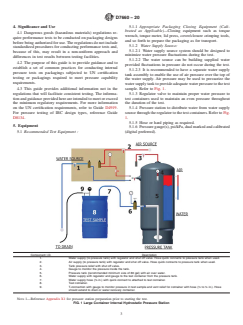
4.3 This guide provides additional information not in the sample. Refer to Fig. 1.
regulations that will facilitate consistent testing. The informa-
5.1.3 Regulator valve to maintain proper water pressure to
tionandguidanceprovidedhereareintendedtomeetorexceed test containers used to maintain an even pressure throughout
the minimum regulatory requirements. For more information
the duration of the test.
on the UN certification requirements, refer to Guide D4919. 5.1.4 Pressure station to distribute water from water supply
For pressure testing of IBC design types, reference Guide
sourcethroughtheregulatortothetestcontainers.RefertoFig.
D8134. 1.
5.1.5 Hose or hard piping as required.
5. Equipment
5.1.6 Pressuregauge(s),psi/kPa,dualmarkedandcalibrated
5.1 Recommended Test Equipment : (digital preferred).
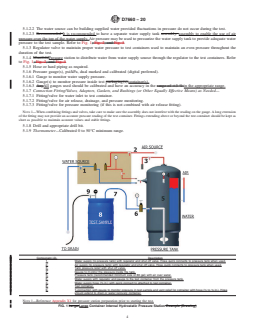
Component I.D. Description
1. Water supply (to pressure tank) with regulator and shut off valve. Hose quick connects to pressure tank when used.
2. Air supply (to pressure tank) with regulator and shut off valve. Hose quick connects to pressure tank when used.
3. Tank pressure relief with shut off valve.
4. Gauge to monitor the pressure inside the tank.
5. Pressure tank (recommended minimum size of 80 gal) with air over water.
6. Water supply with regulator and gauge to the test container from the pressure tank.
7. Water supply hose (¾ in.) with quick connect to attached to test container.
8. Test container.
9. T-connection with gauge to monitor pressure in test sample and vent relief for container with hose (½ to ¾ in.). Hose
should extend to drain or water recovery container.
NOTE 1—Reference Appendix X1 for pressure station preparation prior to starting the test.
FIG. 1 Large Container Internal Hydrostatic Pressure Station
D7660 − 20
NOTE 4—This may not always be the top head of the container if the
5.1.6.1 Gauge to monitor water supply pressure.
container is tested in the horizontal orientation.
5.1.6.2 Gauge(s) to monitor pressure inside test contain-
er(s). 7.2.1.2 Inner Packagings—It may be difficult to attach
5.1.6.3 All gauges used should be calibrated and have an fittings to the top head of smaller containers.
accuracy in the in the appropriate range. (1) Glass Bottles—Iftherequiredtestpressureis95kPaor
5.1.7 Connection Fitting/Valves, Adaptors, Gaskets, and less, a vacuum pressure test is recommended for all glass
Bushings (or Other Equally Effective Means) as Needed— bottles or vials. If the required test pressure is more than 95
5.1.7.1 Fitting/valve for water inlet to test container. kPa, the hydrostatic pressure test may be conducted, but care
5.1.7.2 Fitting/valve for air release, drainage, and pressure should be taken when fittings are attached. The fittings should
monitoring. be attached to the closure area provided the closure integrity is
5.1.7.3 Fitting/valve for pressure monitoring (if this is not maintained.
combined with air release fitting). (2) F-style Metal or Aluminum Cans—Attachfittingstothe
side or bottom of the container and avoid placing them near
NOTE
...
This document is not an ASTM standard and is intended only to provide the user of an ASTM standard an indication of what changes have been made to the previous version. Because
it may not be technically possible to adequately depict all changes accurately, ASTM recommends that users consult prior editions as appropriate. In all cases only the current version
of the standard as published by ASTM is to be considered the official document.
Designation: D7660 − 10 (Reapproved 2018) D7660 − 20
Standard Guide for
Conducting Internal Pressure Tests on United Nations (UN)
Packagings
This standard is issued under the fixed designation D7660; the number immediately following the designation indicates the year of
original adoption or, in the case of revision, the year of last revision. A number in parentheses indicates the year of last reapproval. A
superscript epsilon (´) indicates an editorial change since the last revision or reapproval.
1. Scope Scope*
1.1 This guide is intended to provide a standardized method and a set of basic instructions for performing internal and
hydrostatic pressure testing on packaging designs.designs intended for shipping liquids in accordance with the United States
Department of Transportation Title 49 Code of Federal Regulations (CFR) and the United Nations Recommendations on the
Transport of Dangerous Goods (UN).
1.2 This guide provides information to help clarify various terms used as part of the United Nations (UN) certification process
that may assist in determining the applicable test.
1.3 This guide provides the suggested minimum information that should be documented when conducting pressure testing.
1.4 This guide provides information for recommended equipment and fittings for conducting pressure tests.
1.5 This guide is based on the current information contained in 49 CFR, §173.27 and §178.605.
1.6 When testing packaging designs intended for hazardous materials (dangerous goods), the user of this guide shall be trained
in accordance with 49 CFR §172.700 and other applicable hazardous materials regulations such as the ICAO Technical
Instructions, IMDG Code, and carrier rules such as the IATA Dangerous Goods Regulations.
1.7 Units—The values stated in SI units are to be regarded as standard. No other units of measurement are included in this
standard.
1.8 This standard does not purport to address all of the safety concerns, if any, associated with its use. It is the responsibility
of the user of this standard to establish appropriate safety, health, and environmental practices and determine the applicability of
regulatory limitations prior to use.
1.9 This international standard was developed in accordance with internationally recognized principles on standardization
established in the Decision on Principles for the Development of International Standards, Guides and Recommendations issued
by the World Trade Organization Technical Barriers to Trade (TBT) Committee.
2. Referenced Documents
2.1 ASTM Standards:
D4919 Guide for Testing of Hazardous Materials (Dangerous Goods) Packagings
D4991 Test Method for Leakage Testing of Empty Rigid Containers by Vacuum Method
D8134 Guide for Conducting Internal Hydrostatic Pressure Tests on United Nations (UN) IBC Design Types
2.2 Federal Standard:
49 CFR U.S. Department of Transportation Code of Federal Regulations Title 49, Transportation (49 CFR) Parts 100-185
2.3 UN Standard:
UN UN United Nations Recommendations on the Transport of Dangerous Goods, Model Regulations (UN Orange Book)
This guide is under the jurisdiction of ASTM Committee D10 on Packaging and is the direct responsibility of Subcommittee D10.22 on Hazardous Materials.
Current edition approved May 1, 2018April 1, 2020. Published June 2018June 2020. Originally approved in 2010. Last previous edition approved in 2010 as D7660–10.
–10 (2018). DOI: 10.1520/D7660–10R18.10.1520/D7660-20.
For referenced ASTM standards, visit the ASTM website, www.astm.org, or contact ASTM Customer Service at service@astm.org. For Annual Book of ASTM Standards
volume information, refer to the standard’s Document Summary page on the ASTM website.
Available from Superintendent of Documents, U.S. Government Printing Office Superintendent of Documents, Office, Washington, DC 20402–9371, http://
phmsa.dot.gov/hazmat. 20402-9371 (website: https://www.phmsa.dot.gov/phmsa-regulations).
Available from the UN Economic Commission for Europe, Information Service, Palais des Nations, CH-1211 Geneva 10, Switzerland, http://www.unece.org/trans/
danger/danger.htm. 10 Switzerland (website: http:// www.unece.org/trans/danger/danger.htm).
*A Summary of Changes section appears at the end of this standard
Copyright © ASTM International, 100 Barr Harbor Drive, PO Box C700, West Conshohocken, PA 19428-2959. United States
D7660 − 20
2.4 IATA Standard:
IATA IATA International Air Transport Association (IATA) Dangerous Goods Regulations
2.5 ICAO Standard:
ICAO ICAO Technical Instructions for the Safe Transport of Dangerous Goods by Air
2.6 IMDG Standard:
IMDG Code International Maritime Dangerous Goods Code (IMDG Code)
3. Terminology
3.1 Definitions:
2 2
3.1.1 bar, n—metric unit of atmospheric pressure equal to 14.50 psi (lb/in. ), 1.02 kg/cm , 29.53 in.-Hg, or 0.9869 atmosphere.
3.1.2 hydrostatic pressure test, n—internal pressure test conducted on a container or packaging filled with water and pressurized
with water or other suitable means; regulatory reference sections: 49 CFR §178.605, UN 6.1.5.5, IMDG Code 6.1.5.5, ICAO 6.4.5,
and IATA 6.3.5.
3.1.2.1 Discussion—
This test is required for all single and composite packagings intended for shipping liquid dangerous goods (hazardous materials).
For single and composite packagings, the test pressure rating will appear as part of the UN specification marking sequence. This
test may also be used to comply with the pressure differential requirements for air transportation (49 CFR §173.27) for inner
packagings of combination packagings intended for shipping liquid hazardous materials. For further discussion and clarification,
refer to the pressure differential section.
3.1.3 inches-mercury, in.-Hg, n—pressure exerted by a 2.54-cm high column of mercury that has a density of 13.5951 g ⁄cm
when the acceleration of gravity has the standard value of 9.8 m/s ; used as a unit in the measurement of atmospheric pressure.
One in.-Hg is equal to 3.3864 kPa or 0.491154 psi.
3.1.4 kilopascal, kPa, n—unit of pressure in the SI system of international units, the primary, standard system used by the United
Nationals (UN) and the U.S. Department of Transportation (DOT) throughout their respective regulations per 49 CFR §171.10.
3.1.4.1 Discussion—
To convert kPa to psi, multiply by 0.145130.1450377 (95 kPa × 0.145130.1450377 = 13.8 psi). For single and composite
packagings, the test pressure rating will appear as part of the UN specification marking sequence and shall be shown in kPa.
3.1.5 leakproofness test, n—pressure test conducted on an empty container or packaging and pressurized with air or other
suitable means; regulatory reference sections: 49 CFR §178.604, UN 6.1.5.4, IMDG Code 6.1.5.4, ICAO 6.4.4, and IATA 6.3.4.
3.1.5.1 Discussion—
All packagings intended to contain liquids, except the inner packagings of combination packagings, shall be capable of passing
a leakproofness test. Methods to comply are outlined in Appendix B to Part 178 of DOT, 49 CFR.
3.1.5.2 Discussion—
The definition for leakproofness is provided in this guide, but the test methods will be addressed in a separate standard.
3.1.6 packagings, n—receptacles and any other components or materials necessary for the receptacle to perform its containment
function and includes nonbulknon-bulk packagings and composite packagings and are: designed to contain a net mass not
exceeding 400 kg; designed with a capacity not exceeding 450 L; not intended to transport most gases; not intended to transport
infectious substances; not intended to transport most radioactive materials; and not an intermediate bulk container (IBC) as defined
in UN Recommendations 6.5.
3.1.7 pounds per square inch, psi, n—unit of measure in the English measurement system.
Available from the International Air Transport Association (IATA), 800 Place Victoria,Victoria PO Box 113, Montreal, Quebec, H4Z 1M1, Canada, http://
www.iata.org.113 Montreal - H4Z 1M1 Quebec - Canada (website: http:// www.iata.org).
6 Available from the International Civil Aviation Organization (ICAO),Organization, (ICAO) 999 University St., Montreal, Quebec,Street, Montréal, Quebec H3C 5H7,
Canada, http://www.icao.org. Canada (website: http:// www.icao.org/).
Available from the International Marine Organization (IMO),(IMO, 4 Albert Embankment, London, SE1 7SR, U.K., http://www.imo.org.7SR United Kingdom (website:
http://www.imo.org/).
D7660 − 20
3.1.7.1 Discussion—
To convert psi to kPa, multiply by 6.89 (13.8 psi × 6.89 = 95 kPa).
3.1.8 pressure differential test, n—combination packagings with inner packagings containing liquid hazardous materials shall be
capable of meeting the pressure differential requirements for transport by air; regulatory reference sections: 49 CFR §173.27(c),
ICAO 4; 1.1.6, and IATA 5.0.2.9.
3.1.8.1 Discussion—
The pressure differential is intended to consider both the reduced external pressure as a result of changes in altitude as well as
increased internal pressure as a result of the vapor pressure of the hazardous materials in the package. To meet the pressure
differential requirement, the following tests may be used:
(1) hydrostatic pressure, n—The hydrostatic pressure test method should be used for all nonrigid containers and inner packagings.
Nonrigid containers are those that expand under pressure such as plastic bottles or vials and thin walled metal containers;
(2) vacuum pressure, n—The vacuum pressure test is an appropriate method for rigid containers and inner packagings if the
required test pressure (pressure differential) is 95 kPa or less. A container is considered rigid if it does not volumetrically expand
more than 0.5 % of its nonpressurized volume at ambient temperature when subjected to an internal pressure of 1 atmosphere (100
kPa) as specified in Test Method D4991. Rigid containers are those such as glass bottles and vials, earthenware, and plastic and
metal containers with thicker walls that do not significantly expand under pressure.
3.1.8.2 Discussion—
The appropriate pressure differential test method shall be validated to confirm the minimum required internal pressure has been
met.
3.1.8.3 Discussion—
The vacuum pressure method should not be used for “nonrigid” or flexible containers. When a flexible packaging such as a plastic
bag is subjected to a vacuum test, the air (fill material) inside the bag will cause the flexible packaging to expand and, subsequently,
the internal pressure will decrease. The pressure differential of the test is inversely related to the volume increase of the sample;
therefore, large volume increases detract from the severity of the test.
3.1.9 torr, n—unit of measure for the pressure exerted by 1 mm of mercury equal to ⁄760 th of standard atmospheric pressure;
used to measure pressure in vacuum systems.
3.1.9.1 Discussion—
–3
The corresponding SI unit is the pascal (Pa). It is a unit of pressure that is equal to approximately 1.316 × 10 atmospheres or
133.3 Pa (0.1333 kPa).
4. Significance and Use
4.1 Dangerous goods (hazardous materials) regulations require performance tests to be conducted on packaging designs before
being authorized for use. The regulations do not include standardized procedures for conducting performance tests and, because
of this, may result in a non-uniform approach and differences in test results between testing facilities.
4.2 The purpose of this guide is to provide guidance and to establish a set of common practices for conducting internal pressure
tests on packagings under goingsubjected to UN certification testing or packagings required to meet pressure capability
requirements. For more information on the UN certification requirements, refer to Guide D4919.
4.3 This guide provides additional information not in the regulations that will facilitate consistent testing. The information and
guidance provided here are intended to meet or exceed the minimum regulatory requirements. For more information on the UN
certification requirements, refer to Guide D4919. For pressure testing of IBC design types, reference Guide D8134.
5. Equipment
5.1 Recommended Test Equipment :
5.1.1 Appropriate Packaging Closing Equipment (Calibrated as Applicable)—Closing equipment such as torque wrench, torque
meter, lid press, cover/closure crimping tools, and so forth to prepare the packaging as for transport.
5.1.2 Water Supply Source:
5.1.2.1 Water supply source system should be designed to minimize water pressure fluctuations during the test.
D7660 − 20
5.1.2.2 The water source can be building supplied water provided fluctuations in pressure do not occur during the test.
5.1.2.3 Recommended It is recommended to have a separate water supply tank assembly. assembly to enable the use of air
pressure over the top of the water supply. Air pressure may be used to pressurize the water supply tank to provide adequate water
pressure to the test sample. Refer to Fig. 1, Fig. 2, and Fig. 3.
5.1.3 Regulator valve to maintain proper water pressure to test containers used to maintain an even pressure throughout the
duration of the test.
5.1.4 ManifoldPressure station to distribute water from water supply source through the regulator to the test containers. Refer
to Fig. 1, Fig. 2, and Fig. 3.
5.1.5 Hose or hard piping as required.
5.1.6 Pressure gauge(s), psi/kPa, dual marked and calibrated (digital preferred).
5.1.6.1 Gauge to monitor water supply pressure.
5.1.6.2 Gauge(s) to monitor pressure inside test packaging(s).container(s).
5.1.6.3 AnyAll gauges used should be calibrated and have an accuracy in the range of 63 %.in the appropriate range.
5.1.7 Connection Fitting/Valves, Adaptors, Gaskets, and Bushings (or Other Equally Effective Means) as Needed—
5.1.7.1 Fitting/valve for water inlet to test container.
5.1.7.2 Fitting/valve for air release, drainage, and pressure monitoring.
5.1.7.3 Fitting/valve for pressure monitoring (if this is not combined with air release fitting).
NOTE 1—When combining fittings and valves, take care to make sure the assembly does not interfere with the reading on the gauge. A long extension
of the fitting may not provide an accurate pressure reading of the test container. Fittings extending above or beyond the test container should be kept as
short as possible to maintain accurate values and stable fittings.
5.1.8 Drill and appropriate drill bit.
5.1.9 Thermometer—Calibrated 0 to 50°C minimum range.
Component I.D. Description
1. Water supply (to pressure tank) with regulator and shut off valve. Hose quick connects to pressure tank when used.
2. Air supply (to pressure tank) with regulator and shut off valve. Hose quick connects to pressure tank when used.
3. Tank pressure relief with shut off valve.
4. Gauge to monitor the pressure inside the tank.
5. Pressure tank (recommended minimum size of 80 gal) with air over water.
6. Water supply with regulator and gauge to the test container from the pressure tank.
7. Water supply hose (¾ in.) with quick connect to attached to test container.
8. Test container.
9. T-connection with gauge to monitor pressure in test sample and vent relief for container with hose (½ to ¾ in.). Hose
should extend to drain or water recovery container.
NOTE 1—Reference Appendix X1 for pressure station preparation prior to starting the test.
FIG. 1 LargerLarge Container Internal Hydrostatic Pressure Station Example (Drawing)
D7660 − 20
5.1.10 Timer with Audible Alarm—0 to 60 min.
5.2 Recommended Safety Equipment:
5.2.1 Safety glasses with side shield.
5.2.2 Gloves—fabric, leather, or rubber slip resistant, as appropriate.
6. Sample Size
6.1 Inner Packagings for Ai
...