

ASTM C614-20
(Test Method)Standard Test Method for Alkali Resistance of Porcelain Enamels
General Information
- Abstract
SIGNIFICANCE AND USE
2.1 This test method is intended specifically for testing the resistance to alkaline attack of porcelain enamels to be used as a final finish on washing machines, dishwashers, combination washer-dryers, and similar appliances where the surface is normally exposed to an alkaline environment at elevated temperatures.
SCOPE
1.1 This test method2 covers the measurement of the resistance of a porcelain enamel to a hot solution of tetrasodium pyrophosphate. Although the specific alkali mentioned herein is tetrasodium pyrophosphate, the equipment and techniques are equally applicable to other alkali solutions.
1.2 Units—The values stated in inch-pound units are to be regarded as standard. The values given in parentheses are mathematical conversions to SI units that are provided for information only and are not considered standard.
1.3 This standard does not purport to address all of the safety concerns, if any, associated with its use. It is the responsibility of the user of this standard to establish appropriate safety, health, and environmental practices and determine the applicability of regulatory limitations prior to use.
1.4 This international standard was developed in accordance with internationally recognized principles on standardization established in the Decision on Principles for the Development of International Standards, Guides and Recommendations issued by the World Trade Organization Technical Barriers to Trade (TBT) Committee.
- Status
- Published
- Publication Date
- 31-Oct-2020
- Technical Committee
- B08 - Metallic and Inorganic Coatings
- Drafting Committee
- B08.12 - Materials for Porcelain Enamel and Ceramic-Metal Systems
Overview
ASTM C614-20, titled Standard Test Method for Alkali Resistance of Porcelain Enamels, is an internationally recognized test method developed by ASTM International. This standard provides a reliable and reproducible procedure for evaluating the resistance of porcelain enamels against alkaline attack, specifically in environments where surfaces are exposed to elevated temperatures and alkaline solutions, such as household appliances. The method uses a hot solution of tetrasodium pyrophosphate but is also applicable to other alkali solutions. Its primary use is for quality assurance of finishes on products like washing machines, dishwashers, and combination laundry appliances.
Key Topics
Alkali Resistance Evaluation
The standard outlines a systematic procedure for testing how porcelain enamel surfaces withstand attack from alkaline substances, which is crucial for the performance of coated surfaces in typical appliance applications.Test Procedures
- Preparation of test specimens cut from enameled metal
- Cleaning and pre-weighing of specimens
- Immersion of specimens in a controlled hot alkaline solution
- Careful measurement of changes, such as weight loss and, optionally, gloss retention
Equipment and Environment
Utilizes standardized test chambers with precise temperature control, specimen holders, and high-accuracy balances to ensure consistency and repeatability across laboratories.Data Analysis and Reporting
The standard provides guidance on statistical treatment of test results, such as calculating mean weight loss, standard deviation, and statistical error for accurate reporting and comparison.
Applications
The ASTM C614-20 standard is especially valuable for:
Appliance Manufacturing
Offers critical assessment for manufacturers producing washing machines, dishwashers, and similar appliances where porcelain enamel finishes are routinely exposed to hot, alkaline cleaning agents.Quality Assurance and Product Development
Ensures that enamel coatings meet durability requirements and drives the development of more robust enamel compositions and manufacturing processes.Comparative Testing Between Laboratories
The methodology increases reproducibility and consistency, facilitating reliable comparison of alkali resistance data across different facilities.Regulatory Compliance and Performance Certification
Supports compliance with international trade and quality standards regarding material performance in household appliances.
Related Standards
When implementing or referencing ASTM C614-20, consider these related standards and guidelines:
- ASTM C282 - Test Method for Acid Resistance of Porcelain Enamels
- ASTM B117 - Practice for Operating Salt Spray (Fog) Apparatus
(useful for assessing corrosion resistance in complementary contexts) - ISO 28706 - Vitreous and porcelain enamels - Determination of resistance to chemical corrosion
(for global alignment and harmonization of testing practices) - ASTM D3359 - Test Methods for Measuring Adhesion by Tape Test
(to assess complementary coating performance factors)
Practical Value
Implementing ASTM C614-20 ensures that porcelain enamel finishes on household appliances offer long-term performance and resistance to alkaline attack, thereby extending product life and maintaining visual and functional quality. Its reproducible method gives manufacturers, labs, and regulators confidence in enamel durability under real-world washing and cleaning conditions, protecting consumer investment and brand reputation. The standard’s international recognition also facilitates trade and market access for compliant products.
Keywords: ASTM C614-20, alkali resistance, porcelain enamels, test method, appliance coatings, washing machine enamel, dishwasher finish, tetrasodium pyrophosphate, enamel durability, standardization, quality assurance, international standards
Get Certified
Connect with accredited certification bodies for this standard

DVS-ZERT GmbH
German welding certification society.
CARES (UK Certification Authority for Reinforcing Steels)
UK certification for reinforcing steels and construction.
EWF/IIW (European/International Welding Federation)
International welding personnel certification.
Sponsored listings
Frequently Asked Questions
ASTM C614-20 is a standard published by ASTM International. Its full title is "Standard Test Method for Alkali Resistance of Porcelain Enamels". This standard covers: SIGNIFICANCE AND USE 2.1 This test method is intended specifically for testing the resistance to alkaline attack of porcelain enamels to be used as a final finish on washing machines, dishwashers, combination washer-dryers, and similar appliances where the surface is normally exposed to an alkaline environment at elevated temperatures. SCOPE 1.1 This test method2 covers the measurement of the resistance of a porcelain enamel to a hot solution of tetrasodium pyrophosphate. Although the specific alkali mentioned herein is tetrasodium pyrophosphate, the equipment and techniques are equally applicable to other alkali solutions. 1.2 Units—The values stated in inch-pound units are to be regarded as standard. The values given in parentheses are mathematical conversions to SI units that are provided for information only and are not considered standard. 1.3 This standard does not purport to address all of the safety concerns, if any, associated with its use. It is the responsibility of the user of this standard to establish appropriate safety, health, and environmental practices and determine the applicability of regulatory limitations prior to use. 1.4 This international standard was developed in accordance with internationally recognized principles on standardization established in the Decision on Principles for the Development of International Standards, Guides and Recommendations issued by the World Trade Organization Technical Barriers to Trade (TBT) Committee.
SIGNIFICANCE AND USE 2.1 This test method is intended specifically for testing the resistance to alkaline attack of porcelain enamels to be used as a final finish on washing machines, dishwashers, combination washer-dryers, and similar appliances where the surface is normally exposed to an alkaline environment at elevated temperatures. SCOPE 1.1 This test method2 covers the measurement of the resistance of a porcelain enamel to a hot solution of tetrasodium pyrophosphate. Although the specific alkali mentioned herein is tetrasodium pyrophosphate, the equipment and techniques are equally applicable to other alkali solutions. 1.2 Units—The values stated in inch-pound units are to be regarded as standard. The values given in parentheses are mathematical conversions to SI units that are provided for information only and are not considered standard. 1.3 This standard does not purport to address all of the safety concerns, if any, associated with its use. It is the responsibility of the user of this standard to establish appropriate safety, health, and environmental practices and determine the applicability of regulatory limitations prior to use. 1.4 This international standard was developed in accordance with internationally recognized principles on standardization established in the Decision on Principles for the Development of International Standards, Guides and Recommendations issued by the World Trade Organization Technical Barriers to Trade (TBT) Committee.
ASTM C614-20 is classified under the following ICS (International Classification for Standards) categories: 25.220.50 - Enamels. The ICS classification helps identify the subject area and facilitates finding related standards.
ASTM C614-20 is available in PDF format for immediate download after purchase. The document can be added to your cart and obtained through the secure checkout process. Digital delivery ensures instant access to the complete standard document.
Standards Content (Sample)
This international standard was developed in accordance with internationally recognized principles on standardization established in the Decision on Principles for the
Development of International Standards, Guides and Recommendations issued by the World Trade Organization Technical Barriers to Trade (TBT) Committee.
Designation: C614 − 20
Standard Test Method for
Alkali Resistance of Porcelain Enamels
This standard is issued under the fixed designation C614; the number immediately following the designation indicates the year of
original adoption or, in the case of revision, the year of last revision. A number in parentheses indicates the year of last reapproval. A
superscript epsilon (´) indicates an editorial change since the last revision or reapproval.
INTRODUCTION
Although all porcelain enamels are highly resistant to attack by cold alkaline solutions, some
compositions are affected by hot solutions of the type encountered in automatic laundry and
dishwashing equipment. Tests to eliminate porcelain enamels of poor resistance have been developed
and used by various laboratories. In general, these tests consist of subjecting specimens to a boiling
solution of either sodium pyrophosphate or sodium hydroxide for a period of two or more hours. The
specimens are weighed before and after exposure to the test treatment and the loss-in-weight is taken
as a measure of alkali attack. In some tests representing milder exposure conditions, the 45 degree
specular gloss is measured before and after exposure, and the percentage of initial gloss retained is
used as an indicator of alkali resistance. While such tests have served a useful purpose in developing
more resistant porcelain enamel compositions and in manufacturing control operations, agreement
between laboratories has left something to be desired. The present test was designed to provide the
reproducibility between laboratories that is so essential to any standard test procedure.
1. Scope mendations issued by the World Trade Organization Technical
2 Barriers to Trade (TBT) Committee.
1.1 This test method covers the measurement of the resis-
tance of a porcelain enamel to a hot solution of tetrasodium
2. Significance and Use
pyrophosphate. Although the specific alkali mentioned herein
is tetrasodium pyrophosphate, the equipment and techniques 2.1 This test method is intended specifically for testing the
are equally applicable to other alkali solutions. resistance to alkaline attack of porcelain enamels to be used as
a final finish on washing machines, dishwashers, combination
1.2 Units—The values stated in inch-pound units are to be
washer-dryers, and similar appliances where the surface is
regarded as standard. The values given in parentheses are
normally exposed to an alkaline environment at elevated
mathematical conversions to SI units that are provided for
temperatures.
information only and are not considered standard.
1.3 This standard does not purport to address all of the
3. Apparatus
safety concerns, if any, associated with its use. It is the
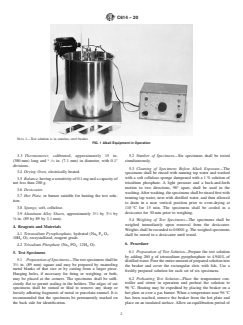
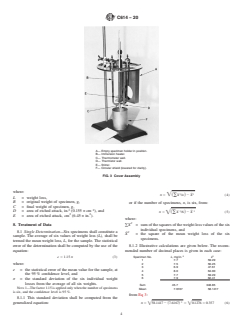
3.1 Test Chamber, of a type illustrated in Fig. 1, Fig. 3, and
responsibility of the user of this standard to establish appro-
Fig. 6. This part of the equipment consists of a stainless steel
priate safety, health, and environmental practices and deter-
beaker fitted with an O-ring sealed cover which supports an
mine the applicability of regulatory limitations prior to use.
immersion heater, a stirring device, thermometer and thermis-
1.4 This international standard was developed in accor-
tor wells; three specimen holders; a reflux condenser; a flow
dance with internationally recognized principles on standard-
channeling shield to slide over and be supported by the
ization established in the Decision on Principles for the
immersion heater; and a stirring motor. The beaker, heater
Development of International Standards, Guides and Recom-
sheath, stirring device, thermometer and thermistor wells,
specimenholders,andtheflowchannelingshieldshallbemade
from stainless steel alloys from the AISI 300 Series.
ThistestmethodisunderthejurisdictionofASTMCommitteeB08onMetallic
and Inorganic Coatings and is the direct responsibility of Subcommittee B08.12 on
3.2 Temperature Controller, thermistor-actuated, capable of
Materials for Porcelain Enamel and Ceramic-Metal Systems.
maintaining the temperature of the alkali solution in the beaker
Current edition approved Nov. 1, 2020. Published December 2020. Originally
at 96.00 6 0.20 °C.
approvedin1968.Lastpreviouseditionapprovedin2015asC614 – 10(2015).DOI:
10.1520/C0614-20.
This test was developed at the National Bureau of Standards under the
sponsorship of The Porcelain Enamel Institute, Inc., and published as P. E. I.
Bulletin T-25. See the appendix for drawings of the equipment.
Copyright © ASTM International, 100 Barr Harbor Drive, PO Box C700, West Conshohocken, PA 19428-2959. United States
C614 − 20
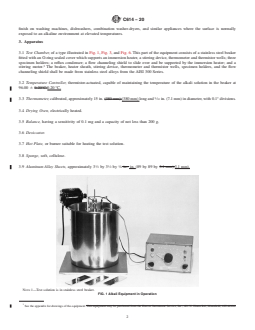
NOTE 1—Test solution is in stainless steel beaker.
FIG. 1 Alkali Equipment in Operation
3.3 Thermometer, calibrated, approximately 15 in. 5.2 Number of Specimens—Six specimens shall be tested
(380 mm) long and ⁄32 in. (7.1 mm) in diameter, with 0.1°
simultaneously.
divisions.
5.3 Cleaning of Specimens Before Alkali Exposure—The
3.4 Drying Oven, electrically heated.
specimens shall be rinsed with running tap water and washed
with a soft cellulose sponge dampened with a 1 % solution of
3.5 Balance,havingasensitivityof0.1mgandacapacityof
not less than 200 g. trisodium phosphate. A light pressure and a back-and-forth
motion in two directions, 90° apart, shall be used in the
3.6 Desiccator.
washing.Afterwashing,thespecimensshallberinsedfirstwith
3.7 Hot Plate, or burner suitable for heating the test solu-
running tap water, next with distilled water, and then allowed
tion.
to drain in a near vertical position prior to oven-drying at
3.8 Sponge, soft, cellulose.
110 °C for 15 min. The specimens shall be cooled in a
desiccator for 30 min prior to weighing.
1 1
3.9 Aluminum Alloy Sheets, approximately 3 ⁄2 by 3 ⁄2 by
⁄8 in. (89 by 89 by 3.1 mm).
5.4 Weighing of Test Specimens—The specimens shall be
weighed immediately upon removal from the desiccator.
4. Reagents and Materials
Weights shall be recorded to 0.0001 g.The weighed specimens
4.1 Tetrasodium Pyrophosphate, hydrated (Na P O ·
4 2 7 shall be stored in a desiccator until tested.
10H O), recrystallized, reagent grade.
6. Procedure
4.2 Trisodium Phosphate (Na PO ·12H O).
3 4 2
6.1 Preparation of Test Solution—Prepare the test solution
5. Test Specimens
by adding 260 g of tetrasodium pyrophosphate to 4.940 L of
5.1 PreparationofSpecimens—Thetestspecimensshallbe
distilledwater.Pourtheentireamountofpreparedsolutioninto
3 ⁄2 in. (89 mm) square and may be prepared by enameling
the beaker and cover the rectangular slots with lids. Use a
metal blanks of that size or by cutting from a larger piece.
freshly prepared solution for each set of six specimens.
Hanging holes, if necessary for firing or weighing, or both,
6.2 Preheating Test Solution—Place the temperature con-
may be placed at the corners. The specimens shall be suffi-
troller and stirrer in operation and preheat the solution to
ciently flat to permit sealing in the holders. The edges of cut
96 °C. Heating may be expedited by placing the beaker on a
specimens shall be stoned or filed to remove any sharp or
loosely adhering fragments of metal or porcelain enamel. It is hot plate or over a gas burner. When a temperature near 96 °C
has been reached, remove the beaker from the hot plate and
recommended that the specimens be permanently marked on
the back side for identification. place on an insulated surface.Allow an equilibration perio
...
This document is not an ASTM standard and is intended only to provide the user of an ASTM standard an indication of what changes have been made to the previous version. Because
it may not be technically possible to adequately depict all changes accurately, ASTM recommends that users consult prior editions as appropriate. In all cases only the current version
of the standard as published by ASTM is to be considered the official document.
Designation: C614 − 10 (Reapproved 2015) C614 − 20
Standard Test Method for
Alkali Resistance of Porcelain Enamels
This standard is issued under the fixed designation C614; the number immediately following the designation indicates the year of
original adoption or, in the case of revision, the year of last revision. A number in parentheses indicates the year of last reapproval. A
superscript epsilon (´) indicates an editorial change since the last revision or reapproval.
INTRODUCTION
Although all porcelain enamels are highly resistant to attack by cold alkaline solutions, some
compositions are affected by hot solutions of the type encountered in automatic laundry and
dishwashing equipment. Tests to eliminate porcelain enamels of poor resistance have been developed
and used by various laboratories. In general, these tests consist of subjecting specimens to a boiling
solution of either sodium pyrophosphate or sodium hydroxide for a period of two or more hours. The
specimens are weighed before and after exposure to the test treatment and the loss-in-weight is taken
as a measure of alkali attack. In some tests representing milder exposure conditions, the 45 degree
specular gloss is measured before and after exposure, and the percentage of initial gloss retained is
used as an indicator of alkali resistance. While such tests have served a useful purpose in developing
more resistant porcelain enamel compositions and in manufacturing control operations, agreement
between laboratories has left something to be desired. The present test was designed to provide the
reproducibility between laboratories that is so essential to any standard test procedure.
1. Scope
1.1 This test method covers the measurement of the resistance of a porcelain enamel to a hot solution of tetrasodium
pyrophosphate. Although the specific alkali mentioned herein is tetrasodium pyrophosphate, the equipment and techniques are
equally applicable to other alkali solutions.
1.2 Units—The values stated in inch-pound units are to be regarded as standard. The values given in parentheses are mathematical
conversions to SI units that are provided for information only and are not considered standard.
1.3 This standard does not purport to address all of the safety concerns, if any, associated with its use. It is the responsibility
of the user of this standard to establish appropriate safety safety, health, and healthenvironmental practices and determine the
applicability of regulatory limitations prior to use.
1.4 This international standard was developed in accordance with internationally recognized principles on standardization
established in the Decision on Principles for the Development of International Standards, Guides and Recommendations issued
by the World Trade Organization Technical Barriers to Trade (TBT) Committee.
2. Significance and Use
2.1 This test method is intended specifically for testing the resistance to alkaline attack of porcelain enamels to be used as a final
This test method is under the jurisdiction of ASTM Committee B08 on Metallic and Inorganic Coatings and is the direct responsibility of Subcommittee B08.12 on
Materials for Porcelain Enamel and Ceramic-Metal Systems.
Current edition approved May 1, 2015Nov. 1, 2020. Published May 2015December 2020. Originally approved in 1968. Last previous edition approved in 20112015 as
C614 – 10(2011).(2015). DOI: 10.1520/C0614-10R15.10.1520/C0614-20.
This test was developed at the National Bureau of Standards under the sponsorship of The Porcelain Enamel Institute, Inc., and published as P. E. I. Bulletin T-25.
Copyright © ASTM International, 100 Barr Harbor Drive, PO Box C700, West Conshohocken, PA 19428-2959. United States
C614 − 20
finish on washing machines, dishwashers, combination washer-dryers, and similar appliances where the surface is normally
exposed to an alkaline environment at elevated temperatures.
3. Apparatus
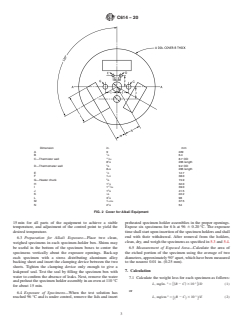
3.1 Test Chamber, of a type illustrated in Fig. 1, Fig. 3, and Fig. 6. This part of the equipment consists of a stainless steel beaker
fitted with an O-ring sealed cover which supports an immersion heater, a stirring device, thermometer and thermistor wells; three
specimen holders; a reflux condenser; a flow channeling shield to slide over and be supported by the immersion heater; and a
stirring motor. The beaker, heater sheath, stirring device, thermometer and thermistor wells, specimen holders, and the flow
channeling shield shall be made from stainless steel alloys from the AISI 300 Series.
3.2 Temperature Controller, thermistor-actuated, capable of maintaining the temperature of the alkali solution in the beaker at
96.00 6 0.20°C.0.20 °C.
3.3 Thermometer, calibrated, approximately 15 in. (380 mm) (380 mm) long and ⁄32 in. (7.1 mm) in diameter, with 0.1° divisions.
3.4 Drying Oven, electrically heated.
3.5 Balance, having a sensitivity of 0.1 mg and a capacity of not less than 200 g.
3.6 Desiccator.
3.7 Hot Plate, or burner suitable for heating the test solution.
3.8 Sponge, soft, cellulose.
1 1 1
3.9 Aluminum Alloy Sheets, approximately 3 ⁄2 by 3 ⁄2 by ⁄8 in. in. (89 by 89 by 3.1 mm).3.1 mm).
NOTE 1—Test solution is in stainless steel beaker.
FIG. 1 Alkali Equipment in Operation
See the appendix for drawings of the equipment. This equipment may be purchased from the Hoover Instrument Service, Inc., 401 N. Home Rd., Mansfield, OH 44906.
C614 − 20
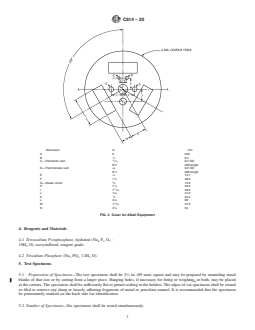
Dimension in. mm
A 9 229
B ⁄4 6.4
C—Thermistor well ⁄32 8.7 OD
8 ⁄8 206 length
D—Thermometer well ⁄8 9.2 OD
8 ⁄8 206 length
E ⁄2 12.7
F 1 ⁄2 38.0
G—Heater chuck ⁄8 15.9
H 1 ⁄4 32.0
I 1 ⁄32 39.0
J 1 ⁄8 41.5
K ⁄8 22.2
L 3 ⁄8 98
M 1 ⁄32 37.5
N 2 ⁄8 54
FIG. 2 Cover for Alkali Equipment
4. Reagents and Materials
4.1 Tetrasodium Pyrophosphate, hydrated (Na P O ·
4 2 7
10H O), recrystallized, reagent grade.
4.2 Trisodium Phosphate (Na PO ·12H O).
3 4 2
5. Test Specimens
5.1 Preparation of Specimens—The test specimens shall be 3 ⁄2 in. (89 mm) square and may be prepared by enameling metal
blanks of that size or by cutting from a larger piece. Hanging holes, if necessary for firing or weighing, or both, may be placed
at the corners. The specimens shall be sufficiently flat to permit sealing in the holders. The edges of cut specimens shall be stoned
or filed to remove any sharp or loosely adhering fragments of metal or porcelain enamel. It is recommended that the specimens
be permanently marked on the back side for identification.
5.2 Number of Specimens—Six specimens shall be tested simultaneously.
C614 − 20
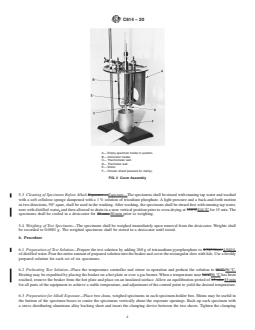
A— Empty specimen holder in position.
B— Immersion heater.
C— Thermometer well.
D— Thermistor well.
E— Stirrer.
F— Circular shield (lowered for clarity).
FIG. 3 Cover Assembly
5.3 Cleaning of Specimens Before Alkali Exposure —Exposure—The specimens shall be rinsed with running tap water and washed
with a soft cellulose sponge dampened with a 1 % solution of trisodium phosphate. A light pressure and a back-and-forth motion
in two directions, 90° apart, shall be used in the washing. After washing, the specimens shall be rinsed first with running tap water,
next with distilled water, and then allowed to drain in a near vertical position prior to oven-drying at 110°C110 °C for 15 min. The
specimens shall be cooled in a desiccator for 30 min 30 min prior to weighing.
5.4 Weighing of Test Specimens—The specimens shall be weighed immediately upon removal from the desiccator. Weights shall
be recorded to 0.0001 g. The
...