

ASTM D2274-14(2019)
(Test Method)Standard Test Method for Oxidation Stability of Distillate Fuel Oil (Accelerated Method)
General Information
- Abstract
SIGNIFICANCE AND USE
5.1 This test method provides a basis for the estimation of the oxidation stability of middle distillate fuels such as No. 2 fuel oil.
5.2 The test method may not provide a prediction of the quantity of insolubles that will form in field storage over any given period of time. The amount of insolubles formed in such field storage is subject to the specific conditions which are too variable for this test method to predict accurately.
5.3 Test Method D2274 yields results more rapidly than Test Method D4625, the 43 °C bottle test. However, as a result of the significantly elevated temperature and the pure oxygen atmosphere, the nature and amount of insolubles may deviate to a greater extent than Test Method D4625 from those formed in field storage.
SCOPE
1.1 This test method covers the measurement of the inherent stability of middle distillate petroleum fuels under specified oxidizing conditions at 95 °C.
Note 1: Fuels used in establishing the precision measures for this test method were described as gas oil, diesel fuel, No. 2 heating oil, and DFM, a Navy distillate fuel suitable for diesels, boilers, and gas turbines. (The term DFM is no longer used when referring to fuel meeting MIL-F-16884 requirements; rather it is called F76 as it conforms to NATO F76 requirements.) While the test method may be used for fuels outside the range of these fuels, the precision measures may not apply.
1.2 This test method is not applicable to fuels containing residual oil. This test method has not been validated for testing biodiesel, such as meeting Specification D6751 or blends of middle distillates and biodiesel, such as meeting Specification D7467, or both. Test Method D7462 has been determined to be suitable for testing B100 and all blends of middle distillates and biodiesel.
Note 2: No. 1 and No. 2 grades in Specifications D396 or D975 currently allow up to 5 % biodiesel meeting Specification D6751. Samples containing biodiesel can result in partial dissolution or compromise of the membrane filter and give erroneous results.
1.3 The values given in SI units are to be regarded as the standard. The values in parentheses are for information only.
1.4 This standard does not purport to address all of the safety concerns, if any, associated with its use. It is the responsibility of the user of this standard to establish appropriate safety, health, and environmental practices and determine the applicability of regulatory limitations prior to use.
1.5 This international standard was developed in accordance with internationally recognized principles on standardization established in the Decision on Principles for the Development of International Standards, Guides and Recommendations issued by the World Trade Organization Technical Barriers to Trade (TBT) Committee.
- Status
- Published
- Publication Date
- 30-Nov-2019
- Technical Committee
- D02 - Petroleum Products, Liquid Fuels, and Lubricants
- Drafting Committee
- D02.14 - Stability, Cleanliness and Compatibility of Liquid Fuels
Overview
ASTM D2274-14(2019): Standard Test Method for Oxidation Stability of Distillate Fuel Oil (Accelerated Method) specifies a laboratory procedure for evaluating the inherent oxidation stability of middle distillate fuels under accelerated test conditions. The standard is developed by ASTM International and intended primarily for petroleum products such as gas oil, diesel fuel, No. 2 heating oil, and certain navy distillate fuels, under controlled oxidizing conditions at 95°C.
This method measures the tendency of fuel samples to form insoluble materials (both filterable and adherent insolubles) when exposed to oxygen at elevated temperatures. The results provide a rapid assessment of fuel stability, helping users estimate the potential for gum and deposit formation during storage.
Keywords: oxidation stability, distillate fuel oil, ASTM D2274, accelerated test, diesel fuel, insolubles, fuel testing.
Key Topics
- Purpose: Evaluate oxidation stability of middle distillate petroleum fuels, including No. 2 fuel oil and diesel, by accelerated aging in oxygen-rich conditions.
- Test Scope:
- Applicable to middle distillate fuels without residual oils; not validated for biodiesel or blends exceeding 5% biodiesel.
- Results may differ from field storage conditions due to the nature of the test.
- Test Principle:
- Fuel sample is aged at 95°C with oxygen flow for 16 hours.
- Total insolubles (filterable and adherent) are quantified and reported as mg per 100 mL fuel.
- Significance:
- Provides a rapid indication of fuel’s oxidation stability.
- Useful for quality control and specification compliance.
- Limitations:
- Does not precisely predict field storage insoluble formation.
- Results may not directly correlate with long-term storage or operational behavior.
Applications
- Fuel Quality Control: Regularly used in refineries, terminals, and quality labs to assess the oxidation stability of diesel, heating oil, and other middle distillates.
- Specification Compliance: Supports compliance with product specifications (e.g., ASTM D975 and D396 for diesel and heating oils) by ensuring fuel meets minimum stability criteria.
- Comparative Testing: Enables rapid comparison of fuel stability across different batches or sources, critical for blending decisions and supply chain management.
- Research and Development: Utilized in testing new fuel additives, formulations, or refining techniques to enhance fuel storage stability.
- Military and Industrial Use: Referenced in military fuel specifications and suitable for marine, rail, and heavy-duty applications demanding consistent, stable fuel performance.
Related Standards
- ASTM D4625 - Test Method for Storage Stability of Middle Distillate Fuels at 43°C: Offers a lower-temperature, longer-duration test for storage simulation.
- ASTM D381 - Test Method for Gum Content in Fuels: Evaluates tendency to form surface-deposited residues.
- ASTM D975 - Specification for Diesel Fuel Oils: Product specification referencing oxidation stability.
- ASTM D396 - Specification for Fuel Oils: Specification for various grades including No. 2 heating oil.
- ASTM D6751 & D7467 - Specifications addressing biodiesel and biodiesel blends.
- ASTM D7462 - Addresses oxidation stability of biodiesel fuels and blends (not for use in D2274).
- ASTM D4057 & D4177 - Sampling practices for petroleum products to ensure representative samples.
Practical Value
The ASTM D2274 test method is a valuable tool for fuel producers, suppliers, and users needing to verify that middle distillate fuels maintain stability during storage and handling. By identifying fuels prone to forming problematic insolubles, this standard helps prevent operational issues such as filter plugging, injector fouling, and engine deposits. While not a direct predictor of real-world storage outcomes, its accelerated approach makes it ideal for regular monitoring and quality assurance, supporting reliable fuel supply and efficient performance across a range of industrial, commercial, and military applications.
Relations
- Effective Date
- 15-Dec-2023
- Effective Date
- 01-Oct-2023
- Effective Date
- 01-Jun-2020
- Effective Date
- 01-Jan-2020
- Effective Date
- 15-Dec-2019
- Effective Date
- 01-May-2019
- Effective Date
- 01-May-2019
- Effective Date
- 01-Feb-2019
- Effective Date
- 15-Dec-2018
- Effective Date
- 01-Dec-2018
- Effective Date
- 01-Oct-2018
- Effective Date
- 01-Oct-2018
- Effective Date
- 01-Oct-2018
- Effective Date
- 01-May-2018
- Effective Date
- 01-May-2018
Get Certified
Connect with accredited certification bodies for this standard

Element Materials Technology
Materials testing and product certification.

ABS Group Brazil
ABS Group certification services in Brazil.

ABS Quality Evaluations Inc.
American Bureau of Shipping quality certification.
Sponsored listings
Frequently Asked Questions
ASTM D2274-14(2019) is a standard published by ASTM International. Its full title is "Standard Test Method for Oxidation Stability of Distillate Fuel Oil (Accelerated Method)". This standard covers: SIGNIFICANCE AND USE 5.1 This test method provides a basis for the estimation of the oxidation stability of middle distillate fuels such as No. 2 fuel oil. 5.2 The test method may not provide a prediction of the quantity of insolubles that will form in field storage over any given period of time. The amount of insolubles formed in such field storage is subject to the specific conditions which are too variable for this test method to predict accurately. 5.3 Test Method D2274 yields results more rapidly than Test Method D4625, the 43 °C bottle test. However, as a result of the significantly elevated temperature and the pure oxygen atmosphere, the nature and amount of insolubles may deviate to a greater extent than Test Method D4625 from those formed in field storage. SCOPE 1.1 This test method covers the measurement of the inherent stability of middle distillate petroleum fuels under specified oxidizing conditions at 95 °C. Note 1: Fuels used in establishing the precision measures for this test method were described as gas oil, diesel fuel, No. 2 heating oil, and DFM, a Navy distillate fuel suitable for diesels, boilers, and gas turbines. (The term DFM is no longer used when referring to fuel meeting MIL-F-16884 requirements; rather it is called F76 as it conforms to NATO F76 requirements.) While the test method may be used for fuels outside the range of these fuels, the precision measures may not apply. 1.2 This test method is not applicable to fuels containing residual oil. This test method has not been validated for testing biodiesel, such as meeting Specification D6751 or blends of middle distillates and biodiesel, such as meeting Specification D7467, or both. Test Method D7462 has been determined to be suitable for testing B100 and all blends of middle distillates and biodiesel. Note 2: No. 1 and No. 2 grades in Specifications D396 or D975 currently allow up to 5 % biodiesel meeting Specification D6751. Samples containing biodiesel can result in partial dissolution or compromise of the membrane filter and give erroneous results. 1.3 The values given in SI units are to be regarded as the standard. The values in parentheses are for information only. 1.4 This standard does not purport to address all of the safety concerns, if any, associated with its use. It is the responsibility of the user of this standard to establish appropriate safety, health, and environmental practices and determine the applicability of regulatory limitations prior to use. 1.5 This international standard was developed in accordance with internationally recognized principles on standardization established in the Decision on Principles for the Development of International Standards, Guides and Recommendations issued by the World Trade Organization Technical Barriers to Trade (TBT) Committee.
SIGNIFICANCE AND USE 5.1 This test method provides a basis for the estimation of the oxidation stability of middle distillate fuels such as No. 2 fuel oil. 5.2 The test method may not provide a prediction of the quantity of insolubles that will form in field storage over any given period of time. The amount of insolubles formed in such field storage is subject to the specific conditions which are too variable for this test method to predict accurately. 5.3 Test Method D2274 yields results more rapidly than Test Method D4625, the 43 °C bottle test. However, as a result of the significantly elevated temperature and the pure oxygen atmosphere, the nature and amount of insolubles may deviate to a greater extent than Test Method D4625 from those formed in field storage. SCOPE 1.1 This test method covers the measurement of the inherent stability of middle distillate petroleum fuels under specified oxidizing conditions at 95 °C. Note 1: Fuels used in establishing the precision measures for this test method were described as gas oil, diesel fuel, No. 2 heating oil, and DFM, a Navy distillate fuel suitable for diesels, boilers, and gas turbines. (The term DFM is no longer used when referring to fuel meeting MIL-F-16884 requirements; rather it is called F76 as it conforms to NATO F76 requirements.) While the test method may be used for fuels outside the range of these fuels, the precision measures may not apply. 1.2 This test method is not applicable to fuels containing residual oil. This test method has not been validated for testing biodiesel, such as meeting Specification D6751 or blends of middle distillates and biodiesel, such as meeting Specification D7467, or both. Test Method D7462 has been determined to be suitable for testing B100 and all blends of middle distillates and biodiesel. Note 2: No. 1 and No. 2 grades in Specifications D396 or D975 currently allow up to 5 % biodiesel meeting Specification D6751. Samples containing biodiesel can result in partial dissolution or compromise of the membrane filter and give erroneous results. 1.3 The values given in SI units are to be regarded as the standard. The values in parentheses are for information only. 1.4 This standard does not purport to address all of the safety concerns, if any, associated with its use. It is the responsibility of the user of this standard to establish appropriate safety, health, and environmental practices and determine the applicability of regulatory limitations prior to use. 1.5 This international standard was developed in accordance with internationally recognized principles on standardization established in the Decision on Principles for the Development of International Standards, Guides and Recommendations issued by the World Trade Organization Technical Barriers to Trade (TBT) Committee.
ASTM D2274-14(2019) is classified under the following ICS (International Classification for Standards) categories: 75.160.20 - Liquid fuels. The ICS classification helps identify the subject area and facilitates finding related standards.
ASTM D2274-14(2019) has the following relationships with other standards: It is inter standard links to ASTM D975-23a, ASTM D7467-23, ASTM D7467-20a, ASTM D7467-20, ASTM D396-19a, ASTM D396-19, ASTM D7467-19, ASTM D975-19, ASTM D7467-18b, ASTM D975-18a, ASTM D396-18a, ASTM D6751-18, ASTM D7467-18a, ASTM D396-18, ASTM D7467-18. Understanding these relationships helps ensure you are using the most current and applicable version of the standard.
ASTM D2274-14(2019) is available in PDF format for immediate download after purchase. The document can be added to your cart and obtained through the secure checkout process. Digital delivery ensures instant access to the complete standard document.
Standards Content (Sample)
This international standard was developed in accordance with internationally recognized principles on standardization established in the Decision on Principles for the
Development of International Standards, Guides and Recommendations issued by the World Trade Organization Technical Barriers to Trade (TBT) Committee.
Designation: D2274 −14 (Reapproved 2019)
Designation: 388⁄97
Standard Test Method for
Oxidation Stability of Distillate Fuel Oil (Accelerated
Method)
This standard is issued under the fixed designation D2274; the number immediately following the designation indicates the year of
original adoption or, in the case of revision, the year of last revision. A number in parentheses indicates the year of last reapproval. A
superscript epsilon (´) indicates an editorial change since the last revision or reapproval.
This standard has been approved for use by agencies of the U.S. Department of Defense.
1. Scope mendations issued by the World Trade Organization Technical
Barriers to Trade (TBT) Committee.
1.1 Thistestmethodcoversthemeasurementoftheinherent
stability of middle distillate petroleum fuels under specified
2. Referenced Documents
oxidizing conditions at 95 °C.
2.1 ASTM Standards:
NOTE 1—Fuels used in establishing the precision measures for this test
D381 Test Method for Gum Content in Fuels by Jet Evapo-
method were described as gas oil, diesel fuel, No. 2 heating oil, and DFM,
ration
a Navy distillate fuel suitable for diesels, boilers, and gas turbines. (The
term DFM is no longer used when referring to fuel meeting MIL-F-16884
D396 Specification for Fuel Oils
requirements; rather it is called F76 as it conforms to NATO F76
D943 Test Method for Oxidation Characteristics of Inhibited
requirements.) While the test method may be used for fuels outside the
Mineral Oils
range of these fuels, the precision measures may not apply.
D975 Specification for Diesel Fuel
1.2 This test method is not applicable to fuels containing
D1193 Specification for Reagent Water
residual oil. This test method has not been validated for testing
D4057 Practice for Manual Sampling of Petroleum and
biodiesel, such as meeting Specification D6751 or blends of
Petroleum Products
middle distillates and biodiesel, such as meeting Specification
D4177 Practice for Automatic Sampling of Petroleum and
D7467, or both.Test Method D7462 has been determined to be
Petroleum Products
suitable for testing B100 and all blends of middle distillates
D4625 Test Method for Middle Distillate Fuel Storage
and biodiesel.
Stability at 43 °C (110 °F)
NOTE 2—No. 1 and No. 2 grades in Specifications D396 or D975 D6751 Specification for Biodiesel Fuel Blend Stock (B100)
currentlyallowupto5 %biodieselmeetingSpecificationD6751.Samples
for Middle Distillate Fuels
containing biodiesel can result in partial dissolution or compromise of the
D7462 Test Method for Oxidation Stability of Biodiesel
membrane filter and give erroneous results.
(B100) and Blends of Biodiesel with Middle Distillate
1.3 The values given in SI units are to be regarded as the
Petroleum Fuel (Accelerated Method) (Withdrawn 2016)
standard. The values in parentheses are for information only.
D7467 Specification for Diesel Fuel Oil, Biodiesel Blend
1.4 This standard does not purport to address all of the (B6 to B20)
safety concerns, if any, associated with its use. It is the
2.2 Military Specification:
responsibility of the user of this standard to establish appro-
MIL-F-16884 Fuel, Navy Distillate
priate safety, health, and environmental practices and deter-
mine the applicability of regulatory limitations prior to use.
3. Terminology
1.5 This international standard was developed in accor-
3.1 Definitions of Terms Specific to This Standard:
dance with internationally recognized principles on standard-
ization established in the Decision on Principles for the
Development of International Standards, Guides and Recom-
For referenced ASTM standards, visit the ASTM website, www.astm.org, or
contact ASTM Customer Service at service@astm.org. For Annual Book of ASTM
This test method is under the jurisdiction of Committee D02 on Petroleum Standards volume information, refer to the standard’s Document Summary page on
Products, Liquid Fuels, and Lubricants and is the direct responsibility of Subcom- the ASTM website.
mittee D02.14 on Stability, Cleanliness and Compatibility of Liquid Fuels. The last approved version of this historical standard is referenced on
Current edition approved Dec. 1, 2019. Published December 2019. Originally www.astm.org.
approved in 1964. Last previous edition approved in 2014 as D2274 – 14. DOI: Available from Standardization Documents Order Desk, Bldg. 4, 700 Robbins
10.1520/D2274-14R19. Ave., Philadelphia, PA 19111-5098. Attn: NPODS
Copyright © ASTM International, 100 Barr Harbor Drive, PO Box C700, West Conshohocken, PA 19428-2959. United States
D2274 − 14 (2019)
3.1.1 adherent insolubles (formerly adherent gum), coils of copper and steel are used, it is important that any
n—material which is produced in the course of stressing residues that could contain these metals be eliminated from the
distillate fuel under the conditions of this test and which apparatus by thorough cleaning prior to use. Similarly, to
adheres to the glassware after fuel has been flushed from the preclude the presence of chromium ions, as well as to protect
system. laboratory personnel from potential harm, chromic acid shall
not be used for cleaning glassware in the practice of this
3.1.2 filterable insolubles, n—material, which is produced
method.
in the course of stressing distillate fuel under the conditions of
this test, which is capable of being removed from the fuel by
6.2 It has been found that commercial grades of acetone, if
filtration.This includes both material suspended in the fuel and
used in the trisolvent, can have impurities which cause an
material easily removed from the oxidation cell and oxygen
apparently greater level of adherent insolubles to be measured.
delivery tube with hydrocarbon solvent.
It is, therefore, critical that only reagent (or higher) grade
materials be used in preparing the trisolvent mixture.
3.1.3 inherent stability, n—the resistance to change when
the fuel is exposed to air, but in the absence of other
6.3 Ultraviolet light exposure has been found to increase the
environmental factors such as water, or reactive metals and
amount of total insolubles. Therefore, the fuel being tested
dirt.
shall be shielded from direct exposure to ultraviolet light
(sunlight or fluorescent). Conduct all sampling, measuring,
3.1.4 totalinsolubles,n—arithmeticsumoftheadherentand
filtration, and weighing away from direct sunlight and in as
filterable insolubles.
dark an area as would be compatible with other laboratory
3.1.5 zero time, n—the time the first of a batch of oxidation
operations. Storage before stress, the stress period and cool-
cells is placed in the heating bath.
down after stressing shall be in the dark.
3.1.5.1 Discussion—This is the time taken as the start of the
16 h of residence in the heating bath.
7. Apparatus
NOTE 3—It is suggested that all measuring equipment be calibrated
4. Summary of Test Method
according to manufacturer’s instructions on a periodic basis to assure
consistency of results.
4.1 A 350 mL volume of filtered middle distillate fuel is
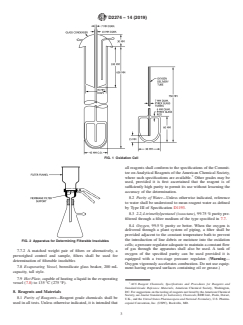
7.1 Oxidation Cell, of borosilicate glass, as shown in Fig. 1,
aged at 95 °C (203 °F) for 16 h while oxygen is bubbled
shall consist of a test tube, condenser, and oxygen delivery
through the sample at a rate of 3 L/h. After aging, the sample
tube. This cell is identical to that used in Test Method D943.
is cooled to approximately room temperature before filtering to
obtain the filterable insolubles quantity. Adherent insolubles
7.2 Heating Bath, with a thermostatically controlled liquid
are then removed from the oxidation cell and associated
medium, shall be capable of maintaining the bath temperature
glasswarewithtrisolvent.Thetrisolventisevaporatedtoobtain
at 95 °C 6 0.2 °C (203 °F 6 0.4 °F). It shall be fitted with a
the quantity of adherent insolubles. The sum of the filterable
suitable stirring device to provide a uniform temperature
and adherent insolubles, expressed as milligrams per 100 mL,
throughoutthebath.Itshallbelargeenoughtoholdthedesired
is reported as total insolubles.
number of oxidation cells immersed to a depth of approxi-
mately 350 mm. Further, the bath construction must permit
5. Significance and Use
shielding the fuel samples in the oxidation cells from light
while they are undergoing oxidation.
5.1 This test method provides a basis for the estimation of
the oxidation stability of middle distillate fuels such as No. 2
7.3 Flowmeters, shall have a capability of measuring 3 L⁄h
fuel oil.
60.3 L⁄hofoxygen.Oneflowmetershallbeprovidedforeach
oxidation cell.
5.2 The test method may not provide a prediction of the
quantity of insolubles that will form in field storage over any
7.4 Filter Drying Oven, shall be capable of safely evapo-
given period of time. The amount of insolubles formed in such
rating the solvent at 80 °C 6 2 °C (176 °F 6 4 °F) for the
field storage is subject to the specific conditions which are too
drying of filters.
variable for this test method to predict accurately.
7.5 Glassware Drying Oven, shall be capable of drying
5.3 TestMethodD2274yieldsresultsmorerapidlythanTest
glassware at 105 °C 6 5 °C (221 °F 6 9 °F).
Method D4625, the 43 °C bottle test. However, as a result of
7.6 Filtration Assembly, see Fig. 2, shall be capable of
the significantly elevated temperature and the pure oxygen
holding the filters described in 7.7.
atmosphere, the nature and amount of insolubles may deviate
7.7 Filter Media , 47 mm diameter cellulose ester
to a greater extent than Test Method D4625 from those formed
surfactant-free membrane filters with a nominal pore size of
in field storage.
0.8 µm.
7.7.1 Single filters are to be used for prefiltration.
6. Interferences
6.1 Oxidation is a major chemical process causing adherent
This apparatus is available from suppliers of specialty petroleum testing
and filterable insolubles to form.Any substance such as copper
equipment.
or chromium that catalyzes oxidation reactions will cause
Supporting data have been filed at ASTM International Headquarters and may
greater quantities of insolubles to form. Since the apparatus
be obtained by requesting Research Report RR:D02-1012. Filters may be qualified
used in this test can also be used in Test Method D943, where using the procedure in this research report.
D2274 − 14 (2019)
FIG. 1 Oxidation Cell
all reagents shall conform to the specifications of the Commit-
tee onAnalytical Reagents of theAmerican Chemical Society,
where such specifications are available. Other grades may be
used, provided it is first ascertained that the reagent is of
sufficiently high purity to permit its use without lessening the
accuracy of the determination.
8.2 Purity of Water—Unless otherwise indicated, reference
to water shall be understood to mean reagent water as defined
by Type III of Specification D1193.
8.3 2.2,4-trimethylpentanel (isooctane), 99.75 % purity pre-
filtered through a filter medium of the type specified in 7.7.
8.4 Oxygen, 99.5 % purity or better. When the oxygen is
delivered through a plant system of piping, a filter shall be
provided adjacent to the constant temperature bath to prevent
the introduction of line debris or moisture into the oxidation
FIG. 2 Apparatus for Determining Filterable Insolubles
cells; a pressure regulator adequate to maintain a constant flow
of gas through the apparatus shall also be used. A tank of
7.7.2 A matched weight pair of filters or alternatively, a
oxygen of the specified purity can be used provided it is
preweighed control and sample, filters shall be used for
equipped with a two-stage pressure regulator. (Warning—
determination of filterable insolubles
Oxygen vigorously accelerates combustion. Do not use equip-
7.8 Evaporating Vessel, borosilicate glass beaker, 200 mL
ment having exposed surfaces containing oil or grease.)
capacity, tall style.
7.9 Hot Plate, capable of heating a liquid in the evaporating
vessel (7.8) to 135 °C (275 °F).
ACS Reagent Chemicals, Specifications and Procedures for Reagents and
Standard-Grade Reference Materials, American Chemical Society, Washington,
8. Reagents and Materials DC. For suggestions on the testing of reagents not listed by theAmerican Chemical
Society, see Analar Standards for Laboratory Chemicals, BDH Ltd., Poole, Dorset,
8.1 Purity of Reagents—Reagent grade chemicals shall be
U.K., and the United States Pharmacopeia and National Formulary, U.S. Pharma-
used in all tests. Unless otherwise indicated, it is intended that copeial Convention, Inc. (USPC), Rockville, MD.
D2274 − 14 (2019)
8.5 Trisolvent, a mixture of equal volumes of acetone, 11. Procedure
methanol, and toluene. See 8.1.(Warning—It is particularly
11.1 Preparing the Sample—Place one filter (described in
important that technical, commercial, practical, or industrial
7.7) on
...