

ASTM B905-00(2021)
(Test Method)Standard Test Methods for Assessing the Adhesion of Metallic and Inorganic Coatings by the Mechanized Tape Test
General Information
- Abstract
SIGNIFICANCE AND USE
4.1 If a coating is to fulfill its function of protecting or imparting unique properties to the surface of a substrate, it must adhere to the substrate for the expected service life. Because surface preparation (or lack of it) has a drastic effect on adhesion of coatings, a test method for evaluating adhesion to different surface treatments or of different coatings to the same treatment is of considerable use to the industry.
4.2 The limitations of all adhesion methods, and the specific limitation of this test method to lower levels of adhesion (see 1.3) should be recognized before using it. These test methods are mechanized adaptations of Test Methods D3359; therefore, the intra- and interlaboratory precision of these test methods are similar to Test Methods D3359 and to other widely-accepted tests for coated substrates, for example, Test Method D2370, but this is partly the result of it being insensitive to all but large differences in adhesion. The pass-fail scale of 0 to 5 for Method B1 and B2 was selected deliberately to avoid a false impression of being sensitive.
SCOPE
1.1 These test methods describe procedures for assessing the adhesion of metallic and inorganic coatings and other thin films to metallic and nonmetallic substrates. Assessment is made by applying pressure-sensitive tape to a coated surface and then utilizing a mechanical device to remove the tape at a regulated, uniform rate and constant angle while simultaneously recording the removal force.
1.2 Four methods are described. Methods A1 and A2 are intended primarily for use on parts. Methods B1 and B2 are intended primarily for use in laboratory evaluations. Methods B1 and B2 are not recommended for testing coatings and films on polymer substrates.
1.3 These test methods may be used to establish whether the adhesion of a coating to a substrate is within a required range (between a quantified low and a quantified high level). Determination of actual adhesive forces requires more sophisticated methods of measurement. In multilayer systems adhesion failure may occur between intermediate coating layers so that the adhesion of the total coating system to the substrate may not necessarily be determined.
1.4 The values stated in SI units are to be regarded as standard. No other units of measurement are included in this standard.
1.5 This standard does not purport to address all of the safety concerns, if any, associated with its use. It is the responsibility of the user of this standard to establish appropriate safety, health, and environmental practices and determine the applicability of regulatory limitations prior to use.
1.6 This international standard was developed in accordance with internationally recognized principles on standardization established in the Decision on Principles for the Development of International Standards, Guides and Recommendations issued by the World Trade Organization Technical Barriers to Trade (TBT) Committee.
- Status
- Published
- Publication Date
- 30-Sep-2021
- Technical Committee
- B08 - Metallic and Inorganic Coatings
- Drafting Committee
- B08.10 - Test Methods
Overview
ASTM B905-00(2021): Standard Test Methods for Assessing the Adhesion of Metallic and Inorganic Coatings by the Mechanized Tape Test specifies reliable, repeatable procedures to evaluate how well metallic and inorganic coatings, as well as other thin films, adhere to both metallic and nonmetallic substrates. This standard uses a mechanized tape test, ensuring uniform application and removal of tape to objectively assess adhesion performance. Developed under the internationally recognized principles of standardization, ASTM B905 is crucial for industries requiring coatings to maintain protective functions or impart special surface properties throughout their service life.
Key Topics
- Purpose: Ensure coatings reliably adhere to substrates for durability and performance.
- Applicability: Evaluates adhesion on both metallic and nonmetallic materials; not recommended for coatings on polymer substrates using some methods.
- Test Methods:
- Methods A1 and A2: Nondestructive, primarily for parts. Involves peeling tape at set angles (90° and 180°) without damaging the part.
- Methods B1 and B2: Destructive, primarily for laboratory panels. Feature a scored grid pattern followed by tape removal at defined angles.
- Assessment: Results indicate “pass” or “fail” or are classified on a 0–5 scale (for methods B1 and B2) based on the degree of coating detachment.
- Precision: Emphasizes consistent, controlled conditions-such as peel rate, angle, and pressure-to ensure interlaboratory comparability.
- Limitations: Test is designed for lower adhesion levels and can differentiate only significant differences; not suitable for measuring precise adhesive forces or for multilayer system interface failures.
Applications
ASTM B905-00(2021) is widely used across multiple industries to:
- Quality Assurance: Verify coating adhesion during production and final inspection of plated, painted, or treated surface parts.
- Surface Preparation Evaluation: Compare effectiveness of surface treatments or substrate conditions before coating application.
- Research & Development: Support formulation and process improvement by team’s investigating new coating systems or pre-treatment processes.
- Failure Analysis: Identify adhesion failures or weaknesses in metallic and inorganic coating systems before products are released or during field service evaluation.
- Compliance and Specification: Used to confirm that coatings meet minimum adhesion strength requirements as specified by manufacturers, customers, or regulatory bodies.
Industries benefiting from this standard include:
- Automotive and aerospace manufacturing
- Electronics and semiconductor fabrication
- Construction and architectural finishing
- Appliance and consumer goods production
Related Standards
To ensure comprehensive process control and compatibility, ASTM B905 references and aligns with the following standards:
- ASTM D3359: Test Methods for Rating Adhesion by Tape Test
- ASTM D3330/D3330M: Peel Adhesion of Pressure-Sensitive Tape
- ASTM D2370: Test Method for Tensile Properties of Organic Coatings
- ASTM B183/B242/B254/B281/B320/B343/B481/B482/B537/B629/B630/B727: Various preparation practices and guides for substrate materials prior to electroplating or coating
- ASTM D1730/D1731/D1732: Preparation of metallic surfaces for painting or coating
These related standards support consistent sample preparation, test application, and reporting, while enhancing the reliability of adhesion assessments across various coating types and industries.
ASTM B905-00(2021) establishes a standardized, reproducible method for testing metallic and inorganic coating adhesion, enhancing both process quality and product reliability for industries reliant on robust coatings. Through its mechanized approach, it delivers actionable, comparable results that underpin quality assurance, specification compliance, and coating process optimization.
Relations
- Refers
ASTM D1732-03(2023) - Standard Practices for Preparation of Magnesium Alloy Surfaces for Painting - Effective Date
- 01-Nov-2023
- Effective Date
- 01-May-2020
- Refers
ASTM D1731-09(2020) - Standard Practices for Preparation of Hot-Dip Aluminum Surfaces for Painting - Effective Date
- 01-May-2020
- Effective Date
- 01-Apr-2019
- Effective Date
- 01-Apr-2019
- Effective Date
- 01-Apr-2019
- Effective Date
- 01-Apr-2019
- Effective Date
- 01-Apr-2019
- Refers
ASTM D1732-03(2018) - Standard Practices for Preparation of Magnesium Alloy Surfaces for Painting - Effective Date
- 01-Oct-2018
- Effective Date
- 01-Nov-2014
- Effective Date
- 01-Nov-2014
- Refers
ASTM D1731-09(2014) - Standard Practices for Preparation of Hot-Dip Aluminum Surfaces for Painting - Effective Date
- 01-Nov-2014
- Effective Date
- 01-Nov-2014
- Effective Date
- 01-Dec-2013
- Effective Date
- 01-Dec-2013
Get Certified
Connect with accredited certification bodies for this standard

DVS-ZERT GmbH
German welding certification society.
CARES (UK Certification Authority for Reinforcing Steels)
UK certification for reinforcing steels and construction.
EWF/IIW (European/International Welding Federation)
International welding personnel certification.
Sponsored listings
Frequently Asked Questions
ASTM B905-00(2021) is a standard published by ASTM International. Its full title is "Standard Test Methods for Assessing the Adhesion of Metallic and Inorganic Coatings by the Mechanized Tape Test". This standard covers: SIGNIFICANCE AND USE 4.1 If a coating is to fulfill its function of protecting or imparting unique properties to the surface of a substrate, it must adhere to the substrate for the expected service life. Because surface preparation (or lack of it) has a drastic effect on adhesion of coatings, a test method for evaluating adhesion to different surface treatments or of different coatings to the same treatment is of considerable use to the industry. 4.2 The limitations of all adhesion methods, and the specific limitation of this test method to lower levels of adhesion (see 1.3) should be recognized before using it. These test methods are mechanized adaptations of Test Methods D3359; therefore, the intra- and interlaboratory precision of these test methods are similar to Test Methods D3359 and to other widely-accepted tests for coated substrates, for example, Test Method D2370, but this is partly the result of it being insensitive to all but large differences in adhesion. The pass-fail scale of 0 to 5 for Method B1 and B2 was selected deliberately to avoid a false impression of being sensitive. SCOPE 1.1 These test methods describe procedures for assessing the adhesion of metallic and inorganic coatings and other thin films to metallic and nonmetallic substrates. Assessment is made by applying pressure-sensitive tape to a coated surface and then utilizing a mechanical device to remove the tape at a regulated, uniform rate and constant angle while simultaneously recording the removal force. 1.2 Four methods are described. Methods A1 and A2 are intended primarily for use on parts. Methods B1 and B2 are intended primarily for use in laboratory evaluations. Methods B1 and B2 are not recommended for testing coatings and films on polymer substrates. 1.3 These test methods may be used to establish whether the adhesion of a coating to a substrate is within a required range (between a quantified low and a quantified high level). Determination of actual adhesive forces requires more sophisticated methods of measurement. In multilayer systems adhesion failure may occur between intermediate coating layers so that the adhesion of the total coating system to the substrate may not necessarily be determined. 1.4 The values stated in SI units are to be regarded as standard. No other units of measurement are included in this standard. 1.5 This standard does not purport to address all of the safety concerns, if any, associated with its use. It is the responsibility of the user of this standard to establish appropriate safety, health, and environmental practices and determine the applicability of regulatory limitations prior to use. 1.6 This international standard was developed in accordance with internationally recognized principles on standardization established in the Decision on Principles for the Development of International Standards, Guides and Recommendations issued by the World Trade Organization Technical Barriers to Trade (TBT) Committee.
SIGNIFICANCE AND USE 4.1 If a coating is to fulfill its function of protecting or imparting unique properties to the surface of a substrate, it must adhere to the substrate for the expected service life. Because surface preparation (or lack of it) has a drastic effect on adhesion of coatings, a test method for evaluating adhesion to different surface treatments or of different coatings to the same treatment is of considerable use to the industry. 4.2 The limitations of all adhesion methods, and the specific limitation of this test method to lower levels of adhesion (see 1.3) should be recognized before using it. These test methods are mechanized adaptations of Test Methods D3359; therefore, the intra- and interlaboratory precision of these test methods are similar to Test Methods D3359 and to other widely-accepted tests for coated substrates, for example, Test Method D2370, but this is partly the result of it being insensitive to all but large differences in adhesion. The pass-fail scale of 0 to 5 for Method B1 and B2 was selected deliberately to avoid a false impression of being sensitive. SCOPE 1.1 These test methods describe procedures for assessing the adhesion of metallic and inorganic coatings and other thin films to metallic and nonmetallic substrates. Assessment is made by applying pressure-sensitive tape to a coated surface and then utilizing a mechanical device to remove the tape at a regulated, uniform rate and constant angle while simultaneously recording the removal force. 1.2 Four methods are described. Methods A1 and A2 are intended primarily for use on parts. Methods B1 and B2 are intended primarily for use in laboratory evaluations. Methods B1 and B2 are not recommended for testing coatings and films on polymer substrates. 1.3 These test methods may be used to establish whether the adhesion of a coating to a substrate is within a required range (between a quantified low and a quantified high level). Determination of actual adhesive forces requires more sophisticated methods of measurement. In multilayer systems adhesion failure may occur between intermediate coating layers so that the adhesion of the total coating system to the substrate may not necessarily be determined. 1.4 The values stated in SI units are to be regarded as standard. No other units of measurement are included in this standard. 1.5 This standard does not purport to address all of the safety concerns, if any, associated with its use. It is the responsibility of the user of this standard to establish appropriate safety, health, and environmental practices and determine the applicability of regulatory limitations prior to use. 1.6 This international standard was developed in accordance with internationally recognized principles on standardization established in the Decision on Principles for the Development of International Standards, Guides and Recommendations issued by the World Trade Organization Technical Barriers to Trade (TBT) Committee.
ASTM B905-00(2021) is classified under the following ICS (International Classification for Standards) categories: 25.220.40 - Metallic coatings. The ICS classification helps identify the subject area and facilitates finding related standards.
ASTM B905-00(2021) has the following relationships with other standards: It is inter standard links to ASTM D1732-03(2023), ASTM D1730-09(2020), ASTM D1731-09(2020), ASTM B281-88(2019)e1, ASTM B320-60(2019), ASTM B629-77(2019), ASTM B482-85(2019), ASTM B481-68(2019), ASTM D1732-03(2018), ASTM D1730-09(2014), ASTM B183-79(2014), ASTM D1731-09(2014), ASTM B242-99(2014), ASTM B537-70(2013), ASTM B320-60(2013). Understanding these relationships helps ensure you are using the most current and applicable version of the standard.
ASTM B905-00(2021) is available in PDF format for immediate download after purchase. The document can be added to your cart and obtained through the secure checkout process. Digital delivery ensures instant access to the complete standard document.
Standards Content (Sample)
This international standard was developed in accordance with internationally recognized principles on standardization established in the Decision on Principles for the
Development of International Standards, Guides and Recommendations issued by the World Trade Organization Technical Barriers to Trade (TBT) Committee.
Designation: B905 − 00 (Reapproved 2021)
Standard Test Methods for
Assessing the Adhesion of Metallic and Inorganic Coatings
by the Mechanized Tape Test
This standard is issued under the fixed designation B905; the number immediately following the designation indicates the year of
original adoption or, in the case of revision, the year of last revision. A number in parentheses indicates the year of last reapproval. A
superscript epsilon (´) indicates an editorial change since the last revision or reapproval.
1. Scope 2. Referenced Documents
1.1 These test methods describe procedures for assessing 2.1 ASTM Standards:
the adhesion of metallic and inorganic coatings and other thin B183 Practice for Preparation of Low-Carbon Steel for
films to metallic and nonmetallic substrates. Assessment is Electroplating
made by applying pressure-sensitive tape to a coated surface B242 Guide for Preparation of High-Carbon Steel for Elec-
and then utilizing a mechanical device to remove the tape at a troplating
regulated, uniform rate and constant angle while simultane- B252 Guide for Preparation of Zinc Alloy Die Castings for
ously recording the removal force. Electroplating and Conversion Coatings
B253 Guide for Preparation of Aluminum Alloys for Elec-
1.2 Four methods are described. Methods A1 and A2 are
troplating
intended primarily for use on parts. Methods B1 and B2 are
B254 Practice for Preparation of and Electroplating on
intended primarily for use in laboratory evaluations. Methods
Stainless Steel
B1 and B2 are not recommended for testing coatings and films
B281 Practice for Preparation of Copper and Copper-Base
on polymer substrates.
Alloys for Electroplating and Conversion Coatings
1.3 Thesetestmethodsmaybeusedtoestablishwhetherthe
B320 Practice for Preparation of Iron Castings for Electro-
adhesion of a coating to a substrate is within a required range
plating
(between a quantified low and a quantified high level). Deter-
B343 Practice for Preparation of Nickel for Electroplating
mination of actual adhesive forces requires more sophisticated
with Nickel
methods of measurement. In multilayer systems adhesion
B480 Guide for Preparation of Magnesium and Magnesium
failure may occur between intermediate coating layers so that
Alloys for Electroplating
the adhesion of the total coating system to the substrate may
B481 Practice for Preparation of Titanium and Titanium
not necessarily be determined.
Alloys for Electroplating
B482 Practice for Preparation of Tungsten and Tungsten
1.4 The values stated in SI units are to be regarded as
standard. No other units of measurement are included in this Alloys for Electroplating
B537 Practice for Rating of Electroplated Panels Subjected
standard.
to Atmospheric Exposure
1.5 This standard does not purport to address all of the
B538 Method of FACT (Ford Anodized Aluminum Corro-
safety concerns, if any, associated with its use. It is the
sion Test) (Withdrawn 1986)
responsibility of the user of this standard to establish appro-
B629 Practice for Preparation of Molybdenum and Molyb-
priate safety, health, and environmental practices and deter-
denum Alloys for Electroplating
mine the applicability of regulatory limitations prior to use.
B630 Practice for Preparation of Chromium for Electroplat-
1.6 This international standard was developed in accor-
ing with Chromium
dance with internationally recognized principles on standard-
B727 Practice for Preparation of Plastics Materials for Elec-
ization established in the Decision on Principles for the
troplating
Development of International Standards, Guides and Recom-
D1730 Practices for Preparation of Aluminum and
mendations issued by the World Trade Organization Technical
Aluminum-Alloy Surfaces for Painting
Barriers to Trade (TBT) Committee.
1 2
These test methods are under the jurisdiction of ASTM Committee B08 on For referenced ASTM standards, visit the ASTM website, www.astm.org, or
Metallic and Inorganic Coatings and are the direct responsibility of Subcommittee contact ASTM Customer Service at service@astm.org. For Annual Book of ASTM
B08.10 on Test Methods. Standards volume information, refer to the standard’s Document Summary page on
Current edition approved Oct. 1, 2021. Published November 2021. Originally the ASTM website.
approvedin2000.Lastpreviouseditionapprovedin2016asB905 – 00(2016).DOI: The last approved version of this historical standard is referenced on
10.1520/B0905-00R21. www.astm.org.
Copyright © ASTM International, 100 Barr Harbor Drive, PO Box C700, West Conshohocken, PA 19428-2959. United States
B905 − 00 (2021)
D1731 Practices for Preparation of Hot-DipAluminum Sur- 5. Apparatus and Materials
faces for Painting
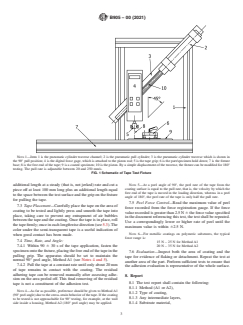
5.1 PeelTestFixture—Thefixtureshallconsistofaframeto
D1732 Practices for Preparation of Magnesium Alloy Sur-
which the specimen is rigidly clamped, and a moveable beam
faces for Painting
by which the tape is pulled off under a constant peel angle of
D2370 Test Method for Tensile Properties of Organic Coat-
90 (MethodA1 and B1) or 180° (MethodA2 and B2).The peel
ings
rate should be controllable between 20 mm/s and 200 mm/s for
D3330/D3330M TestMethodforPeelAdhesionofPressure-
Method A1 and B1 and between 14 mm/s and 140 mm/s for
Sensitive Tape
Methods A2 and B2. A recording force gage is fitted between
D3359 Test Methods for Rating Adhesion by Tape Test
the tape grip and the movable beam (see Fig. 1).
5.2 Pressure-Sensitive Tape—Unless otherwise specified in
3. Summary of Test Method
the document referencing this test, the tape shall be 25 mm
3.1 Pressure-sensitive tape is adhered to the surface of the
wide,semitransparent,pressure-sensitivetapewithanadhesion
coating and then removed utilizing a motorized mechanical
strength of 43 6 5.6 g/mm or N/100 mm width when tested in
device that peels the tape at a constantly maintained angle and
accordance with D3330/D3330M. The adhesion shall not
controlled rate of peel.Adigital recording force gage is used to
change by more than + 6.5 % of its mean value within 12
record the maximum peel force.
months.Thebackingofthetapemayconsistoffiber-reinforced
cellulose acetate, unplasticized poly (vinyl chloride), or poly-
NOTE 1—All due care must be taken to ensure that test specimens are
ester film. When results obtained in different laboratories do
handled and stored such that they are not subjected to conditions that will
notagreeitisrecommendedthatthetestberepeatedusingtape
cause deleterious effects. These conditions include but are not limited to
handling without the use of gloves, storing in areas that accumulate dust,
from the same batch.
areas of high humidity or where the sample may be subjected to fumes or
5.3 Roller—The roller, which is hand operated, consists of
vapors that might condense on the sample.
a steel roller 85 6 2.5 mm in diameter and 45 6 1.5 mm in
3.2 Methods A1 and A2:
width, covered with rubber approximately 6 mm in thickness,
3.2.1 In these methods, which are nondestructive, the mea-
having a Shore scale A durometer hardness of 80 6 5. The
surement area used is the unbroken coating surface with peel
surfaceoftherollershallbeatruecylindervoidofanyconcave
angles of 90 and 180° respectively.
orconvexdeviations.Themassoftherollershallbe2040 645
3.2.2 Adhesion is assessed in terms of “passed,” if the
g.
coating does not detach, or “failed,” if the coating detaches
NOTE 2—A standardized roller is used in place of the pencil eraser of
within the specified range of peel forces as recorded during the
Test Methods D3359 because of the variety of rubber and abrasives
test.
formulations used to make pencil erasers.Afurther consideration was the
extended range of localized pressures that could be exerted by the pencil
3.3 Methods B1 and B2:
and eraser.
3.3.1 In these methods, which are destructive, the measure-
ment area used is a broken coating surface created by scoring
TEST METHOD A
alatticepatternthroughthecoatingtothesubstrateandpeeling
NONDESTRUCTIVE, PARTS TAPE TEST
at angles of 90 and 180°, respectively.
3.3.2 Adhesion is assessed qualitatively on the 0 to 5 scale.
6. Test Specimen
6.1 Parts—This test normally is performed on parts. Any
4. Significance and Use
requirements for test specimens will be found in the document
4.1 If a coating is to fulfill its function of protecting or specifying their use.
imparting unique properties to the surface of a substrate, it
NOTE 3—When specified by the document referencing this test, the
must adhere to the substrate for the expected service life.
coated parts shall be subjected to a preliminary exposure, such as water
Because surface preparation (or lack of it) has a drastic effect immersion, salt spray, or humidity, before conducting the tape test.
on adhesion of coatings, a test method for evaluating adhesion
7. Procedure
to different surface treatments or of different coatings to the
7.1 Test Area—Select a flat area, on a significant surface,
same treatment is of considerable use to the industry.
free of blemishes and minor surface imperfections. Ensure that
4.2 The limitations of all adhesion methods, and the specific
the surface is clean and dry. Extremes in temperature or
limitation of this test method to lower levels of adhesion (see
relative humidity may affect the adhesion of the tape or the
1.3) should be recognized before using it. These test methods
coating.
are mechanized adaptations of Test Methods D3359; therefore,
7.2 Tape Section—Remove two complete laps of the
the intra- and interlaboratory precision of these test methods
pressure-sensitive tape from the roll and discard. Remove an
are similar to Test Methods D3359 and to other widely-
accepted tests for coated substrates, for example, Test Method
The sole source of supply of the apparatus known to the committee at this time
D2370, but this is partly the result of it being insensitive to all
is Pressure-Sensitive Tape Council (PSTC), 104 Wilmot Rd., Suite 201, Deerfield,
but large differences in adhesion. The pass-fail scale of 0 to 5
IL 60015. If you are aware of alternative suppliers, please provide this information
for Method B1 and B2 was selected deliberately to avoid a
to ASTM International Headquarters. Your comments will receive careful consid-
false impression of being sensitive. eration at a meeting of the responsible technical committee, which you may attend.
B905 − 00 (2021)
NOTE 1—Item 1 is the pneumatic cylinder traverse channel; 2 is the pneumatic pull cylinder; 3 is the pneumatic cylinder traverse which is shown in
the 90° pull position; 4 is the digital force gage, which is attached to the piston rod; 5 is the tape grip; 6 is the part/specimen hold down; 7 is the fixture
base; 8 is the free end of the tape; 9 is a coated specimen; 10 is the piston. By a simple displacement of the traverse, the fixture can be modified for 180°
testing. The pull rate is adjustable between 20 and 250 mm/s.
FIG. 1 Schematic of Tape Test Fixture
NOTE 5—At a peel angle of 90°, the peel rate of the tape from the
additional length at a steady (t
...