

ASTM F969-11(2016)
(Practice)Standard Practice for Construction of Chain-Link Tennis Court Fence
General Information
- Abstract
SIGNIFICANCE AND USE
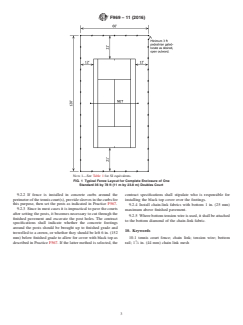
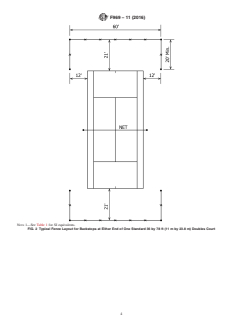
5.1 The intended use of this practice is for 10- or 12-ft (3050 or 3660 mm) high chain-link fencing as complete enclosures around single or multiple tennis courts, or as backstops at either end of tennis courts.
5.2 This practice is not intended for applications where fencing higher than 12 ft (3660 mm) is desired for a special application.
5.3 Caution Regarding Windscreens—If wind screens are to be installed at the time of fence erection or at a later time, it is advisable to use stronger framework and parts and closer spacing of posts or back bracing depending upon the type of screening material to be used, area of fence to be covered, and local wind conditions. The Chain Link Fence Manufacturers Institute’s (CLFMI), Guide WLG 2445, provides the designer with the process to select the post size and post spacing.
SCOPE
1.1 This practice covers fencing around tennis courts, built from various types of chain-link fabric and framework materials, and installation practices for same.
1.2 The values stated in inch-pound units are to be regarded as standard. The values given in parentheses are mathematical conversions to SI units that are provided for information only and are not considered standard.
1.3 This standard does not purport to address all of the safety concerns, if any, associated with its use. It is the responsibility of the user of this standard to establish appropriate safety and health practices and determine the applicability of regulatory limitations prior to use.
- Status
- Published
- Publication Date
- 31-May-2016
- Technical Committee
- F14 - Fences
- Drafting Committee
- F14.10 - Specific Applications and Other Fence Systems and Components
Overview
ASTM F969-11(2016): Standard Practice for Construction of Chain-Link Tennis Court Fence provides detailed guidance on the design, materials, and installation of chain-link fencing for tennis courts. Developed by ASTM International, this standard is intended to ensure that tennis court enclosures and backstops made from chain-link fence systems meet high standards of performance, durability, and safety.
The standard primarily addresses fencing 10 or 12 feet (3050 or 3660 mm) in height, suitable for enclosing single or multiple tennis courts or for use as backstops at either court end. ASTM F969 is recognized internationally and addresses key considerations such as material types, installation practices, and ordering information for tennis court fencing projects.
Key Topics
- Types of Chain-Link Fence Fabric: The standard identifies four types of chain-link fencing (Types I-IV), differentiated by coatings including aluminum, zinc, zinc-5% aluminum-mischmetal alloy, and polymer coatings.
- Fencing Heights and Applications: Guidance is specific to fences 10 or 12 feet high, the standard heights used for tennis court perimeters and backstops.
- Material Specifications: References to other ASTM standards ensure compatibility for materials such as fence fabric, posts, rails, tension wire, fittings, and gates.
- Installation Requirements: Instructions cover layout, positioning, and mounting, including post placement, horizontal rails, bottom tension wire, and gate installation.
- Customization and Ordering: The standard emphasizes the importance of clear purchase orders detailing measurements, materials, coating types and colors, rail quantities, and other project-specific requirements.
- Considerations for Windscreens: Specific recommendations are provided for projects incorporating wind screens, which may require enhanced framework strength and closer post spacing based on wind loads.
- Safety and Compliance: Users are reminded to observe appropriate safety and local regulatory practices not fully covered within the standard.
Applications
ASTM F969 is essential for professionals involved in:
- Tennis Court Construction: Ensures reliable, consistent fencing for recreational, commercial, or public tennis facilities.
- Sport Facility Design: Guides architects, engineers, and contractors in specifying chain-link fence systems compliant with recognized industry standards.
- Fence Manufacturing and Installation: Offers manufacturers and installers precise requirements for fabric types, mesh size, coatings, framework, and hardware, ensuring compatibility with standard tennis court dimensions.
- Project Procurement and Specification: Helps facility owners, municipalities, and purchasing agents define chain-link tennis court fence requirements in tenders, contracts, and RFPs with confidence in regulatory compliance.
- Maintenance and Upgrades: Serves as a baseline reference when repairing or upgrading existing tennis court fences to meet current standards.
Related Standards
Several ASTM and industry standards are referenced to support comprehensive tennis court fence construction:
- ASTM A392 - Zinc-Coated Steel Chain-Link Fence Fabric
- ASTM A491 - Aluminum-Coated Steel Chain-Link Fence Fabric
- ASTM F668 - PVC, polyolefin, and other polymer-coated steel chain-link fence fabric
- ASTM F626 - Fence Fittings
- ASTM F567 - Installation of Chain-Link Fence
- ASTM F900 - Industrial and Commercial Steel Swing Gates
- ASTM F1043 / F1083 - Steel Fence Framework and Pipe
- Chain Link Fence Manufacturers Institute Guide (WLG 2445) - Wind load considerations and guidance for post size and spacing.
- ASTM F552 - Terminology Relating to Chain Link Fencing
- ASTM F934 - Colors for Polymer-Coated Chain-Link Fence Materials
Practical Value
By adhering to ASTM F969, industry professionals ensure the construction of safe, durable, and high-performing chain-link tennis court enclosures. This results in:
- Standardized Quality: Uniform practices and material specifications minimize performance variability across projects.
- Enhanced Safety and Performance: Proper fencing helps contain play, improves site security, and withstands environmental and mechanical stresses.
- Regulatory Acceptance: Compliance with ASTM standards is often required in public and private contracts, reducing legal and liability risks.
- Longevity and Maintenance: Using prescribed materials and installation techniques extends the service life of tennis court fences, reducing long-term costs.
For anyone involved in tennis court development, following ASTM F969 is a key step toward project success and long-term facility value.
Relations
- Effective Date
- 01-Jun-2016
- Effective Date
- 01-Jun-2017
- Effective Date
- 01-Feb-2017
- Effective Date
- 01-Jun-2016
- Effective Date
- 01-Feb-2016
- Effective Date
- 01-Jan-2016
- Effective Date
- 01-Mar-2015
- Effective Date
- 01-Oct-2014
- Effective Date
- 15-Sep-2014
- Effective Date
- 01-Aug-2014
- Effective Date
- 01-Apr-2014
- Effective Date
- 01-Apr-2014
- Effective Date
- 15-Nov-2013
- Effective Date
- 01-Nov-2013
- Effective Date
- 01-Mar-2013
Frequently Asked Questions
ASTM F969-11(2016) is a standard published by ASTM International. Its full title is "Standard Practice for Construction of Chain-Link Tennis Court Fence". This standard covers: SIGNIFICANCE AND USE 5.1 The intended use of this practice is for 10- or 12-ft (3050 or 3660 mm) high chain-link fencing as complete enclosures around single or multiple tennis courts, or as backstops at either end of tennis courts. 5.2 This practice is not intended for applications where fencing higher than 12 ft (3660 mm) is desired for a special application. 5.3 Caution Regarding Windscreens—If wind screens are to be installed at the time of fence erection or at a later time, it is advisable to use stronger framework and parts and closer spacing of posts or back bracing depending upon the type of screening material to be used, area of fence to be covered, and local wind conditions. The Chain Link Fence Manufacturers Institute’s (CLFMI), Guide WLG 2445, provides the designer with the process to select the post size and post spacing. SCOPE 1.1 This practice covers fencing around tennis courts, built from various types of chain-link fabric and framework materials, and installation practices for same. 1.2 The values stated in inch-pound units are to be regarded as standard. The values given in parentheses are mathematical conversions to SI units that are provided for information only and are not considered standard. 1.3 This standard does not purport to address all of the safety concerns, if any, associated with its use. It is the responsibility of the user of this standard to establish appropriate safety and health practices and determine the applicability of regulatory limitations prior to use.
SIGNIFICANCE AND USE 5.1 The intended use of this practice is for 10- or 12-ft (3050 or 3660 mm) high chain-link fencing as complete enclosures around single or multiple tennis courts, or as backstops at either end of tennis courts. 5.2 This practice is not intended for applications where fencing higher than 12 ft (3660 mm) is desired for a special application. 5.3 Caution Regarding Windscreens—If wind screens are to be installed at the time of fence erection or at a later time, it is advisable to use stronger framework and parts and closer spacing of posts or back bracing depending upon the type of screening material to be used, area of fence to be covered, and local wind conditions. The Chain Link Fence Manufacturers Institute’s (CLFMI), Guide WLG 2445, provides the designer with the process to select the post size and post spacing. SCOPE 1.1 This practice covers fencing around tennis courts, built from various types of chain-link fabric and framework materials, and installation practices for same. 1.2 The values stated in inch-pound units are to be regarded as standard. The values given in parentheses are mathematical conversions to SI units that are provided for information only and are not considered standard. 1.3 This standard does not purport to address all of the safety concerns, if any, associated with its use. It is the responsibility of the user of this standard to establish appropriate safety and health practices and determine the applicability of regulatory limitations prior to use.
ASTM F969-11(2016) is classified under the following ICS (International Classification for Standards) categories: 97.220.10 - Sports facilities. The ICS classification helps identify the subject area and facilitates finding related standards.
ASTM F969-11(2016) has the following relationships with other standards: It is inter standard links to ASTM F969-11, ASTM F1043-17a, ASTM F1043-17, ASTM F1043-16a, ASTM F1043-16, ASTM F1083-16, ASTM F1345-10a(2015), ASTM F1043-14, ASTM F552-14, ASTM F567-14a, ASTM F567-14, ASTM F626-14, ASTM F1083-13, ASTM F1043-13, ASTM F626-08(2013). Understanding these relationships helps ensure you are using the most current and applicable version of the standard.
ASTM F969-11(2016) is available in PDF format for immediate download after purchase. The document can be added to your cart and obtained through the secure checkout process. Digital delivery ensures instant access to the complete standard document.
Standards Content (Sample)
This international standard was developed in accordance with internationally recognized principles on standardization established in the Decision on Principles for the
Development of International Standards, Guides and Recommendations issued by the World Trade Organization Technical Barriers to Trade (TBT) Committee.
Designation: F969 − 11 (Reapproved 2016)
Standard Practice for
Construction of Chain-Link Tennis Court Fence
ThisstandardisissuedunderthefixeddesignationF969;thenumberimmediatelyfollowingthedesignationindicatestheyearoforiginal
adoption or, in the case of revision, the year of last revision.Anumber in parentheses indicates the year of last reapproval.Asuperscript
epsilon (´) indicates an editorial change since the last revision or reapproval.
1. Scope Coated (Galvanized) Welded, for Fence Structures
F1345 Specification for Zinc-5 % Aluminum-Mischmetal
1.1 This practice covers fencing around tennis courts, built
Alloy-Coated Steel Chain-Link Fence Fabric
from various types of chain-link fabric and framework
F1664 Specification for Poly(Vinyl Chloride) (PVC) and
materials, and installation practices for same.
Other Conforming Organic Polymer-Coated SteelTension
1.2 The values stated in inch-pound units are to be regarded
Wire Used with Chain-Link Fence
as standard. The values given in parentheses are mathematical
2.2 Chain Link Fence Manufacturers Institute:
conversions to SI units that are provided for information only
WLG 2445 Chain Link Fence Wind Load Guide for the
and are not considered standard.
Selection of Line Post and Line Post Spacing
1.3 This standard does not purport to address all of the
safety concerns, if any, associated with its use. It is the
3. Terminology
responsibility of the user of this standard to establish appro-
3.1 Definitions—See Definitions F552 for definitions of
priate safety and health practices and determine the applica-
terms used in this practice.
bility of regulatory limitations prior to use.
4. Summary of Practice
2. Referenced Documents
4.1 This practice is intended primarily to guide those
2.1 ASTM Standards:
responsible for or concerned with the design and installation of
A392 Specification for Zinc-Coated Steel Chain-Link Fence
chain-link fencing around tennis courts.
Fabric
A491 Specification for Aluminum-Coated Steel Chain-Link
4.2 This practice does not intend to preclude any practice
Fence Fabric
that has proven equal to or given better performance under
A824 Specification for Metallic-Coated Steel Marcelled
varying conditions such as location, weather, intended use, etc.
Tension Wire for Use With Chain Link Fence
F552 Terminology Relating to Chain Link Fencing
5. Significance and Use
F567 Practice for Installation of Chain-Link Fence
5.1 Theintendeduseofthispracticeisfor10-or12-ft(3050
F626 Specification for Fence Fittings
or 3660 mm) high chain-link fencing as complete enclosures
F668 Specification for Polyvinyl Chloride (PVC), Polyolefin
around single or multiple tennis courts, or as backstops at
and Other Polymer-Coated Steel Chain Link Fence Fabric
either end of tennis courts.
F900 Specification for Industrial and Commercial Steel
5.2 This practice is not intended for applications where
Swing Gates
fencing higher than 12 ft (3660 mm) is desired for a special
F934 Specification for Colors for Polymer-Coated Chain
application.
Link Fence Materials
F1043 Specification for Strength and Protective Coatings on
5.3 Caution Regarding Windscreens—Ifwindscreensareto
Steel Industrial Fence Framework
be installed at the time of fence erection or at a later time, it is
F1083 Specification for Pipe, Steel, Hot-Dipped Zinc-
advisable to use stronger framework and parts and closer
spacing of posts or back bracing depending upon the type of
screening material to be used, area of fence to be covered, and
This practice is under the jurisdiction ofASTM Committee F14 on Fences and
local wind conditions. The Chain Link Fence Manufacturers
is the direct responsibility of Subcommittee F14.10 on Specific Applications.
Institute’s (CLFMI), Guide WLG 2445, provides the designer
Current edition approved June 1, 2016. Published June 2016. Originally
with the process to select the post size and post spacing.
approved in 1986. Last previous edition approved in 2011 as F969 - 11. DOI:
10.1520/F0969-11R16.
For referenced ASTM standards, visit the ASTM website, www.astm.org, or
contact ASTM Customer Service at service@astm.org. For Annual Book of ASTM
Standards volume information, refer to the standard’s Document Summary page on AvailablefromChainLinkFenceManufacturersInstitute,10015OldColumbia
the ASTM website. Road, Suite B-215, Columbia, MD 21046, http://www.chainlinkinfo.org.
Copyright © ASTM International, 100 Barr Harbor Drive, PO Box C700, West Conshohocken, PA 19428-2959. United States
F969 − 11 (2016)
6. Classification 8.1.3 Size of wire shall be 0.120 in. (3.05 mm) 11 gauge or
0.148 in. (3.76 mm) 9 gauge. If polymer-coated Type IV fabric
6.1 The four types of chain-link fencing described in this
is selected, the wire size gauge is the gauge of the metallic-
practice are classified as follows:
coated core wire.
6.1.1 Type I—Built with aluminum-coated steel chain-link
8.1.4 Size of fabric mesh shall be 1 ⁄4 in. (44 mm).
fence fabric as specified in Specification A491.
8.1.5 Height of fabric shall be 10 or 12 ft (3050 or 3660
6.1.2 Type II—Built with zinc-coated steel chain-link fence
mm), as selected.
fabric as specified in Specification A392, Class 1 or Class 2
8.1.6 Fabric selvage shall be knuckled top and bottom.
coating, as selected.
6.1.3 Type III—Built with zinc-5% aluminum-mischmetal
8.2 Posts:
alloy-coated steel chain-link fence fabric as specified in Speci-
8.2.1 Posts shall be as selected from Specifications F1043
fication F1345, in a choice of Class 1 or Class 2 coating, as
and F1083. If polymer-coated, specify type of coating and
selected.
color.
6.1.4 Type IV—Built with polymer-coated steel chain-link
8.2.2 The posts shall not be splice-welded.
fence fabric as specified in Specification F668, in a choice of
8.3 Horizontal Rails:
Class 1, Class 2a, or Class 2b coating, as selected.
8.3.1 Horizontal rails shall be as selected from Specifica-
tions F1043 and F1083. If polymer-coated, specify type of
7. Ordering Information
coating and color.
7.1 Purchase orders, construction specifications, or detailed
8.3.2 All fences shall have a top rail. Fences 12 ft (3660
drawings should include the following information:
mm) in height shall have a continuous middle rail. Additional
7.1.1 Quantity or total measurements in lineal feet of fence
rails at mid-points or at the bottom of the fence may be
and gates.
specified.
7.1.2 Type of fence fabric and ga
...