

ASTM F2000-19
(Specification)Standard Safety Performance Specification for Fences for Baseball and Softball Fields
General Information
- Abstract
SCOPE
1.1 This specification provides recommended minimum requirements for various types of fences used in softball and baseball ballfields and other sports facilities, and practices for installation.
1.2 The values stated in inch-pound units are to be regarded as standard. The values given in parentheses are mathematical conversions to SI units that are provided for information only and are not considered standard.
1.3 This standard does not purport to address all of the safety concerns, if any, associated with its use. It is the responsibility of the user of this standard to establish appropriate safety, health, and environmental practices and determine the applicability of regulatory limitations prior to use.
1.4 This international standard was developed in accordance with internationally recognized principles on standardization established in the Decision on Principles for the Development of International Standards, Guides and Recommendations issued by the World Trade Organization Technical Barriers to Trade (TBT) Committee.
- Status
- Published
- Publication Date
- 14-Apr-2019
- Technical Committee
- F14 - Fences
- Drafting Committee
- F14.10 - Specific Applications and Other Fence Systems and Components
Buy Documents
ASTM F2000-19 - Standard Safety Performance Specification for Fences for Baseball and Softball Fields
REDLINE ASTM F2000-19 - Standard Safety Performance Specification for Fences for Baseball and Softball Fields
Overview
ASTM F2000-19: Standard Safety Performance Specification for Fences for Baseball and Softball Fields provides minimum safety and performance requirements for fences used in baseball and softball facilities, including specifications for dimensions, materials, installation, and maintenance practices. Developed by ASTM Committee F14, this international standard is designed to enhance player and spectator safety while helping facility managers, municipalities, and contractors meet compliance needs.
This specification applies to various fence types around baseball and softball fields, such as outfield fences, foul line fences, backstops, spectator protective barriers, and player bench enclosures. While offering recommended best practices, it does not supersede local building codes but aims to serve as a standard reference for construction and installation.
Key Topics
- Fence Types and Locations: Addresses requirements for permanent and portable outfield fences, foul line fencing, backstops, spectator areas, and player bench protection.
- Safety and Injury Prevention: Focuses on structural safety to reduce injury risks from collisions, climbing, and impact with fence components.
- Minimum Height and Clearance: Specifies standard fence heights (minimum 8 ft/2.44 m), ground clearances, and maximum panel openings to prevent foot entrapment and unauthorized access.
- Material and Fabric Selection: Recommends suitable materials (chain-link, synthetic mesh, wood) and outlines mesh size and edge safety to reduce footholds and injury risks.
- Installation Practices: Provides guidelines for proper positioning, anchoring, and stability of fence structures, including requirements for access gates and emergency egress.
- Grounding: Calls for electrical safety measures in accordance with NFPA 70 and ANSI/IEEE C2 to prevent electrical hazards from metal fencing.
- Inspection and Certification: Outlines requirements for testing, inspection, marking, and certification of fence components prior to installation and use.
Applications
ASTM F2000-19 is widely used for:
- New Baseball and Softball Facility Construction: Ensuring fences meet essential safety and performance standards for youth, amateur, and professional sports fields.
- Upgrading Existing Fields: Supporting compliance with current fence safety requirements during renovation or maintenance projects.
- Spectator and Player Protection: Defining fence arrangements to protect both athletes and spectators from balls, bats, and field intrusion.
- Local and State Regulation Support: Providing a recognized technical basis for municipal codes, permitting, and facility inspections.
- Sports Associations and Organizations: Acting as a reference for field classification systems, risk mitigation, and organizational policies.
Organizations such as parks departments, school districts, private clubs, and contractors benefit from implementing ASTM F2000-19 to ensure consistent safety standards, limit liability, and promote a safe sporting environment.
Related Standards
ASTM F2000-19 references and aligns with several related standards to ensure comprehensive coverage:
- ASTM A392 - Zinc-Coated Steel Chain-Link Fence Fabric
- ASTM A491 - Aluminum-Coated Steel Chain-Link Fence Fabric
- ASTM F552 - Terminology Relating to Chain Link Fencing
- ASTM F626 - Fence Fittings
- ASTM F668 - Polymer-Coated Steel Chain Link Fence Fabric
- ASTM F1043 & F1083 - Steel Fence Framework and Pipe Specifications
- NFPA 70 - National Electric Code (for grounding)
- ANSI/IEEE C2 - National Electric Safety Code
By utilizing ASTM F2000-19 together with these referenced documents, stakeholders can achieve robust and effective solutions for baseball field fencing, softball field fencing, and general sports facility perimeter protection that meets both safety and regulatory requirements.
Relations
- Effective Date
- 15-Apr-2019
- Effective Date
- 01-Nov-2019
- Effective Date
- 01-Jun-2017
- Effective Date
- 01-Feb-2017
- Effective Date
- 01-Jun-2016
- Effective Date
- 01-Feb-2016
- Effective Date
- 01-Jan-2016
- Effective Date
- 01-Mar-2015
- Effective Date
- 01-Nov-2014
- Effective Date
- 01-Oct-2014
- Effective Date
- 15-Sep-2014
- Effective Date
- 15-Nov-2013
- Effective Date
- 01-Nov-2013
- Effective Date
- 01-Mar-2013
- Effective Date
- 15-Nov-2012
Buy Documents
ASTM F2000-19 - Standard Safety Performance Specification for Fences for Baseball and Softball Fields
REDLINE ASTM F2000-19 - Standard Safety Performance Specification for Fences for Baseball and Softball Fields
Frequently Asked Questions
ASTM F2000-19 is a technical specification published by ASTM International. Its full title is "Standard Safety Performance Specification for Fences for Baseball and Softball Fields". This standard covers: SCOPE 1.1 This specification provides recommended minimum requirements for various types of fences used in softball and baseball ballfields and other sports facilities, and practices for installation. 1.2 The values stated in inch-pound units are to be regarded as standard. The values given in parentheses are mathematical conversions to SI units that are provided for information only and are not considered standard. 1.3 This standard does not purport to address all of the safety concerns, if any, associated with its use. It is the responsibility of the user of this standard to establish appropriate safety, health, and environmental practices and determine the applicability of regulatory limitations prior to use. 1.4 This international standard was developed in accordance with internationally recognized principles on standardization established in the Decision on Principles for the Development of International Standards, Guides and Recommendations issued by the World Trade Organization Technical Barriers to Trade (TBT) Committee.
SCOPE 1.1 This specification provides recommended minimum requirements for various types of fences used in softball and baseball ballfields and other sports facilities, and practices for installation. 1.2 The values stated in inch-pound units are to be regarded as standard. The values given in parentheses are mathematical conversions to SI units that are provided for information only and are not considered standard. 1.3 This standard does not purport to address all of the safety concerns, if any, associated with its use. It is the responsibility of the user of this standard to establish appropriate safety, health, and environmental practices and determine the applicability of regulatory limitations prior to use. 1.4 This international standard was developed in accordance with internationally recognized principles on standardization established in the Decision on Principles for the Development of International Standards, Guides and Recommendations issued by the World Trade Organization Technical Barriers to Trade (TBT) Committee.
ASTM F2000-19 is classified under the following ICS (International Classification for Standards) categories: 97.220.10 - Sports facilities. The ICS classification helps identify the subject area and facilitates finding related standards.
ASTM F2000-19 has the following relationships with other standards: It is inter standard links to ASTM F2000-10, ASTM A700-14(2019), ASTM F1043-17a, ASTM F1043-17, ASTM F1043-16a, ASTM F1043-16, ASTM F1083-16, ASTM F1345-10a(2015), ASTM A700-14, ASTM F1043-14, ASTM F552-14, ASTM F1083-13, ASTM F1043-13, ASTM F552-02(2013), ASTM F1043-12. Understanding these relationships helps ensure you are using the most current and applicable version of the standard.
ASTM F2000-19 is available in PDF format for immediate download after purchase. The document can be added to your cart and obtained through the secure checkout process. Digital delivery ensures instant access to the complete standard document.
Standards Content (Sample)
This international standard was developed in accordance with internationally recognized principles on standardization established in the Decision on Principles for the
Development of International Standards, Guides and Recommendations issued by the World Trade Organization Technical Barriers to Trade (TBT) Committee.
Designation: F2000 −19
Standard Safety Performance Specification for
Fences for Baseball and Softball Fields
This standard is issued under the fixed designation F2000; the number immediately following the designation indicates the year of
original adoption or, in the case of revision, the year of last revision. A number in parentheses indicates the year of last reapproval. A
superscript epsilon (´) indicates an editorial change since the last revision or reapproval.
1. Scope Steel Industrial Fence Framework
F1083 Specification for Pipe, Steel, Hot-Dipped Zinc-
1.1 This specification provides recommended minimum re-
Coated (Galvanized) Welded, for Fence Structures
quirements for various types of fences used in softball and
F1345 Specification for Zinc-5 % Aluminum-Mischmetal
baseball ballfields and other sports facilities, and practices for
Alloy-Coated Steel Chain-Link Fence Fabric
installation.
2.2 BOCA Document:
1.2 The values stated in inch-pound units are to be regarded
BOCA National Building Code/1993 – 12th Edition
as standard. The values given in parentheses are mathematical
2.3 NFPA Document:
conversions to SI units that are provided for information only
NFPA 70 National Electric Code (NEC)
and are not considered standard.
2.4 ANSI/IEEE Document:
1.3 This standard does not purport to address all of the
ANSI/IEEE C2 National Electric Safety Code
safety concerns, if any, associated with its use. It is the
3. Terminology
responsibility of the user of this standard to establish appro-
3.1 See Terminology F552 for definitions of terms relating
priate safety, health, and environmental practices and deter-
mine the applicability of regulatory limitations prior to use. to chain-link fencing.
1.4 This international standard was developed in accor-
3.2 Definitions of Terms Specific to This Standard:
dance with internationally recognized principles on standard-
3.2.1 fence, n—a type of barrier that surrounds and deters
ization established in the Decision on Principles for the
balls, bats, and passage to or from the playing area.
Development of International Standards, Guides and Recom-
3.2.2 field, n—the outdoor area that has been either
mendations issued by the World Trade Organization Technical
designated, designed, constructed, or otherwise used for soft-
Barriers to Trade (TBT) Committee.
ball or baseball, or both.
3.2.3 grade, n—the finished elevation at any specified point
2. Referenced Documents
of the ground or pavement outside or inside the playing area.
2.1 ASTM Standards:
3.2.4 outdoor, adj—site located outside of a completely
A392 Specification for Zinc-Coated Steel Chain-Link Fence
enclosed building or other structure.
Fabric
A491 Specification for Aluminum-Coated Steel Chain-Link
4. Summary of Specification
Fence Fabric
4.1 This standard is based in part upon recommendations of
A700 Guide for Packaging, Marking, and Loading Methods
the task groups concerned with baseball and softball ofASTM
for Steel Products for Shipment
Committee F08.
F552 Terminology Relating to Chain Link Fencing
F668 Specification for Polyvinyl Chloride (PVC), Polyolefin
4.2 This standard is directed to outfield fences, side and foul
and Other Polymer-Coated Steel Chain Link Fence Fabric line fences, backstops, on-grade players benches, and below
F1043 Specification for Strength and Protective Coatings on
grade players dugouts.
5. Significance and Use
5.1 Thisstandardsetsforthminimumstandardrequirements
This specification is under the jurisdiction ofASTM Committee F14 on Fences
and is the direct responsibility of Subcommittee F14.10 on Specific Applications
for use in local codes and ordinances relating to baseball and
and Other Fence Systems and Components.
softball fencing.
Current edition approved April 15, 2019. Published June 2019. Originally
approved in 2000. Last previous edition approved in 2010 as F2000 – 10. DOI:
10.1520/F2000-19. Available from the International Code Council (ICC), https://www.iccsafe.org.
2 4
For referenced ASTM standards, visit the ASTM website, www.astm.org, or Available from National Fire Protection Association (NFPA), 1 Batterymarch
contact ASTM Customer Service at service@astm.org. For Annual Book of ASTM Park, Quincy, MA 02169-7471, http://www.nfpa.org.
Standards volume information, refer to the standard’s Document Summary page on Available from American National Standards Institute (ANSI), 25 W. 43rd St.,
the ASTM website. 4th Floor, New York, NY 10036, http://www.ansi.org.
Copyright © ASTM International, 100 Barr Harbor Drive, PO Box C700, West Conshohocken, PA 19428-2959. United States
F2000 − 19
5.2 This standard does not have the effect of law, nor is it or horizontal members in any area between posts exceeds
intended to supersede local codes and ordinances of a more 1 ⁄4 in. (4.44 cm), in order to prevent climbing into the ball-
restrictive nature. field.
6.1.6 Fabric or Mesh—Mesh opening for chain-link and
5.3 Studies, as listed in Annex A1, have been referenced as
other fence fabrics shall be a minimum of 2 in. (5 mm) mesh,
the basis for certain recommendations in this standard and will
9 gauge.All chain-link fabric shall have a knuckle and knuckle
assist those who intend to provide protection against injuries or
selvage and shall be selected from chain-link fabric in accor-
fatalities associated with anticipated thrown or batted balls and
dance with Specifications A392, A491, F668,or F1345. Other
bats as well as passage to or from a baseball or softball field.
materials shall have blunt edges.
This would include, but not be limited to, state and local
governments, model code organizations, building code groups, 6.2 Portable Outfield Fence:
and consumers. It is understood that the format will vary
6.2.1 Portable outfield, and often sideline, fencing is gener-
depending upon the specific use and local conditions.
ally used when it is necessary to reconfigure the playing field
boundary for games in which the classification will change or
5.4 Articles and studies have noted that fencing for baseball
when the field is to have multiple uses. The potential for injury
and softball sports, or both, should exist for baseball and
caused by an outfielder colliding with a fence that does not
softball sports outfields, backstops, sidelines, players on-grade
meet resiliency, break away, or fall-down requirements is
benches, below-grade dugouts, and spectator seating.
significant. The added criteria that must be considered is the
stability of the cross or horizontal pieces, supports, the panel
6. Dimensions and Materials
fabric opening, the vertical pieces and their give away, and the
height. Portable fence systems made of specially formulated
6.1 Permanent Outfield Fence:
polymers in approximate 10 ft (3.05 m) lengths with break-
6.1.1 Height—The top of the fence shall be a minimum of
apart connections and stable support should allow panels to
96 in. (2.4 m) above grade measured on the side of the fence
release and fall down in sections when impacted. The collaps-
that faces away from the ballfield (see 3.2.3 for the definition
ibility feature should prevent cartwheeling over the fence and
of grade specific to this standard).The height is to be such that
allow the outfielder to be lowered to the ground in a fall. The
players in the outfield can safely attempt to catch a fly ball
downed panel should quickly and easily return to its original
without impaction on the kidneys, back, or head. However, in
position and be snapped into place.
circumstanceswhereitisnecessarytoprotectpeopleorobjects
outside the fences, the height should be increased accordingly.
6.3 Wood Outfield Fence:
Top rail padding systems may also be used. A mid rail is not
6.3.1 Height—The top of the fence shall conform to height
needed, in accordance with Specification F668.
for other fence types.
6.1.2 Ground Clearance—The maximum vertical clearance
6.3.2 Ground Clearance—The clearances shall conform to
between grade and the bottom of the fence shall be no more
prior appropriate sections to eliminate foot entrapment.
than a 1 in. (25.4 mm) reveal or space, measured on the side of
6.3.3 Panels—The panels should conform to prior appropri-
the fence that faces the ballfield, to avoid entrapment of feet.
ate sections with the flush side inside the playing area and shall
6.1.3 Panels—Solid barriers and safety padding that does
be covered with a wall padding.
not have openings, such as plastic, plywood, or canvas, shall
6.4 Foul Line Fencing:
not contain indentations or protrusions, except for normal
6.4.1 Height—The top of the fence shall be a minimum of
construction tolerances and joints. Such indentations shall not
96 in. (8 ft) (2.44 m) above grade measured at the side of the
be deeper than 0.375 in. (9.5 mm) and should be flush facing
fencefromtheballfieldwhereanysidelineobstructionsexistor
the ballfield.
where objects such as other activity areas, parking lots, and so
6.1.4 Horizontal and Vertical Members—Where the fence is
forth have to be protected.
composed of horizontal and vertical members, the structural
6.4.2 Ground Clearance—The clearance shall conform to
members shall be located on the side opposite of the play
prior appropriate sections to eliminate foot entrapment.
environment to prevent encountering the member. The spacing
6.4.3 Panels—The panels should conform to prior appropri-
between the vertical or horizontal members shall not exceed
ate sections.
1 ⁄4 in. (4.44 cm). If of a lattice design, the members shall be
6.4.4 Horizontal and Vertical Members—Thehorizontaland
diagonal.
vertical members shall conform to prior appropriate sections.
6.1.5 Diagonal Members:
6.4.5 Diagonal Members—The diagonal members shall
6.1.5.1 Where the fence is composed of diagonal or other
conform to prior appropriate sections.
angular positioned members, such as in a lattice fence, any
6.4.6 Fabric or Mesh—The fabric or mesh shall conform to
opening created by the diagonal members shall be a maximum
prior appropriate sections.
of1 ⁄4in.(4.44cm)measuredinitslargestdirection,toprevent
toe holds. Such members should be on the side away from the
6.5 Spectator Protective Fencing:
ballfield.
6.5.1 Height—The top of the fence shall be a minimum of
6.1.5.2 Diagonal bracing members extending from one cor- 8 ft, 0 in. (2.44 m) above grade or of a greater dimension that
ner to the opposite corner, creating a ladder effect on all styles ensures protection of spectators from a fouled line drive or
of fences and gates, are not permitted where s
...
This document is not an ASTM standard and is intended only to provide the user of an ASTM standard an indication of what changes have been made to the previous version. Because
it may not be technically possible to adequately depict all changes accurately, ASTM recommends that users consult prior editions as appropriate. In all cases only the current version
of the standard as published by ASTM is to be considered the official document.
Designation: F2000 − 10 F2000 − 19
Standard Guide for Safety Performance Specification for
Fences for Baseball and Softball Fields
This standard is issued under the fixed designation F2000; the number immediately following the designation indicates the year of
original adoption or, in the case of revision, the year of last revision. A number in parentheses indicates the year of last reapproval. A
superscript epsilon (´) indicates an editorial change since the last revision or reapproval.
1. Scope
1.1 This guide provides recommended minimum requirements for various types of fences used in softball and baseball ballfields
and other sports facilities, and practices for installation.
1.2 The values stated in inch-pound units are to be regarded as standard. The SI values given in parentheses are for information
only.
1.3 This guide does not purport to address all of the safety concerns, if any, associated with its use. It is the responsibility of
the user of this standard to establish appropriate safety and health practices and determine the applicability of regulatory
limitations prior to use.
2. Referenced Documents
2.1 ASTM Standards:
A392 Specification for Zinc-Coated Steel Chain-Link Fence Fabric
A491 Specification for Aluminum-Coated Steel Chain-Link Fence Fabric
A700 Guide for Packaging, Marking, and Loading Methods for Steel Products for Shipment
F552 Terminology Relating to Chain Link Fencing
F567 Practice for Installation of Chain-Link Fence
F626 Specification for Fence Fittings
F668 Specification for Polyvinyl Chloride (PVC), Polyolefin and Other Polymer-Coated Steel Chain Link Fence Fabric
F1043 Specification for Strength and Protective Coatings on Steel Industrial Fence Framework
F1083 Specification for Pipe, Steel, Hot-Dipped Zinc-Coated (Galvanized) Welded, for Fence Structures
F1183 Specification for Aluminum Alloy Chain Link Fence Fabric
F1345 Specification for Zinc-5 % Aluminum-Mischmetal Alloy-Coated Steel Chain-Link Fence Fabric
F1664 Specification for Poly(Vinyl Chloride) (PVC) and Other Conforming Organic Polymer-Coated Steel Tension Wire Used
with Chain-Link Fence
2.2 CPSC Document:
CPSC Staff Recommendations
2.3 ASA and Other Ball Sports Associations:
Staff Recommendations
2.4 BOCA Document:
BOCA National Building Code/1993 – 12th Edition
2.5 NFPA Documents:
Staff Recommendations
NFPA 70 National Electric Code (NEC)
2.6 ANSI/IEEE Document:
ANSI/IEEE C2 National Electric Safety Code
This guidespecification is under the jurisdiction of ASTM Committee F14 on Fences and is the direct responsibility of Subcommittee F14.10 on Specific Applications
and Other Fence Systems and Components.
Current edition approved Aug. 1, 2010April 15, 2019. Published November 2010June 2019. Originally approved in 2000. Last previous edition approved in 20062010
as F2000 - 06.F2000 – 10. DOI: 10.1520/F2000-10.10.1520/F2000-19.
For referenced ASTM standards, visit the ASTM website, www.astm.org, or contact ASTM Customer Service at service@astm.org. For Annual Book of ASTM Standards
volume information, refer to the standard’s Document Summary page on the ASTM website.
Available from National Fire Protection Association (NFPA), 1 Batterymarch Park, Quincy, MA 02169-7471, http://www.nfpa.org.
Available from American National Standards Institute (ANSI), 25 W. 43rd St., 4th Floor, New York, NY 10036, http://www.ansi.org.
Copyright © ASTM International, 100 Barr Harbor Drive, PO Box C700, West Conshohocken, PA 19428-2959. United States
F2000 − 19
3. Terminology
3.1 See Terminology F552 for definitions of terms relating to chain-link fencing.
3.2 Definitions of Terms Specific to This Standard:
3.2.1 fence, n—a type of barrier that surrounds and deters balls, bats, and passage to or from the playing area.
3.2.2 field, n—the outdoor area that has been either designated, designed, constructed, or otherwise used for softball or baseball,
or both.
3.2.3 grade, n—the finished elevation at any specified point of the ground or pavement outside or inside the playing area.
3.2.4 outdoor, adj—site located outside of a completely enclosed building or other structure.
4. Summary of Guide
4.1 This guide is based in part upon recommendations of the task groups concerned with baseball and softball of ASTM
Committee F08.
4.2 This guide is directed to outfield fences, side and foul line fences, backstops, on-grade players benches and below grade
players dugouts.
5. Significance and Use
5.1 This guide sets forth minimum standard requirements for use in local codes and ordinances relating to baseball and softball
fencing.
5.2 This guide does not have the effect of law, nor is it intended to supersede local codes and ordinances of a more restrictive
nature.
5.3 Studies, as listed in Annex A1, have been referenced as the basis for certain recommendations in this guide and will assist
those who intend to provide protection against injuries or fatalities associated with anticipated thrown or batted balls and bats as
well as passage to or from a baseball or softball field. This would include, but not be limited to, state and local governments, model
code organizations, building code groups, and consumers. It is understood that the format will vary depending upon the specific
use and local conditions.
5.4 Articles and studies have noted that fencing for baseball and softball sports, or both, should exist for baseball and softball
sports outfields, backstops, sidelines, players on-grade benches, below-grade dugouts, and spectator seating.
6. Dimensions and Materials
6.1 Permanent Outfield Fence:
6.1.1 Height—The top of the fence shall be a minimum of 96 in. (2.4 m) above grade measured on the side of the fence that
faces away from the ballfield (see 3.2.3 for the definition of grade specific to this guide). The height is to be such that players in
the outfield can safely attempt to catch a fly ball without impaction on the kidneys, back, or head. However, in circumstances where
it is necessary to protect people or objects outside the fences, the height should be increased accordingly. Top rail padding systems
may also be used. A mid rail is not needed, in accordance with Specification F668.
6.1.2 Ground Clearance—The maximum vertical clearance between grade and the bottom of the fence shall be no more than
a 1 in. (25.4 mm) reveal or space, measured on the side of the fence that faces the ballfield, to avoid entrapment of feet.
6.1.3 Panels—Solid barriers and safety padding that does not have openings, such as plastic, plywood, or canvas, shall not
contain indentations or protrusions, except for normal construction tolerances and joints. Such indentations shall not be deeper than
0.375 in. (9.5 mm) and should be flush facing the ballfield.
6.1.4 Horizontal and Vertical Members—Where the fence is composed of horizontal and vertical members, the structural
members shall be located on the side opposite of the play environment to prevent encountering the member. The spacing between
the vertical or horizontal members shall not exceed 1 ⁄4 in. (4.44 cm). If of a lattice design, the members shall be diagonal.
6.1.5 Diagonal Members:
6.1.5.1 Where the fence is composed of diagonal or other angular positioned members, such as in a lattice fence, any opening
created by the diagonal members shall be a maximum of 1 ⁄4 in. (4.44 cm) measured in its largest direction, to prevent toe holds.
Such members should be on the side away from the ballfield.
6.1.5.2 Diagonal bracing members extending from one corner to the opposite corner, creating a ladder effect on all styles of
fences and gates, are not permitted where spacing of vertical or horizontal members in any area between posts exceeds 1 ⁄4 in. (4.44
cm), in order to prevent climbing into the ballfield.
6.1.6 Fabric or Mesh—Mesh opening for chain-link and other fence fabrics shall be a minimum of 2-in. (5-mm) mesh, 9 gauge.
All chain-link fabric shall have a knuckle and knuckle selvage and shall be selected from chain-link fabric in accordance with
Specifications A392, A491, F668, or F1345. Other materials shall have blunt edges.
6.2 Portable Outfield Fence:
6.2.1 Portable outfield, and often sideline, fencing is generally used when it is necessary to reconfigure the playing field
boundary for games in which the classification will change or when the field is to have multiple uses. The potential for injury
F2000 − 19
caused by an outfielder colliding with a fence that does not meet resiliency, break away, or fall-down requirements is significant.
The added criteria that must be considered is the stability of the cross or horizontal pieces, supports, the panel fabric opening, the
vertical pieces and their give away, and the height. Portable fence systems made of specially formulated polymers in approximate
10-ft (3.05-m) lengths with break-apart connections and stable support should allow panels to release and fall down in sections
when impacted. The collapsibility feature should prevent cartwheeling over the fence and allow the outfielder to be lowered to the
ground in a fall. The downed panel should quickly and easily return to its original position and be snapped into place.
6.3 Wood Outfield Fence:
6.3.1 Height—The top of the fence shall conform to height for other fence types.
6.3.2 Ground Clearance— The clearances shall conform to prior appropriate sections to eliminate foot entrapment.
6.3.3 Panels—The panels should conform to prior appropriate sections with the flush side inside the playing area and shall be
covered with a wall padding.
6.4 Foul Line Fencing:
6.4.1 Height—The top of the fence shall be a minimum of 96 in. to 8 ft (2.44 m) above grade measured at the side of the fence
from the ballfield where any sideline obstructions exist or where objects such as other activity areas, parking lots, and so forth have
to be protected.
6.4.2 Ground Clearance— The clearance shall conform to prior appropriate sections to eliminate foot entrapment.
6.4.3 Panels—The panels should conform to prior appropriate sections.
6.4.4 Horizontal and Vertical Members—The horizontal and vertical members shall conform to prior appropriate sections.
6.4.5 Diagonal Members—The diagonal members shall conform to prior appropriate sections.
6.4.6 Fabric or Mesh— The fabric or mesh shall conform to prior appropriate sections.
6.5 Spectator Protective Fencing:
6.5.1 Height—The top of the fence shall be a minimum of 8 ft, 0 in. (2.44 m) above grade or of a greater dimension that ensures
protection of spectators from a fouled line drive or related trajectory.
6.5.2 Ground Clearance—The clearance shall conform to prior appropriate sections to eliminate foot entrapment.
6.5.3 Panels—The panels shall conform to prior appropriate sections.
6.5.4 Horizontal and Vertical Members—The horizontal and vertical members shall conform to prior appropriate sections.
6.5.5 Diagonal Members—The diagonal members shall conform to prior appropriate sections.
6.5.6 Fabric or Mesh—The fabric or mesh shall conform to prior appropriate sections.
6.6 Player Bench Protective Fencing:
6.6.1 Height—The top of the fence shall be a minimum of 96 in. (8 ft) (2.44 m) above grade measured at the side of the play
side of the fence. For the below-grade dugouts the protective fencing should cover the entire opening from ground level to top of
dugout roof or overhang.
6.6.2 Ground Clearance—The space from the fence bottom and ground shall conform to prior appropriate sections to eliminate
foot entrapment.
6.6.3 Panels—The panels shall conform to prior appropriate sections.
6.6.4 Diagonal Members—The diagonal members shall conform to prior appropriate sections.
6.6.5 Fabric or Mesh—The fabric or mesh shall conform to prior appropriate sections.
6.7 Backstop Fencing:
6.7.1 Backstops provide a containment of pitched, thrown, and batted balls. It should delineate the spectator area from the
playfield. It most often consists of three panels; one panel centered behind home plate with the other two panels located at the end
of the center panel at an angle of 45° to the center panel and parallel to the foul lines.
6.7.2 Backstops should be of a protective mesh of either chain-link or synthetic net materials of a 2 in. (5 mm) mesh to prevent
climbing.
6.7.3 The vertical backstop center panel for softball fields and youth baseball fields should be no less than 25 ft (7.62 m) behind
home plate. The side panel should be no less than 25ft from the foul line. The vertical backstop center panel for 90 ft (27.43 m)
(bases) baseball field should be no less than 60 ft (18.28 m) behind home plate, and the distance from the ends of the backstop
to the sidelines should be no less than 60ft (18.28m).
6.7.4 The backstop height and width may vary depending on the type of ball being played, the size and height of the spectator
area around it, and other structures or objects that should be protected from foul balls, passed balls, wild pitches, and overthrows.
The minimum height for backstops should be 16 ft (4.88 m). The height should be determined by the extent of protection of the
spectators while standing behind it at the highest level of seating. The minimum width of the panels is dependent upon the
structural design supporting the chain-link or net fabric.
6.7.5 The backstop overhang panels should be installed at the top of the center and wings of a design that meets height
regulations of the game played.
6.8 Access Gates:
F2000 − 19
6.8.1 Double-leaf access gates shall comply with the requirements of prior appropriate sections and shall be equipped with a
padlock device.
6.8.2 Single-leaf pedestrian access gates shall open outward away from the play environment, shall be self-closing, and shall
have a self-latching device. The release mechanism shall be located on the side opposite of the play environment or the gate. It
shall be of a height to facilitate egress/access below the top of the gate. The gate and fence shall have no opening greater than ⁄2
in. (13 mm) within 18 in. (457 mm) of the release mechanism when the gate is in the fully closed position.
7. Location
7.1 Outfield Fence—The outfield fences are located by a radius measurement from home plate. The radius distance is
determined by the level and type of ball play expected on the field and in conformance with the efforts of ASTM Committee F08
for classification of field systems. There should be no physical obstructions between the backstop and the outfield fence, light poles,
and foul ball markers, and other equipment should be located outside the playing field fence.
7.2 Foul Line Fence—The foul line fence is designed to protect the fielder from obstructions and other sideline objects, to
contain the ball and prevent spectators from intruding onto the field. The fence shall be offset to the entire foul line from a point
opposite the first and third bases toward the outfield fence. The minimum distance between the foul lines and the sideline fence
at the outfield fence shall be 25 ft (7.62 m) for softball fields and 60 ft (18.28 m) baseball fields. The minimum distance between
the foul line opposite the bases and the fence line shall be 25 ft. (7.62 m).
7.3 Spectator Protective Fence—The spectator fence shall be located where spectators will congregate to watch the game or in
front of bleachers of an 8 ft height or of a sufficient height to protect spectators at the highest point of the bleachers.
7.4 Player Bench Protective Fence—The protective fencing in front of an on-grade players bench, and below-grade dugouts,
shall be a minimum of 96 in. or 8 ft (2.4 m).
7.5 Backstop Fence—The backstops shall conform to prior appropriate sections applicable to backstops.
7.6 Gates—The gates shall be placed to provide emergency and maintenance access to the field as well as for officials use and
player use.
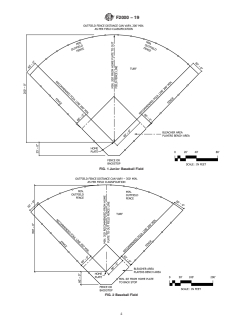
FIG. 1 Junior Baseball Field
F2000 − 19
FIG. 2 Baseball Field
FIG. 3 Softball Field
F2000 − 19
8. Grounding
8.1 Grounding and bonding shall be in accordance with NFPA 70 and ANSI/IEEE C2.
8.2 Grounding rods shall be positioned so as not to be a hazard to ballplayers and spectators.
9. Strength
9.1 Post, rails, and braces for chain-link fence shall conform to strength requirements of Specification F1043 or Specification
F1083 and Uniform Building Code: Chapter 23, Sec. 2303 (d).
9.2 All permanent fence posts shall have a design factor considering soil-bearing values and wind or earthquake forces, either
acting alone or when combined with other loads.
10. Workmanship, Finish, and Appearance
10.1 The finished fence shall be reasonably plumb and free of defects.
11. Inspection and Certification of Raw Material
11.1 All tests and inspection of posts, rails, and fabrics shall be made at the place of manufacture prior to shipment, unless
otherwise specified, and shall be so conducted as not to interfere unnecessarily with the operation of the works.
11.2 Responsibility for inspection of raw materials, unless otherwise specified in the contract or purchase order, rests upon the
producer. This includes performance of all inspection and test requirements specified herein.
11.2.1 Except as otherwise specified in the contract order, the producer may use their own or any other suitable facilities for
the performance of the inspection and test requirements specified herein unless disapproved by the purchaser. The purchaser shall
have the right to perform any of the inspections and tests set forth in this specification where such inspections are deemed necessary
to ensure that material conforms to the prescribed requirements.
12. Rejection
12.1 Each length of fence received from the manufacturer may be visually inspected by the purchaser and, if it does not meet
the requirements of this guide based on the inspection and test method as submitted by the producer, may be rejected and the
manufacturer shall be notified. Disposition of rejected fence shall be a matter of agreement between the manufacturer/retailer and
the purchaser.
12.2 Fence found in fabrication or installation to be unsuitable for the intended use, under the scope and requirements of this
guide, may be set aside and the manufacturer notified. Such fence shall be subject to mutual investigation as to the nature and
severity of the deficiency involved, and the forming or installation conditions, or both. Disposition shall be a matter for agreement.
13. Certification
13.1 The producer or supplier shall, upon request, furnish to the purchaser a certificate of inspection stating that the material
has been sampled, tested, and inspected in accordance with the applicable specification, and has been found to meet the
requirements.
14. Packaging, Marking, and Loading
14.1 When specified on the purchase order, packaging, marking, and loading for shipment shall be in accordance with Practices
A700.
15. Keywords
15.1 fence; fences
1. Scope
1.1 This specification provides recommended minimum requirements for various types of fences used in softball and baseball
ballfields and other sports facilities, and practices for installation.
1.2 The values stated in inch-pound
...