

ASTM B1007-21
(Specification)Standard Specification for Welded Precipitation Hardenable or Cold Worked, Nickel Alloy Tube
General Information
- Abstract
ABSTRACT
This specification covers the manufacturing requirements and test methods for nominal and minimum wall-thickness welded tubes and welded and cold worked tubes 1/8 to 6 in. (3.2 to 152.4 mm) in outside diameter and 0.015 to 0.148 in. (0.41 to 3.7 mm) inclusive in wall thickness. The tubes are made from the following nickel alloys: aluminum, boron, carbon, chromium, cobalt, columbium, copper, iron, manganese, molybdenum, nickel, phosphorous, silicon, sulphur, titanium, tungsten, and vanadium. Anticipated uses cover applications where strength and strength at elevated temperatures are desired attributes. Some examples are hydraulic control lines, boilers, heat exchangers, and solar absorbers. The tubes shall be supplied in one of the following conditions: cold worked, cold worked and precipitation hardened, solution annealed plus precipitation hardened, or solution annealed and descaled conditions. When atmosphere control is used, descaling is not necessary.
This specification also covers ordering information, chemical and mechanical requirements, heat treatments, conditions representing different levels of mechanical properties, hydrostatic or nondestructive electric test, surface condition, weight, and workmanship, finish, and appearance.
SCOPE
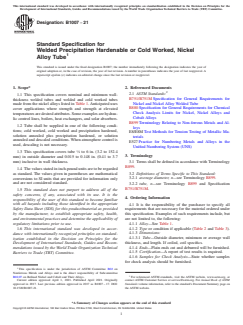
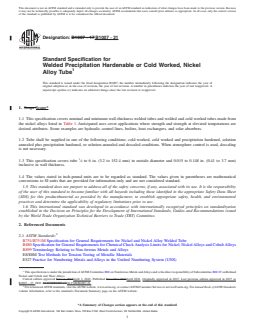
1.1 This specification covers nominal and minimum wall-thickness welded tubes and welded and cold worked tubes made from the nickel alloys listed in Table 1. Anticipated uses cover applications where strength and strength at elevated temperatures are desired attributes. Some examples are hydraulic control lines, boilers, heat exchangers, and solar absorbers.
1.2 Tube shall be supplied in one of the following conditions; cold worked, cold worked and precipitation hardened, solution annealed plus precipitation hardened, or solution annealed and descaled conditions. When atmosphere control is used, descaling is not necessary.
1.3 This specification covers tube 1/8 to 6 in. (3.2 to 152.4 mm) in outside diameter and 0.015 to 0.148 in. (0.41 to 3.7 mm) inclusive in wall thickness.
1.4 The values stated in inch-pound units are to be regarded as standard. The values given in parentheses are mathematical conversions to SI units that are provided for information only and are not considered standard.
1.5 This standard does not purport to address all of the safety concerns, if any, associated with its use. It is the responsibility of the user of this standard to become familiar with all hazards including those identified in the appropriate Safety Data Sheet (SDS) for this product/material as provided by the manufacturer, to establish appropriate safety, health, and environmental practices and determine the applicability of regulatory limitations prior to use.
1.6 This international standard was developed in accordance with internationally recognized principles on standardization established in the Decision on Principles for the Development of International Standards, Guides and Recommendations issued by the World Trade Organization Technical Barriers to Trade (TBT) Committee.
- Status
- Published
- Publication Date
- 31-Mar-2021
- Technical Committee
- B02 - Nonferrous Metals and Alloys
- Drafting Committee
- B02.07 - Refined Nickel and Cobalt and Their Alloys
Buy Documents
ASTM B1007-21 - Standard Specification for Welded Precipitation Hardenable or Cold Worked, Nickel Alloy Tube
REDLINE ASTM B1007-21 - Standard Specification for Welded Precipitation Hardenable or Cold Worked, Nickel Alloy Tube
Overview
ASTM B1007-21: Standard Specification for Welded Precipitation Hardenable or Cold Worked, Nickel Alloy Tube is an internationally recognized standard developed by ASTM International. This specification establishes requirements for the manufacture, chemical and mechanical properties, heat treatments, and testing of welded nickel alloy tubes. Covered products include both nominal and minimum wall-thickness tubes, intended for high-strength and high-temperature applications such as hydraulic control lines, boilers, heat exchangers, and solar absorbers. The standard supports engineering and procurement professionals by promoting consistent product quality in demanding environments.
Key Topics
- Scope and Materials: Applicable to welded tubes ranging from 1/8 to 6 inches (3.2 to 152.4 mm) in outside diameter and 0.015 to 0.148 inches (0.41 to 3.7 mm) in wall thickness, using various nickel alloys (e.g., UNS N07725, N07740, N09945, N09946, N09925, N07718, N10276, N06985).
- Product Conditions: Tubes may be provided as cold worked, cold worked and precipitation hardened, solution annealed plus precipitation hardened, or solution annealed and descaled. Bright annealing may eliminate the need for descaling.
- Mechanical and Chemical Requirements: Includes limits for tensile strength, yield strength, elongation, and chemical composition per Table 1 of the standard. Testing is required on a lot basis to ensure compliance.
- Manufacturing Processes: Specifies fusion welding with inert gas shielding and no filler metal, as well as subsequent bead working and solution annealing. Additional mechanical manipulation tests and hardness testing are required for quality control.
- Testing and Inspection: Each tube must undergo either hydrostatic or nondestructive electric testing (e.g., eddy current, ultrasonic) as defined in referenced ASTM standards. Tubes must also meet criteria for workmanship, finish, straightness, and surface quality.
- Ordering Information: Purchasers are responsible for specifying alloy, tube dimensions, end requirements, certification needs, and inspection preferences to ensure delivered products meet intended application needs.
Applications
The welded precipitation hardenable and cold worked nickel alloy tubes covered by ASTM B1007-21 provide exceptional mechanical strength and resistance to high temperatures, making them ideal for:
- Hydraulic Control Lines: Where reliability and leak resistance are critical under high pressure and temperature.
- Boilers: For enduring cyclic loading and thermal stresses in power generation and industrial heating systems.
- Heat Exchangers: Providing corrosion resistance and high durability in aggressive environments, including chemical processing and energy sectors.
- Solar Absorbers: Utilizing precise tolerances and elevated temperature strength for efficient thermal transfer.
- General High-Performance Tubing: In locations requiring trusted resistance to mechanical stress and corrosion, especially in chemical, petrochemical, and marine industries.
Related Standards
ASTM B1007-21 integrates and references several key standards to ensure robust and harmonized product requirements:
- ASTM B751/B751M: General requirements for nickel and nickel alloy welded tubes.
- ASTM B880: Specifications for chemical check analysis limits for nickel, nickel alloys, and cobalt alloys.
- ASTM B899: Terminology relating to non-ferrous metals and alloys.
- ASTM E8/E8M: Test methods for tension testing of metallic materials.
- ASTM E527: Practice for numbering metals and alloys in the Unified Numbering System (UNS).
Practical Value
ASTM B1007-21 supports manufacturers, engineers, and procurement specialists seeking reliable, high-strength welded nickel alloy tubes for industrial and commercial projects. Adhering to this specification ensures consistency, safety, and performance in critical applications exposed to demanding operational conditions. The standard facilitates global trade by aligning with internationally recognized practices, providing assurance in product quality, and streamlining stakeholder communication throughout the supply chain.
For anyone specifying, producing, or verifying welded nickel alloy tubing for environments requiring peak mechanical and thermal performance, ASTM B1007-21 provides essential requirements and guidance for safe, effective, and compliant product selection and use.
Relations
- Effective Date
- 01-Jan-2024
- Effective Date
- 01-Oct-2016
- Effective Date
- 15-Jul-2016
- Effective Date
- 01-Oct-2015
- Effective Date
- 01-Feb-2015
- Effective Date
- 01-Oct-2014
- Effective Date
- 01-Jun-2013
- Effective Date
- 01-Feb-2013
- Effective Date
- 01-Dec-2011
- Effective Date
- 01-Oct-2009
- Effective Date
- 01-Oct-2009
- Effective Date
- 01-Mar-2008
- Effective Date
- 01-Dec-2006
- Effective Date
- 01-Nov-2005
- Effective Date
- 01-May-2004
Buy Documents
ASTM B1007-21 - Standard Specification for Welded Precipitation Hardenable or Cold Worked, Nickel Alloy Tube
REDLINE ASTM B1007-21 - Standard Specification for Welded Precipitation Hardenable or Cold Worked, Nickel Alloy Tube
Get Certified
Connect with accredited certification bodies for this standard

Institut za varilstvo d.o.o. (Welding Institute)
Slovenia's leading welding institute since 1952. ISO 3834, EN 1090, pressure equipment certification, NDT personnel, welder qualification. Only IIW Au
Sponsored listings
Frequently Asked Questions
ASTM B1007-21 is a technical specification published by ASTM International. Its full title is "Standard Specification for Welded Precipitation Hardenable or Cold Worked, Nickel Alloy Tube". This standard covers: ABSTRACT This specification covers the manufacturing requirements and test methods for nominal and minimum wall-thickness welded tubes and welded and cold worked tubes 1/8 to 6 in. (3.2 to 152.4 mm) in outside diameter and 0.015 to 0.148 in. (0.41 to 3.7 mm) inclusive in wall thickness. The tubes are made from the following nickel alloys: aluminum, boron, carbon, chromium, cobalt, columbium, copper, iron, manganese, molybdenum, nickel, phosphorous, silicon, sulphur, titanium, tungsten, and vanadium. Anticipated uses cover applications where strength and strength at elevated temperatures are desired attributes. Some examples are hydraulic control lines, boilers, heat exchangers, and solar absorbers. The tubes shall be supplied in one of the following conditions: cold worked, cold worked and precipitation hardened, solution annealed plus precipitation hardened, or solution annealed and descaled conditions. When atmosphere control is used, descaling is not necessary. This specification also covers ordering information, chemical and mechanical requirements, heat treatments, conditions representing different levels of mechanical properties, hydrostatic or nondestructive electric test, surface condition, weight, and workmanship, finish, and appearance. SCOPE 1.1 This specification covers nominal and minimum wall-thickness welded tubes and welded and cold worked tubes made from the nickel alloys listed in Table 1. Anticipated uses cover applications where strength and strength at elevated temperatures are desired attributes. Some examples are hydraulic control lines, boilers, heat exchangers, and solar absorbers. 1.2 Tube shall be supplied in one of the following conditions; cold worked, cold worked and precipitation hardened, solution annealed plus precipitation hardened, or solution annealed and descaled conditions. When atmosphere control is used, descaling is not necessary. 1.3 This specification covers tube 1/8 to 6 in. (3.2 to 152.4 mm) in outside diameter and 0.015 to 0.148 in. (0.41 to 3.7 mm) inclusive in wall thickness. 1.4 The values stated in inch-pound units are to be regarded as standard. The values given in parentheses are mathematical conversions to SI units that are provided for information only and are not considered standard. 1.5 This standard does not purport to address all of the safety concerns, if any, associated with its use. It is the responsibility of the user of this standard to become familiar with all hazards including those identified in the appropriate Safety Data Sheet (SDS) for this product/material as provided by the manufacturer, to establish appropriate safety, health, and environmental practices and determine the applicability of regulatory limitations prior to use. 1.6 This international standard was developed in accordance with internationally recognized principles on standardization established in the Decision on Principles for the Development of International Standards, Guides and Recommendations issued by the World Trade Organization Technical Barriers to Trade (TBT) Committee.
ABSTRACT This specification covers the manufacturing requirements and test methods for nominal and minimum wall-thickness welded tubes and welded and cold worked tubes 1/8 to 6 in. (3.2 to 152.4 mm) in outside diameter and 0.015 to 0.148 in. (0.41 to 3.7 mm) inclusive in wall thickness. The tubes are made from the following nickel alloys: aluminum, boron, carbon, chromium, cobalt, columbium, copper, iron, manganese, molybdenum, nickel, phosphorous, silicon, sulphur, titanium, tungsten, and vanadium. Anticipated uses cover applications where strength and strength at elevated temperatures are desired attributes. Some examples are hydraulic control lines, boilers, heat exchangers, and solar absorbers. The tubes shall be supplied in one of the following conditions: cold worked, cold worked and precipitation hardened, solution annealed plus precipitation hardened, or solution annealed and descaled conditions. When atmosphere control is used, descaling is not necessary. This specification also covers ordering information, chemical and mechanical requirements, heat treatments, conditions representing different levels of mechanical properties, hydrostatic or nondestructive electric test, surface condition, weight, and workmanship, finish, and appearance. SCOPE 1.1 This specification covers nominal and minimum wall-thickness welded tubes and welded and cold worked tubes made from the nickel alloys listed in Table 1. Anticipated uses cover applications where strength and strength at elevated temperatures are desired attributes. Some examples are hydraulic control lines, boilers, heat exchangers, and solar absorbers. 1.2 Tube shall be supplied in one of the following conditions; cold worked, cold worked and precipitation hardened, solution annealed plus precipitation hardened, or solution annealed and descaled conditions. When atmosphere control is used, descaling is not necessary. 1.3 This specification covers tube 1/8 to 6 in. (3.2 to 152.4 mm) in outside diameter and 0.015 to 0.148 in. (0.41 to 3.7 mm) inclusive in wall thickness. 1.4 The values stated in inch-pound units are to be regarded as standard. The values given in parentheses are mathematical conversions to SI units that are provided for information only and are not considered standard. 1.5 This standard does not purport to address all of the safety concerns, if any, associated with its use. It is the responsibility of the user of this standard to become familiar with all hazards including those identified in the appropriate Safety Data Sheet (SDS) for this product/material as provided by the manufacturer, to establish appropriate safety, health, and environmental practices and determine the applicability of regulatory limitations prior to use. 1.6 This international standard was developed in accordance with internationally recognized principles on standardization established in the Decision on Principles for the Development of International Standards, Guides and Recommendations issued by the World Trade Organization Technical Barriers to Trade (TBT) Committee.
ASTM B1007-21 is classified under the following ICS (International Classification for Standards) categories: 23.040.15 - Non-ferrous metal pipes. The ICS classification helps identify the subject area and facilitates finding related standards.
ASTM B1007-21 has the following relationships with other standards: It is inter standard links to ASTM E8/E8M-24, ASTM B899-16, ASTM E8/E8M-16, ASTM B899-15, ASTM E8/E8M-15, ASTM B899-14, ASTM E8/E8M-13, ASTM B899-13, ASTM E8/E8M-11, ASTM B899-09, ASTM B899-09e1, ASTM B880-03(2008), ASTM B899-06, ASTM B899-05, ASTM B899-04. Understanding these relationships helps ensure you are using the most current and applicable version of the standard.
ASTM B1007-21 is available in PDF format for immediate download after purchase. The document can be added to your cart and obtained through the secure checkout process. Digital delivery ensures instant access to the complete standard document.
Standards Content (Sample)
This international standard was developed in accordance with internationally recognized principles on standardization established in the Decision on Principles for the
Development of International Standards, Guides and Recommendations issued by the World Trade Organization Technical Barriers to Trade (TBT) Committee.
Designation:B1007 −21
Standard Specification for
Welded Precipitation Hardenable or Cold Worked, Nickel
Alloy Tube
This standard is issued under the fixed designation B1007; the number immediately following the designation indicates the year of
original adoption or, in the case of revision, the year of last revision.Anumber in parentheses indicates the year of last reapproval.A
superscript epsilon (´) indicates an editorial change since the last revision or reapproval.
1. Scope* 2. Referenced Documents
2.1 ASTM Standards:
1.1 This specification covers nominal and minimum wall-
B751/B751MSpecification for General Requirements for
thickness welded tubes and welded and cold worked tubes
Nickel and Nickel Alloy Welded Tube
made from the nickel alloys listed in Table 1.Anticipated uses
B880Specification for General Requirements for Chemical
cover applications where strength and strength at elevated
Check Analysis Limits for Nickel, Nickel Alloys and
temperaturesaredesiredattributes.Someexamplesarehydrau-
Cobalt Alloys
lic control lines, boilers, heat exchangers, and solar absorbers.
B899Terminology Relating to Non-ferrous Metals and Al-
1.2 Tube shall be supplied in one of the following condi-
loys
tions; cold worked, cold worked and precipitation hardened,
E8/E8MTest Methods for Tension Testing of Metallic Ma-
solution annealed plus precipitation hardened, or solution
terials
annealed and descaled conditions.When atmosphere control is
E527Practice for Numbering Metals and Alloys in the
used, descaling is not necessary.
Unified Numbering System (UNS)
1.3 This specification covers tube ⁄8 to 6 in. (3.2 to 152.4
3. Terminology
mm) in outside diameter and 0.015 to 0.148 in. (0.41 to 3.7
mm) inclusive in wall thickness.
3.1 Terms shall be defined in accordance with Terminology
B899.
1.4 The values stated in inch-pound units are to be regarded
3.2 Definitions of Terms Specific to This Standard:
as standard. The values given in parentheses are mathematical
conversions to SI units that are provided for information only 3.2.1 average diameter, n—see Terminology B899.
and are not considered standard.
3.2.2 tube, n—see Terminology B899 and Specification
B751/B751M.
1.5 This standard does not purport to address all of the
safety concerns, if any, associated with its use. It is the
4. Ordering Information
responsibility of the user of this standard to become familiar
with all hazards including those identified in the appropriate 4.1 It is the responsibility of the purchaser to specify all
Safety Data Sheet (SDS) for this product/material as provided
requirements that are necessary for the material ordered under
by the manufacturer, to establish appropriate safety, health, this specification. Examples of such requirements include, but
and environmental practices and determine the applicability of
are not limited to, the following:
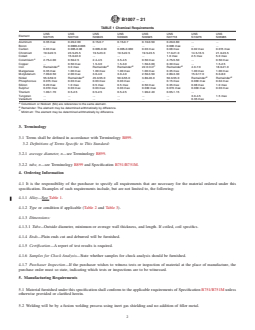
regulatory limitations prior to use. 4.1.1 Alloy—See Table 1.
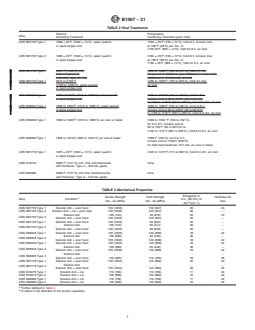
4.1.2 Type or condition if applicable (Table 2 and Table 3).
1.6 This international standard was developed in accor-
4.1.3 Dimensions:
dance with internationally recognized principles on standard-
4.1.3.1 Tube—Outside diameter, minimum or average wall
ization established in the Decision on Principles for the
thickness, and length. If coiled, coil specifics.
Development of International Standards, Guides and Recom-
4.1.4 Ends—Plain ends cut and deburred will be furnished.
mendations issued by the World Trade Organization Technical
4.1.5 Certification—A report of test results is required.
Barriers to Trade (TBT) Committee.
4.1.6 Samples for Check Analysis—State whether samples
for check analysis should be furnished.
This specification is under the jurisdiction of ASTM Committee B02 on
Nonferrous Metals and Alloys and is the direct responsibility of Subcommittee
B02.07 on Refined Nickel and Cobalt and Their Alloys. For referenced ASTM standards, visit the ASTM website, www.astm.org, or
Current edition approved April 1, 2021. Published April 2021. Originally contact ASTM Customer Service at service@astm.org. For Annual Book of ASTM
approved in 2017. Last previous edition approved in 2017 as B1007–17. DOI: Standards volume information, refer to the standard’s Document Summary page on
10.1520/B1007-21. the ASTM website.
*A Summary of Changes section appears at the end of this standard
Copyright © ASTM International, 100 Barr Harbor Drive, PO Box C700, West Conshohocken, PA 19428-2959. United States
B1007−21
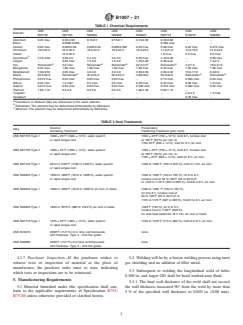
TABLE 1 Chemical Requirements
UNS UNS UNS UNS UNS UNS UNS UNS
Element
N07725 N07740 N09945 N09946 N09925 N07718 N10276 N06985
Aluminum 0.35 max 0.20-2.00 0.15-0.7 0.15-0.7 0.10-0.50 0.20-0.80 . .
Boron . 0.0006-0.006 . . . 0.006 max . .
Carbon 0.03 max 0.005-0.08 0.005-0.04 0.005-0.030 0.03 max 0.08 max 0.02 max 0.015 max
Chromium 19.0-22.5 23.5-25.5 19.5-23.0 19.5-22.5 19.5-23.5 17.0-21.0 14.5-16.5 21.0-23.5
Cobalt . 15.0-22.0 . . . 1.0 max 2.5 max 5.0 max
A
Columbium 2.75-4.00 0.50-2.5 2.4-4.5 3.5-4.5 0.50 max 4.75-5.50 . 0.50 max
Copper . 0.50 max 1.5-3.0 1.5-3.0 1.50-3.00 0.30 max . 1.5-2.5
B B B C B
Iron Remainder 3.0 max Remainder Remainder 22.0 min Remainder 4.0-7.0 18.0-21.0
Manganese 0.35 max 1.00 max 1.00 max 1.00 max 1.00 max 0.35 max 1.00 max 1.00 max
Molybdenum 7.00-9.50 2.00 max 3.0-4.0 3.0-4.0 2.50-3.50 2.80-3.30 15.0-17.0 6.0-8.0
B B B
Nickel 55.0-59.0 Remainder 45.0-55.0 50.0-55.0 3.80-46.0 50.0-55.0 Remainder Remainder
Phosphorous 0.015 max 0.03 max 0.03 max 0.03 max . 0.15 max 0.030 max 0.04 max
Silicon 0.20 max 1.0 max 0.5 max 0.5 max 0.50 max 0.35 max 0.08 max 1.0 max
Sulphur 0.010 max 0.03 max 0.03 max 0.03 max 0.030 max 0.015 max 0.030 max 0.03 max
Titanium 1.00-1.70 0.5-2.5 0.5-2.5 0.5-2.5 1.90-2.40 0.65-1.15 .
Tungsten . . . . . . 3.0-4.5 1.5 max
Vanadium . . . . . . 0.35 max .
A
Columbium or Niobium (Nb) are references to the same element.
B
Remainder: The element may be determined arithmetically by difference.
C
Minimum: The element may be determined arithmetically by difference.
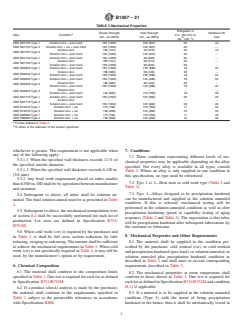
TABLE 2 Heat Treatments
Solution Precipitation
Alloy
Annealing Treatment Hardening Treatment (prec hard)
UNS N07725 Type 1 1900 ± 25°F (1040 ± 14°C), water quench 1350 ± 25°F (730 ± 14°C), hold 8 h, furnace cool
or rapid air/gas cool at 100°F (56°C) per min. to
1150 25°F (620 ± 14°C), hold for 8 h, air cool
UNS N07725 Type 2 1900 ± 25°F (1040 ± 14°C), water quench 1350 ± 25°F (730 ± 14°C), hold 8 h, furnace cool
or rapid air/gas cool at 100°F (56°C) per min. to
1150 ± 25°F (820 ± 14°C), hold for 8 h, air cool
UNS N07740 Type 1 2012 to 2192°F (1100 to 1200°C), water quench 1400 to 1500°F (760 to 815°C), hold4hmin,air cool
or rapid air/gas cool
UNS N09945 Type 1 1850 to 1950°F (1010 to 1066°C), water quench 1300 to 1350°F (704 to 732°C), for 6 to 8 h,
or rapid air/gas cool furnace cool at 50 to 100°F (26 to 56°C)/h
to 1125 to 1175°F (607 to 635°C), hold 6 to 8 h, air cool
UNS N09946 Type 1 1850 to 1950°F (1010 to 1066°C) air cool, or faster 1300 to 1350 °F (704 to 732°C),
for 6 to 8 h, furnace cool at
50 to 100°F (26 to 56°C)/h to
1125 to 1175°F (607 to 365°C), hold 6 to 8 h, air cool
UNS N09925 Type 1 1825 to 1875°C (996 to 1024°C) air cool or faster 1365°F (740°C), for 6 to 9 h,
furnace cool to 1150°F (620°C),
for total heat treatment 18 h min, air cool or faster
UNS N07718 Type 1 1875 ± 25°F (1024 ± 14°C), water quench 1425 to 1475°F (774 to 802°C), hold 6 to 8 h, air cool
or rapid air/gas cool
UNS N10276 2050°F (1121°C) min, time commensurate none
with thickness. Type3–N/Athis grade.
UNS N06985 2050°F (1121°C) min time commensurate none
with thickness. Type3–N/Athis grade.
4.1.7 Purchaser Inspection—If the purchaser wishes to 5.2 Welding will be by a fusion welding process using inert
witness tests or inspection of material at the place of gas shielding and no addition of filler metal.
manufacture, the purchase order must so state, indicating
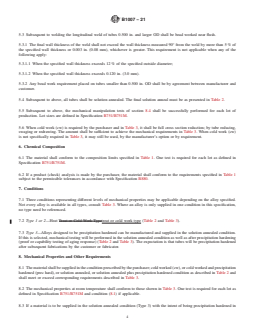
5.3 Subsequent to welding the longitudinal weld of tubes
which tests or inspections are to be witnessed.
0.500 in. and larger OD shall be bead worked near flush.
5. Manufacturing Requirements
5.3.1 The final wall thickness of the weld shall not exceed
5.1 Material furnished under this specification shall con- the wall thickness measured 90° from the weld by more than
form to the applicable requirements of Specification B751/ 5% of the specified wall thickness or 0.003 in. (0.08 mm),
B751M unless otherwise provided or clarified herein.
B1007−21
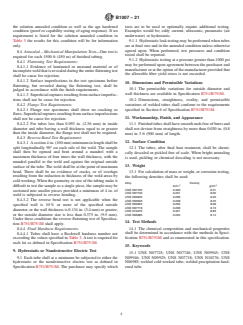
TABLE 3 Mechanical Properties
Elongation in
Tensile Strength Yield Strength Hardness Rc
A
Alloy Condition 2 in. (50 mm) or
min., ksi (MPa) min., ksi (MPa) max
B
4D, min. %
UNS N07725 Type 1 Solution Ann + prec hard 150 (1035) 120 (827) 20 43
UNS N07725 Type 2 Solution Ann + cw + prec hard 150 (1035) 120 (827) 20 .
Solution Ann 105 (724) 40 (276) 45 10
UNS N07725 Type 3
Solution Ann + prec hard 150 (1035) 120 (827) 20 .
UNS N07740 Type 1 Solution Ann + prec hard 150 (1035) 90 (620) 20 .
Solution Ann 105 (724) 60 (414) 30 .
UNS N07740 Type 3
Solution Ann + prec hard 150 (1035) 90 (620) 20 .
UNS N09945 Type 1 Solution Ann + prec hard 150 (1035) 130 (896) 18 42
Solution Ann 100 (689) 65 (448) 30 .
UNS N09945 Type 3
Solution Ann + prec hard 150 (1035) 130 (896) 18 42
UNS N09946 Type 1 Solution Ann + prec hard 165 (1035) 140 (896) 18 42
Solution Ann 100 (689) 65 (448) 30 .
UNS N09946 Type 3
Solution Ann + prec hard 165 (1035) 140 (896) 18 42
Solution Ann . . . .
UNS N09925 Type 3
Solution Ann + prec hard 140 (965) 110 (758) 18 38
UNS N07718 Type 1 Solution Ann + prec hard 150 (1034) 125 (862) 20 40
Solution Ann . . . .
UNS N07718 Type 3
Solution Ann + prec hard 150 (1034) 125 (862) 20 40
UNS N10276 Type 1 Solution Ann + cw 115 (793) 110 (758) 11 40
UNS N10276 Type 2 Solution Ann + cw 130 (896) 125 (862) 10 40
UNS N06985 Type 1 Solution Ann + cw 115 (793) 110 (758) 11 40
UNS N06985 Type 2 Solution Ann + cw 130 (896) 125 (862) 10 40
A
Further defined in Table 2.
B
D refers to the diameter of the tension specimen.
whichever is greater. This requirement is not applicable when 7. Conditions
any of the following apply:
7.1 Three conditions representing different levels of me-
5.3.1.1 When the specified wall thickness exceeds 12% of
chanical properties may be applicable depending on the alloy
the specified outside diameter;
specified. Not every alloy is available in all types, consult
5.3.1.2 When the specified wall thickness exceeds 0.120 in.
Table 3. Where an alloy is only supplied in one condition in
(3.0 mm).
this specification, no type need be referenced.
5.3.2 Any bead work requirement placed on tubes smaller
7.2 Type1or2—Heat treat or cold work type (Table 2 and
than0.500in.ODshallbebyagreem
...
This document is not an ASTM standard and is intended only to provide the user of an ASTM standard an indication of what changes have been made to the previous version. Because
it may not be technically possible to adequately depict all changes accurately, ASTM recommends that users consult prior editions as appropriate. In all cases only the current version
of the standard as published by ASTM is to be considered the official document.
Designation: B1007 − 17 B1007 − 21
Standard Specification for
Welded Precipitation Hardenable or Cold Worked, Nickel
Alloy Tube
This standard is issued under the fixed designation B1007; the number immediately following the designation indicates the year of
original adoption or, in the case of revision, the year of last revision. A number in parentheses indicates the year of last reapproval. A
superscript epsilon (´) indicates an editorial change since the last revision or reapproval.
1. Scope Scope*
1.1 This specification covers nominal and minimum wall-thickness welded tubes and welded and cold worked tubes made from
the nickel alloys listed in Table 1. Anticipated uses cover applications where strength and strength at elevated temperatures are
desired attributes. Some examples are hydraulic control lines, boilers, heat exchangers, and solar absorbers.
1.2 Tube shall be supplied in one of the following conditions; cold worked, cold worked and precipitation hardened, solution
annealed plus precipitation hardened, or solution annealed and descaled conditions. When atmosphere control is used, descaling
is not necessary.
1.3 This specification covers tube ⁄8 to 6 in. (3.2 to 152.4 mm) in outside diameter and 0.015 to 0.148 in. (0.41 to 3.7 mm)
inclusive in wall thickness.
1.4 The values stated in inch-pound units are to be regarded as standard. The values given in parentheses are mathematical
conversions to SI units that are provided for information only and are not considered standard.
1.5 This standard does not purport to address all of the safety concerns, if any, associated with its use. It is the responsibility
of the user of this standard to become familiar with all hazards including those identified in the appropriate Safety Data Sheet
(SDS) for this product/material as provided by the manufacturer, to establish appropriate safety, health, and environmental
practices and determine the applicability of regulatory limitations prior to use.
1.6 This international standard was developed in accordance with internationally recognized principles on standardization
established in the Decision on Principles for the Development of International Standards, Guides and Recommendations issued
by the World Trade Organization Technical Barriers to Trade (TBT) Committee.
2. Referenced Documents
2.1 ASTM Standards:
B751/B751M Specification for General Requirements for Nickel and Nickel Alloy Welded Tube
B880 Specification for General Requirements for Chemical Check Analysis Limits for Nickel, Nickel Alloys and Cobalt Alloys
B899 Terminology Relating to Non-ferrous Metals and Alloys
E8/E8M Test Methods for Tension Testing of Metallic Materials
E527 Practice for Numbering Metals and Alloys in the Unified Numbering System (UNS)
This specification is under the jurisdiction of ASTM Committee B02 on Nonferrous Metals and Alloys and is the direct responsibility of Subcommittee B02.07 on Refined
Nickel and Cobalt and Their Alloys.
Current edition approved Nov. 1, 2017April 1, 2021. Published December 2017April 2021. Originally approved in 2017. Last previous edition approved in 2017 as
B1007 – 17. DOI: 10.1520/B1007-17.10.1520/B1007-21.
For referenced ASTM standards, visit the ASTM website, www.astm.org, or contact ASTM Customer Service at service@astm.org. For Annual Book of ASTM Standards
volume information, refer to the standard’s Document Summary page on the ASTM website.
*A Summary of Changes section appears at the end of this standard
Copyright © ASTM International, 100 Barr Harbor Drive, PO Box C700, West Conshohocken, PA 19428-2959. United States
B1007 − 21
TABLE 1 Chemical Requirements
UNS UNS UNS UNS UNS UNS UNS UNS
Element
N07725 N07740 N09945 N09946 N09925 N07718 N10276 N06985
Aluminum 0.35 max 0.20-2.00 0.15-0.7 0.15-0.7 0.10-0.50 0.20-0.80 . .
Boron . 0.0006-0.006 . . . 0.006 max . .
Carbon 0.03 max 0.005-0.08 0.005-0.04 0.005-0.030 0.03 max 0.08 max 0.02 max 0.015 max
Chromium 19.0-22.5 23.5-25.5 19.5-23.0 19.5-22.5 19.5-23.5 17.0-21.0 14.5-16.5 21.0-23.5
Cobalt . 15.0-22.0 . . . 1.0 max 2.5 max 5.0 max
A
Columbium 2.75-4.00 0.50-2.5 2.4-4.5 3.5-4.5 0.50 max 4.75-5.50 . 0.50 max
Copper . 0.50 max 1.5-3.0 1.5-3.0 1.50-3.00 0.30 max . 1.5-2.5
B B B C B
Iron Remainder 3.0 max Remainder Remainder 22.0 min Remainder 4.0-7.0 18.0-21.0
Manganese 0.35 max 1.00 max 1.00 max 1.00 max 1.00 max 0.35 max 1.00 max 1.00 max
Molybdenum 7.00-9.50 2.00 max 3.0-4.0 3.0-4.0 2.50-3.50 2.80-3.30 15.0-17.0 6.0-8.0
B B B
Nickel 55.0-59.0 Remainder 45.0-55.0 50.0-55.0 3.80-46.0 50.0-55.0 Remainder Remainder
Phosphorous 0.015 max 0.03 max 0.03 max 0.03 max . 0.15 max 0.030 max 0.04 max
Silicon 0.20 max 1.0 max 0.5 max 0.5 max 0.50 max 0.35 max 0.08 max 1.0 max
Sulphur 0.010 max 0.03 max 0.03 max 0.03 max 0.030 max 0.015 max 0.030 max 0.03 max
Titanium 1.00-1.70 0.5-2.5 0.5-2.5 0.5-2.5 1.90-2.40 0.65-1.15 .
Tungsten . . . . . . 3.0-4.5 1.5 max
Vanadium . . . . . . 0.35 max .
A
Columbium or Niobium (Nb) are references to the same element.
B
Remainder: The element may be determined arithmetically by difference.
C
Minimum: The element may be determined arithmetically by difference.
3. Terminology
3.1 Terms shall be defined in accordance with Terminology B899.
3.2 Definitions of Terms Specific to This Standard:
3.2.1 average diameter, n—see Terminology B899.
3.2.2 tube, n—see Terminology B899 and Specification B751/B751M.
4. Ordering Information
4.1 It is the responsibility of the purchaser to specify all requirements that are necessary for the material ordered under this
specification. Examples of such requirements include, but are not limited to, the following:
4.1.1 Alloy—See Table 1.
4.1.2 Type or condition if applicable (Table 2 and Table 3).
4.1.3 Dimensions:
4.1.3.1 Tube—Outside diameter, minimum or average wall thickness, and length. If coiled, coil specifics.
4.1.4 Ends—Plain ends cut and deburred will be furnished.
4.1.5 Certification—A report of test results is required.
4.1.6 Samples for Check Analysis—State whether samples for check analysis should be furnished.
4.1.7 Purchaser Inspection—If the purchaser wishes to witness tests or inspection of material at the place of manufacture, the
purchase order must so state, indicating which tests or inspections are to be witnessed.
5. Manufacturing Requirements
5.1 Material furnished under this specification shall conform to the applicable requirements of Specification B751/B751M unless
otherwise provided or clarified herein.
5.2 Welding will be by a fusion welding process using inert gas shielding and no addition of filler metal.
B1007 − 21
TABLE 2 Heat Treatments
Solution Precipitation
Alloy
Annealing Treatment Hardening Treatment (prec hard)
UNS N07725 Type 1 1900 ± 25°F (1040 ± 14°C), water quench 1350 ± 25°F (730 ± 14°C), hold 8 h, furnace cool
or rapid air/gas cool at 100°F (56°C) per min. to
1150 25°F (620 ± 14°C), hold for 8 h, air cool
UNS N07725 Type 2 1900 ± 25°F (1040 ± 14°C), water quench 1350 ± 25°F (730 ± 14°C), hold 8 h, furnace cool
or rapid air/gas cool at 100°F (56°C) per min. to
1150 ± 25°F (820 ± 14°C), hold for 8 h, air cool
UNS N07740 Type 1 2012°F (1100°C) min, 1400 to 1500°F (760 to 815°C), hold 4 h min
hold 1 h per in. of for up to 2 in. thickness plus additional ⁄2 h per each
thickness, rapid air cool additional in. of thickness, air cool
UNS N07740 Type 1 2012 to 2192°F 1400 to 1500°F (760 to 815°C), hold 4 h min,
(1100 to 1200°C), water quench air cool
or rapid air/gas cool
UNS N09945 Type 1 1850 to1950°F (1010 to 1066°C) water quench 1300 to 1350°F (704 to 732°C), for 6 to 8 h,
or rapid air/gas cool furnace cool at 50 to 100°F (26 to 56°C)/h
to 1125 to 1175°F (607 to 635°C), hold 6 to 8 h, air cool
UNS N09945 Type 1 1850 to 1950°F (1010 to 1066°C), water quench 1300 to 1350°F (704 to 732°C), for 6 to 8 h,
or rapid air/gas cool furnace cool at 50 to 100°F (26 to 56°C)/h
to 1125 to 1175°F (607 to 635°C), hold 6 to 8 h, air cool
UNS N09946 Type 1 1850 to 1950°F (1010 to 1066°C) air cool, or faster 1300 to 1350 °F (704 to 732°C),
for 6 to 8 h, furnace cool at
50 to 100°F (26 to 56°C)/h to
1125 to 1175°F (607 to 365°C), hold 6 to 8 h, air cool
UNS N09925 Type 1 1825 to 1875°C (996 to 1024°C) air cool or faster 1365°F (740°C), for 6 to 9 h,
furnace cool to 1150°F (620°C),
for total heat treatment 18 h min, air cool or faster
UNS N07718 Type 1 1875 ± 25°F (1024 ± 14°C), water quench 1425 to 1475°F (774 to 802°C), hold 6 to 8 h, air cool
or rapid air/gas cool
UNS N10276 2050°F (1121°C) min, time commensurate none
with thickness. Type 3 – N/A this grade.
UNS N06985 2050°F (1121°C) min time commensurate none
with thickness. Type 3 – N/A this grade.
TABLE 3 Mechanical Properties
Elongation in
Tensile Strength Yield Strength Hardness Rc
A
Alloy Condition 2 in. (50 mm) or
min., ksi (MPa) min., ksi (MPa) max
B
4D, min. %
UNS N07725 Type 1 Solution Ann + prec hard 150 (1035) 120 (827) 20 43
UNS N07725 Type 2 Solution Ann + cw + prec hard 150 (1035) 120 (827) 20 .
Solution Ann 105 (724) 40 (276) 45 10
UNS N07725 Type 3
Solution Ann + prec hard 150 (1035) 120 (827) 20 .
UNS N07740 Type 1 Solution Ann + prec hard 150 (1035) 90 (620) 20 .
Solution Ann 105 (724) 60 (414) 30 .
UNS N07740 Type 3
Solution Ann + prec hard 150 (1035) 90 (620) 20 .
UNS N09945 Type 1 Solution Ann + prec hard 150 (1035) 130 (896) 18 42
Solution Ann 100 (689) 65 (448) 30 .
UNS N09945 Type 3
Solution Ann + prec hard 150 (1035) 130 (896) 18 42
UNS N09946 Type 1 Solution Ann + prec hard 165 (1035) 140 (896) 18 42
Solution Ann 100 (689) 65 (448) 30 .
UNS N09946 Type 3
Solution Ann + prec hard 165 (1035) 140 (896) 18 42
Solution Ann . . . .
UNS N09925 Type 3
Solution Ann + prec hard 140 (965) 110 (758) 18 38
UNS N07718 Type 1 Solution Ann + prec hard 150 (1034) 125 (862) 20 40
Solution Ann . . . .
UNS N07718 Type 3
Solution Ann + prec hard 150 (1034) 125 (862) 20 40
UNS N10276 Type 1 Solution Ann + cw 115 (793) 110 (758) 11 40
UNS N10276 Type 2 Solution Ann + cw 130 (896) 125 (862) 10 40
UNS N06985 Type 1 Solution Ann + cw 115 (793) 110 (758) 11 40
UNS N06985 Type 2 Solution Ann + cw 130 (896) 125 (862) 10 40
A
Further defined in Table 2.
B
D refers to the diameter of the tension specimen.
B1007 − 21
5.3 Subsequent to welding the longitudinal weld of tubes 0.500 in. and larger OD shall be bead worked near flush.
5.3.1 The final wall thickness of the weld shall not exceed the wall thickness measured 90° from the weld by more than 5 % of
the specified wall thickness or 0.003 in. (0.08 mm), whichever is greater. This requirement is not applicable when any of the
following apply:
5.3.1.1 When the specified wall thickness exceeds 12 % of the specified outside diameter;
5.3.1.2 When the specified wall thickness exceeds 0.120 in. (3.0 mm).
5.3.2 Any bead work requirement placed on tubes smaller than 0.500 in. OD shall be by agreement between manufacturer and
customer.
5.4 Subsequent to above, all tubes shall be solution annealed. The final solution anneal must be as p
...