

ASTM E1559-09(2022)
(Test Method)Standard Test Method for Contamination Outgassing Characteristics of Spacecraft Materials
General Information
- Abstract
ABSTRACT
This test method covers a technique for generating data to characterize the kinetics of the release of outgassing products from spacecraft materials. This technique will determine both the total mass flux evolved by a material when exposed to a vacuum environment and the deposition of this flux on surfaces held at various specified temperatures. The quartz crystal microbalances used in this test method provide a sensitive technique for measuring very small quantities of deposited mass. There are two test methods in this standard: Test Method A and Test Method B. The test apparatus shall consists of four main subsystems: a vacuum chamber, a temperature control system, internal configuration, and a data acquisition system. A test procedure for collecting data and a test method for processing and presenting the collected data are included.
SCOPE
1.1 This test method covers a technique for generating data to characterize the kinetics of the release of outgassing products from materials. This technique will determine both the total mass flux evolved by a material when exposed to a vacuum environment and the deposition of this flux on surfaces held at various specified temperatures.
1.2 This test method describes the test apparatus and related operating procedures for evaluating the total mass flux that is evolved from a material being subjected to temperatures that are between 298 and 398 K. Pressures external to the sample effusion cell are less than 7 × 10⁻³ Pa (5 × 10⁻⁵ torr). Deposition rates are measured during material outgassing tests. A test procedure for collecting data and a test method for processing and presenting the collected data are included.
1.3 This test method can be used to produce the data necessary to support mathematical models used for the prediction of molecular contaminant generation, migration, and deposition.
1.4 All types of organic, polymeric, and inorganic materials can be tested. These include polymer potting compounds, foams, elastomers, films, tapes, insulations, shrink tubing, adhesives, coatings, fabrics, tie cords, and lubricants.
1.5 There are two test methods in this standard. Test Method A uses standardized specimen and collector temperatures. Test Method B allows the flexibility of user-specified specimen and collector temperatures, material and test geometry, and user-specified QCMs.
1.6 The values stated in SI units are to be regarded as the standard. The values given in parentheses are for information only.
1.7 This standard does not purport to address all of the safety concerns, if any, associated with its use. It is the responsibility of the user of this standard to establish appropriate safety, health, and environmental practices and determine the applicability of regulatory limitations prior to use.
1.8 This international standard was developed in accordance with internationally recognized principles on standardization established in the Decision on Principles for the Development of International Standards, Guides and Recommendations issued by the World Trade Organization Technical Barriers to Trade (TBT) Committee.
- Status
- Published
- Publication Date
- 31-Mar-2022
- Technical Committee
- E21 - Space Simulation and Applications of Space Technology
- Drafting Committee
- E21.05 - Contamination
Overview
ASTM E1559-09(2022), titled Standard Test Method for Contamination Outgassing Characteristics of Spacecraft Materials, is a comprehensive international standard developed by ASTM. The standard describes techniques for evaluating how materials release outgassing products in vacuum conditions representative of the space environment. It provides a validated methodology for determining both the total mass flux of outgassed substances and their deposition on surfaces maintained at controlled temperatures.
Utilizing sensitive quartz crystal microbalance (QCM) technology, ASTM E1559 enables highly accurate and low-level detection of contaminants released from various spacecraft materials. This standard is essential for assessing material suitability in aerospace applications where molecular contamination can impact component performance-especially optical or thermal surfaces.
Key Topics
- Outgassing Kinetics: Characterization of the rate and quantity of gas molecules released from materials exposed to vacuum.
- Total Mass Flux Measurement: Quantification of the total mass of outgassed material as substances migrate from a sample under test.
- Deposition Analysis: Measurement of the mass of outgassed contaminants that deposit on collector surfaces at various specified temperatures.
- Test Apparatus Design: Detailed requirements for vacuum chambers, temperature control, internal configuration, and data acquisition necessary for accurate and repeatable results.
- Sample Preparation and Conditioning: Guidance on representative sample geometries, pre-test conditioning, and handling to simulate actual application use.
- Test Methods: Distinction between two test methods:
- Method A: Standardized specimen and collector temperatures and geometry.
- Method B: Greater flexibility with user-specified temperatures, geometry, and QCM configuration to match specific spacecraft requirements.
- Material Applicability: The procedure is suitable for organic, polymeric, and inorganic materials commonly found in spacecraft construction, including adhesives, coatings, lubricants, fabrics, tapes, foams, insulations, electrical components, and more.
Applications
- Spacecraft Material Selection: Assess the outgassing propensity of candidate materials for spacecraft, satellites, and space probes to prevent optical contamination and hardware malfunction.
- Contamination Control: Quantitative determination of outgassing and deposition informs contamination budgeting and risk management for sensitive payloads (e.g., telescopes, sensors, solar panels).
- Model Input: Provides empirical data to support or validate mathematical models predicting molecular contamination, enabling simulation and mitigation strategies during the design phase.
- Quality Assurance: Used by component manufacturers and materials suppliers to certify compliance with outgassing performance requirements and support procurement documentation.
- Research and Development: Supports evaluation of new materials and variants for advanced space missions where performance under vacuum and temperature extremes is critical.
Related Standards
- ASTM E595 – Test Method for Total Mass Loss and Collected Volatile Condensable Materials from Outgassing in a Vacuum Environment. Often referenced for initial screening of materials for spaceflight suitability.
- SMC-TR-95-28 – Non-Volatile Residue Solvent Replacement, relevant for hardware cleaning prior to outgassing testing.
- Military Standards (MIL-P-27401D) – Specifications related to nitrogen purging and cleanliness for space applications.
- Other ASTM Space Simulation Standards – Complementary procedures for environmental testing of spacecraft components.
By adhering to ASTM E1559-09(2022), organizations ensure they use materials with rigorously evaluated outgassing characteristics, supporting long-term mission success by minimizing contamination risks.
Relations
- Effective Date
- 01-Dec-2007
- Effective Date
- 01-Nov-2006
- Effective Date
- 01-Oct-2003
- Effective Date
- 01-Oct-2003
- Effective Date
- 10-Apr-1999
Get Certified
Connect with accredited certification bodies for this standard

BUREAU VERITAS Certification Germany
Bureau Veritas certification in Germany.

Element Materials Technology
Materials testing and product certification.

AQMS Ltd.
AQMS provides ISO certification to SMEs across the UK.
Sponsored listings
Frequently Asked Questions
ASTM E1559-09(2022) is a standard published by ASTM International. Its full title is "Standard Test Method for Contamination Outgassing Characteristics of Spacecraft Materials". This standard covers: ABSTRACT This test method covers a technique for generating data to characterize the kinetics of the release of outgassing products from spacecraft materials. This technique will determine both the total mass flux evolved by a material when exposed to a vacuum environment and the deposition of this flux on surfaces held at various specified temperatures. The quartz crystal microbalances used in this test method provide a sensitive technique for measuring very small quantities of deposited mass. There are two test methods in this standard: Test Method A and Test Method B. The test apparatus shall consists of four main subsystems: a vacuum chamber, a temperature control system, internal configuration, and a data acquisition system. A test procedure for collecting data and a test method for processing and presenting the collected data are included. SCOPE 1.1 This test method covers a technique for generating data to characterize the kinetics of the release of outgassing products from materials. This technique will determine both the total mass flux evolved by a material when exposed to a vacuum environment and the deposition of this flux on surfaces held at various specified temperatures. 1.2 This test method describes the test apparatus and related operating procedures for evaluating the total mass flux that is evolved from a material being subjected to temperatures that are between 298 and 398 K. Pressures external to the sample effusion cell are less than 7 × 10⁻³ Pa (5 × 10⁻⁵ torr). Deposition rates are measured during material outgassing tests. A test procedure for collecting data and a test method for processing and presenting the collected data are included. 1.3 This test method can be used to produce the data necessary to support mathematical models used for the prediction of molecular contaminant generation, migration, and deposition. 1.4 All types of organic, polymeric, and inorganic materials can be tested. These include polymer potting compounds, foams, elastomers, films, tapes, insulations, shrink tubing, adhesives, coatings, fabrics, tie cords, and lubricants. 1.5 There are two test methods in this standard. Test Method A uses standardized specimen and collector temperatures. Test Method B allows the flexibility of user-specified specimen and collector temperatures, material and test geometry, and user-specified QCMs. 1.6 The values stated in SI units are to be regarded as the standard. The values given in parentheses are for information only. 1.7 This standard does not purport to address all of the safety concerns, if any, associated with its use. It is the responsibility of the user of this standard to establish appropriate safety, health, and environmental practices and determine the applicability of regulatory limitations prior to use. 1.8 This international standard was developed in accordance with internationally recognized principles on standardization established in the Decision on Principles for the Development of International Standards, Guides and Recommendations issued by the World Trade Organization Technical Barriers to Trade (TBT) Committee.
ABSTRACT This test method covers a technique for generating data to characterize the kinetics of the release of outgassing products from spacecraft materials. This technique will determine both the total mass flux evolved by a material when exposed to a vacuum environment and the deposition of this flux on surfaces held at various specified temperatures. The quartz crystal microbalances used in this test method provide a sensitive technique for measuring very small quantities of deposited mass. There are two test methods in this standard: Test Method A and Test Method B. The test apparatus shall consists of four main subsystems: a vacuum chamber, a temperature control system, internal configuration, and a data acquisition system. A test procedure for collecting data and a test method for processing and presenting the collected data are included. SCOPE 1.1 This test method covers a technique for generating data to characterize the kinetics of the release of outgassing products from materials. This technique will determine both the total mass flux evolved by a material when exposed to a vacuum environment and the deposition of this flux on surfaces held at various specified temperatures. 1.2 This test method describes the test apparatus and related operating procedures for evaluating the total mass flux that is evolved from a material being subjected to temperatures that are between 298 and 398 K. Pressures external to the sample effusion cell are less than 7 × 10⁻³ Pa (5 × 10⁻⁵ torr). Deposition rates are measured during material outgassing tests. A test procedure for collecting data and a test method for processing and presenting the collected data are included. 1.3 This test method can be used to produce the data necessary to support mathematical models used for the prediction of molecular contaminant generation, migration, and deposition. 1.4 All types of organic, polymeric, and inorganic materials can be tested. These include polymer potting compounds, foams, elastomers, films, tapes, insulations, shrink tubing, adhesives, coatings, fabrics, tie cords, and lubricants. 1.5 There are two test methods in this standard. Test Method A uses standardized specimen and collector temperatures. Test Method B allows the flexibility of user-specified specimen and collector temperatures, material and test geometry, and user-specified QCMs. 1.6 The values stated in SI units are to be regarded as the standard. The values given in parentheses are for information only. 1.7 This standard does not purport to address all of the safety concerns, if any, associated with its use. It is the responsibility of the user of this standard to establish appropriate safety, health, and environmental practices and determine the applicability of regulatory limitations prior to use. 1.8 This international standard was developed in accordance with internationally recognized principles on standardization established in the Decision on Principles for the Development of International Standards, Guides and Recommendations issued by the World Trade Organization Technical Barriers to Trade (TBT) Committee.
ASTM E1559-09(2022) is classified under the following ICS (International Classification for Standards) categories: 49.025.01 - Materials for aerospace construction in general. The ICS classification helps identify the subject area and facilitates finding related standards.
ASTM E1559-09(2022) has the following relationships with other standards: It is inter standard links to ASTM E595-07, ASTM E595-06, ASTM E595-93(2003)e1, ASTM E595-93(2003)e2, ASTM E595-93(1999). Understanding these relationships helps ensure you are using the most current and applicable version of the standard.
ASTM E1559-09(2022) is available in PDF format for immediate download after purchase. The document can be added to your cart and obtained through the secure checkout process. Digital delivery ensures instant access to the complete standard document.
Standards Content (Sample)
This international standard was developed in accordance with internationally recognized principles on standardization established in the Decision on Principles for the
Development of International Standards, Guides and Recommendations issued by the World Trade Organization Technical Barriers to Trade (TBT) Committee.
Designation: E1559 − 09 (Reapproved 2022)
Standard Test Method for
Contamination Outgassing Characteristics of Spacecraft
Materials
This standard is issued under the fixed designation E1559; the number immediately following the designation indicates the year of
original adoption or, in the case of revision, the year of last revision.Anumber in parentheses indicates the year of last reapproval.A
superscript epsilon (´) indicates an editorial change since the last revision or reapproval.
1. Scope priate safety, health, and environmental practices and deter-
mine the applicability of regulatory limitations prior to use.
1.1 This test method covers a technique for generating data
1.8 This international standard was developed in accor-
to characterize the kinetics of the release of outgassing
dance with internationally recognized principles on standard-
products from materials. This technique will determine both
ization established in the Decision on Principles for the
the total mass flux evolved by a material when exposed to a
Development of International Standards, Guides and Recom-
vacuumenvironmentandthedepositionofthisfluxonsurfaces
mendations issued by the World Trade Organization Technical
held at various specified temperatures.
Barriers to Trade (TBT) Committee.
1.2 Thistestmethoddescribesthetestapparatusandrelated
operating procedures for evaluating the total mass flux that is
2. Referenced Documents
evolved from a material being subjected to temperatures that
2.1 ASTM Standards:
are between 298 and 398 K. Pressures external to the sample
E595Test Method for Total Mass Loss and Collected Vola-
−3 −5
effusion cell are less than7×10 Pa (5 × 10 torr).
tile Condensable Materials from Outgassing in a Vacuum
Depositionratesaremeasuredduringmaterialoutgassingtests.
Environment
A test procedure for collecting data and a test method for
2.2 Military Standard:
processing and presenting the collected data are included.
MIL-P-27401DPropellant Pressurizing Agent, Nitrogen
1.3 This test method can be used to produce the data
2.3 Other Standard:
necessary to support mathematical models used for the predic-
SMC-TR-95–28 Non-Volatile Residue Solvent
tion of molecular contaminant generation, migration, and
Replacement, Report No. TR95 (5448)-1
deposition.
1.4 All types of organic, polymeric, and inorganic materials
3. Terminology
can be tested. These include polymer potting compounds,
3.1 Definitions:
foams, elastomers, films, tapes, insulations, shrink tubing,
3.1.1 AT cut crystal, n—a quartz crystal orientation that
adhesives, coatings, fabrics, tie cords, and lubricants.
minimizes the temperature coefficient (frequency change ver-
1.5 Therearetwotestmethodsinthisstandard.TestMethod
sus temperature) over a wide range of temperature.
Auses standardized specimen and collector temperatures. Test
3.1.2 azeotropic mixture, n—a solution of two or more
Method B allows the flexibility of user-specified specimen and
liquids, the composition of which does not change upon
collector temperatures, material and test geometry, and user-
distillation. Also known as azeotrope.
specified QCMs.
3.1.3 collected volatile condensable material, CVCM,
1.6 The values stated in SI units are to be regarded as the
n—(fromTestMethodE595).Thequantityofoutgassedmatter
standard. The values given in parentheses are for information
from a test specimen that condenses on a collector maintained
only.
at a specific constant temperature for a specified time and
1.7 This standard does not purport to address all of the
measured before and after the test outside the chamber.
safety concerns, if any, associated with its use. It is the
responsibility of the user of this standard to establish appro-
For referenced ASTM standards, visit the ASTM website, www.astm.org, or
contact ASTM Customer Service at service@astm.org. For Annual Book of ASTM
This test method is under the jurisdiction of ASTM Committee E21 on Space Standards volume information, refer to the standard’s Document Summary page on
Simulation andApplications of SpaceTechnology and is the direct responsibility of the ASTM website.
Subcommittee E21.05 on Contamination. AvailablefromStandardizationDocumentsOrderDesk,Bldg.4SectionD,700
Current edition approved April 1, 2022. Published May 2022. Originally Robbins Ave., Philadelphia, PA 19111-5094, Attn: NPODS.
approved in 1993. Last previous edition approved in 2016 as E1559–09(2016). Available fromTheAerospace Corporation, P.O. Box 92957, LosAngeles, CA
DOI: 10.1520/E1559-09R22. 90009–2957, http://www.aero.org.
Copyright © ASTM International, 100 Barr Harbor Drive, PO Box C700, West Conshohocken, PA 19428-2959. United States
E1559 − 09 (2022)
3.1.3.1 Discussion—CVCMisspecifictoTestMethodE595 3.1.14 total mass loss, TML, n—total mass of material
and is calculated from the condensate mass determined from outgassedfromatestspecimenthatismaintainedataspecified
thedifferenceinmassofthecollectorplatebeforeandafterthe constant temperature and operating pressure for a specified
test in a controlled laboratory environment. CVCM is ex- time and measured within the test chamber. TMLis expressed
pressed as a percentage of the initial specimen mass.The view as a percentage of the initial specimen mass. In addition,TML
factor is not considered; so all the VCM outgassing from the can be normalized with respect to the sample surface area and
sample may not be collected. Care should be used in compar- be expresed as µg/cm .
ing the CVCM from Test Method E595 with VCM from this
3.1.14.1 in-situ TML, n—calculated from the mass depos-
test method.
ited on a cryogenically cooled QCM and the view factor from
3.1.4 differential scanning calorimetry, DSC, n—a tech-
the effusion cell orifice to the QCM.
nique in which the difference in energy inputs into a substance
3.1.14.2 Discussion—In-situ TML is a function of the out-
and a reference material is measured as a function of tempera-
gassing test time and is expressed as a percentage of the initial
turewhilethesubstanceandreferencematerialaresubjectedto
specimen mass. This is not necessarily the same as the TML
a controlled-temperature program.
determined by Test Method E595.
3.1.5 effusion cell, n—a container, placed in a vacuum, in
3.1.14.3 ex-situ TML, n—total mass of material outgassed
which a sample of material can be placed and heated to some
from a test specimen that is maintained at a specified constant
specified temperature.
temperature and operating pressure for a specified time and
measured outside the test chamber.
3.1.5.1 Discussion—The container has a cylindrical orifice
at one end so that evolving gases exit the cell in a controlled
3.1.14.4 Discussion—Ex-situ TML is calculated from the
manner. The effusion cell dimensions and orifice size are
mass of the specimen as measured before and after the test in
specified such that there is free molecular flow of the evolving
a controlled laboratory environment and is expressed as a
gasses and a predictable molecular flux from the orifice.
percentage of the initial specimen mass. (From Test Method
3.1.6 mass flux, n—the mass of molecular flux.
E595.)
−2 −1
3.1.7 molecular flux (molecules·cm ·s ), n—the number 3.1.15 total outgassing rate, n—the net rate of mass loss
ofgasmoleculescrossingaspecifiedplaneinunittimeperunit
from a material sample as a result of outgassing. Total
area. outgassing rate can be normalized per unit sample surface area
−2 −1
and expressed as g·cm ·s or it can be normalized per unit
3.1.8 nonvolatile residue, NVR, n—the quantity of residual
−1 −1
initial sample mass and expressed as g·g ·s .
molecular and particulate matter remaining following the
3.1.16 volatile condensable material, VCM, n—the matter
filtration of a solvent containing contaminants and evaporation
of the solvent at a specified temperature. that outgasses from a material and condenses on a collector
surface that is at a specified temperature.
3.1.9 outgassing, n—the evolution of gas from a material,
usually in a vacuum. Outgassing also occurs in a higher
3.1.16.1 Discussion—For this test method, this is the quan-
pressure environment.
tityofoutgassedmatterfromatestspecimenthatcondenseson
surfaces maintained at QT2 or QT3. The VCM is calculated
3.1.10 quartz crystal microbalance, QCM, n—a device for
from the mass deposited on QCM2 or QCM3 and the view
measuring small quantities of mass using the properties of a
factor from the effusion cell orifice to the QCMs. VCM is a
quartz crystal oscillator.
function of the outgassing test time and is expressed as a
3.1.10.1 Discussion—The resonant frequency of a quartz
percentage of the initial specimen mass. In addition,VCM can
crystal oscillator is inversely proportional to the thickness of
be normalized with respect to the sample surface area and be
the crystal. When the mass of a uniform deposit is small 2
expressed as µg/cm . This is not the same as CVCM as
relative to the mass of the crystal, the change in frequency is
determined by Test Method E595 (see 3.1.3).
proportional to the mass of the deposit.
3.2 Acronyms:
3.1.11 QCM thermogravimetric analysis, QTGA, n—a tech-
3.2.1 GN,n—gaseous nitrogen.
nique in which a QCM is heated at a constant rate to remove
3.2.2 LN,n—liquid nitrogen.
a collected deposit.
3.2.3 MAPTIS, n—Materials and Process Technical Infor-
3.1.11.1 Discussion—This is performed to determine the
mation Service.
evaporation characteristics of the species in the deposit. The
3.3 Definitions of Terms Specific to This Standard:
mass of the deposit on the QCM is recorded as a function of
3.3.1 QCM1—the QCM that is operating at the temperature
time or temperature.
TQ1 (cryogenic) for measuring the total outgassing rate.
3.1.12 residual gas analyzer, RGA, n—a mass spectrometer
3.3.2 QCM2 and QCM3—the QCMs that are operating at
mounted inside or attached to a vacuum chamber.
temperatures TQ2 and TQ3 for the measurement of the
3.1.12.1 Discussion—RGA can be used for identifying
deposition of outgassing matter.
gases in the vacuum chamber.
−2 −1
4. Summary of Test Method
3.1.13 totalmassflux(g·cm ·s ),n—thesummationofthe
mass from all molecular species crossing a specified plane in 4.1 The test apparatus described in this test method is
unit time per unit area. designed to measure outgassing rate data that can be used to
E1559 − 09 (2022)
develop kinetic expressions for use in models that predict the 4.7 It is critical to the posttest analysis that the material
evolution of molecular contaminants and the migration and sample be completely described and specified, so that the
deposition of these contaminants on spacecraft surfaces. Ma- outgassing characteristics can be applied to the material when
terialsthatcontainvolatilespeciesthatwillbeoutgassedunder used on a spacecraft. It is also necessary so that any material
sample can be properly compared with that of other samples.
the temperature and vacuum conditions of this test method can
be characterized.The quartz crystal microbalances used in this The outgassing rate of the material will, in general, be
determined by its composition, processing history, and envi-
test method provide a sensitive technique for measuring very
small quantities of deposited mass. In addition to providing ronmentalconditioningbeforethetest.Alltestsampleprocess-
ingshouldberepresentativeofnormalmaterialprocessingand
data for kinetic expressions, the reduced data can be used to
usage.All materials are environmentally conditioned to speci-
compare the outgassing behavior of different materials for
fied conditions. However, samples may be subjected to envi-
material selection purposes.
ronmental conditions that are expected during actual use. Test
4.2 Therearetwotestmethodsinthisstandard.TestMethod
sampleprocessingandconditioninghistoryshallbeincludedin
Aisthestandardprocedureusingprescribedconfigurationsand
the test report.
temperatures. Test Method B allows for the use of spacecraft
4.8 Because outgassing of all materials is, to some extent,
systemspecifictemperatures,configurations,andQCMcollec-
diffusion rate controlled, the outgassing rate of a test sample
tor surface finishes.
depends on the distance from the sample interior to a free
4.3 The measurements are made by placing the material
surface. Hence, the geometry of a test sample must be
sample in an effusion cell so that the outgassing flux leaving
controlled in a specified manner to permit meaningful inter-
thecellorificewillimpingeonthreeQCMswhicharearranged
pretation of the data. When possible, the sample geometry
toviewtheorifice.AfourthQCMisoptional.Theeffusioncell
should be in the specified configuration to simplify modeling.
is held at a constant temperature in the high vacuum chamber
However, the material sample can be made with the same
and has a small orifice directed at the QCMs. The QCMs are
geometry as it would have in an actual application.
controlledtoselectedtemperatures.Thetotaloutgassingrateis
5. Test Apparatus
determined from the collection rate on a cryocooled QCM.At
5.1 Description—The test apparatus consists of four main
the end of the isothermal test, the QCMs are heated in a
subsystems: a vacuum chamber, a temperature control system,
controlled manner to determine the evaporation characteristics
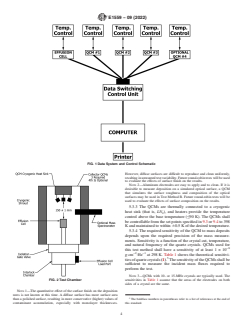
internal configuration, and a data acquisition system. Fig. 1 is
of the deposits.
a schematic of the systems, and Fig. 2 shows the vacuum
4.4 The effusion cell is loaded from the vacuum interlock
chamber and internal configuration.
chamber to the main test chamber and is positioned at a fixed
5.2 Vacuum Chamber—The principal components of the
distance and angle with respect to the QCM surfaces. The
vacuum chamber are the main test chamber, the vacuum
effusion cell is temperature controlled to provide constant and
interlock chamber, and cryogenic shrouds (for example, LN ).
uniform heating of the sample.The vacuum interlock chamber
A high-vacuum gate valve is used to isolate the main test
is a device that enables the expedient introduction of the test
chamber from the interlock chamber. This allows the effusion
sample into the high vacuum of the main test chamber. Use of
celltobewithdrawnorinsertedintothemainchamberwithout
theinterlockchambertoloadandunloadsamplespreventsloss
the loss of high vacuum in the main chamber. High-vacuum
of vacuum in the main chamber and diminishes the need to
electrical and mechanical feedthroughs are used to access the
pump it down before each test.
interior of the chamber.
4.5 The QCM collection method for measuring the total
5.3 Internal Configuration—Three quartz crystal microbal-
outgassing rate from a sample is an indirect technique. Rather
ances(QCMs)(afourthQCMisoptional),aneffusioncell,and
than directly measuring sample mass loss, the basic measure-
cryogenic heat sinks in the chamber are the principal compo-
ment is the fraction of the flux that condenses on the cryogeni-
nents. The cryogenic heat sinks are used to ground the QCMs
cally cooled QCM collector at a point in the outgassing flow
thermally and to cool shrouds which surround the effusion cell
field. That point in the flow field is defined as the geometric
and QCMs. The cold shrouds limit molecular contaminant
location of the QCM relative to the effusion cell orifice, which
fluxestotheline-of-sightoutgassingfluxfromtheeffusioncell
isatafixedlocation.Todeterminetherateofsamplemassloss
orifice to the collector QCMs. The cryogenic heat sink system
from the rate of QCM collection, the view factor from the
(LN reservoirs) and shrouds, effusion cell, and QCMs are
QCMtotheeffusioncellorificeandtheangulardistributionof
shown in Fig. 2.
flux leaving the orifice must be determined. This relationship
5.3.1 The QCMs are thermally shielded from each other so
canbecalculatedfromtheapparatusgeometryandtheeffusion
that the temperatures of each can be controlled independently.
cell orifice dimensions.
Each QCM has its own temperature sensing and control
4.6 AQCMthermogravimetricanalysis(QTGA)testisalso system.
included in the procedure.This technique heats the QCMs at a 5.3.2 Each QCM contains two crystals (one for mass
constant rate to measure evaporation characteristics of the collectionandoneforreference),theoscillatorelectronics,and
deposits collected on the QCMs. The QTGA also provides an a temperature sensor. The QCM crystals shall have optically
effective means to clean the QCM surfaces before subsequent polished surfaces (60/40 cerium polish). Uncoated, aluminum
tests. electrodes shall be used for the sensing and reference crystals.
E1559 − 09 (2022)
FIG. 1 Data System and Control Schematic
However, diffuse surfaces are difficult to reproduce and clean uniformly,
resultinginunwantedtestvariability.Futureround-robintestswillbeused
to evaluate the effects of surface finish on the results.
NOTE 2—Aluminum electrodes are easy to apply and to clean. If it is
desirable to measure deposition on a simulated optical surface, a QCM
that simulates the surface roughness and composition of the optical
surfaces may be used in Test Method B. Future round-robin tests will be
used to evaluate the effects of surface composition on the results.
5.3.3 The QCMs are thermally connected to a cryogenic
heat sink (that is, LN ), and heaters provide the temperature
control above the base temperature (≤90 K). The QCMs shall
becontrollablefromthesetpointsspecifiedin9.3or9.4to398
Kandmaintainedtowithin 60.5Kofthedesiredtemperature.
5.3.4 The required sensitivity of the QCM to mass deposits
depends upon the required precision of the mass measure-
ments. Sensitivity is a function of the crystal cut, temperature,
and natural frequency of the quartz crystals. QCMs used for
−8
this test method shall have a sensitivity of at least 1 × 10
−2 −1
g·cm ·Hz at 298 K. Table 1 shows the theoretical sensitivi-
tiesofquartzcrystals (1). ThesensitivityoftheQCMsshallbe
sufficient to measure the incident mass fluxes required to
perform the test.
NOTE 3—QCMs with 10- or 15-MHz crystals are typically used. The
FIG. 2 Test Chamber sensitivities in Table 1 assume that the areas of the electrodes on both
sides of a crystal are the same.
NOTE 1—The quantitative effect of the surface finish on the deposition
rates is not known at this time. A diffuse surface has more surface area
than a polished surface, resulting in more conservative (higher) values of The boldface numbers in parentheses refer to a list of references at the end of
contaminant accumulation, especially with monolayer thicknesses. this standard.
E1559 − 09 (2022)
TABLE 1 AT or Rotated Cut Crystal with Identical Electrode Areas
performing ramp functions, in which temperatures are in-
on Each Side of the Crystal
creased at a constant rate of 1 K per minute.
Natural Frequency (f), Sensitivity at 298 K (K ),
s
−2 −1
NOTE 9—Users should be aware that the QTGAheating rate can affect
MHz g·cm ·Hz
thetestdata.Aheatingrateof1Kperminutewasselectedforpracticality.
−9
10 4.42 × 10
−9
1 K per minute was found to provide good agreement with the predicted
15 1.96 × 10
−9
evaporationratesofwaterusingvaporpressuredata.Higherratesshowed
20 1.10 × 10
significanterrors.ThisiscoveredinRef (2).Lowerrateshavealsoshown
differences but will result in long, impractical test times.
5.5 DataAcquisitionSystem—Dataacquisition,storage,and
manipulation can be accomplished by any method that is
5.3.5 The QCMs are arranged symmetrically so that each
capable of measuring the frequencies of the QCMs, the
QCM has the same view factor to the effusion cell orifice.The
temperatures of the QCMs and the effusion cell, and the times
QCMs are angled 10 6 0.5° off the normal to the plane of the
of data collection at specified intervals. Experimental or
effusion cell orifice so that the axes of the QCMs intersect at a
processed data shall be stored for later retrieval for further
common point that coincides with the location of the effusion
analysis. An automated, computer operated data collection
cell orifice when the cell is placed in its standard position.The
system is recommended.
distance from the effusion cell orifice to each QCM collector
surface is 150 6 1 mm.
6. Support Equipment/Materials
NOTE 4—This QCM to collector surface geometry is mandated forTest 6.1 Analytical Microbalance, with a 30 g or greater tare, a
Method A. See 9.1 for Test Method B, allowing nonstandard geometries
readability of 10 µg or better, and a precision of 610 µg is
and test conditions.
required for recording mass changes of the samples.
NOTE 5—The QCMs shall be placed so that the active surface of any
QCM cannot “see” the active surface of any other QCM.
6.2 Oil-Free Aluminum Foil, is recommended as a nonout-
gassing substrate.
5.3.6 The effusion cell is cylindrical, and the recommended
dimensions are 65 6 5-mm inside diameter by 50 65mmin
6.3 High Purity, Low NVR Solvents are required for clean-
depth. Effusion cell dimensions shall accommodate the stan-
ing the effusion cell and other hardware before insertion into
dard sample geometries described in Section 8. The flux
the vacuum chamber. Suitable reagent grade solvents include
distributionoftheoutgassingproductsleavingtheeffusioncell
acetone, methanol, ethanol, and an azeotropic mixture of ethyl
is controlled by the cylindrical orifice in the top of the effusion
acetate (47% volume) and cyclohexane (53% volume).
cell.The orifice size shall be 3.0 6 0.1-mm diameter by 3.0 6
NOTE 10—Methyl chloroform, used in these practices, is toxic, and is
0.1-mm long.
being phased out for many applications. Methyl chloroform has been
replaced in this edition of these practices. The replacement solvents were
NOTE 6—This orifice size is mandated for conformance to this test
selected based on tests and analyses performed by The Aerospace
method.
Corporation and described in SMC-TR-95–28.
5.3.7 Thecellshallbemachinedfromaluminum(Note7)or
6.3.1 LowNVRhexaneortolueneisrequiredtocleanQCM
copper (Note 8) for high thermal conductivity. The cell shall
surfaces.
have an integral heater and temperature sensor. The integral
heatershallbecapableofuniformlyheatingtheeffusioncellto
NOTE11—SomeQCMsmayusematerialsontheelectrodesthatarenot
398 K within 20 min after inserting the cell into the main compatible with some solvents. Cleaning instructions from the QCM
manufacturer should be followed.
vacuum chamber.
6.3.2 Swabs shall be extracted to have a low NVR.
NOTE 7—Wrought aluminum alloys such as the 2000 and 6000 series
can be used.
NOTE 12—Commercial swabs may be acceptable but should be tested
NOTE 8—OFHC (oxygen free, high conductivity) copper has been
before use for NVR and suitability for this application.
found to be satisfactory.
6.3.3 Gloves shall be powder-free latex or polyethylene.
5.3.8 Effusioncelltemperaturesshallbecontrolledtowithin
60.5 K. NOTE 13—Powder-free latex gloves are available commercially. Com-
mercial gloves should be tested for suitability before use.
5.3.9 The positioning mechanism shall place the exit plane
of the effusion cell orifice at a distance of 150 6 1 mm from
6.4 An accurate micrometer is required to measure sample
the surface of the sensing crystal in each QCM.
dimensions. Dimensions shall be determined to an accuracy of
5.3.10 A shroud, cooled with a cryogenic heat sink, shall
61% of the dimension.
surround the effusion cell to minimize the reflection of mo-
lecularfluxfromthechamberwalltotheQCMs.Ashuttermay
7. Hardware Cleaning
beusedovertheorificetoisolatetheQCMsfromthemolecular
NOTE 14—The following guidelines should be followed upon the
flux. removal of the QCMs.
7.1 Vacuum System:
5.4 Temperature Control System—All temperatures of the
7.1.1 Clean in accordance with good vacuum practices
effusion cell and the QCMs are maintained by independently
controlled heaters to a precision of 60.5 K or better. In before assembly.
addition to maintaining temperatures at selected specific 7.1.2 Metal components may be chemically cleaned using
values, the controller for the QCMs shall be capable of procedures appropriate to the material.
E1559 − 09 (2022)
7.1.3 Some residual contamination may be removed using mented.Testsamplemassshallbemeasuredonamicrobalance
toluene, methyl ethyl ketone, or acetone. Perform a final rinse to an accuracy of 610 µg.
with a low NVR solvent (see 6.3).
8.5 The identity and the procurement, acceptance, and
application specifications of the material used for the test
NOTE 15—Cleaning with solvents may be hazardous. All procedures
should be reviewed for conformance to local safety requirements.
sample shall be documented. Identification markings shall not
NOTE16—ThebackgroundaccumulationontheQCMsshallfallwithin
be applied to the sample. A separate ID tag that is removed
the rates in 9.3.2. To meet these rates, it may be necessary to bakeout the
during the test shall be used. The traceability of a particular
chamber in vacuum at temperatures up to 125°C. This should be
materialsampleshallbeachievedbyspecifyingthesupplierlot
performedwithouttheQCMsoranyotherequipmentinstalledthatcannot
or batch number, or both.
tolerate the temperature.
7.2 QCMs:
8.6 Unlessspecialhandlingisspecified,allsamplesshallbe
7.2.1 CarefullyrinsetheQCMcrystalswithcleansolventas
preconditionedbeforetestbyholdingthemat296K(23°C)in
specified in 6.3.1 so as not to damage the electrode surfaces.
a 50% relative humidity environment for at least 24 h. This
preconditioning procedure is the same as that specified in Test
NOTE 17—Some electrodes are extremely delicate (such as gold), and
Method E595.
care should be taken to prevent damage.
7.2.2 Extracted, seedless cotton balls or low NVR swabs 8.7 It is suggested that materials such as laminates,
adhesives, potting compounds, paints, and coatings that are
(see Note 12) may be used to wipe the crystal surfaces gently
to remove stubborn deposits. typically “cured” in some fashion be screened for degree of
cure before use in this test. The “degree of cure” for a sample
NOTE 18—Soft electrode surfaces, such as gold, should be rinsed with
can be performed in a differential scanning calorimetry (DSC)
the appropriate solvents and then cleaned using a vacuum bakeout.
test apparatus that is commonly available in analytical chem-
Mechanical cleaning, if required, must be done with great care.
istry labs. Materials that are not in a fully cured state can be
7.2.3 Ifseedlesscottonballsareused,theymaybeextracted
expected to outgas more than one that is fully cured. Phase
using a low NVR solvent in an ultrasonic bath or by Soxhlet
changes in these materials might occur during heating and
extraction. If an ultrasonic bath is used, at least two extraction
could affect temperature measurements in the effusion cell.
cycles shall be used. Each cycle shall use clean solvent.
7.2.4 QCM Sensor Housing—Cleaning of the sensor hous-
NOTE19—Itisdesirableforthespecimentobeingoodthermalcontact
with the effusion cell. However, this is affected by the shape and size of
ing shall follow good vacuum equipment practices and be
the specimen.
compatible with the housing materials.
8.8 Adhesives and Sealants—Castable adhesives and seal-
8. Test Specimen Specification
ants shall be cast and cured in a 10-mm diameter by 25-mm
long tube.The tube shall be made of a nonoutgassing material.
8.1 Outgassing kinetics depend upon the thickness of the
Film, paste, filled, and supported adhesives shall be cured
material and the surface area exposed to vacuum. The geom-
between two nonoutgassing plates, such as aluminum foil (see
etry of a material test sample shall be representative of the
6.2). Uniform edge thickness shall be maintained with dams,
application geometry for that material or selected such that the
shim, or clamps which are removed for the test. The sample
outgassing rates for other geometries can be inferred from the
dimensionsshallbe1mmthickby40mmsquare.Theexposed
outgassing rate data measured for the test sample. The test
adhesive surface area shall be measured.
sample geometry that satisfies this requirement depends on the
physical processes involved in outgassing for the specific test
8.9 Cable Insulation and Shrink Tubing—Cable insulation
material.
and shrink tubing shall be tested in the as-supplied geometry.
8.2 The dimensions of the sample and its holder or
8.10 Conformal Coatings—Conformal coatings shall be ap-
substrate, where applicable, shall be controlled, measured, and
plied to a nonoutgassing substrate, such as aluminum foil (see
documented. Sample dimensions shall be measured to an
6.2). Cut the substrate into sections of small enough area to
accuracyof 61%.Samplesurfaceareaandvolumearecritical
stackintheeffusioncell.Donotpacktightlysothatoutgassing
todataanalysis.Fibervolumeandinertfillercompositionshall
rates from the coating surfaces are constrained by venting
be reported when applicable.
geometry.
8.3 The sample mass can range from 0.5 to 10 g, not
8.11 Electrical Components—Electrical components shall
including substrate. The specimen mass is determined by the
be tested in the as-supplied geometry.
quantityofoutgasseddepositsthatcanbemeasuredaccurately.
8.12 Electrical Shields—Electrical shields shall be tested in
This requirement is determined by apparatus measurement
the as-supplied geometry.
sensitivity limitations. The upper limit of specimen mass is
determined by the saturation of the QCM when the mass of 8.13 Films and Sheet Materials—Films and sheet materials
shall be tested in the as-supplied geometry. (Adhesive films
deposit becomes too large. With saturation, the circuit stops
oscillating. In addition, when the deposit of the QCM is a shall be cured and used as in 8.8.)
liquid,thefrequencychangeversusmassbecomesnonlinearas
8.14 Foams—Foams supplied as sheet stock shall be tested
the deposit becomes thicker.
in the as-supplied thicknesses. Sample dimensions shall be
8.4 The mass of the test sample and its holder or substrate, selected so as to have a surface area to volume that is
where applicable, shall be controlled, measured, and docu- representative of the application and to minimize edge effects.
E1559 − 09 (2022)
Foams supplied as castable curing materials shall be tested in 9.1.1 Clean the test chamber components before assembly
accordancewith8.8.Excesscuredfoamshallbetrimmedfrom in accordance with Section 7.
the top of the tube.
9.2 Test Chamber Preparation:
8.15 Grease, Lubricants, and Liquids—Grease, lubricants,
NOTE 20—The following three steps are only required for a new
and liquids shall be placed in a 25-mm-diameter, nonoutgas-
chamber or when major repairs are performed on the chamber.
sing (for example, aluminum) dish-type holder, to a depth of
9.2.1 Cleanthetestchamberbeforeassemblyinaccordance
approximately3mm.Thedish-typeholderisthenplacedinthe
with 7.1 to remove all residual molecular and particulate
effusion cell. The holder shall maintain a constant exposed
contamination resulting from the manufacturing processes.
liquid surface area during the evaporation process.
9.2.2 CleantheQCMsusingtheprocedurein7.2ifthereare
8.16 Lacing Tape and Cord Cable Ties—Lacing tape and
visible contaminants on the surfaces of the crystals or if bench
cord cable ties shall be tested in the as-supplied geometry.
tests show evidence of contamination.
8.17 Laminates and Circuit Boards—Laminates and circuit
9.2.3 Install the QCMs and other equipment.
boards shall be tested in the as-supplied geometry. A sample
9.2.4 Clean the effusion cell in accordance with 7.1.
sizeofapproximately40by40mmisacceptable.Thepresence
9.2.5 Close the isolation gate valve between the interlock
and orientation of reinforcements affects diffusion rates. Out-
and main chambers if it is not already closed.
gassingfromresin-richsurfacespredominatesduringtheinitial
9.2.6 Placetheemptyeffusioncellintheinterlockchamber.
period. Then, diffusion may occur parallel to fiber paths; thus,
9.2.7 Replace the effusion cell load port cover.
laminate edge effects may be important, especially in thick
−3
9.2.8 Evacuate the interlock chamber to7×10 Pa (5 ×
samples. Distance to a free surface is an important consider-
−5
10 torr) or less.
ation. If anisotropy exists, prepare a special sample holder to
9.2.9 Heat the effusion cell to 398 K and continue for a
constrain the outgassing flow appropriately.
minimum of 12 h. Allow the cell to cool to ambient tempera-
8.18 Paint, Ink, Lacquers, and Varnishes—Paint, lacquers,
ture.
varnishes, and similar coatings shall be applied to a nonout-
−3 −
...