

ASTM C1786-19
(Specification)Standard Specification for Segmental Precast Reinforced Concrete Box Sections for Culverts, Storm Drains, and Sewers Designed According to AASHTO LRFD
General Information
- Abstract
ABSTRACT
This specification covers precast reinforced concrete box sections comprised of separate segments that once properly field assembled make the final structure. These structures are intended to be used for the construction of culverts and for the conveyance of storm water, industrial wastes, and sewage. This specification provides requirements for the acceptability of the box sections, material and manufacture, design, reinforcement, joints, repairs, inspection, and product marking.
SCOPE
1.1 This specification covers precast reinforced concrete box sections comprised of separate segments that once properly field assembled make the final structure. These structures are intended to be used for the construction of culverts and for the conveyance of storm water, industrial wastes and sewage.
Note 1: This specification is primarily a manufacturing and purchasing specification. However, box culverts manufactured to this standard are intended to meet the design requirements of the AASHTO LRFD Bridge Design Specifications, and as such, design guidance is included in Appendix X1.
Note 2: The successful performance of this product depends upon the proper selection of the box section, bedding, backfill, and care that the installation conforms to the construction specifications. The purchaser of the precast reinforced concrete box sections specified herein is cautioned that proper correlation of the loading conditions and the field requirements with the box section specified, and provision for inspection at the construction site, are required.
1.2 The values stated in inch-pound units are to be regarded as standard. No other units of measurement are included in this standard.
1.3 This international standard was developed in accordance with internationally recognized principles on standardization established in the Decision on Principles for the Development of International Standards, Guides and Recommendations issued by the World Trade Organization Technical Barriers to Trade (TBT) Committee.
- Status
- Published
- Publication Date
- 14-Jul-2019
- Technical Committee
- C13 - Concrete Pipe
- Drafting Committee
- C13.07 - Acceptance Specifications and Precast Concrete Box Sections
Buy Documents
ASTM C1786-19 - Standard Specification for Segmental Precast Reinforced Concrete Box Sections for Culverts, Storm Drains, and Sewers Designed According to AASHTO LRFD
REDLINE ASTM C1786-19 - Standard Specification for Segmental Precast Reinforced Concrete Box Sections for Culverts, Storm Drains, and Sewers Designed According to AASHTO LRFD
Overview
ASTM C1786-19 is the standard specification established by ASTM International for segmental precast reinforced concrete box sections used in culverts, storm drains, and sewers. These box section structures are formed from multiple precast segments, assembled on site to achieve the final configuration. This standard ensures these products are suitable for the conveyance of stormwater, sewage, and industrial wastes, and that they meet the rigorous design requirements set forth in the AASHTO LRFD Bridge Design Specifications.
ASTM C1786-19 provides comprehensive requirements related to materials, manufacturing, design, reinforcement, joints, repairs, inspection, and product marking, supporting high performance and quality in infrastructure projects.
Key Topics
Scope and Applicability
- Covers precast reinforced concrete box sections made from multiple field-assembled segments.
- Primarily a manufacturing and purchasing specification designed to align with AASHTO LRFD Bridge Design Specifications.
- Intended for use in culverts, storm drains, and sewers.
Material Requirements
- Specifies use of portland cement, admixtures, concrete aggregates, fly ash, slag cement, and reinforcing steel in accordance with relevant ASTM material standards.
- Allows various combinations of cementitious materials for enhanced durability.
- Permits the use of synthetic or non-synthetic fibers as optional nonstructural manufacturing materials.
Design and Reinforcement
- Requires compliance with AASHTO LRFD Bridge Design Specifications for all structural calculations and reinforcement layouts.
- Reinforcement must meet specified minimum yield strengths and be placed according to defined spacing and coverage requirements.
- Details guidelines for joint design to ensure adequate load transfer and tightness.
Manufacturing and Inspection
- Outlines manufacturing methods, including concrete mixing, forming, and curing processes.
- Sets specific permissible dimensional variations for all components to maintain quality and fit.
- Specifies physical testing and inspection protocols, including compressive strength tests and routine product evaluations at the manufacturing site.
Product Marking and Documentation
- Mandates marking on each box segment with span, rise, design covers, date, manufacturer, and orientation.
Applications
Segmental precast reinforced concrete box sections meeting ASTM C1786-19 are used extensively in civil infrastructure for:
- Culverts: Supporting load-bearing crossings beneath roads, railways, and embankments.
- Storm Drains: Managing stormwater flow to reduce flood risks in urban and industrial environments.
- Sewers: Conveying sanitary, storm, or combined flows efficiently and reliably.
- Industrial Waste Channels: Handling process water and effluent transport in manufacturing or processing facilities.
These box sections are favored for their ease of installation, consistent quality due to factory manufacturing, and ability to meet diverse site and structural requirements. Their design according to AASHTO LRFD principles ensures durability and reliable performance under varying load and environmental conditions.
Related Standards
Implementing ASTM C1786-19 may require reference to additional standards, including:
- AASHTO LRFD Bridge Design Specifications: Basis for design criteria and load assumptions.
- ASTM A615/A706/A1064: Specifications for steel reinforcement used in concrete.
- ASTM C33/C150/C595/C618/C989: Standards pertaining to concrete aggregates, cements, pozzolans, and slag.
- ASTM C494/C260/C1017: Standards for chemical and air-entraining admixtures.
- ASTM C309: Curing compound requirements.
- ACI 318: Building Code for structural concrete design and testing.
For compliance, ensure alignment between project specifications, installation practices, and all referenced standards.
Keywords: ASTM C1786-19, segmental precast reinforced concrete box sections, culverts, storm drains, sewers, AASHTO LRFD, reinforced concrete, infrastructure, drainage systems, ASTM standards, civil engineering.
Relations
- Effective Date
- 15-Jul-2019
- Effective Date
- 15-Apr-2024
- Effective Date
- 01-Feb-2024
- Effective Date
- 01-Oct-2019
- Refers
ASTM C309-19 - Standard Specification for Liquid Membrane-Forming Compounds for Curing Concrete - Effective Date
- 15-Jun-2019
- Effective Date
- 01-Apr-2019
- Effective Date
- 01-Jan-2019
- Effective Date
- 01-Nov-2018
- Effective Date
- 01-Jun-2018
- Effective Date
- 01-May-2018
- Effective Date
- 01-Jan-2018
- Effective Date
- 01-Jan-2018
- Effective Date
- 01-Oct-2017
- Effective Date
- 01-Oct-2017
- Effective Date
- 01-Apr-2017
Buy Documents
ASTM C1786-19 - Standard Specification for Segmental Precast Reinforced Concrete Box Sections for Culverts, Storm Drains, and Sewers Designed According to AASHTO LRFD
REDLINE ASTM C1786-19 - Standard Specification for Segmental Precast Reinforced Concrete Box Sections for Culverts, Storm Drains, and Sewers Designed According to AASHTO LRFD
Get Certified
Connect with accredited certification bodies for this standard

Institut za varilstvo d.o.o. (Welding Institute)
Slovenia's leading welding institute since 1952. ISO 3834, EN 1090, pressure equipment certification, NDT personnel, welder qualification. Only IIW Au
Sponsored listings
Frequently Asked Questions
ASTM C1786-19 is a technical specification published by ASTM International. Its full title is "Standard Specification for Segmental Precast Reinforced Concrete Box Sections for Culverts, Storm Drains, and Sewers Designed According to AASHTO LRFD". This standard covers: ABSTRACT This specification covers precast reinforced concrete box sections comprised of separate segments that once properly field assembled make the final structure. These structures are intended to be used for the construction of culverts and for the conveyance of storm water, industrial wastes, and sewage. This specification provides requirements for the acceptability of the box sections, material and manufacture, design, reinforcement, joints, repairs, inspection, and product marking. SCOPE 1.1 This specification covers precast reinforced concrete box sections comprised of separate segments that once properly field assembled make the final structure. These structures are intended to be used for the construction of culverts and for the conveyance of storm water, industrial wastes and sewage. Note 1: This specification is primarily a manufacturing and purchasing specification. However, box culverts manufactured to this standard are intended to meet the design requirements of the AASHTO LRFD Bridge Design Specifications, and as such, design guidance is included in Appendix X1. Note 2: The successful performance of this product depends upon the proper selection of the box section, bedding, backfill, and care that the installation conforms to the construction specifications. The purchaser of the precast reinforced concrete box sections specified herein is cautioned that proper correlation of the loading conditions and the field requirements with the box section specified, and provision for inspection at the construction site, are required. 1.2 The values stated in inch-pound units are to be regarded as standard. No other units of measurement are included in this standard. 1.3 This international standard was developed in accordance with internationally recognized principles on standardization established in the Decision on Principles for the Development of International Standards, Guides and Recommendations issued by the World Trade Organization Technical Barriers to Trade (TBT) Committee.
ABSTRACT This specification covers precast reinforced concrete box sections comprised of separate segments that once properly field assembled make the final structure. These structures are intended to be used for the construction of culverts and for the conveyance of storm water, industrial wastes, and sewage. This specification provides requirements for the acceptability of the box sections, material and manufacture, design, reinforcement, joints, repairs, inspection, and product marking. SCOPE 1.1 This specification covers precast reinforced concrete box sections comprised of separate segments that once properly field assembled make the final structure. These structures are intended to be used for the construction of culverts and for the conveyance of storm water, industrial wastes and sewage. Note 1: This specification is primarily a manufacturing and purchasing specification. However, box culverts manufactured to this standard are intended to meet the design requirements of the AASHTO LRFD Bridge Design Specifications, and as such, design guidance is included in Appendix X1. Note 2: The successful performance of this product depends upon the proper selection of the box section, bedding, backfill, and care that the installation conforms to the construction specifications. The purchaser of the precast reinforced concrete box sections specified herein is cautioned that proper correlation of the loading conditions and the field requirements with the box section specified, and provision for inspection at the construction site, are required. 1.2 The values stated in inch-pound units are to be regarded as standard. No other units of measurement are included in this standard. 1.3 This international standard was developed in accordance with internationally recognized principles on standardization established in the Decision on Principles for the Development of International Standards, Guides and Recommendations issued by the World Trade Organization Technical Barriers to Trade (TBT) Committee.
ASTM C1786-19 is classified under the following ICS (International Classification for Standards) categories: 23.040.50 - Pipes and fittings of other materials. The ICS classification helps identify the subject area and facilitates finding related standards.
ASTM C1786-19 has the following relationships with other standards: It is inter standard links to ASTM C1786-18, ASTM A1064/A1064M-24, ASTM C989/C989M-24, ASTM C497-19a, ASTM C309-19, ASTM C150/C150M-19, ASTM C497-19, ASTM A1064/A1064M-18, ASTM C497-18b, ASTM C497-18a, ASTM C497-18, ASTM C822-18, ASTM C618-17, ASTM C989/C989M-17, ASTM C497-17. Understanding these relationships helps ensure you are using the most current and applicable version of the standard.
ASTM C1786-19 is available in PDF format for immediate download after purchase. The document can be added to your cart and obtained through the secure checkout process. Digital delivery ensures instant access to the complete standard document.
Standards Content (Sample)
This international standard was developed in accordance with internationally recognized principles on standardization established in the Decision on Principles for the
Development of International Standards, Guides and Recommendations issued by the World Trade Organization Technical Barriers to Trade (TBT) Committee.
Designation:C1786 −19
Standard Specification for
Segmental Precast Reinforced Concrete Box Sections for
Culverts, Storm Drains, and Sewers Designed According to
AASHTO LRFD
This standard is issued under the fixed designation C1786; the number immediately following the designation indicates the year of
original adoption or, in the case of revision, the year of last revision. A number in parentheses indicates the year of last reapproval. A
superscript epsilon (´) indicates an editorial change since the last revision or reapproval.
1. Scope* A706/A706M Specification for Deformed and Plain Low-
Alloy Steel Bars for Concrete Reinforcement
1.1 This specification covers precast reinforced concrete
A1064/A1064M Specification for Carbon-Steel Wire and
box sections comprised of separate segments that once prop-
Welded Wire Reinforcement, Plain and Deformed, for
erly field assembled make the final structure. These structures
Concrete
are intended to be used for the construction of culverts and for
C33/C33M Specification for Concrete Aggregates
the conveyance of storm water, industrial wastes and sewage.
C150/C150M Specification for Portland Cement
NOTE 1—This specification is primarily a manufacturing and purchas-
C260/C260M Specification for Air-Entraining Admixtures
ing specification. However, box culverts manufactured to this standard are
for Concrete
intended to meet the design requirements of the AASHTO LRFD Bridge
C309 Specification for Liquid Membrane-Forming Com-
Design Specifications, and as such, design guidance is included in
pounds for Curing Concrete
Appendix X1.
NOTE 2—The successful performance of this product depends upon the
C494/C494M Specification for Chemical Admixtures for
proper selection of the box section, bedding, backfill, and care that the
Concrete
installation conforms to the construction specifications. The purchaser of
C497 Test Methods for Concrete Pipe, Concrete Box
the precast reinforced concrete box sections specified herein is cautioned
Sections, Manhole Sections, or Tile
thatpropercorrelationoftheloadingconditionsandthefieldrequirements
C595/C595M Specification for Blended Hydraulic Cements
with the box section specified, and provision for inspection at the
construction site, are required.
C618 Specification for Coal Fly Ash and Raw or Calcined
Natural Pozzolan for Use in Concrete
1.2 The values stated in inch-pound units are to be regarded
C822 Terminology Relating to Concrete Pipe and Related
as standard. No other units of measurement are included in this
Products
standard.
C989/C989M Specification for Slag Cement for Use in
1.3 This international standard was developed in accor-
Concrete and Mortars
dance with internationally recognized principles on standard-
C1017/C1017M Specification for Chemical Admixtures for
ization established in the Decision on Principles for the
Use in Producing Flowing Concrete
Development of International Standards, Guides and Recom-
C1116/C1116M Specification for Fiber-Reinforced Concrete
mendations issued by the World Trade Organization Technical
C1602/C1602M Specification for Mixing Water Used in the
Barriers to Trade (TBT) Committee.
Production of Hydraulic Cement Concrete
2.2 AASHTO Standards:
2. Referenced Documents
AASHTO LRFD Bridge Design Specifications
2.1 ASTM Standards:
AASHTO LRFD Bridge Construction Specifications
A615/A615M SpecificationforDeformedandPlainCarbon- 4
2.3 ACI Standards:
Steel Bars for Concrete Reinforcement
ACI 318 Building Code Requirements for Structural Con-
crete
This test method is under the jurisdiction of ASTM Committee C13 on
3. Terminology
Concrete Pipe and is the direct responsibility of Subcommittee C13.07 on
Acceptance Specifications and Precast Concrete Box Sections. 3.1 Definitions of Terms Specific to This Standard:
Current edition approved July 15, 2019. Published August 2019. Originally
approved in 2014. Las previous edition approved in 2018 as C1786 – 18. DOI:
10.1520/C1786–19. Available from American Association of State Highway and Transportation
For referenced ASTM standards, visit the ASTM website, www.astm.org, or Officials (AASHTO), 444 N. Capitol St., NW, Suite 249, Washington, DC 20001,
contact ASTM Customer Service at service@astm.org. For Annual Book of ASTM http://www.transportation.org.
Standards volume information, refer to the standard’s Document Summary page on Available fromAmerican Concrete Institute (ACI), P.O. Box 9094, Farmington
the ASTM website. Hills, MI 48333-9094, http://www.concrete.org.
*A Summary of Changes section appears at the end of this standard
Copyright © ASTM International, 100 Barr Harbor Drive, PO Box C700, West Conshohocken, PA 19428-2959. United States
C1786−19
3.1.1 box section—the completed box culvert unit with all 5.4.1 Air-entraining admixture conforming to Specification
segments adjoined (see Fig. 1 for configuration options). C260/C260M;
5.4.2 Chemical admixture conforming to Specification
3.1.2 box segment—the individual piece (top slab, bottom
C494/C494M;
slab, or three-sided structure) that gets adjoined to other pieces
to complete the final box section
5.4.3 Chemical admixture for use in producing flowing
concrete conforming to Specification C1017/C1017M.
3.2 Definitions—Fordefinitionsoftermsrelatingtoconcrete
5.4.4 Chemical admixture or blend approved by the owner.
box culvert sections not found above, see Terminology C822.
5.5 Steel Reinforcement—Reinforcement shall consist of
4. Basis of Acceptance
welded wire reinforcement conforming to Specification
4.1 Acceptability of the box sections produced in accor-
A1064/A1064M or billet-steel bars conforming to Specifica-
dance with this standard shall be determined by the results of
tion A615/A615M, Grade 60 or A706/A706M, Grade 60. The
the concrete compressive strength tests described in Section
box culvert segments shall be manufactured with reinforce-
10, by the material requirements described in Section 5, and by
mentmeetingtheyieldstrengthsdesignatedinthedesignofthe
inspection of the finished box sections by the owner or their
box culvert, but the yield strength shall not be less than 60 ksi.
designee.
5.6 Fibers—Synthetic and non-synthetic fibers shall be
NOTE 3—The box culvert structure itself is not complete until it is fully
allowed to be used, at the manufacturer’s option, in concrete
assembled in the field. Field assembly is not included in this specification.
boxes as a nonstructural manufacturing material. Synthetic
However, a final field inspection is recommended before the box culvert
fibers (Type II and Type III) and non-synthetic fiber (Type I)
is considered fit for duty.
designed and manufactured specifically for use in concrete and
5. Material conforming to the requirements of Specification C1116/
C1116M shall be accepted.
5.1 Reinforced Concrete—The reinforced concrete shall
consist of cementitious materials, mineral aggregates, admix-
5.7 Water—Water used in the production of concrete shall
tures if used, and water, in which steel has been embedded in
be potable, or non-potable water that meets the requirements of
such a manner that the steel and concrete act together.
Specification C1602/C1602M.
5.2 Cementitious Materials:
6. Design
5.2.1 Cement—Cement shall conform to the requirements
for portland cement of Specification C150/C150M or shall be
6.1 Each segment of the box shall meet the requirements of
portland blast-furnace slag cement, portland-limestone cement,
the AASHTO LRFD Bridge Design Specifications. Guidance
or portland-pozzolan cement conforming to the requirements
is given in Appendix X1.
of Specification C595/C595M, except that the pozzolan con-
6.2 The manufacturer shall maintain on file a copy of a
stituent in the Type IP portland-pozzolan cement shall be fly
sealed “stamped” design by a professional engineer in accor-
ash.
dance with the AASHTO LRFD Bridge Design Specifications
5.2.2 Fly Ash—Fly ash shall conform to the requirements of
and this standard for each structure manufactured.
Specification C618, Class F or Class C.
5.2.3 Slag Cement—Slag cement shall conform to the re-
6.3 The minimum compressive strength of concrete seg-
quirementsofGrade100or120ofSpecificationC989/C989M.
ments produced to this standard shall be 4000 psi, unless
5.2.4 Allowable Combinations of Cementitious Materials—
otherwise designated by the engineer.
The combination of cementitious materials used in concrete
6.4 The manufacturer shall produce box culvert segments
shall be one of the following:
meetingthedesignrequirementsdesignatedinthedesignofthe
5.2.4.1 Portland cement only,
segmental precast box structure. As a minimum, the box
5.2.4.2 Portland blast-furnace slag cement only,
culvert segments shall meet the reinforcement layout, concrete
5.2.4.3 Portland-pozzolan cement only,
cover, and all other manufacturing details required by this
5.2.4.4 Portland-limestone cement only,
standard.
5.2.4.5 A combination of portland cement or portland-
limestone cement and fly ash,
6.5 The manufacturer may request approval by the pur-
5.2.4.6 A combination of portland cement or portland-
chaser for modified designs which differ from the requirements
limestone cement and slag cement, or
in this standard. When such modified designs are approved, it
5.2.4.7 A combination of portland cement or portland-
shall be so indicated on the manufactured box with the
limestone cement, slag cement, and fly ash, or
designation “C1786–Modified.”
5.2.4.8 A combination of portland-pozzolan cement and fly
NOTE 4—(Advisory)—Construction procedures, such as heavy equip-
ash.
ment movement or stockpiling of material over or adjacent to a box
5.3 Aggregates—Aggregates shall conform to Specification
structure can induce higher loads than those used for the structure’s final
C33/C33M,exceptthattherequirementsforgradationshallnot design. These construction and surcharge loads are allowable as long as
the final steel areas in the box are equal to or larger than those required for
apply.
the construction phase. The design engineer shall take into consideration
5.4 Admixtures—The following admixtures and blends are
the potential for higher loads induced by construction procedures in
allowable: determining the final design of the box structure.
C1786−19
FIG. 1Segment Configuration Options
C1786−19
7. Reinforcement lapped with the outside circumferential reinforcement in the
sides. If welds are made to welded wire circumferential
7.1 Placement of Reinforcement—Reinforcement shall be
reinforcement, they shall be made only to selected circumfer-
assembled utilizing any combination of single or multiple
ential wires that are not less than 18 in. apart along the
layersofweldedwirereinforcement,nottoexceedthreelayers,
longitudinal axis of the three-sided section. When spacers are
orutilizingsingleordoublelayersofdeformedbilletsteelbars.
welded to circumferential wires, they shall be welded only to
The cover of concrete over the circumferential reinforcement
these selected circumferential wires. There shall be no welding
shall be 1 in. except for when the box culvert has less than 2 ft
to other circumferential wires. No welds shall be made to the
of earth cover, then the concrete cover over the top slab
inside circumferential wires in the middle third of the top span.
reinforcement shall be 2 inches (see Figs. 2 and 3). Concrete
No welds shall be made to the outside circumferential wires in
cover shall be subject to the provisions of Section 11. The
the top span within one fourth of the span from the corners or
welded wire reinforcement shall be composed of circumferen-
in any location in either leg. Welding of deformed billet steel
tial and longitudinal wires meeting the spacing requirements of
bar circumferential reinforcement is prohibited in all cases.
7.2 and shall contain sufficient longitudinal wires extending
When distribution reinforcement is fastened to a cage by
through the box section to maintain the shape and position of
welding, it shall be welded only to longitudinal wires or bars
reinforcement.Longitudinaldistributionreinforcementshallbe
and only near the ends of the three-sided section. The spacing
welded-wire reinforcement or deformed billet-steel bars and
center to center of the circumferential reinforcement shall not
shall meet the spacing requirements of 7.2. The ends of the
be less than 2 in. nor more than 4 in. for welded wire
longitudinal distribution reinforcement shall not be more than
reinforcement, or less than 2 in. nor more than 8 in. for
2in.fromtheendsoftheboxsection.Theexposureoftheends
deformed billet steel bars. The spacing center to center of the
of longitudinals, stirrups, and spacers used to position the
longitudinal reinforcement shall not be more than 8 in. for
reinforcement shall not be a cause for rejection.
welded wire reinforcement or more than 12 in. for deformed
7.2 Laps, Welds, and Spacing—When deformed billet steel
billetsteelbars.IfweldsaremadetoGrade60reinforcingbars,
bars are utilized for the primary reinforcing, the requirements
weldable bars conforming to Specification A706/A706M shall
in the AASHTO LRFD Bridge Design Specifications, Section
be used.
5.11 for splices and development of reinforcement shall be
NOTE 5—(Advisory)—The AASHTO LRFD Bridge Design Specifica-
followed. When wire reinforcement is utilized, the require-
tions should be consulted for weld requirements and development lengths
ments of this section shall be followed. Splices in the circum-
not directly addressed in this standard.
ferential reinforcement shall be made by lapping. The overlap
measured between the outermost longitudinal wires of each 7.3 Minimum Reinforcement—Box culvert sections with
reinforcement sheet shall not be less than the space containing less than 2 ft of earth or pavement cover shall contain
twolongitudinalwiresofeachmeshplus2in.,butnotlessthan distribution reinforcement in the bottom of the top slab in
10inches.Nosplicingispermittedinindividualslabsegments. accordance withArticle 9.7.3.2 of theAASHTO LRFD Bridge
Design Specifications, but shall be no less than 0.002*Ag in
The outside circumferential reinforcement in the top or bottom
slab of a three-sided segment shall be continuous with, or accordance with Article 12.11.4.3.
FIG. 2Top Slab Reinforcement Placement
(Joint configuration is for illustration purposes only, and other configurations are acceptable.)
C1786−19
FIG. 3Bottom Slab Reinforcement Placement
(Joint configuration is for illustration purposes only, and other configurations are acceptable.)
8. Joints 9.2.3 Membrane Curing—A sealing membrane conforming
to the requirements of Specification C309 shall be applied and
8.1 The ends of the box segments shall be of such design
shall be left intact until the required concrete compressive
thateachsegmentcanbefittedtogethertoformacompletebox
strength is attained. The concrete temperature at the time of
section unit. The ends of the box section units shall be so
application shall be within 10°F of the atmospheric tempera-
formed that the sections can be laid together to make a
ture.All surfaces shall be kept moist prior to the application of
continuous line of box sections compatible with the permis-
the compounds and shall be damp when the compound is
sible variations given in Section 11.
applied.
8.2 Longitudinal joints shall be designed to carry the ap-
9.3 Forms—The forms used in manufacture shall be suffi-
plied vertical forces, and so formed so that they can be
ciently rigid and accurate to maintain the box section dimen-
assembled to transmit forces and provide joint tightness
sions within the permissible variations given in Section 10.All
consistent with the requirements for transverse joints.
casting surfaces shall be of smooth nonporous material.
9. Manufacture
9.4 Handling—Handling devices or holes are not prohibited
in each box segment for the purpose of handling and laying.
9.1 Mixture—The aggregates shall be sized, graded,
proportioned, and mixed with such proportions of cementitious
10. Physical Requirements
materials and water as will produce a thoroughly mixed
concrete of such quality that the box section will conform to 10.1 Type of Test Specimen—Compression tests for deter-
the test and design requirements of this specification. All mining concrete compressive strength shall be allowed to be
concrete shall have a water-cementitious materials ratio not made on either standard rodded concrete cylinders or concrete
exceeding 0.50 by weight. Cementitious materials shall be as cylinders compacted and cured in like manner as the box
specified in 5.2 and shall be added to the mix in a proportion segments, or on cores drilled from the box section.
not less than 470 lb/yd unless mix designs with a lower
10.2 Compression Testing of Cylinders:
cementitious materials content demonstrate that the quality and
10.2.1 Cylinders shall be prepared, cured, and tested in
performance of the box section meet the requirements of this
accordance with Section 11 of Test Methods C494/C494M.
specification.
Cylinders shall be exposed to the same curing conditions as the
9.2 Curing—The box segments shall be cured for a suffi- manufactured box segments and shall remain with the seg-
cient length of time so that the concrete will develop the ments until tested.
specifiedcompressivestrengthbythetimeofdelivery.Anyone 10.2.2 Prepare not less than three test cylinders from each
of the following methods of curing or combinations thereof concrete mix used within a lot (one day’s production) of box
shall be used: segments.
9.2.1 Steam Curing—The box segments shall be low 10.2.3 Acceptability on the Basis of Cylinder Test Results:
pressure, steam-cured by a system that will maintain a moist 10.2.3.1 When the average compressive strength of all
atmosphere. cylinders tested is equal to or greater than the design concrete
9.2.2 Water Curing—The box segments shall be water- strength, not more than 10 % of the cylinders tested have a
cured by any method that will keep the sections moist. compressive strength less than the design concrete strength,
C1786−19
and no cylinder tested has a compressive strength less than 80 11. Permissible Variations
% of the design concrete strength, the lot shall be accepted.
11.1 Internal Dimensions—The internal dimensions shall
10.2.3.2 Box segments that fail to meet the strength require-
not vary more than 1 % from the design dimensions. If
ments under 10.2 shall not be retested under 10.3 without the
haunches are used, the haunch dimensions shall not vary more
approval of the purchaser.
than ⁄4 in. from the design dimensions.
10.2.3.3 When the compressive strength of the cylinders is
NOTE 7—The size of the haunches shall be established by the Engineer.
unavailable, the acceptability of the lot shall be determined in
The use of haunches is not required. However, maintaining the proper
accordance with the provisions of 10.3.
concrete cover, while still maintaining the minimum
...
This document is not an ASTM standard and is intended only to provide the user of an ASTM standard an indication of what changes have been made to the previous version. Because
it may not be technically possible to adequately depict all changes accurately, ASTM recommends that users consult prior editions as appropriate. In all cases only the current version
of the standard as published by ASTM is to be considered the official document.
Designation: C1786 − 18 C1786 − 19
Standard Specification for
Segmental Precast Reinforced Concrete Box Sections for
Culverts, Storm Drains, and Sewers Designed According to
AASHTO LRFD
This standard is issued under the fixed designation C1786; the number immediately following the designation indicates the year of
original adoption or, in the case of revision, the year of last revision. A number in parentheses indicates the year of last reapproval. A
superscript epsilon (´) indicates an editorial change since the last revision or reapproval.
1. Scope*
1.1 This specification covers precast reinforced concrete box sections comprised of separate segments that once properly field
assembled make the final structure. These structures are intended to be used for the construction of culverts and for the conveyance
of storm water, industrial wastes and sewage.
NOTE 1—This specification is primarily a manufacturing and purchasing specification. However, box culverts manufactured to this standard are
intended to meet the design requirements of the AASHTO LRFD Bridge Design Specifications, and as such, design guidance is included in Appendix
X1.
NOTE 2—The successful performance of this product depends upon the proper selection of the box section, bedding, backfill, and care that the
installation conforms to the construction specifications. The purchaser of the precast reinforced concrete box sections specified herein is cautioned that
proper correlation of the loading conditions and the field requirements with the box section specified, and provision for inspection at the construction site,
are required.
1.2 The values stated in inch-pound units are to be regarded as standard. No other units of measurement are included in this
standard.
1.3 This international standard was developed in accordance with internationally recognized principles on standardization
established in the Decision on Principles for the Development of International Standards, Guides and Recommendations issued
by the World Trade Organization Technical Barriers to Trade (TBT) Committee.
2. Referenced Documents
2.1 ASTM Standards:
A615/A615M Specification for Deformed and Plain Carbon-Steel Bars for Concrete Reinforcement
A706/A706M Specification for Deformed and Plain Low-Alloy Steel Bars for Concrete Reinforcement
A1064/A1064M Specification for Carbon-Steel Wire and Welded Wire Reinforcement, Plain and Deformed, for Concrete
C33/C33M Specification for Concrete Aggregates
C150/C150M Specification for Portland Cement
C260/C260M Specification for Air-Entraining Admixtures for Concrete
C309 Specification for Liquid Membrane-Forming Compounds for Curing Concrete
C494/C494M Specification for Chemical Admixtures for Concrete
C497 Test Methods for Concrete Pipe, Concrete Box Sections, Manhole Sections, or Tile
C595/C595M Specification for Blended Hydraulic Cements
C618 Specification for Coal Fly Ash and Raw or Calcined Natural Pozzolan for Use in Concrete
C822 Terminology Relating to Concrete Pipe and Related Products
C989/C989M Specification for Slag Cement for Use in Concrete and Mortars
C1017/C1017M Specification for Chemical Admixtures for Use in Producing Flowing Concrete
C1116/C1116M Specification for Fiber-Reinforced Concrete
C1602/C1602M Specification for Mixing Water Used in the Production of Hydraulic Cement Concrete
This test method is under the jurisdiction of ASTM Committee C13 on Concrete Pipe and is the direct responsibility of Subcommittee C13.07 on Acceptance
Specifications and Precast Concrete Box Sections.
Current edition approved Jan. 1, 2018July 15, 2019. Published February 2018August 2019. Originally approved in 2014. Las previous edition approved in 20172018 as
C1786 – 17.18. DOI: 10.1520/C1786–18.10.1520/C1786–19.
For referenced ASTM standards, visit the ASTM website, www.astm.org, or contact ASTM Customer Service at service@astm.org. For Annual Book of ASTM Standards
volume information, refer to the standard’s Document Summary page on the ASTM website.
*A Summary of Changes section appears at the end of this standard
Copyright © ASTM International, 100 Barr Harbor Drive, PO Box C700, West Conshohocken, PA 19428-2959. United States
C1786 − 19
2.2 AASHTO Standards:
AASHTO LRFD Bridge Design Specifications
AASHTO LRFD Bridge Construction Specifications
2.3 ACI Standards:
ACI 318 Building Code Requirements for Structural Concrete
3. Terminology
3.1 Definitions of Terms Specific to This Standard:
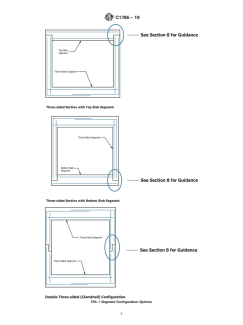
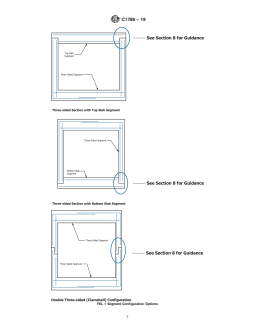
3.1.1 box section—the completed box culvert unit with all segments adjoined (see Fig. 1 for configuration options).
3.1.2 box segment—the individual piece (top slab, bottom slab, or three-sided structure) that gets adjoined to other pieces to
complete the final box section
3.2 Definitions—For definitions of terms relating to concrete box culvert sections not found above, see Terminology C822.
4. Basis of Acceptance
4.1 Acceptability of the box sections produced in accordance with this standard shall be determined by the results of the
concrete compressive strength tests described in Section 10, by the material requirements described in Section 5, and by inspection
of the finished box sections by the owner or their designee.
NOTE 3—The box culvert structure itself is not complete until it is fully assembled in the field. Field assembly is not included in this specification.
However, a final field inspection is recommended before the box culvert is considered fit for duty.
5. Material
5.1 Reinforced Concrete—The reinforced concrete shall consist of cementitious materials, mineral aggregates, admixtures if
used, and water, in which steel has been embedded in such a manner that the steel and concrete act together.
5.2 Cementitious Materials:
5.2.1 Cement—Cement shall conform to the requirements for portland cement of Specification C150/C150M or shall be
portland blast-furnace slag cement, portland-limestone cement, or portland-pozzolan cement conforming to the requirements of
Specification C595/C595M, except that the pozzolan constituent in the Type IP portland-pozzolan cement shall be fly ash.
5.2.2 Fly Ash—Fly ash shall conform to the requirements of Specification C618, Class F or Class C.
5.2.3 Slag Cement—Slag cement shall conform to the requirements of Grade 100 or 120 of Specification C989/C989M.
5.2.4 Allowable Combinations of Cementitious Materials—The combination of cementitious materials used in concrete shall be
one of the following:
5.2.4.1 Portland cement only,
5.2.4.2 Portland blast-furnace slag cement only,
5.2.4.3 Portland-pozzolan cement only,
5.2.4.4 Portland-limestone cement only,
5.2.4.5 A combination of portland cement or portland-limestone cement and fly ash,
5.2.4.6 A combination of portland cement or portland-limestone cement and slag cement, or
5.2.4.7 A combination of portland cement or portland-limestone cement, slag cement, and fly ash, or
5.2.4.8 A combination of portland-pozzolan cement and fly ash.
5.3 Aggregates—Aggregates shall conform to Specification C33/C33M, except that the requirements for gradation shall not
apply.
5.4 Admixtures—The following admixtures and blends are allowable:
5.4.1 Air-entraining admixture conforming to Specification C260/C260M;
5.4.2 Chemical admixture conforming to Specification C494/C494M;
5.4.3 Chemical admixture for use in producing flowing concrete conforming to Specification C1017/C1017M.
5.4.4 Chemical admixture or blend approved by the owner.
5.5 Steel Reinforcement—Reinforcement shall consist of welded wire reinforcement conforming to Specification A1064/
A1064M or billet-steel bars conforming to Specification A615/A615M, Grade 60 or A706/A706M, Grade 60. The box culvert
segments shall be manufactured with reinforcement meeting the yield strengths designated in the design of the box culvert, but
the yield strength shall not be less than 60 ksi.
Available from American Association of State Highway and Transportation Officials (AASHTO), 444 N. Capitol St., NW, Suite 249, Washington, DC 20001,
http://www.transportation.org.
Available from American Concrete Institute (ACI), P.O. Box 9094, Farmington Hills, MI 48333-9094, http://www.concrete.org.
C1786 − 19
FIG. 1 Segment Configuration Options
C1786 − 19
5.6 Fibers—Synthetic and non-synthetic fibers shall be allowed to be used, at the manufacturer’s option, in concrete boxes as
a nonstructural manufacturing material. Synthetic fibers (Type II and Type III) and non-synthetic fiber (Type I) designed and
manufactured specifically for use in concrete and conforming to the requirements of Specification C1116/C1116M shall be
accepted.
5.7 Water—Water used in the production of concrete shall be potable, or non-potable water that meets the requirements of
Specification C1602/C1602M.
6. Design
6.1 Each segment of the box shall meet the requirements of the AASHTO LRFD Bridge Design Specifications. Guidance is
given in Appendix X1.
6.2 The manufacturer shall maintain on file a copy of a sealed “stamped” design by a professional engineer in accordance with
the AASHTO LRFD Bridge Design Specifications and this standard for each structure manufactured.
6.3 The minimum compressive strength of concrete segments produced to this standard shall be 4000 psi, unless otherwise
designated by the engineer.
6.4 The manufacturer shall produce box culvert segments meeting the design requirements designated in the design of the
segmental precast box structure. As a minimum, the box culvert segments shall meet the reinforcement layout, concrete cover, and
all other manufacturing details required by this standard.
6.5 The manufacturer may request approval by the purchaser for modified designs which differ from the requirements in this
standard. When such modified designs are approved, it shall be so indicated on the manufactured box with the designation
“C1786–Modified.”
NOTE 4—(Advisory)—Construction procedures, such as heavy equipment movement or stockpiling of material over or adjacent to a box structure can
induce higher loads than those used for the structure’s final design. These construction and surcharge loads are allowable as long as the final steel areas
in the box are equal to or larger than those required for the construction phase. The design engineer shall take into consideration the potential for higher
loads induced by construction procedures in determining the final design of the box structure.
7. Reinforcement
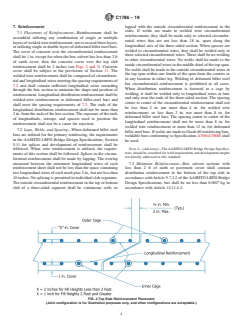
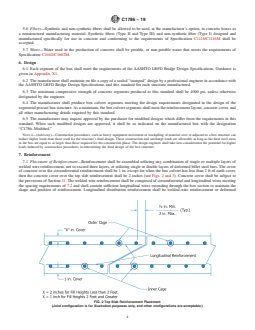
7.1 Placement of Reinforcement—Reinforcement shall be assembled utilizing any combination of single or multiple layers of
welded wire reinforcement, not to exceed three layers, or utilizing single or double layers of deformed billet steel bars. The cover
of concrete over the circumferential reinforcement shall be 1 in. except for when the box culvert has less than 2 ft of earth cover,
then the concrete cover over the top slab reinforcement shall be 2 inches (see Figs. 2 and 3). Concrete cover shall be subject to
the provisions of Section 11. The welded wire reinforcement shall be composed of circumferential and longitudinal wires meeting
the spacing requirements of 7.2 and shall contain sufficient longitudinal wires extending through the box section to maintain the
shape and position of reinforcement. Longitudinal distribution reinforcement shall be welded-wire reinforcement or deformed
FIG. 2 Top Slab Reinforcement Placement
(Joint configuration is for illustration purposes only, and other configurations are acceptable.)
C1786 − 19
FIG. 3 Bottom Slab Reinforcement Placement
(Joint configuration is for illustration purposes only, and other configurations are acceptable.)
billet-steel bars and shall meet the spacing requirements of 7.2. The ends of the longitudinal distribution reinforcement shall not
be more than 2 in. from the ends of the box section. The exposure of the ends of longitudinals, stirrups, and spacers used to position
the reinforcement shall not be a cause for rejection.
7.2 Laps, Welds, and Spacing—When deformed billet steel bars are utilized for the primary reinforcing, the requirements in the
AASHTO LRFD Bridge Design Specifications, Section 5.11 for splices and development of reinforcement shall be followed. When
wire reinforcement is utilized, the requirements of this section shall be followed. Splices in the circumferential reinforcement shall
be made by lapping. The overlap measured between the outermost longitudinal wires of each reinforcement sheet shall not be less
than the space containing two longitudinal wires of each mesh plus 2 in., but not less than 10 inches. No splicing is permitted in
individual slab segments. The outside circumferential reinforcement in the top or bottom slab of a three-sided segment shall be
continuous with, or lapped with the outside circumferential reinforcement in the sides. If welds are made to welded wire
circumferential reinforcement, they shall be made only to selected circumferential wires that are not less than 18 in. apart along
the longitudinal axis of the three-sided section. When spacers are welded to circumferential wires, they shall be welded only to
these selected circumferential wires. There shall be no welding to other circumferential wires. No welds shall be made to the inside
circumferential wires in the middle third of the top span. No welds shall be made to the outside circumferential wires in the top
span within one fourth of the span from the corners or in any location in either leg. Welding of deformed billet steel bar
circumferential reinforcement is prohibited in all cases. When distribution reinforcement is fastened to a cage by welding, it shall
be welded only to longitudinal wires or bars and only near the ends of the three-sided section. The spacing center to center of the
circumferential reinforcement shall not be less than 2 in. nor more than 4 in. for welded wire reinforcement, or less than 2 in. nor
more than 8 in. for deformed billet steel bars. The spacing center to center of the longitudinal reinforcement shall not be more than
8 in. for welded wire reinforcement or more than 12 in. for deformed billet steel bars. If welds are made to Grade 60 reinforcing
bars, weldable bars conforming to Specification A706/A706M shall be used.
NOTE 5—(Advisory)—The AASHTO LRFD Bridge Design Specifications should be consulted for weld requirements and development lengths not
directly addressed in this standard.
7.3 Minimum Reinforcement—Box culvert sections with less than 2 ft of earth or pavement cover shall contain distribution
reinforcement in the bottom of the top slab in accordance with Article 9.7.3.2 of the AASHTO LRFD Bridge Design Specifications,
but shall be no less than 0.002*Ag in accordance with Article 12.11.4.3.
8. Joints
8.1 The ends of the box segments shall be of such design that each segment can be fitted together to form a complete box section
unit. The ends of the box section units shall be so formed that the sections can be laid together to make a continuous line of box
sections compatible with the permissible variations given in Section 11.
8.2 Longitudinal joints shall be designed to carry the applied vertical forces, and so formed so that they can be assembled to
transmit forces and provide joint tightness consistent with the requirements for transverse joints.
9. Manufacture
9.1 Mixture—The aggregates shall be sized, graded, proportioned, and mixed with such proportions of cementitious materials
and water as will produce a thoroughly mixed concrete of such quality that the box section will conform to the test and design
C1786 − 19
requirements of this specification. All concrete shall have a water-cementitious materials ratio not exceeding 0.50 by weight.
Cementitious materials shall be as specified in 5.2 and shall be added to the mix in a proportion not less than 470 lb/yd unless
mix designs with a lower cementitious materials content demonstrate that the quality and performance of the box section meet the
requirements of this specification.
9.2 Curing—The box segments shall be cured for a sufficient length of time so that the concrete will develop the specified
compressive strength by the time of delivery. Any one of the following methods of curing or combinations thereof shall be used:
9.2.1 Steam Curing—The box segments shall be low pressure, steam-cured by a system that will maintain a moist atmosphere.
9.2.2 Water Curing—The box segments shall be water-cured by any method that will keep the sections moist.
9.2.3 Membrane Curing—A sealing membrane conforming to the requirements of Specification C309 shall be applied and shall
be left intact until the required concrete compressive strength is attained. The concrete temperature at the time of application shall
be within 10°F of the atmospheric temperature. All surfaces shall be kept moist prior to the application of the compounds and shall
be damp when the compound is applied.
9.3 Forms—The forms used in manufacture shall be sufficiently rigid and accurate to maintain the box section dimensions
within the permissible variations given in Section 10. All casting surfaces shall be of smooth nonporous material.
9.4 Handling—Handling devices or holes are not prohibited in each box segment for the purpose of handling and laying.
10. Physical Requirements
10.1 Type of Test Specimen—Compression tests for determining concrete compressive strength shall be allowed to be made on
either standard rodded concrete cylinders or concrete cylinders compacted and cured in like manner as the box segments, or on
cores drilled from the box section.
10.2 Compression Testing of Cylinders:
10.2.1 Cylinders shall be prepared, cured, and tested in accordance with Section 11 of Test Methods C494/C494M. Cylinders
shall be exposed to the same curing conditions as the manufactured box segments and shall remain with the segments until tested.
10.2.2 Prepare not less than three test cylinders from each concrete mix used within a lot (one day’s production) of box
segments.
10.2.3 Acceptability on the Basis of Cylinder Test Results:
10.2.3.1 When the average compressive strength of all cylinders tested is equal to or greater than the design concrete strength,
not more than 10 % of the cylinders tested have a compressive strength less than the design concrete strength, and no cylinder
tested has a compressive strength less than 80 % of the design concrete strength, the lot shall be accepted.
10.2.3.2 Box segments that fail to meet the strength requirements under 10.2 shall not be retested under 10.3 without the
approval of the purchaser.
10.2.3.3 When the compressive strength of the cylinders is unavailable, the acceptability of the lot shall be determined in
accordance with the provisions of 10.3.
10.3 Compression Testing of Cores:
10.3.1 Cores shall be obtained, prepared, and tested for compressive strength in accordance with the provisions of Test Methods
C497.
10.3.2 Three separate box sections shall be selected at random from each group of 15 box sections or fraction thereof, of a single
size from each continuous production run. Cores shall be taken from each individual box segment comprising the full box section.
10.3.3
...