

ASTM D5288-21
(Test Method)Standard Test Method for Determining Tracking Index of Electrical Insulating Materials Using Various Electrode Materials (Excluding Platinum)
General Information
- Abstract
SIGNIFICANCE AND USE
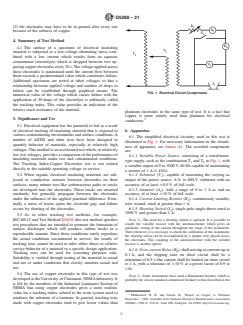
5.1 Electrical equipment has the potential to fail as a result of electrical tracking of insulating material that is exposed to various contaminating environments and surface conditions. A number of ASTM and other tests have been designed to quantify behavior of materials, especially at relatively high voltages. This method is an accelerated test which, at relatively low test voltages, provides a comparison of the performance of insulating materials under wet and contaminated conditions. The Tracking Index-Copper Electrodes test is not related directly to the suitable operating voltage in service.
5.2 When organic electrical insulating materials are subjected to conduction currents between electrodes on their surfaces, many minute tree-like carbonaceous paths or tracks are developed near the electrodes. These tracks are oriented randomly, but generally propagate between the electrodes under the influence of the applied potential difference. Eventually a series of tracks spans the electrode gap, and failure occurs by shorting of the electrodes.
5.3 As in other tracking test methods, for example, IEC 60112 and Test Method D3638, this test method specifies test procedures that are intended to promote the formation of surface discharges which will produce carbon tracks in a reproducible manner. Since these conditions rarely reproduce the actual conditions encountered in service, the results of tracking tests cannot be used to infer either direct or relative service behavior of a material in a specific design application. Tracking tests can be used for screening purposes only. Suitability is verified through testing of the material in actual end use or under conditions that closely simulate actual end use.
5.4 The use of copper electrodes in this type of test was developed at the University of Cincinnati, NEMA laboratory. It is felt by the members of the Industrial Laminates Section of NEMA that using copper electrodes gives a more realistic value for a tracking...
SCOPE
1.1 This test method was developed using copper electrodes to evaluate the low-voltage (up to 600 V) tracking resistance of materials in the presence of aqueous contaminants.2
Note 1: At this time, only industrial laminates have been examined using this method, which was developed at the National Manufacturers Electrical Association (NEMA) laboratory located at the University of Cincinnati. It was found that a closer end point (less scatter) was obtained than with platinum electrodes, and materials tested tended to be ranked by resin system.
1.1.1 It is acceptable to consider other electrode materials for use with this test method depending upon the application of the insulating material.
1.2 This test method is similar to Test Method D3638, which determines the comparative tracking index of materials using platinum electrodes to produce the tracking on the specimen surface.
1.3 The values stated in metric (SI) units are the standard. The inch-pound equivalents of the metric units are approximate.
1.4 This standard does not purport to address all of the safety concerns, if any, associated with its use. It is the responsibility of the user of this standard to establish appropriate safety, health, and environmental practices and determine the applicability of regulatory limitations prior to use.
1.5 Fire testing is inherently hazardous. Adequate safeguards for personnel and property shall be employed in conducting these tests.
1.6 This international standard was developed in accordance with internationally recognized principles on standardization established in the Decision on Principles for the Development of International Standards, Guides and Recommendations issued by the World Trade Organization Technical Barriers to Trade (TBT) Committee.
- Status
- Published
- Publication Date
- 31-Aug-2021
- Technical Committee
- D09 - Electrical and Electronic Insulating Materials
- Drafting Committee
- D09.12 - Electrical Tests
Buy Documents
ASTM D5288-21 - Standard Test Method for Determining Tracking Index of Electrical Insulating Materials Using Various Electrode Materials (Excluding Platinum)
REDLINE ASTM D5288-21 - Standard Test Method for Determining Tracking Index of Electrical Insulating Materials Using Various Electrode Materials (Excluding Platinum)
Overview
ASTM D5288-21, titled "Standard Test Method for Determining Tracking Index of Electrical Insulating Materials Using Various Electrode Materials (Excluding Platinum)", provides a reliable, reproducible method for evaluating the resistance of electrical insulating materials to surface tracking under wet and contaminated conditions. This test method, originally developed with copper electrodes, is particularly relevant to screening electrical insulators at low voltages (up to 600 V). The method is essential for identifying the relative tracking performance of materials, which is critical in assessing material safety and durability in electrical equipment.
Surface tracking, the development of conductive paths due to electrical stress and contaminants, can lead to insulation failure. ASTM D5288-21 offers standardized procedures to quantitatively compare materials’ resistance to this failure mode. Although widely used for screening purposes, test results should not be used as direct indicators of in-service performance without further end-use validations.
Key Topics
- Tracking Phenomena: The standard focuses on evaluating how organic electrical insulating materials develop localized carbonaceous paths (tracks), leading to potential insulation breakdown through short-circuiting.
- Test Methodology: Specimens are subjected to alternating voltage and contaminant droplets between opposing electrodes (typically copper). Tracking index (TI-Cu) is determined based on the voltage that causes failure within 50 contaminant drops.
- Electrode Materials: While copper is the primary electrode used, the method allows consideration of other materials depending on application needs, distinguishing it from standards relying solely on platinum electrodes.
- Test Conditions: The method specifies test voltages, electrode configuration and preparation, drop rate and solution, and reporting requirements to drive consistent, repeatable results.
- Significance of Results: The tracking index enables screening and comparison of insulating materials, especially for industrial laminates. However, it is not a direct substitute for application-specific testing.
Applications
ASTM D5288-21 is widely applied by laboratories, manufacturers, and quality assurance teams working with electrical insulating materials. Its key use cases include:
- Material Selection: Screening and comparing a range of polymeric and laminate insulators for their resistance to tracking, especially under wet or contaminated conditions commonly encountered in the field.
- Industrial Laminates: The method's development and main use have focused on industrial laminate materials, providing significant insights into performance differences caused by variations in resin systems or substrates.
- Product Development: Early-stage evaluation allows engineers to identify materials with suitable tracking resistance, guiding product design before more costly, full-scale testing.
- Regulatory Compliance and Quality Assurance: Ensures materials meet industry requirements and internal standards for safety and durability.
- Benchmarking: Manufacturers can compare new material formulations or suppliers, ensuring competitive and compliant electrical insulation performance.
Related Standards
ASTM D5288-21 has conceptual and procedural alignment with several global and industry standards related to electrical insulation testing:
- ASTM D3638 – Test Method for Comparative Tracking Index of Electrical Insulating Materials, using platinum electrodes.
- IEC 60112 – International standard for determining proof and comparative tracking indices of solid insulating materials.
- ASTM D618 – Practice for Conditioning Plastics for Testing.
- ASTM D1711 – Terminology Relating to Electrical Insulation.
- ASTM D3636 – Practice for Sampling and Judging Quality of Solid Electrical Insulating Materials.
Understanding these related standards ensures consistency, comparability, and broader acceptance of test results within the electrical insulation field.
Keywords: tracking index, electrical insulating materials, ASTM D5288-21, copper electrodes, surface tracking, insulation failure, comparative tracking index, industrial laminates, insulation testing, tracking resistance.
Relations
- Effective Date
- 01-Mar-2024
- Effective Date
- 01-Apr-2019
- Effective Date
- 01-Nov-2015
- Effective Date
- 01-Nov-2014
- Effective Date
- 01-May-2014
- Effective Date
- 01-Nov-2013
- Effective Date
- 01-Mar-2013
- Effective Date
- 01-Mar-2013
- Effective Date
- 01-Jan-2013
- Effective Date
- 01-Aug-2011
- Effective Date
- 15-Apr-2011
- Effective Date
- 01-Nov-2008
- Effective Date
- 01-May-2008
- Effective Date
- 01-Jun-2007
- Effective Date
- 01-Jun-2006
Buy Documents
ASTM D5288-21 - Standard Test Method for Determining Tracking Index of Electrical Insulating Materials Using Various Electrode Materials (Excluding Platinum)
REDLINE ASTM D5288-21 - Standard Test Method for Determining Tracking Index of Electrical Insulating Materials Using Various Electrode Materials (Excluding Platinum)
Get Certified
Connect with accredited certification bodies for this standard

IMQ S.p.A. (Certification)
Italian electrical product certification.

SLG Prüf- und Zertifizierungs GmbH
German testing and certification body.

UL Solutions
Global safety science company with testing, inspection and certification.
Sponsored listings
Frequently Asked Questions
ASTM D5288-21 is a standard published by ASTM International. Its full title is "Standard Test Method for Determining Tracking Index of Electrical Insulating Materials Using Various Electrode Materials (Excluding Platinum)". This standard covers: SIGNIFICANCE AND USE 5.1 Electrical equipment has the potential to fail as a result of electrical tracking of insulating material that is exposed to various contaminating environments and surface conditions. A number of ASTM and other tests have been designed to quantify behavior of materials, especially at relatively high voltages. This method is an accelerated test which, at relatively low test voltages, provides a comparison of the performance of insulating materials under wet and contaminated conditions. The Tracking Index-Copper Electrodes test is not related directly to the suitable operating voltage in service. 5.2 When organic electrical insulating materials are subjected to conduction currents between electrodes on their surfaces, many minute tree-like carbonaceous paths or tracks are developed near the electrodes. These tracks are oriented randomly, but generally propagate between the electrodes under the influence of the applied potential difference. Eventually a series of tracks spans the electrode gap, and failure occurs by shorting of the electrodes. 5.3 As in other tracking test methods, for example, IEC 60112 and Test Method D3638, this test method specifies test procedures that are intended to promote the formation of surface discharges which will produce carbon tracks in a reproducible manner. Since these conditions rarely reproduce the actual conditions encountered in service, the results of tracking tests cannot be used to infer either direct or relative service behavior of a material in a specific design application. Tracking tests can be used for screening purposes only. Suitability is verified through testing of the material in actual end use or under conditions that closely simulate actual end use. 5.4 The use of copper electrodes in this type of test was developed at the University of Cincinnati, NEMA laboratory. It is felt by the members of the Industrial Laminates Section of NEMA that using copper electrodes gives a more realistic value for a tracking... SCOPE 1.1 This test method was developed using copper electrodes to evaluate the low-voltage (up to 600 V) tracking resistance of materials in the presence of aqueous contaminants.2 Note 1: At this time, only industrial laminates have been examined using this method, which was developed at the National Manufacturers Electrical Association (NEMA) laboratory located at the University of Cincinnati. It was found that a closer end point (less scatter) was obtained than with platinum electrodes, and materials tested tended to be ranked by resin system. 1.1.1 It is acceptable to consider other electrode materials for use with this test method depending upon the application of the insulating material. 1.2 This test method is similar to Test Method D3638, which determines the comparative tracking index of materials using platinum electrodes to produce the tracking on the specimen surface. 1.3 The values stated in metric (SI) units are the standard. The inch-pound equivalents of the metric units are approximate. 1.4 This standard does not purport to address all of the safety concerns, if any, associated with its use. It is the responsibility of the user of this standard to establish appropriate safety, health, and environmental practices and determine the applicability of regulatory limitations prior to use. 1.5 Fire testing is inherently hazardous. Adequate safeguards for personnel and property shall be employed in conducting these tests. 1.6 This international standard was developed in accordance with internationally recognized principles on standardization established in the Decision on Principles for the Development of International Standards, Guides and Recommendations issued by the World Trade Organization Technical Barriers to Trade (TBT) Committee.
SIGNIFICANCE AND USE 5.1 Electrical equipment has the potential to fail as a result of electrical tracking of insulating material that is exposed to various contaminating environments and surface conditions. A number of ASTM and other tests have been designed to quantify behavior of materials, especially at relatively high voltages. This method is an accelerated test which, at relatively low test voltages, provides a comparison of the performance of insulating materials under wet and contaminated conditions. The Tracking Index-Copper Electrodes test is not related directly to the suitable operating voltage in service. 5.2 When organic electrical insulating materials are subjected to conduction currents between electrodes on their surfaces, many minute tree-like carbonaceous paths or tracks are developed near the electrodes. These tracks are oriented randomly, but generally propagate between the electrodes under the influence of the applied potential difference. Eventually a series of tracks spans the electrode gap, and failure occurs by shorting of the electrodes. 5.3 As in other tracking test methods, for example, IEC 60112 and Test Method D3638, this test method specifies test procedures that are intended to promote the formation of surface discharges which will produce carbon tracks in a reproducible manner. Since these conditions rarely reproduce the actual conditions encountered in service, the results of tracking tests cannot be used to infer either direct or relative service behavior of a material in a specific design application. Tracking tests can be used for screening purposes only. Suitability is verified through testing of the material in actual end use or under conditions that closely simulate actual end use. 5.4 The use of copper electrodes in this type of test was developed at the University of Cincinnati, NEMA laboratory. It is felt by the members of the Industrial Laminates Section of NEMA that using copper electrodes gives a more realistic value for a tracking... SCOPE 1.1 This test method was developed using copper electrodes to evaluate the low-voltage (up to 600 V) tracking resistance of materials in the presence of aqueous contaminants.2 Note 1: At this time, only industrial laminates have been examined using this method, which was developed at the National Manufacturers Electrical Association (NEMA) laboratory located at the University of Cincinnati. It was found that a closer end point (less scatter) was obtained than with platinum electrodes, and materials tested tended to be ranked by resin system. 1.1.1 It is acceptable to consider other electrode materials for use with this test method depending upon the application of the insulating material. 1.2 This test method is similar to Test Method D3638, which determines the comparative tracking index of materials using platinum electrodes to produce the tracking on the specimen surface. 1.3 The values stated in metric (SI) units are the standard. The inch-pound equivalents of the metric units are approximate. 1.4 This standard does not purport to address all of the safety concerns, if any, associated with its use. It is the responsibility of the user of this standard to establish appropriate safety, health, and environmental practices and determine the applicability of regulatory limitations prior to use. 1.5 Fire testing is inherently hazardous. Adequate safeguards for personnel and property shall be employed in conducting these tests. 1.6 This international standard was developed in accordance with internationally recognized principles on standardization established in the Decision on Principles for the Development of International Standards, Guides and Recommendations issued by the World Trade Organization Technical Barriers to Trade (TBT) Committee.
ASTM D5288-21 is classified under the following ICS (International Classification for Standards) categories: 29.035.01 - Insulating materials in general. The ICS classification helps identify the subject area and facilitates finding related standards.
ASTM D5288-21 has the following relationships with other standards: It is inter standard links to ASTM D1711-24, ASTM D3636-19, ASTM D1711-15, ASTM D1711-14a, ASTM D1711-14, ASTM D1711-13, ASTM D3636-13a, ASTM D3636-13ae1, ASTM D3636-13, ASTM D1711-11a, ASTM D3636-11, ASTM D618-08, ASTM D1711-08, ASTM D3638-07, ASTM D3636-06. Understanding these relationships helps ensure you are using the most current and applicable version of the standard.
ASTM D5288-21 is available in PDF format for immediate download after purchase. The document can be added to your cart and obtained through the secure checkout process. Digital delivery ensures instant access to the complete standard document.
Standards Content (Sample)
This international standard was developed in accordance with internationally recognized principles on standardization established in the Decision on Principles for the
Development of International Standards, Guides and Recommendations issued by the World Trade Organization Technical Barriers to Trade (TBT) Committee.
Designation: D5288 − 21
Standard Test Method for
Determining Tracking Index of Electrical Insulating Materials
Using Various Electrode Materials (Excluding Platinum)
This standard is issued under the fixed designation D5288; the number immediately following the designation indicates the year of
original adoption or, in the case of revision, the year of last revision.Anumber in parentheses indicates the year of last reapproval.A
superscript epsilon (´) indicates an editorial change since the last revision or reapproval.
1. Scope* mendations issued by the World Trade Organization Technical
Barriers to Trade (TBT) Committee.
1.1 Thistestmethodwasdevelopedusingcopperelectrodes
toevaluatethelow-voltage(upto600V)trackingresistanceof
2. Referenced Documents
materials in the presence of aqueous contaminants.
2.1 ASTM Standards:
NOTE 1—At this time, only industrial laminates have been examined
D618Practice for Conditioning Plastics for Testing
using this method, which was developed at the National Manufacturers
D1711Terminology Relating to Electrical Insulation
Electrical Association (NEMA) laboratory located at the University of
Cincinnati. It was found that a closer end point (less scatter) was obtained D3636Practice for Sampling and Judging Quality of Solid
thanwithplatinumelectrodes,andmaterialstestedtendedtoberankedby
Electrical Insulating Materials
resin system.
D3638Test Method for Comparative Tracking Index of
1.1.1 It is acceptable to consider other electrode materials
Electrical Insulating Materials
forusewiththistestmethoddependingupontheapplicationof
2.2 IEC Publication:
the insulating material.
IEC 60112Standard Method for the Determination of the
Proof and the Comparative Tracking Indices of Solid
1.2 This test method is similar to Test Method D3638,
Insulating Materials, 2003
which determines the comparative tracking index of materials
using platinum electrodes to produce the tracking on the
3. Terminology
specimen surface.
3.1 Definitions—For definitions of terms used in this test
1.3 The values stated in metric (SI) units are the standard.
method and associated with electrical and electronic insulating
The inch-pound equivalents of the metric units are approxi-
materials, use Terminology D1711.
mate.
3.2 Definitions of Terms Specific to This Standard:
1.4 This standard does not purport to address all of the
3.2.1 tracking index, TI, n—an index for electrical insulat-
safety concerns, if any, associated with its use. It is the
ingmaterialswhichisarbitrarilydefinedasthenumericalvalue
responsibility of the user of this standard to establish appro-
of that voltage which will cause failure by tracking when the
priate safety, health, and environmental practices and deter-
number of drops of contaminant required to cause failure is
mine the applicability of regulatory limitations prior to use.
equal to 50.
1.5 Fire testing is inherently hazardous. Adequate safe-
3.2.1.1 Discussion—This value is obtained from a plot of
guards for personnel and property shall be employed in
the number of drops required to cause failure by tracking
conducting these tests.
versus the applied voltage.
1.6 This international standard was developed in accor-
3.2.2 tracking index-copper electrodes, TI-Cu, n—a track-
dance with internationally recognized principles on standard-
ing index test using copper electrodes.
ization established in the Decision on Principles for the
3.2.2.1 Discussion—This test is comparable to comparative
Development of International Standards, Guides and Recom-
tracking index,Test Method D3638, with the following excep-
tions: (1) copper electrodes are used instead of platinum, and
This test method is under the jurisdiction of ASTM Committee D09 on
Electrical and Electronic Insulating Materials and is the direct responsibility of
Subcommittee D09.12 on Electrical Tests. For referenced ASTM standards, visit the ASTM website, www.astm.org, or
Current edition approved Sept. 1, 2021. Published October 2021. Originally contact ASTM Customer Service at service@astm.org. For Annual Book of ASTM
approved in 1992. Last previous edition approved in 2014 as D5288–14. DOI: Standards volume information, refer to the standard’s Document Summary page on
10.1520/D5288-21. the ASTM website.
2 4
Mathes, K. N., “Surface Failure Measurements,” in Engineering Dielectrics Available from International Electrotechnical Commission (IEC), 3, rue de
Volume IIB Electrical Properties of Solid Insulating Materials: Measurement Varembé, 1st floor, P.O. Box 131, CH-1211, Geneva 20, Switzerland, https://
Techniques, STP926, ASTM International, 1987. www.iec.ch.
*A Summary of Changes section appears at the end of this standard
Copyright © ASTM International, 100 Barr Harbor Drive, PO Box C700, West Conshohocken, PA 19428-2959. United States
D5288 − 21
(2) the electrodes may have to be re-ground after every test
because of the softness of copper.
4. Summary of Test Method
4.1 The surface of a specimen of electrical insulating
material is subjected to a low-voltage alternating stress com-
bined with a low current which results from an aqueous
contaminant (electrolyte) which is dropped between two op-
posingcopperelectrodesevery30s.Thevoltageappliedacross
these electrodes is maintained until the current flow between
them exceeds a predetermined value which constitutes failure.
Additional specimens are tested at other voltages so that a
relationship between applied voltage and number of drops to
failure can be established through graphical means. The
FIG. 1 Electrical Circuit Components
numerical value of the voltage which causes failure with the
application of 50drops of the electrolyte is arbitrarily called
the tracking index. This value provides an indication of the
relative track resistance of the material.
platinum electrodes in the same type of test. It is a fact that
copper is more widely used than platinum for electrical
5. Significance and Use 5
conductors.
5.1 Electrical equipment has the potential to fail as a result
of electrical tracking of insulating material that is exposed to 6. Apparatus
various contaminating environments and surface conditions.A
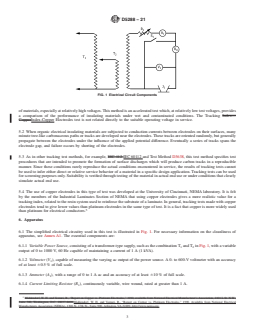
6.1 The simplified electrical circuitry used in this test is
number of ASTM and other tests have been designed to
illustrated in Fig. 1. For necessary information on the cleanli-
quantify behavior of materials, especially at relatively high
ness of apparatus, see Annex A1. The essential components
voltages.Thismethodisanacceleratedtestwhich,atrelatively
are:
lowtestvoltages,providesacomparisonoftheperformanceof
6.1.1 Variable Power Source, consisting of a transformer-
insulating materials under wet and contaminated conditions.
type supply, such as the combination T and T in Fig. 1, with
1 2
The Tracking Index-Copper Electrodes test is not related
a variable output of 0 to 1000V, 60 Hz capable of maintaining
directly to the suitable operating voltage in service.
a current of 1 A (1 kVA).
5.2 When organic electrical insulating materials are sub- 6.1.2 Voltmeter (V ), capable of measuring the varying ac
jected to conduction currents between electrodes on their output of the power source. A 0- to 600-V voltmeter with an
surfaces, many minute tree-like carbonaceous paths or tracks
accuracy of at least 60.5% of full scale.
are developed near the electrodes. These tracks are oriented 6.1.3 Ammeter (A ), with a range of 0 to 1 A ac and an
randomly, but generally propagate between the electrodes accuracy of at least 610% of full scale.
under the influence of the applied potential difference. Even- 6.1.4 Current Limiting Resistor (R ), continuously variable,
tually a series of tracks spans the electrode gap, and failure wire wound, rated at greater than 1 A.
occurs by shorting of the electrodes. 6.1.5 Shorting Switch (S ), single-pole single-throw rated at
1000 V and greater than 1 A.
5.3 As in other tracking test methods, for example,
IEC60112 and Test Method D3638, this test method specifies
NOTE 2—The need for a shorting switch is optional. It is possible to
couple the variable resistor with the autotransformer which gives an
test procedures that are intended to promote the formation of
automatic setting of the current throughout the range of the instrument.
surface discharges which will produce carbon tracks in a
Then whenever it is necessary to check the calibration of the instrument,
reproducible manner. Since these conditions rarely reproduce
the shorting action can be accomplished by a jumper wire placed across
the actual conditions encountered in service, the results of
the electrodes. This coupling of the autotransformer with the variable
tracking tests cannot be used to infer either direct or relative
resistor is another option.
service behavior of a material in a specific design application.
6.1.6 Over-current Relay(R ),shallnottripatcurrentsupto
Tracking tests can be used for screening purposes only.
0.1A, and the tripping time on short circuit shall be a
Suitability is verified through testing of the material in actual
minimum of 0.5 s (the current shall be limited on short circuit
end use or under conditions that closely simulate actual end
to 1A, with a tolerance of 610% at a power factor of 0.9 to
use.
1.0).
5.4 The use of copper electrodes in this type of test was
NOTE 3—Some instruments have used a Heinemann breaker, which is
developedattheUniversityofCincinnati,NEMAlaboratory.It
probably the closest standard commercial breaker to that described in the
is felt by the members of the Industrial Laminates Section of
NEMA that using copper electrodes gives a more realistic
value for a tracking index, related to the resin system used to
Middendorf, W. H. and Vemuri, R., “Report on Copper vs. Platinum
reinforce the substrate of a laminate. In general, tracking tests
Electrodes,” 1990. Available from National Electrical Manufacturers Association
made with copper electrodes tend to give lower values than (NEMA), 1300 N. 17th St., Suite 900,Arlington, VA22209, http://www.nema.org.
D5288 − 21
⁄2°C, the solution is suitable for use in the test. If the
resistivity is outside the above limits, adjust the concentration
until these limits are observed.Adjustment is accomplished by
adding water or NH Cl.
7.1.3 Calibrate the conductivity cell with 0.01 N potassium
chloride calibrating solution which is available from the cell
manufacturer.
8. Test Specimens
8.1 Select samples in accordance with Practice D3636.
8.2 Typical test specimens are 50 mm (2 in.) or 100 mm
(4in.)diameterdisksoranyothersimilarshape.Theminimum
thickness is 2.5 mm (0.100 in.). Test five specimens of each
sample.
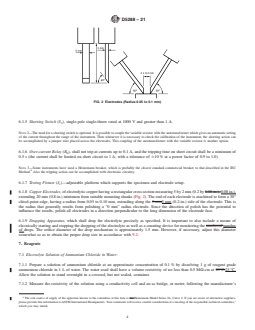
FIG. 2 Electrodes (Radius 0.05 to 0.1 mm) 8.3 Variations in values can result from a lack of uniformity
of dispersion of the material throughout the molded specimen
or from surface imperfections. Take care to prepare specimens
IEC Method. Also the tripping action can be
...
This document is not an ASTM standard and is intended only to provide the user of an ASTM standard an indication of what changes have been made to the previous version. Because
it may not be technically possible to adequately depict all changes accurately, ASTM recommends that users consult prior editions as appropriate. In all cases only the current version
of the standard as published by ASTM is to be considered the official document.
Designation: D5288 − 14 D5288 − 21
Standard Test Method for
Determining Tracking Index of Electrical Insulating Materials
Using Various Electrode Materials (Excluding Platinum)
This standard is issued under the fixed designation D5288; the number immediately following the designation indicates the year of
original adoption or, in the case of revision, the year of last revision. A number in parentheses indicates the year of last reapproval. A
superscript epsilon (´) indicates an editorial change since the last revision or reapproval.
1. Scope*
1.1 This test method was developed using copper electrodes to evaluate the low-voltage (up to 600 V) tracking resistance of
materials in the presence of aqueous contaminants.
NOTE 1—At this time, only industrial laminates have been examined using this method, which was developed at the National Manufacturers Electrical
Association (NEMA) laboratory located at the University of Cincinnati. It was found that a closer end point (less scatter) was obtained than with platinum
electrodes, and materials tested tended to be ranked by resin system.
1.1.1 It is acceptable to consider other electrode materials for use with this test method depending upon the application of the
insulating material.
1.2 This test method is similar to Test Method D3638, which determines the comparative tracking index of materials using
platinum electrodes to produce the tracking on the specimen surface.
1.3 The values stated in metric (SI) units are the standard. The inch-pound equivalents of the metric units are approximate.
1.4 This standard is used to measure and describe the response of materials, products, or assemblies to heat and flame under
controlled conditions, but does not by itself incorporate all factors required for fire hazard or fire risk assessment of the materials,
products, or assemblies under actual fire conditions.does not purport to address all of the safety concerns, if any, associated with
its use. It is the responsibility of the user of this standard to establish appropriate safety, health, and environmental practices and
determine the applicability of regulatory limitations prior to use.
1.5 Fire testing is inherently hazardous. Adequate safeguards for personnel and property shall be employed in conducting these
tests.
1.6 This international standard was developed in accordance with internationally recognized principles on standardization
established in the Decision on Principles for the Development of International Standards, Guides and Recommendations issued
by the World Trade Organization Technical Barriers to Trade (TBT) Committee.
This test method is under the jurisdiction of ASTM Committee D09 on Electrical and Electronic Insulating Materials and is the direct responsibility of Subcommittee
D09.12 on Electrical Tests.
Current edition approved Nov. 1, 2014Sept. 1, 2021. Published December 2014October 2021. Originally approved in 1992. Last previous edition approved in 20102014
as D5288 – 10.D5288 – 14. DOI: 10.1520/D5288-14.10.1520/D5288-21.
Mathes, K. N., Chapter 4, “Surface Failure Measurements,” Engineering Dielectrics, Vol IIB, Electrical Properties of Solid Insulating Materials, Measurement
Techniques, R. Bartnikas, Editor, ASTM STP 926, ASTM, Philadelphia, 1987.Mathes, K. N., “Surface Failure Measurements,” in Engineering Dielectrics Volume IIB
Electrical Properties of Solid Insulating Materials: Measurement Techniques, STP926, ASTM International, 1987.
*A Summary of Changes section appears at the end of this standard
Copyright © ASTM International, 100 Barr Harbor Drive, PO Box C700, West Conshohocken, PA 19428-2959. United States
D5288 − 21
2. Referenced Documents
2.1 ASTM Standards:
D618 Practice for Conditioning Plastics for Testing
D1711 Terminology Relating to Electrical Insulation
D3636 Practice for Sampling and Judging Quality of Solid Electrical Insulating Materials
D3638 Test Method for Comparative Tracking Index of Electrical Insulating Materials
2.2 IEC Publication:
IEC 60112 Standard Method for the Determination of the Proof and the Comparative Tracking Indices of Solid Insulating
Materials, 2003
3. Terminology
3.1 Definitions—For definitions of terms used in this test method and associated with electrical and electronic insulating materials,
use Terminology D1711.
3.2 Definitions of Terms Specific to This Standard:
3.2.1 track, n—a partially conducting path of localized deterioration on the surface of an insulating material.
3.2.2 tracking, n—the process that produces tracks as a result of the action of electric discharges on or close to an insulation
surface.
3.2.3 tracking, contamination, n—tracking caused by scintillations that result from the increased surface conduction due to
contamination.
3.2.1 tracking index, TI, n—an index for electrical insulating materials which is arbitrarily defined as the numerical value of that
voltage which will cause failure by tracking when the number of drops of contaminant required to cause failure is equal to 50.
3.2.1.1 Discussion—
This value is obtained from a plot of the number of drops required to cause failure by tracking versus the applied voltage.
3.2.2 tracking index–copperindex-copper electrodes, TI-Cu, n—a tracking index test using copper electrodes.
3.2.2.1 Discussion—
This test is comparable to comparative tracking index, Test Method D3638, with the following exceptions: (1) copper electrodes
are used instead of platinum, and (2) the electrodes may have to be re-ground after every test because of the softness of copper.
3.2.6 tracking resistance, n—the quantitative expression of the voltage and the time required to develop a track under specified
conditions.
4. Summary of Test Method
4.1 The surface of a specimen of electrical insulating material is subjected to a low-voltage alternating stress combined with a low
current which results from an aqueous contaminant (electrolyte) which is dropped between two opposing copper electrodes every
30 s. The voltage applied across these electrodes is maintained until the current flow between them exceeds a predetermined value
which constitutes failure. Additional specimens are tested at other voltages so that a relationship between applied voltage and
number of drops to failure can be established through graphical means. The numerical value of the voltage which causes failure
with the application of 50 drops 50 drops of the electrolyte is arbitrarily called the tracking index. This value provides an indication
of the relative track resistance of the material.
5. Significance and Use
5.1 Electrical equipment has the potential to fail as a result of electrical tracking of insulating material that is exposed to various
contaminating environments and surface conditions. A number of ASTM and other tests have been designed to quantify behavior
For referenced ASTM standards, visit the ASTM website, www.astm.org, or contact ASTM Customer Service at service@astm.org. For Annual Book of ASTM Standards
volume information, refer to the standard’s Document Summary page on the ASTM website.
Available from International Electrotechnical Commission (IEC), 3 Rue3, rue de Varembé, Case postale 1st floor, P.O. Box 131, CH-1211, Geneva 20, Switzerland,
http://www.iec.ch.https://www.iec.ch.
D5288 − 21
FIG. 1 Electrical Circuit Components
of materials, especially at relatively high voltages. This method is an accelerated test which, at relatively low test voltages, provides
a comparison of the performance of insulating materials under wet and contaminated conditions. The Tracking Index—
CopperIndex-Copper Electrodes test is not related directly to the suitable operating voltage in service.
5.2 When organic electrical insulating materials are subjected to conduction currents between electrodes on their surfaces, many
minute tree-like carbonaceous paths or tracks are developed near the electrodes. These tracks are oriented randomly, but generally
propagate between the electrodes under the influence of the applied potential difference. Eventually a series of tracks spans the
electrode gap, and failure occurs by shorting of the electrodes.
5.3 As in other tracking test methods, for example, IEC 112 IEC 60112 and Test Method D3638, this test method specifies test
procedures that are intended to promote the formation of surface discharges which will produce carbon tracks in a reproducible
manner. Since these conditions rarely reproduce the actual conditions encountered in service, the results of tracking tests cannot
be used to infer either direct or relative service behavior of a material in a specific design application. Tracking tests can be used
for screening purposes only. Suitability is verified through testing of the material in actual end use or under conditions that closely
simulate actual end use.
5.4 The use of copper electrodes in this type of test was developed at the University of Cincinnati, NEMA laboratory. It is felt
by the members of the Industrial Laminates Section of NEMA that using copper electrodes gives a more realistic value for a
tracking index, related to the resin system used to reinforce the substrate of a laminate. In general, tracking tests made with copper
electrodes tend to give lower values than platinum electrodes in the same type of test. It is a fact that copper is more widely used
than platinum for electrical conductors.
6. Apparatus
6.1 The simplified electrical circuitry used in this test is illustrated in Fig. 1. For necessary information on the cleanliness of
apparatus, see Annex A1. The essential components are:
6.1.1 Variable Power Source, consisting of a transformer-type supply, such as the combination T and T in Fig. 1, with a variable
1 2
output of 0 to 1000 V, 60 Hz capable of maintaining a current of 1 A (1 kVA).
6.1.2 Voltmeter (V ), capable of measuring the varying ac output of the power source. A 0- to 600-V voltmeter with an accuracy
of at least 60.5 % of full scale.
6.1.3 Ammeter (A ), with a range of 0 to 1 A ac and an accuracy of at least 610 % of full scale.
6.1.4 Current Limiting Resistor (R ), continuously variable, wire wound, rated at greater than 1 A.
Middendorf, W. H. and Vemuri, R., “Report on Copper vs. Platinum Electrodes,” 1990, available from National Electrical Manufacturer’s Association, 2101 L St. N.W.,
Suite 300, Washington, D.C. 20037-8400.Middendorf, W. H. and Vemuri, R., “Report on Copper vs. Platinum Electrodes,” 1990. Available from National Electrical
Manufacturers Association (NEMA), 1300 N. 17th St., Suite 900, Arlington, VA 22209, http://www.nema.org.
D5288 − 21
FIG. 2 Electrodes (Radius 0.05 to 0.1 mm)
6.1.5 Shorting Switch (S ), single-pole single-throw rated at 1000 V and greater than 1 A.
NOTE 2—The need for a shorting switch is optional. It is possible to couple the variable resistor with the autotransformer which gives an automatic setting
of the current throughout the range of the instrument. Then whenever it is necessary to check the calibration of the instrument, the shorting action can
be accomplished by a jumper wire placed across the electrodes. This coupling of the autotransformer with the variable resistor is another option.
6.1.6 Over-current Relay (R ), shall not trip at currents up to 0.1 A, and the tripping time on short circuit shall be a minimum of
0.5 s (the current shall be limited on short circuit to 1 A, with a tolerance of 610 % at a power factor of 0.9 to 1.0).
NOTE 3—Some instruments have used a Heinemann breaker, which is probably the closest standard commercial breaker to that described in the IEC
Method. Also the tripping action can be accomplished with electronic circuitry.
6.1.7 Testing Fixture (J )—adjustable platform which supports the specimen and electrode setup.
6.1.8 Copper Electrodes, of electrolytic copper having a rectan
...