

ASTM F1499-22
(Specification)Standard Specification for Coextruded Composite Drain, Waste, and Vent Pipe (DWV)
General Information
- Abstract
ABSTRACT
This specification covers co extruded composite drain, waste, and vent pipe (DWV). The pipe is produced in Schedule 40 IPS sizes by a co extrusion die system, in which the concentric layers are formed and combined before exiting the die. Coextruded composite drain, waste, and vent pipe, DWV, by definition, is permitted to be produced with two or more layers. The outer layer shall be ABS. The middle layer is permitted to be thermally foamed PVC or solid PVC or a blend of rework material, as specified. The inner layer is permitted to be solid PVC or ABS, or a blend of rework material as specified. The basic material used for pipes is a virgin compound which is used in the outer layer of co extruded composite drain, waste, and vent pipe or (DWV). It shall contain pigments or screening agents to provide protection against UV radiation. Different tests and measurements shall be conducted in order to determine the following properties of pipes: outside diameter, wall thickness, length, pipe flattening, pipe stiffness, impact strength, and bond. The inside and outside surfaces of pipe produced shall be free of chalking, sticky, or tacky material. The surfaces shall be free of excessive bloom. Bloom or chalking may develop in pipe exposed to direct rays of the sun (ultraviolet radiant energy) for extended periods and consequently, these requirements do not apply to pipe after extended exposure to direct rays of the sun. The inside and outside surfaces of pipe shall be free of foreign inclusion or other defects that re visible to the naked eye, and may affect the wall integrity.
SCOPE
1.1 This specification covers coextruded composite drain, waste, and vent pipe (DWV). The pipe is produced in Schedule 40 IPS sizes by a coextrusion die system, in which the concentric layers are formed and combined before exiting the die.
1.1.1 Coextruded composite drain, waste, and vent pipe, DWV, by definition, is permitted to be produced with two or more layers. The outer layer shall be ABS. The middle layer is permitted to be thermally foamed PVC or solid PVC or a blend of rework material, as specified in the rework material section. The inner layer is permitted to be solid PVC or ABS, or a blend of rework material as specified in the rework material section.
1.1.2 The function of this specification is to provide standardization of product, technical data, and serve as a purchasing guide.
1.2 DWV is permitted to be produced utilizing a two layer or three layer coextrusion die.
1.3 Materials that do not meet the requirements of the material section are excluded.
1.4 Pipe produced to this specification is permitted to be joined using molded fittings meeting the requirements of Specification D2661 or Specification F628. The fitting patterns must comply with Specification D3311.
1.5 Pipe produced to this specification is permitted to be perforated in accordance with any specified standard or by agreement between the purchaser and the supplier.
1.6 Pipe produced to this specification is permitted to be belled for joining by solvent cementing or belled for joining by an elastomeric seal (gasket), in accordance with any specified standard or by agreement between the purchaser and the supplier.
1.7 Recommendations for storage, joining, and installation are provided in Appendix X1, Appendix X2, and Appendix X3, respectively.
1.8 The values stated in inch-pound units are to be regarded as the standard. The SI units given in parentheses are for information only.
1.9 The text of this specification references notes, footnotes, and appendixes which provide explanatory material. These notes and footnotes (excluding those in tables and figures) shall not be considered as requirements of this specification.
Note 1: Specifications related to this specification are as follows: Specifications D2661, D2665, F628, and F891.
1.10 The values stated in inch-pound units are to be regarded as standard. The values giv...
- Status
- Published
- Publication Date
- 30-Jun-2022
- Technical Committee
- F17 - Plastic Piping Systems
- Drafting Committee
- F17.63 - DWV
Buy Documents
ASTM F1499-22 - Standard Specification for Coextruded Composite Drain, Waste, and Vent Pipe (DWV)
REDLINE ASTM F1499-22 - Standard Specification for Coextruded Composite Drain, Waste, and Vent Pipe (DWV)
Overview
ASTM F1499-22: Standard Specification for Coextruded Composite Drain, Waste, and Vent Pipe (DWV) establishes the requirements for coextruded composite DWV pipe systems with two or more layers, manufactured in Schedule 40 Iron Pipe Sizes (IPS) using a coextrusion die system. This standard is applicable to pipes incorporating different plastic compounds in concentric layers, ensuring product consistency, performance, and quality across the construction, plumbing, and building industries.
The outer layer of the pipe must be acrylonitrile-butadiene-styrene (ABS), and inner or middle layers can include solid or thermally foamed poly(vinyl chloride) (PVC), additional ABS, or blends of rework material. The purpose of ASTM F1499-22 is to define the manufacturing, quality, marking, and testing requirements, serving as a technical and purchasing guide for manufacturers, contractors, and code authorities.
Keywords: DWV pipe, coextruded composite pipe, ASTM F1499-22, Schedule 40 DWV, ABS pipe, PVC pipe, plastic drain pipe standard, plumbing standards.
Key Topics
Material Requirements:
- Outer layer is always virgin ABS compound with UV protection.
- Middle layer may be thermally foamed PVC, solid PVC, or a blend of rework material.
- Inner layer can be solid PVC, ABS, or permitted rework material.
- Only virgin (unprocessed) compound is allowed for the outer layer.
Manufacturing Process:
- Coextrusion forms concentric pipe layers prior to die exit.
- Pipes permitted to be manufactured with two or three layers.
Physical Properties and Quality:
- Pipes must be free from visible defects, foreign inclusions, excessive bloom, chalking, or tackiness.
- Strict dimensional tolerances for outside diameter, wall thickness, and length.
- Mechanical properties include pipe stiffness, impact strength, bond integrity, and flattening resistance.
Joining Methods:
- Compatible molded fittings as per ASTM D2661 or F628.
- Pipe may be joined by solvent cement or elastomeric gasket.
- Marking must specify material layers, pipe size, and appropriate codes.
Testing and Inspection:
- Quality control covers dimensions, strength, impact resistance, and joint integrity.
- Sampling and tests follow referenced ASTM methodologies.
- Manufacturer is responsible for ongoing compliance and product marking.
Applications
Coextruded composite DWV pipe designed according to ASTM F1499-22 is widely used in:
- Residential and Commercial Plumbing:
- Drainage, waste, and vent piping in new construction and retrofits.
- Building Infrastructure:
- Sewer and vent systems where stability, longevity, and code compliance are required.
- Industrial Settings:
- Select applications for handling non-industrial liquid waste (additional code authority approval recommended for industrial environments).
- Underground Installations:
- Suitable for burial under slabs and crawlspaces, following established installation and backfill guidelines.
- Custom and Standard Plumbing Systems:
- The specification supports systems with both solvent-weld and gasketed connections, as well as both perforated and non-perforated piping according to customer or project requirements.
Compliance with ASTM F1499-22 ensures DWV piping systems offer:
- Consistent quality and dimension control
- Reliable mechanical performance
- Compatibility with standard fittings and joining methods
- Marked traceability for inspection and code verification
Related Standards
Several other ASTM standards and industry documents are referenced and often used in conjunction with ASTM F1499-22, including:
- ASTM D2661: Specification for ABS Schedule 40 DWV pipe and fittings
- ASTM F628: Specification for ABS Schedule 40 pipe with cellular core
- ASTM D3311: Specification for DWV plastic fittings patterns
- ASTM D2665: Specification for PVC Schedule 40 DWV pipe and fittings
- ASTM D2235: Solvent cement for ABS pipes and fittings
- ASTM D1784 & D3965: Classification for PVC and ABS resin compounds
- ASTM D2122, D2412, D2444: Test methods for dimensions, loading, and impact resistance
By following ASTM F1499-22 and related standards, stakeholders can ensure plumbing systems are manufactured and installed to the highest performance and safety criteria recognized throughout the construction industry.
Relations
- Effective Date
- 01-Apr-2024
- Effective Date
- 01-Apr-2024
- Effective Date
- 01-Feb-2024
- Effective Date
- 01-Nov-2023
- Effective Date
- 01-Sep-2023
- Effective Date
- 01-Aug-2020
- Effective Date
- 01-Apr-2020
- Effective Date
- 15-Mar-2020
- Effective Date
- 15-Jan-2020
- Effective Date
- 01-Jan-2020
- Effective Date
- 01-Aug-2019
- Effective Date
- 15-Apr-2019
- Effective Date
- 01-Feb-2019
- Effective Date
- 01-Jan-2019
- Effective Date
- 01-Dec-2018
Buy Documents
ASTM F1499-22 - Standard Specification for Coextruded Composite Drain, Waste, and Vent Pipe (DWV)
REDLINE ASTM F1499-22 - Standard Specification for Coextruded Composite Drain, Waste, and Vent Pipe (DWV)
Get Certified
Connect with accredited certification bodies for this standard

Zavod za gradbeništvo Slovenije (ZAG) - Inšpekcija
ZAG inspection body for construction products, structures, and materials.
Sponsored listings
Frequently Asked Questions
ASTM F1499-22 is a technical specification published by ASTM International. Its full title is "Standard Specification for Coextruded Composite Drain, Waste, and Vent Pipe (DWV)". This standard covers: ABSTRACT This specification covers co extruded composite drain, waste, and vent pipe (DWV). The pipe is produced in Schedule 40 IPS sizes by a co extrusion die system, in which the concentric layers are formed and combined before exiting the die. Coextruded composite drain, waste, and vent pipe, DWV, by definition, is permitted to be produced with two or more layers. The outer layer shall be ABS. The middle layer is permitted to be thermally foamed PVC or solid PVC or a blend of rework material, as specified. The inner layer is permitted to be solid PVC or ABS, or a blend of rework material as specified. The basic material used for pipes is a virgin compound which is used in the outer layer of co extruded composite drain, waste, and vent pipe or (DWV). It shall contain pigments or screening agents to provide protection against UV radiation. Different tests and measurements shall be conducted in order to determine the following properties of pipes: outside diameter, wall thickness, length, pipe flattening, pipe stiffness, impact strength, and bond. The inside and outside surfaces of pipe produced shall be free of chalking, sticky, or tacky material. The surfaces shall be free of excessive bloom. Bloom or chalking may develop in pipe exposed to direct rays of the sun (ultraviolet radiant energy) for extended periods and consequently, these requirements do not apply to pipe after extended exposure to direct rays of the sun. The inside and outside surfaces of pipe shall be free of foreign inclusion or other defects that re visible to the naked eye, and may affect the wall integrity. SCOPE 1.1 This specification covers coextruded composite drain, waste, and vent pipe (DWV). The pipe is produced in Schedule 40 IPS sizes by a coextrusion die system, in which the concentric layers are formed and combined before exiting the die. 1.1.1 Coextruded composite drain, waste, and vent pipe, DWV, by definition, is permitted to be produced with two or more layers. The outer layer shall be ABS. The middle layer is permitted to be thermally foamed PVC or solid PVC or a blend of rework material, as specified in the rework material section. The inner layer is permitted to be solid PVC or ABS, or a blend of rework material as specified in the rework material section. 1.1.2 The function of this specification is to provide standardization of product, technical data, and serve as a purchasing guide. 1.2 DWV is permitted to be produced utilizing a two layer or three layer coextrusion die. 1.3 Materials that do not meet the requirements of the material section are excluded. 1.4 Pipe produced to this specification is permitted to be joined using molded fittings meeting the requirements of Specification D2661 or Specification F628. The fitting patterns must comply with Specification D3311. 1.5 Pipe produced to this specification is permitted to be perforated in accordance with any specified standard or by agreement between the purchaser and the supplier. 1.6 Pipe produced to this specification is permitted to be belled for joining by solvent cementing or belled for joining by an elastomeric seal (gasket), in accordance with any specified standard or by agreement between the purchaser and the supplier. 1.7 Recommendations for storage, joining, and installation are provided in Appendix X1, Appendix X2, and Appendix X3, respectively. 1.8 The values stated in inch-pound units are to be regarded as the standard. The SI units given in parentheses are for information only. 1.9 The text of this specification references notes, footnotes, and appendixes which provide explanatory material. These notes and footnotes (excluding those in tables and figures) shall not be considered as requirements of this specification. Note 1: Specifications related to this specification are as follows: Specifications D2661, D2665, F628, and F891. 1.10 The values stated in inch-pound units are to be regarded as standard. The values giv...
ABSTRACT This specification covers co extruded composite drain, waste, and vent pipe (DWV). The pipe is produced in Schedule 40 IPS sizes by a co extrusion die system, in which the concentric layers are formed and combined before exiting the die. Coextruded composite drain, waste, and vent pipe, DWV, by definition, is permitted to be produced with two or more layers. The outer layer shall be ABS. The middle layer is permitted to be thermally foamed PVC or solid PVC or a blend of rework material, as specified. The inner layer is permitted to be solid PVC or ABS, or a blend of rework material as specified. The basic material used for pipes is a virgin compound which is used in the outer layer of co extruded composite drain, waste, and vent pipe or (DWV). It shall contain pigments or screening agents to provide protection against UV radiation. Different tests and measurements shall be conducted in order to determine the following properties of pipes: outside diameter, wall thickness, length, pipe flattening, pipe stiffness, impact strength, and bond. The inside and outside surfaces of pipe produced shall be free of chalking, sticky, or tacky material. The surfaces shall be free of excessive bloom. Bloom or chalking may develop in pipe exposed to direct rays of the sun (ultraviolet radiant energy) for extended periods and consequently, these requirements do not apply to pipe after extended exposure to direct rays of the sun. The inside and outside surfaces of pipe shall be free of foreign inclusion or other defects that re visible to the naked eye, and may affect the wall integrity. SCOPE 1.1 This specification covers coextruded composite drain, waste, and vent pipe (DWV). The pipe is produced in Schedule 40 IPS sizes by a coextrusion die system, in which the concentric layers are formed and combined before exiting the die. 1.1.1 Coextruded composite drain, waste, and vent pipe, DWV, by definition, is permitted to be produced with two or more layers. The outer layer shall be ABS. The middle layer is permitted to be thermally foamed PVC or solid PVC or a blend of rework material, as specified in the rework material section. The inner layer is permitted to be solid PVC or ABS, or a blend of rework material as specified in the rework material section. 1.1.2 The function of this specification is to provide standardization of product, technical data, and serve as a purchasing guide. 1.2 DWV is permitted to be produced utilizing a two layer or three layer coextrusion die. 1.3 Materials that do not meet the requirements of the material section are excluded. 1.4 Pipe produced to this specification is permitted to be joined using molded fittings meeting the requirements of Specification D2661 or Specification F628. The fitting patterns must comply with Specification D3311. 1.5 Pipe produced to this specification is permitted to be perforated in accordance with any specified standard or by agreement between the purchaser and the supplier. 1.6 Pipe produced to this specification is permitted to be belled for joining by solvent cementing or belled for joining by an elastomeric seal (gasket), in accordance with any specified standard or by agreement between the purchaser and the supplier. 1.7 Recommendations for storage, joining, and installation are provided in Appendix X1, Appendix X2, and Appendix X3, respectively. 1.8 The values stated in inch-pound units are to be regarded as the standard. The SI units given in parentheses are for information only. 1.9 The text of this specification references notes, footnotes, and appendixes which provide explanatory material. These notes and footnotes (excluding those in tables and figures) shall not be considered as requirements of this specification. Note 1: Specifications related to this specification are as follows: Specifications D2661, D2665, F628, and F891. 1.10 The values stated in inch-pound units are to be regarded as standard. The values giv...
ASTM F1499-22 is classified under the following ICS (International Classification for Standards) categories: 93.030 - External sewage systems. The ICS classification helps identify the subject area and facilitates finding related standards.
ASTM F1499-22 has the following relationships with other standards: It is inter standard links to ASTM D2665-24, ASTM F891-24, ASTM D883-24, ASTM D883-23, ASTM F891-23, ASTM D2665-20, ASTM F412-20, ASTM D2321-20, ASTM D1784-20, ASTM D883-20, ASTM D883-19c, ASTM D883-19a, ASTM D883-19, ASTM F412-19, ASTM D883-18a. Understanding these relationships helps ensure you are using the most current and applicable version of the standard.
ASTM F1499-22 is available in PDF format for immediate download after purchase. The document can be added to your cart and obtained through the secure checkout process. Digital delivery ensures instant access to the complete standard document.
Standards Content (Sample)
This international standard was developed in accordance with internationally recognized principles on standardization established in the Decision on Principles for the
Development of International Standards, Guides and Recommendations issued by the World Trade Organization Technical Barriers to Trade (TBT) Committee.
Designation:F1499 −22 An American National Standard
Standard Specification for
Coextruded Composite Drain, Waste, and Vent Pipe (DWV)
This standard is issued under the fixed designation F1499; the number immediately following the designation indicates the year of
original adoption or, in the case of revision, the year of last revision.Anumber in parentheses indicates the year of last reapproval.A
superscript epsilon (´) indicates an editorial change since the last revision or reapproval.
1. Scope* 1.8 Thevaluesstatedininch-poundunitsaretoberegarded
as the standard. The SI units given in parentheses are for
1.1 This specification covers coextruded composite drain,
information only.
waste,andventpipe(DWV).ThepipeisproducedinSchedule
1.9 Thetextofthisspecificationreferencesnotes,footnotes,
40 IPS sizes by a coextrusion die system, in which the
concentric layers are formed and combined before exiting the and appendixes which provide explanatory material. These
notesandfootnotes(excludingthoseintablesandfigures)shall
die.
not be considered as requirements of this specification.
1.1.1 Coextruded composite drain, waste, and vent pipe,
DWV, by definition, is permitted to be produced with two or
NOTE 1—Specifications related to this specification are as follows:
more layers.The outer layer shall beABS.The middle layer is
Specifications D2661, D2665, F628, and F891.
permittedtobethermallyfoamedPVCorsolidPVCorablend
1.10 The values stated in inch-pound units are to be re-
of rework material, as specified in the rework material section.
garded as standard. The values given in parentheses are
TheinnerlayerispermittedtobesolidPVCorABS,orablend
mathematical conversions to SI units that are provided for
of rework material as specified in the rework material section.
information only and are not considered standard.
1.1.2 The function of this specification is to provide stan-
1.11 This standard does not purport to address all of the
dardization of product, technical data, and serve as a purchas-
safety concerns, if any, associated with its use. It is the
ing guide.
responsibility of the user of this standard to establish appro-
1.2 DWV is permitted to be produced utilizing a two layer
priate safety, health, and environmental practices and deter-
or three layer coextrusion die.
mine the applicability of regulatory limitations prior to use.
1.12 This international standard was developed in accor-
1.3 Materials that do not meet the requirements of the
dance with internationally recognized principles on standard-
material section are excluded.
ization established in the Decision on Principles for the
1.4 Pipe produced to this specification is permitted to be
Development of International Standards, Guides and Recom-
joined using molded fittings meeting the requirements of
mendations issued by the World Trade Organization Technical
SpecificationD2661orSpecificationF628.Thefittingpatterns
Barriers to Trade (TBT) Committee.
must comply with Specification D3311.
1.5 Pipe produced to this specification is permitted to be
2. Referenced Documents
perforated in accordance with any specified standard or by
2.1 The following standards contain provisions that, though
agreement between the purchaser and the supplier.
referenced in this specification, constitute provisions of this
1.6 Pipe produced to this specification is permitted to be specification. All standards are subject to revision and parties
belledforjoiningbysolventcementingorbelledforjoiningby using this specification, shall reference the most recent edition
an elastomeric seal (gasket), in accordance with any specified of the standards listed as follows:
standard or by agreement between the purchaser and the
2.2 ASTM Standards:
supplier.
D618Practice for Conditioning Plastics for Testing
1.7 Recommendations for storage, joining, and installation D696TestMethodforCoefficientofLinearThermalExpan-
sion of Plastics Between −30°C and 30°C with a Vitreous
are provided in Appendix X1, Appendix X2, and Appendix
Silica Dilatometer
X3, respectively.
D883Terminology Relating to Plastics
This specification is under the jurisdiction ofASTM Committee F17 on Plastic
Piping Systems and is the direct responsibility of Subcommittee F17.63 on DWV. For referenced ASTM standards, visit the ASTM website, www.astm.org, or
Current edition approved July 1, 2022. Published September 2022. Originally contact ASTM Customer Service at service@astm.org. For Annual Book of ASTM
published as approved in 1994. Last previous edition approved in 2017 as Standards volume information, refer to the standard’s Document Summary page on
F1499–17. DOI: 10.1520/F1499-22. the ASTM website.
*A Summary of Changes section appears at the end of this standard
Copyright © ASTM International, 100 Barr Harbor Drive, PO Box C700, West Conshohocken, PA 19428-2959. United States
F1499−22
D1600TerminologyforAbbreviatedTermsRelatingtoPlas- 3.1.1 Definitions are in accordance withTerminology D883
tics and F412. Abbreviations are in accordance with Terminology
D1784Classification System and Basis for Specification for D1600. Plastic materials are classified in accordance with
Rigid Poly(Vinyl Chloride) (PVC) Compounds and Chlo- Classification D4000.
rinated Poly(Vinyl Chloride) (CPVC) Compounds 3.1.2 coextruded pipe—pipe consisting of two or more
D2122Test Method for Determining Dimensions of Ther- concentric layers of material bonded together in processing by
moplastic Pipe and Fittings any combination of temperature, pressure, grafting,
D2235Specification for Solvent Cement for Acrylonitrile- crosslinking, or adhesion.
Butadiene-Styrene (ABS) Plastic Pipe and Fittings
3.1.3 compound—a mixture of a polymer with other ingre-
D2321PracticeforUndergroundInstallationofThermoplas-
dients such as inert fillers, stabilizers, catalysts, processing
tic Pipe for Sewers and Other Gravity-Flow Applications
aids, lubricants, impact modifiers, pigments, or curing agents.
D2412Test Method for Determination of External Loading
3.1.4 out-of-roundness—the allowed difference between the
Characteristics of Plastic Pipe by Parallel-Plate Loading
maximum measured diameter and the minimum measured
D2444Practice for Determination of the Impact Resistance
diameter (stated as an absolute deviation).
of Thermoplastic Pipe and Fittings by Means of a Tup
3.1.5 thermally foamed plastic—a cellular plastic produced
(Falling Weight)
by applying heat to effect gaseous decomposition or volatilize
D2661 Specification for Acrylonitrile-Butadiene-Styrene
of a constituent. (1985)
(ABS) Schedule 40 Plastic Drain, Waste, and Vent Pipe
and Fittings
3.1.6 virgin plastic, (adj)—materials in the form of pellets,
D2665Specification for Poly(Vinyl Chloride) (PVC) Plastic
granules, powder, floc, or liquid that has not been subjected to
Drain, Waste, and Vent Pipe and Fittings
use or processing other than that required for its initial
D3311Specification for Drain, Waste, and Vent (DWV)
manufacture. (1985)
Plastic Fittings Patterns
3.2 Definitions of Terms Specific to This Standard:
D3965ClassificationSystemandBasisforSpecificationsfor
3.2.1 ABS/PVC—an acronym for a blend of acrylonitrile-
Rigid Acrylonitrile-Butadiene-Styrene (ABS) Materials
butadiene-styrene and poly vinyl chloride.
for Pipe and Fittings
3.2.2 lot—a lot shall consist of all pipe produced, of one
D4000Classification System for Specifying Plastic Materi-
size, from one extrusion line, during one designated 24-h
als
period.
E105Guide for Probability Sampling of Materials
E122PracticeforCalculatingSampleSizetoEstimate,With 3.2.3 rework material—a blend of the different materials
generated from coextruded composite drain, waste, and vent
Specified Precision, the Average for a Characteristic of a
Lot or Process pipe (DWV).
F402 Practice for Safe Handling of Solvent Cements,
Primers, and Cleaners Used for Joining Thermoplastic 4. Classification
Pipe and Fittings
4.1 Coextruded composite drain, waste, and vent pipe,
F412Terminology Relating to Plastic Piping Systems
DWV, produced in compliance this specification will provide
F628 Specification for Acrylonitrile-Butadiene-Styrene
pipe suitable for the drainage and venting of sewage and
(ABS) Schedule 40 Plastic Drain, Waste, and Vent Pipe
certain other liquid wastes.
With a Cellular Core
NOTE 2—Before installing coextruded composite pipe in an industrial
F891Specification for Coextruded Poly(Vinyl Chloride)
waste disposal system, the approval of the cognizant building code
(PVC) Plastic Pipe With a Cellular Core
authorityshouldbeobtainedasconditionsnotcommonlyfoundinnormal
2.3 Federal Standard:
usemaybeencounteredandtemperaturesinexcessof180°F(82°C)may
be encountered.
Fed. Std. No. 123Marking for Shipments (CivilAgencies)
2.4 Military Standard:
5. Ordering Information
MIL-STD-129 Marking for Shipment and Storage
5.1 Orders for coextruded composite drain, waste, and vent
2.5 ANSI Standard:
pipe, DWV, produced in compliance with this specification
ANSI Z34.1American National Standard for Certification-
should include the following:
Third-Party Program
ANSI Z34.2 American National Standard for Certification- 5.1.1 ThisASTMdesignationnumber,andtheyearofissue,
Self-Certification by Producer or Supplier 5.1.2 Pipe size,
5.1.3 Footage required of each size, and
3. Terminology
5.1.4 Materials.
3.1 Definitions:
6. Materials and Manufacture
6.1 Basic Compound—Virgincompoundforuseintheouter
Available from Naval Publications and Forms Center, 5801 Tabor Ave.,
layer of coextruded composite drain, waste, and vent pipe,
Philadelphia, PA 19120.
DWV, shall contain pigments or screening agents to provide
Available fromAmerican National Standards Institute (ANSI), 25 W. 43rd St.,
4th Floor, New York, NY 10036, http://www.ansi.org. protection against UV radiation.
F1499−22
6.2 ABS Compound Specification—The ABS compound accordance with Method D2122. The tolerances for out-of-
shallbevirginABScompoundconformingtotherequirements roundness shall apply to the pipe at the time of manufacture.
of Specification D3965 and shall meet all of the requirements 7.2.2 Wall Thickness—The wall thickness and tolerances
for Cell Class 4-2-2-2-2. shall meet the requirements of Table 2 when measured in
6.2.1 The color and form of the material shall be in accordance with Method D2122.
accordance with Specification D3965. 7.2.3 Length—Thepipeshallbeineither10or20-ft(3.05or
6.1-m) lengths, unless otherwise specified. The allowable
6.3 PVC Compound Specification—The PVC compound
tolerance on the length shall be + ⁄2,−0 in.
shallbevirginPVCcompoundconformingtotherequirements
of Specification D1784 and shall meet all of the requirements 7.3 Pipe Stiffness—The minimum pipe stiffness at 5 %
forCellClass12344exceptthatthetensilestrengthshallnotbe deflection when measured in accordance with Test Method
lessthan6500psiandthemodulusofelasticityshallnotbeless D2412 shall equal or exceed the value in Table 3. The rate of
than 380,000. crosshead motion shall be 0.20 in./min to 0.25 in./min (5.1
6.3.1 The color and form of the material shall be in mm/minto6.3mm/min).Threespecimensshallbetested.Ifall
accordance with Specification D1784. threemeetthisrequirement,thesamplemeetsthisrequirement.
6.3.2 Individual cell class values are permitted to be greater If one or two fail, additional testing shall be conducted in
than those listed. accordance with 7.3.1. If all three fail, the sample does not
meet the requirement.
6.4 Rework Material—A blend of clean rework materials
7.3.1 Pipe Stiffness and Lower Confidence Limit—In the
generated from the manufacturers own pipe production is
eventthatoneortwoofthespecimenstestedin7.3failtomeet
permitted to be used by the same manufacturer, provided the
the minimum requirement, the average pipe stiffness of eleven
pipe produced meets all of the requirements of this specifica-
specimens shall meet or exceed the minimum requirement
tion.
given in Table 3.The 99 % lower confidence limit (LCL) shall
6.4.1 Rework material generated from composite pipe shall
be within 15 % of the average value. The LCL shall be
not be used in the outer layer.
calculated using the Student’s “t” distribution, with N–1
6.4.2 Thermally foamed layer shall not be used in the inner
degrees of freedom, where N is the number of specimens (11).
or outer layer.
The critical t value shall be used to at least three significant
digits. Alternatively, if the LCL exceeds the minimum PS
7. Requirements
requirement in Table 3, but is not within 15 % of the average,
7.1 General—The inside and outside surfaces of pipe pro-
thesamplemeetstherequirementsofthePipeStiffnesstesting.
duced in accordance with this specification shall be free of
Theelevenspecimensincludethethreetestedunder7.3,andan
chalking,sticky,ortackymaterial.Thesurfacesshallbefreeof
additional eight with rotation by 35°, as specified in D2412,
excessive bloom. Bloom or chalking may develop in pipe
continuing throughout the remaining specimens.
exposedtodirectraysofthesun(ultravioletradiantenergy)for
The LCLbased on testing eleven specimens is calculated as
extended periods and consequently, these requirements do not
follows (Note: N = 11):
apply to pipe after extended exposure to direct rays of the sun.
LCL 5 AveragePS 2 2.76 StandardDeviation /= N (1)
~ ! $ ~ ! ~ !%
The inside and outside surfaces of pipe shall be free of foreign
inclusion or other defects that are visible to the naked eye, and
where:
may affect the wall integrity.
AveragePS 5 @ PS #/ 11 (2)
~ ! ~ ! ~ !
7.1.1 The requirements in this section are intended only for ( i
2 1/2
use as quality control tests, not as simulated service tests.
PS 2 PS /N
~ !
( (
StandardDeviation 5 (3)
~ ! F G
N 21
7.2 Dimensions and Tolerances:
7.2.1 Outside Diameter—The outside diameter and toler-
The 15 % requirement is calculated as:
ancesshallmeettherequirementsofTable1whenmeasuredin
Average 2LCL / Average 3100%#15% (4)
~ ! ~ !
NOTE 3—This test is conducted at the time of manufacture.
NOTE 4—The 5% deflection criterion is arbitrarily selected for testing
TABLE 1 Outside Diameter and Tolerance
convenience. It should not be considered as a limitation with respect to
Outside Diameter, in. (mm)
Out-of-
Roundness
Nominal
Tolerance on Average Outside Maximum TABLE 2 Wall Thickness and Tolerance
Pip Average
Diameter Diameter Minus
Sizes
Wall Thickness, in. (mm)
Minimum
A A
Diameter Nominal Pipe Sizes Minimum Wall Tolerance
1 1
1 ⁄4 1.660 (42.16) +0.010, −0.000 (+0.25, −0.00) 0.024 (0.60) 1 ⁄4 0.140 (3.56) +0.020 (+0.50)
1 1
1 ⁄2 1.900 (48.26) +0.010, −0.000 (+0.25, −0.00) 0.024 (0.60) 1 ⁄2 0.145 (3.68) +0.020 (+0.50)
2 2.375 (60.32) +0.010, −0.000 (+0.25, −0.00) 0.024 (0.60) 2 0.154 (3.91) +0.020 (+0.50)
3 3.500 (88.90) +0.015, −0.000 (+0.38, −0.00) 0.060 (1.52) 3 0.216 (5.42) +0.026 (+0.66)
4 4.500 (114.30) +0.015, −0.000 (+0.38, −0.00) 0.100 (2.54) 4 0.237 (6.02) +0.028 (+0.71)
6 6.625 (168.28) +0.016, −0.006 (+0.41, −0.15) 0.100 (2.54) 6 0.280 (7.11) +0.034 (+0.86)
8 8.625 (219.07) +0.022, −0.008 (+0.56, −0.20) 0.150 (3.81) 8 0.322 (8.18) +0.034 (+0.86)
A A
Measured at time of manufacturing. The minimum is the lowest wall thickness of the pipe at any cross section.
F1499−22
TABLE 3 Pipe Stiffness
7.7 Inspection—Inspection shall be made prior to installa-
Minimum Pipe Stiffness at 5 % Deflection tion of all pipe. Pipe that does not meet the requirements of
Nominal Pipe Sizes
psi (MPa) Section 8 shall be returned to the seller.
1 ⁄4 600 (4.13)
7.8 Solvent Cement—In the assembly of solvent cement
1 ⁄2 535 (3.69)
2 300 (2.06) joints,thesolventcementshallbecompatiblewiththematerial
3 280 (1.93)
in the outer layer, as marked on the pipe, and shall meet the
4 175 (1.21)
requirements of Specification D2235.
6 75 (0.52)
8 75 (0.52)
7.8.1 The safety requirements of Practice F402 shall be
followed.
7.9 Qualification Test:
7.9.1 Joint Tightness—Join two pieces of pipe together
in-use deflection. The engineer is responsible for establishing the deflec-
using molded fittings and solvent cement. Use solvent cement
tion limit.
meetingtherequirementsof7.8.Curethesolventcementjoints
NOTE 5—The strength and load-carrying capabilities of composite
24 h at room temperature, before testing. Joints shall not leak
DWV pipe is measured and reported as pipe stiffness, that is determined
in accordance with Test Method D2412. The term “crushing strength” is
when tested at an internal water pressure of 25 psi (170 kPA),
not applicable to thermoplastic piping.
for 1 h using water at 73°F (23°C). Refer to 9.1.
7.4 Pipe Flattening—There shall be no evidence of rupture
NOTE 6—The qualification test is designed to qualify the thickness of
or cracking when deflected 25% of the initial inside diameter
the outer layer, to ensure that the thickness of the outer layer is sufficient
when tested by Test Method D2412. Test three specimens.
to withstand the effect of the solvent cement, and thus ensure a good
When all pass, accept the lot. When one fails, the lot does not
leak-free joint.
meet the requirements of this specification. Failure shall be a
crack or break extending entirely through the pipe wall visible
8. Sampling and Conditioning for Quality Control
to the unaided eye. Refer to 9.1 (see Note 3).
Testing
7.5 Impact Resistance—The minimum impact resistance,
8.1 Sampling—The lot shall consist of all pipe produced of
when tested at the time of manufacture, shall comply with the
one size from one extrusion line during one designated 24-h
requirements of Table 4. Test in accordance with Test Method
period. Take the number of specimens for each test from pipe
D2444usingTupBandHolderB.Usea20–lb(9.1kg)tupfor
selected at random.
all sizes.
NOTE 7—Also see Practices E105 and E122.
7.5.1 Test 10 specimens. When 9 or 10 specimens pass
accept the lot. When 2 or more specimens fail, test 10
8.2 Conditioning:
additional specimens. When 17 of 20 specimens tested pass,
8.2.1 For referee testing at 73°F, condition the specimens
accept the lot. When 4 or more of 20 specimens fail, test 20
prior to the test at 73°F 6 4°F (23°C 6 2°C) and 50% 6
additional specimens. When 32 of 40 specimens pass, accept
10% relative humidity in accordance with Practice D618,
the lot. When 9 or more of 40 specimens fail, the lot does not
Procedure A.
meet the requirements of this specification.
8.2.2 For routine quality control testing at 73°F, condition
7.5.2 Failure of the test specimen shall be shattering or any
the specimens at the temperature and humidity of the manu-
crack or break extending entirely through the pipe wall and
facturers testing facility for not less than1hor until the
visible to the unaided eye.
specimens are at room temperature.
7.6 Bond—The bond between layers shall be strong and
8.2.3 Forrefereetestingat32°F,conditionthespecimensat
uniform.Itshallnotbepossibletoseparateanytwolayerswith
32°F 64°F(0 6 2°) for at least 16 h in air.
a probe or point of a knife blade so that the layers separate
8.2.4 For quality control testing at 32°F, condition the
cleanly, or the probe or knife blade moves freely between the
specimensat32°F 64°F(0 62°C)foratleast12h,orinice
layers; nor shall separation of bond occur between layers
water for at least 1 h.
during testing performed under the requirements of this speci-
fication. Refer to 9.1 (see Note 3). 8.3 Test Conditions:
8.3.1 For referee purposes, conduct test in the standard
laboratory atmosphere of 73°F 6 4°F (23°C 6 2°C) and
50% 6 10% relative humidity.
TABLE 4 Impact Resistance
8.3.2 For routine quality control testing, conduct tests at the
Minimum Impact Resistance, ft |b3 lbf (J)
Nominal Pipe Sizes
temperature and humidity of the manufacturer’s testing area.
At 32 °F (0 °C)
8.3.3 For testing at 32°F, complete the test as soon as
1 ⁄4 15 (20)
possible after removal from the conditioning atmosphere, but
1 ⁄2 20 (27)
2 30 (41)
in any case within 15 s.
3 40 (54)
4 40 (54)
8.4 Frequency of Test—The frequency of testing shall be
6 40 (54)
established by the manufacturers, consistent with good quality
8 40 (54)
control practices.
F1499−22
8.5 Number of Tests—The number of tests for quality minimum requirement of this specification by such means as
control shall be under the manufacturer’s established quality omitting test methods that are a part of the specification,
control program. substituting or modifying a test method, or by changing the
specification limits. In retesting, the product requirements of
8.6 Tes
...
This document is not an ASTM standard and is intended only to provide the user of an ASTM standard an indication of what changes have been made to the previous version. Because
it may not be technically possible to adequately depict all changes accurately, ASTM recommends that users consult prior editions as appropriate. In all cases only the current version
of the standard as published by ASTM is to be considered the official document.
Designation: F1499 − 17 F1499 − 22 An American National Standard
Standard Specification for
Coextruded Composite Drain, Waste, and Vent Pipe (DWV)
This standard is issued under the fixed designation F1499; the number immediately following the designation indicates the year of
original adoption or, in the case of revision, the year of last revision. A number in parentheses indicates the year of last reapproval. A
superscript epsilon (´) indicates an editorial change since the last revision or reapproval.
1. Scope*
1.1 This specification covers coextruded composite drain, waste, and vent pipe (DWV). The pipe is produced in Schedule 40 IPS
sizes by a coextrusion die system, in which the concentric layers are formed and combined before exiting the die.
1.1.1 Coextruded composite drain, waste, and vent pipe, DWV, by definition, is permitted to be produced with two or more layers.
The outer layer shall be ABS. The middle layer is permitted to be thermally foamed PVC or solid PVC or a blend of rework
material, as specified in the rework material section. The inner layer is permitted to be solid PVC or ABS, or a blend of rework
material as specified in the rework material section.
1.1.2 The function of this specification is to provide standardization of product, technical data, and serve as a purchasing guide.
1.2 DWV is permitted to be produced utilizing a two layer or three layer coextrusion die.
1.3 Materials that do not meet the requirements of the material section are excluded.
1.4 Pipe produced to this specification is permitted to be joined using molded fittings meeting the requirements of Specification
D2661 or Specification F628. The fitting patterns must comply with Specification D3311.
1.5 Pipe produced to this specification is permitted to be perforated in accordance with any specified standard or by agreement
between the purchaser and the supplier.
1.6 Pipe produced to this specification is permitted to be belled for joining by solvent cementing or belled for joining by an
elastomeric seal (gasket), in accordance with any specified standard or by agreement between the purchaser and the supplier.
1.7 Recommendations for storage, joining, and installation are provided in Appendix X1, Appendix X2, and Appendix X3,
respectively.
1.8 The values stated in inch-pound units are to be regarded as the standard. The SI units given in parentheses are for information
only.
1.9 The text of this specification references notes, footnotes, and appendixes which provide explanatory material. These notes and
footnotes (excluding those in tables and figures) shall not be considered as requirements of this specification.
This specification is under the jurisdiction of ASTM Committee F17 on Plastic Piping Systems and is the direct responsibility of Subcommittee F17.63 on DWV.
Current edition approved Nov. 1, 2017July 1, 2022. Published December 2017September 2022. Originally published as approved in 1994. Last previous edition approved
in 20122017 as F1499 – 12.F1499 – 17. DOI: 10.1520/F1499-17.10.1520/F1499-22.
*A Summary of Changes section appears at the end of this standard
Copyright © ASTM International, 100 Barr Harbor Drive, PO Box C700, West Conshohocken, PA 19428-2959. United States
F1499 − 22
NOTE 1—Specifications related to this specification are as follows: Specifications D2661, D2665, F628, and F891.
1.10 The values stated in inch-pound units are to be regarded as standard. The values given in parentheses are mathematical
conversions to SI units that are provided for information only and are not considered standard.
1.11 This standard does not purport to address all of the safety concerns, if any, associated with its use. It is the responsibility
of the user of this standard to establish appropriate safety, health, and environmental practices and determine the applicability of
regulatory limitations prior to use.
1.12 This international standard was developed in accordance with internationally recognized principles on standardization
established in the Decision on Principles for the Development of International Standards, Guides and Recommendations issued
by the World Trade Organization Technical Barriers to Trade (TBT) Committee.
2. Referenced Documents
2.1 The following standards contain provisions that, though referenced in this specification, constitute provisions of this
specification. All standards are subject to revision and parties using this specification, shall reference the most recent edition of the
standards listed as follows:
2.2 ASTM Standards:
D618 Practice for Conditioning Plastics for Testing
D696 Test Method for Coefficient of Linear Thermal Expansion of Plastics Between −30°C and 30°C with a Vitreous Silica
Dilatometer
D883 Terminology Relating to Plastics
D1600 Terminology for Abbreviated Terms Relating to Plastics
D1784 Classification System and Basis for Specification for Rigid Poly(Vinyl Chloride) (PVC) Compounds and Chlorinated
Poly(Vinyl Chloride) (CPVC) Compounds
D2122 Test Method for Determining Dimensions of Thermoplastic Pipe and Fittings
D2235 Specification for Solvent Cement for Acrylonitrile-Butadiene-Styrene (ABS) Plastic Pipe and Fittings
D2321 Practice for Underground Installation of Thermoplastic Pipe for Sewers and Other Gravity-Flow Applications
D2412 Test Method for Determination of External Loading Characteristics of Plastic Pipe by Parallel-Plate Loading
D2444 Practice for Determination of the Impact Resistance of Thermoplastic Pipe and Fittings by Means of a Tup (Falling
Weight)
D2661 Specification for Acrylonitrile-Butadiene-Styrene (ABS) Schedule 40 Plastic Drain, Waste, and Vent Pipe and Fittings
D2665 Specification for Poly(Vinyl Chloride) (PVC) Plastic Drain, Waste, and Vent Pipe and Fittings
D3311 Specification for Drain, Waste, and Vent (DWV) Plastic Fittings Patterns
D3965 Classification System and Basis for Specifications for Rigid Acrylonitrile-Butadiene-Styrene (ABS) Materials for Pipe
and Fittings
D4000 Classification System for Specifying Plastic Materials
E105 Guide for Probability Sampling of Materials
E122 Practice for Calculating Sample Size to Estimate, With Specified Precision, the Average for a Characteristic of a Lot or
Process
F402 Practice for Safe Handling of Solvent Cements, Primers, and Cleaners Used for Joining Thermoplastic Pipe and Fittings
F412 Terminology Relating to Plastic Piping Systems
F628 Specification for Acrylonitrile-Butadiene-Styrene (ABS) Schedule 40 Plastic Drain, Waste, and Vent Pipe With a Cellular
Core
F891 Specification for Coextruded Poly(Vinyl Chloride) (PVC) Plastic Pipe With a Cellular Core
2.3 Federal Standard:
Fed. Std. No. 123 Marking for Shipments (Civil Agencies)
2.4 Military Standard:
MIL-STD-129 Marking for Shipment and Storage
2.5 ANSI Standard:
ANSI Z 34.1 American National Standard for Certification-Third-Party Program
ANSI Z 34.2 American National Standard for Certification-Self-Certification by Producer or Supplier
For referenced ASTM standards, visit the ASTM website, www.astm.org, or contact ASTM Customer Service at service@astm.org. For Annual Book of ASTM Standards
volume information, refer to the standard’s Document Summary page on the ASTM website.
Available from Naval Publications and Forms Center, 5801 Tabor Ave., Philadelphia, PA 19120.
Available from American National Standards Institute (ANSI), 25 W. 43rd St., 4th Floor, New York, NY 10036, http://www.ansi.org.
F1499 − 22
2.6 Uniform Classification Committee Standards:
Uniform Freight Classification
2.7 National Motor Freight Traffıc Association Standard:
National Motor Freight Classification
3. Terminology
3.1 Definitions:
3.1.1 Definitions are in accordance with Terminology D883 and F412. Abbreviations are in accordance with Terminology D1600.
Plastic materials are classified in accordance with Classification D4000.
3.1.2 coextruded pipe—pipe consisting of two or more concentric layers of material bonded together in processing by any
combination of temperature, pressure, grafting, crosslinking, or adhesion.
3.1.3 compound—a mixture of a polymer with other ingredients such as inert fillers, stabilizers, catalysts, processing aids,
lubricants, impact modifiers, pigments, or curing agents.
3.1.4 out-of-roundness—the allowed difference between the maximum measured diameter and the minimum measured diameter
(stated as an absolute deviation).
3.1.5 thermally foamed plastic—a cellular plastic produced by applying heat to effect gaseous decomposition or volatilize of a
constituent. (1985)
3.1.6 virgin plastic, (adj)—materials in the form of pellets, granules, powder, floc, or liquid that has not been subjected to use or
processing other than that required for its initial manufacture. (1985)
3.2 Definitions of Terms Specific to This Standard:
3.2.1 ABS/PVC—an acronym for a blend of acrylonitrile-butadiene-styrene and poly vinyl chloride.
3.2.2 lot—a lot shall consist of all pipe produced, of one size, from one extrusion line, during one designated 24-h period.
3.2.3 rework material—a blend of the different materials generated from coextruded composite drain, waste, and vent pipe
(DWV).
4. Classification
4.1 Coextruded composite drain, waste, and vent pipe, DWV, produced in compliance this specification will provide pipe suitable
for the drainage and venting of sewage and certain other liquid wastes.
NOTE 2—Before installing coextruded composite pipe in an industrial waste disposal system, the approval of the cognizant building code authority should
be obtained as conditions not commonly found in normal use may be encountered and temperatures in excess of 180°F (82°C)180 °F (82 °C) may be
encountered.
5. Ordering Information
5.1 Orders for coextruded composite drain, waste, and vent pipe, DWV, produced in compliance with this specification should
include the following:
5.1.1 This ASTM designation number, and the year of issue,
5.1.2 Pipe size,
5.1.3 Footage required of each size, and
5.1.4 Materials.
F1499 − 22
6. Materials and Manufacture
6.1 Basic Compound—Virgin compound for use in the outer layer of coextruded composite drain, waste, and vent pipe, DWV,
shall contain pigments or screening agents to provide protection against UV radiation.
6.2 ABS Compound Specification—The ABS compound shall be virgin ABS compound conforming to the requirements of
Specification D3965 and shall meet all of the requirements for Cell Class 4-2-2-2-2.
6.2.1 The color and form of the material shall be by agreement between the purchaser and the supplier, in accordance with
Specification D3965.
6.3 PVC Compound Specification—The PVC compound shall be virgin PVC compound conforming to the requirements of
Specification D1784 and shall meet all of the requirements for Cell Class 12344 except that the tensile strength shall not be less
than 6500 psi and the modulus of elasticity shall not be less than 380,000.
6.3.1 The color and form of the material shall be by agreement between the purchaser and the supplier in accordance with
Specification D1784.
6.3.2 Individual cell class values are permitted to be greater than those listed.
6.4 Rework Material—A blend of clean rework materials generated from the manufacturers own pipe production is permitted to
be used by the same manufacturer, provided the pipe produced meets all of the requirements of this specification.
6.4.1 Rework material generated from composite pipe shall not be used in the outer layer.
6.4.2 Thermally foamed layer shall not be used in the inner or outer layer.
7. Requirements
7.1 General—The inside and outside surfaces of pipe produced in accordance with this specification shall be free of chalking,
sticky, or tacky material. The surfaces shall be free of excessive bloom. Bloom or chalking may develop in pipe exposed to direct
rays of the sun (ultraviolet radiant energy) for extended periods and consequently, these requirements do not apply to pipe after
extended exposure to direct rays of the sun. The inside and outside surfaces of pipe shall be free of foreign inclusion or other
defects that are visible to the naked eye, and may affect the wall integrity.
7.1.1 The requirements in this section are intended only for use as quality control tests, not as simulated service tests.
7.2 Dimensions and Tolerances:
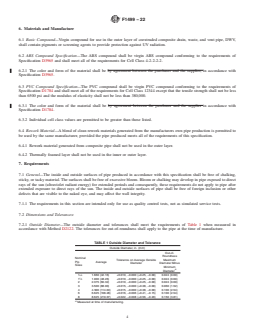
7.2.1 Outside Diameter—The outside diameter and tolerances shall meet the requirements of Table 1 when measured in
accordance with Method D2122. The tolerances for out-of-roundness shall apply to the pipe at the time of manufacture.
TABLE 1 Outside Diameter and Tolerance
Outside Diameter, in. (mm)
Out-of-
Roundness
Nominal
Tolerance on Average Outside Maximum
Pip Average
Diameter Diameter Minus
Sizes
Minimum
A
Diameter
1 ⁄4 1.660 (42.16) +0.010, −0.000 (+0.25, −0.00) 0.024 (0.60)
1 ⁄2 1.900 (48.26) +0.010, −0.000 (+0.25, −0.00) 0.024 (0.60)
2 2.375 (60.32) +0.010, −0.000 (+0.25, −0.00) 0.024 (0.60)
3 3.500 (88.90) +0.015, −0.000 (+0.38, −0.00) 0.060 (1.52)
4 4.500 (114.30) +0.015, −0.000 (+0.38, −0.00) 0.100 (2.54)
6 6.625 (168.28) +0.016, −0.006 (+0.41, −0.15) 0.100 (2.54)
8 8.625 (219.07) +0.022, −0.008 (+0.56, −0.20) 0.150 (3.81)
A
Measured at time of manufacturing.
F1499 − 22
7.2.2 Wall Thickness—The wall thickness and tolerances shall meet the requirements of Table 2 when measured in accordance
with Method D2122.
7.2.3 Length—The pipe shall be in either 10 or 20-ft (3.05 or 6.1-m) lengths, unless otherwise specified. The allowable tolerance
on the length shall be + ⁄2,−0 in.
7.3 Pipe Stiffness—The minimum pipe stiffness at 5 % deflection when measured in accordance with Test Method D2412 shall
equal or exceed the value in Table 3. The rate of crosshead motion shall be 0.20 in./min to 0.25 in./min (5.1 mm/min to 6.3
mm/min). Three specimens shall be tested. If all three meet this requirement, the sample meets this requirement. If one or two fail,
additional testing shall be conducted in accordance with 7.3.1. If all three fail, the sample does not meet the requirement.
7.3.1 Pipe Stiffness and Lower Confidence Limit—In the event that one or two of the specimens tested in 7.3 fail to meet the
minimum requirement, the average pipe stiffness of eleven specimens shall meet or exceed the minimum requirement given in
Table 3. The 99 % lower confidence limit (LCL) shall be within 15 % of the average value. The LCL shall be calculated using
the Student’s “t” distribution, with N–1 degrees of freedom, where N is the number of specimens (11). The critical t value shall
be used to at least three significant digits. Alternatively, if the LCL exceeds the minimum PS requirement in Table 3, but is not
within 15 % of the average, the sample meets the requirements of the Pipe Stiffness testing. The eleven specimens include the three
tested under 7.3, and an additional eight with rotation by 35°, as specified in D2412, continuing throughout the remaining
specimens.
The LCL based on testing eleven specimens is calculated as follows (Note: N = 11):
LCL 5 Average PS 2 2.76 Standard Deviation /= N (1)
~ ! $ ~ ! ~ !%
where:
Average PS 5@ PS #/ 11 (2)
~ ! ~ ! ~ !
( i
2 1/2
PS 2 PS /N
~ !
( (
Standard Deviation 5 (3)
~ ! F G
N 2 1
The 15 % requirement is calculated as:
Average 2 LCL / Average 3100 %# 15 % (4)
~ ! ~ !
NOTE 3—This test is conducted at the time of manufacture.
NOTE 4—The 5 % deflection criterion is arbitrarily selected for testing convenience. It should not be considered as a limitation with respect to in-use
deflection. The engineer is responsible for establishing the deflection limit.
NOTE 5—The strength and load-carrying capabilities of composite DWV pipe is measured and reported as pipe stiffness, that is determined in accordance
with Test Method D2412. The term “crushing strength” is not applicable to thermoplastic piping.
7.4 Pipe Flattening—There shall be no evidence of rupture or cracking when deflected 25 % of the initial inside diameter when
tested by Test Method D2412. Test three specimens. When all pass, accept the lot. When one fails, the lot does not meet the
requirements of this specification. Failure shall be a crack or break extending entirely through the pipe wall visible to the unaided
eye. Refer to 9.1 (see Note 3).
7.5 Impact Resistance—The minimum impact resistance, when tested at the time of manufacture, shall comply with the
requirements of Table 4. Test in accordance with Test Method D2444 using Tup B and Holder B. Use a 20–lb (9.1 kg) tup for all
sizes.
TABLE 2 Wall Thickness and Tolerance
Wall Thickness, in. (mm)
A
Nominal Pipe Sizes Minimum Wall Tolerance
1 ⁄4 0.140 (3.56) +0.020 (+0.50)
1 ⁄2 0.145 (3.68) +0.020 (+0.50)
2 0.154 (3.91) +0.020 (+0.50)
3 0.216 (5.42) +0.026 (+0.66)
4 0.237 (6.02) +0.028 (+0.71)
6 0.280 (7.11) +0.034 (+0.86)
8 0.322 (8.18) +0.034 (+0.86)
A
The minimum is the lowest wall thickness of the pipe at any cross section.
F1499 − 22
TABLE 3 Pipe Stiffness
Minimum Pipe Stiffness at 5 % Deflection
Nominal Pipe Sizes
psi (MPa)
1 ⁄4 600 (4.13)
1 ⁄2 535 (3.69)
2 300 (2.06)
3 280 (1.93)
4 175 (1.21)
6 75 (0.52)
8 75 (0.52)
TABLE 4 Impact Resistance
Minimum Impact Resistance, ft |b3 lbf (J)
Nominal Pipe Sizes
At 32°F (0°C)32 °F (0 °C)
1 ⁄4 15 (20)
1 ⁄2 20 (27)
2 30 (41)
3 40 (54)
4 40 (54)
6 40 (54)
8 40 (54)
7.5.1 Test 10 specimens. When 9 or 10 specimens pass accept the lot. When 2 or more specimens fail, test 10 additional
specimens. When 17 of 20 specimens tested pass, accept the lot. When 4 or more of 20 specimens fail, test 20 additional specimens.
When 32 of 40 specimens pass, accept the lot. When 9 or more of 40 specimens fail, the lot does not meet the requirements of
this specification.
7.5.2 Failure of the test specimen shall be shattering or any crack or break extending entirely through the pipe wall and visible
to the unaided eye.
7.6 Bond—The bond between layers shall be strong and uniform. It shall not be possible to separate any two layers with a probe
or point of a knife blade so that the layers separate cleanly, or the probe or knife blade moves freely between the layers; nor shall
separation of bond occur between layers during testing performed under the requirements of this specification. Refer to 9.1 (see
Note 3).
7.7 Inspection—Inspection shall be made prior to installation of all pipe. Pipe that does not meet the requirements of Section 8
shall be returned to the seller.
7.8 Solvent Cement—In the assembly of solvent cement joints, the solvent cement shall be compatible with the material in the
outer layer, as marked on the pipe, and shall meet the requirements of Specification D2235.
7.8.1 The safety requirements of Practice F402 shall be followed.
7.9 Qualification Test:
7.9.1 Joint Tightness—Join two pieces of pipe together using molded fittings and solvent cement. Use solvent cement meeting the
requirements of 7.8. Cure the solvent cement joints 24 h at room temperature, before testing. Joints shall not leak when tested at
an internal water pressure of 25 psi (170 kPA), for 1 h using water at 73°F (23°C).73 °F (23 °C). Refer to 9.1.
NOTE 6—The qualification test is designed to qualify the thickness of the outer layer, to ensure that the thickness of the outer layer is sufficient to withstand
the effect of the solvent cement, and thus ensure a good leak-free joint.
8. Sampling and Conditioning for Quality Control Testing
8.1 Sampling—The lot shall consist of all pipe produced of one size from one extrusion line during one designated 24-h period.
Take the number of specimens for each test from pipe selected at random.
F1499 − 22
NOTE 7—Also see Practices E105 and E122.
8.2 Conditioning:
8.2.1 For referee testing at 73° F, 73 °F, condition the specimens prior to the test at 7373 °F 6 4°F (234 °F (23 °C 6 2°C)2 °C)
and 5050 % 6 10 % relative humidity in accordance with Practice D618, Procedure A.
8.2.2 For routine quality control testing at 73°F,73 °F, condition the specimens at the temperature and humidity of the
manufacturers testing facility for not less than 1 h or until the specimens are at room temperature.
8.2.3 For referee testing at 32°F,32 °F, condition the specimens at 3232 °F 6 4°F4 °F (0 6 2°) for at least 16 h in air.
8.2.4 For quality control testing at 32°F,32 °F, condition the specimens at 3232 °F 6 4°F4 °F (0 6 2°C)2 °C) for at least 12 h,
or in ice water for at least 1 h.
8.3 Test Conditions:
8.3.1 For referee purposes, conduct test in the standard laboratory atmosphere of 7373 °F 6 4°F (234 °F (23 °C 6 2°C)2 °C) and
5050 % 6 10 % relative humidity.
8.3.2 For routine quality control testing, conduct tests at the temperature and humidity of the manufacturer’s testing area.
8.3.3 For testing at 32°F,32 °F, complete the test as soon as possible after removal from the conditioning atmosphere, but in any
case within 15 s.
8.4 Frequency of Test—The frequency of testing shall be established by the manufacturers, consistent with good quality control
practices.
8.5 Number of Tests—The number of tests for quality control shall be under the manufacturer’s established quality control
program.
8.6 Test Conditions For Quality Control Testing—Conduct quality control testing at the temperature and humidity of the
manufacturer’s testing area in accordance with Practice D618.
8.7 Quality Control Test—The quality control program shall include testing for compliance with this specification of the following:
8.7.1 Outside diameter,
8.7.2 Wall thickness,
8.7.3 Length,
8.7.4 Pipe stiffness,
8.7.5 Pipe flattening,
8.7.6 Impact strength, and
8.7.7 Bond.
8.8 Referee Testing:
8.8.1 Sampling—Collect specimens in accordance with 8.1. The number of specimens shall be sufficient to obtain a complete set
of test results for t
...