

ASTM D2196-20
(Test Method)Standard Test Methods for Rheological Properties of Non-Newtonian Materials by Rotational Viscometer
General Information
- Abstract
SIGNIFICANCE AND USE
3.1 Test Method A is used for determining the apparent viscosity at a given rotational speed, although viscosities at two or more speeds give better characterization of a non-Newtonian material than does a single viscosity measurement.
3.2 With Test Methods B and C, the extent of shear thinning is indicated by the drop in viscosity with increasing rotational speed. The degree of thixotropy is indicated by comparison of viscosities at increasing and decreasing rotational speeds (Test Method B), viscosity recovery (Test Method B), or viscosities before and after high shear (combination of Test Methods B and C). The high-shear treatment in Test Method C approximates shearing during paint application. The viscosity behavior measured after high shear is indicative of the characteristics of the paint soon after application.
SCOPE
1.1 These test methods cover the determination of the apparent viscosity and the shear thinning and thixotropic properties of non-Newtonian materials in the shear rate range from 0.1 s−1 to 50 s−1 using a rotational viscometer operating in a fluid contained in a 600 mL low form Griffin beaker.
1.2 The values stated in SI units are to be regarded as the standard. The values given in parentheses are for information only.
1.3 This standard does not purport to address all of the safety concerns, if any, associated with its use. It is the responsibility of the user of this standard to establish appropriate safety, health, and environmental practices and determine the applicability of regulatory limitations prior to use.
1.4 This international standard was developed in accordance with internationally recognized principles on standardization established in the Decision on Principles for the Development of International Standards, Guides and Recommendations issued by the World Trade Organization Technical Barriers to Trade (TBT) Committee.
- Status
- Published
- Publication Date
- 30-Nov-2020
- Technical Committee
- D01 - Paint and Related Coatings, Materials, and Applications
- Drafting Committee
- D01.24 - Physical Properties of Liquid Paints & Paint Materials
Buy Documents
ASTM D2196-20 - Standard Test Methods for Rheological Properties of Non-Newtonian Materials by Rotational Viscometer
REDLINE ASTM D2196-20 - Standard Test Methods for Rheological Properties of Non-Newtonian Materials by Rotational Viscometer
Overview
ASTM D2196-20: Standard Test Methods for Rheological Properties of Non-Newtonian Materials by Rotational Viscometer outlines comprehensive procedures for determining the apparent viscosity, shear thinning, and thixotropic properties of non-Newtonian materials. Utilizing a rotational viscometer, these test methods provide reliable techniques to measure rheological behavior in materials like paints, coatings, and related substances within a defined shear rate range (0.1 s⁻¹ to 50 s⁻¹). Developed by ASTM International, these methods aid users in consistently evaluating material performance in real-world applications.
Key Topics
Apparent Viscosity Measurement:
Test Method A details the procedure for measuring apparent viscosity at specific rotational speeds, providing insight into the flow resistance of a material under certain shear conditions.Shear Thinning and Thixotropy:
Test Methods B and C examine the reduction in viscosity with increased shear (shear thinning) and the structure recovery or breakdown over time under changing shear conditions (thixotropy). These properties are critical for understanding how a material responds during application and subsequent resting periods.Rotational Viscometer Requirements:
The standard specifies minimum apparatus requirements, including torque measurement precision, temperature control, data acquisition, and proper setup to ensure accurate and repeatable results.Specimen Handling and Preparation:
Detailed preparation steps ensure sampling consistency, temperature equilibrium, and agitation procedures for reliable rheological testing.Reporting and Precision:
Guidance is provided on reporting all relevant test conditions and measured values, with established criteria for precision and repeatability both within and between laboratories.
Applications
ASTM D2196-20 is widely used across industries where non-Newtonian materials’ flow properties impact processing, application, and end-use performance. Practical uses include:
Paints and Coatings:
Assessing how viscosity changes during brushing, rolling, or spraying, and evaluating recovery after application for smooth finishes.Adhesives, Sealants, and Inks:
Characterizing flow under various mechanical stresses to optimize formulation for ease of application, leveling, and sag resistance.Food and Personal Care Products:
Ensuring products maintain desired texture and stability during production, packaging, and use.Polymers and Resins:
Monitoring rheological behavior for quality control and process optimization.
By quantifying parameters like apparent viscosity, shear thinning, and thixotropy, manufacturers can better predict product performance and tailor formulations to desired end-use characteristics.
Related Standards
For broader context or complementary testing, consider the following standards:
- ASTM D2197 – Standard Test Method for Adhesion of Organic Coatings by Scrape Adhesion
- ASTM D445 – Standard Test Method for Kinematic Viscosity of Transparent and Opaque Liquids
- ASTM D4287 – Standard Test Method for High-Shear Viscosity Using a Rotational Viscometer
- ISO 3219 – Plastics - Polymers/Resins in the Liquid State or as Emulsions or Dispersions - Determination of Viscosity Using a Rotational Viscometer
Practical Value
Adherence to ASTM D2196-20 ensures standardized, reproducible measurements of non-Newtonian rheological properties. This supports consistent product quality, regulatory compliance, and effective communication between manufacturers, suppliers, and stakeholders. Implementing these test methods helps optimize material performance in diverse applications, shortening development cycles and minimizing production issues arising from uncontrolled viscosity or flow behavior.
Keywords:
non-Newtonian, rheological properties, rotational viscometer, viscosity, shear thinning, thixotropy, ASTM D2196-20, paint testing, material characterization, quality control, coatings.
Buy Documents
ASTM D2196-20 - Standard Test Methods for Rheological Properties of Non-Newtonian Materials by Rotational Viscometer
REDLINE ASTM D2196-20 - Standard Test Methods for Rheological Properties of Non-Newtonian Materials by Rotational Viscometer
Get Certified
Connect with accredited certification bodies for this standard

BSMI (Bureau of Standards, Metrology and Inspection)
Taiwan's standards and inspection authority.
Sponsored listings
Frequently Asked Questions
ASTM D2196-20 is a standard published by ASTM International. Its full title is "Standard Test Methods for Rheological Properties of Non-Newtonian Materials by Rotational Viscometer". This standard covers: SIGNIFICANCE AND USE 3.1 Test Method A is used for determining the apparent viscosity at a given rotational speed, although viscosities at two or more speeds give better characterization of a non-Newtonian material than does a single viscosity measurement. 3.2 With Test Methods B and C, the extent of shear thinning is indicated by the drop in viscosity with increasing rotational speed. The degree of thixotropy is indicated by comparison of viscosities at increasing and decreasing rotational speeds (Test Method B), viscosity recovery (Test Method B), or viscosities before and after high shear (combination of Test Methods B and C). The high-shear treatment in Test Method C approximates shearing during paint application. The viscosity behavior measured after high shear is indicative of the characteristics of the paint soon after application. SCOPE 1.1 These test methods cover the determination of the apparent viscosity and the shear thinning and thixotropic properties of non-Newtonian materials in the shear rate range from 0.1 s−1 to 50 s−1 using a rotational viscometer operating in a fluid contained in a 600 mL low form Griffin beaker. 1.2 The values stated in SI units are to be regarded as the standard. The values given in parentheses are for information only. 1.3 This standard does not purport to address all of the safety concerns, if any, associated with its use. It is the responsibility of the user of this standard to establish appropriate safety, health, and environmental practices and determine the applicability of regulatory limitations prior to use. 1.4 This international standard was developed in accordance with internationally recognized principles on standardization established in the Decision on Principles for the Development of International Standards, Guides and Recommendations issued by the World Trade Organization Technical Barriers to Trade (TBT) Committee.
SIGNIFICANCE AND USE 3.1 Test Method A is used for determining the apparent viscosity at a given rotational speed, although viscosities at two or more speeds give better characterization of a non-Newtonian material than does a single viscosity measurement. 3.2 With Test Methods B and C, the extent of shear thinning is indicated by the drop in viscosity with increasing rotational speed. The degree of thixotropy is indicated by comparison of viscosities at increasing and decreasing rotational speeds (Test Method B), viscosity recovery (Test Method B), or viscosities before and after high shear (combination of Test Methods B and C). The high-shear treatment in Test Method C approximates shearing during paint application. The viscosity behavior measured after high shear is indicative of the characteristics of the paint soon after application. SCOPE 1.1 These test methods cover the determination of the apparent viscosity and the shear thinning and thixotropic properties of non-Newtonian materials in the shear rate range from 0.1 s−1 to 50 s−1 using a rotational viscometer operating in a fluid contained in a 600 mL low form Griffin beaker. 1.2 The values stated in SI units are to be regarded as the standard. The values given in parentheses are for information only. 1.3 This standard does not purport to address all of the safety concerns, if any, associated with its use. It is the responsibility of the user of this standard to establish appropriate safety, health, and environmental practices and determine the applicability of regulatory limitations prior to use. 1.4 This international standard was developed in accordance with internationally recognized principles on standardization established in the Decision on Principles for the Development of International Standards, Guides and Recommendations issued by the World Trade Organization Technical Barriers to Trade (TBT) Committee.
ASTM D2196-20 is classified under the following ICS (International Classification for Standards) categories: 17.060 - Measurement of volume, mass, density, viscosity. The ICS classification helps identify the subject area and facilitates finding related standards.
ASTM D2196-20 is available in PDF format for immediate download after purchase. The document can be added to your cart and obtained through the secure checkout process. Digital delivery ensures instant access to the complete standard document.
Standards Content (Sample)
This international standard was developed in accordance with internationally recognized principles on standardization established in the Decision on Principles for the
Development of International Standards, Guides and Recommendations issued by the World Trade Organization Technical Barriers to Trade (TBT) Committee.
Designation:D2196 −20
Standard Test Methods for
Rheological Properties of Non-Newtonian Materials by
Rotational Viscometer
This standard is issued under the fixed designation D2196; the number immediately following the designation indicates the year of
original adoption or, in the case of revision, the year of last revision.Anumber in parentheses indicates the year of last reapproval.A
superscript epsilon (´) indicates an editorial change since the last revision or reapproval.
This standard has been approved for use by agencies of the U.S. Department of Defense.
1. Scope viscometer with a spindle operating in a fluid contained in a
600 mL low form Griffin beaker. The agitation of the material
1.1 These test methods cover the determination of the
immediately preceding the viscosity measurements is carefully
apparent viscosity and the shear thinning and thixotropic
controlled.
properties of non-Newtonian materials in the shear rate range
−1 −1
from 0.1 s to 50 s using a rotational viscometer operating
3. Significance and Use
in a fluid contained in a 600 mL low form Griffin beaker.
3.1 Test Method A is used for determining the apparent
1.2 The values stated in SI units are to be regarded as the
viscosityatagivenrotationalspeed,althoughviscositiesattwo
standard. The values given in parentheses are for information
ormorespeedsgivebettercharacterizationofanon-Newtonian
only.
material than does a single viscosity measurement.
1.3 This standard does not purport to address all of the
3.2 WithTestMethodsBandC,theextentofshearthinning
safety concerns, if any, associated with its use. It is the
is indicated by the drop in viscosity with increasing rotational
responsibility of the user of this standard to establish appro-
speed. The degree of thixotropy is indicated by comparison of
priate safety, health, and environmental practices and deter-
viscosities at increasing and decreasing rotational speeds (Test
mine the applicability of regulatory limitations prior to use.
Method B), viscosity recovery (Test Method B), or viscosities
1.4 This international standard was developed in accor-
before and after high shear (combination of Test Methods B
dance with internationally recognized principles on standard-
and C). The high-shear treatment in Test Method C approxi-
ization established in the Decision on Principles for the
matesshearingduringpaintapplication.Theviscositybehavior
Development of International Standards, Guides and Recom-
measured after high shear is indicative of the characteristics of
mendations issued by the World Trade Organization Technical
the paint soon after application.
Barriers to Trade (TBT) Committee.
4. Apparatus
2. Summary of Test Method
4.1 Rotational Viscometer—The essential instrument will
2.1 Test Method A consists of determining the apparent
have the following capabilities at a minimum:
viscosity of coatings and related materials by measuring the
4.1.1 A drive motor, to apply a unidirectional rotational
torque on a spindle rotating at a constant speed in a 600 mL
displacement to the spindle immersed in the specimen for
low form Griffin beaker.
rotational speeds between 0.307 rad/sec and 10.24 rad/sec (0.3
2.2 Test Methods B and C consist of determining the shear r/min and 100 r/min) constant to within 0.1%.
4.1.2 Aforce sensor to measure the torque required to drive
thinning and thixotropic (time-dependent) rheological proper-
ties of the materials. The viscosities of these materials are the spindle immersed in the specimen at each of the defined
speed settings to within 0.1%.
determined at a series of prescribed speeds of a rotational
4.1.3 A coupling shaft, or other means, to transmit the
rotational displacement from the motor to the spindle.
These test methods are under the jurisdiction of ASTM Committee D01 on 4.1.4 A rotational element, spindle, or tool, such as the
Paint and Related Coatings, Materials, and Applications and are the direct
shapesshowninFig.1tofixthespecimenbetweenthespindle
responsibility of Subcommittee D01.24 on Physical Properties of Liquid Paints &
andastationarysurface.Theprotectivebracket,whichattaches
Paint Materials.
to the viscometer and protects the spindle, provides the
Current edition approved Dec. 1, 2020. Published December 2020. Originally
ɛ1
approved in 1963. Last previous edition approved in 2018 as D2196–18 . DOI:
stationary surface described in the preceding sentence.
10.1520/D2196-20.
NOTE 1—Each spindle can measure a range of almost four decades in
Pierce, P. E., “Measurement of Rheology of Thixotropic Organic Coatings and
Resins with the Brookfield Viscometer,” Journal of Paint Technology, Vol 43, No. viscosity for the speed settings specified in this method. The spindle is
557, 1971, pp. 35–43. selected so that the measured torque value is between 10% and 100%.
Copyright © ASTM International, 100 Barr Harbor Drive, PO Box C700, West Conshohocken, PA 19428-2959. United States
D2196−20
5. Materials
5.1 Viscosity Reference Oils, calibrated in scientific units of
either Pascal-seconds, milliPascal-seconds, Poise, or centi-
poises.
6. Calibration Verification of Apparatus
6.1 Select one viscosity reference oil within the viscosity
range of the material being measured. Condition the oil to
25.0°C 6 0.1°C (or other agreed-upon temperature) for 1h in
a 600 mL low form Griffin beaker (or equivalent container).
Select an appropriate spindle, connect it to the viscometer, and
attach the bracket. Immerse the spindle and bracket into the oil
and allow these items to equilibrate to temperature during the
1 h period. Measure the oil viscosity at three increasing
rotational speeds which give torque readings between 10%
and 100%.
NOTE 3—Ensure that the spindle is centered in the container prior to
taking measurements.
NOTE 4—Reference oils can exhibit a change in viscosity of about
7%⁄°C. If measurements are not made at 25°C, then the stated viscosities
shall be corrected to the temperature at which they are measured.
6.2 Each measured viscosity value must be within the
following calculation for the viscometer to pass the calibration
check.
FIG. 1Cylindrical and Disc Rotational Element Configuration
6.2.1 Determine the full scale viscosity range for the
spindle/speed combination being used. Calculate 1% of this
number.
4.1.5 A data collection device, to provide a means of
6.2.2 Calculate 1% of the viscosity value for the reference
acquiring, storing, and displaying measured or calculated oil.
signals, or both. The minimum output signals required for a
6.2.3 Add the viscosity values obtained in the two previous
viscosity measurement are rotational speed of the spindle and
calculations. Add and subtract this sum from the actual
torque. Best practice is to record output signals for time of
viscosity value for the reference oil. The measured viscosity
spindle rotation when making the viscosity measurement and
value must fall between these calculated limits for the viscom-
the temperature of the specimen.
eter to pass the calibration check.
NOTE 2—Manual observation and recording of data are acceptable. 6.2.4 Ifanyofthethreeviscositymeasurementsdonotpass,
repeat the test. If the test is still not successful, contact the
4.1.6 Astand, to support, level, and adjust the height of the
instrument manufacturer for service of the rotational viscom-
drive motor, shaft and rotational element.
eter.
4.1.7 A level to indicate the vertical plumb of the drive
motor, shaft and rotational element.
7. Preparation of Specimen
4.1.8 Auxiliary instrumentation considered useful in con-
ducting this method includes: 7.1 Fill a 0.5-L(1-pt) or 1-L(1-qt) container with sample to
4.1.8.1 Data analysis capability to provide viscosity, stress within 25mm (1 in.) of the top with the sample and bring it to
a temperature of 25°C 6 0.5°C or other agreed-upon tempera-
or other useful parameters derived from the measured signals.
ture prior to test.
4.2 A temperature measuring and recording device to pro-
vide specimen temperature of the fluid near the rotational 7.2 Vigorously shake the specimen on the shaker or equiva-
element over the range of 20°C to 70°C to within 0.1°C (see
lentfor10min,removeitfromtheshaker,andallowittostand
Note 2). undisturbedfor60minat25°Cpriortotesting.Startthetestno
later than 65 min after removing the container from the shaker.
4.3 A 600 mL low form Griffin beaker or equivalent
Donottransferthespecimenfromthecontainerinwhichitwas
cylindrical container with minimum volume capacity of 500
shaken. Shake time may be reduced if necessary, or as agreed
mL, minimum diameter of 85 mm (3.35 in.), and minimum
uponbetweenthepurchaserandmanufacturer,but,inanycase,
depth of 100 mm (3.94 in.) to contain the specimen during
shall not be less than 3 min.
testing.
NOTE 5—Shake time may be reduced if necessary, if agreed upon
4.4 Shaker, or equivalent, machine capable of vigorously
betweenthepurchaserandmanufacturer,but,inanycase,shallnotbeless
shaking the test specimen. than 3 min.
D2196−20
TEST METHOD A—APPARENT VISCOSITY TEST METHOD B—VISCOSITY UNDER CHANGING
SPEED CONDITIONS, DEGREE OF SHEAR
8. Procedure
THINNING AND THIXOTROPY
8.1 Make all measurements at 25°C 6 0.5°C, or other
12. Procedure
agreed-upon temperature.
8.2 Place the instrument on the adjustable stand. Lower the 12.1 Makeallviscosity(ortorque)measurementsat25°C 6
viscometertoalevelthatwillimmersethespindletotheproper 0.5°C, or other agreed upon temperature.
depth. Level the instrument.
12.2 Adjusttheinstrumentandattachthespindleasin8.2–
8.3 Tilt the selected spindle (Note 3), insert it into one side
8.4.
of the center of the surface of the material, and attach the
12.3 Decide upon the different rotational speeds to be used
spindle to the instrument.
for the test; a minimum of three speeds is recommended. Set
NOTE 6—When connecting the spindle to the viscometer avoid undue
the viscometer at the slowest rotational speed chosen for the
side pressure which might affect alignment.Avoid rotating the spindle so
test (Note 8). Initiate the spindle rotation and record the
that the viscometer indicator touches the stops at either extreme of the
reading after ten revolutions (or other agreed-upon number of
scale.
revolutions).
NOTE 7—Select the spindle/speed combination that will give a mini-
mum scale reading of 10 % but preferably in the middle or upper portion
NOTE 9—Ahigher initial rotational speed may be used upon agreement
of the scale. The speed and spindle to be used may differ from this by
between producer and user.
agreement between user and producer.
8.4 Lower the viscometer until the immersion mark on the 12.4 Increase the rotational speed in steps and record the
shaft just touches the specimen.Adjust the viscometer level if reading after ten revolutions (or equivalent time for each
necessary. Move the container
...
This document is not an ASTM standard and is intended only to provide the user of an ASTM standard an indication of what changes have been made to the previous version. Because
it may not be technically possible to adequately depict all changes accurately, ASTM recommends that users consult prior editions as appropriate. In all cases only the current version
of the standard as published by ASTM is to be considered the official document.
´1
Designation: D2196 − 18 D2196 − 20
Standard Test Methods for
Rheological Properties of Non-Newtonian Materials by
Rotational Viscometer
This standard is issued under the fixed designation D2196; the number immediately following the designation indicates the year of
original adoption or, in the case of revision, the year of last revision. A number in parentheses indicates the year of last reapproval. A
superscript epsilon (´) indicates an editorial change since the last revision or reapproval.
This standard has been approved for use by agencies of the U.S. Department of Defense.
ε NOTE—Editorial corrections were made throughout in September 2018.
1. Scope
1.1 These test methods cover the determination of the apparent viscosity and the shear thinning and thixotropic properties of
−1 −1
non-Newtonian materials in the shear rate range from 0.1 s to 50 s using a rotational viscometer operating in a fluid contained
in a 600 mL low form Griffin beaker.
1.2 The values stated in SI units are to be regarded as the standard. The values given in parentheses are for information only.
1.3 This standard does not purport to address all of the safety concerns, if any, associated with its use. It is the responsibility
of the user of this standard to establish appropriate safety, health, and environmental practices and determine the applicability of
regulatory limitations prior to use.
1.4 This international standard was developed in accordance with internationally recognized principles on standardization
established in the Decision on Principles for the Development of International Standards, Guides and Recommendations issued
by the World Trade Organization Technical Barriers to Trade (TBT) Committee.
2. Summary of Test Method
2.1 Test Method A consists of determining the apparent viscosity of coatings and related materials by measuring the torque on a
spindle rotating at a constant speed in a 600 mL low form Griffin beaker.
2.2 Test Methods B and C consist of determining the shear thinning and thixotropic (time-dependent) rheological properties of the
materials. The viscosities of these materials are determined at a series of prescribed speeds of a rotational viscometer with a
spindle operating in a fluid contained in a 600 mL low form Griffin beaker. The agitation of the material immediately preceding
the viscosity measurements is carefully controlled.
3. Significance and Use
3.1 Test Method A is used for determining the apparent viscosity at a given rotational speed, although viscosities at two or more
speeds give better characterization of a non-Newtonian material than does a single viscosity measurement.
These test methods are under the jurisdiction of ASTM Committee D01 on Paint and Related Coatings, Materials, and Applications and are the direct responsibility of
Subcommittee D01.24 on Physical Properties of Liquid Paints & Paint Materials.
Current edition approved June 1, 2018Dec. 1, 2020. Published August 2018December 2020. Originally approved in 1963. Last previous edition approved in 20152018
ɛ1
as D2196 – 15.D2196 – 18 . DOI: 10.1520/D2196-18E01.10.1520/D2196-20.
Pierce, P. E., “Measurement of Rheology of Thixotropic Organic Coatings and Resins with the Brookfield Viscometer,” Journal of Paint Technology, Vol 43, No. 557,
1971, pp. 35–43.
Copyright © ASTM International, 100 Barr Harbor Drive, PO Box C700, West Conshohocken, PA 19428-2959. United States
D2196 − 20
3.2 With Test Methods B and C, the extent of shear thinning is indicated by the drop in viscosity with increasing rotational speed.
The degree of thixotropy is indicated by comparison of viscosities at increasing and decreasing rotational speeds (Test Method B),
viscosity recovery (Test Method B), or viscosities before and after high shear (combination of Test Methods B and C). The
high-shear treatment in Test Method C approximates shearing during paint application. The viscosity behavior measured after high
shear is indicative of the characteristics of the paint soon after application.
4. Apparatus
4.1 Rotational Viscometer—The essential instrument will have the following capabilities at a minimum:
4.1.1 A drive motor, to apply a unidirectional rotational displacement to the spindle immersed in the specimen for rotational speeds
between 0.307 rad/sec and 10.24 rad/sec (0.3 r/min and 100 rpm)r/min) constant to within 0.01%.0.1 %.
4.1.2 A force sensor to measure the torque required to drive the spindle immersed in the specimen at each of the defined speed
settings to within 0.1%.0.1 %.
4.1.3 A coupling shaft, or other means, to transmit the rotational displacement from the motor to the spindle.
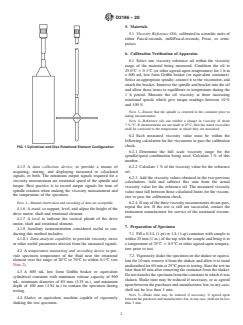
4.1.4 A rotational element, spindle, or tool, such as the shapes shown in Fig. 1 to fix the specimen between the spindle and a
stationary surface. The protective bracket, which attaches to the viscometer and protects the spindle, provides the stationary surface
described in the preceding sentence.
NOTE 1—Each spindle can measure a range of almost four decades in viscosity for the speed settings specified in this method. The spindle is selected
so that the measured torque value is between 10 % and 100 %.
4.1.5 A data collection device, to provide a means of acquiring, storing, and displaying measured or calculated signals, or both.
The minimum output signals required for a viscosity measurement are rotational speed of the spindle and torque. Best practice is
to record output signals for time of spindle rotation when making the viscosity measurement and the temperature of the specimen.
FIG. 1 Cylindrical and Disc Rotational Element Configuration
D2196 − 20
NOTE 2—Manual observation and recording of data are acceptable.
4.1.6 A stand, to support, level, and adjust the height of the drive motor, shaft and rotational element.
4.1.7 A level to indicate the vertical plumb of the drive motor, shaft and rotational element.
4.1.8 Auxiliary instrumentation considered useful in conducting this method includes:
4.1.8.1 Data analysis capability to provide viscosity, stress or other useful parameters derived from the measured signals.
4.2 A temperature measuring and recording device to provide specimen temperature of the fluid near the rotational element over
the range of 2020°C to 70°C to within 0.1°C (see Note 2).
4.3 A 600 mL low form Griffin beaker or equivalent cylindrical container with minimum volume capacity of 500 mL, minimum
diameter of 85 mm (3.35 in.), and minimum depth of 100 mm (3.94 in.) to contain the specimen during testing.
4.4 Shaker, or equivalent, machine capable of vigorously shaking the test specimen.
5. Materials
5.1 Viscosity Reference Oils, calibrated in scientific units of either Pascal-seconds, milliPascal-seconds, Poise, or centipoises.
6. Calibration Verification of Apparatus
6.1 Select one viscosity reference oil within the viscosity range of the material being measured. Condition the oil to 25.0°C 6
0.1°C (or other agreed-upon temperature) for 1 h 1 h in a 600 mL low form Griffin beaker (or equivalent container). Select an
appropriate spindle, connect it to the viscometer, and attach the bracket. Immerse the spindle and bracket into the oil and allow
these items to equilibrate to temperature during the 1 h period. Measure the oil viscosity at three increasing rotational speeds which
give torque readings between 10 % and 100 %.
NOTE 3—Ensure that the spindle is centered in the container prior to taking measurements.
NOTE 4—Reference oils can exhibit a change in viscosity of about 7 % ⁄°C. If measurements are not made at 25°C, then the stated viscosities shall be
corrected to the temperature at which they are measured.
6.2 Each measured viscosity value must be within the following calculation for the viscometer to pass the calibration check.
6.2.1 Determine the full scale viscosity range for the spindle/speed combination being used. Calculate 1 % of this number.
6.2.2 Calculate 1 % of the viscosity value for the reference oil.
6.2.3 Add the viscosity values obtained in the two previous calculations. Add and subtract this sum from the actual viscosity value
for the reference oil. The measured viscosity value must fall between these calculated limits for the viscometer to pass the
calibration check.
6.2.4 If any of the three viscosity measurements do not pass, repeat the test. If the test is still not successful, contact the instrument
manufacturer for service of the rotational viscometer.
7. Preparation of Specimen
7.1 Fill a 0.5-L (1-pt) or 1-L (1-qt) container with sample to within 25 mm 25 mm (1 in.) of the top with the sample and bring
it to a temperature of 25°C 6 0.5°C or other agreed-upon temperature prior to test.
7.2 Vigorously shake the specimen on the shaker or equivalent for 10 min, remove it from the shaker, and allow it to stand
undisturbed for 60 min at 25°C prior to testing. Start the test no later than 65 min after removing the container from the shaker.
Do not transfer the specimen from the container in which it was shaken. Shake time may be reduced if necessary, or as agreed upon
between the purchaser and manufacturer, but, in any case, shall not be less than 3 min.
D2196 − 20
NOTE 5—Shake time may be reduced if necessary, if agreed upon between the purchaser and manufacturer, but, in any case, shall not be less than 3 min.
TEST METHOD A—APPARENT VISCOSITY
8. Procedure
8.1 Make all measurements at 2525°C 6 0.5°C, or other agreed-upon temperature.
8.2 Place the instrument on the adjustable stand. Lower the viscometer to a level that will immerse the spindle to the proper depth.
Level the instrument.
8.3 Tilt the selected spindle (Note 3), insert it into one side of the center of the surface of the material, and attach the spindle to
the instrument.
NOTE 6—When connecting the spindle to the viscometer avoid undue side pressure which might affect alignment. Avoid rotating the spindle so that the
viscometer indicator touches the stops at either extreme of the scale.
NOTE 7—Select the spindle/speed combination that will give a minimum scale reading of 10 % but preferably in the middle or upper portion of the scale.
The speed and spindle to be used may differ from this by agreement between user and producer.
8.4 Lower the viscometer until the immersion mark on the shaft just touches the specimen. Adjust the viscometer level if
necessary. Move the container slowly in a horizontal plane until the spindle is located in the approximate center of the container.
8.5 Initiate the rotation of the spindle. Adjust the rotational speed so that the torque reads between 1010 % and 100 %. Allow the
viscometer to run until reading stabilizes. Record the torque and the viscosity reading.
NOTE 8—In thixotropic paints, the reading does not always stabilize. On occasion it reaches a peak and then gradually declines as the structure is broken
down. In these cases, the time of rotation or number of revolutions prior to reading the viscometer should be agreed to between user and manufacturer.
9. Calculation (Dial Reading Viscometer)
9.1 Calculate the apparent viscosity at each speed, as follows:
V 5 fs (1)
where:
V = viscosity
...