

ASTM D1335-21
(Test Method)Standard Test Method for Tuft Bind of Pile Yarn Floor Coverings
General Information
- Abstract
SIGNIFICANCE AND USE
5.1 Test Method D1335 for tuft bind of pile yarn floor coverings is being used for acceptance testing of commercial shipments. Comparative tests as directed in 5.1.1 may be advisable.
5.1.1 In case of a dispute arising from differences in reported test results using this test method, the purchaser and the supplier should conduct comparative tests to determine if there is a statistical bias between their laboratories. Competent statistical assistance is recommended from the investigation of bias. As a minimum, the two parties should take a group of test samples that are homogeneous as possible and are from a lot of material of the type in question. The test samples should then be randomly assigned in equal numbers to each laboratory for testing. The average results from the two laboratories should be compared using appropriate statistical analysis, and a probability level chosen by the two parties before testing begun. If a bias is found, either its cause must be found and corrected or the purchaser and the supplier must agree to interpret future test results with consideration to the known bias.
5.2 The satisfactory performance of a pile yarn floor covering depends to a considerable extent on the maintenance of its original appearance. In a cut pile yarn floor covering an inadequate tuft bind may result in complete loss of pile in areas exposed to severe wear. In a looped pile yarn floor covering with inadequate tuft bind the pile loops may be pulled out to form unsightly long loops which may be hazardous.
SCOPE
1.1 This test method covers the measurement of force required to pull or break a tuft from a pile floor covering sample.
1.2 This test method is applicable to both cut and loop pile yarn floor covering.
1.3 The values stated in inch-pound units are to be regarded as standard. The values given in parentheses are mathematical conversions to SI units that are provided for information only and are not considered standard.
1.4 This standard does not purport to address all of the safety concerns, if any, associated with its use. It is the responsibility of the user of this standard to establish appropriate safety, health, and environmental practices and determine the applicability of regulatory limitations prior to use.
1.5 This international standard was developed in accordance with internationally recognized principles on standardization established in the Decision on Principles for the Development of International Standards, Guides and Recommendations issued by the World Trade Organization Technical Barriers to Trade (TBT) Committee.
- Status
- Published
- Publication Date
- 31-Dec-2020
- Technical Committee
- D13 - Textiles
- Drafting Committee
- D13.21 - Pile Floor Coverings
Overview
ASTM D1335-21: Standard Test Method for Tuft Bind of Pile Yarn Floor Coverings is a key international standard developed by ASTM International for the textile and flooring industry. This standard outlines the test method for measuring the force required to pull or break a tuft from a pile yarn floor covering sample. It applies to both cut pile and loop pile yarn floor coverings, including carpets and textile-based floor coverings. Ensuring proper tuft bind is essential for maintaining product durability, safety, and long-term appearance under commercial and residential use.
Key Topics
- Scope of the Method: ASTM D1335-21 specifies how to determine the tuft bind- the force needed to remove or break the pile yarn tufts in floor coverings, using standardized tensile testing equipment.
- Test Applicability: This method is suitable for acceptance testing during commercial shipments, quality control, and certification of both cut and loop pile floor coverings.
- Sampling and Procedure:
- Randomized samples from defined lots ensure statistical representativeness.
- Samples are conditioned according to standard textile testing atmospheres.
- A tensile testing machine, equipped with specific clamps or hooks, measures the force required to remove individual tufts.
- Significance of Tuft Bind:
- Inadequate tuft bind can result in visible pile loss, unsightly loops, or pose safety hazards in high-wear environments.
- Tuft bind data are essential for product selection in contract flooring, commercial spaces, and safety-critical applications.
- Statistical Analysis: It provides guidance for collaborative testing between supplier and purchaser to identify and resolve any laboratory bias or discrepancies.
- Safety and Compliance: Users of ASTM D1335-21 should follow appropriate safety, health, and environmental practices and verify regulatory compliance.
Applications
ASTM D1335-21 is widely applied in various sectors of the floor covering and textile industries:
- Product Development and R&D: Ensures new carpet designs have adequate tuft bind for intended end uses.
- Quality Assurance: Used by manufacturers and quality control labs to verify the bond strength of pile yarn in commercial or residential floor coverings.
- Product Certification: Provides specifiers, architects, and procurement professionals with an objective assessment method for carpet durability and performance.
- Dispute Resolution: When differences arise between test results obtained by suppliers and purchasers, comparative tests using this standard help resolve disputes by identifying any statistical bias.
- Regulatory and Safety Compliance: Meets requirements for performance in safety-sensitive and high-traffic areas, such as schools, offices, and public buildings.
Related Standards
ASTM D1335-21 references and aligns with several other ASTM standards to ensure comprehensive testing and terminology consistency:
- ASTM D76 – Specification for Tensile Testing Machines for Textiles
- ASTM D123 – Terminology Relating to Textiles
- ASTM D1776 – Practice for Conditioning and Testing Textiles
- ASTM D5684 – Terminology Relating to Pile Floor Coverings
- ASTM E691 – Practice for Conducting an Interlaboratory Study to Determine the Precision of a Test Method
- ASTM E177 – Practice for Use of the Terms Precision and Bias in ASTM Test Methods
This integrated approach supports precise, reliable, and internationally recognized testing procedures for pile yarn floor coverings.
Keywords: ASTM D1335, tuft bind, carpet testing, pile yarn, floor covering, cut pile, loop pile, textile standards, carpet durability, tensile testing, quality assurance.
Relations
- Effective Date
- 01-Jul-2019
- Effective Date
- 15-May-2019
- Effective Date
- 01-Mar-2017
- Effective Date
- 15-Sep-2015
- Effective Date
- 01-Sep-2015
- Effective Date
- 01-Apr-2015
- Effective Date
- 01-May-2014
- Effective Date
- 15-Jun-2013
- Effective Date
- 15-Jun-2013
- Effective Date
- 15-May-2013
- Effective Date
- 01-May-2013
- Effective Date
- 01-May-2013
- Effective Date
- 01-Jul-2012
- Effective Date
- 01-Feb-2012
- Effective Date
- 01-Feb-2012
Frequently Asked Questions
ASTM D1335-21 is a standard published by ASTM International. Its full title is "Standard Test Method for Tuft Bind of Pile Yarn Floor Coverings". This standard covers: SIGNIFICANCE AND USE 5.1 Test Method D1335 for tuft bind of pile yarn floor coverings is being used for acceptance testing of commercial shipments. Comparative tests as directed in 5.1.1 may be advisable. 5.1.1 In case of a dispute arising from differences in reported test results using this test method, the purchaser and the supplier should conduct comparative tests to determine if there is a statistical bias between their laboratories. Competent statistical assistance is recommended from the investigation of bias. As a minimum, the two parties should take a group of test samples that are homogeneous as possible and are from a lot of material of the type in question. The test samples should then be randomly assigned in equal numbers to each laboratory for testing. The average results from the two laboratories should be compared using appropriate statistical analysis, and a probability level chosen by the two parties before testing begun. If a bias is found, either its cause must be found and corrected or the purchaser and the supplier must agree to interpret future test results with consideration to the known bias. 5.2 The satisfactory performance of a pile yarn floor covering depends to a considerable extent on the maintenance of its original appearance. In a cut pile yarn floor covering an inadequate tuft bind may result in complete loss of pile in areas exposed to severe wear. In a looped pile yarn floor covering with inadequate tuft bind the pile loops may be pulled out to form unsightly long loops which may be hazardous. SCOPE 1.1 This test method covers the measurement of force required to pull or break a tuft from a pile floor covering sample. 1.2 This test method is applicable to both cut and loop pile yarn floor covering. 1.3 The values stated in inch-pound units are to be regarded as standard. The values given in parentheses are mathematical conversions to SI units that are provided for information only and are not considered standard. 1.4 This standard does not purport to address all of the safety concerns, if any, associated with its use. It is the responsibility of the user of this standard to establish appropriate safety, health, and environmental practices and determine the applicability of regulatory limitations prior to use. 1.5 This international standard was developed in accordance with internationally recognized principles on standardization established in the Decision on Principles for the Development of International Standards, Guides and Recommendations issued by the World Trade Organization Technical Barriers to Trade (TBT) Committee.
SIGNIFICANCE AND USE 5.1 Test Method D1335 for tuft bind of pile yarn floor coverings is being used for acceptance testing of commercial shipments. Comparative tests as directed in 5.1.1 may be advisable. 5.1.1 In case of a dispute arising from differences in reported test results using this test method, the purchaser and the supplier should conduct comparative tests to determine if there is a statistical bias between their laboratories. Competent statistical assistance is recommended from the investigation of bias. As a minimum, the two parties should take a group of test samples that are homogeneous as possible and are from a lot of material of the type in question. The test samples should then be randomly assigned in equal numbers to each laboratory for testing. The average results from the two laboratories should be compared using appropriate statistical analysis, and a probability level chosen by the two parties before testing begun. If a bias is found, either its cause must be found and corrected or the purchaser and the supplier must agree to interpret future test results with consideration to the known bias. 5.2 The satisfactory performance of a pile yarn floor covering depends to a considerable extent on the maintenance of its original appearance. In a cut pile yarn floor covering an inadequate tuft bind may result in complete loss of pile in areas exposed to severe wear. In a looped pile yarn floor covering with inadequate tuft bind the pile loops may be pulled out to form unsightly long loops which may be hazardous. SCOPE 1.1 This test method covers the measurement of force required to pull or break a tuft from a pile floor covering sample. 1.2 This test method is applicable to both cut and loop pile yarn floor covering. 1.3 The values stated in inch-pound units are to be regarded as standard. The values given in parentheses are mathematical conversions to SI units that are provided for information only and are not considered standard. 1.4 This standard does not purport to address all of the safety concerns, if any, associated with its use. It is the responsibility of the user of this standard to establish appropriate safety, health, and environmental practices and determine the applicability of regulatory limitations prior to use. 1.5 This international standard was developed in accordance with internationally recognized principles on standardization established in the Decision on Principles for the Development of International Standards, Guides and Recommendations issued by the World Trade Organization Technical Barriers to Trade (TBT) Committee.
ASTM D1335-21 is classified under the following ICS (International Classification for Standards) categories: 97.150 - Floor coverings. The ICS classification helps identify the subject area and facilitates finding related standards.
ASTM D1335-21 has the following relationships with other standards: It is inter standard links to ASTM D5684-19a, ASTM D5684-19, ASTM D123-17, ASTM D123-15b, ASTM D123-15a, ASTM D123-15, ASTM E177-14, ASTM D123-13ae1, ASTM D123-13a, ASTM D123-13, ASTM E177-13, ASTM E691-13, ASTM D5684-12, ASTM D123-12e1, ASTM D123-12. Understanding these relationships helps ensure you are using the most current and applicable version of the standard.
ASTM D1335-21 is available in PDF format for immediate download after purchase. The document can be added to your cart and obtained through the secure checkout process. Digital delivery ensures instant access to the complete standard document.
Standards Content (Sample)
This international standard was developed in accordance with internationally recognized principles on standardization established in the Decision on Principles for the
Development of International Standards, Guides and Recommendations issued by the World Trade Organization Technical Barriers to Trade (TBT) Committee.
Designation:D1335 −21
Standard Test Method for
Tuft Bind of Pile Yarn Floor Coverings
This standard is issued under the fixed designation D1335; the number immediately following the designation indicates the year of
original adoption or, in the case of revision, the year of last revision. A number in parentheses indicates the year of last reapproval. A
superscript epsilon (´) indicates an editorial change since the last revision or reapproval.
This standard has been approved for use by agencies of the U.S. Department of Defense.
1. Scope 3. Terminology
1.1 This test method covers the measurement of force 3.1 For all terminology related to Pile Floor Coverings,
required to pull or break a tuft from a pile floor covering D13.21, refer to Terminology D5684.
sample. 3.1.1 The following terms are relevant to this standard:
carpet, constant-rate-of-extension, cut pile yarn floor covering,
1.2 This test method is applicable to both cut and loop pile
finished, finished pile yarn floor covering, floor covering, loop
yarn floor covering.
pile yarn floor covering, pile, pile yarn floor covering, textile
1.3 The values stated in inch-pound units are to be regarded
floor covering, tuft, tuft bind, tuft leg, tufted fabric.
as standard. The values given in parentheses are mathematical
3.2 For all other terminology related to textiles see Termi-
conversions to SI units that are provided for information only
nology D123.
and are not considered standard.
1.4 This standard does not purport to address all of the 4. Summary of Method
safety concerns, if any, associated with its use. It is the
4.1 A test sample is mounted on a metal cylindrical sample
responsibility of the user of this standard to establish appro-
holder in a clamping fixture to the base of a tensile testing
priate safety, health, and environmental practices and deter-
machine. A hook (for loops specimen) or a tuft clamp (for cut
mine the applicability of regulatory limitations prior to use.
pilespecimen)areusedtoremoveaspecimenfromthesample.
1.5 This international standard was developed in accor-
The force to pull the specimen free from the test sample is
dance with internationally recognized principles on standard-
measured as the tuft bind.
ization established in the Decision on Principles for the
Development of International Standards, Guides and Recom- 5. Significance and Use
mendations issued by the World Trade Organization Technical
5.1 Test Method D1335 for tuft bind of pile yarn floor
Barriers to Trade (TBT) Committee.
coverings is being used for acceptance testing of commercial
shipments. Comparative tests as directed in 5.1.1 may be
2. Referenced Documents
advisable.
2.1 ASTM Standards:
5.1.1 In case of a dispute arising from differences in
D76 Specification for Tensile Testing Machines for Textiles
reported test results using this test method, the purchaser and
D123 Terminology Relating to Textiles
the supplier should conduct comparative tests to determine if
D1776 Practice for Conditioning and Testing Textiles
there is a statistical bias between their laboratories. Competent
D5684 Terminology Relating to Pile Floor Coverings
statistical assistance is recommended from the investigation of
E691 Practice for Conducting an Interlaboratory Study to
bias.As a minimum, the two parties should take a group of test
Determine the Precision of a Test Method
samples that are homogeneous as possible and are from a lot of
E177 Practice for Use of the Terms Precision and Bias in
material of the type in question. The test samples should then
ASTM Test Methods
be randomly assigned in equal numbers to each laboratory for
testing.Theaverageresultsfromthetwolaboratoriesshouldbe
compared using appropriate statistical analysis, and a probabil-
ity level chosen by the two parties before testing begun. If a
This test method is under the jurisdiction ofASTM Committee D13 on Textiles
and is the direct responsibility of Subcommittee D13.21 on Pile Floor Coverings.
bias is found, either its cause must be found and corrected or
Current edition approved Jan. 1, 2021. Published January 2021. Originally
the purchaser and the supplier must agree to interpret future
ɛ1
approved in 1954. Last previous edition approved in 2017 as D1335 – 17 . DOI:
test results with consideration to the known bias.
10.1520/D1335-21.
For referenced ASTM standards, visit the ASTM website, www.astm.org, or
5.2 The satisfactory performance of a pile yarn floor cover-
contact ASTM Customer Service at service@astm.org. For Annual Book of ASTM
ing depends to a considerable extent on the maintenance of its
Standards volume information, refer to the standard’s Document Summary page on
theASTM website. original appearance. In a cut pile yarn floor covering an
Copyright © ASTM International, 100 Barr Harbor Drive, PO Box C700, West Conshohocken, PA 19428-2959. United States
D1335−21
inadequate tuft bind may result in complete loss of pile in areas
exposed to severe wear. In a looped pile yarn floor covering
with inadequate tuft bind the pile loops may be pulled out to
form unsightly long loops which may be hazardous.
6. Apparatus
6.1 Tensile Testing Machine, Constant-rate-of-extension
(CRE) type, conforming to Specification D76, with a capacity
selected such that the force required to complete the test falls
within 15 to 85 % of full scale. A full scale ranging from 1 to
25 lbf (4.45 to 111 N) is generally adequate. For constant-rate-
of-extension (CRE) type and constant-rate-of-traverse (CRT)
type machines, the rate is 12 6 0.5 in./min (300 6 12
mm/min). In case of controversy the CRE type tensile testing
machine shall prevail.
NOTE 1—The test results obtained with different types of testing
machines is not always the same.
6.2 Clamps and Jaw Faces—The use of hydraulic or pneu-
matic clamping systems with a minimum of 1 by 3 in. (25 by
76 mm) serrated or padded faces designed to minimize
slippage in the clamps during testing is recommended. Manual
clamping is permitted providing no slippage of the specimen is
observed.Thefacesshallbeparallelandhavematchingcenters
with respect to one another in the same clamp and to the
corresponding jaw face of the other clamp.
FIG. 1 Relative Position of Cylinder Opening, Cylinder, the
6.3 Metal Cylindrical Sample Holder, 6.0 6 0.5 in. (152 6
Cylinder, Hook or Tuft Clamp and the Carpet Sample
12 mm) long made from 1.5 6 0.06 in. (38 6 1.5 mm) outside
diameter tubing with a section 2.0 6 0.2 in. (50 6 5.0 mm)
long and 1.5 6 0.2 in. (38 6 5 mm) wide cut away from the
center portion of the tubing. See Fig. 1 and Fig. 2. The sample
holder should be constructed in a manner that will permit
clamping the test sample in the non-measuring clamp of the
tensile testing machine or replacement of the non-measuring
clamp by the sample holder.
6.4 Tuft Clamp, for use with a cut pile specimen. The clamp
is a tweezer-like device that can be used to grip a single tuft
tightly enough to ensure removal from the sample without
slippage. The gripping of the tuft by the tuft clamp is shown in
Fig. 3. Alternatively, a hemostat can be used.
6.5 Loop Hook, for use with loop pile specimen. The hook
should be designed to readily pass through a tufted loop. The
hook should be made of steel wire having a diameter of at least
⁄32 in. (0.8 mm).The wire must be constructed so that it can be
hooked into the test specimen and then clamped/attached to, or
FIG. 2 Cylinder Configuration
replace, the measuring clamp of the test machine. (See Fig. 4).
7. Sampling
NOTE 2—An adequate specification or other agreement between the
purchaserandsupplierrequirestakingintoaccountthevariabilitybetween
7.1 LotSample—Asalotsampleforacceptancetesting,take
rolls or pieces of pile yarn floor covering and between specimens from a
at random the number of rolls, or pieces, of pile yarn floor
roll or pieces of pile yarn floor covering to provide a sampling plan with
covering as directed in an applicable material specification or
a meaningful producer’s risk, consumer’s risk, acceptable quality level,
and limiting quality level.
other agreement between the purchaser and the supplier.
Consider the rolls, or pieces, of pile yarn floor covering to be
7.2 Laboratory Sample—For acceptance testing, cut a sec-
the primary sampling units. In the absence of such agreement,
tion extending the full width of the pile yarn floor covering and
take one roll or piece from the lot to be tested.
at least 4 in. (100 mm) longer than the test sample requested in
7.3, from each roll, or piece, in the lot. For rolls of pile floor
covering, take a sample that will exclude fabric with visible
Hemostats suitable for this purpose can be obtained from many laboratory
equipment suppliers. damage.
D1335−21
7.3.1 If the pile floor covering is back coated only, exercise
care in handling the sample to prevent breaking, or otherwise
disturbing, the back coating.
7.4 Test Specimens—Test three specimens from each test
sample. A specimen is a tuft leg or loop. In cases where a pile
yarn floor covering contains both cut and uncut pile, test only
the uncut (loop).
NOTE3—Iftheuncut(loop)issatisfactory,thecutpilewillbeadequate.
7.5 Test Result—The test result is the average for the three
specimens in a test sample.
8. Preparation and Verification of Apparatus
8.1 Tensile Testing Machine, A constant-rate-of extension
(CRE) type conforming to Specification D76 with a constant
rate-of-traverse of 12 6 0.5 in./min (300 6 12 mm/min) is
preferred. A constant-rate-of-traverse (CRT) type tensile test-
FIG. 3 Tuft Clamp Device Gripping Tuft Leg ing machine conforming to Specification D76 and operated at
the same speed is permitted.
8.2 If required, replace the nonmeasuring clamp of the test
machine with the sample holder described in 6.3.
8.3 Replace the measuring clamp of the test machine with,
or attach to the measuring clamp of the test machine, the tuft
clamp described in 6.4 or the loop-hook described in 6.5
depending on which is required for the type of pile yarn floor
covering under test (Note 3).
8.3.1 Because the tuft clamp or loop hook is attached to, or
replaces, the usual measuring clamp of the test machine,
compensate for the effect of the altered mass of the clamp to
retain the previous verification of the testing machine.
9. C
...
This document is not an ASTM standard and is intended only to provide the user of an ASTM standard an indication of what changes have been made to the previous version. Because
it may not be technically possible to adequately depict all changes accurately, ASTM recommends that users consult prior editions as appropriate. In all cases only the current version
of the standard as published by ASTM is to be considered the official document.
´1
Designation: D1335 − 17 D1335 − 21
Standard Test Method for
Tuft Bind of Pile Yarn Floor Coverings
This standard is issued under the fixed designation D1335; the number immediately following the designation indicates the year of
original adoption or, in the case of revision, the year of last revision. A number in parentheses indicates the year of last reapproval. A
superscript epsilon (´) indicates an editorial change since the last revision or reapproval.
This standard has been approved for use by agencies of the U.S. Department of Defense.
ε NOTE—In 8.1, the units in parentheses were corrected from (300 6 10 mm/min) to (300 6 12 mm/min) editorially in
March 2018.
1. Scope
1.1 This test method covers the measurement of force required to pull or break a tuft from a pile floor covering sample.
1.2 This test method is applicable to both cut and loop pile yarn floor covering.
1.3 The values stated in inch-pound units are to be regarded as standard. The values given in parentheses are mathematical
conversions to SI units that are provided for information only and are not considered standard.
1.4 This standard does not purport to address all of the safety concerns, if any, associated with its use. It is the responsibility
of the user of this standard to establish appropriate safety safety, health, and healthenvironmental practices and determine the
applicability of regulatory limitations prior to use.
1.5 This international standard was developed in accordance with internationally recognized principles on standardization
established in the Decision on Principles for the Development of International Standards, Guides and Recommendations issued
by the World Trade Organization Technical Barriers to Trade (TBT) Committee.
2. Referenced Documents
2.1 ASTM Standards:
D76 Specification for Tensile Testing Machines for Textiles
D123 Terminology Relating to Textiles
D1776 Practice for Conditioning and Testing Textiles
D5684 Terminology Relating to Pile Floor Coverings
E691 Practice for Conducting an Interlaboratory Study to Determine the Precision of a Test Method
E177 Practice for Use of the Terms Precision and Bias in ASTM Test Methods
3. Terminology
3.1 For all terminology related to Pile Floor Coverings, D13.21, refer to Terminology D5684.
This test method is under the jurisdiction of ASTM Committee D13 on Textiles and is the direct responsibility of Subcommittee D13.21 on Pile Floor Coverings.
Current edition approved July 15, 2017Jan. 1, 2021. Published August 2017January 2021. Originally approved in 1954. Last previous edition approved in 20122017 as
ɛ1
D1335 – 12.D1335 – 17 . DOI: 10.1520/D1335-17E01.10.1520/D1335-21.
For referenced ASTM standards, visit the ASTM website, www.astm.org, or contact ASTM Customer Service at service@astm.org. For Annual Book of ASTM Standards
volume information, refer to the standard’s Document Summary page on the ASTM website.
Copyright © ASTM International, 100 Barr Harbor Drive, PO Box C700, West Conshohocken, PA 19428-2959. United States
D1335 − 21
3.1.1 The following terms are relevant to this standard: carpet, constant-rate-of-extension, cut pile yarn floor covering, finished,
finished pile yarn floor covering, floor covering, loop pile yarn floor covering, pile, pile yarn floor covering, textile floor covering,
tuft, tuft bind, tuft leg, tufted fabric.
3.2 For all other terminology related to textiles see Terminology D123.
4. Summary of Method
4.1 A test sample is mounted on a metal cylindrical sample holder in a special clamping fixture to the base of a tensile testing
machine. A hook (for loops specimen) or a tuft clamp (for cut pile specimen) are used to remove a specimen from the sample. The
force to pull the specimen free from the test sample is measured as the tuft bind.
5. Significance and Use
5.1 Test Method D1335 for tuft bind of pile yarn floor coverings is being used for acceptance testing of commercial shipments.
Comparative tests as directed in 5.1.1 may be advisable.
5.1.1 In case of a dispute arising from differences in reported test results using this test method, the purchaser and the supplier
should conduct comparative tests to determine if there is a statistical bias between their laboratories. Competent statistical
assistance is recommended from the investigation of bias. As a minimum, the two parties should take a group of test samples that
are homogeneous as possible and are from a lot of material of the type in question. The test samples should then be randomly
assigned in equal numbers to each laboratory for testing. The average results from the two laboratories should be compared using
appropriate statistical analysis, and a probability level chosen by the two parties before testing begun. If a bias is found, either its
cause must be found and corrected or the purchaser and the supplier must agree to interpret future test results with consideration
to the known bias.
5.2 The satisfactory performance of a pile yarn floor covering depends to a considerable extent on the maintenance of its original
appearance. In a cut pile yarn floor covering an inadequate tuft bind may result in complete loss of pile in areas exposed to severe
wear. In a looped pile yarn floor covering with inadequate tuft bind the pile loops may be pulled out to form unsightly long loops
which may be hazardous.
6. Apparatus
6.1 Tensile Testing Machine, Constant-rate-of-extension (CRE) type, conforming to Specification D76, with a capacity selected
such that the force required to complete the test falls within 15 to 85 % of full scale. A full scale ranging from 1 to 25 lbf (4.45
to 111 N) is generally adequate. For constant-rate-of-extension (CRE) type and constant-rate-of-traverse (CRT) type machines, the
rate is 12 6 0.5 in./min (300 6 12 mm/min). In case of controversy the CRE type tensile testing machine shall prevail.
NOTE 1—The test results obtained with different types of testing machines is not always the same.
6.2 Clamps and Jaw Faces—The use of hydraulic or pneumatic clamping systems with a minimum of 1 by 3 in. (25 by 76 mm)
serrated or padded faces designed to minimize slippage in the clamps during testing is recommended. Manual clamping is
permitted providing no slippage of the specimen is observed. The faces shall be parallel and have matching centers with respect
to one another in the same clamp and to the corresponding jaw face of the other clamp.
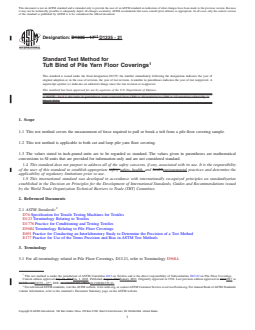
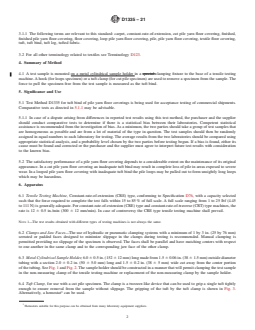
6.3 Metal Cylindrical Sample Holder, 6.0 6 0.5 in. (152 6 12 mm) long made from 1.5 6 0.06 in. (38 6 1.5 mm) outside diameter
tubing with a section 2.0 6 0.2 in. (50 6 5.0 mm) long and 1.5 6 0.2 in. (38 6 5 mm) wide cut away from the center portion
of the tubing. See Fig. 1 and Fig. 2. The sample holder should be constructed in a manner that will permit clamping the test sample
in the non-measuring clamp of the tensile testing machine or replacement of the non-measuring clamp by the sample holder.
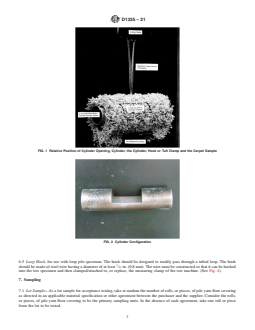
6.4 Tuft Clamp, for use with a cut pile specimen. The clamp is a tweezer-like device that can be used to grip a single tuft tightly
enough to ensure removal from the sample without slippage. The gripping of the tuft by the tuft clamp is shown in Fig. 3.
Alternatively, a hemostat can be used.
Hemostats suitable for this purpose can be obtained from many laboratory equipment suppliers.
D1335 − 21
FIG. 1 Relative Position of Cylinder Opening, Cylinder, the Cylinder, Hook or Tuft Clamp and the Carpet Sample
FIG. 2 Cylinder Configuration
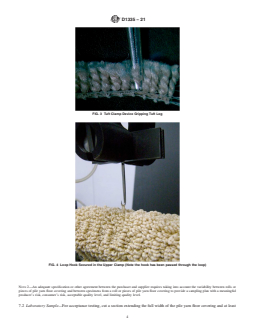
6.5 Loop Hook, for use with loop pile specimen. The hook should be designed to readily pass through a tufted loop. The hook
should be made of steel wire having a diameter of at least ⁄32 in. (0.8 mm). The wire must be constructed so that it can be hooked
into the test specimen and then clamped/attached to, or replace, the measuring clamp of the test machine. (See Fig. 4).
7. Sampling
7.1 Lot Sample—As a lot sample for acceptance testing, take at random the number of rolls, or pieces, of pile yarn floor covering
as directed in an applicable material specification or other agreement between the purchaser and the supplier. Consider the rolls,
or pieces, of pile yarn floor covering to be the primary sampling units. In the absence of such agreement, take one roll or piece
from the lot to be tested.
D1335 − 21
FIG. 3 Tuft Clamp Device Gripping Tuft Leg
FIG. 4 Loop Hook Secured in the Upper Clamp (Note the hook has been passed through the loop)
NOTE 2—An adequate specification or other agreement between the purchaser and supplier requires taking into account the variability between rolls or
pieces of pile yarn floor covering and between specimens from a roll or pieces of pile yarn floor covering to provide a sampling plan with a meaningful
producer’s risk, consumer’s risk, acceptable quality level, and limiting quality level.
7.2 Laboratory Sample—For acceptance testing, cut a section extending the full width of the pile yarn floor covering and at least
D1335 − 21
4 in. (100 mm) longer than the test sample requested in 7.3, from each roll, or piece, in the lot. For rolls of pile floor covering,
take a sample that will exclude fabric with visible damage.
7.3 Test Sample—From each laboratory sampling unit, cut five test samples with the longer direction parallel to the machine
direction. Consider the long direction as the direction of test. Cut each test sample 6 by 8 in. (150 by 200 mm). The test sample
should be taken no nearer to the edge than 5 % of the pile yarn floor covering width.
7.3.1 If the pile floor covering is back coated only, exercise care in handling the sample to prevent breaking, or otherwise
disturbing, the back coating.
7.4 Test Specimens—Test three specimens from each test sample. A specimen is a tuft leg or loop. In cases where a pile yarn floor
covering contains both cut and uncut pile, test only the uncut (loop).
NOTE 3—If the uncut (loop) is satisfactory, the cut pile will be adequate.
7.5 Test Result—The test result is the average for the three specimens in a test sample.
8. Preparation and Verification of Apparatus
8.1 Tensile Testing Machine, A constant-rate-of extension (CRE) type conforming to Specification D76 with a constant
rate-of-traverse of 12 6 0.5 in./min (300 6 12 mm/min) is preferred. A constant-rate-of-traverse (CRT) type tensile testing
machine conforming to Specification D76 and operated at the same speed is permitted.
...