

ASTM D1607-91(2018)e1
(Test Method)Standard Test Method for Nitrogen Dioxide Content of the Atmosphere (Griess-Saltzman Reaction)
General Information
- Abstract
SIGNIFICANCE AND USE
5.1 Nitrogen dioxide plays an important role in photochemical smog-forming reactions and, in sufficient concentrations, is deleterious to health, agriculture, materials, and visibility.
5.2 In combustion processes, significant amounts of nitric oxide (NO) may be produced by combination of atmospheric nitrogen and oxygen; at ambient temperatures NO can be converted to NO2 by oxygen and other atmospheric oxidants. Nitrogen dioxide may also be generated from processes involving nitric acid, nitrates, the use of explosives, and welding.
SCOPE
1.1 This test method2 covers the manual determination of nitrogen dioxide (NO2) in the atmosphere in the range from 4 to 10 000 μg/m3 (0.002 to 5 ppm(v)) when sampling is conducted in fritted-tip bubblers.
1.2 For concentrations of NO2 in excess of 10 mg/m3 (5 ppm(v)), as occur in industrial atmospheres, gas burner stacks, or automotive exhaust, or for samples relatively high in sulfur dioxide content, other methods should be applied. See for example Test Method D1608.
1.3 The maximum sampling period is 60 min at a flow rate of 0.4 L/min.
1.4 The values stated in SI units are to be regarded as standard. The values given in parentheses are mathematical conversions to inch-pound units that are provided for information only and are not considered standard.
1.5 This standard does not purport to address all of the safety concerns, if any, associated with its use. It is the responsibility of the user of this standard to establish appropriate safety, health, and environmental practices and determine the applicability of regulatory limitations prior to use. See also 7.2.2 for other precautions.
1.6 This international standard was developed in accordance with internationally recognized principles on standardization established in the Decision on Principles for the Development of International Standards, Guides and Recommendations issued by the World Trade Organization Technical Barriers to Trade (TBT) Committee.
- Status
- Published
- Publication Date
- 30-Jun-2018
- Technical Committee
- D22 - Air Quality
- Drafting Committee
- D22.03 - Ambient Atmospheres and Source Emissions
Overview
ASTM D1607-91(2018)e1 is the internationally recognized standard test method for determining nitrogen dioxide (NO₂) content in atmospheric air using the Griess-Saltzman reaction. Developed by ASTM International, this standard provides a reliable manual procedure to measure NO₂ concentrations in the range of 4 to 10,000 μg/m³ (0.002 to 5 ppm(v)), making it appropriate for urban ambient air monitoring and selected occupational settings. The test method is valued for its accuracy and is referenced by regulatory bodies and environmental monitoring professionals to assess air quality and support compliance with health, environmental, and visibility standards.
Key Topics
Significance of NO₂ Monitoring
Nitrogen dioxide is a major contributor to photochemical smog and is harmful to human health, materials, agriculture, and visibility. Monitoring NO₂ levels is essential for evaluating air quality, regulatory compliance, and understanding the impact of combustion and industrial activities.Griess-Saltzman Reaction Principle
The Griess-Saltzman reaction is a colorimetric technique where sampled NO₂ is absorbed in a specialized reagent, producing a red-violet color. This color is measured spectrophotometrically at 550 nm, allowing quantitative analysis of NO₂ concentrations.Test Method Parameters
- Manual sampling using fritted-tip bubblers
- Sample flow rate of 0.4 L/min with a maximum 60-minute duration
- Effective for ambient or lightly polluted air; higher NO₂ concentration scenarios may require alternative test methods
Accuracy, Precision, and Interferences
The method includes guidance on calibration, standardization, and correction for temperature and pressure. It also addresses potential interferences, such as sulfur dioxide, ozone, and other nitrogen oxides, to ensure reliable NO₂ determination.
Applications
- Ambient Air Quality Monitoring
- Used by environmental agencies and research organizations to measure ambient NO₂, supporting regulatory compliance and air quality improvement initiatives.
- Industrial Hygiene and Occupational Monitoring
- Supports risk assessment and exposure control in workplaces where combustion, welding, or use of nitric acid and nitrates are common.
- Pollution Source Assessment
- Applicable to monitoring urban emissions, tracking trends in air pollution, and investigating the sources and spatial distribution of NO₂ in cities or near industrial operations.
- Validation of Air Cleaning and Mitigation Measures
- Utilized to quantify changes in atmospheric NO₂ following implementation of emission reduction strategies or installation of air filtration equipment.
Related Standards
- ASTM D1608 - Test Method for Oxides of Nitrogen in Gaseous Combustion Products, recommended for higher NO₂ concentration environments such as industrial exhaust.
- ASTM D1356 - Terminology relating to sampling and analysis of atmospheres.
- ASTM D1357 - Practice for planning air sampling campaigns.
- ASTM D1071 - Methods for volumetric measurement of gaseous fuel samples.
- ASTM D3195 - Practice for rotameter calibration.
- ASTM D3631 - Methods for measuring atmospheric pressure.
- ASTM E1 - Specification for laboratory thermometers.
- ASTM D1193 - Specification for reagent water.
Practical Value
Adopting ASTM D1607-91(2018)e1 ensures standardized, internationally recognized procedures for ambient nitrogen dioxide measurement. This enhances comparability of air quality data, aids in identifying pollution trends, and supports health and environmental protection efforts. The method is especially valuable where accuracy, repeatability, and regulatory acceptance are required for air monitoring programs.
Keywords: ASTM D1607, nitrogen dioxide test method, Griess-Saltzman reaction, NO₂ measurement, ambient air quality, colorimetric analysis, air sampling, environmental compliance, atmospheric monitoring.
Relations
- Effective Date
- 01-Jul-2018
- Effective Date
- 01-Sep-2020
- Effective Date
- 15-Mar-2020
- Effective Date
- 01-Nov-2019
- Effective Date
- 01-Aug-2019
- Effective Date
- 01-Apr-2017
- Effective Date
- 01-Mar-2017
- Effective Date
- 01-Mar-2016
- Effective Date
- 15-Oct-2015
- Effective Date
- 01-Jul-2015
- Effective Date
- 01-Dec-2014
- Effective Date
- 01-May-2014
- Effective Date
- 15-Jan-2014
- Effective Date
- 01-May-2013
- Effective Date
- 01-Oct-2011
Get Certified
Connect with accredited certification bodies for this standard

CIS Institut d.o.o.
Personal Protective Equipment (PPE) certification body. Notified Body NB-2890 for EU Regulation 2016/425 PPE.

Kiwa BDA Testing
Building and construction product certification.
Kmetijski inštitut Slovenije
Agricultural Institute of Slovenia. Soil testing, plant health, agricultural product analysis.
Sponsored listings
Frequently Asked Questions
ASTM D1607-91(2018)e1 is a standard published by ASTM International. Its full title is "Standard Test Method for Nitrogen Dioxide Content of the Atmosphere (Griess-Saltzman Reaction)". This standard covers: SIGNIFICANCE AND USE 5.1 Nitrogen dioxide plays an important role in photochemical smog-forming reactions and, in sufficient concentrations, is deleterious to health, agriculture, materials, and visibility. 5.2 In combustion processes, significant amounts of nitric oxide (NO) may be produced by combination of atmospheric nitrogen and oxygen; at ambient temperatures NO can be converted to NO2 by oxygen and other atmospheric oxidants. Nitrogen dioxide may also be generated from processes involving nitric acid, nitrates, the use of explosives, and welding. SCOPE 1.1 This test method2 covers the manual determination of nitrogen dioxide (NO2) in the atmosphere in the range from 4 to 10 000 μg/m3 (0.002 to 5 ppm(v)) when sampling is conducted in fritted-tip bubblers. 1.2 For concentrations of NO2 in excess of 10 mg/m3 (5 ppm(v)), as occur in industrial atmospheres, gas burner stacks, or automotive exhaust, or for samples relatively high in sulfur dioxide content, other methods should be applied. See for example Test Method D1608. 1.3 The maximum sampling period is 60 min at a flow rate of 0.4 L/min. 1.4 The values stated in SI units are to be regarded as standard. The values given in parentheses are mathematical conversions to inch-pound units that are provided for information only and are not considered standard. 1.5 This standard does not purport to address all of the safety concerns, if any, associated with its use. It is the responsibility of the user of this standard to establish appropriate safety, health, and environmental practices and determine the applicability of regulatory limitations prior to use. See also 7.2.2 for other precautions. 1.6 This international standard was developed in accordance with internationally recognized principles on standardization established in the Decision on Principles for the Development of International Standards, Guides and Recommendations issued by the World Trade Organization Technical Barriers to Trade (TBT) Committee.
SIGNIFICANCE AND USE 5.1 Nitrogen dioxide plays an important role in photochemical smog-forming reactions and, in sufficient concentrations, is deleterious to health, agriculture, materials, and visibility. 5.2 In combustion processes, significant amounts of nitric oxide (NO) may be produced by combination of atmospheric nitrogen and oxygen; at ambient temperatures NO can be converted to NO2 by oxygen and other atmospheric oxidants. Nitrogen dioxide may also be generated from processes involving nitric acid, nitrates, the use of explosives, and welding. SCOPE 1.1 This test method2 covers the manual determination of nitrogen dioxide (NO2) in the atmosphere in the range from 4 to 10 000 μg/m3 (0.002 to 5 ppm(v)) when sampling is conducted in fritted-tip bubblers. 1.2 For concentrations of NO2 in excess of 10 mg/m3 (5 ppm(v)), as occur in industrial atmospheres, gas burner stacks, or automotive exhaust, or for samples relatively high in sulfur dioxide content, other methods should be applied. See for example Test Method D1608. 1.3 The maximum sampling period is 60 min at a flow rate of 0.4 L/min. 1.4 The values stated in SI units are to be regarded as standard. The values given in parentheses are mathematical conversions to inch-pound units that are provided for information only and are not considered standard. 1.5 This standard does not purport to address all of the safety concerns, if any, associated with its use. It is the responsibility of the user of this standard to establish appropriate safety, health, and environmental practices and determine the applicability of regulatory limitations prior to use. See also 7.2.2 for other precautions. 1.6 This international standard was developed in accordance with internationally recognized principles on standardization established in the Decision on Principles for the Development of International Standards, Guides and Recommendations issued by the World Trade Organization Technical Barriers to Trade (TBT) Committee.
ASTM D1607-91(2018)e1 is classified under the following ICS (International Classification for Standards) categories: 13.040.20 - Ambient atmospheres. The ICS classification helps identify the subject area and facilitates finding related standards.
ASTM D1607-91(2018)e1 has the following relationships with other standards: It is inter standard links to ASTM D1607-91(2011), ASTM D1356-20a, ASTM D1356-20, ASTM E128-99(2019), ASTM D1357-95(2019), ASTM D1071-17, ASTM D3631-99(2017), ASTM D1608-16, ASTM D1356-15a, ASTM D1356-15, ASTM D1356-14b, ASTM D1356-14a, ASTM D1356-14, ASTM E1-13, ASTM D3631-99(2011). Understanding these relationships helps ensure you are using the most current and applicable version of the standard.
ASTM D1607-91(2018)e1 is available in PDF format for immediate download after purchase. The document can be added to your cart and obtained through the secure checkout process. Digital delivery ensures instant access to the complete standard document.
Standards Content (Sample)
This international standard was developed in accordance with internationally recognized principles on standardization established in the Decision on Principles for the
Development of International Standards, Guides and Recommendations issued by the World Trade Organization Technical Barriers to Trade (TBT) Committee.
´1
Designation: D1607 − 91 (Reapproved 2018)
Standard Test Method for
Nitrogen Dioxide Content of the Atmosphere (Griess-
Saltzman Reaction)
This standard is issued under the fixed designation D1607; the number immediately following the designation indicates the year of
original adoption or, in the case of revision, the year of last revision.Anumber in parentheses indicates the year of last reapproval.A
superscript epsilon (´) indicates an editorial change since the last revision or reapproval.
This standard has been approved for use by agencies of the U.S. Department of Defense.
ε NOTE—Warning notes were editorially updated throughout in July 2018.
1. Scope 2. Referenced Documents
2.1 ASTM Standards:
1.1 This test method covers the manual determination of
D1071Test Methods for Volumetric Measurement of Gas-
nitrogen dioxide (NO ) in the atmosphere in the range from 4
eous Fuel Samples
to 10 000 µg/m (0.002 to 5 ppm(v)) when sampling is
D1193Specification for Reagent Water
conducted in fritted-tip bubblers.
D1356Terminology Relating to Sampling and Analysis of
1.2 For concentrations of NO in excess of 10 mg/m (5
Atmospheres
ppm(v)), as occur in industrial atmospheres, gas burner stacks,
D1357Practice for Planning the Sampling of the Ambient
or automotive exhaust, or for samples relatively high in sulfur
Atmosphere
dioxide content, other methods should be applied. See for
D1608Test Method for Oxides of Nitrogen in Gaseous
example Test Method D1608.
Combustion Products (Phenol-Disulfonic Acid Proce-
1.3 The maximum sampling period is 60 min at a flow rate dures)
of 0.4 L/min.
D3195Practice for Rotameter Calibration
D3609Practice for Calibration Techniques Using Perme-
1.4 The values stated in SI units are to be regarded as
ation Tubes
standard. The values given in parentheses are mathematical
D3631Test Methods for Measuring Surface Atmospheric
conversions to inch-pound units that are provided for informa-
Pressure
tion only and are not considered standard.
E1Specification for ASTM Liquid-in-Glass Thermometers
1.5 This standard does not purport to address all of the
E128Test Method for Maximum Pore Diameter and Perme-
safety concerns, if any, associated with its use. It is the
ability of Rigid Porous Filters for Laboratory Use
responsibility of the user of this standard to establish appro-
3. Terminology
priate safety, health, and environmental practices and deter-
mine the applicability of regulatory limitations prior to use.
3.1 Fordefinitionsoftermsusedinthistestmethod,referto
See also 7.2.2 for other precautions.
Terminology D1356.
1.6 This international standard was developed in accor-
4. Summary of Test Method
dance with internationally recognized principles on standard-
4.1 The NO is absorbed in an azo-dye-forming reagent
ization established in the Decision on Principles for the
(1). Ared-violetcolorisproducedwithin15min,theintensity
Development of International Standards, Guides and Recom-
of which is measured spectrophotometrically at 550 nm.
mendations issued by the World Trade Organization Technical
Barriers to Trade (TBT) Committee.
5. Significance and Use
5.1 Nitrogendioxideplaysanimportantroleinphotochemi-
cal smog-forming reactions and, in sufficient concentrations, is
This test method is under the jurisdiction of ASTM Committee D22 on Air
deleterious to health, agriculture, materials, and visibility.
Quality and is the direct responsibility of Subcommittee D22.03 on Ambient
Atmospheres and Source Emissions.
CurrenteditionapprovedJuly1,2018.PublishedJuly2018.Originallyapproved For referenced ASTM standards, visit the ASTM website, www.astm.org, or
in 1958. Last previous edition approved in 2011 as D1607–91 (2011). DOI: contact ASTM Customer Service at service@astm.org. For Annual Book of ASTM
10.1520/D1607-91R18E01. Standards volume information, refer to the standard’s Document Summary page on
Adaptedfrom“SelectedMethodsfortheMeasurementofAirPollutants,”PHS the ASTM website.
Publication No 999-AP-11, May 1965.Asimilar version has been submitted to the The boldface numbers in parentheses refer to a list of references at the end of
Intersociety Committee. this standard.
Copyright © ASTM International, 100 Barr Harbor Drive, PO Box C700, West Conshohocken, PA 19428-2959. United States
´1
D1607 − 91 (2018)
5.2 In combustion processes, significant amounts of nitric 7.2.1 The porosity of the fritted bubbler, as well as the
oxide (NO) may be produced by combination of atmospheric sampling flow rate, affect absorption efficiency. An efficiency
nitrogen and oxygen; at ambient temperatures NO can be of over 95% may be expected with a flow rate of 0.4 L/min or
converted to NO by oxygen and other atmospheric oxidants. less and a maximum pore diameter of 60 µm. Frits having a
Nitrogendioxidemayalsobegeneratedfromprocessesinvolv- maximum pore diameter less than 60 µm will have a higher
ing nitric acid, nitrates, the use of explosives, and welding. efficiency but will require an inconvenient pressure drop for
sampling. Considerably lower efficiencies are obtained with
6. Interferences
coarser frits.
7.2.2 Measure the porosity of an absorber in accordance
6.1 Aten-foldratioofsulfurdioxide(SO)toNO produces
2 2
with Test Method E128. If the frit is clogged or visibly
no effect. A thirty-fold ratio slowly bleaches the color to a
discolored, carefully clean with concentrated chromic-sulfuric
slight extent.The addition of acetone to the reagent retards the
acid mixture, and rinse well with water and redetermine the
fadingbyformingatemporaryadditionproductwithSO .This
maximum pore diameter. (Warning—Do not dispose of this
permits reading the color intensity within 4 to 5 h (instead of
reagent in the drain system.)
the 45 min required without the acetone) without appreciable
7.2.3 Rinse the bubbler thoroughly with water and allow to
losses.
dry before using.
6.2 A five-fold ratio of ozone to NO will cause a small
7.3 Mist Eliminator or Gas Drying Tube, filled with acti-
interference, the maximal effect occurring in 3 h. The reagent
vated charcoal or soda lime is used to prevent damage to the
assumes a slightly orange tint.
flowmeter and pump.
6.3 Peroxyacetyl nitrate (PAN) can produce a color change
7.4 Air-Metering Device—Acalibrated, glass, variable-area
intheabsorbingreagent.However,inordinaryambientair,the
flowmeter, or dry gas meter coupled with a flow indicator
concentration of PAN is too low to cause any significant error
capable of accurately measuring a flow of 0.4 L/min.
in the measurement of NO .
7.5 Thermometer—ASTM Thermometer 33C, meeting the
6.4 Interferences may exist from other nitrogen oxides and
requirements of Specification E1, will be suitable for most
other gases that might be found in polluted air.
applications of this test method.
7. Apparatus
7.6 Manometer, accurate to 670 Pa (0.20 in. Hg). See Test
Methods D3631.
7.1 Sampling Probe—A glass or TFE-fluorocarbon (pre-
ferred) tube, 6 to 10 mm in diameter provided with a
7.7 Air Pump—A suction pump capable of drawing the
downwindfacingintake(funnelortip).Thedeadvolumeofthe
required sample flow for intervals of up to 60 min is suitable.
system should be kept minimal to avoid losses of NO on the
7.8 Spectrophotometer or Colorimeter—Aninstrumentsuit-
surfaces of the apparatus.
able for measuring the intensity of absorption at 550 nm, with
7.2 Absorber—Anall-glassbubblerwitha60-µmmaximum
stoppered tubes or cuvettes.The wavelength band-width is not
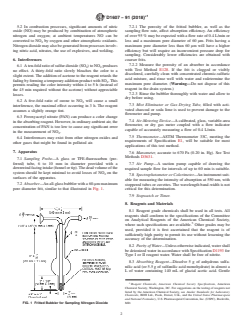
pore diameter frit, similar to that illustrated in Fig. 1. critical for this determination.
7.9 Stopwatch or Timer.
8. Reagents and Materials
8.1 Reagent grade chemicals shall be used in all tests. All
reagents shall conform to the specifications of the Committee
on Analytical Reagents of the American Chemical Society,
where such specifications are available. Other grades may be
used, provided it is first ascertained that the reagent is of
sufficiently high purity to permit its use without lessening the
accuracy of the determination.
8.2 Purity of Water—Unlessotherwiseindicated,watershall
bedeionizedwaterinaccordancewithSpecificationD1193for
Type I or II reagent water. Water shall be free of nitrite.
8.3 Absorbing Reagent—Dissolve5gof anhydrous sulfa-
nilic acid (or 5.5 g of sulfanilic acid monohydrate) in almost a
L of water containing 140 mL of glacial acetic acid. Gentle
Reagent Chemicals, American Chemical Society Specifications, American
Chemical Society, Washington, DC. For suggestions on the testing of reagents not
listed by the American Chemical Society, see Analar Standards for Laboratory
Chemicals, BDH Ltd., Poole, Dorset, U.K., and the United States Pharmacopeia
and National Formulary, U.S. Pharmacopeial Convention, Inc. (USPC), Rockville,
FIG. 1 Fritted Bubbler for Sampling Nitrogen Dioxide MD.
´1
D1607 − 91 (2018)
heating is permissible to speed up the process. To the cooled 10.2.2 Alternate Procedure:
mixture, add 20 mL of the 0.1% stock solution of N-(1-
10.2.2.1 Standardization is based upon the empirical obser-
naphthyl)-ethylenediamine dihydrochloride, and 10 mL of
vation (1, 3) that0.82molofNaNO producesthesamecolor
acetone. Dilute to 1 L. The solution will be stable for several
as 1 mol of NO . One mL of the working standard solution
months if kept well-stoppered in a brown bottle in the
contains 24.6 µg of NaNO . Since the molecular weight of
refrigerator. The absorbing reagent shall be at room tempera-
NaNO is 69.1, this is equivalent to (24.6/
ture before use. Avoid lengthy contact with air during prepa-
69.1)×(46.0⁄0.82)=20 µg NO .
rationandusesincediscolorationofreagentwillresultbecause
10.2.2.2 For convenience, standard conditions are taken as
of absorption of NO .
2 101 kPa (29.92 in. Hg) and 25°C, at which the molar gas
volumeis24.47L.Thisisveryclosetothestandardconditions
8.4 N-(1-Naphthyl)-Ethylenediamine Dihydrochloride,
used for air-handling equipment–101 kPa (29.92 in. Hg), 70°F
Stock Solution (0.1 %)—Dissolve 0.1 g of the reagent in 100
(21.1°C), and 50% relative humidity, at which the molar gas
mLof water. Solution will be stable for several mo
...