

ASTM F2397-18
(Specification)Standard Specification for Protective Headgear Used in Combative Sports
General Information
- Abstract
ABSTRACT
This specification delas with the performance requirements for head protection used for training and competition in martial arts such as karate, wushu, and taekwondo, where normal contact between participants may be repeated, but is limited to a level that is not intended to produce injury. These activities typically take place in indoor or outdoor environments where the temperature is moderate. This specification recognizes the desirability of a lightweight and streamlined construction, and ventilation; however it is a performance specification, and is not intended to restrict design. Headgears shall be tested for the following and using the following test methods: reference marking, configuration, materials, projections, vision, retention test, stability or roll-off test, low-energy falling impact test, high-energy falling impact test, low-energy striking impact test, high-energy striking impact test, and high and low speed errors. The apparatus which shall be used are the test headforms, stability test instruments and equipment, falling impact test instruments and equipment, and striking impact instruments and equipment. The significance and use, conditioning environments, and test schedule are also detailed.
SCOPE
1.1 This specification covers performance requirements for head protection used for training and competition in combative sports such as karate, wushu, and taekwondo, where normal contact between participants may be repeated, but is limited to a level that is not intended to produce injury. These activities typically take place in indoor or outdoor environments where the temperature is moderate. This specification recognizes the desirability of a lightweight and streamlined construction, and ventilation; however, it is a performance specification, and is not intended to restrict design.
1.2 All testing and requirements of this specification shall be in accordance with Test Methods F1446, except where noted in this specification.
1.3 Partial utilization of this standard is prohibited. Any statement of compliance with this specification shall be a certification that the product meets all of the requirements of the specification in its entirety. A product that fails to meet any one of the requirements of this specification is considered to have failed the specification, and shall not be distributed or sold with any indication that it meets parts of the specification.
1.4 The values stated in SI units are to be regarded as standard. No other units of measurement are included in this standard.
1.5 The following safety caveat applies to the chemical, mechanical, or physical, or a combination thereof, test methods described herein and is meant specifically for those performing the tests (in an effort to provide them with notice to take the appropriate precautions when conducting the tests): This standard does not purport to address all of the safety concerns, if any, associated with its use. It is the responsibility of the user of this standard to establish appropriate safety, health, and environmental practices and determine the applicability of regulatory limitations prior to use.
1.6 This international standard was developed in accordance with internationally recognized principles on standardization established in the Decision on Principles for the Development of International Standards, Guides and Recommendations issued by the World Trade Organization Technical Barriers to Trade (TBT) Committee.
- Status
- Published
- Publication Date
- 30-Sep-2018
- Technical Committee
- F08 - Sports Equipment, Playing Surfaces, and Facilities
- Drafting Committee
- F08.53 - Headgear and Helmets
Buy Documents
ASTM F2397-18 - Standard Specification for Protective Headgear Used in Combative Sports
REDLINE ASTM F2397-18 - Standard Specification for Protective Headgear Used in Combative Sports
Overview
ASTM F2397-18: Standard Specification for Protective Headgear Used in Combative Sports provides essential performance requirements for protective headgear used in martial arts and combative sports such as karate, taekwondo, and wushu. The goal of this ASTM standard is to minimize the risk of head injuries during training and competition where physical contact is present but not intended to cause harm. The specification emphasizes the need for lightweight, ventilated, and streamlined headgear while ensuring robust testing protocols to guarantee user safety.
Key Topics
Scope and Purpose:
- Covers head protection for martial arts and combative sports where repetitive contact occurs but is not meant to cause injury.
- Supports both indoor and outdoor use in moderate temperatures.
- Emphasizes performance requirements without restricting design innovation.
Performance and Testing Requirements:
- Headgear must meet strict criteria through testing, including:
- Reference marking
- Configuration and materials
- Projections and vision
- Retention and stability tests (roll-off)
- Low and high-energy falling and striking impact tests
- Tests are conducted following ASTM F1446 Test Methods for evaluating protective headgear, ensuring consistency and reliability.
- Headgear must meet strict criteria through testing, including:
Materials and Construction:
- Headgear should offer external cushioning, especially over hard surfaces and projections.
- Must provide adequate ear openings and alternate air paths for safety and hearing.
Labels and Warnings:
- Products must include instructions regarding intended use, limits of protection, and self-inspection methods for damage.
Compliance:
- Partial compliance is prohibited; headgear must satisfy all specification aspects to be certified.
Applications
ASTM F2397-18 is crucial for manufacturers, testing laboratories, and sporting organizations involved with protective headgear for martial arts. Its primary applications include:
- Product Design & Development: Guides manufacturers in engineering headgear that meets recognized safety criteria while allowing for design flexibility and innovation.
- Testing & Certification: Sets standardized methods for impact, retention, and stability testing, enabling manufacturers and labs to assess headgear consistently.
- Market Access: Compliance enables products to be accepted in regulated sports competitions and by sporting authorities.
- End-user Assurance: Provides martial arts schools, athletes, and trainers with confidence that approved headgear reduces the risk of superficial head injuries.
Related Standards
Meeting ASTM F2397-18 often requires reference to additional standards and supporting documents:
- ASTM F1446 - Test Methods for Equipment and Procedures Used in Evaluating the Performance Characteristics of Protective Headgear: Provides the foundation for most testing required by F2397-18.
- Other Sport-Specific Headgear Standards: For non-martial arts applications, refer to the relevant ASTM or ISO standards targeting bicycle helmets, team sports, or industrial head protection.
Organizations developing, selecting, or approving protective headgear for combative sports should always ensure compliance with ASTM F2397-18 to provide maximum safety and reliability for athletes engaged in karate, taekwondo, wushu, and related disciplines.
Keywords: combative sports, martial arts, protective headgear, ASTM F2397-18, karate, taekwondo, wushu, headgear standards, safety, helmet testing, athlete protection, sports equipment standards.
Relations
- Effective Date
- 01-Oct-2018
- Effective Date
- 01-Oct-2018
- Effective Date
- 01-Oct-2018
Buy Documents
ASTM F2397-18 - Standard Specification for Protective Headgear Used in Combative Sports
REDLINE ASTM F2397-18 - Standard Specification for Protective Headgear Used in Combative Sports
Get Certified
Connect with accredited certification bodies for this standard

CIS Institut d.o.o.
Personal Protective Equipment (PPE) certification body. Notified Body NB-2890 for EU Regulation 2016/425 PPE.

Kiwa BDA Testing
Building and construction product certification.
Kmetijski inštitut Slovenije
Agricultural Institute of Slovenia. Soil testing, plant health, agricultural product analysis.
Sponsored listings
Frequently Asked Questions
ASTM F2397-18 is a technical specification published by ASTM International. Its full title is "Standard Specification for Protective Headgear Used in Combative Sports". This standard covers: ABSTRACT This specification delas with the performance requirements for head protection used for training and competition in martial arts such as karate, wushu, and taekwondo, where normal contact between participants may be repeated, but is limited to a level that is not intended to produce injury. These activities typically take place in indoor or outdoor environments where the temperature is moderate. This specification recognizes the desirability of a lightweight and streamlined construction, and ventilation; however it is a performance specification, and is not intended to restrict design. Headgears shall be tested for the following and using the following test methods: reference marking, configuration, materials, projections, vision, retention test, stability or roll-off test, low-energy falling impact test, high-energy falling impact test, low-energy striking impact test, high-energy striking impact test, and high and low speed errors. The apparatus which shall be used are the test headforms, stability test instruments and equipment, falling impact test instruments and equipment, and striking impact instruments and equipment. The significance and use, conditioning environments, and test schedule are also detailed. SCOPE 1.1 This specification covers performance requirements for head protection used for training and competition in combative sports such as karate, wushu, and taekwondo, where normal contact between participants may be repeated, but is limited to a level that is not intended to produce injury. These activities typically take place in indoor or outdoor environments where the temperature is moderate. This specification recognizes the desirability of a lightweight and streamlined construction, and ventilation; however, it is a performance specification, and is not intended to restrict design. 1.2 All testing and requirements of this specification shall be in accordance with Test Methods F1446, except where noted in this specification. 1.3 Partial utilization of this standard is prohibited. Any statement of compliance with this specification shall be a certification that the product meets all of the requirements of the specification in its entirety. A product that fails to meet any one of the requirements of this specification is considered to have failed the specification, and shall not be distributed or sold with any indication that it meets parts of the specification. 1.4 The values stated in SI units are to be regarded as standard. No other units of measurement are included in this standard. 1.5 The following safety caveat applies to the chemical, mechanical, or physical, or a combination thereof, test methods described herein and is meant specifically for those performing the tests (in an effort to provide them with notice to take the appropriate precautions when conducting the tests): This standard does not purport to address all of the safety concerns, if any, associated with its use. It is the responsibility of the user of this standard to establish appropriate safety, health, and environmental practices and determine the applicability of regulatory limitations prior to use. 1.6 This international standard was developed in accordance with internationally recognized principles on standardization established in the Decision on Principles for the Development of International Standards, Guides and Recommendations issued by the World Trade Organization Technical Barriers to Trade (TBT) Committee.
ABSTRACT This specification delas with the performance requirements for head protection used for training and competition in martial arts such as karate, wushu, and taekwondo, where normal contact between participants may be repeated, but is limited to a level that is not intended to produce injury. These activities typically take place in indoor or outdoor environments where the temperature is moderate. This specification recognizes the desirability of a lightweight and streamlined construction, and ventilation; however it is a performance specification, and is not intended to restrict design. Headgears shall be tested for the following and using the following test methods: reference marking, configuration, materials, projections, vision, retention test, stability or roll-off test, low-energy falling impact test, high-energy falling impact test, low-energy striking impact test, high-energy striking impact test, and high and low speed errors. The apparatus which shall be used are the test headforms, stability test instruments and equipment, falling impact test instruments and equipment, and striking impact instruments and equipment. The significance and use, conditioning environments, and test schedule are also detailed. SCOPE 1.1 This specification covers performance requirements for head protection used for training and competition in combative sports such as karate, wushu, and taekwondo, where normal contact between participants may be repeated, but is limited to a level that is not intended to produce injury. These activities typically take place in indoor or outdoor environments where the temperature is moderate. This specification recognizes the desirability of a lightweight and streamlined construction, and ventilation; however, it is a performance specification, and is not intended to restrict design. 1.2 All testing and requirements of this specification shall be in accordance with Test Methods F1446, except where noted in this specification. 1.3 Partial utilization of this standard is prohibited. Any statement of compliance with this specification shall be a certification that the product meets all of the requirements of the specification in its entirety. A product that fails to meet any one of the requirements of this specification is considered to have failed the specification, and shall not be distributed or sold with any indication that it meets parts of the specification. 1.4 The values stated in SI units are to be regarded as standard. No other units of measurement are included in this standard. 1.5 The following safety caveat applies to the chemical, mechanical, or physical, or a combination thereof, test methods described herein and is meant specifically for those performing the tests (in an effort to provide them with notice to take the appropriate precautions when conducting the tests): This standard does not purport to address all of the safety concerns, if any, associated with its use. It is the responsibility of the user of this standard to establish appropriate safety, health, and environmental practices and determine the applicability of regulatory limitations prior to use. 1.6 This international standard was developed in accordance with internationally recognized principles on standardization established in the Decision on Principles for the Development of International Standards, Guides and Recommendations issued by the World Trade Organization Technical Barriers to Trade (TBT) Committee.
ASTM F2397-18 is classified under the following ICS (International Classification for Standards) categories: 13.340.20 - Head protective equipment. The ICS classification helps identify the subject area and facilitates finding related standards.
ASTM F2397-18 has the following relationships with other standards: It is inter standard links to ASTM F2397-09(2015), ASTM F2374-22, ASTM F2747-19. Understanding these relationships helps ensure you are using the most current and applicable version of the standard.
ASTM F2397-18 is available in PDF format for immediate download after purchase. The document can be added to your cart and obtained through the secure checkout process. Digital delivery ensures instant access to the complete standard document.
Standards Content (Sample)
This international standard was developed in accordance with internationally recognized principles on standardization established in the Decision on Principles for the
Development of International Standards, Guides and Recommendations issued by the World Trade Organization Technical Barriers to Trade (TBT) Committee.
Designation:F2397 −18 An American National Standard
Standard Specification for
Protective Headgear Used in Combative Sports
This standard is issued under the fixed designation F2397; the number immediately following the designation indicates the year of
original adoption or, in the case of revision, the year of last revision. A number in parentheses indicates the year of last reapproval. A
superscript epsilon (´) indicates an editorial change since the last revision or reapproval.
1. Scope ization established in the Decision on Principles for the
Development of International Standards, Guides and Recom-
1.1 This specification covers performance requirements for
mendations issued by the World Trade Organization Technical
head protection used for training and competition in combative
Barriers to Trade (TBT) Committee.
sports such as karate, wushu, and taekwondo, where normal
contact between participants may be repeated, but is limited to
2. Referenced Documents
a level that is not intended to produce injury. These activities
2.1 ASTM Standards:
typically take place in indoor or outdoor environments where
F1446 Test Methods for Equipment and Procedures Used in
the temperature is moderate. This specification recognizes the
Evaluating the Performance Characteristics of Protective
desirability of a lightweight and streamlined construction, and
Headgear
ventilation; however, it is a performance specification, and is
not intended to restrict design.
3. Terminology
1.2 All testing and requirements of this specification shall
3.1 See Test Methods F1446.
beinaccordancewithTestMethodsF1446,exceptwherenoted
4. Significance and Use
in this specification.
4.1 The purpose of this specification is to provide reliable
1.3 Partial utilization of this standard is prohibited. Any
and repeatable test methods for the evaluation of protective
statement of compliance with this specification shall be a
headgear for combative sports training and competition. Inju-
certification that the product meets all of the requirements of
ries resulting from accidentally hard hand-to-head impacts,
the specification in its entirety.Aproduct that fails to meet any
foot-to-head impacts, and head-to-ground impacts may be
one of the requirements of this specification is considered to
decreased in severity and, in some cases, prevented. No
have failed the specification, and shall not be distributed or
headgear can protect against all impacts, foreseeable or not.
sold with any indication that it meets parts of the specification.
Forces resulting from strikes to the head due to kicks, punches,
1.4 The values stated in SI units are to be regarded as
and falls are not well understood. The mechanism of possible
standard. No other units of measurement are included in this
injury is not addressed in this specification.
standard.
5. Certification
1.5 The following safety caveat applies to the chemical,
mechanical,orphysical,oracombinationthereof,testmethods 5.1 See Test Methods F1446.
described herein and is meant specifically for those performing
6. Apparatus
the tests (in an effort to provide them with notice to take the
appropriate precautions when conducting the tests): This stan- 6.1 Test Headforms—Headforms to be used for the stability
and falling impact tests in this specification are as defined in
dard does not purport to address all of the safety concerns, if
any, associated with its use. It is the responsibility of the user Test Methods F1446. The appropriate size headform shall be
selected for the headgear to be tested. For the striking impact
of this standard to establish appropriate safety, health, and
environmental practices and determine the applicability of tests in this specification, it is acceptable to use the appropriate
size Hybrid III head- and neck-forms.
regulatory limitations prior to use.
1.6 This international standard was developed in accor-
6.2 Stability Test Instruments and Equipment—Stability test
dance with internationally recognized principles on standard-
instruments and equipment shall be in accordance with the
requirements of the roll-off test described in Test Methods
F1446.
This specification is under the jurisdiction ofASTM Committee F08 on Sports
Equipment, Playing Surfaces, and Facilities and is the direct responsibility of
Subcommittee F08.53 on Headgear and Helmets. For referenced ASTM standards, visit the ASTM website, www.astm.org, or
Current edition approved Oct. 1, 2018. Published November 2018. Originally contact ASTM Customer Service at service@astm.org. For Annual Book of ASTM
approved in 2004. Last previous edition approved in 2015 as F2397 – 09 (2015). Standards volume information, refer to the standard’s Document Summary page on
DOI: 10.1520/F2397-18. the ASTM website.
Copyright © ASTM International, 100 Barr Harbor Drive, PO Box C700, West Conshohocken, PA 19428-2959. United States
F2397−18
6.3 Falling Impact Test Instruments and Equipment— 7. Samples for Testing
Impact test instruments and equipment for falling impact shall
7.1 Conditions and attachments in accordance with Test
beinaccordancewiththerequirementsofTestMethodsF1446,
Methods F1446.
using the flat anvil described in Test Methods F1446.
7.2 Number of Samples—A test normally requires seven
6.4 Striking Impact Instruments and Equipment—All tests
samples of each size. All testing may be done on two size
for striking impact shall be performed with a Hybrid III
groups only if the material, material thickness, and construc-
headform and neck. A tri-axial accelerometer capable of
tion of all the sizes are the same, that is, differing in coverage
measuring impact of at least 1000-G and frequencies greater
area only. If only two size groups are tested, the sizes must
than 3 kHz, mounted at the center of mass of the headform,
represent the largest and smallest sizes that will fit the
shall be used to measure the resultant acceleration of the
appropriate headform. If the material, material thickness, or
headform. The headform and neck are to be rigidly connected
construction is different between each size, then all sizes must
at the neck to a 25-kg steel mass, and suspended head-down on
be tested.
a flexible joint. The striker shall be an aluminum tube with a
length of 500 6 5 mm from its pivot point to the strike point,
8. Calibration and Standardization
extend an additional 50 6 5 mm beyond the strike point, and
8.1 See Test Methods F1446.
have an external diameter of 80 6 5 mm. The mass of the tube
shall be 4.5 6 0.2 kg, uniformly distributed along its length.
9. Conditioning Environments
The striker shall be loaded with a spring or a falling mass, such
9.1 See Test Methods F1446. The ambient temperature and
that when the striker is rotated back and released, it rotates
water immersion environments shall be used.
forward toward the headform and strikes it at the designated
points. No force is to be applied to the striker by the spring or
9.2 The following modified high temperature environment
falling mass once the striker rotates forward beyond the initial
shall be used. The sample shall be kept in a 47 to 53°C
impact point, however, the striker must be free to rotate
environment for 4 to 24 h. The sample shall then be kept in a
forward after impact. Rotating the striker further backwards
35 to 40°C environment for 4 to 24 h. Testing must begin
before releasing it can increase the striking speed.The terminal
within 1 min after removal from this final conditioning
speed impact shall be measured within 100 mm of the point of
environment. Before further testing, the headgear must be
free rotation. A schematic diagram of a typical striking impact returned to the final conditioning environment within 3 min, or
tester is shown in Fig. 1.
be reconditioned for 5 min for each minute it is out of the final
conditioning environment beyond the allowed 3 min.
10. Test Schedule
10.1 One sample from each size group to be tested will be
inspected according to the schedule listed in Test Methods
F1446.
10.2 Two headgear will be assigned to the ambient condi-
tioning environment. Two headgear will be assigned to each of
the other two conditioning environments.
10.3 Testing will be performed in the following order:
10.3.1 Retention test,
10.3.2 Low-energy falling impact test,
10.3.3 High-energy falling impact test,
10.3.4 Low-energy striking impact test, and
10.3.5 High-energy striking impact test.
10.4 Testing must be complete 30 min after initial removal
from the conditioning environment. Once testing has begun on
a sample, all tests on that sample must be completed within 3
min. For each minute, or fraction thereof, this time limit is
exceeded, the sample must be returned to the conditioning
environment for an additional 5 min.
11. Test Methods
11.1 Reference Marking:
11.1.1 Place the headgear on the appropriate headform in
accordance with Test Methods F1446. Pre-load with a ballast
of 5 kg.
11.1.2 Draw lines A-B-C-D-E on the headgear as shown in
FIG. 1Striking Impact Test. Fig. 2. This represents the test line for impact in the frontal,
F2397−18
ASTM X Y R S
Headform Size mm mm mm mm
A 24.0 89.7 38.0 7.0
E 26.0 96.0 39.0 8.0
J 27.5 102.5 41.0 8.0
M 29.0 107.0 41.0 8.0
O 31.0 110.0 42.0 9.0
FIG. 2Marking the Test Line
temporal, and occipital directions. Lines A-B-C and D-E are where normal contact between participants is limited to a level
parallel to the reference and basic planes. Line B-D is that is not intended to produce injury. While headgear is
co-planar with the coronal plane. The center of impact may be designed to decrease the chance of having a head injury or
selected to be anywhere on or between the test lines. decrease its severity, no headgear can prevent all head injuries.
11.4.3 Each headgear shall also have instructions for
11.2 Configuration:
method and frequency of self-inspection for damage, and for
11.2.1 In general, the headgear shall be constructed to
disposal after a period of
...
This document is not an ASTM standard and is intended only to provide the user of an ASTM standard an indication of what changes have been made to the previous version. Because
it may not be technically possible to adequately depict all changes accurately, ASTM recommends that users consult prior editions as appropriate. In all cases only the current version
of the standard as published by ASTM is to be considered the official document.
Designation: F2397 − 09 (Reapproved 2015) F2397 − 18 An American National Standard
Standard Specification for
Protective Headgear Used in Martial ArtsCombative Sports
This standard is issued under the fixed designation F2397; the number immediately following the designation indicates the year of
original adoption or, in the case of revision, the year of last revision. A number in parentheses indicates the year of last reapproval. A
superscript epsilon (´) indicates an editorial change since the last revision or reapproval.
1. Scope
1.1 This specification covers performance requirements for head protection used for training and competition in martial
artscombative sports such as karate, wushu, and taekwondo, where normal contact between participants may be repeated, but is
limited to a level that is not intended to produce injury. These activities typically take place in indoor or outdoor environments
where the temperature is moderate. This specification recognizes the desirability of a lightweight and streamlined construction, and
ventilation; however, it is a performance specification, and is not intended to restrict design.
1.2 All testing and requirements of this specification shall be in accordance with Test Methods F1446, except where noted in
this specification.
1.3 Partial utilization of this standard is prohibited. Any statement of compliance with this specification shall be a certification
that the product meets all of the requirements of the specification in its entirety. A product that fails to meet any one of the
requirements of this specification is considered to have failed the specification, and shall not be distributed or sold with any
indication that it meets parts of the specification.
1.4 The values stated in SI units are to be regarded as standard. No other units of measurement are included in this standard.
1.5 The following safety caveat applies to the chemical, mechanical, or physical, or a combination thereof, test methods
described herein and is meant specifically for those performing the tests (in an effort to provide them with notice to take the
appropriate precautions when conducting the tests): This standard does not purport to address all of the safety concerns, if any,
associated with its use. It is the responsibility of the user of this standard to establish appropriate safety safety, health, and
healthenvironmental practices and determine the applicability of regulatory limitations prior to use.
1.6 This international standard was developed in accordance with internationally recognized principles on standardization
established in the Decision on Principles for the Development of International Standards, Guides and Recommendations issued
by the World Trade Organization Technical Barriers to Trade (TBT) Committee.
2. Referenced Documents
2.1 ASTM Standards:
F1446 Test Methods for Equipment and Procedures Used in Evaluating the Performance Characteristics of Protective Headgear
3. Terminology
3.1 See Test Methods F1446.
4. Significance and Use
4.1 The purpose of this specification is to provide reliable and repeatable test methods for the evaluation of protective headgear
for martial artscombative sports training and competition. Injuries resulting from accidentally hard hand-to-head impacts,
foot-to-head impacts, and head-to-ground impacts may be decreased in severity and, in some cases, prevented. No headgear can
protect against all impacts, foreseeable or not. Forces resulting from strikes to the head due to kicks, punches, and falls are not
well understood. The mechanism of possible injury is not addressed in this specification.
This specification is under the jurisdiction of ASTM Committee F08 on Sports Equipment, Playing Surfaces, and Facilities and is the direct responsibility of
Subcommittee F08.53 on Headgear and Helmets.
Current edition approved Jan. 1, 2015Oct. 1, 2018. Published February 2015November 2018. Originally approved in 2004. Last previous edition approved in 20092015
as F2397 – 09.F2397 – 09 (2015). DOI: 10.1520/F2397-09R15.10.1520/F2397-18.
For referenced ASTM standards, visit the ASTM website, www.astm.org, or contact ASTM Customer Service at service@astm.org. For Annual Book of ASTM Standards
volume information, refer to the standard’s Document Summary page on the ASTM website.
Copyright © ASTM International, 100 Barr Harbor Drive, PO Box C700, West Conshohocken, PA 19428-2959. United States
F2397 − 18
5. Certification
5.1 See Test Methods F1446.
6. Apparatus
6.1 Test Headforms—Headforms to be used for the stability and falling impact tests in this specification are as defined in Test
Methods F1446. The appropriate size headform shall be selected for the headgear to be tested. For the striking impact tests in this
specification, it is acceptable to use the appropriate size Hybrid III head- and neck-forms.
6.2 Stability Test Instruments and Equipment—Stability test instruments and equipment shall be in accordance with the
requirements of the roll-off test described in Test Methods F1446.
6.3 Falling Impact Test Instruments and Equipment—Impact test instruments and equipment for falling impact shall be in
accordance with the requirements of Test Methods F1446, using the flat anvil described in Test Methods F1446.
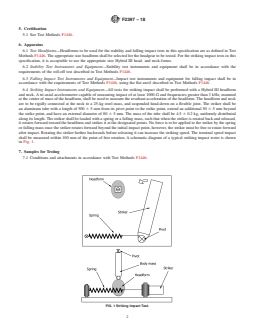
6.4 Striking Impact Instruments and Equipment—All tests for striking impact shall be performed with a Hybrid III headform
and neck. A tri-axial accelerometer capable of measuring impact of at least 1000-G and frequencies greater than 3 kHz, mounted
at the center of mass of the headform, shall be used to measure the resultant acceleration of the headform. The headform and neck
are to be rigidly connected at the neck to a 25-kg steel mass, and suspended head-down on a flexible joint. The striker shall be
an aluminum tube with a length of 500 6 5 mm from its pivot point to the strike point, extend an additional 50 6 5 mm beyond
the strike point, and have an external diameter of 80 6 5 mm. The mass of the tube shall be 4.5 6 0.2 kg, uniformly distributed
along its length. The striker shall be loaded with a spring or a falling mass, such that when the striker is rotated back and released,
it rotates forward toward the headform and strikes it at the designated points. No force is to be applied to the striker by the spring
or falling mass once the striker rotates forward beyond the initial impact point, however, the striker must be free to rotate forward
after impact. Rotating the striker further backwards before releasing it can increase the striking speed. The terminal speed impact
shall be measured within 100 mm of the point of free rotation. A schematic diagram of a typical striking impact tester is shown
in Fig. 1.
7. Samples for Testing
7.1 Conditions and attachments in accordance with Test Methods F1446.
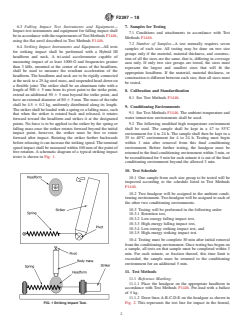
FIG. 1 Striking Impact Test.
F2397 − 18
7.2 Number of Samples—A test normally requires seven samples of each size. All testing may be done on two size groups only
if the material, material thickness, and construction of all the sizes are the same, that is, differing in coverage area only. If only
two size groups are tested, the sizes must represent the largest and smallest sizes that will fit the appropriate headform. If the
material, material thickness, or construction is different between each size, then all sizes must be tested.
8. Calibration and Standardization
8.1 See Test Methods F1446.
9. Conditioning Environments
9.1 See Test Methods F1446. The ambient temperature and water immersion environments shall be used.
9.2 The following modified high temperature environment shall be used. The sample shall be kept in a 47 to 53°C environment
for 4 to 24 h. The sample shall then be kept in a 35 to 40°C environment for 4 to 24 h. Testing must begin within 1 min after
removal from this final conditioning environment. Before further testing, the headgear must be returned to the final conditioning
environment within 3 min, or be reconditioned for 5 min for each minute it is out of the final conditioning environment beyond
the allowed 3 min.
10. Test Schedule
10.1 One sample from each size group to be tested will be inspected according to the schedule listed in Test Methods F1446.
10.2 Two headgear will be assigned to the ambient conditioning environment. Two headgear will be assigned to each of the
other two conditioning environments.
10.3 Testing will be performed in the following order:
10.3.1 Retention test,
10.3.2 Low-energy falling impact test,
10.3.3 High-energy falling impact test,
10.3.4 Low-energy striking impact test, and
10.3.5 High-energy striking impact test.
10.4 Testing must be complete 30 min after initial removal from the conditioning environment. Once testing has begun on a
sample, all tests on that sample must be completed within 3 min. For each minute, or fraction thereof, this time limit is exceeded,
the sample must be returned to the conditioning environment for an additional 5 min.
11. Test Methods
11.1 Reference Marking:
11.1.1 Place the headgear on the appropriate headform in accordance with Test Methods F1446. Pre-load with a ballast of 5 kg.
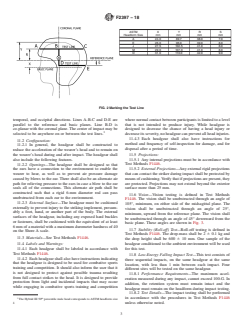
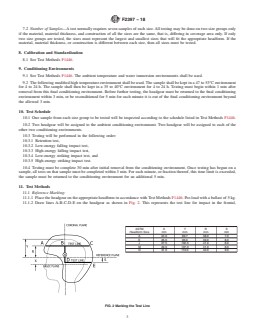
11.1.2 Draw lines A-B-C-D-E on the headgear as shown in Fig. 2. This represents the test line for impact in the frontal,
ASTM X Y R S
Headform Size mm mm mm mm
A 24.0 89.7 38.0 7.0
E 26.0 96.0 39.0 8.0
J 27.5 102.5 41.0 8.0
M 29.0 107.0 41.0 8.0
O 31.0 110.0 42.0 9.0
FIG. 2 Marking the Test Line
F2397 − 18
temporal, and occipital directions. Lines A-B-C and D-E are parallel to the reference and basic planes. Line B-D is co-planar with
the coronal plane. The center of impact may be selected to be anywhere on or between the test lines.
11.2 Configuration:
11.2.1 In general, the headgear shall be constructed to reduce the acceleration of the wearer’s head and to remain on the wearer’s
head during and after impact. The headgear shall also include the following features.
11.2.2 Openings—The headgear shall be designed so that the ears have a connection to the environment to enable the
...