

ASTM B997-16(2021)
(Specification)Standard Specification for Zinc-Aluminum Alloys in Ingot Form for Hot-Dip Coatings
General Information
- Abstract
ABSTRACT
This specification covers three types of zinc-aluminum (Zn-Al) alloys in ingot form for re-melting for use in the production of hot-dip coatings on steel: Type 5 (95/5 Zn/Al), Type 10 (90/10 Zn/Al), and Type 15 (85/15 Zn/Al). Requirements prescribed by this specification cover ordering information; chemical, physical, and mechanical requirements; sampling for determination of chemical composition; methods for chemical analysis; material and manufacturing requirements; dimensions, mass, shapes, and sizes; workmanship, finish, and appearance; inspection and certification; product and package marking; and packaging and preparation for delivery.
SCOPE
1.1 This specification covers certain zinc-aluminum (Zn-Al) alloys in ingot form for re-melting for use in the production of hot-dip coatings on steel. Alloy compositions are specified below and in Table 1.
ASTM
Common
UNS
Type 5
95/5 Zn/Al
Z30507
Type 10
90/10 Zn/Al
Z30600
Type 15
85/15 Zn/Al
Z30706
Note 1: The zinc-aluminum alloys in Specification B997 are intended to be used primarily to create a molten zinc-aluminum bath and differ from the master alloys in Specification B860 which are intended primarily to adjust the concentration of certain elements in molten zinc galvanizing baths.
1.2 The values stated in inch-pound units are to be regarded as standard. The values given in parentheses are mathematical conversions to SI units that are provided for information only and are not considered standard.
1.3 This standard does not purport to address all of the safety concerns, if any, associated with its use. It is the responsibility of the user of this standard to establish appropriate safety, health, and environmental practices and determine the applicability of regulatory limitations prior to use.
1.4 This international standard was developed in accordance with internationally recognized principles on standardization established in the Decision on Principles for the Development of International Standards, Guides and Recommendations issued by the World Trade Organization Technical Barriers to Trade (TBT) Committee.
- Status
- Published
- Publication Date
- 31-Oct-2021
- Technical Committee
- B02 - Nonferrous Metals and Alloys
- Drafting Committee
- B02.04 - Zinc and Cadmium
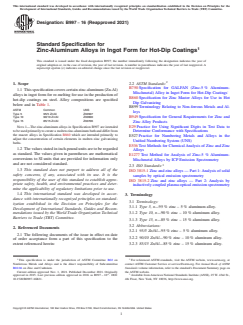
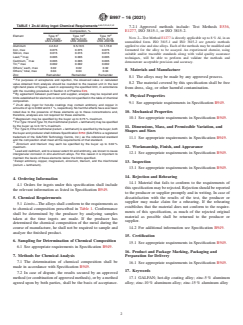


Overview
ASTM B997-16(2021), titled Standard Specification for Zinc-Aluminum Alloys in Ingot Form for Hot-Dip Coatings, establishes requirements for zinc-aluminum (Zn-Al) alloys supplied as ingots for re-melting and subsequent use in the hot-dip coating of steel products. Developed by ASTM International, this standard is widely referenced in the global galvanizing industry to ensure consistent and reliable production of hot-dip coated steel.
The specification addresses three alloy types:
- Type 5 (95/5 Zn/Al, UNS Z30507)
- Type 10 (90/10 Zn/Al, UNS Z30600)
- Type 15 (85/15 Zn/Al, UNS Z30706)
These ingots are formulated primarily for creating molten Zn-Al baths used in the hot-dip process, notably differing from master alloys designed to fine-tune galvanizing bath compositions.
Key Topics
ASTM B997-16(2021) covers a comprehensive set of requirements to support high-quality production and supply of Zn-Al alloy ingots for hot-dip coating applications. Key provisions include:
- Ordering Information: Clear guidance on what purchasers must specify, referencing relevant manufacturing and quality standards.
- Chemical Requirements: Defines strict compositional limits for aluminum content (based on type), as well as minor element and impurity thresholds for iron, silicon, lead, cadmium, and tin.
- Sampling and Analysis: Details procedures for sampling ingots and approved methods for chemical analysis including ASTM and ISO protocols.
- Manufacture and Material Quality: Stipulates that ingots must be free from dross, slag, and detrimental contamination.
- Physical and Mechanical Properties: References separate ASTM standards (like B949) for requirements on dimensions, mass, and mechanical integrity.
- Workmanship and Appearance: Outlines expectations for ingot finish and freedom from surface defects.
- Inspection and Certification: Connects to recognized inspection protocols and mandates traceable certification of compliance.
- Marking and Packaging: Requires clear product and package labeling to ensure proper identification during transportation and delivery.
Applications
Zn-Al alloy ingots manufactured according to ASTM B997-16(2021) are vital raw materials for:
- Hot-Dip Galvanizing: Preparation of Zn-Al baths for producing durable, corrosion-resistant steel products such as structural beams, pipes, fasteners, wire, and sheet metal.
- Protective Coatings: Application in a wide range of industries - construction, automotive, utility infrastructure - where enhanced protection against atmospheric and chemical exposure is required.
- Process Standardization: Ensuring coating uniformity and longevity by controlling alloy composition and quality in large-scale galvanizing operations.
These alloys provide performance benefits over traditional zinc coatings, offering improved barrier protection, sacrificial characteristics, and in some cases, better formability and appearance.
Related Standards
ASTM B997-16(2021) references several related international and ASTM standards to ensure thorough quality and compatibility in hot-dip galvanizing processes:
- ASTM B750: Specification for GALFAN (Zinc-5% Aluminum-Mischmetal) Alloy Ingot for Hot-Dip Coatings
- ASTM B860: Specification for Zinc Master Alloys for Use in Hot-Dip Galvanizing
- ASTM B899: Terminology Relating to Non-ferrous Metals and Alloys
- ASTM B949: General Requirements for Zinc and Zinc Alloy Products
- ISO 3815-1/2: Analysis of zinc and zinc alloys by optical and ICP emission spectrometry
By following ASTM B997-16(2021), manufacturers, suppliers, and end-users can achieve consistency, safety, and regulatory compliance in zinc-aluminum alloy supply chains for galvanized steel production. This contributes to improved product performance, extended service life, and global market acceptance of hot-dip coated steel products.
Relations
- Effective Date
- 01-Jun-2017
- Effective Date
- 01-Oct-2016
- Effective Date
- 01-May-2016
- Effective Date
- 01-Oct-2015
- Effective Date
- 01-Oct-2015
- Effective Date
- 01-Jun-2015
- Effective Date
- 01-Oct-2014
- Refers
ASTM B949-13 - Standard Specification for General Requirements for Zinc and Zinc Alloy Products - Effective Date
- 01-Aug-2013
- Effective Date
- 01-Feb-2013
- Effective Date
- 01-Feb-2013
- Effective Date
- 01-May-2012
- Effective Date
- 01-Oct-2009
- Effective Date
- 01-Oct-2009
- Refers
ASTM B860-09ae1 - Standard Specification for Zinc Master Alloys for Use in Hot Dip Galvanizing - Effective Date
- 01-Oct-2009
- Effective Date
- 01-Oct-2009
Get Certified
Connect with accredited certification bodies for this standard

Element Materials Technology
Materials testing and product certification.

Inštitut za kovinske materiale in tehnologije
Institute of Metals and Technology. Materials testing, metallurgical analysis, NDT.
Sponsored listings
Frequently Asked Questions
ASTM B997-16(2021) is a technical specification published by ASTM International. Its full title is "Standard Specification for Zinc-Aluminum Alloys in Ingot Form for Hot-Dip Coatings". This standard covers: ABSTRACT This specification covers three types of zinc-aluminum (Zn-Al) alloys in ingot form for re-melting for use in the production of hot-dip coatings on steel: Type 5 (95/5 Zn/Al), Type 10 (90/10 Zn/Al), and Type 15 (85/15 Zn/Al). Requirements prescribed by this specification cover ordering information; chemical, physical, and mechanical requirements; sampling for determination of chemical composition; methods for chemical analysis; material and manufacturing requirements; dimensions, mass, shapes, and sizes; workmanship, finish, and appearance; inspection and certification; product and package marking; and packaging and preparation for delivery. SCOPE 1.1 This specification covers certain zinc-aluminum (Zn-Al) alloys in ingot form for re-melting for use in the production of hot-dip coatings on steel. Alloy compositions are specified below and in Table 1. ASTM Common UNS Type 5 95/5 Zn/Al Z30507 Type 10 90/10 Zn/Al Z30600 Type 15 85/15 Zn/Al Z30706 Note 1: The zinc-aluminum alloys in Specification B997 are intended to be used primarily to create a molten zinc-aluminum bath and differ from the master alloys in Specification B860 which are intended primarily to adjust the concentration of certain elements in molten zinc galvanizing baths. 1.2 The values stated in inch-pound units are to be regarded as standard. The values given in parentheses are mathematical conversions to SI units that are provided for information only and are not considered standard. 1.3 This standard does not purport to address all of the safety concerns, if any, associated with its use. It is the responsibility of the user of this standard to establish appropriate safety, health, and environmental practices and determine the applicability of regulatory limitations prior to use. 1.4 This international standard was developed in accordance with internationally recognized principles on standardization established in the Decision on Principles for the Development of International Standards, Guides and Recommendations issued by the World Trade Organization Technical Barriers to Trade (TBT) Committee.
ABSTRACT This specification covers three types of zinc-aluminum (Zn-Al) alloys in ingot form for re-melting for use in the production of hot-dip coatings on steel: Type 5 (95/5 Zn/Al), Type 10 (90/10 Zn/Al), and Type 15 (85/15 Zn/Al). Requirements prescribed by this specification cover ordering information; chemical, physical, and mechanical requirements; sampling for determination of chemical composition; methods for chemical analysis; material and manufacturing requirements; dimensions, mass, shapes, and sizes; workmanship, finish, and appearance; inspection and certification; product and package marking; and packaging and preparation for delivery. SCOPE 1.1 This specification covers certain zinc-aluminum (Zn-Al) alloys in ingot form for re-melting for use in the production of hot-dip coatings on steel. Alloy compositions are specified below and in Table 1. ASTM Common UNS Type 5 95/5 Zn/Al Z30507 Type 10 90/10 Zn/Al Z30600 Type 15 85/15 Zn/Al Z30706 Note 1: The zinc-aluminum alloys in Specification B997 are intended to be used primarily to create a molten zinc-aluminum bath and differ from the master alloys in Specification B860 which are intended primarily to adjust the concentration of certain elements in molten zinc galvanizing baths. 1.2 The values stated in inch-pound units are to be regarded as standard. The values given in parentheses are mathematical conversions to SI units that are provided for information only and are not considered standard. 1.3 This standard does not purport to address all of the safety concerns, if any, associated with its use. It is the responsibility of the user of this standard to establish appropriate safety, health, and environmental practices and determine the applicability of regulatory limitations prior to use. 1.4 This international standard was developed in accordance with internationally recognized principles on standardization established in the Decision on Principles for the Development of International Standards, Guides and Recommendations issued by the World Trade Organization Technical Barriers to Trade (TBT) Committee.
ASTM B997-16(2021) is classified under the following ICS (International Classification for Standards) categories: 77.150.60 - Lead, zinc and tin products. The ICS classification helps identify the subject area and facilitates finding related standards.
ASTM B997-16(2021) has the following relationships with other standards: It is inter standard links to ASTM B860-17, ASTM B899-16, ASTM B860-16, ASTM B860-15, ASTM B899-15, ASTM E536-15, ASTM B899-14, ASTM B949-13, ASTM B899-13, ASTM B860-13, ASTM B750-12, ASTM B899-09e1, ASTM B750-09, ASTM B860-09ae1, ASTM B899-09. Understanding these relationships helps ensure you are using the most current and applicable version of the standard.
ASTM B997-16(2021) is available in PDF format for immediate download after purchase. The document can be added to your cart and obtained through the secure checkout process. Digital delivery ensures instant access to the complete standard document.
Standards Content (Sample)
This international standard was developed in accordance with internationally recognized principles on standardization established in the Decision on Principles for the
Development of International Standards, Guides and Recommendations issued by the World Trade Organization Technical Barriers to Trade (TBT) Committee.
Designation: B997 −16 (Reapproved 2021)
Standard Specification for
Zinc-Aluminum Alloys in Ingot Form for Hot-Dip Coatings
This standard is issued under the fixed designation B997; the number immediately following the designation indicates the year of
original adoption or, in the case of revision, the year of last revision. A number in parentheses indicates the year of last reapproval. A
superscript epsilon (´) indicates an editorial change since the last revision or reapproval.
1. Scope 2.2 ASTM Standards:
B750 Specification for GALFAN (Zinc-5 % Aluminum-
1.1 Thisspecificationcoverscertainzinc-aluminum(Zn-Al)
,
Mischmetal) Alloy in Ingot Form for Hot-Dip Coatings
alloys in ingot form for re-melting for use in the production of
B860 Specification for Zinc Master Alloys for Use in Hot
hot-dip coatings on steel. Alloy compositions are specified
Dip Galvanizing
below and in Table 1.
B899 Terminology Relating to Non-ferrous Metals and Al-
ASTM Common UNS
loys
Type 5 95/5 Zn/Al Z30507
B949 Specification for General Requirements for Zinc and
Type 10 90/10 Zn/Al Z30600
Type 15 85/15 Zn/Al Z30706
Zinc Alloy Products
E29 Practice for Using Significant Digits in Test Data to
NOTE 1—The zinc-aluminum alloys in Specification B997 are intended
tobeusedprimarilytocreateamoltenzinc-aluminumbathanddifferfrom Determine Conformance with Specifications
the master alloys in Specification B860 which are intended primarily to
E527 Practice for Numbering Metals and Alloys in the
adjust the concentration of certain elements in molten zinc galvanizing
Unified Numbering System (UNS)
baths.
E536 Test Methods for Chemical Analysis of Zinc and Zinc
1.2 The values stated in inch-pound units are to be regarded
Alloys
as standard. The values given in parentheses are mathematical
E1277 Test Method for Analysis of Zinc-5 % Aluminum-
conversions to SI units that are provided for information only
Mischmetal Alloys by ICP Emission Spectrometry
and are not considered standard.
2.3 ISO Standards:
1.3 This standard does not purport to address all of the
ISO 3815-1 Zinc and zinc alloys — Part 1:Analysis of solid
safety concerns, if any, associated with its use. It is the
samples by optical emission spectrometry
responsibility of the user of this standard to establish appro-
ISO 3815-2 Zinc and zinc alloys — Part 2: Analysis by
priate safety, health, and environmental practices and deter-
inductively coupled plasma optical emission spectrometry
mine the applicability of regulatory limitations prior to use.
1.4 This international standard was developed in accor-
3. Terminology
dance with internationally recognized principles on standard-
3.1 Terminology:
ization established in the Decision on Principles for the
3.1.1 Type 5, n—95 % zinc – 5 % aluminum alloy.
Development of International Standards, Guides and Recom-
mendations issued by the World Trade Organization Technical 3.1.2 Type 10, n—90 % zinc – 10 % aluminum alloy.
Barriers to Trade (TBT) Committee.
3.1.3 Type 15, n—85 % zinc – 15 % aluminum alloy.
3.2 Abbreviations:
2. Referenced Documents
3.2.1 95/5 Zn/Al—95 % zinc – 5 % aluminum alloy.
2.1 The following documents of the issue in effect on date
3.2.2 90/10 Zn/Al—90 % zinc – 10 % aluminum alloy.
of order acceptance form a part of this specification to the
extent referenced herein: 3.2.3 85/15 Zn/Al—85 % zinc – 15 % aluminum alloy.
1 2
This specification is under the jurisdiction of ASTM Committee B02 on For referenced ASTM standards, visit the ASTM website, www.astm.org, or
Nonferrous Metals and Alloys and is the direct responsibility of Subcommittee contact ASTM Customer Service at service@astm.org. For Annual Book of ASTM
B02.04 on Zinc and Cadmium. Standards volume information, refer to the standard’s Document Summary page on
Current edition approved Nov. 1, 2021. Published December 2021. Originally the ASTM website.
ɛ1 3
approved in 2015. Last previous edition approved in 2016 as B997 – 16 . DOI: Available fromAmerican National Standards Institute (ANSI), 25 W. 43rd St.,
10.1520/B0997-16R21. 4th Floor, New York, NY 10036, http://www.ansi.org.
Copyright © ASTM International, 100 Barr Harbor Drive, PO Box C700, West Conshohocken, PA 19428-2959. United States
B997 − 16 (2021)
A,B,C,D,E,F,G
TABLE 1 Zn-Al Alloy Ingot Chemical Requirements
7.2.1 Approved methods include: Test Methods E536,
Composition, %
E1277, ISO 3815-1, or ISO 3815-2.
F E E
Type 5 Type 10 Type 15
Element
NOTE 2—Test Method E1277 is directly applicable up to 8 %Al, in an
95/5 Zn/Al 90/10 Zn/Al 85/15 Zn/Al
UNS Z30507 UNS Z30600 UNS Z30706
unmodified form. ISO 3815-1 and ISO 3815-2 are generic methods
Aluminum 4.2-6.2 9.5-10.5 14.1-15.9 applied to zinc and zinc alloys. Each of the methods may be modified and
Iron, max 0.075 0.075 0.075
formatted for the alloy to be assayed. An experienced chemist, using
Silicon, max 0.015 0.015 0.015
suitable and/or traceable standards along with valid quality assurance
H
Lead, max 0.005 0.005 0.005
techniques, will be able to perform and validate the methods and
H
Cadmium, max 0.005 0.005 0.005
demonstrate acceptable precision and accuracy.
H
Tin, max 0.002 0.002 0.002
I
Others, each, max 0.02 0.02 0.02
I 8. Materials and Manufacture
Others, total, max 0.04 0.04 0.04
Zinc Remainder Remainder Remainder
8.1 The alloys may be made by any approve
...