

ASTM B1013-22
(Specification)Standard Specification for High Fluidity (HF) Zinc-Aluminum Alloy Thin Wall Die Castings
General Information
- Abstract
SCOPE
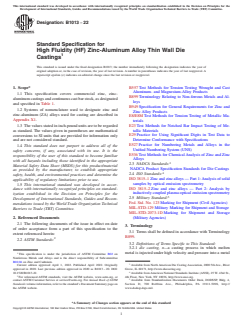
1.1 This specification covers commercial zinc, zinc-aluminum castings and continuous cast bar stock, as designated and specified in Table 1.
1.2 Systems of nomenclature used to designate zinc and zinc-aluminum (ZA) alloys used for casting are described in Appendix X1.
1.3 The values stated in inch-pound units are to be regarded as standard. The values given in parentheses are mathematical conversions to SI units that are provided for information only and are not considered standard.
1.4 This standard does not purport to address all of the safety concerns, if any, associated with its use. It is the responsibility of the user of this standard to become familiar with all hazards including those identified in the appropriate Material Safety Data Sheet (MSDS) for this product/material as provided by the manufacturer, to establish appropriate safety, health, and environmental practices and determine the applicability of regulatory limitations prior to use.
1.5 This international standard was developed in accordance with internationally recognized principles on standardization established in the Decision on Principles for the Development of International Standards, Guides and Recommendations issued by the World Trade Organization Technical Barriers to Trade (TBT) Committee.
- Status
- Published
- Publication Date
- 31-Mar-2022
- Technical Committee
- B02 - Nonferrous Metals and Alloys
- Drafting Committee
- B02.04 - Zinc and Cadmium
Buy Documents
ASTM B1013-22 - Standard Specification for High Fluidity (HF) Zinc-Aluminum Alloy Thin Wall Die Castings
REDLINE ASTM B1013-22 - Standard Specification for High Fluidity (HF) Zinc-Aluminum Alloy Thin Wall Die Castings
Overview
ASTM B1013-22 is the international standard specification for high fluidity (HF) zinc-aluminum alloy thin wall die castings, developed by ASTM International. This standard defines the requirements for commercial zinc and zinc-aluminum (ZA) alloy castings and continuous cast bar stock used in applications that demand precise and consistent thin wall geometries, enhanced fluidity, and reliable mechanical performance. ASTM B1013-22 is widely applied in industries such as automotive, electronics, and consumer goods, ensuring quality and uniformity in the manufacturing of thin-walled die cast components.
Key Topics
- Chemical Composition:
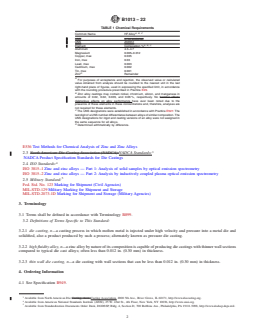
- Specifies the required elemental composition of HF zinc-aluminum alloys, including aluminum, magnesium, copper, iron, lead, cadmium, tin, and zinc, with precise limits to guarantee consistent alloy quality.
- Nomenclature and Identification:
- Utilizes unified numbering system (UNS) designations-such as UNS Z33512-for clear and global identification of alloy grades.
- Dimensional and Mechanical Requirements:
- Outlines permissible dimensional tolerances based on industry-standard die casting practices.
- Notes that mechanical properties, while provided for informational purposes, must not be used as acceptance criteria unless specified by the purchaser.
- Sampling and Testing:
- Details procedures for chemical analysis and sampling, referencing related ASTM and ISO standards for ensuring precise alloy verification.
- Quality Assurance and Marking:
- Stipulates inspection, packaging, marking, and documentation requirements for both civil and military shipments.
- Safety and Environmental Compliance:
- Directs users to adhere to safety, health, and environmental guidelines, including compliance with Material Safety Data Sheets (MSDS).
Applications
ASTM B1013-22-certified high fluidity zinc-aluminum thin wall die castings are essential in:
- Automotive Components: Ideal for lightweight and intricately shaped automotive parts requiring strong thin sections, such as electrical housings, brackets, and covers.
- Electronics and Electrical Devices: Suited for compact enclosures and connectors that demand precision and high electrical conductivity.
- Consumer Products: Frequently used in manufacturing durable yet lightweight casings for appliances, tools, and hardware.
- Industrial Equipment: Applied in situations where complex geometries and tight tolerances are necessary for functionality and cost-effectiveness.
By specifying chemical and quality requirements for zinc-aluminum alloys with high fluidity, this standard ensures manufacturers can reliably produce thin-walled, structurally sound castings for critical and high-volume applications.
Related Standards
The following standards are commonly referenced for compliance and additional guidance when using ASTM B1013-22:
- ASTM B557 – Test Methods for Tension Testing Wrought and Cast Aluminum- and Magnesium-Alloy Products
- ASTM B899 – Terminology Relating to Non-ferrous Metals and Alloys
- ASTM B949 – Specification for General Requirements for Zinc and Zinc Alloy Products
- ASTM E8/E8M – Test Methods for Tension Testing of Metallic Materials
- ASTM E23 – Test Methods for Notched Bar Impact Testing of Metallic Materials
- ISO 3815-1 / ISO 3815-2 – Zinc and zinc alloys: Analysis methods by optical emission and ICP spectrometry
- NADCA Product Specification Standards for Die Castings – North American Die Casting Association guidelines for tolerances and process control
- Fed. Std. No. 123 / MIL-STD-129 / MIL-STD-2073-1D – Standards for marking and packaging for shipment in civilian and military contexts
Summary
ASTM B1013-22 provides essential specifications and guidance for producing high fluidity zinc-aluminum alloy thin wall die castings. By standardizing chemical composition, nomenclature, and quality control, it enables manufacturers and buyers to achieve reliable, high-quality thin wall die castings for demanding industrial, automotive, electronics, and consumer applications. Compliance with this standard promotes consistency, safety, and international compatibility in zinc-aluminum thin wall die casting processes.
Relations
- Effective Date
- 01-Apr-2024
- Effective Date
- 01-Jan-2024
- Effective Date
- 01-Oct-2016
- Effective Date
- 15-Jul-2016
- Effective Date
- 01-Apr-2016
- Effective Date
- 01-Jan-2016
- Effective Date
- 01-Oct-2015
- Effective Date
- 01-Jun-2015
- Effective Date
- 01-Feb-2015
- Effective Date
- 01-Oct-2014
- Effective Date
- 15-May-2014
- Refers
ASTM B949-13 - Standard Specification for General Requirements for Zinc and Zinc Alloy Products - Effective Date
- 01-Aug-2013
- Effective Date
- 01-Jun-2013
- Effective Date
- 01-Feb-2013
- Effective Date
- 15-Nov-2012
Buy Documents
ASTM B1013-22 - Standard Specification for High Fluidity (HF) Zinc-Aluminum Alloy Thin Wall Die Castings
REDLINE ASTM B1013-22 - Standard Specification for High Fluidity (HF) Zinc-Aluminum Alloy Thin Wall Die Castings
Get Certified
Connect with accredited certification bodies for this standard

Element Materials Technology
Materials testing and product certification.

Inštitut za kovinske materiale in tehnologije
Institute of Metals and Technology. Materials testing, metallurgical analysis, NDT.
Sponsored listings
Frequently Asked Questions
ASTM B1013-22 is a technical specification published by ASTM International. Its full title is "Standard Specification for High Fluidity (HF) Zinc-Aluminum Alloy Thin Wall Die Castings". This standard covers: SCOPE 1.1 This specification covers commercial zinc, zinc-aluminum castings and continuous cast bar stock, as designated and specified in Table 1. 1.2 Systems of nomenclature used to designate zinc and zinc-aluminum (ZA) alloys used for casting are described in Appendix X1. 1.3 The values stated in inch-pound units are to be regarded as standard. The values given in parentheses are mathematical conversions to SI units that are provided for information only and are not considered standard. 1.4 This standard does not purport to address all of the safety concerns, if any, associated with its use. It is the responsibility of the user of this standard to become familiar with all hazards including those identified in the appropriate Material Safety Data Sheet (MSDS) for this product/material as provided by the manufacturer, to establish appropriate safety, health, and environmental practices and determine the applicability of regulatory limitations prior to use. 1.5 This international standard was developed in accordance with internationally recognized principles on standardization established in the Decision on Principles for the Development of International Standards, Guides and Recommendations issued by the World Trade Organization Technical Barriers to Trade (TBT) Committee.
SCOPE 1.1 This specification covers commercial zinc, zinc-aluminum castings and continuous cast bar stock, as designated and specified in Table 1. 1.2 Systems of nomenclature used to designate zinc and zinc-aluminum (ZA) alloys used for casting are described in Appendix X1. 1.3 The values stated in inch-pound units are to be regarded as standard. The values given in parentheses are mathematical conversions to SI units that are provided for information only and are not considered standard. 1.4 This standard does not purport to address all of the safety concerns, if any, associated with its use. It is the responsibility of the user of this standard to become familiar with all hazards including those identified in the appropriate Material Safety Data Sheet (MSDS) for this product/material as provided by the manufacturer, to establish appropriate safety, health, and environmental practices and determine the applicability of regulatory limitations prior to use. 1.5 This international standard was developed in accordance with internationally recognized principles on standardization established in the Decision on Principles for the Development of International Standards, Guides and Recommendations issued by the World Trade Organization Technical Barriers to Trade (TBT) Committee.
ASTM B1013-22 is classified under the following ICS (International Classification for Standards) categories: 77.150.60 - Lead, zinc and tin products. The ICS classification helps identify the subject area and facilitates finding related standards.
ASTM B1013-22 has the following relationships with other standards: It is inter standard links to ASTM E23-24, ASTM E8/E8M-24, ASTM B899-16, ASTM E8/E8M-16, ASTM E23-16a, ASTM E23-16, ASTM B899-15, ASTM E536-15, ASTM E8/E8M-15, ASTM B899-14, ASTM B557-14, ASTM B949-13, ASTM E8/E8M-13, ASTM B899-13, ASTM E23-12c. Understanding these relationships helps ensure you are using the most current and applicable version of the standard.
ASTM B1013-22 is available in PDF format for immediate download after purchase. The document can be added to your cart and obtained through the secure checkout process. Digital delivery ensures instant access to the complete standard document.
Standards Content (Sample)
This international standard was developed in accordance with internationally recognized principles on standardization established in the Decision on Principles for the
Development of International Standards, Guides and Recommendations issued by the World Trade Organization Technical Barriers to Trade (TBT) Committee.
Designation:B1013 −22
Standard Specification for
High Fluidity (HF) Zinc-Aluminum Alloy Thin Wall Die
Castings
This standard is issued under the fixed designation B1013; the number immediately following the designation indicates the year of
original adoption or, in the case of revision, the year of last revision. A number in parentheses indicates the year of last reapproval. A
superscript epsilon (´) indicates an editorial change since the last revision or reapproval.
1. Scope* B557 Test Methods for Tension Testing Wrought and Cast
Aluminum- and Magnesium-Alloy Products
1.1 This specification covers commercial zinc, zinc-
B899 Terminology Relating to Non-ferrous Metals and Al-
aluminumcastingsandcontinuouscastbarstock,asdesignated
loys
and specified in Table 1.
B949 Specification for General Requirements for Zinc and
1.2 Systems of nomenclature used to designate zinc and
Zinc Alloy Products
zinc-aluminum (ZA) alloys used for casting are described in
E8/E8M Test Methods for Tension Testing of Metallic Ma-
Appendix X1.
terials
1.3 The values stated in inch-pound units are to be regarded E23 Test Methods for Notched Bar Impact Testing of Me-
tallic Materials
as standard. The values given in parentheses are mathematical
conversions to SI units that are provided for information only E29 Practice for Using Significant Digits in Test Data to
Determine Conformance with Specifications
and are not considered standard.
E527 Practice for Numbering Metals and Alloys in the
1.4 This standard does not purport to address all of the
Unified Numbering System (UNS)
safety concerns, if any, associated with its use. It is the
E536 Test Methods for ChemicalAnalysis of Zinc and Zinc
responsibility of the user of this standard to become familiar
Alloys
with all hazards including those identified in the appropriate
2.3 NADCA Standards:
Material Safety Data Sheet (MSDS) for this product/material
NADCA Product Specification Standards for Die Castings
as provided by the manufacturer, to establish appropriate
2.4 ISO Standards:
safety, health, and environmental practices and determine the
ISO 3815–1 Zinc and zinc alloys — Part 1:Analysis of solid
applicability of regulatory limitations prior to use.
samples by optical emission spectrometry
1.5 This international standard was developed in accor-
ISO 3815–2 Zinc and zinc alloys — Part 2: Analysis by
dance with internationally recognized principles on standard-
inductively coupled plasma optical emission spectrometry
ization established in the Decision on Principles for the
2.5 Military Standard:
Development of International Standards, Guides and Recom-
Fed. Std. No. 123 Marking for Shipment (Civil Agencies)
mendations issued by the World Trade Organization Technical
MIL-STD-129 Military Marking for Shipment and Storage
Barriers to Trade (TBT) Committee.
MIL-STD-2073-1D Marking for Shipment and Storage
2. Referenced Documents (Military Agencies)
2.1 The following documents of the issue in effect on date
3. Terminology
of order acceptance form a part of this specification to the
3.1 Terms shall be defined in accordance with Terminology
extent referenced herein:
B899.
2.2 ASTM Standards:
3.2 Definitions of Terms Specific to This Standard:
3.2.1 die casting, n—a casting process in which molten
1 metal is injected under high velocity and pressure into a metal
This specification is under the jurisdiction of ASTM Committee B02 on
Nonferrous Metals and Alloys and is the direct responsibility of Subcommittee
B02.04 on Zinc and Cadmium.
Current edition approved April 1, 2022. Published April 2022. Originally Available from NorthAmerican Die CastingAssociation, 2000 5thAve., River
approved in 2020. Last previous edition approved in 2020 as B1013 – 20. DOI: Grove, IL 60171, http://www.diecasting.org.
10.1520/B1013-22. Available fromAmerican National Standards Institute (ANSI), 25 W. 43rd St.,
For referenced ASTM standards, visit the ASTM website, www.astm.org, or 4th Floor, New York, NY 10036, http://www.ansi.org.
contact ASTM Customer Service at service@astm.org. For Annual Book of ASTM Available from Standardization Documents Order Desk, DODSSP, Bldg. 4,
Standards volume information, refer to the standard’s Document Summary page on Section D, 700 Robbins Ave., Philadelphia, PA 19111-5098, http://
the ASTM website. www.dodssp.daps.mil.
*A Summary of Changes section appears at the end of this standard
Copyright © ASTM International, 100 Barr Harbor Drive, PO Box C700, West Conshohocken, PA 19428-2959. United States
B1013−22
TABLE 1 Chemical Requirements
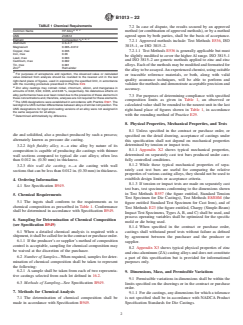
7.2 In case of dispute, the results secured by an approved
A, B, C
Common Name HF Alloy method (or combination of approved methods), or by a method
UNS Z33512 agreed upon by both parties, shall be the basis of acceptance.
A, B, C
Element Composition %
7.2.1 Approved methods include: Test Methods E536, ISO
Aluminum 4.3–4.7
3815–1, or ISO 3815–2.
Magnesium 0.005–0.012
Copper, max 0.035 7.2.1.1 Test Methods E536 is generally applicable but must
Iron, max 0.03
be slightly modified to cover the higherAl range. ISO 3815–1
Lead, max 0.003
and ISO 3815–2 are generic methods applied to zinc and zinc
Cadmium, max 0.002
Tin, max 0.001
alloys.Eachofthemethodsmaybemodifiedandformattedfor
D
Zinc Remainder
the alloy to be assayed.An experienced chemist, using suitable
A
For purposes of acceptance and rejection, the observed value or calculated
or traceable reference materials, or both, along with valid
value obtained from analysis should be rounded to the nearest unit in the last
quality assurance techniques, will be able to perform and
right-hand place of figures, used in expressing the specified limit, in accordance
with the rounding procedure prescribed in Practice E29. validate the methods and demonstrate acceptable precision and
B
Zinc alloy castings may contain nickel, chromium, silicon, and manganese in
accuracy.
amounts of 0.02, 0.02, 0.035, and 0.06 %, respectively. No deleterious effects on
alloy performance have ever been noted due to the presence of these elements in
7.3 For purposes of determining compliance with specified
these concentrations and, therefore, analyses are not required for these elements.
C composition limits as given in Table 1, an observed or
The UNS designations were established in accordance with Practice E527. The
last digit of a UNS number differentiates between alloys of similar composition. The calculated value shall be rounded to the nearest unit in the last
UNS designations for ingot and casting versions of an alloy were not assigned in
right-hand place of figures shown in Table 1, in accordance
the same sequence for all alloys.
D with the rounding method of Practice E29.
Determined arithmetically by difference.
8. Physical Properties, Mechanical Properties, and Tests
8.1 Unless specified in the contract or purchase order, or
die and solidified, also a product produced by such a process;
specified on the detail drawing, acceptance of castings under
alternately known as pressure die casting.
this specification shall not depend on mechanical properties
determined by tension or impact tests.
3.2.2 high fluidity alloy, n—a zinc alloy by nature of its
8.1.1 Appendix X2 shows typical mechanical properties,
composition is capable of producing die castings with thinner
determined on separately cast test bars produced under care-
wall sections compared to typical die cast alloys; often less
fully controlled conditions.
than 0.012 in. (0.30 mm) in thickness.
8.1.2 While these typical mechanical properties of sepa-
3.2.3 thin wall die casting, n—a die casting with wall
rately cast test bars are useful for comparing the relative
sections that can be less than 0.012 in. (0.30 mm) in thickness.
properties of various casting alloys, they should not be used to
establish design limits or acceptance criteria.
4. Ordering Information
8.1.3 If tension or impact tests are made on separately cast
4.1 See Specification B949.
test bars, test specimens conforming to the dimensions shown
in Test Methods B557 (the figure entitled, Standard Tension
5. Chemical Requirements
Test Specimen for Die Castings), Test Methods E8/E8M (the
5.1 The ingots shall conform to the requirements as to
figure entitled Standard Test Specimen for Cast Iron), and of
chemical composition as prescribed in Table 1. Conformance
Test Methods E23 (the figure entitled, Charpy (Simple-Beam)
shall be determined in accordance with Specification B949.
Impact Test Specimens, TypesA, B, and C) shall be used, and
process operating variables shall be optimized for the specific
6. Sampling for Determination of Chemical Composition
mold or die being used.
(see Specification B949)
8.1.4 When specified in the contract or purchase order,
6.1 When a detailed chemical analysis is required with a
castings shall withstand proof tests without failure as defined
shipment,itshallbecalledforinthecontractorpurchaseorder.
by agreement between the purchaser and the producer or
6.1.1 If the producer’s or supplier’s method of composition
supplier.
control is acceptable, sampling for chemical composition may
8.2 Appendix X3 shows typical physical properties of zinc
be waived at the discretion of the purchaser.
and zinc-aluminum (ZA) casting alloys and does not constitute
6.2 Number of Samples—When required, samples for deter-
a part of this specification but is provided for informational
mination of chemical composition shall be taken to represent
purposes only.
the following:
6.2.1 A sample shall be taken from each of two representa-
9. Dimensions, Mass, and Permissible Variations
tive castings selected from each lot defined in 16.2.
9.1 Permissible variations in dimensions shall be within the
6.3 Methods of Sampling—See Specification B949.
limits specified on the drawings or in the contract or purchase
order.
7. Methods for Chemical Analysis
9.1.1 For die castings, any dimensions for which a tolerance
7.1 The determination of chemical composition shall be is not specified shall be in accordance with NADCA Product
made in accordance with
...
This document is not an ASTM standard and is intended only to provide the user of an ASTM standard an indication of what changes have been made to the previous version. Because
it may not be technically possible to adequately depict all changes accurately, ASTM recommends that users consult prior editions as appropriate. In all cases only the current version
of the standard as published by ASTM is to be considered the official document.
Designation: B1013 − 20 B1013 − 22
Standard Specification for
High Fluidity (HF) Zinc-Aluminum Alloy Thin Wall Die
Castings
This standard is issued under the fixed designation B1013; the number immediately following the designation indicates the year of
original adoption or, in the case of revision, the year of last revision. A number in parentheses indicates the year of last reapproval. A
superscript epsilon (´) indicates an editorial change since the last revision or reapproval.
1. Scope Scope*
1.1 This specification covers commercial zinc, zinc-aluminum castings and continuous cast bar stock, as designated and specified
in Table 1.
1.2 Systems of nomenclature used to designate zinc and zinc-aluminum (ZA) alloys used for casting are described in Appendix
X1.
1.3 The values stated in inch-pound units are to be regarded as standard. The values given in parentheses are mathematical
conversions to SI units that are provided for information only and are not considered standard.
1.4 This standard does not purport to address all of the safety concerns, if any, associated with its use. It is the responsibility
of the user of this standard to become familiar with all hazards including those identified in the appropriate Material Safety Data
Sheet (MSDS) for this product/material as provided by the manufacturer, to establish appropriate safety, health, and environmental
practices and determine the applicability of regulatory limitations prior to use.
1.5 This international standard was developed in accordance with internationally recognized principles on standardization
established in the Decision on Principles for the Development of International Standards, Guides and Recommendations issued
by the World Trade Organization Technical Barriers to Trade (TBT) Committee.
2. Referenced Documents
2.1 The following documents of the issue in effect on date of order acceptance form a part of this specification to the extent
referenced herein:
2.2 ASTM Standards:
B557 Test Methods for Tension Testing Wrought and Cast Aluminum- and Magnesium-Alloy Products
B899 Terminology Relating to Non-ferrous Metals and Alloys
B949 Specification for General Requirements for Zinc and Zinc Alloy Products
E8E8/E8M Test Methods for Tension Testing of Metallic Materials [Metric] E0008_E0008M
E23 Test Methods for Notched Bar Impact Testing of Metallic Materials
E29 Practice for Using Significant Digits in Test Data to Determine Conformance with Specifications
E527 Practice for Numbering Metals and Alloys in the Unified Numbering System (UNS)
This specification is under the jurisdiction of ASTM Committee B02 on Nonferrous Metals and Alloys and is the direct responsibility of Subcommittee B02.04 on Zinc
and Cadmium.
Current edition approved April 1, 2020April 1, 2022. Published April 2020April 2022. Originally approved in 2020. Last previous edition approved in 2020 as B1013 – 20.
DOI: 10.1520/B1013-20.10.1520/B1013-22.
For referenced ASTM standards, visit the ASTM website, www.astm.org, or contact ASTM Customer Service at service@astm.org. For Annual Book of ASTM Standards
volume information, refer to the standard’s Document Summary page on the ASTM website.
*A Summary of Changes section appears at the end of this standard
Copyright © ASTM International, 100 Barr Harbor Drive, PO Box C700, West Conshohocken, PA 19428-2959. United States
B1013 − 22
TABLE 1 Chemical Requirements
A, B, C
Common Name HF Alloy
UNS to be assigned
UNS Z33512
A, B, C
Element Composition %
Aluminum 4.3–4.7
Magnesium 0.005–0.012
Copper, max 0.035
Iron, max 0.03
Lead, max 0.003
Cadmium, max 0.002
Tin, max 0.001
D
Zinc Remainder
A
For purposes of acceptance and rejection, the observed value or calculated
value obtained from analysis should be rounded to the nearest unit in the last
right-hand place of figures, used in expressing the specified limit, in accordance
with the rounding procedure prescribed in Practice E29.
B
Zinc alloy castings may contain nickel, chromium, silicon, and manganese in
amounts of 0.02, 0.02, 0.035, and 0.06 %, respectively. No harmful effects
deleterious effects on alloy performance have ever been noted due to the
presence of these elements in these concentrations and, therefore, analyses are
not required for these elements.
C
The UNS designations were established in accordance with Practice E527. The
last digit of a UNS number differentiates between alloys of similar composition. The
UNS designations for ingot and casting versions of an alloy were not assigned in
the same sequence for all alloys.
D
Determined arithmetically by difference.
E536 Test Methods for Chemical Analysis of Zinc and Zinc Alloys
2.3 North American Die Casting Association (NADCA):NADCA Standards:
NADCA Product Specification Standards for Die Castings
2.4 ISO Standards:
ISO 3815–1 Zinc and zinc alloys — Part 1: Analysis of solid samples by optical emission spectrometry
ISO 3815–2 Zinc and zinc alloys — Part 2: Analysis by inductively coupled plasma optical emission spectrometry
2.5 Military Standard:
Fed. Std. No. 123 Marking for Shipment (Civil Agencies)
MIL-STD-129 Military Marking for Shipment and Storage
MIL-STD-2073-1D Marking for Shipment and Storage (Military Agencies)
3. Terminology
3.1 Terms shall be defined in accordance with Terminology B899.
3.2 Definitions of Terms Specific to This Standard:
3.2.1 die casting, n—a casting process in which molten metal is injected under high velocity and pressure into a metal die and
solidified, also a product produced by such a process; alternately known as pressure die casting.
3.2.2 high fluidity alloy, n—a zinc alloy by nature of its composition is capable of producing die castings with thinner wall sections
compared to typical die cast alloys; often less than 0.012 in. (0.30 mm) in thickness.
3.2.3 thin wall die casting, n—a die casting with wall sections that can be less than 0.012 in. (0.30 mm) in thickness.
4. Ordering Information
4.1 See Specification B949.
Available from North American Die Casting, Assn.,Casting Association, 2000 5th Ave., River Grove, IL 60171, http://www.diecasting.org.
Available from American National Standards Institute (ANSI), 25 W. 43rd St., 4th Floor, New York, NY 10036, http://www.ansi.org.
Available from Standardization Documents Order Desk, DODSSP, Bldg. 4, Section D, 700 Robbins Ave., Philadelphia, PA 19111-5098, http://www.dodssp.daps.mil.
B1013 − 22
5. Chemical Requirements
5.1 The ingots shall conform to the requirements as to chemical composition as prescribed in Table 1. Conformance shall be
determined in accordance with Specification B949.
6. Sampling for Determination of Chemical Composition (see Specification B949)
6.1 When a detailed chemical analysis is required with a shipment, it shall be called for in the contract or purchase order.
6.1.1 If the producer’s or supplier’s method of composition control is acceptable, sampling for chemical composition may be
waived at the discretion of the purchaser.
6.2 Number of Samples—When required, samples for determination of chemical composition shall be taken to represent the
following:
6.2.1 A sample shall be taken from each of two representative castings selected from each lot defined in 16.2.
6.3 Methods of Sampling—See Specification B949.
7. Methods for Chemical Analysis
7.1 The determination of chemical composition shall be made in accordance with Specification B949.
7.2 In case of dispute, the results secured by an approved method (or combination of approved methods), or by a method agreed
upon by both parties, shall be the basis of acceptance.
7.2.1 Approved methods include: Test Methods E536, ISO 3815–1, or ISO 3815–2.
7.2.1.1 Test Methods E536 is generally applicable but must be slightly modified to cover the higher Al range. ISO 3815–1 and
ISO 3815–2 are generic methods applied to zinc and zinc alloys. Each of the methods may be modified and formatted for the alloy
to be assayed. An experienced chemist, using suitable or traceable reference materials, or both, along with valid quality assurance
techniques, will be able to perform and validate the methods and demonstrate acceptable precision and accuracy.
7.3 For purposes of determining compliance with specified composition limits as given in Table 1, an observed or calculated value
shall be rounded to the nearest unit in the last right-hand place of figures shown in Table 1, in accordance with the rounding method
of Practice E29.
8. Physical Properties, Mechanical Properties, and Tests
8.1 Unless specified in the contract or purchase order, or specified on the detail drawing, acceptance of castings under this
specification shall not depend on mechanical properties determined by tension or impact tests.
8.1.1 Appendix X2 shows typical mechanical properties, determined on separately cast test bars produced under carefully
controlled conditions.
8.1.2 While these typical mechanical properties of separately cast test bars are useful for comparing the relative properties of
various casting alloys, they should not be used to establish design limits or acceptance criteria.
8.1.3 If tension or impact tests are made on separately cast test bars, test specimens conforming to the dimensions shown in Test
Methods B557 (the figure entitled, Standard Tension Test Specimen for Die Castings), Test Methods E8E8/E8M (the figure entitled
Standard Test Specimen for Cast Iron), and of Test Methods E23 (the figure entitled, Charpy (Simple-Beam) Impact Test
Specimens, Types A, B, and C) shall be used, and process operating variables shall be optimized for the specific mold or die being
used.
8.1.4 When specified in the contract or purchase order, castings shall withstand proof tests without failure as defined by agreement
between the purchaser and the producer or supplier.
B1013 − 22
8.2 Appendix X3 shows typical physical properties of zinc and zinc-aluminum (ZA) casting alloys and does not constitute a part
of this specification but is provided for informational purposes only.
9. Dimensions, Mass, and Permissible Variations
9.1 Permissible variations in dimensions shall be within the limits specified on the drawings or in the contract or purchase order.
9.1.1 For die castings, any dimension
...