

ASTM F3387-23
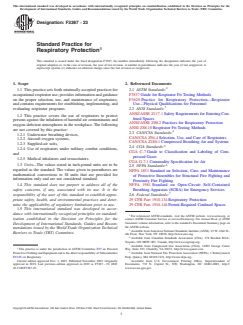
(Practice)Standard Practice for Respiratory Protection
General Information
- Abstract
SIGNIFICANCE AND USE
4.1 The purpose of this practice is to provide information and guidance on the proper selection, use, and maintenance of respirators, which will help safeguard the life and health of respirator wearers. This practice is written for all persons concerned with respiratory protection, but especially for those primarily responsible for establishing and administering an acceptable respirator program. This practice contains requirements recommended for enforcement authorities in establishing regulations or codes for respiratory protection use.
4.2 Exceptions—Users of this practice shall be aware that regulatory agencies may have requirements that are different from this practice.
SCOPE
1.1 This practice sets forth minimally accepted practices for occupational respirator use; provides information and guidance on the proper selection, use, and maintenance of respirators; and contains requirements for establishing, implementing, and evaluating respirator programs.
1.2 This practice covers the use of respirators to protect persons against the inhalation of harmful air contaminants and oxygen-deficient atmospheres in the workplace. The following are not covered by this practice:
1.2.1 Underwater breathing devices,
1.2.2 Aircraft oxygen systems,
1.2.3 Supplied-air suits,
1.2.4 Use of respirators under military combat conditions, and
1.2.5 Medical inhalators and resuscitators.
1.3 Units—The values stated in inch-pound units are to be regarded as the standard. The values given in parentheses are mathematical conversions to SI units that are provided for information only and are not considered standard.
1.4 This standard does not purport to address all of the safety concerns, if any, associated with its use. It is the responsibility of the user of this standard to establish appropriate safety, health, and environmental practices and determine the applicability of regulatory limitations prior to use.
1.5 This international standard was developed in accordance with internationally recognized principles on standardization established in the Decision on Principles for the Development of International Standards, Guides and Recommendations issued by the World Trade Organization Technical Barriers to Trade (TBT) Committee.
- Status
- Published
- Publication Date
- 31-Oct-2023
- Technical Committee
- F23 - Personal Protective Clothing and Equipment
- Drafting Committee
- F23.65 - Respiratory
Overview
ASTM F3387-23: Standard Practice for Respiratory Protection is an international standard developed by ASTM to provide essential guidance on the selection, use, and maintenance of respirators in occupational environments. This standard is designed to safeguard workers against harmful air contaminants and oxygen-deficient atmospheres, ensuring a safer workplace. The requirements outlined are intended for employers responsible for creating and administering an effective respiratory protection program and can also inform regulatory authorities setting compliance codes. This practice is applicable across industries where respiratory hazards exist and is globally aligned with the World Trade Organization’s principles for standardization.
Key Topics
- Respirator Program Requirements: Defines the essential elements of a workplace respirator program, including assignment of program administration, development of written procedures, medical evaluation, selection, user training, fit-testing, inspection, and maintenance.
- Employer Responsibilities: Employers must select approved respirators based on workplace hazards, provide them at no cost to employees, train users, and implement a written program subject to regular review and auditing.
- User Responsibilities: Respirator wearers must follow instructions and training, perform seal checks, and report any physical conditions or issues affecting the fit or performance of the respirator.
- Hazard Assessment and Respirator Selection: Guidance on evaluating workplace atmospheres for contaminants, determining the physical and chemical properties of those contaminants, and selecting suitable respirator types based on identified risks and exposure limits.
- Fit Testing and Medical Evaluation: Requirements to ensure only medically qualified and properly fitted personnel are assigned respirators, following processes for both qualitative and quantitative fit testing.
- Maintenance, Inspection, and Storage: Ongoing responsibilities to ensure respirators are clean, properly maintained, and in good working order, with regular checks and secure storage practices.
Applications
The ASTM F3387-23 standard offers practical value in a broad range of industries and occupational settings where respiratory hazards are present, such as:
- Manufacturing and Industrial Plants: Used to implement comprehensive respirator programs for employees exposed to dust, fumes, gases, or aerosols.
- Chemical Processing: Ensures protective measures against inhalation of hazardous substances and addresses oxygen-deficient atmospheres.
- Construction and Demolition: Applies to workers subject to potential exposure from particulate matter, chemicals, and confined space entry.
- Healthcare and Bioaerosol Environments: Supports programs protecting staff from infectious aerosols and other airborne biological hazards.
- Emergency Services and Firefighting: Guides the selection and use of appropriate respiratory protection in IDLH (immediately dangerous to life or health) environments.
By following ASTM F3387-23, employers can establish robust respiratory protection programs, maintain regulatory compliance, and promote worker health and safety through systematic selection, fit, and maintenance of respiratory protective equipment.
Related Standards
For comprehensive workplace respiratory protection, ASTM F3387-23 references and aligns with several other critical standards and regulations, including:
- ASTM F3537: Guide for Respirator Fit Testing Methods
- ASTM F3620: Practice for Respiratory Protection-Physical Qualifications for Personnel
- ANSI/ASSE Z88.2: Practices for Respiratory Protection
- CAN/CSA Z94.4: Selection, Use, and Care of Respirators
- CGA C-7: Guide to Classification and Labeling of Compressed Gases
- NFPA 1981: Open-Circuit Self-Contained Breathing Apparatus (SCBA) for Emergency Services
- OSHA 29 CFR 1910.134: Respiratory Protection regulation
By integrating ASTM F3387-23 with these related standards and regulatory requirements, organizations can ensure their respiratory protection programs meet the latest best practices in health and safety management.
For official standards documentation and updates, refer to the ASTM website.
Relations
- Effective Date
- 01-Nov-2023
- Effective Date
- 01-Nov-2023
- Effective Date
- 01-Nov-2023
- Effective Date
- 01-Nov-2023
- Effective Date
- 01-Nov-2023
Get Certified
Connect with accredited certification bodies for this standard

CIS Institut d.o.o.
Personal Protective Equipment (PPE) certification body. Notified Body NB-2890 for EU Regulation 2016/425 PPE.

Kiwa BDA Testing
Building and construction product certification.
Kmetijski inštitut Slovenije
Agricultural Institute of Slovenia. Soil testing, plant health, agricultural product analysis.
Sponsored listings
Frequently Asked Questions
ASTM F3387-23 is a standard published by ASTM International. Its full title is "Standard Practice for Respiratory Protection". This standard covers: SIGNIFICANCE AND USE 4.1 The purpose of this practice is to provide information and guidance on the proper selection, use, and maintenance of respirators, which will help safeguard the life and health of respirator wearers. This practice is written for all persons concerned with respiratory protection, but especially for those primarily responsible for establishing and administering an acceptable respirator program. This practice contains requirements recommended for enforcement authorities in establishing regulations or codes for respiratory protection use. 4.2 Exceptions—Users of this practice shall be aware that regulatory agencies may have requirements that are different from this practice. SCOPE 1.1 This practice sets forth minimally accepted practices for occupational respirator use; provides information and guidance on the proper selection, use, and maintenance of respirators; and contains requirements for establishing, implementing, and evaluating respirator programs. 1.2 This practice covers the use of respirators to protect persons against the inhalation of harmful air contaminants and oxygen-deficient atmospheres in the workplace. The following are not covered by this practice: 1.2.1 Underwater breathing devices, 1.2.2 Aircraft oxygen systems, 1.2.3 Supplied-air suits, 1.2.4 Use of respirators under military combat conditions, and 1.2.5 Medical inhalators and resuscitators. 1.3 Units—The values stated in inch-pound units are to be regarded as the standard. The values given in parentheses are mathematical conversions to SI units that are provided for information only and are not considered standard. 1.4 This standard does not purport to address all of the safety concerns, if any, associated with its use. It is the responsibility of the user of this standard to establish appropriate safety, health, and environmental practices and determine the applicability of regulatory limitations prior to use. 1.5 This international standard was developed in accordance with internationally recognized principles on standardization established in the Decision on Principles for the Development of International Standards, Guides and Recommendations issued by the World Trade Organization Technical Barriers to Trade (TBT) Committee.
SIGNIFICANCE AND USE 4.1 The purpose of this practice is to provide information and guidance on the proper selection, use, and maintenance of respirators, which will help safeguard the life and health of respirator wearers. This practice is written for all persons concerned with respiratory protection, but especially for those primarily responsible for establishing and administering an acceptable respirator program. This practice contains requirements recommended for enforcement authorities in establishing regulations or codes for respiratory protection use. 4.2 Exceptions—Users of this practice shall be aware that regulatory agencies may have requirements that are different from this practice. SCOPE 1.1 This practice sets forth minimally accepted practices for occupational respirator use; provides information and guidance on the proper selection, use, and maintenance of respirators; and contains requirements for establishing, implementing, and evaluating respirator programs. 1.2 This practice covers the use of respirators to protect persons against the inhalation of harmful air contaminants and oxygen-deficient atmospheres in the workplace. The following are not covered by this practice: 1.2.1 Underwater breathing devices, 1.2.2 Aircraft oxygen systems, 1.2.3 Supplied-air suits, 1.2.4 Use of respirators under military combat conditions, and 1.2.5 Medical inhalators and resuscitators. 1.3 Units—The values stated in inch-pound units are to be regarded as the standard. The values given in parentheses are mathematical conversions to SI units that are provided for information only and are not considered standard. 1.4 This standard does not purport to address all of the safety concerns, if any, associated with its use. It is the responsibility of the user of this standard to establish appropriate safety, health, and environmental practices and determine the applicability of regulatory limitations prior to use. 1.5 This international standard was developed in accordance with internationally recognized principles on standardization established in the Decision on Principles for the Development of International Standards, Guides and Recommendations issued by the World Trade Organization Technical Barriers to Trade (TBT) Committee.
ASTM F3387-23 is classified under the following ICS (International Classification for Standards) categories: 13.340.30 - Respiratory protective devices. The ICS classification helps identify the subject area and facilitates finding related standards.
ASTM F3387-23 has the following relationships with other standards: It is inter standard links to ASTM F3387-19, ASTM F3537-21, ASTM F3620-22, ASTM E2952-23, ASTM F3407-21. Understanding these relationships helps ensure you are using the most current and applicable version of the standard.
ASTM F3387-23 is available in PDF format for immediate download after purchase. The document can be added to your cart and obtained through the secure checkout process. Digital delivery ensures instant access to the complete standard document.
Standards Content (Sample)
This international standard was developed in accordance with internationally recognized principles on standardization established in the Decision on Principles for the
Development of International Standards, Guides and Recommendations issued by the World Trade Organization Technical Barriers to Trade (TBT) Committee.
Designation: F3387 − 23
Standard Practice for
Respiratory Protection
This standard is issued under the fixed designation F3387; the number immediately following the designation indicates the year of
original adoption or, in the case of revision, the year of last revision. A number in parentheses indicates the year of last reapproval. A
superscript epsilon (´) indicates an editorial change since the last revision or reapproval.
1. Scope 2. Referenced Documents
1.1 This practice sets forth minimally accepted practices for 2.1 ASTM Standards:
occupational respirator use; provides information and guidance F3537 Guide for Respirator Fit Testing Methods
on the proper selection, use, and maintenance of respirators; F3620 Practice for Respiratory Protection—Respirator
and contains requirements for establishing, implementing, and Use—Physical Qualifications for Personnel
evaluating respirator programs. 2.2 ANSI Standards:
ANSI/ASSE Z117.1 Safety Requirements for Entering Con-
1.2 This practice covers the use of respirators to protect
fined Spaces
persons against the inhalation of harmful air contaminants and
ANSI/ASSE Z88.2 Practices for Respiratory Protection
oxygen-deficient atmospheres in the workplace. The following
ANSI Z88.10 Respirator Fit Testing Methods
are not covered by this practice:
2.3 CAN/CSA Standards:
1.2.1 Underwater breathing devices,
CAN/CSA Z94.4 Selection, Use, and Care of Respirators
1.2.2 Aircraft oxygen systems,
CAN/CSA Z180.1 Compressed Breathing Air and Systems
1.2.3 Supplied-air suits,
2.4 CGA Standards:
1.2.4 Use of respirators under military combat conditions,
CGA C-7 Guide to Classification and Labeling of Com-
and
pressed Gases
1.2.5 Medical inhalators and resuscitators.
CGA G-7.1 Commodity Specification for Air
1.3 Units—The values stated in inch-pound units are to be
2.5 NFPA Standards:
regarded as the standard. The values given in parentheses are
NFPA 1851 Standard on Selection, Care, and Maintenance
mathematical conversions to SI units that are provided for
of Protective Ensembles for Structural Fire Fighting and
information only and are not considered standard.
Proximity Fire Fighting
1.4 This standard does not purport to address all of the NFPA 1981 Standard on Open-Circuit Self-Contained
safety concerns, if any, associated with its use. It is the Breathing Apparatus (SCBA) for Emergency Services
responsibility of the user of this standard to establish appro- 2.6 Federal Standards:
priate safety, health, and environmental practices and deter- 29 CFR Part 1910.134 Respiratory Protection
mine the applicability of regulatory limitations prior to use. 29 CFR Part 1910.146 Permit-Required Confined Spaces
1.5 This international standard was developed in accor-
dance with internationally recognized principles on standard-
For referenced ASTM standards, visit the ASTM website, www.astm.org, or
ization established in the Decision on Principles for the
contact ASTM Customer Service at service@astm.org. For Annual Book of ASTM
Standards volume information, refer to the standard’s Document Summary page on
Development of International Standards, Guides and Recom-
the ASTM website.
mendations issued by the World Trade Organization Technical
Available from American National Standards Institute (ANSI), 25 W. 43rd St.,
Barriers to Trade (TBT) Committee.
4th Floor, New York, NY 10036, http://www.ansi.org.
Available from Canadian Standards Association (CSA), 178 Rexdale Blvd.,
Toronto, ON M9W 1R3, Canada, http://www.csagroup.org.
Available from Compressed Gas Association (CGA), 14501 George Carter
This practice is under the jurisdiction of ASTM Committee F23 on Personal Way, Suite 103, Chantilly, VA 20151, http://www.cganet.com.
Protective Clothing and Equipment and is the direct responsibility of Subcommittee Available from National Fire Protection Association (NFPA), 1 Batterymarch
F23.65 on Respiratory. Park, Quincy, MA 02169-7471, http://www.nfpa.org.
Current edition approved Nov. 1, 2023. Published November 2023. Originally Available from U.S. Government Printing Office, Superintendent of
approved in 2019. Last previous edition approved in 2019 as F3387 – 19. DOI: Documents, 732 N. Capitol St., NW, Washington, DC 20401-0001, http://
10.1520/F3387-23. www.access.gpo.gov.
Copyright © ASTM International, 100 Barr Harbor Drive, PO Box C700, West Conshohocken, PA 19428-2959. United States
F3387 − 23
42 CFR Part 84 Respiratory Protective Devices vapor-removing sorbent or catalyst that removes gases and
49 CFR Part 180 Continuing Qualification and Maintenance vapors and filter that removes particles from inspired air (or air
of Packagings drawn through the unit).
3.1.12.1 Discussion—Typically attached to a full-face piece,
3. Terminology
either mounted directly to the chin or connected to a breathing
3.1 Definitions: tube so the canister may be worn in the front or back of the
3.1.1 abrasive blasting respirator, n—airline respirator de- person. Respirators with air-purifying canisters are approved
signed to protect the wearer from inhalation of, impact of, and
by NIOSH as gas masks and contain an approval number
abrasion by materials used or generated in abrasive blasting. TC-14G-xxxx.
3.1.2 aerodynamic diameter, n—diameter of a unit density
3.1.13 canister (carbon dioxide scrubbing), n—container
sphere having the same terminal settling velocity as the particle filled with a chemical used to remove carbon dioxide from
in question.
exhaled air before that air is rebreathed in a closed-circuit
SCBA.
3.1.3 aerosol, n—particles, solid or liquid, suspended in air
(for example, dust, fumes, mists, or fibers).
3.1.14 canister (oxygen generating), n—container filled
with a chemical that generates oxygen by chemical reaction
3.1.4 airline respirator (supplied-air respirator, SAR),
used in closed-circuit SCBA.
n—atmosphere-supplying respirator in which the respirable air
is supplied from a hose or breathing tube rather than being 3.1.15 cartridge, n—small container filled with sorbents or
carried by the wearer.
catalysts that remove gases and vapors from the inspired air.
3.1.15.1 Discussion—The cartridge may also have particu-
3.1.5 air-purifying respirator, n—respirator in which ambi-
late filters that are an integral part or ones that are replaceable.
ent air is passed through an air-purifying element by either
inhalation or by means of a blower. 3.1.16 ceiling limit, n—maximum allowable concentration
of an airborne contaminant that shall not be exceeded at any
3.1.6 ambient air pump, n—motorized blower used to sup-
time.
ply air to a continuous-flow airline respirator.
3.1.17 certified, v—see approved.
3.1.7 approved, v—respirator for which a formal certificate
was issued by the National Institute for Occupational Safety
3.1.18 change schedule, n—time interval after which a used
and Health (NIOSH) or by NIOSH and the Mine Safety and
filter, cartridge, or canister is replaced with a new one.
Health Administration (MSHA) in accordance with 42 CFR
3.1.19 confined space, n—enclosed space not designed for
Part 84 and is maintained in full compliance with the certifi-
human occupancy that has the following characteristics: re-
cate.
stricted entry and exit, primary function is something other
3.1.8 assigned protection factor, APF, n—minimum ex-
than human occupancy, and contains potential or known
pected workplace level of respiratory protection that would be
respiratory hazards.
provided by a properly functioning and used respirator or a
3.1.19.1 Discussion—Examples of confined spaces include,
class of respirators to properly fitted and trained wearers when
but are not limited to: tanks, silos, vessels, pits, sewers,
all elements of an effective respirator program are established
pipelines, tank cars, boilers, septic tanks, and utility vaults. See
and being implemented.
29 CFR 1910.146 and ANSI/ASSE Z117.1 for more details on
permit-required confined spaces.
3.1.9 atmosphere-supplying respirator, ASR—class of respi-
rators that supply a respirable atmosphere independent of the
3.1.20 contaminant, n—potentially harmful, irritating, or
workplace atmosphere.
nuisance airborne material.
3.1.9.1 Discussion—This class includes airline respirators
3.1.21 continuous-flow respirator—atmosphere-supplying
and self-contained breathing apparatus (SCBA).
respirator that provides a continuous flow of respirable air to
3.1.10 bioaerosol, n—liquid droplet (generated, for
the respiratory inlet covering.
example, by coughing, sneezing) or a solid particle (generated,
3.1.22 demand respirator, n—atmosphere-supplying respi-
for example, by sweeping, shoveling) suspended in the air that
rator that admits respirable air to the respiratory inlet covering
is living or originates from living organisms.
only when a negative pressure is created inside the respiratory
3.1.10.1 Discussion—Bioaerosols include living or dead
inlet covering by inhalation.
microorganisms, fragments, toxins, and particulate waste prod-
3.1.23 dust, n—aerosol consisting of mechanically produced
ucts from all varieties of living things. They are capable of
solid particles derived from the breaking up of larger particles.
causing infection and an adverse or allergic response poten-
3.1.24 end-of-service-life indicator, ESLI, n—system or de-
tially leading to disease. Individual bioaerosols most often
range in size from 0.4 to 3937 μin. (0.01 to 100 μm) in vice that warns the wearer of the approach of the end of
adequate respiratory protection.
diameter.
3.1.11 biomonitoring, v—determination of the concentration 3.1.25 escape-only respirator, n—respirator intended only
for use during emergency egress from a hazardous atmosphere.
of a substance in biological fluids or tissue and used for
occupational exposure surveillance.
3.1.26 filter, n—material used in air-purifying respirators to
3.1.12 canister (air purifying), n—container with (1) gas- remove solid or liquid aerosols from inspired air; some filters
and vapor-removing sorbent or catalyst, or (2) gas- and are encapsulated in a container and some are not.
F3387 − 23
3.1.26.1 HE filter, n—NIOSH classification for a 99.97 % cover the neck and shoulders, and may or may not offer head
efficiency filter used in a powered air-purifying respirator protection against impact and penetration.
(PAPR) that is effective against all particulate aerosols.
3.1.39 mass median aerodynamic diameter, MMAD,
3.1.26.2 N-series particulate filter, n—NIOSH classification n—calculated aerodynamic diameter that divides the aerosol
for particulate filters effective against particulate aerosols free
particles based on the weight of the particles.
of oil; time-use restrictions may apply. 3.1.39.1 Discussion—By weight, 50 % of the particles will
be larger than the MMAD and 50 % of the particles will be
3.1.26.3 P-series particulate filter, n—NIOSH classification
smaller than the MMAD.
for particulate filter effective against all particulate aerosols.
3.1.40 maximum use concentration, MUC, n—maximum
3.1.26.4 R-series particulate filter, n—NIOSH classification
atmospheric concentration of a hazardous substance from
for particulate filter effective against all particulate aerosols;
which a wearer can be expected to be protected when wearing
time-use restrictions may apply.
a respirator and is frequently determined by the assigned
3.1.26.5 Discussion—N-, R-, and P-series particulate filters
protection factor of the respirator or class of respirators and the
are tested at 99.97, 99, and 95 % efficiency levels, referred to
exposure limit of the hazardous substance.
as Classes 100, 99, and 95, respectively.
3.1.40.1 Discussion—The MUC can frequently be deter-
3.1.27 filtering face piece, n—negative-pressure respirator
mined mathematically by multiplying the assigned protection
in which the filter is an integral part of the face piece or
factor specified for a respirator by the required time-weighted
comprises the entire face piece.
average occupational exposure limit (OEL), short-term expo-
sure limit, or ceiling limit. When no OEL is available for a
3.1.28 fit factor, n—numeric expression of how well a
tight-fitting respirator fits a wearer during a quantitative fit test, hazardous substance, an employer shall determine a MUC on
the basis of relevant available information and informed
and it is the ratio of the measured challenge agent concentra-
professional judgment.
tion outside the respirator (C ) to its concentration inside the
out
respirator (C ).
in 3.1.41 mist, n—aerosol composed of liquid droplets pro-
duced either mechanically or by condensation of vaporized
Fit factor 5 C ⁄ C (1)
out in
liquid.
3.1.28.1 Discussion—A fit factor resulting from a qualita-
tive fit test has been validated to 100 (Annex A5).
3.1.42 mouthpiece and nose clamp assembly, n—respiratory
inlet covering that is held in the wearer’s mouth and shall
3.1.29 fit test, n—use of a qualitative or quantitative proto-
col to evaluate sealing surface leakage of a specific tight-fitting always be used in conjunction with a nose clamp.
respirator while worn by an individual.
3.1.43 negative-pressure respirator, n—respirator in which
the air pressure inside the respiratory inlet covering is negative
3.1.30 fume, n—aerosols formed by condensation of a
vaporized solid. during inhalation with respect to the ambient air pressure.
3.1.44 occupational exposure limit, OEL, n—maximum al-
3.1.31 gas, n—fluid that has neither an independent shape
nor volume and tends to expand indefinitely. lowable concentration of a contaminant in the air to which an
individual may be exposed over a period of time.
3.1.31.1 Discussion—In contrast, liquids have independent
volume but not independent shape. 3.1.44.1 Discussion—Commonly used OELs include Occu-
pational Safety and Health Administration (OSHA) permissible
3.1.32 hazard ratio, n—number obtained by dividing the
exposure limits (PELs) and ACGIH® threshold limit values
concentration of a contaminant by its occupational exposure
(TLVs®). These may be time-weighted averages, short-term
limit.
limits, or ceiling limits.
3.1.33 hazardous atmosphere, n—atmosphere that contains
3.1.45 physician or other licensed healthcare professional,
a contaminant(s) in excess of the occupational exposure limit
PLHCP, n—individual whose legally permitted scope of prac-
or is oxygen deficient.
tice (that is, license, registration, or certification) allows them
3.1.34 helmet, n—hood that offers head protection to the
to independently provide, or be delegated the responsibility to
wearer against impact and penetration.
provide, some or all of the healthcare services required by 29
3.1.35 high-effıciency particulate air (HEPA) filter,
CFR 1910.134(e).
n—HEPA filters are considered N100, R100, P100, and HE.
3.1.46 positive-pressure respirator, n—respirator in which
3.1.35.1 Discussion—P100 and HE filters are identified with
the pressure inside the respiratory inlet covering is normally
a magenta color.
positive with respect to ambient air pressure (Annex A6).
3.1.36 hood, n—tight- or loose-fitting respiratory inlet cov-
3.1.47 powered air-purifying respirator, PAPR, n—air-
ering that completely covers the head and neck and may cover
purifying respirator that uses a blower to move the ambient
portions of the shoulders.
atmosphere through air-purifying elements into the respiratory
3.1.37 immediately dangerous to life or health, IDLH,
inlet covering.
n—any atmosphere that poses an immediate hazard to life or
immediate irreversible debilitating effects on health.
3.1.38 loose-fitting face piece, n—respiratory inlet covering
ACGIH® and TLVs® are registered trademarks of the American Conference of
that is designed to form a partial seal with the face, does not Governmental Industrial Hygienists.
F3387 − 23
3.1.48 pressure-demand respirator, n—atmosphere- 3.1.66 wearer seal check (namely, user seal check),
supplying respirator in which the pressure inside the respira- n—procedure conducted by the wearer to determine if a
tory inlet covering, in relation to the pressure surrounding the tight-fitting respirator is properly donned; see Section 11.
outside of the respiratory inlet covering, is positive during both
3.1.67 written record, n—documentation, either paper or
inhalation and exhalation.
electronic, of any record-keeping requirements and details of
the respirator program.
3.1.49 qualitative fit test, QLFT, n—pass/fail fit test that
relies on the subject’s sensory response to detect a challenge
4. Significance and Use
agent.
4.1 The purpose of this practice is to provide information
3.1.50 quantitative fit test, QNFT, n—fit test that uses an
and guidance on the proper selection, use, and maintenance of
instrument to measure face seal leakage.
respirators, which will help safeguard the life and health of
3.1.51 required fit factor, RFF, n—numeric value established
respirator wearers. This practice is written for all persons
as pass/fail point or acceptance criterion for a quantitative fit
concerned with respiratory protection, but especially for those
test.
primarily responsible for establishing and administering an
3.1.52 respirator, n—personal protective equipment (PPE) acceptable respirator program. This practice contains require-
designed to protect the wearer from inhalation of hazardous ments recommended for enforcement authorities in establish-
atmospheres. ing regulations or codes for respiratory protection use.
4.2 Exceptions—Users of this practice shall be aware that
3.1.53 respirator manufacturer, n—entity that designs or
manufactures (or both) a respirator, or has a respirator designed regulatory agencies may have requirements that are different
from this practice.
or manufactured (or both) for them under their name or
trademark.
5. Respirator Program Requirements
3.1.54 respirator user instructions, n—instructions and in-
5.1 Purpose—This section establishes requirements for us-
formation provided by the respirator manufacturer.
ing respirators in the workplace. The following requirements
3.1.55 respiratory inlet covering, n—that portion of a res-
are supplemented by recommended practices in subsequent
pirator that connects the wearer’s respiratory tract to an air- or
sections of this practice.
atmosphere-supplying respirator.
5.2 Permissible Practice—In the control of those occupa-
3.1.55.1 Discussion—They may be either tight fitting or
tional diseases or injuries caused by breathing contaminated air
loose fitting in design. It may be a face piece, helmet, hood, or
or oxygen-deficient atmospheres, the primary objective shall
mouthpiece/nose clamp.
be to minimize the workplace exposure. This shall be accom-
3.1.56 self-contained breathing apparatus, SCBA,
plished as far as feasible by accepted engineering control
n—atmosphere-supplying respirator in which the respirable gas
measures (for example, enclosure or confinement of the
source is designed to be carried by the wearer.
operation, general and local ventilation, and substitution of less
toxic materials). When effective engineering controls are not
3.1.57 service life, n—period of time that a respirator
feasible, or while they are being implemented or evaluated,
provides adequate protection to the wearer.
appropriate respirators shall be used according to the require-
3.1.58 shall, v—denoting a mandatory requirement.
ments of this practice.
3.1.59 should, v—denotes a recommendation.
5.3 Employer Responsibility:
3.1.60 sorbent, n—material that removes specific gases and 5.3.1 The employer shall select approved respirators ac-
vapors from the inhaled air.
cording to the airborne hazards likely to be encountered in the
workplace and provide them at no cost to the employee. The
3.1.61 supplied-air respirator, n—see airline respirator.
selection process shall include workplace and user factors that
3.1.62 tight-fitting respiratory inlet covering, n—respirator
are specific and unique to each workplace.
component designed to form a complete seal with the face or
5.3.2 The employer shall be responsible for establishing and
neck.
maintaining a respirator program that shall include the require-
3.1.62.1 Discussion—A half-face piece (includes quarter-
ments outlined in 5.5.
masks, filtering face piece, and half-face piece with elastomeric
5.3.3 The employer shall allow a respirator wearer to leave
face pieces) covers the nose and mouth; a full-face piece covers
the hazardous atmosphere for any respirator-related cause.
the nose, mouth, and eyes. Tight-fitting hoods seal at the neck.
Reasons may include, but are not limited to:
5.3.3.1 Respirator fails to provide adequate protection;
3.1.63 user, n—person or organization who makes use of the
5.3.3.2 Respirator malfunction;
respirator; for example, one involved in selecting, maintaining,
5.3.3.3 Detecting air-contaminant leakage into the respira-
or wearing the respirator.
tor;
3.1.64 vapor, n—gaseous phase of matter that normally
5.3.3.4 Increased breathing resistance;
exists in a liquid or solid state at room temperature and
5.3.3.5 Unusual discomfort in wearing the respirator;
pressure.
5.3.3.6 Illness of the respirator wearer, including sensation
3.1.65 wearer, n—person who wears the respirator. of dizziness, nausea, and weakness;
F3387 − 23
5.3.3.7 Breathing difficulty, coughing, sneezing, vomiting, not an employee has any medical conditions that would
fever, and chills; preclude the use of respirators, limitations on use, or other
restrictions.
5.3.3.8 To wash their face and the respirator face piece to
minimize skin irritation;
5.5.3.1 The program administrator shall advise the PLHCP
5.3.3.9 To change the air-purifying elements or other com- of the following conditions to aid in determining the medical
ponents whenever needed; and
evaluation required:
(1) Type and weight of the respirator to be used by the
5.3.3.10 When the respirator reaches the limits of its service
employee;
life.
(2) Duration and frequency of respirator use (including use
5.3.4 The employer shall investigate malfunctions of respi-
for rescue and escape), typical work activities, and environ-
rators to determine the cause and ensure corrective measures
mental conditions (for example, temperature and humidity
are taken. Suspected manufacturing defects should be reported
extremes);
to the manufacturer and the certifying agency.
(3) Hazards for which the respirator will be worn, includ-
5.3.5 The employer shall use a respirator equipped with an
ing potential exposure to reduced-oxygen environments; and
end-of-service-life indicator or establish a change schedule for
(4) Additional protective clothing and equipment to be
filters, cartridges, and canisters. Guidance for determining a
worn.
change schedule is contained in Annex A1.
5.5.3.2 Written records of medical evaluations shall be
5.3.6 The employer shall train the wearer in the proper and
secured and maintained as medical records.
effective use of the provided respirators, including the proper
egress from the hazardous environment before the end of
5.5.3.3 For additional information on medical evaluations,
service is reached and during failures of the respirator accord-
refer to Practice F3620.
ing to Section 9.
5.5.4 Respirator Selection—The selection of the proper
5.3.7 For all tight-fitting respirators, the employer shall
type(s) of respirator(s) shall be based upon their capabilities,
ensure that employees perform a wearer seal check each time
limitations, and respiratory hazards (Section 8).
they put on the respirator using the procedures described in
5.5.5 Training—Each respirator wearer shall be given train-
Section 11. Either the positive or negative pressure checks
ing and retraining according to Section 9.
according to the respirator manufacturer’s recommended
5.5.6 Fit Testing—Each wearer shall be fit tested before
wearer seal check method shall be used. Wearer seal checks are
being assigned a tight-fitting respirator (Section 10).
not substitutes for qualitative or quantitative fit tests.
5.5.7 Maintenance, Inspection, and Storage—Maintenance
5.4 Wearer Responsibility:
shall be carried out by properly trained individuals according to
5.4.1 The wearer shall use the provided respirator in accor-
the respirator user instructions and on a schedule that ensures
dance with instructions and training received.
that each respirator wearer is provided with a respirator that is
5.4.2 The wearer shall guard against damage to the respira-
clean, sanitary, and in good operating condition. Each respira-
tor.
tor shall be inspected by the wearer before its use to ensure that
5.4.3 The wearer shall immediately leave the contaminated it is in proper working condition. Respirators shall be stored in
area according to established procedures if the wearer detects
a convenient, clean, and sanitary location according to the
contaminant by odor, taste, or irritation; an ESLI indicates end
respirator user’s instructions (Section 12).
of cartridge service life; or a respirator malfunction occurs. The
wearer shall also immediately report the situation to the person
6. Program Administration
designated by the employer in the written standard operating
6.1 Respirator Program Administrator—An individual shall
procedures (SOP).
be assigned responsibility and authority for administering the
5.4.4 The wearer shall report to the person designated by the
respirator program. This individual shall have access and direct
employer in the written SOP any physical or medical condition
communication to the site manager for matters impacting
that could impair the ability to wear a respirator properly.
worker safety and health. It is preferable that the administrator
5.4.5 The wearer who uses a tight-fitting respirator shall
be in the company’s industrial hygiene, environmental, health
perform a wearer seal check to ensure that an adequate seal is
physics, or safety engineering department. A third-party entity
achieved each time the respirator is worn.
meeting these requirements may provide this service.
5.5 Minimal Acceptable Respirator Program Elements:
6.2 Respirator Program Administrator Qualifications—
5.5.1 Program Administration—Responsibility and author-
Respirator program administrators shall be knowledgeable in
ity for the respirator program shall be assigned to a single
respiratory protection and competent in the administration of
person (Section 6). That person shall be identified to all
their duties. Program administrators shall keep abreast of
respirator wearers as the respirator program administrator in
current issues, advances, and regulations.
the written SOP.
6.3 Responsibilities:
5.5.2 SOP—Written SOP covering the complete respirator
program shall be established and implemented (Section 7).
6.3.1 Respirator Program Administrator Responsibilities—
The administrator’s responsibilities shall ensure that the fol-
5.5.3 Medical Evaluation—A physician or other licensed
healthcare professional (PLHCP) shall determine whether or lowing components of the respirator program are conducted:
F3387 − 23
6.3.1.1 Measurement, estimation, or review of information with a PLHCP, shall determine the medical surveillance
on the concentration of airborne contaminant(s) in the work program requirements.
area before respirator selection and periodically during respi-
rator use; 7. Standard Operating Procedures (SOP)
6.3.1.2 Ensuring that medical evaluations, training, and fit
7.1 Written SOP shall be established by the employer and
testing are performed;
shall cover a complete respirator program for routine and
6.3.1.3 Selection of the appropriate type or class of respi-
emergency situations. Copies of the procedures shall be avail-
rator that will provide adequate protection for each
able for all wearers to read. The procedures shall be reviewed
contaminant, present or anticipated;
in conjunction with the annual respirator program audit and
revised by the program administrator as necessary.
6.3.1.4 Maintenance of records and written procedures in a
manner that documents the respirator program and allows for
7.2 Operating Procedure Elements for Respirator Use—
the evaluation of the program’s effectiveness;
Written SOP shall include information necessary, as
6.3.1.5 Evaluation of the respirator program’s effectiveness;
appropriate, for the proper use of respirators, including:
and
7.2.1 Hazard assessment;
6.3.1.6 Revision of the program as necessary.
7.2.2 Respirator selection;
6.3.2 Respirator Program Audit—The most comprehensive 7.2.3 Medical evaluation;
respirator program is of little value if it is not maintained and
7.2.4 Training;
implemented as designed and corrected when deficiencies are
7.2.5 Fit testing;
identified. Therefore, in addition to ongoing surveillance, the
7.2.6 Issuance;
program administrator shall annually audit the respirator pro-
7.2.7 Maintenance, inspection, and storage;
gram to ensure that the program procedures reflect the require-
7.2.8 Air-purifying element change schedule;
ments of current applicable regulations and industry-accepted
7.2.9 Breathing air quality;
standards and the program as implemented reflects the written
7.2.10 Monitoring respirator use;
procedures.
7.2.11 Hazard re-evaluation;
6.3.2.1 To aid objectivity, an additional audit shall be
7.2.12 Employer policies; and
conducted by a knowledgeable person not directly associated
7.2.13 Program evaluation and auditing.
with the program, rather than the respirator program adminis-
trator. The frequency of this outside audit should be determined
7.3 Special Considerations for Respirators Used for Emer-
by the size and complexity of the respirator program and
gency Escape—Written SOP shall be developed covering
previous audit findings. An audit checklist, or equivalent, shall
respirators used for emergency escape. Using guidance in
be prepared and updated as necessary.
Section 8, a hazard assessment shall be performed to determine
6.3.2.2 The audit shall focus, as a minimum, on the follow- if, during an emergency, the use of respirators for escape is
required and, if so, the appropriate type of respirator for escape
ing areas:
(1) Respirator program; shall be selected. Consideration should be given to past
emergencies and occurrences that required using respirators for
(2) Program administration;
(3) Training; escape, as well as conditions that may have necessitated their
use, such as equipment or power failures, uncontrolled chemi-
(4) Medical evaluation;
(5) Fit testing; cal reactions, fire, explosion, or human error.
(6) Air sampling and classification of hazard(s); 7.3.1 An adequate number of escape respirators shall be
(7) Selection and issuance;
provided and accessible where they may be needed.
(8) Use;
7.3.2 Personnel Assigned to Work Areas Where Escape
(9) Equipment cleaning, maintenance, and inspection;
Respirators Are Required—Personnel assigned to areas where
(10) Breathing air quantity and quality;
respirators may be required for escape shall be enrolled in the
(11) Storage;
complete respirator program, including medical evaluation and
(12) Emergency preparedness;
training in the use and limitations of escape respirators.
(13) Special problems; and
7.3.3 Visitors and Personnel Not Assigned to Work Areas
(14) Corrective action.
Where Escape Respirators Are Required—Medical approval is
6.3.2.3 Action shall be taken to correct any defects or
not required for visitors and personnel not assigned to work
shortcomings found during the audit. Findings shall be
areas where hooded or mouthpiece escape-only respirators are
documented, including plans to correct problem areas with
provided for potential emergencies. However, they shall be
target dates for completion and tracking mechanisms to ensure
trained in how to don and use the escape-only respirator
completion.
according to the respirator user instructions.
6.3.3 Medical Surveillance—When applicable, medical 7.3.3.1 For work areas where self-contained breathing ap-
surveillance, which may include biomonitoring, shall be car- paratus having a tight-fitting respiratory inlet covering, gas
ried out periodically to determine if respirator wearers are masks, or other non-escape-only respirators are selected for
adequately protected. An occupational health professional (for emergency escape, visitors shall receive medical evaluation,
example, industrial hygienist, health physicist), in conjunction respirator training, and fit testing.
F3387 − 23
7.3.4 Operating Procedure Elements for Emergency 8.2.2.4 If the contaminant is a particulate hazard, determine
Respirator—Written SOP shall be developed for all emergency if it is an oil or if an oil aerosol is present along with the
use and anticipated emergency use. particulate contaminant.
NOTE 1—Knowledge of the presence of airborne oil is needed to select
8. Respirator Selection
a particulate filter properly (8.3.2.11 and Annex A2).
NOTE 2—Examples of activities that are known to produce airborne oil
8.1 Respirator selection for routine and emergency use shall
include use of air compressor systems with oil lubricators and operation of
involve:
motor vehicles.
8.1.1 Hazard assessment;
8.2.2.5 Determine the likely airborne concentration of the
8.1.2 Respirator selection of type or class of respirators that
contaminant(s). An estimate of the airborne concentrations of
can offer adequate protection; and
contaminants to which persons might be exposed shall be
8.1.3 Maintaining written records of hazard assessment and
conducted as follows:
respirator selection (Section 14).
(1) Air sampling and analysis conducted in accordance
with recognized occupational hygiene practices (1);
8.2 Hazard Assessment—Perform a hazard assessment in-
(2) Mathematical modeling or estimating based on the
cluding evaluation of potential respiratory hazards (oxygen
workplace volume and physical properties (for example, vapor
deficiency or airborne contaminants) and any other hazardous
pressure); or
conditions present such as eye and skin hazards, humidity and
(3) Experience from similar circumstances and materials.
temperature extremes, and other environmental conditions to
8.2.2.6 Anticipated exposures should account for variations
assist in the selection of an appropriate respirator
in process operation, rate and direction of air movement,
8.2.1 When the only hazard identified is a bioaerosol, the
temperature (ambient or process), and seasonal variations. The
guidance in 8.3.3 shall be followed.
workplace atmosphere shall be assessed on a regular basis for
8.2.2 Hazard Assessment Steps for the Inhalation Hazard:
respiratory hazards to confirm that the proper type of respirator
8.2.2.1 The nature of the inhalation hazard shall be estab-
is being used.
lished by determining:
8.2.2.7 Determine if the potential for an oxygen-deficient
(1) Which contaminant(s) may be present in the workplace;
environment exists. Where the potential for an oxygen-
(2) The physical state and chemical properties of all
deficient atmosphere exists, the oxygen concentration shall be
airborne contaminants;
measured. Where oxygen concentration is below 159 mmHg
(3) By measurement or estimation, the likely airborne
(21 kPa) (20.9 % oxygen at sea level), the cause of the
concentration of the contaminant(s);
deficiency shall be identified and understood or monitored if
(4) If the potential for an oxygen-deficient environment
appropriate, or both. Where oxygen concentration is confirmed
exists;
to be below 19.5 % (at sea level), the cause of the deficiency
(5) Whether there is an occupational exposure limit for
shall be determined and ongoing monitoring shall be per-
each contaminant;
formed (Annex A3) or the atmosphere shall be assumed to be
(6) If an IDLH atmosphere exists;
IDLH until the cause of the deficiency is understood and
(7) If there is an applicable health regulation or OSHA
controlled to greater than 122 mmHg (16.27 kPa) (16 % oxy-
substance-specific standard (for example, lead, asbestos) for
gen at sea level); see 8.2.2.10.
the contaminant(s); and
8.2.2.8 Oxygen deficiency is classified as either IDLH or
(8) If the contaminant(s) can be absorbed through the eyes
non-IDLH by this practice.
or skin, produce skin sensitization, or be irritating or corrosive
(1) Oxygen-Deficiency IDLH—An oxygen partial pressure
to the eyes or skin.
less than 122 mmHg (16.27 kPa) (16 % oxygen at sea level)
8.2.2.2 Determine which contaminant(s) may be present in
shall be considered IDLH.
the workplace. The following factors concerning an operation
(2) Oxygen-Deficiency Non-IDLH—An oxygen partial
or process shall be taken into consideration:
pressure of ≥122 mmHg (16.27 kPa) (16 % oxygen at sea
(1) Operation or process characteristics as they relate to the
level) and less than 148 mmHg (19.73 kPa) (19.5 % oxygen at
release of air contaminants through routine or non-routine
sea level) shall be considered an oxygen-deficient atmosphere
procedures, malfunctioning of equipment, or processes or
that is not immediately dangerous to life.
spills;
8.2.2.9 Determine whether there is an occupational expo-
(2) Materials used, produced, or stored, including raw
sure limit for each contaminant. Occupational exposure limits
materials, end products, by-products, chemical reactivity, and
shall be identified such as published threshold limit value,
wastes; and
permissible exposure limit, derived air concentration (radio-
(3) Emergency repair, shutdown procedures, escape, and
logical protection limits), or any other available exposure
rescue operations.
limits or estimate of toxicity for the contaminant(s).
8.2.2.3 Determine the physical state and chemical properties
8.2.2.10 Determine if an IDLH atmosphere exists. A loca-
of all airborne contaminants. The physical states for all
tion shall be considered to be IDLH when:
airborne contaminants as they are likely to be encountered shall
be identified as follows:
(1) Gas or vapor, or
The boldface numbers in parentheses refer to a list of references at the end of
(2) Particle. this standard.
F3387 − 23
(1) The identity or concentration of a contaminant is 8.3.1.3 Worker Activity—Worker activity and worker loca-
unknown (for example, interior structural fire-fighting) or it is tion in a hazardous area shall be considered in selecting the
proper respirator. These considerations shall include:
an atmosphere known or suspected to have concentrations
(1) The period of time for which the respirator is to be
above the IDLH level for that contaminant (see Ref (2) for
used, whether the worker is in the hazardous area continuously
IDLH values for specific substances);
or intermittently during the work shift;
(2) It is a space that contains less than the normal
(2) Physical demands made on the worker, whether the
159 mmHg (21 kPa) (20.9 % oxygen at sea level) oxygen,
work rate is light, medium, or heavy;
unless the source of the oxygen reduction is understood and
(3) Work area layout;
controlled or the oxygen concentration is unknown;
(4) Work activities; and
(3) Oxygen partial pressure is below 122 mmHg
(5) Temperature and humidity of the work environment
(16.27 kPa) (16 % oxygen at sea level);
(8.3.8.5) or concern for heat stress, or both, based on other
(4) Total atmospheric pressure less than 584 mmHg
personal protective equipment (PPE) selected.
(77.86 kPa) equivalent to 7000 ft (2134 m) altitude or any
8.3.1.4 Several of these considerations may apply. For
combination of reduced percentage of oxygen and reduced
example, extreme physical exertion can cause the wearer to
pressure that leads to an oxygen partial pressure less than
deplete the air supply in a SCBA such that service life is
122 mmHg (16.27 kPa) (for example, areas other than sea
significantly reduced.
level) (8.3.4 and Annex A3); or
(5) Any confined space containing less than 159 mmHg 8.3.1.5 Respirator Use Duration—The period of time that a
(21 kPa) (20.9 % oxygen at sea level) oxygen, unless the respirator shall be worn is an important factor that shall be
source of the oxygen reduction is understood and controlled taken into account in selecting a respirator. Consideration shall
(8.3.4 and 8.3.5). This restriction is imposed because any be given to the type of use, such as routine, non-routine,
emergency, or rescue. Respirator wearers shall be given breaks
reduction in the percentage of oxygen present is proof, at a
throughout the day. The work/rest period may be dependent on
minimum, that the confined space is not adequately ventilated.
other factors such as heat stress, work rate, and intended
8.2.2.11 Determine if there is an applicable OSHA
service life of the respirator.
substance-specific standard for the contaminant(s). Determine
8.3.1.6 Respirator Limitations—Performance limitations of
if there is an applicable substance-specific standard by review-
the various types of respirators shall be considered during the
ing applicable standards, for example, OSHA, MSHA. If so,
selection process. Types of respirators and considerations for
there may be specific respirators required that will influence the
their use are described in Annex A2. For example:
selection process.
(1) Service Life—The expected service time of a cartridge
8.2.2.12 Determination of Other Hazards:
or filter, or the amount of breathing air available;
(1) Determine whether the contaminant(s) can be absorbed
(2) Worker Mobility—Limits for hoses may include length,
through the eyes or skin, produce skin sensitization, or be
entry, and exit points. Bulkiness may limit entry into tight
irritating or corrosive to the eyes or skin.
spaces;
(2) Determine the nature of other hazards and environmen-
(3) Compatibility with Other Protective Equipment—
tal conditions that may exist that would affect respirator
Respirator fit when used with other equipment, for example,
selection, such as:
the need for safety glasses, face shield, or welding equipment;
(a) Heat, cold, humidity;
(4) Durability—Physical limitations of a specific respira-
(b) Head impact hazards;
tor;
(c) Welding arc;
(5) Comfort Factors—Respirator fit, weight, breathing
(d) Splash; and
resistance, and ease of use;
(e) Eye impact.
(6) Compatibility with the Environment—For example, if
flammable, explosive, or corrosive substances are present; and
8.3 Respirator Selection:
(7) Compatibility with Job and Workplace Performance—
8.3.1 General Considerations:
For example, use of a firearm with different types of face
8.3.1.1 Proper respirator selection for any situation shall
pieces.
consider the following:
8.3.1.7 Approved Respirators—Approved respirators shall
(1) The nature of the hazard;
be used. Under 42 CFR Part 84, respirators are approved by
(2) Worker activity and workplace factors;
NIOSH except respirators used in mine rescue and other mine
(3) Respirator use duration;
emergencies, which are required to be approved by both
(4) Respirator limitation; and
NIOSH and MSHA. Any change or modification, however
(5) Use of approved respirators.
minor, may adversely affect the performance of the respirator
8.3.1.2 Nature of the Hazard—Nature of the hazardous
and the resulting respirator configuration will not be NIOSH
atmosphere shall be determined by the hazard assessment:
approved. Respirators approved by NIOSH and NIOSH/
(1) IDLH;
MSHA under provisions of 42 CFR Part 84 are listed in the
(2) Non-IDLH; NIOSH Certified Equipment List, which is available on the
(3) Oxygen deficient; or
NIOSH website at: http://www.cdc.gov/niosh/npptl/topics/
(4) Bioaerosol. respirators/cel/.
F3387 − 23
8.3.2 Selection Steps—The following shall be considered or be selected (refer to Annex A2 for description of these filters).
known for the respirator selection: Refer to 8.3.6 for filter change schedule.
8.3.2.1 If there is an oxygen-deficient atmosphere, the type
8.3.2.12 If the contaminant is a gas or vapor, an atmosphere-
of respirator selected depends on the partial pressure of oxygen
supplying respirator shall be used unless:
and the concentration of other contaminant(s) that may be
(1) The air-purifying respirator has an end-of-service-life
present; go to 8.3.2.2.
indicator (ESLI) that will indicate to the wearer before con-
8.3.2.2 If the atmosphere is oxygen-deficient IDLH, go to
taminant breakthrough, or
8.3.4 and 8.3.5; if not, go to 8.3.2.3.
(2) Chemical cartridge/canister change schedule is imple-
8.3.2.3 If an OSHA substance-specific standard or regula-
mented. Some substance-specific regulations include
...
This document is not an ASTM standard and is intended only to provide the user of an ASTM standard an indication of what changes have been made to the previous version. Because
it may not be technically possible to adequately depict all changes accurately, ASTM recommends that users consult prior editions as appropriate. In all cases only the current version
of the standard as published by ASTM is to be considered the official document.
Designation: F3387 − 19 F3387 − 23
Standard Practice for
Respiratory Protection
This standard is issued under the fixed designation F3387; the number immediately following the designation indicates the year of
original adoption or, in the case of revision, the year of last revision. A number in parentheses indicates the year of last reapproval. A
superscript epsilon (´) indicates an editorial change since the last revision or reapproval.
1. Scope
1.1 This practice sets forth minimally accepted practices for occupational respirator use; provides information and guidance on
the proper selection, use, and maintenance of respirators; and contains requirements for establishing, implementing, and evaluating
respirator programs.
1.2 This practice covers the use of respirators to protect persons against the inhalation of harmful air contaminants and
oxygen-deficient atmospheres in the workplace. The following are not covered by this practice:
1.2.1 Underwater breathing devices,
1.2.2 Aircraft oxygen systems,
1.2.3 Supplied-air suits,
1.2.4 Use of respirators under military combat conditions, and
1.2.5 Medical inhalators and resuscitators.
1.3 Units—The values stated in inch-pound units are to be regarded as the standard. The values given in parentheses are
mathematical conversions to SI units that are provided for information only and are not considered standard.
1.4 This standard does not purport to address all of the safety concerns, if any, associated with its use. It is the responsibility
of the user of this standard to establish appropriate safety, health, and environmental practices and determine the applicability of
regulatory limitations prior to use.
1.5 This international standard was developed in accordance with internationally recognized principles on standardization
established in the Decision on Principles for the Development of International Standards, Guides and Recommendations issued
by the World Trade Organization Technical Barriers to Trade (TBT) Committee.
2. Referenced Documents
2.1 ASTM Standards:
F3537 Guide for Respirator Fit Testing Methods
F3620 Practice for Respiratory Protection—Respirator Use—Physical Qualifications for Personnel
This practice is under the jurisdiction of ASTM Committee F23 on Personal Protective Clothing and Equipment and is the direct responsibility of Subcommittee F23.65
on Respiratory.
Current edition approved Aug. 1, 2019Nov. 1, 2023. Published August 2019November 2023. Originally approved in 2019. Last previous edition approved in 2019 as
F3387 – 19. DOI: 10.1520/F3387-19.10.1520/F3387-23.
For referenced ASTM standards, visit the ASTM website, www.astm.org, or contact ASTM Customer Service at service@astm.org. For Annual Book of ASTM Standards
volume information, refer to the standard’s Document Summary page on the ASTM website.
Copyright © ASTM International, 100 Barr Harbor Drive, PO Box C700, West Conshohocken, PA 19428-2959. United States
F3387 − 23
2.2 ANSI Standards:
ANSI/ASSE Z117.1 Safety Requirements for Entering Confined Spaces
ANSI/ASSE Z88.2 Practices for Respiratory Protection
ANSI Z88.6 Respiratory Protection—Respirator Use—Physical Qualifications for Personnel
ANSI Z88.10 Respirator Fit Testing Methods
2.3 CAN/CSA Standards:
CAN/CSA Z94.4 Selection, Use, and Care of Respirators
CAN/CSA Z180.1 Compressed Breathing Air and Systems
2.4 CGA Standards:
CGA C-7 Guide to Classification and Labeling of Compressed Gases
CGA G-7.1 Commodity Specification for Air
2.5 NFPA Standards:
NFPA 1851 Standard on Selection, Care, and Maintenance of Protective Ensembles for Structural Fire Fighting and Proximity
Fire Fighting
NFPA 1981 Standard on Open-Circuit Self-Contained Breathing Apparatus (SCBA) for Emergency Services
2.6 Federal Standards:
29 CFR Part 1910.134 Respiratory Protection
29 CFR Part 1910.146 Permit-Required Confined Spaces
42 CFR Part 84 Respiratory Protective Devices
49 CFR Part 180 Continuing Qualification and Maintenance of Packagings
3. Terminology
3.1 Definitions:
3.1.1 abrasive blasting respirator, n—airline respirator designed to protect the wearer from inhalation of, impact of, and abrasion
by materials used or generated in abrasive blasting.
3.1.2 aerodynamic diameter, n—diameter of a unit density sphere having the same terminal settling velocity as the particle in
question.
3.1.3 aerosol, n—particles, solid or liquid, suspended in air (for example, dust, fumes, mists, or fibers).
3.1.4 airline respirator (supplied-air respirator, SAR), n—atmosphere-supplying respirator in which the respirable air is supplied
from a hose or breathing tube rather than being carried by the wearer.
3.1.5 air-purifying respirator, n—respirator in which ambient air is passed through an air-purifying element by either inhalation
or by means of a blower.
3.1.6 ambient air pump, n—motorized blower used to supply air to a continuous-flow airline respirator.
3.1.7 approved, v—respirator for which a formal certificate was issued by the National Institute for Occupational Safety and
Health (NIOSH) or by NIOSH and the Mine Safety and Health Administration (MSHA) in accordance with 42 CFR Part 84 and
is maintained in full compliance with the certificate.
3.1.8 assigned protection factor, APF, n—minimum expected workplace level of respiratory protection that would be provided by
a properly functioning and used respirator or a class of respirators to properly fitted and trained wearers when all elements of an
effective respirator program are established and being implemented.
3.1.9 atmosphere-supplying respirator, ASR—class of respirators that supply a respirable atmosphere independent of the
workplace atmosphere.
Available from American National Standards Institute (ANSI), 25 W. 43rd St., 4th Floor, New York, NY 10036, http://www.ansi.org.
Available from Canadian Standards Association (CSA), 178 Rexdale Blvd., Toronto, ON M9W 1R3, Canada, http://www.csagroup.org.
Available from Compressed Gas Association (CGA), 14501 George Carter Way, Suite 103, Chantilly, VA 20151, http://www.cganet.com.
Available from National Fire Protection Association (NFPA), 1 Batterymarch Park, Quincy, MA 02169-7471, http://www.nfpa.org.
Available from U.S. Government Printing Office, Superintendent of Documents, 732 N. Capitol St., NW, Washington, DC 20401-0001, http://www.access.gpo.gov.
F3387 − 23
3.1.9.1 Discussion—
This class includes airline respirators and self-contained breathing apparatus (SCBA).
3.1.10 bioaerosol, n—liquid droplet (generated, for example, by coughing, sneezing) or a solid particle (generated, for example,
by sweeping, shoveling) suspended in the air that is living or originates from living organisms.
3.1.10.1 Discussion—
Bioaerosols include living or dead microorganisms, fragments, toxins, and particulate waste products from all varieties of living
things. They are capable of causing infection and an adverse or allergic response potentially leading to disease. Individual
bioaerosols most often range in size from 0.4 to 3937 μin. (0.01 to 100 μm) in diameter.
3.1.11 biomonitoring, v—determination of the concentration of a substance in biological fluids or tissue and used for occupational
exposure surveillance.
3.1.12 canister (air purifying), n—container with (1) gas- and vapor-removing sorbent or catalyst, or (2) gas- and vapor-removing
sorbent or catalyst that removes gases and vapors and filter that removes particles from inspired air (or air drawn through the unit).
3.1.12.1 Discussion—
Typically attached to a full-face piece, either mounted directly to the chin or connected to a breathing tube so the canister may be
worn in the front or back of the person. Respirators with air-purifying canisters are approved by NIOSH as gas masks and contain
an approval number TC-14G-xxxx.
3.1.13 canister (carbon dioxide scrubbing), n—container filled with a chemical used to remove carbon dioxide from exhaled air
before that air is rebreathed in a closed-circuit SCBA.
3.1.14 canister (oxygen generating), n—container filled with a chemical that generates oxygen by chemical reaction used in
closed-circuit SCBA.
3.1.15 cartridge, n—small container filled with sorbents or catalysts that remove gases and vapors from the inspired air.
3.1.15.1 Discussion—
The cartridge may also have particulate filters that are an integral part or ones that are replaceable.
3.1.16 ceiling limit, n—maximum allowable concentration of an airborne contaminant that shall not be exceeded at any time.
3.1.17 certified, v—see approved.
3.1.18 change schedule, n—time interval after which a used filter, cartridge, or canister is replaced with a new one.
3.1.19 confined space, n—enclosed space not designed for human occupancy that has the following characteristics: restricted entry
and exit, primary function is something other than human occupancy, and contains potential or known respiratory hazards.
3.1.19.1 Discussion—
Examples of confined spaces include, but are not limited to: tanks, silos, vessels, pits, sewers, pipelines, tank cars, boilers, septic
tanks, and utility vaults. See 29 CFR 1910.146 and ANSI/ASSE Z117.1 for more details on permit-required confined spaces.
3.1.20 contaminant, n—potentially harmful, irritating, or nuisance airborne material.
3.1.21 continuous-flow respirator—atmosphere-supplying respirator that provides a continuous flow of respirable air to the
respiratory inlet covering.
3.1.22 demand respirator, n—atmosphere-supplying respirator that admits respirable air to the respiratory inlet covering only
when a negative pressure is created inside the respiratory inlet covering by inhalation.
3.1.23 dust, n—aerosol consisting of mechanically produced solid particles derived from the breaking up of larger particles.
3.1.24 end-of-service-life indicator, ESLI, n—system or device that warns the wearer of the approach of the end of adequate
respiratory protection.
F3387 − 23
3.1.25 escape-only respirator, n—respirator intended only for use during emergency egress from a hazardous atmosphere.
3.1.26 filter, n—material used in air-purifying respirators to remove solid or liquid aerosols from inspired air; some filters are
encapsulated in a container and some are not.
3.1.26.1 HE filter, n—NIOSH classification for a 99.97 % efficiency filter used in a powered air-purifying respirator (PAPR) that
is effective against all particulate aerosols.
3.1.26.2 N-series particulate filter, n—NIOSH classification for particulate filters effective against particulate aerosols free of
oil; time-use restrictions may apply.
3.1.26.3 P-series particulate filter, n—NIOSH classification for particulate filter effective against all particulate aerosols.
3.1.26.4 R-series particulate filter, n—NIOSH classification for particulate filter effective against all particulate aerosols;
time-use restrictions may apply.
3.1.26.5 Discussion—
N-, R-, and P-series particulate filters are tested at 99.97, 99, and 95 % efficiency levels, referred to as Classes 100, 99, and 95,
respectively.
3.1.27 filtering face piece, n—negative-pressure respirator in which the filter is an integral part of the face piece or comprises the
entire face piece.
3.1.28 fit factor, n—numeric expression of how well a tight-fitting respirator fits a wearer during a quantitative fit test, and it is
the ratio of the measured challenge agent concentration outside the respirator (C ) to its concentration inside the respirator (C ).
out in
Fit factor 5 C ⁄C (1)
out in
3.1.28.1 Discussion—
A fit factor resulting from a qualitative fit test has been validated to 100 (Annex A5).
3.1.29 fit test, n—use of a qualitative or quantitative protocol to evaluate sealing surface leakage of a specific tight-fitting respirator
while worn by an individual.
3.1.30 fume, n—aerosols formed by condensation of a vaporized solid.
3.1.31 gas, n—fluid that has neither an independent shape nor volume and tends to expand indefinitely.
3.1.31.1 Discussion—
In contrast, liquids have independent volume but not independent shape.
3.1.32 hazard ratio, n—number obtained by dividing the concentration of a contaminant by its occupational exposure limit.
3.1.33 hazardous atmosphere, n—atmosphere that contains a contaminant(s) in excess of the occupational exposure limit or is
oxygen deficient.
3.1.34 helmet, n—hood that offers head protection to the wearer against impact and penetration.
3.1.35 high-effıciency particulate air (HEPA) filter, n—HEPA filters are considered N100, R100, P100, and HE.
3.1.35.1 Discussion—
P100 and HE filters are identified with a magenta color.
3.1.36 hood, n—tight- or loose-fitting respiratory inlet covering that completely covers the head and neck and may cover portions
of the shoulders.
3.1.37 immediately dangerous to life or health, IDLH, n—any atmosphere that poses an immediate hazard to life or immediate
irreversible debilitating effects on health.
3.1.38 loose-fitting face piece, n—respiratory inlet covering that is designed to form a partial seal with the face, does not cover
the neck and shoulders, and may or may not offer head protection against impact and penetration.
F3387 − 23
3.1.39 mass median aerodynamic diameter, MMAD, n—calculated aerodynamic diameter that divides the aerosol particles based
on the weight of the particles.
3.1.39.1 Discussion—
By weight, 50 % of the particles will be larger than the MMAD and 50 % of the particles will be smaller than the MMAD.
3.1.40 maximum use concentration, MUC, n—maximum atmospheric concentration of a hazardous substance from which a wearer
can be expected to be protected when wearing a respirator and is frequently determined by the assigned protection factor of the
respirator or class of respirators and the exposure limit of the hazardous substance.
3.1.40.1 Discussion—
The MUC can frequently be determined mathematically by multiplying the assigned protection factor specified for a respirator by
the required time-weighted average occupational exposure limit (OEL), short-term exposure limit, or ceiling limit. When no OEL
is available for a hazardous substance, an employer shall determine a MUC on the basis of relevant available information and
informed professional judgment.
3.1.41 mist, n—aerosol composed of liquid droplets produced either mechanically or by condensation of vaporized liquid.
3.1.42 mouthpiece and nose clamp assembly, n—respiratory inlet covering that is held in the wearer’s mouth and shall always be
used in conjunction with a nose clamp.
3.1.43 negative-pressure respirator, n—respirator in which the air pressure inside the respiratory inlet covering is negative during
inhalation with respect to the ambient air pressure.
3.1.44 occupational exposure limit, OEL, n—maximum allowable concentration of a contaminant in the air to which an individual
may be exposed over a period of time.
3.1.44.1 Discussion—
Commonly used OELs include Occupational Safety and Health Administration (OSHA) permissible exposure limits (PELs) and
ACGIH® threshold limit values (TLVs®). These may be time-weighted averages, short-term limits, or ceiling limits.
3.1.45 physician or other licensed healthcare professional, PLHCP, n—individual whose legally permitted scope of practice (that
is, license, registration, or certification) allows them to independently provide, or be delegated the responsibility to provide, some
or all of the healthcare services required by 29 CFR 1910.134(e).
3.1.46 positive-pressure respirator, n—respirator in which the pressure inside the respiratory inlet covering is normally positive
with respect to ambient air pressure (Annex A6).
3.1.47 powered air-purifying respirator, PAPR, n—air-purifying respirator that uses a blower to move the ambient atmosphere
through air-purifying elements into the respiratory inlet covering.
3.1.48 pressure-demand respirator, n—atmosphere-supplying respirator in which the pressure inside the respiratory inlet covering,
in relation to the pressure surrounding the outside of the respiratory inlet covering, is positive during both inhalation and
exhalation.
3.1.49 qualitative fit test, QLFT, n—pass/fail fit test that relies on the subject’s sensory response to detect a challenge agent.
3.1.50 quantitative fit test, QNFT, n—fit test that uses an instrument to measure face seal leakage.
3.1.51 required fit factor, RFF, n—numeric value established as pass/fail point or acceptance criterion for a quantitative fit test.
3.1.52 respirator, n—personal protective equipment (PPE) designed to protect the wearer from inhalation of hazardous
atmospheres.
ACGIH® and TLVs® are registered trademarks of the American Conference of Governmental Industrial Hygienists.
F3387 − 23
3.1.53 respirator manufacturer, n—entity that designs or manufactures (or both) a respirator, or has a respirator designed or
manufactured (or both) for them under their name or trademark.
3.1.54 respirator user instructions, n—instructions and information provided by the respirator manufacturer.
3.1.55 respiratory inlet covering, n—that portion of a respirator that connects the wearer’s respiratory tract to an air- or
atmosphere-supplying respirator.
3.1.55.1 Discussion—
They may be either tight fitting or loose fitting in design. It may be a face piece, helmet, hood, or mouthpiece/nose clamp.
3.1.56 self-contained breathing apparatus, SCBA, n—atmosphere-supplying respirator in which the respirable gas source is
designed to be carried by the wearer.
3.1.57 service life, n—period of time that a respirator provides adequate protection to the wearer.
3.1.58 shall, v—denoting a mandatory requirement.
3.1.59 should, v—denotes a recommendation.
3.1.60 sorbent, n—material that removes specific gases and vapors from the inhaled air.
3.1.61 supplied-air respirator, n—see airline respirator.
3.1.62 tight-fitting respiratory inlet covering, n—respirator component designed to form a complete seal with the face or neck.
3.1.62.1 Discussion—
A half-face piece (includes quarter-masks, filtering face piece, and half-face piece with elastomeric face pieces) covers the nose
and mouth; a full-face piece covers the nose, mouth, and eyes. Tight-fitting hoods seal at the neck.
3.1.63 user, n—person or organization who makes use of the respirator; for example, one involved in selecting, maintaining, or
wearing the respirator.
3.1.64 vapor, n—gaseous phase of matter that normally exists in a liquid or solid state at room temperature and pressure.
3.1.65 wearer, n—person who wears the respirator.
3.1.66 wearer seal check (namely, user seal check), n—procedure conducted by the wearer to determine if a tight-fitting respirator
is properly donned; see Section 11.
3.1.67 written record, n—documentation, either paper or electronic, of any record-keeping requirements and details of the
respirator program.
4. Significance and Use
4.1 The purpose of this practice is to provide information and guidance on the proper selection, use, and maintenance of
respirators, which will help safeguard the life and health of respirator wearers. This practice is written for all persons concerned
with respiratory protection, but especially for those primarily responsible for establishing and administering an acceptable
respirator program. This practice contains requirements recommended for enforcement authorities in establishing regulations or
codes for respiratory protection use.
4.2 Exceptions—Users of this practice shall be aware that regulatory agencies may have requirements that are different from this
practice.
F3387 − 23
5. Respirator Program Requirements
5.1 Purpose—This section establishes requirements for using respirators in the workplace. The following requirements are
supplemented by recommended practices in subsequent sections of this practice.
5.2 Permissible Practice—In the control of those occupational diseases or injuries caused by breathing contaminated air or
oxygen-deficient atmospheres, the primary objective shall be to minimize the workplace exposure. This shall be accomplished as
far as feasible by accepted engineering control measures (for example, enclosure or confinement of the operation, general and local
ventilation, and substitution of less toxic materials). When effective engineering controls are not feasible, or while they are being
implemented or evaluated, appropriate respirators shall be used according to the requirements of this practice.
5.3 Employer Responsibility:
5.3.1 The employer shall select approved respirators according to the airborne hazards likely to be encountered in the workplace
and provide them at no cost to the employee. The selection process shall include workplace and user factors that are specific and
unique to each workplace.
5.3.2 The employer shall be responsible for establishing and maintaining a respirator program that shall include the requirements
outlined in 5.5.
5.3.3 The employer shall allow a respirator wearer to leave the hazardous atmosphere for any respirator-related cause. Reasons
may include, but are not limited to:
5.3.3.1 Respirator fails to provide adequate protection;
5.3.3.2 Respirator malfunction;
5.3.3.3 Detecting air-contaminant leakage into the respirator;
5.3.3.4 Increased breathing resistance;
5.3.3.5 Unusual discomfort in wearing the respirator;
5.3.3.6 Illness of the respirator wearer, including sensation of dizziness, nausea, and weakness;
5.3.3.7 Breathing difficulty, coughing, sneezing, vomiting, fever, and chills;
5.3.3.8 To wash their face and the respirator face piece to minimize skin irritation;
5.3.3.9 To change the air-purifying elements or other components whenever needed; and
5.3.3.10 When the respirator reaches the limits of its service life.
5.3.4 The employer shall investigate malfunctions of respirators to determine the cause and ensure corrective measures are taken.
Suspected manufacturing defects should be reported to the manufacturer and the certifying agency.
5.3.5 The employer shall use a respirator equipped with an end-of-service-life indicator or establish a change schedule for filters,
cartridges, and canisters. Guidance for determining a change schedule is contained in Annex A1.
5.3.6 The employer shall train the wearer in the proper and effective use of the provided respirators, including the proper egress
from the hazardous environment before the end of service is reached and during failures of the respirator according to Section 9.
5.3.7 For all tight-fitting respirators, the employer shall ensure that employees perform a wearer seal check each time they put on
the respirator using the procedures described in Section 11. Either the positive or negative pressure checks according to the
respirator manufacturer’s recommended wearer seal check method shall be used. Wearer seal checks are not substitutes for
qualitative or quantitative fit tests.
F3387 − 23
5.4 Wearer Responsibility:
5.4.1 The wearer shall use the provided respirator in accordance with instructions and training received.
5.4.2 The wearer shall guard against damage to the respirator.
5.4.3 The wearer shall immediately leave the contaminated area according to established procedures if the wearer detects
contaminant by odor, taste, or irritation; an ESLI indicates end of cartridge service life; or a respirator malfunction occurs. The
wearer shall also immediately report the situation to the person designated by the employer in the written standard operating
procedures (SOP).
5.4.4 The wearer shall report to the person designated by the employer in the written SOP any physical or medical condition that
could impair the ability to wear a respirator properly.
5.4.5 The wearer who uses a tight-fitting respirator shall perform a wearer seal check to ensure that an adequate seal is achieved
each time the respirator is worn.
5.5 Minimal Acceptable Respirator Program Elements:
5.5.1 Program Administration—Responsibility and authority for the respirator program shall be assigned to a single person
(Section 6). That person shall be identified to all respirator wearers as the respirator program administrator in the written SOP.
5.5.2 SOP—Written SOP covering the complete respirator program shall be established and implemented (Section 7).
5.5.3 Medical Evaluation—A physician or other licensed healthcare professional (PLHCP) shall determine whether or not an
employee has any medical conditions that would preclude the use of respirators, limitations on use, or other restrictions.
5.5.3.1 The program administrator shall advise the PLHCP of the following conditions to aid in determining the medical
evaluation required:
(1) Type and weight of the respirator to be used by the employee;
(2) Duration and frequency of respirator use (including use for rescue and escape), typical work activities, and environmental
conditions (for example, temperature and humidity extremes);
(3) Hazards for which the respirator will be worn, including potential exposure to reduced-oxygen environments; and
(4) Additional protective clothing and equipment to be worn.
5.5.3.2 Written records of medical evaluations shall be secured and maintained as medical records.
5.5.3.3 For additional information on medical evaluations, refer to ANSIPractice F3620Z88.6.
5.5.4 Respirator Selection—The selection of the proper type(s) of respirator(s) shall be based upon their capabilities, limitations,
and respiratory hazards (Section 8).
5.5.5 Training—Each respirator wearer shall be given training and retraining according to Section 9.
5.5.6 Fit Testing—Each wearer shall be fit tested before being assigned a tight-fitting respirator (Section 10).
5.5.7 Maintenance, Inspection, and Storage—Maintenance shall be carried out by properly trained individuals according to the
respirator user instructions and on a schedule that ensures that each respirator wearer is provided with a respirator that is clean,
sanitary, and in good operating condition. Each respirator shall be inspected by the wearer before its use to ensure that it is in proper
working condition. Respirators shall be stored in a convenient, clean, and sanitary location according to the respirator user’s
instructions (Section 12).
6. Program Administration
6.1 Respirator Program Administrator—An individual shall be assigned responsibility and authority for administering the
respirator program. This individual shall have access and direct communication to the site manager for matters impacting worker
F3387 − 23
safety and health. It is preferable that the administrator be in the company’s industrial hygiene, environmental, health physics, or
safety engineering department. A third-party entity meeting these requirements may provide this service.
6.2 Respirator Program Administrator Qualifications—Respirator program administrators shall be knowledgeable in respiratory
protection and competent in the administration of their duties. Program administrators shall keep abreast of current issues,
advances, and regulations.
6.3 Responsibilities:
6.3.1 Respirator Program Administrator Responsibilities—The administrator’s responsibilities shall ensure that the following
components of the respirator program are conducted:
6.3.1.1 Measurement, estimation, or review of information on the concentration of airborne contaminant(s) in the work area
before respirator selection and periodically during respirator use;
6.3.1.2 Ensuring that medical evaluations, training, and fit testing are performed;
6.3.1.3 Selection of the appropriate type or class of respirator that will provide adequate protection for each contaminant, present
or anticipated;
6.3.1.4 Maintenance of records and written procedures in a manner that documents the respirator program and allows for the
evaluation of the program’s effectiveness;
6.3.1.5 Evaluation of the respirator program’s effectiveness; and
6.3.1.6 Revision of the program as necessary.
6.3.2 Respirator Program Audit—The most comprehensive respirator program is of little value if it is not maintained and
implemented as designed and corrected when deficiencies are identified. Therefore, in addition to ongoing surveillance, the
program administrator shall annually audit the respirator program to ensure that the program procedures reflect the requirements
of current applicable regulations and industry-accepted standards and the program as implemented reflects the written procedures.
6.3.2.1 To aid objectivity, an additional audit shall be conducted by a knowledgeable person not directly associated with the
program, rather than the respirator program administrator. The frequency of this outside audit should be determined by the size
and complexity of the respirator program and previous audit findings. An audit checklist, or equivalent, shall be prepared and
updated as necessary.
6.3.2.2 The audit shall focus, as a minimum, on the following areas:
(1) Respirator program;
(2) Program administration;
(3) Training;
(4) Medical evaluation;
(5) Fit testing;
(6) Air sampling and classification of hazard(s);
(7) Selection and issuance;
(8) Use;
(9) Equipment cleaning, maintenance, and inspection;
(10) Breathing air quantity and quality;
(11) Storage;
(12) Emergency preparedness;
(13) Special problems; and
(14) Corrective action.
6.3.2.3 Action shall be taken to correct any defects or shortcomings found during the audit. Findings shall be documented,
including plans to correct problem areas with target dates for completion and tracking mechanisms to ensure completion.
6.3.3 Medical Surveillance—When applicable, medical surveillance, which may include biomonitoring, shall be carried out
F3387 − 23
periodically to determine if respirator wearers are adequately protected. An occupational health professional (for example,
industrial hygienist, health physicist), in conjunction with a PLHCP, shall determine the medical surveillance program
requirements.
7. Standard Operating Procedures (SOP)
7.1 Written SOP shall be established by the employer and shall cover a complete respirator program for routine and emergency
situations. Copies of the procedures shall be available for all wearers to read. The procedures shall be reviewed in conjunction with
the annual respirator program audit and revised by the program administrator as necessary.
7.2 Operating Procedure Elements for Respirator Use—Written SOP shall include information necessary, as appropriate, for the
proper use of respirators, including:
7.2.1 Hazard assessment;
7.2.2 Respirator selection;
7.2.3 Medical evaluation;
7.2.4 Training;
7.2.5 Fit testing;
7.2.6 Issuance;
7.2.7 Maintenance, inspection, and storage;
7.2.8 Air-purifying element change schedule;
7.2.9 Breathing air quality;
7.2.10 Monitoring respirator use;
7.2.11 Hazard re-evaluation;
7.2.12 Employer policies; and
7.2.13 Program evaluation and auditing.
7.3 Special Considerations for Respirators Used for Emergency Escape—Written SOP shall be developed covering respirators
used for emergency escape. Using guidance in Section 8, a hazard assessment shall be performed to determine if, during an
emergency, the use of respirators for escape is required and, if so, the appropriate type of respirator for escape shall be selected.
Consideration should be given to past emergencies and occurrences that required using respirators for escape, as well as conditions
that may have necessitated their use, such as equipment or power failures, uncontrolled chemical reactions, fire, explosion, or
human error.
7.3.1 An adequate number of escape respirators shall be provided and accessible where they may be needed.
7.3.2 Personnel Assigned to Work Areas Where Escape Respirators Are Required—Personnel assigned to areas where respirators
may be required for escape shall be enrolled in the complete respirator program, including medical evaluation and training in the
use and limitations of escape respirators.
7.3.3 Visitors and Personnel Not Assigned to Work Areas Where Escape Respirators Are Required—Medical approval is not
required for visitors and personnel not assigned to work areas where hooded or mouthpiece escape-only respirators are provided
for potential emergencies. However, they shall be trained in how to don and use the escape-only respirator according to the
respirator user instructions.
F3387 − 23
7.3.3.1 For work areas where self-contained breathing apparatus having a tight-fitting respiratory inlet covering, gas masks, or
other non-escape-only respirators are selected for emergency escape, visitors shall receive medical evaluation, respirator training,
and fit testing.
7.3.4 Operating Procedure Elements for Emergency Respirator—Written SOP shall be developed for all emergency use and
anticipated emergency use.
8. Respirator Selection
8.1 Respirator selection for routine and emergency use shall involve:
8.1.1 Hazard assessment;
8.1.2 Respirator selection of type or class of respirators that can offer adequate protection; and
8.1.3 Maintaining written records of hazard assessment and respirator selection (Section 14).
8.2 Hazard Assessment—Perform a hazard assessment including evaluation of potential respiratory hazards (oxygen deficiency or
airborne contaminants) and any other hazardous conditions present such as eye and skin hazards, humidity and temperature
extremes, and other environmental conditions to assist in the selection of an appropriate respirator
8.2.1 When the only hazard identified is a bioaerosol, the guidance in 8.3.3 shall be followed.
8.2.2 Hazard Assessment Steps for the Inhalation Hazard:
8.2.2.1 The nature of the inhalation hazard shall be established by determining:
(1) Which contaminant(s) may be present in the workplace;
(2) The physical state and chemical properties of all airborne contaminants;
(3) By measurement or estimation, the likely airborne concentration of the contaminant(s);
(4) If the potential for an oxygen-deficient environment exists;
(5) Whether there is an occupational exposure limit for each contaminant;
(6) If an IDLH atmosphere exists;
(7) If there is an applicable health regulation or OSHA substance-specific standard (for example, lead, asbestos) for the
contaminant(s); and
(8) If the contaminant(s) can be absorbed through the eyes or skin, produce skin sensitization, or be irritating or corrosive to
the eyes or skin.
8.2.2.2 Determine which contaminant(s) may be present in the workplace. The following factors concerning an operation or
process shall be taken into consideration:
(1) Operation or process characteristics as they relate to the release of air contaminants through routine or non-routine
procedures, malfunctioning of equipment, or processes or spills;
(2) Materials used, produced, or stored, including raw materials, end products, by-products, chemical reactivity, and wastes;
and
(3) Emergency repair, shutdown procedures, escape, and rescue operations.
8.2.2.3 Determine the physical state and chemical properties of all airborne contaminants. The physical states for all airborne
contaminants as they are likely to be encountered shall be identified as follows:
(1) Gas or vapor, or
(2) Particle.
8.2.2.4 If the contaminant is a particulate hazard, determine if it is an oil or if an oil aerosol is present along with the particulate
contaminant.
NOTE 1—Knowledge of the presence of airborne oil is needed to select a particulate filter properly (8.3.2.11 and Annex A2).
NOTE 2—Examples of activities that are known to produce airborne oil include use of air compressor systems with oil lubricators and operation of motor
vehicles.
F3387 − 23
8.2.2.5 Determine the likely airborne concentration of the contaminant(s). An estimate of the airborne concentrations of
contaminants to which persons might be exposed shall be conducted as follows:
(1) Air sampling and analysis conducted in accordance with recognized occupational hygiene practices (1);
(2) Mathematical modeling or estimating based on the workplace volume and physical properties (for example, vapor
pressure); or
(3) Experience from similar circumstances and materials.
8.2.2.6 Anticipated exposures should account for variations in process operation, rate and direction of air movement, temperature
(ambient or process), and seasonal variations. The workplace atmosphere shall be assessed on a regular basis for respiratory
hazards to confirm that the proper type of respirator is being used.
8.2.2.7 Determine if the potential for an oxygen-deficient environment exists. Where the potential for an oxygen-deficient
atmosphere exists, the oxygen concentration shall be measured. Where oxygen concentration is below 159 mmHg (21 kPa)
(20.9 % oxygen at sea level), the cause of the deficiency shall be identified and understood or monitored if appropriate, or both.
Where oxygen concentration is confirmed to be below 19.5 % (at sea level), the cause of the deficiency shall be determined and
ongoing monitoring shall be performed (Annex A3) or the atmosphere shall be assumed to be IDLH until the cause of the
deficiency is understood and controlled to greater than 122 mmHg (16.27 kPa) (16 % oxygen at sea level); see 8.2.2.10.
8.2.2.8 Oxygen deficiency is classified as either IDLH or non-IDLH by this practice.
(1) Oxygen-Deficiency IDLH—An oxygen partial pressure less than 122 mmHg (16.27 kPa) (16 % oxygen at sea level) shall
be considered IDLH.
(2) Oxygen-Deficiency Non-IDLH—An oxygen partial pressure of ≥122 mmHg (16.27 kPa) (16 % oxygen at sea level) and less
than 148 mmHg (19.73 kPa) (19.5 % oxygen at sea level) shall be considered an oxygen-deficient atmosphere that is not
immediately dangerous to life.
8.2.2.9 Determine whether there is an occupational exposure limit for each contaminant. Occupational exposure limits shall be
identified such as published threshold limit value, permissible exposure limit, derived air concentration (radiological protection
limits), or any other available exposure limits or estimate of toxicity for the contaminant(s).
8.2.2.10 Determine if an IDLH atmosphere exists. A location shall be considered to be IDLH when:
(1) The identity or concentration of a contaminant is unknown (for example, interior structural fire-fighting) or it is an
atmosphere known or suspected to have concentrations above the IDLH level for that contaminant (see Ref (2) for IDLH values
for specific substances);
(2) It is a space that contains less than the normal 159 mmHg (21 kPa) (20.9 % oxygen at sea level) oxygen, unless the source
of the oxygen reduction is understood and controlled or the oxygen concentration is unknown;
(3) Oxygen partial pressure is below 122 mmHg (16.27 kPa) (16 % oxygen at sea level);
(4) Total atmospheric pressure less than 584 mmHg (77.86 kPa) equivalent to 7000 ft (2134 m) altitude or any combination of
reduced percentage of oxygen and reduced pressure that leads to an oxygen partial pressure less than 122 mmHg (16.27 kPa) (for
example, areas other than sea level) (8.3.4 and Annex A3); or
(5) Any confined space containing less than 159 mmHg (21 kPa) (20.9 % oxygen at sea level) oxygen, unless the source of the
oxygen reduction is understood and controlled (8.3.4 and 8.3.5). This restriction is imposed because any reduction in the
percentage of oxygen present is proof, at a minimum, that the confined space is not adequately ventilated.
8.2.2.11 Determine if there is an applicable OSHA substance-specific standard for the contaminant(s). Determine if there is an
applicable substance-specific standard by reviewing applicable standards, for example, OSHA, MSHA. If so, there may be specific
respirators required that will influence the selection process.
8.2.2.12 Determination of Other Hazards:
(1) Determine whether the contaminant(s) can be absorbed through the eyes or skin, produce skin sensitization, or be irritating
or corrosive to the eyes or skin.
(2) Determine the nature of other hazards and environmental conditions that may exist that would affect respirator selection,
such as:
(a) Heat, cold, humidity;
(b) Head impact hazards;
(c) Welding arc;
The boldface numbers in parentheses refer to a list of references at the end of this standard.
F3387 − 23
(d) Splash; and
(e) Eye impact.
8.3 Respirator Selection:
8.3.1 General Considerations:
8.3.1.1 Proper respirator selection for any situation shall consider the following:
(1) The nature of the hazard;
(2) Worker activity and workplace factors;
(3) Respirator use duration;
(4) Respirator limitation; and
(5) Use of approved respirators.
8.3.1.2 Nature of the Hazard—Nature of the hazardous atmosphere shall be determined by the hazard assessment:
(1) IDLH;
(2) Non-IDLH;
(3) Oxygen deficient; or
(4) Bioaerosol.
8.3.1.3 Worker Activity—Worker activity and worker location in a hazardous area shall be considered in selecting the proper
respirator. These considerations shall include:
(1) The period of time for which the respirator is to be used, whether the worker is in the hazardous area continuously or
intermittently during the work shift;
(2) Physical demands made on the worker, whether the work rate is light, medium, or heavy;
(3) Work area layout;
(4) Work activities; and
(5) Temperature and humidity of the work environment (8.3.8.5) or concern for heat stress, or both, based on other personal
protective equipment (PPE) selected.
8.3.1.4 Several of these considerations may apply. For example, extreme physical exertion can cause the wearer to deplete the air
supply in a SCBA such that service life is significantly reduced.
8.3.1.5 Respirator Use Duration—The period of time that a respirator shall be worn is an important factor that shall be taken into
account in selecting a respirator. Consideration shall be given to the type of use, such as routine, non-routine, emergency, or rescue.
Respirator wearers shall be given breaks throughout the day. The work/rest period may be dependent on other factors such as heat
stress, work rate, and intended service life of the respirator.
8.3.1.6 Respirator Limitations—Performance limitations of the various types of respirators shall be considered during the selection
process. Types of respirators and considerations for their use are described in Annex A2. For example:
(1) Service Life—The expected service time of a cartridge or filter, or the amount of breathing air available;
(2) Worker Mobility—Limits for hoses may include length, entry, and exit points. Bulkiness may limit entry into tight spaces;
(3) Compatibility with Other Protective Equipment—Respirator fit when used with other equipment, for example, the need for
safety glasses, face shield, or welding equipment;
(4) Durability—Physical limitations of a specific respirator;
(5) Comfort Factors—Respirator fit, weight, breathing resistance, and ease of use;
(6) Compatibility with the Environment—For example, if flammable, explosive, or corrosive substances are present; and
(7) Compatibility with Job and Workplace Performance—For example, use of a firearm with different types of face pieces.
8.3.1.7 Approved Respirators—Approved respirators shall be used. Under 42 CFR Part 84, respirators are approved by NIOSH
except respirators used in mine rescue and other mine emergencies, which are required to be approved by both NIOSH and MSHA.
Any change or modification, however minor, may adversely affect the performance of the respirator and the resulting respirator
configuration will not be NIOSH approved. Respirators approved by NIOSH and NIOSH/MSHA under provisions of 42 CFR Part
84 are listed in the NIOSH Certified Equipment List, which is available on the NIOSH website at: http://www.cdc.gov/niosh/
npptl/topics/respirators/cel/.
8.3.2 Selection Steps—The following shall be considered or known for the respirator selection:
F3387 − 23
8.3.2.1 If there is an oxygen-deficient atmosphere, the type of respirator selected depends on the partial pressure of oxygen and
the concentration of other contaminant(s) that may be present; go to 8.3.2.2.
8.3.2.2 If the atmosphere is oxygen-deficient IDLH, go to 8.3.4 and 8.3.5; if not, go to 8.3.2.3.
8.3.2.3 If an OSHA substance-specific sta
...