

ASTM E292-18
(Test Method)Standard Test Methods for Conducting Time-for-Rupture Notch Tension Tests of Materials
General Information
- Abstract
SIGNIFICANCE AND USE
4.1 Rupture life of notched specimens is an indication of the ability of a material to deform locally without cracking under multi-axial stress conditions, thereby redistributing stresses around a stress concentrator.
4.2 The notch test is used principally as a qualitative tool in comparing the suitability of materials for designs that will contain deliberate or accidental stress concentrators.
SCOPE
1.1 These test methods cover the determination of the time for rupture of notched specimens under conditions of constant force and temperature. These test methods also includes the essential requirements for testing equipment.
1.2 The values stated in inch-pound units are to be regarded as the standard. The units in parentheses are for information only.
1.3 This standard does not purport to address all of the safety concerns, if any, associated with its use. It is the responsibility of the user of this standard to establish appropriate safety, health, and environmental practices and determine the applicability of regulatory limitations prior to use.
1.4 This international standard was developed in accordance with internationally recognized principles on standardization established in the Decision on Principles for the Development of International Standards, Guides and Recommendations issued by the World Trade Organization Technical Barriers to Trade (TBT) Committee.
- Status
- Published
- Publication Date
- 31-Mar-2018
- Technical Committee
- E28 - Mechanical Testing
- Drafting Committee
- E28.04 - Uniaxial Testing
Overview
ASTM E292-18 is the international standard developed by ASTM for conducting time-for-rupture notch tension tests of materials. This standard outlines methods for determining the time to rupture of notched specimens when subjected to constant force and temperature conditions. The results offer important insights regarding a material’s ability to withstand multi-axial stress, redistribute stresses around concentrators, and resist local deformation and cracking. ASTM E292-18 serves as a valuable qualitative tool for comparing the suitability of different materials, especially where components are designed with, or may encounter, deliberate or accidental stress concentrators.
Key Topics
Purpose and Significance
- Evaluates rupture life and local deformation behavior of materials with notched specimens.
- Assesses material performance under multi-axial stress, such as those caused by stress concentrators.
- Provides a comparison base for material selection in components that may contain notches.
Test Methods and Requirements
- Defines procedures for applying constant force and temperature until specimen rupture.
- Specifies the essential characteristics and calibration requirements of test equipment, including load application accuracy, temperature control, and axiality alignment.
- Details the use of notched and smooth specimens and requirements for precise specimen measurement before and after testing.
Units and Safety
- Standardized in inch-pound units; metric conversions provided for reference.
- Emphasizes the importance of user responsibility in safety, health, and regulatory compliance.
Applications
The procedures outlined in ASTM E292-18 are crucial in industries where material failure due to stress concentration is a risk, such as:
Aerospace and Automotive Engineering
- Testing high-performance alloys or structural components that may contain holes, notches, or abrupt geometry changes.
- Qualitative comparison of candidates for use in critical loaded components where safety margins are essential.
Power Generation and Petrochemical
- Assessment of materials used for pressure vessels, piping, or turbine parts operated under elevated temperatures.
- Selection of alloys that must maintain ductility and resist crack initiation under long-term multi-axial loading.
Materials Research and Development
- Comparing new materials or modified processing routes for improved resistance to notch-induced rupture.
Quality Assurance
- Acceptance tests for raw materials and components where minimum rupture strength or ductility is required by specification.
- Verification of manufacturing consistency and suitability for service environments involving stress concentrators.
Related Standards
To ensure accuracy and reliability, ASTM E292-18 refers to several related standards, including:
- ASTM E4: Practices for Force Verification of Testing Machines
- ASTM E8/E8M: Test Methods for Tension Testing of Metallic Materials
- ASTM E139: Methods for Creep and Creep-Rupture Testing
- ASTM E1012: Practice for Verification of Testing Frame and Specimen Alignment
- ASTM E220: Calibration of Thermocouples by Comparison Techniques
- ASTM E633: Guide for Use of Thermocouples in Creep and Stress-Rupture Testing
- MIL-STD-120: Gage Inspection
Practical Value
Implementing ASTM E292-18 enables organizations to:
- Compare the resistance of different materials to crack initiation and propagation around notches.
- Ensure components can safely operate under service conditions that include stress concentrators.
- Optimize material selection and engineering design for improved safety and reliability.
- Comply with internationally recognized test methods for material characterization and specification.
By following ASTM E292-18, engineers and quality professionals can confidently predict and mitigate risks of component failure, ensuring designs are robust against the challenges of stress concentrations across a range of industries.
Relations
- Effective Date
- 01-Mar-2024
- Effective Date
- 01-Jan-2024
- Effective Date
- 15-Jul-2016
- Effective Date
- 01-Feb-2015
- Effective Date
- 01-Jun-2014
- Effective Date
- 01-May-2014
- Effective Date
- 01-Nov-2013
- Effective Date
- 01-Jun-2013
- Effective Date
- 01-May-2013
- Effective Date
- 01-May-2013
- Effective Date
- 01-May-2013
- Effective Date
- 01-Mar-2013
- Effective Date
- 01-Dec-2012
- Effective Date
- 01-Jun-2012
- Effective Date
- 01-Jun-2012
Get Certified
Connect with accredited certification bodies for this standard

Element Materials Technology
Materials testing and product certification.

Inštitut za kovinske materiale in tehnologije
Institute of Metals and Technology. Materials testing, metallurgical analysis, NDT.
Sponsored listings
Frequently Asked Questions
ASTM E292-18 is a standard published by ASTM International. Its full title is "Standard Test Methods for Conducting Time-for-Rupture Notch Tension Tests of Materials". This standard covers: SIGNIFICANCE AND USE 4.1 Rupture life of notched specimens is an indication of the ability of a material to deform locally without cracking under multi-axial stress conditions, thereby redistributing stresses around a stress concentrator. 4.2 The notch test is used principally as a qualitative tool in comparing the suitability of materials for designs that will contain deliberate or accidental stress concentrators. SCOPE 1.1 These test methods cover the determination of the time for rupture of notched specimens under conditions of constant force and temperature. These test methods also includes the essential requirements for testing equipment. 1.2 The values stated in inch-pound units are to be regarded as the standard. The units in parentheses are for information only. 1.3 This standard does not purport to address all of the safety concerns, if any, associated with its use. It is the responsibility of the user of this standard to establish appropriate safety, health, and environmental practices and determine the applicability of regulatory limitations prior to use. 1.4 This international standard was developed in accordance with internationally recognized principles on standardization established in the Decision on Principles for the Development of International Standards, Guides and Recommendations issued by the World Trade Organization Technical Barriers to Trade (TBT) Committee.
SIGNIFICANCE AND USE 4.1 Rupture life of notched specimens is an indication of the ability of a material to deform locally without cracking under multi-axial stress conditions, thereby redistributing stresses around a stress concentrator. 4.2 The notch test is used principally as a qualitative tool in comparing the suitability of materials for designs that will contain deliberate or accidental stress concentrators. SCOPE 1.1 These test methods cover the determination of the time for rupture of notched specimens under conditions of constant force and temperature. These test methods also includes the essential requirements for testing equipment. 1.2 The values stated in inch-pound units are to be regarded as the standard. The units in parentheses are for information only. 1.3 This standard does not purport to address all of the safety concerns, if any, associated with its use. It is the responsibility of the user of this standard to establish appropriate safety, health, and environmental practices and determine the applicability of regulatory limitations prior to use. 1.4 This international standard was developed in accordance with internationally recognized principles on standardization established in the Decision on Principles for the Development of International Standards, Guides and Recommendations issued by the World Trade Organization Technical Barriers to Trade (TBT) Committee.
ASTM E292-18 is classified under the following ICS (International Classification for Standards) categories: 77.040.10 - Mechanical testing of metals. The ICS classification helps identify the subject area and facilitates finding related standards.
ASTM E292-18 has the following relationships with other standards: It is inter standard links to ASTM A453/A453M-17(2024), ASTM E8/E8M-24, ASTM E8/E8M-16, ASTM E8/E8M-15, ASTM E4-14, ASTM E177-14, ASTM E220-13, ASTM E8/E8M-13, ASTM E177-13, ASTM E74-13a, ASTM E691-13, ASTM E74-13, ASTM E74-12, ASTM E1012-12e1, ASTM E1012-12. Understanding these relationships helps ensure you are using the most current and applicable version of the standard.
ASTM E292-18 is available in PDF format for immediate download after purchase. The document can be added to your cart and obtained through the secure checkout process. Digital delivery ensures instant access to the complete standard document.
Standards Content (Sample)
This international standard was developed in accordance with internationally recognized principles on standardization established in the Decision on Principles for the
Development of International Standards, Guides and Recommendations issued by the World Trade Organization Technical Barriers to Trade (TBT) Committee.
Designation: E292 − 18
Standard Test Methods for
Conducting Time-for-Rupture Notch Tension Tests of
Materials
This standard is issued under the fixed designation E292; the number immediately following the designation indicates the year of
original adoption or, in the case of revision, the year of last revision. A number in parentheses indicates the year of last reapproval. A
superscript epsilon (´) indicates an editorial change since the last revision or reapproval.
1. Scope and Stress-Rupture Tests of Metallic Materials
E177 Practice for Use of the Terms Precision and Bias in
1.1 These test methods cover the determination of the time
ASTM Test Methods
for rupture of notched specimens under conditions of constant
E220 Test Method for Calibration of Thermocouples By
force and temperature. These test methods also includes the
Comparison Techniques
essential requirements for testing equipment.
E633 Guide for Use of Thermocouples in Creep and Stress-
1.2 The values stated in inch-pound units are to be regarded
Rupture Testing to 1800°F (1000°C) in Air
as the standard. The units in parentheses are for information
E691 Practice for Conducting an Interlaboratory Study to
only.
Determine the Precision of a Test Method
1.3 This standard does not purport to address all of the E1012 Practice for Verification of Testing Frame and Speci-
safety concerns, if any, associated with its use. It is the
men Alignment Under Tensile and Compressive Axial
responsibility of the user of this standard to establish appro- Force Application
priate safety, health, and environmental practices and deter-
2.2 Military Standard:
mine the applicability of regulatory limitations prior to use.
MIL-STD-120 Gage Inspection
1.4 This international standard was developed in accor-
dance with internationally recognized principles on standard-
3. Terminology
ization established in the Decision on Principles for the
3.1 Definitions—The definitions of terms relating to creep
Development of International Standards, Guides and Recom-
testing,thatappearsinTerminologyE6shallapplytotheterms
mendations issued by the World Trade Organization Technical
used in these test methods. For the purpose of this practice
Barriers to Trade (TBT) Committee.
only, some of the more general terms are used with the
restricted meanings given below.
2. Referenced Documents
3.2 Definitions of Terms Specific to This Standard:
2.1 ASTM Standards:
3.2.1 axial strain—the average of the strain measured on
A453/A453M Specification for High-Temperature Bolting,
opposite sides and equally distant from the specimen axis.
with Expansion Coefficients Comparable to Austenitic
Stainless Steels
3.2.2 bending strain—the difference between the strain at
E4 Practices for Force Verification of Testing Machines the surface of the specimen and the axial strain. In general, it
E6 Terminology Relating to Methods of Mechanical Testing
varies from point to point around and along reduced section of
E8/E8M Test Methods for Tension Testing of Metallic Ma- the specimen.
terials
3.2.3 gauge length—the original distance between gauge
E74 Practices for Calibration and Verification for Force-
marks made on the specimen for determining elongation after
Measuring Instruments
fracture.
E139 Test Methods for Conducting Creep, Creep-Rupture,
3.2.4 length of the reduced section—the distance between
tangent points of the fillets that bound the reduced section.
These test methods are under the jurisdiction of ASTM Committee E28 on
3.2.5 The adjusted length of the reduced section is greater
Mechanical Testing and is the direct responsibility of Subcommittee E28.04 on
than the length of the reduced section by an amount calculated
Uniaxial Testing.
to compensate for the strain in the fillets adjacent to the
Current edition approved April 1, 2018. Published May 2018. Originally
ɛ1
approvedin1966.Lastpreviouseditionapprovedin2009asE292 – 09 whichwas reduced section.
withdrawn February 2018 and reinstated in April 2018. DOI: 10.1520/E0292-18.
For referenced ASTM standards, visit the ASTM website, www.astm.org, or
contact ASTM Customer Service at service@astm.org. For Annual Book of ASTM
Standards volume information, refer to the standard’s Document Summary page on Available from DLA Document Services, Building 4/D, 700 Robbins Ave.,
the ASTM website. Philadelphia, PA 19111-5094, http://quicksearch.dla.mil.
Copyright © ASTM International, 100 Barr Harbor Drive, PO Box C700, West Conshohocken, PA 19428-2959. United States
E292 − 18
3.2.6 maximumbendingstrain—thelargestvalueofbending tions may deteriorate when used at sufficiently high tempera-
strain in the reduced section of the specimen. It can be tures and lose their original capability for providing satisfac-
calculatedfrommeasurementsofstrainatthreecircumferential tory alignment.
positions at each of two different longitudinal positions.
5.1.4 Whatever method of gripping is employed, the testing
machine and loading train components when new should be
3.2.7 reduced section of the specimen—the central portion
capable of loading a verification specimen at room temperature
of the length having a cross section smaller than that of the
asdescribedin7.2sothatthemaximumbendingstrainis10 %
ends that are gripped. The reduced section is uniform within
or less at the lowest anticipated applied force in the creep-
tolerances prescribed in Test Methods E8/E8M.
rupture test. It is recognized that this measurement will not
3.2.8 stress-rupture test—a test in which time for rupture is
necessarily represent the performance in the elevated-
measured, no deformation measurements being made during
temperature rupture test, but is designed to provide a practical
the test.
means of evaluating a given testing machine and its associated
loading train components. Generally, the eccentricity of load-
4. Significance and Use
ing at elevated temperatures will be reduced by the higher
4.1 Rupturelifeofnotchedspecimensisanindicationofthe
compliance, lower modulus of various mating parts as com-
ability of a material to deform locally without cracking under
pared with the verification test at room temperature. However,
multi-axial stress conditions, thereby redistributing stresses
it should be recognized that depending on the test conditions,
around a stress concentrator.
thefitsbetweenmatingpartsmaydeterioratewithtimeandthat
furnace seals if not properly installed could cause lateral forces
4.2 The notch test is used principally as a qualitative tool in
to be applied to the loading rods. In either case, misalignments
comparing the suitability of materials for designs that will
may be increased relative to the values measured at room
contain deliberate or accidental stress concentrators.
temperature for new equipment. Axiality requirements and
verifications may be omitted when testing performed is for
5. Apparatus
acceptance of material to minimum strength requirements. As
5.1 Testing Machine:
discussed in 5.1.2, excessive bending would result in reduced
5.1.1 Thetestingmachineshallensuretheapplicationofthe
strengthorconservativeresults.Inthislight,shouldacceptance
force to an accuracy of 1 % over the working range.
tests pass minimum requirements, there would be little benefit
5.1.2 The rupture strength of notched or smooth specimens
to improving axiality of loading. However, if excessive bend-
may be reduced by bending stresses produced by eccentricity
ing resulted in high rejection rates, economics would probably
of loading (that is, lack of coincidence between the loading
favor improving axiality.
axis and the longitudinal specimen axis).The magnitude of the
5.1.4.1 Test Method E1012 or equivalent shall be used for
effect of a given amount of eccentricity will increase with
the measurement and calculation of bending strain for cylin-
decreasing ductility of the material and, other things being
drical or flat specimens.
equal, will be larger for notch than for smooth specimens.
5.1.5 This requirement is intended to limit the maximum
Eccentricity of loading can arise from a number of sources
contribution of the testing apparatus to the bending that occurs
associated with misalignments between mating components of
duringatest.Itisrecognizedthatevenwithqualifiedapparatus
the loading train including the specimen. The eccentricity will
different tests may have quite different percent bending strain
varydependingonhowthecomponentsoftheloadingtrainare
due to chance orientation of a loosely fitted specimen, lack of
assembled with respect to each other and with respect to the
symmetry of that particular specimen, lateral force from
attachments to the testing machine. Thus, the bending stress at
furnace packing and thermocouple wire, etc.
a given force can vary from test to test, and this variation may
5.1.6 The testing machine should incorporate means of
result in a substantial contribution to the scatter in rupture
taking up the extension of the specimen so that the applied
strength (1, 2).
force will be maintained within the limits specified in 5.1.1.
5.1.3 Zero eccentricity cannot be consistently achieved.
The extension of the specimen should not allow the loading
However, acceptably low values may be consistently achieved
system to introduce eccentricity of loading in excess of the
by proper design, machining, and assembly of all components
limits specified in 5.1.4. The take-up mechanism should avoid
of the loading train including the specimen. Devices that will
introducing shock or torque forces to the specimen, and
isolate the loading train from misalignments associated with
overloading due to friction, or inertia in the loading system.
the testing machine may also be used. For cylindrical
specimens, precision-machined loading train components em- 5.1.7 The testing machine should be erected to secure
ploying either buttonhead, pin, or threaded grips connected to
reasonable freedom from vibration and shock due to external
the testing machine through precision-machined ball seat causes. Precautions should be made to minimize the transmis-
loading yokes have been shown to provide very low bending
sion of shock to neighboring test machines when a specimen
stresses when used with commercial creep testing machines fractures.
(3). However, it should be emphasized that threaded connec-
5.1.8 For high-temperature testing of materials that are
readily attacked by their environment (such as oxidation of
metal in air), the sample may be enclosed in a capsule so that
it can be tested in a vacuum or inert gas atmosphere. When
The numbers in boldface type refer to the list of references at the end of this
standard. suchequipmentisused,thenecessarycorrectionstoobtainand
E292 − 18
maintain accurate specimen applied forces must be made. For mocouple placement necessary to limit transient temperature
instance, compensation must be made for differences in pres- overshoot and overheating due to set point error. Overheating
sures inside and outside of the capsule and for any applied prior to attaining the limits specified in 5.3.1 should not exceed
force variation due to sealing ring friction, bellows, or other 25 °F(14 °C)abovetheindicatednominaltesttemperature,the
load train features. duration of such overheating not to exceed 20 min.
5.3.6 In testing materials that are subjected to changes in
5.2 Heating Apparatus:
mechanical properties due to any overheating, and all alloys
5.2.1 The apparatus for and method of heating the speci-
where the test temperature is at or above the temperature of
mens should provide the temperature control necessary to
finalheattreatment,overheatingshouldnotexceedthelimitsin
satisfy the requirements specified in 5.3.1 without manual
5.3.1.
adjustment more frequent than once in each 24-h period after
application of force.
6. Test Specimens
5.2.2 Heating shall be by an electric resistance or radiation
furnacewiththespecimeninairatatmosphericpressureunless
6.1 The size and shape of test specimens should be based
other media are specifically agreed upon in advance.
primarily on the requirements necessary to obtain representa-
tive samples of the material being investigated. If at all
NOTE 1—The medium in which the specimens are tested may have a
considerableeffectontheresultsoftests.Thisisparticularlytruewhenthe
possible, the specimens should be taken from material in the
properties are influenced by oxidation or corrosion during the test.
form and condition in which it will be used.
5.3 Temperature Control:
6.2 Specimen type, size, and shape have a large effect on
5.3.1 Indicated specimen temperature variations along the
rupture properties of notch specimens (4, 5, 6, 7). In a notched
reduced section and notch(es) on the specimen should not
specimen test, the material being tested most severely is the
exceed the following limits initially and for the duration of the
small volume at the base of the notch.
test:
6.3 Selection of the exact specimen geometry and the
Up to and including 1800 ± 3 °F (980 ± 1.7 °C)
machining practice used to achieve this geometry and the
Above 1800 ± 5 °F (980 ± 2.8 °C)
methods used to measure it should be agreed upon by all
5.3.1.1 Guide E633 or equivalent shall be used for the
parties concerned because of the influence of these factors on
thermocouple preparation and use.
rupture life.
5.3.2 The temperature should be measured and recorded at
least once each working day. Manual temperature readings
NOTE 2—The notch rupture strength is not only a function of the
may be omitted on non-working days provided the period
theoretical stress concentration, K, but also of the absolute size of the
t
specimen, even though the various specimens used are geometrically
between reading does not exceed 48 h. Automatic recording
similar. Therefore, a comparison of material or different conditions of the
capable of assuring the above temperature limits at the
same material on the basis of their notch rupture strength can only be
notch(es) may be substituted for manual readings provided the
made from test results on the same size specimen.
record is read on the next working day.
6.4 Numerous different specimen geometries have been
5.3.3 For a notch-only specimen, a minimum of one ther-
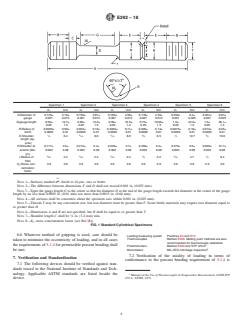
used; some cylindrical specimens are suggested in Fig. 1.A
mocouple at or near the notch (either notch for a flat specimen)
similar specimen is described in Specification A453/A453M.
is required. For a combination of smooth and notched
Separate plain and notched specimens may be used instead of
specimens, in addition to the one thermocouple required at or
the combination specimen described in Fig. 1. Suggested flat
near the notch, one or more thermocouples will be required in
specimens are shown in Fig. 2. Notch preparation methods
the unnotched gauge section. If the unnotched gauge section is
should be chosen to minimize the surface effect and residual
1 in. (25.4 mm) or less, a minimum of one additional
stresses.
thermocouple placed at the center of the gauge is required. For
unnotched gauge sections greater than 1 in. (25.4 mm), at least
NOTE 3—Dimensions of specimens are given in inch-pound units, and
two additional thermocouples at or near the fillets are required.
metric units are not always exact arithmetic equivalents (except for
If thermal gradients are suspected to be greater than the limits tolerances which are reasonable equivalents) but have been adjusted to
provide practical equivalents for critical dimensions while retaining
given in 5.3.1, additional thermocouples should be added. For
geometric proportionality.
specimens with unnotched gauge sections of 1 in. or less,
position the additional thermocouples at or near the fillets. For 6.5 Various methods of attachment of the specimen to the
specimens with unnotched gauge sections greater than 1 in., loading train may be used. Threaded attachments are shown in
position the additional thermocouples uniformly along the Fig.1forcylindricalspecimens,butbuttonhead,tapered,orpin
gauge section. attached may be used. The flat specimen types shown in Fig. 2
5.3.4 The terms “indicated nominal temperature” or “indi- may be attached through loading yokes and pins or by wedge
cated temperature” mean the temperature that is indicated on grips. If sufficient test material is available, the specimen head
the specimen by the temperature-measuring device using good length may be increased to permit attachment to the loading
pyrometric practice. train at a point outside the furnace. Removing the attachment
5.3.5 The heating characteristics of the furnace and the outside the furnace has the advantage that these components
temperature control system should be studied to determine the are not subjected to the test temperature and should therefore
power input, voltage fluctuation, temperature set point, propor- have longer useful lives than similar attachments used inside
tioning control adjustment, reset adjustment, and control ther- the furnace.
E292 − 18
Specimen 1 Specimen 2 Specimen 3 Specimen 4 Specimen 5 Specimen 6
in. mm in. mm in. mm in. mm in. mm in. mm
D-Diameter of 0.125± 3.18± 0.150± 3.81± 0.160± 4.06± 0.178± 4.52± 0.252± 6.4± 0.357± 9.07±
gauge 0.001 0.012 0.001 0.012 0.001 0.012 0.001 0.012 0.001 0.025 0.001 0.025
G-gauge length 0.50± 12.7± 0.60± 15.2± 0.65± 16.5± 0.75± 19.05± 1.0± 24.5± 1.5± 38.1±
0.05 1.3 0.05 1.3 0.05 1.3 0.05 1.3 0.05 1.3 0.05 1.3
R-Radius of 0.0035± 0.09± 0.004± 0.10± 0.0045± 0.11± 0.005± 0.13± 0.0075± 0.19± 0.010± 0.25±
notch 0.0005 0.01 0.0005 0.01 0.0005 0.01 0.0005 0.01 0.0005 0.01 0.0005 0.01
1 5 5 3 1 3
E-Shoulder ⁄4 6.4 ⁄16 8.0 ⁄16 8.0 ⁄8 9.5 ⁄2 12.7 ⁄4 19.0
length (ap-
prox)
H-Shoulder di- 0.177± 4.5± 0.212± 5.4± 0.226± 5.7± 0.250± 6.4± 0.375± 9.5± 0.500± 12.7±
ameter (Ma- 0.003 0.08 0.003 0.08 0.003 0.08 0.003 0.08 0.003 0.08 0.003 0.08
jor)
3 3 3 1 3 1
r-Radius of ⁄32 2.4 ⁄32 2.4 ⁄32 2.4 ⁄8 3.2 ⁄16 4.7 ⁄4 6.4
fillet
K -Stress con- 3.9 3.9 3.9 3.9 3.9 3.9 3.9 3.9 3.9 3.9 3.9 3.9
t
centration
factor
NOTE 1—Surfaces markedU, finish to 16 µin., rms or better.
NOTE 2—The difference between dimensions F and D shall not exceed 0.001 in. (0.025 mm).
NOTE 3—Taper the gauge length G to the center so that the diameter D at the end of the gauge length exceeds the diameter at the center of the gauge
length by no less than 0.0005 in. (0.01 mm) nor more than 0.0015 in. (0.04 mm).
NOTE 4—All sections shall be concentric about the specimen axis within 0.001 in. (0.025 mm).
NOTE 5—Threads T may be any convenient size, but root diameter must be greater than F. Some brittle materials may require root diameter equal to
or greater than H.
NOTE 6—Dimensions A and B are not specified, but B shall be equal to or greater than T.
NOTE 7—Shoulder length C shall be ⁄8 in. (3.2 mm) min.
NOTE 8—K, stress concentration factor (see Ref (8)).
t
FIG. 1 Standard Cylindrical Specimens
6.6 Whatever method of gripping is used, care should be
Loading-measuring system Practices E4 and E74
Thermocouples Method E220. Melting point methods are also
taken to minimize the eccentricity of loading, and in all cases
recommended for thermocouple calibration.
the requirements of 5.1.4 for permissible percent bending shall 5
Potentiometers Method E220 and STP 470 A
be met.
Micrometers MIL-STD-120 Gage Inspection
7.2 Verification of the axiality of loading in terms of
7. Verification and Standardization
conformance to the percent bending requirement of 5.1.4 is
7.1 The following devices should be verified against stan-
dards traced to the National Institute of Standards and Tech-
nology. Applicable ASTM standards are listed beside the 5
Manual on the Use of Thermocouples in Temperature Measurement,ASTM STP
device. 470 A, ASTM, 1971.
E292 − 18
Specimen 1 Specimen 2 Specimen 3 Specimen 4 Specimen 5 Specimen 6
in. mm in. mm in. mm in. mm in. mm in. mm
F-Notch width 0.125± 3.18± 0.150± 3.81± 0.160± 4.06± 0.175± 4.45± 0.250± 6.35± 0.350± 8.89±
0.001 0.025 0.001 0.025 0.001 0.025 0.001 0.025 0.001 0.025 0.001 0.025
H-Major width 0.225± 5.71± 0.230± 5.84± 0.230± 5.84± 0.250± 6.35± 0.375± 9.53± 0.500± 12.70±
0.003 0.08 0.003 0.08 0.003 0.08 0.003 0.08 0.003 0.08 0.003 0.08
R-Radius of 0.005± 0.13± 0.0055± 0.14± 0.0055± 0.14± 0.006± 0.15± 0.009± 0.23± 0.012± 0.30±
notch 0.0005 0.01 0.0005 0.01 0.0005 0.01 0.0005 0.01 0.0005 0.01 0.0005 0.01
3 3 3 3 1
G-gauge ⁄4 19.0 ⁄4 19.0 ⁄4 19.0 ⁄4 19.0 1 25.4 1 ⁄2 38.1
length
(approx)
3 3 3 3 9 3
C-Shoulder ⁄8 9.53 ⁄8 9.53 ⁄8 9.53 ⁄8 9.53 ⁄16 14.29 ⁄4 19.0
width (min)
K -Stress con- 4.5 4.5 4.5 4.5 4.5 4.5 4.5 4.5 4.5 4.5 4.5 4.5
t
centration
factor
NOTE 1—Surfaces markedU, finish to 16 µin. rms or better.
NOTE 2—Dimension A is not specified, but shall be of such length to accommodate gripping ends.
NOTE 3—Dimension T, is thickness of material, but greater than 5 and less than 10 times the notch root radius.
1 1
NOTE 4—Radius r shall be ⁄2 + ⁄32-0 in. (12.7 + 0.8 mm).
NOTE 5—K, stress concentration factor (see Ref (8)).
t
FIG. 2 Standard Flat Specimens
consideredaspartofcalibrationandstandardizationprocedure.
Use a specimen as shown in Fig. 3. Apply strain gages to the
specimen in a configuration outlined in Practice E1012.
7.3 Verifications of the force-measuring system and
temperature-measuring and control system should be made as
frequentlyasnecessarytoassurethattheerrorsforeachtestare
FIG. 4 Test Section of Flat Verification Specimen
less than the permissible variations listed in this recommended
practice. The maximum period between these types of calibra-
tions should be one year, or after each test when the tests last
longer than one year. Verification of the axiality of loading
FIG. 3 Cylindrical Verification Specimen Test Section should be repeated whenever loading rods are replaced and at
-------------------
...