


ASTM E984-12(2020)
(Guide)Standard Guide for Identifying Chemical Effects and Matrix Effects in Auger Electron Spectroscopy
Standard Guide for Identifying Chemical Effects and Matrix Effects in Auger Electron Spectroscopy
SIGNIFICANCE AND USE
4.1 Auger electron spectroscopy is often capable of yielding information concerning the chemical and physical environment of atoms in the near-surface region of a solid as well as giving elemental and quantitative information. This information is manifested as changes in the observed Auger electron spectrum for a particular element in the specimen under study compared to the Auger spectrum produced by the same element when it is in some reference form. The differences in the two spectra are said to be due to a chemical effect or a matrix effect. Despite sometimes making elemental identification and quantitative measurements more difficult, these effects in the Auger spectrum are considered valuable tools for characterizing the environment of the near-surface atoms in a solid.
SCOPE
1.1 This guide outlines the types of chemical effects and matrix effects which are observed in Auger electron spectroscopy.
1.2 Guidelines are given for the reporting of chemical and matrix effects in Auger spectra.
1.3 Guidelines are given for utilizing Auger chemical effects for identification or characterization.
1.4 This guide is applicable to both electron excited and X-ray excited Auger electron spectroscopy.
1.5 This standard does not purport to address all of the safety concerns, if any, associated with its use. It is the responsibility of the user of this standard to establish appropriate safety, health, and environmental practices and determine the applicability of regulatory limitations prior to use.
1.6 This international standard was developed in accordance with internationally recognized principles on standardization established in the Decision on Principles for the Development of International Standards, Guides and Recommendations issued by the World Trade Organization Technical Barriers to Trade (TBT) Committee.
General Information
- Status
- Published
- Publication Date
- 30-Nov-2020
- Technical Committee
- E42 - Surface Analysis
Relations
- Effective Date
- 01-Apr-2019
- Effective Date
- 01-Apr-2019
- Effective Date
- 01-Nov-2018
- Effective Date
- 01-Nov-2018
- Effective Date
- 01-Nov-2010
- Effective Date
- 01-Nov-2010
- Effective Date
- 01-Oct-2008
- Effective Date
- 01-Oct-2007
- Effective Date
- 25-Jul-2005
- Effective Date
- 01-Nov-2004
- Effective Date
- 01-Dec-2003
- Effective Date
- 10-Dec-2002
- Effective Date
- 10-Apr-2002
- Effective Date
- 10-Apr-2002
- Effective Date
- 10-Nov-2001
Overview
ASTM E984-12(2020) - "Standard Guide for Identifying Chemical Effects and Matrix Effects in Auger Electron Spectroscopy" - provides vital guidance for recognizing and reporting chemical and matrix effects in Auger Electron Spectroscopy (AES). Developed by ASTM International, this standard outlines how the physical and chemical environments in the near-surface region of solids influence Auger spectra, affecting both elemental analysis and material characterization. Despite introducing challenges for quantitative and qualitative analyses, these effects are considered valuable for understanding surface chemistry and materials science.
AES is a powerful surface analysis technique sensitive to the chemical and physical context of atoms. ASTM E984-12(2020) applies to both electron-excited and X-ray excited Auger electron spectroscopy, offering clear recommendations for data interpretation, reporting, and utilization of these effects in research and industrial applications.
Key Topics
- Chemical Effects: Describes how the bonding or environment of an element alters the Auger spectrum, leading to chemical shifts and changes in peak shape and intensity. These shifts can be larger than those observed with X-ray Photoelectron Spectroscopy (XPS).
- Matrix Effects: Refers to influences from the bulk material or distribution of the element, impacting the Auger signal and complicating quantitative analysis.
- Auger Chemical Shift: One of the most notable chemical effects, representing energy changes in Auger peaks linked to the element’s environment.
- Auger Parameter: The sum of the photoelectron binding energy and Auger electron kinetic energy, providing a reference that is less impacted by specimen charging-particularly useful for insulating materials.
- Line Shape Analysis: Variations in peak shapes provide clues to different chemical states, phases, or the presence of elements like carbon, sulfur, and aluminum in varied bonding scenarios.
- Reporting Guidelines: Emphasizes standardized approaches for documenting Auger spectra, including detailed instrumentation settings, energy scales, calibration procedures, and referencing established practices such as ASTM E996 and E827.
- Safety and Compliance: Stresses user responsibility in following appropriate safety, health, and environmental protocols, complying with international standardization principles as set by the WTO TBT Committee.
Applications
Auger Electron Spectroscopy and the identification of chemical and matrix effects, as covered by ASTM E984-12(2020), are broadly applied in:
- Materials Characterization: Determining the chemical state, composition, and structure of thin films, coatings, and semiconductor materials.
- Surface Chemistry: Investigating chemical modifications, oxidation states, and contamination on surfaces relevant to catalysis, electronics, and metallurgy.
- Semiconductor Industry: Analyzing doping profiles, junctions, and heterostructures, particularly in advanced device manufacturing.
- Quality Assurance: Supporting failure analysis, contamination detection, and process optimization in manufacturing and research environments.
- Academic and Industrial Research: Providing a framework for reproducible reporting and comparison of Auger spectra, essential for peer-reviewed publications and patent documentation.
Related Standards
For comprehensive surface chemical analysis and standardized reporting, the following documents are referenced alongside ASTM E984-12(2020):
- ASTM E996: Practice for Reporting Data in Auger Electron Spectroscopy and X-ray Photoelectron Spectroscopy.
- ASTM E827: Practice for Identifying Elements by the Peaks in Auger Electron Spectroscopy.
- ASTM E983: Guide for Minimizing Unwanted Electron Beam Effects in Auger Electron Spectroscopy.
- ISO 18118:2004: Surface Chemical Analysis - Auger Electron Spectroscopy and X-ray Photoelectron Spectroscopy - Guide to the Use of Experimentally Determined Relative Sensitivity Factors for the Quantitative Analysis of Homogeneous Materials.
These standards together ensure consistent, accurate, and internationally recognized approaches to surface chemical analysis using AES.
Keywords: Auger electron spectroscopy, AES standard, chemical effects, matrix effects, Auger chemical shift, surface analysis, materials characterization, ASTM E984-12(2020)
Get Certified
Connect with accredited certification bodies for this standard

ECOCERT
Organic and sustainability certification.

Eurofins Food Testing Global
Global leader in food, environment, and pharmaceutical product testing.

Intertek Bangladesh
Intertek certification and testing services in Bangladesh.
Sponsored listings
Frequently Asked Questions
ASTM E984-12(2020) is a guide published by ASTM International. Its full title is "Standard Guide for Identifying Chemical Effects and Matrix Effects in Auger Electron Spectroscopy". This standard covers: SIGNIFICANCE AND USE 4.1 Auger electron spectroscopy is often capable of yielding information concerning the chemical and physical environment of atoms in the near-surface region of a solid as well as giving elemental and quantitative information. This information is manifested as changes in the observed Auger electron spectrum for a particular element in the specimen under study compared to the Auger spectrum produced by the same element when it is in some reference form. The differences in the two spectra are said to be due to a chemical effect or a matrix effect. Despite sometimes making elemental identification and quantitative measurements more difficult, these effects in the Auger spectrum are considered valuable tools for characterizing the environment of the near-surface atoms in a solid. SCOPE 1.1 This guide outlines the types of chemical effects and matrix effects which are observed in Auger electron spectroscopy. 1.2 Guidelines are given for the reporting of chemical and matrix effects in Auger spectra. 1.3 Guidelines are given for utilizing Auger chemical effects for identification or characterization. 1.4 This guide is applicable to both electron excited and X-ray excited Auger electron spectroscopy. 1.5 This standard does not purport to address all of the safety concerns, if any, associated with its use. It is the responsibility of the user of this standard to establish appropriate safety, health, and environmental practices and determine the applicability of regulatory limitations prior to use. 1.6 This international standard was developed in accordance with internationally recognized principles on standardization established in the Decision on Principles for the Development of International Standards, Guides and Recommendations issued by the World Trade Organization Technical Barriers to Trade (TBT) Committee.
SIGNIFICANCE AND USE 4.1 Auger electron spectroscopy is often capable of yielding information concerning the chemical and physical environment of atoms in the near-surface region of a solid as well as giving elemental and quantitative information. This information is manifested as changes in the observed Auger electron spectrum for a particular element in the specimen under study compared to the Auger spectrum produced by the same element when it is in some reference form. The differences in the two spectra are said to be due to a chemical effect or a matrix effect. Despite sometimes making elemental identification and quantitative measurements more difficult, these effects in the Auger spectrum are considered valuable tools for characterizing the environment of the near-surface atoms in a solid. SCOPE 1.1 This guide outlines the types of chemical effects and matrix effects which are observed in Auger electron spectroscopy. 1.2 Guidelines are given for the reporting of chemical and matrix effects in Auger spectra. 1.3 Guidelines are given for utilizing Auger chemical effects for identification or characterization. 1.4 This guide is applicable to both electron excited and X-ray excited Auger electron spectroscopy. 1.5 This standard does not purport to address all of the safety concerns, if any, associated with its use. It is the responsibility of the user of this standard to establish appropriate safety, health, and environmental practices and determine the applicability of regulatory limitations prior to use. 1.6 This international standard was developed in accordance with internationally recognized principles on standardization established in the Decision on Principles for the Development of International Standards, Guides and Recommendations issued by the World Trade Organization Technical Barriers to Trade (TBT) Committee.
ASTM E984-12(2020) is classified under the following ICS (International Classification for Standards) categories: 71.040.50 - Physicochemical methods of analysis. The ICS classification helps identify the subject area and facilitates finding related standards.
ASTM E984-12(2020) has the following relationships with other standards: It is inter standard links to ASTM E983-19, ASTM E996-19, ASTM E983-10(2018), ASTM E996-10(2018), ASTM E983-10, ASTM E996-10, ASTM E827-08, ASTM E827-07, ASTM E983-05, ASTM E996-04, ASTM E673-03, ASTM E673-02a, ASTM E827-95, ASTM E827-02, ASTM E673-01. Understanding these relationships helps ensure you are using the most current and applicable version of the standard.
ASTM E984-12(2020) is available in PDF format for immediate download after purchase. The document can be added to your cart and obtained through the secure checkout process. Digital delivery ensures instant access to the complete standard document.
Standards Content (Sample)
This international standard was developed in accordance with internationally recognized principles on standardization established in the Decision on Principles for the
Development of International Standards, Guides and Recommendations issued by the World Trade Organization Technical Barriers to Trade (TBT) Committee.
Designation: E984 − 12 (Reapproved 2020)
Standard Guide for
Identifying Chemical Effects and Matrix Effects in Auger
Electron Spectroscopy
This standard is issued under the fixed designation E984; the number immediately following the designation indicates the year of
original adoption or, in the case of revision, the year of last revision. A number in parentheses indicates the year of last reapproval. A
superscript epsilon (´) indicates an editorial change since the last revision or reapproval.
1. Scope E996 Practice for Reporting Data in Auger Electron Spec-
troscopy and X-ray Photoelectron Spectroscopy
1.1 This guide outlines the types of chemical effects and
2.2 Other Document:
matrix effects which are observed in Auger electron spectros-
ISO 18118:2004 Surface Chemical Analysis—Auger Elec-
copy.
tron Spectroscopy and X-ray Photoelectron
1.2 Guidelines are given for the reporting of chemical and
Spectroscopy—Guide to the Use of Experimentally De-
matrix effects in Auger spectra.
termined Relative Sensitivity Factors for the Quantitative
1.3 GuidelinesaregivenforutilizingAugerchemicaleffects
Analysis of Homogenous Materials
for identification or characterization.
3. Terminology
1.4 This guide is applicable to both electron excited and
3.1 Terms used in Auger electron spectroscopy are defined
X-ray excited Auger electron spectroscopy.
in Terminology E673.
1.5 This standard does not purport to address all of the
safety concerns, if any, associated with its use. It is the
4. Significance and Use
responsibility of the user of this standard to establish appro-
4.1 Augerelectronspectroscopyisoftencapableofyielding
priate safety, health, and environmental practices and deter-
informationconcerningthechemicalandphysicalenvironment
mine the applicability of regulatory limitations prior to use.
of atoms in the near-surface region of a solid as well as giving
1.6 This international standard was developed in accor-
elemental and quantitative information. This information is
dance with internationally recognized principles on standard-
manifestedaschangesintheobservedAugerelectronspectrum
ization established in the Decision on Principles for the
for a particular element in the specimen under study compared
Development of International Standards, Guides and Recom-
to the Auger spectrum produced by the same element when it
mendations issued by the World Trade Organization Technical
is in some reference form. The differences in the two spectra
Barriers to Trade (TBT) Committee.
are said to be due to a chemical effect or a matrix effect.
2. Referenced Documents Despite sometimes making elemental identification and quan-
2 titative measurements more difficult, these effects in theAuger
2.1 ASTM Standards:
spectrum are considered valuable tools for characterizing the
E673 Terminology Relating to SurfaceAnalysis (Withdrawn
3 environment of the near-surface atoms in a solid.
2012)
E827 Practice for Identifying Elements by the Peaks in
5. Defining Auger Chemical Effects and Matrix Effects
Auger Electron Spectroscopy (Withdrawn 2017)
5.1 Ingeneral,Augerchemicalandmatrixeffectsmayresult
E983 Guide for Minimizing Unwanted Electron Beam Ef-
in(a)ashiftintheenergyofanAugerpeak,(b)achangeinthe
fects in Auger Electron Spectroscopy
shape of anAuger electron energy distribution, (c) a change in
the shape of the electron energy loss distribution associated
This guide is under the jurisdiction of ASTM Committee E42 on Surface
with an Auger peak, or (d) a change in the Auger signal
Analysis and is the direct responsibility of Subcommittee E42.03 on Auger Electron
strengths of an Auger transition. The above changes may be
Spectroscopy and X-Ray Photoelectron Spectroscopy.
due to the bonding or chemical environment of the element
Current edition approved Dec. 1, 2020. Published December 2020. Originally
approved in 1984. Last previous edition approved in 2012 as E984 – 12. DOI:
(chemical effect) or to the distribution of the element or
10.1520/E0984-12R20.
compound within the specimen (matrix effect).
For referenced ASTM standards, visit the ASTM website, www.astm.org, or
contact ASTM Customer Service at service@astm.org. For Annual Book of ASTM
5.2 The Auger chemical shift is one of the most commonly
Standards volume information, refer to the standard’s Document Summary page on
observed chemical effects. A comparison can be made to the
the ASTM website.
more familiar chemical shifts in XPS (X-ray photoelectron
The last approved version of this historical standard is referenced on
www.astm.org. spectroscopy) photoelectron lines, where energy shifts are
Copyright © ASTM International, 100 Barr Harbor Drive, PO Box C700, West Conshohocken, PA 19428-2959. United States
E984 − 12 (2020)
FIG. 3 Auger Spectra for p- and n- Type GaN Heteroepitaxial, the
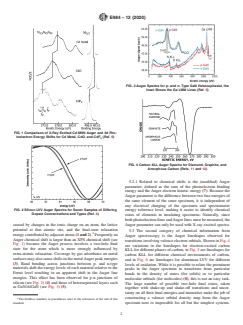
Inset Shows the Ga LMM Lines (Ref. 5)
FIG. 1 Comparison of X-Ray Excited Cd MNN Auger and 3d Pho-
toelectron Energy Shifts for Cd Metal, CdO, and CdF (Ref. 6)
FIG. 4 Carbon KLL Auger Spectra for Diamond, Graphite, and
Amorphous Carbon (Refs. 11 and 12)
5.2.1 Related to chemical shifts is the (modified) Auger
parameter, defined as the sum of the photoelectron binding
energy and the Auger electron kinetic energy (7). Because the
Auger parameter is the difference between two line energies of
the same element of the same specimen, it is independent of
any electrical charging of the specimen and spectrometer
FIG. 2 Silicon LVV Auger Spectra for Seven Samples of Differing energy reference level, making it easier to identify chemical
Dopant Concentrations and Types (Ref. 4)
states of elements in insulating specimens. Naturally, since
bothphotoelectronlinesandAugerlinesmustbemeasured,the
Auger parameter can only be used with X-ray excited spectra.
caused by changes in the ionic charge on an atom, the lattice
potential at that atomic site, and the final-state relaxation
5.3 The second category of chemical information from
energycontributedbyadjacentatoms (1 and 2). Frequentlyan
Auger spectroscopy is the Auger lineshapes observed for
Auger chemical shift is larger than an XPS chemical shift (see
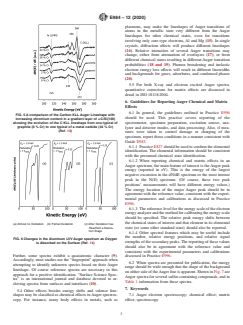
transitions involving valence electron orbitals. Shown in Fig. 4
Fig. 1) because the Auger process involves a two-hole final
are variations in the lineshapes for electron-excited carbon
state for the atom which is more strongly influenced by
KLLfor different phases of carbon, in Fig. 5 are lineshapes for
extra-atomic relaxation. Coverage by gas adsorbates on metal
carbon KLL for different chemical environments of carbon,
surfacesmayalsocauseshiftsinthemetalAugerpeakenergies
and in Fig. 6 are lineshapes for aluminum LVV for different
(3). Band bending across junctions between p- and n-type
levels of oxidation. While it is possible to relate the prominent
materials shift the energy levels of each material relative to the
peaks in the Auger spectrum to transitions from particular
Fermi level resulting in an apparent shift in the Auger line
bands in the density of states (for solids) or to particular
energies. This effect has been observed for p-n junctions of
molecular orbitals (for molecules) (8), this is not an easy task.
silicon (see Fig. 2) (4) and those of heteroepitaxial layers such
The large number of possible two-hole final states, taken
as GaN/AlGaN (see Fig. 3) (5).
together with shake-up and shake-off transitions and uncer-
tainty on all their final energies and intensities make the job of
constructing a valence orbital density map from the Auger
The boldface numbers in parentheses refer to the references at the end of this
standard. spectrum next to impossible for all but the simplest systems.
E984 − 12 (2020)
plasmons, may make the lineshapes of Auger transitions of
atoms in the metallic state very different from the Auger
lineshapes for other chemical states, even for transitions
involving only core-type electrons, Al and Mg (15). In single
crystals, diffraction effects will produce different lineshapes
(16). Relative intensities of several Auger transitions may
change, either from attenuation of overlayers (17), or from
different chemical states resulting in different Auger transition
probabilities (18 and 19). Phonon broadening and inelastic
electron energy loss effects will result in different linewidths
and backgrounds for gases, adsorbates, and condensed phases
(20).
5.5 For both X-ray and electron excited Auger spectra,
quantitative corrections for matrix effects are discussed in
detail in ISO 18118:2004.
6. Guidelines for Reporting Auger Chemical and Matrix
Effect
...
Questions, Comments and Discussion
Ask us and Technical Secretary will try to provide an answer. You can facilitate discussion about the standard in here.
Loading comments...