

ASTM D5806-95(2017)
(Test Method)Standard Test Method for Disinfectant Quaternary Ammonium Salts by Potentiometric Titration
General Information
- Abstract
SIGNIFICANCE AND USE
5.1 This test method is used to determine the percent actives in each type of the disinfectant quaternary ammonium salts, and also in the disinfectant products. Quaternary ammonium compounds being the active ingredients in disinfectant-type products require accurate determination to assess the cost and antimicrobial performance of such products.
SCOPE
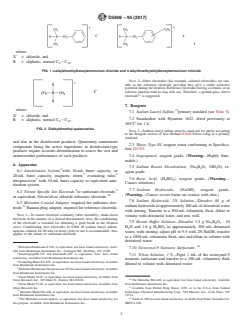
1.1 This test method covers a potentiometric titration procedure for determining active matter in disinfectant quaternary ammonium salts. This test method is intended for the analysis of quaternary ammonium salts used as disinfectants, and only applies to the following commonly used quaternary ammonium salts: n-alkyldimethylbenzylammonium chloride (see Fig. 1), cetyltrimethylammonium chloride, and a blend of n-octyldecyl dimethylammonium chloride, di-n-octyl dimethylammonium chloride, and di-n-decyldimethyl ammonium chloride (see Fig. 2). Also, this test method can be applied to the analysis of disinfectant type products where the formula ingredients are known and the quaternary ammonium salt is one of the above. Interferences such as amines oxides and betaines present in disinfectant formulations were not tested. X− = chloride, and R = aliphatic, normal C8 − C22.
1.2 This disinfectant quaternary ammonium salt conforms to the structures in Fig. 1 and Fig. 2.
1.3 The values stated in SI units are to be regarded as standard. No other units of measurement are included in this standard.
1.4 This standard does not purport to address all of the safety concerns, if any, associated with its use. It is the responsibility of the user of this standard to establish appropriate safety and health practices and determine the applicability of regulatory limitations prior to use. For specific precautionary information, see Section 8.
- Status
- Published
- Publication Date
- 31-Dec-2016
- Technical Committee
- D12 - Soaps and Other Detergents

Overview
ASTM D5806-95(2017): Standard Test Method for Disinfectant Quaternary Ammonium Salts by Potentiometric Titration provides a precise procedure for determining the active ingredient content in disinfectant quaternary ammonium salts (QACs) and their formulations. Accurate measurement of QACs is essential for assessing cost efficiency and antimicrobial effectiveness in disinfectant products used in various industries, including healthcare, food processing, and institutional cleaning.
This standard, developed by ASTM International, ensures consistent evaluation of QAC actives through potentiometric titration, supporting regulatory compliance and quality assurance for manufacturers and users of disinfectant products.
Key Topics
Test Method Scope:
- Designed for the analysis of active matter in specific quaternary ammonium salts commonly used as disinfectants, including:
- n-alkyldimethylbenzylammonium chloride
- cetyltrimethylammonium chloride
- blends of n-octyldecyl dimethylammonium chloride, di-n-octyl dimethylammonium chloride, and di-n-decyldimethyl ammonium chloride
- Applicable to disinfectant-type products where these QACs are ingredient components.
- Designed for the analysis of active matter in specific quaternary ammonium salts commonly used as disinfectants, including:
Analytical Procedure:
- Utilizes potentiometric titration with a standard solution (e.g., sodium lauryl sulfate) and specific ion-selective electrodes to determine the endpoint.
- Results allow calculation of the percentage of active quaternary ammonium compounds.
Precision and Reliability:
- Standardized titration methods improve repeatability within single laboratories and reproducibility across multiple laboratories.
- Precision data are provided to help users assess measurement consistency.
Safety and Compliance:
- Users must rigorously follow chemical handling and safety guidelines.
- Adherence to the standard supports meeting local and international regulatory requirements for disinfectant products.
Applications
Implementing ASTM D5806 potentiometric titration offers significant practical value:
Quality Control for Manufacturers:
- Ensures accurate formulation and labeling of disinfectant products by verifying the percentage of active QACs.
- Helps optimize production processes and batch consistency.
Regulatory Compliance:
- Provides defensible documentation for product registration and compliance with safety and antimicrobial claims.
- Supports adherence to international regulations and audit requirements.
Performance Assessment:
- Directly relates QAC content to antimicrobial performance, critical for mission-critical environments such as hospitals, laboratories, and food preparation areas.
Research and Development:
- Facilitates product development by providing a standardized method for evaluating new QAC-based disinfectant formulations.
Related Standards
For broader or complementary testing needs, the following ASTM standards are referenced or closely related:
- ASTM D459: Terminology Relating to Soaps and Other Detergents
- ASTM D1193: Specification for Reagent Water
- ASTM D1681: Test Method for Synthetic Anionic Active Ingredient in Detergents by Cationic Titration Procedure
- ASTM D3049: Test Method for Synthetic Anionic Ingredient by Cationic Titration
Users engaged in the analysis of disinfectants, detergents, or similar chemical products may benefit from consulting these related methods for comprehensive testing and terminology alignment.
Keywords: ASTM D5806, disinfectant quaternary ammonium salts, potentiometric titration, QAC analysis, active ingredient determination, sodium lauryl sulfate titration, laboratory quality control, disinfectant product compliance.
Relations
- Effective Date
- 01-Jan-2017
- Effective Date
- 01-Jul-2016
- Refers
ASTM D3049-89(2016) - Standard Test Method for Synthetic Anionic Ingredient by Cationic Titration - Effective Date
- 01-Jul-2016
- Refers
ASTM D459-09 - Standard Terminology Relating to Soaps and Other Detergents <a href="#fn00002"></a> - Effective Date
- 01-Oct-2009
- Refers
ASTM D3049-89(2009) - Standard Test Method for Synthetic Anionic Ingredient by Cationic Titration - Effective Date
- 01-Oct-2009
- Refers
ASTM D459-08a - Standard Terminology Relating to Soaps and Other Detergents <a href="#fn00002"></a> - Effective Date
- 15-Oct-2008
- Refers
ASTM D459-08 - Standard Terminology Relating to Soaps and Other Detergents <a href="#fn00002"></a> - Effective Date
- 15-Jul-2008
- Effective Date
- 01-Oct-2007
- Effective Date
- 01-Mar-2006
- Effective Date
- 01-May-2005
- Effective Date
- 10-Jun-2000
- Effective Date
- 10-Feb-1999
- Effective Date
- 10-Feb-1999
- Effective Date
- 10-Mar-1997
- Refers
ASTM D3049-89(1996)e1 - Standard Test Method for Synthetic Anionic Ingredient by Cationic Titration - Effective Date
- 01-Jan-1996
Get Certified
Connect with accredited certification bodies for this standard

ECOCERT
Organic and sustainability certification.

Eurofins Food Testing Global
Global leader in food, environment, and pharmaceutical product testing.

Intertek Bangladesh
Intertek certification and testing services in Bangladesh.
Sponsored listings
Frequently Asked Questions
ASTM D5806-95(2017) is a standard published by ASTM International. Its full title is "Standard Test Method for Disinfectant Quaternary Ammonium Salts by Potentiometric Titration". This standard covers: SIGNIFICANCE AND USE 5.1 This test method is used to determine the percent actives in each type of the disinfectant quaternary ammonium salts, and also in the disinfectant products. Quaternary ammonium compounds being the active ingredients in disinfectant-type products require accurate determination to assess the cost and antimicrobial performance of such products. SCOPE 1.1 This test method covers a potentiometric titration procedure for determining active matter in disinfectant quaternary ammonium salts. This test method is intended for the analysis of quaternary ammonium salts used as disinfectants, and only applies to the following commonly used quaternary ammonium salts: n-alkyldimethylbenzylammonium chloride (see Fig. 1), cetyltrimethylammonium chloride, and a blend of n-octyldecyl dimethylammonium chloride, di-n-octyl dimethylammonium chloride, and di-n-decyldimethyl ammonium chloride (see Fig. 2). Also, this test method can be applied to the analysis of disinfectant type products where the formula ingredients are known and the quaternary ammonium salt is one of the above. Interferences such as amines oxides and betaines present in disinfectant formulations were not tested. X− = chloride, and R = aliphatic, normal C8 − C22. 1.2 This disinfectant quaternary ammonium salt conforms to the structures in Fig. 1 and Fig. 2. 1.3 The values stated in SI units are to be regarded as standard. No other units of measurement are included in this standard. 1.4 This standard does not purport to address all of the safety concerns, if any, associated with its use. It is the responsibility of the user of this standard to establish appropriate safety and health practices and determine the applicability of regulatory limitations prior to use. For specific precautionary information, see Section 8.
SIGNIFICANCE AND USE 5.1 This test method is used to determine the percent actives in each type of the disinfectant quaternary ammonium salts, and also in the disinfectant products. Quaternary ammonium compounds being the active ingredients in disinfectant-type products require accurate determination to assess the cost and antimicrobial performance of such products. SCOPE 1.1 This test method covers a potentiometric titration procedure for determining active matter in disinfectant quaternary ammonium salts. This test method is intended for the analysis of quaternary ammonium salts used as disinfectants, and only applies to the following commonly used quaternary ammonium salts: n-alkyldimethylbenzylammonium chloride (see Fig. 1), cetyltrimethylammonium chloride, and a blend of n-octyldecyl dimethylammonium chloride, di-n-octyl dimethylammonium chloride, and di-n-decyldimethyl ammonium chloride (see Fig. 2). Also, this test method can be applied to the analysis of disinfectant type products where the formula ingredients are known and the quaternary ammonium salt is one of the above. Interferences such as amines oxides and betaines present in disinfectant formulations were not tested. X− = chloride, and R = aliphatic, normal C8 − C22. 1.2 This disinfectant quaternary ammonium salt conforms to the structures in Fig. 1 and Fig. 2. 1.3 The values stated in SI units are to be regarded as standard. No other units of measurement are included in this standard. 1.4 This standard does not purport to address all of the safety concerns, if any, associated with its use. It is the responsibility of the user of this standard to establish appropriate safety and health practices and determine the applicability of regulatory limitations prior to use. For specific precautionary information, see Section 8.
ASTM D5806-95(2017) is classified under the following ICS (International Classification for Standards) categories: 71.100.35 - Chemicals for industrial and domestic disinfection purposes. The ICS classification helps identify the subject area and facilitates finding related standards.
ASTM D5806-95(2017) has the following relationships with other standards: It is inter standard links to ASTM D5806-95(2009), ASTM D459-16, ASTM D3049-89(2016), ASTM D459-09, ASTM D3049-89(2009), ASTM D459-08a, ASTM D459-08, ASTM D459-00(2007), ASTM D1193-06, ASTM D1681-05, ASTM D459-00, ASTM D1193-99, ASTM D1193-99e1, ASTM D1681-92(1997), ASTM D3049-89(1996)e1. Understanding these relationships helps ensure you are using the most current and applicable version of the standard.
ASTM D5806-95(2017) is available in PDF format for immediate download after purchase. The document can be added to your cart and obtained through the secure checkout process. Digital delivery ensures instant access to the complete standard document.
Standards Content (Sample)
This international standard was developed in accordance with internationally recognized principles on standardization established in the Decision on Principles for the
Development of International Standards, Guides and Recommendations issued by the World Trade Organization Technical Barriers to Trade (TBT) Committee.
Designation: D5806 − 95 (Reapproved 2017)
Standard Test Method for
Disinfectant Quaternary Ammonium Salts by Potentiometric
Titration
This standard is issued under the fixed designation D5806; the number immediately following the designation indicates the year of
original adoption or, in the case of revision, the year of last revision.Anumber in parentheses indicates the year of last reapproval.A
superscript epsilon (´) indicates an editorial change since the last revision or reapproval.
1. Scope 2. Referenced Documents
2.1 ASTM Standards:
1.1 This test method covers a potentiometric titration pro-
D459Terminology Relating to Soaps and Other Detergents
cedure for determining active matter in disinfectant quaternary
D1193Specification for Reagent Water
ammonium salts. This test method is intended for the analysis
D1681Test Method for SyntheticAnionicActive Ingredient
of quaternary ammonium salts used as disinfectants, and only
in Detergents by Cationic Titration Procedure
appliestothefollowingcommonlyusedquaternaryammonium
D3049Test Method for Synthetic Anionic Ingredient by
salts: n-alkyldimethylbenzylammonium chloride (see Fig. 1),
Cationic Titration
cetyltrimethylammoniumchloride,andablendof n-octyldecyl
E180Practice for Determining the Precision of ASTM
dimethylammonium chloride, di-n-octyl dimethylammonium
Methods for Analysis and Testing of Industrial and Spe-
chloride,anddi-n-decyldimethylammoniumchloride(seeFig. 3
cialty Chemicals (Withdrawn 2009)
2). Also, this test method can be applied to the analysis of
disinfectant type products where the formula ingredients are
3. Terminology
known and the quaternary ammonium salt is one of the above.
3.1 Definitions—See Terminology D459.
Interferences such as amines oxides and betaines present in
disinfectant formulations were not tested.
4. Summary of Test Method
1.2 This disinfectant quaternary ammonium salt conforms 4.1 Disinfectant type quaternary ammonium compounds
to the structures in Fig. 1 and Fig. 2. present,astheactivematerialsindisinfectanttypeproductsare
titrated potentiometrically in an aqueous medium with a
1.3 The values stated in SI units are to be regarded as
standard solution of sodium lauryl sulphate using a nitrate
standard. No other units of measurement are included in this
ion-selective electrode or a surfactant electrode (see also Test
standard.
Method D1681). In this potentiometric titration, the reaction
involves the formation of a complex between the disinfectant
1.4 This standard does not purport to address all of the
quaternary ammonium compound and the anionic surfactant
safety concerns, if any, associated with its use. It is the
which then precipitates. At the end point, the nitrate ion
responsibility of the user of this standard to establish appro-
electrode or surfactant electrode appears to respond to an
priate safety and health practices and determine the applica-
excess of titrant with a potential change large enough to give a
bility of regulatory limitations prior to use. For specific
well defined inflection in the titration curve.
precautionary information, see Section 8.
5. Significance and Use
5.1 Thistestmethodisusedtodeterminethepercentactives
in each type of the disinfectant quaternary ammonium salts,
1 2
This test method is under the jurisdiction ofASTM Committee D12 on Soaps For referenced ASTM standards, visit the ASTM website, www.astm.org, or
and Other Detergents and is the direct responsibility of Subcommittee D12.12 on contact ASTM Customer Service at service@astm.org. For Annual Book of ASTM
AnalysisandSpecificationsofSoaps,Synthetics,DetergentsandtheirComponents. Standards volume information, refer to the standard’s Document Summary page on
Current edition approved Jan. 1, 2017. Published February 2017. Originally the ASTM website.
approvedin1995.Lastpreviouseditionapprovedin2009asD5806-95(2009).DOI: The last approved version of this historical standard is referenced on
10.1520/D5806-95R17. www.astm.org.
Copyright © ASTM International, 100 Barr Harbor Drive, PO Box C700, West Conshohocken, PA 19428-2959. United States
D5806 − 95 (2017)
where:
−
X = chloride, and
R = aliphatic, normal C −C .
8 22
FIG. 1n-alkyldimethylbenzylammonium chloride and n-alkyldimethylethylbenzylammonium chloride
NOTE 2—Other electrodes (for example, calomel electrodes) are suit-
able as the reference electrode provided they give a stable reference
potential during the titration. Reference electrodes having a ceramic or an
asbestos junction tend to clog with use. Therefore, a ground-glass sleeve
electrode is suggested.
7. Reagents
where: 13
7.1 Sodium Lauryl Sulfate, primary standard (see Note 3).
−
X = chloride, and
7.2 Standardize with Hyamine 1622, dried previously at
R = aliphatic, normal C −C .
8 22
105°C for 1 h.
FIG. 2 Dialkyldimethyl quaternaries
NOTE 3—Sodium lauryl sulfate must be analyzed for purity according
to the Reagent section of Test Method D3049 before using as a primary
standard.
and also in the disinfectant products. Quaternary ammonium
7.3 Water, Type III, reagent water conforming to Specifica-
compounds being the active ingredients in disinfectant-type
tion D1193.
products require accurate determination to assess the cost and
7.4 Isopropanol, reagent grade. (Warning—Highly flam-
antimicrobial performance of such products.
mable.)
6. Apparatus
7.5 Sodium Borate Decahydrate, (Na B O 10H O), re-
2 4 7 2
6.1 Autotitration System, with 10-mL buret capacity, or
agent grade.
5 6
20-mL buret capacity, magnetic stirrer, evaluating ruler,
7 7.6 Boric Acid, (H BO ), reagent grade. (Warning—
3 3
titroprocessor with 10-mL buret capacity or equivalent auto-
Causes irritation.)
titration system.
8 9 7.7 Sodium Hydroxide, (NaOH), reagent grade.
6.2 Nitrate Specific Ion Electrode, or surfactant electrode,
10 (Warning—Causes severe burns on contact with skin.)
or equivalent. Silver/silver chloride reference electrode.
7.8 Sodium Hydroxide, 2N Solution—Dissolve 40 g of
6.3 Metrohm Coaxial Adaptor, required for indicator elec-
11 sodiumhydroxideinapproximately300mLofdeionizedwater
trode. Banana plug adaptor, required for reference electrode.
with stirring. Transfer to a 500-mL volumetric flask, dilute to
NOTE 1—To ensure electrical continuity (after assembly), shake down
volume with deionized water, and mix well.
electrode in the manner of a clinical thermometer.Also, the conditioning
of the electrode is essential for obtaining a good break in the titration 7.9 Borate Buffer Solution—Dissolve 1.5 g Na B O ·10
2 4 7
curve. Conditioning new electrodes in 0.004 M sodium lauryl sulfate,
H O and 1.0 g H BO in approximately 200 mL deionized
2 3 3
aqueous solution for 60 min (or more) prior to use is recommended.Also
water, with stirring; adjust pH to 9.5 with 2N HaOH, transfer
applies to the nitrate or surfactant electrode.
to a 1000-mL volumetric flask, mix and dilute to volume with
deionized water.
Metrohm-Brinkmann E-536, or equivalent, has been found satisfactory.Avail-
7.10 Octoxynol-9 Nonionic Surfactant.
able from Brinkmann Instruments Inc., Cantiague Rd., Westbury, NY 11590.
Potentiograph/E-535 and Dosimat/E-459, or equivalent, have been found
7.11 Triton Solution, 1%—Pipet 1 mL of the octoxynol-9
satisfactory. Available from Brinkmann Instruments Inc.
nonionic surfactant and transfer to a 100-mL volumetric flask
Evaluating Ruler EA-893, or equivalent, has been found satisfactory.Available
diluted to volume with deionized water.
from Brinkmann Instruments Inc.
Metrohm-BrinkmannTitrop
...