

ASTM E2871-21
(Test Method)Standard Test Method for Determining Disinfectant Efficacy Against Biofilm Grown in the CDC Biofilm Reactor Using the Single Tube Method
General Information
- Abstract
SIGNIFICANCE AND USE
5.1 The Single Tube Method is designed to evaluate the efficacy of disinfectants against biofilm grown in the CDC biofilm reactor following the procedures outlined in Practice E3161. Biofilm grown in the CDC reactor is representative of biofilm that forms under high fluid shear on surfaces conducive to biofilm formation.
5.1.1 Vegetative biofilm bacteria are phenotypically different from suspended planktonic cells of the same genotype. Biofilm growth reactors are engineered to produce biofilm with specific characteristics (2). Altering either the engineered system or operating conditions will modify those characteristics as well as the physicochemical environment. The goal in biofilm research and testing is to choose the growth reactor and operating conditions that generate the most relevant biofilm for the particular study.
5.2 The test method was designed to determine the log10 reduction in bacteria after exposure to a disinfectant in a closed system.
5.3 The test method uses 50 mL conical tubes. The conical geometry allows for disinfectant exposure to biofilm on all surfaces of the coupon. For foaming disinfectants or for disinfectants requiring a larger volume of neutralizer, 250 mL conical tubes are used which preserve the required geometry and allow for greater neutralization capacity.
5.4 Each test includes three untreated control coupons (exposed to buffered dilution water) and five treated coupons (per disinfectant/concentration/contact time combination).
SCOPE
1.1 This test method specifies the operational parameters required to perform a quantitative liquid disinfectant efficacy test against bacterial biofilm.
1.2 The test method was optimized and validated for a Pseudomonas aeruginosa or Staphylococcus aureus biofilm grown in the CDC Biofilm Reactor (E3161). The method is suitable for evaluating additional bacteria grown using the procedures outlined in methods with comparable coupon dimensions such as Practice E3161, Test Method E2562, or Test Method E2196.
1.3 Disinfectant preparation and contact time are used in the assessment according to the manufacturer’s instructions for use.
1.4 The test method uses a closed system to treat biofilm. A coupon is placed in a single tube for the treatment, neutralization, and harvesting steps to prevent the loss of cells.
1.5 This test method describes a harvesting and analysis procedure which includes vortexing and sonicating treated and untreated control biofilm, and recovery of culturable cells using filtration to lower the limit of detection. Biofilm population density is recorded as log10 colony-forming units per coupon. Efficacy is reported as a log10 reduction of culturable cells.
1.6 Basic microbiology training is required to perform this assay.
1.7 The values stated in SI units are to be regarded as standard. No other units of measurement are included in this standard.
1.8 This standard does not purport to address all of the safety concerns, if any, associated with its use. It is the responsibility of the user of this standard to establish appropriate safety, health, and environmental practices and determine the applicability of regulatory limitations prior to use.
1.9 This international standard was developed in accordance with internationally recognized principles on standardization established in the Decision on Principles for the Development of International Standards, Guides and Recommendations issued by the World Trade Organization Technical Barriers to Trade (TBT) Committee.
- Status
- Published
- Publication Date
- 31-Oct-2021
- Technical Committee
- E35 - Pesticides, Antimicrobials, and Alternative Control Agents
- Drafting Committee
- E35.15 - Antimicrobial Agents
Buy Documents
ASTM E2871-21 - Standard Test Method for Determining Disinfectant Efficacy Against Biofilm Grown in the CDC Biofilm Reactor Using the Single Tube Method
REDLINE ASTM E2871-21 - Standard Test Method for Determining Disinfectant Efficacy Against Biofilm Grown in the CDC Biofilm Reactor Using the Single Tube Method
Overview
ASTM E2871-21: Standard Test Method for Determining Disinfectant Efficacy Against Biofilm Grown in the CDC Biofilm Reactor Using the Single Tube Method provides a science-based protocol to quantitatively evaluate the efficacy of liquid disinfectants against bacterial biofilms. Utilizing the CDC Biofilm Reactor and the Single Tube Method, this test represents real-world conditions where biofilms form on hard, non-porous surfaces under high-shear environments. This standard is particularly valuable as biofilm-associated bacteria are more resistant to disinfectants than planktonic (free-floating) cells, making efficacy testing against biofilm essential for a comprehensive understanding of antimicrobial performance.
Key Topics
- Biofilm Formation and Relevance:
Biofilms are structured microbial communities attached to surfaces and encased in a matrix. The CDC Biofilm Reactor grows biofilm under controlled, reproducible conditions, resulting in biofilms similar to those found in healthcare, food, and industrial settings. - Test Microorganisms:
The method is optimized and validated for Pseudomonas aeruginosa and Staphylococcus aureus but may be extended to other bacterial species with appropriate adaptation. - Quantitative Efficacy Measurement:
Disinfectant efficacy is measured as a log10 reduction in culturable biofilm bacteria on coupons after exposure and neutralization, using precise microbiological techniques including vortexing, sonication, and membrane filtration. - Closed System Testing:
The Single Tube Method uses conical tubes as a closed system, minimizing cell loss and ensuring accurate results across control and treated samples. - Neutralization and Controls:
Verification of neutralizer effectiveness is essential to distinguish disinfectant killing from residual toxicity. Each test includes untreated control coupons for comparison. - Data Analysis:
Results are calculated to determine both biofilm density and disinfectant efficacy, supporting meaningful comparison across products and studies.
Applications
ASTM E2871-21 is used widely in:
- Disinfectant Product Development:
Manufacturers of surface disinfectants and sanitizers use this method to demonstrate product efficacy claims against biofilms-a growing requirement in regulated industries. - Regulatory Compliance Testing:
Supports submissions to agencies requiring robust evidence of disinfectant performance, such as the U.S. Environmental Protection Agency (EPA) and other international regulatory bodies. - Healthcare Facility Protocols:
Guides the selection and validation of cleaning and disinfecting agents for critical and non-critical surfaces where biofilms may develop, e.g., hospital wards, surgical areas, and dental equipment. - Industrial and Food Processing:
Evaluates cleaning protocols for environments like water systems, food-contact surfaces, and manufacturing lines where persistent biofilms pose contamination risks. - Comparative Product Assessment:
Enables standardized, reproducible comparisons of various disinfectant formulations and concentrations under controlled lab conditions.
Related Standards
Multiple ASTM standards and practices complement and reference ASTM E2871-21, including:
- ASTM E3161: Practice for Preparing Biofilm using the CDC Biofilm Reactor
- ASTM E2562: Quantification of Pseudomonas aeruginosa Biofilm under High Shear Conditions
- ASTM E2196: Quantification of Biofilm under Medium Shear
- ASTM E1054: Evaluation of Inactivators of Antimicrobial Agents
- ASTM E2756: Terminology Relating to Antimicrobial and Antiviral Agents
Additional references such as EPA guidelines and other international standards also support and validate methodologies for antimicrobial efficacy testing.
Keywords: ASTM E2871-21, disinfectant efficacy, biofilm testing, CDC Biofilm Reactor, Single Tube Method, antimicrobial testing, quantitative assessment, log reduction, Pseudomonas aeruginosa, Staphylococcus aureus, standard method, surface disinfection, microbiology, healthcare cleaning standards.
Relations
- Effective Date
- 01-Nov-2019
- Effective Date
- 01-Apr-2018
- Effective Date
- 01-Apr-2012
- Effective Date
- 01-Apr-2012
- Effective Date
- 01-May-2010
- Effective Date
- 01-Apr-2007
- Effective Date
- 01-Apr-2007
- Effective Date
- 10-Apr-2002
Buy Documents
ASTM E2871-21 - Standard Test Method for Determining Disinfectant Efficacy Against Biofilm Grown in the CDC Biofilm Reactor Using the Single Tube Method
REDLINE ASTM E2871-21 - Standard Test Method for Determining Disinfectant Efficacy Against Biofilm Grown in the CDC Biofilm Reactor Using the Single Tube Method
Get Certified
Connect with accredited certification bodies for this standard

ECOCERT
Organic and sustainability certification.

Eurofins Food Testing Global
Global leader in food, environment, and pharmaceutical product testing.

Intertek Bangladesh
Intertek certification and testing services in Bangladesh.
Sponsored listings
Frequently Asked Questions
ASTM E2871-21 is a standard published by ASTM International. Its full title is "Standard Test Method for Determining Disinfectant Efficacy Against Biofilm Grown in the CDC Biofilm Reactor Using the Single Tube Method". This standard covers: SIGNIFICANCE AND USE 5.1 The Single Tube Method is designed to evaluate the efficacy of disinfectants against biofilm grown in the CDC biofilm reactor following the procedures outlined in Practice E3161. Biofilm grown in the CDC reactor is representative of biofilm that forms under high fluid shear on surfaces conducive to biofilm formation. 5.1.1 Vegetative biofilm bacteria are phenotypically different from suspended planktonic cells of the same genotype. Biofilm growth reactors are engineered to produce biofilm with specific characteristics (2). Altering either the engineered system or operating conditions will modify those characteristics as well as the physicochemical environment. The goal in biofilm research and testing is to choose the growth reactor and operating conditions that generate the most relevant biofilm for the particular study. 5.2 The test method was designed to determine the log10 reduction in bacteria after exposure to a disinfectant in a closed system. 5.3 The test method uses 50 mL conical tubes. The conical geometry allows for disinfectant exposure to biofilm on all surfaces of the coupon. For foaming disinfectants or for disinfectants requiring a larger volume of neutralizer, 250 mL conical tubes are used which preserve the required geometry and allow for greater neutralization capacity. 5.4 Each test includes three untreated control coupons (exposed to buffered dilution water) and five treated coupons (per disinfectant/concentration/contact time combination). SCOPE 1.1 This test method specifies the operational parameters required to perform a quantitative liquid disinfectant efficacy test against bacterial biofilm. 1.2 The test method was optimized and validated for a Pseudomonas aeruginosa or Staphylococcus aureus biofilm grown in the CDC Biofilm Reactor (E3161). The method is suitable for evaluating additional bacteria grown using the procedures outlined in methods with comparable coupon dimensions such as Practice E3161, Test Method E2562, or Test Method E2196. 1.3 Disinfectant preparation and contact time are used in the assessment according to the manufacturer’s instructions for use. 1.4 The test method uses a closed system to treat biofilm. A coupon is placed in a single tube for the treatment, neutralization, and harvesting steps to prevent the loss of cells. 1.5 This test method describes a harvesting and analysis procedure which includes vortexing and sonicating treated and untreated control biofilm, and recovery of culturable cells using filtration to lower the limit of detection. Biofilm population density is recorded as log10 colony-forming units per coupon. Efficacy is reported as a log10 reduction of culturable cells. 1.6 Basic microbiology training is required to perform this assay. 1.7 The values stated in SI units are to be regarded as standard. No other units of measurement are included in this standard. 1.8 This standard does not purport to address all of the safety concerns, if any, associated with its use. It is the responsibility of the user of this standard to establish appropriate safety, health, and environmental practices and determine the applicability of regulatory limitations prior to use. 1.9 This international standard was developed in accordance with internationally recognized principles on standardization established in the Decision on Principles for the Development of International Standards, Guides and Recommendations issued by the World Trade Organization Technical Barriers to Trade (TBT) Committee.
SIGNIFICANCE AND USE 5.1 The Single Tube Method is designed to evaluate the efficacy of disinfectants against biofilm grown in the CDC biofilm reactor following the procedures outlined in Practice E3161. Biofilm grown in the CDC reactor is representative of biofilm that forms under high fluid shear on surfaces conducive to biofilm formation. 5.1.1 Vegetative biofilm bacteria are phenotypically different from suspended planktonic cells of the same genotype. Biofilm growth reactors are engineered to produce biofilm with specific characteristics (2). Altering either the engineered system or operating conditions will modify those characteristics as well as the physicochemical environment. The goal in biofilm research and testing is to choose the growth reactor and operating conditions that generate the most relevant biofilm for the particular study. 5.2 The test method was designed to determine the log10 reduction in bacteria after exposure to a disinfectant in a closed system. 5.3 The test method uses 50 mL conical tubes. The conical geometry allows for disinfectant exposure to biofilm on all surfaces of the coupon. For foaming disinfectants or for disinfectants requiring a larger volume of neutralizer, 250 mL conical tubes are used which preserve the required geometry and allow for greater neutralization capacity. 5.4 Each test includes three untreated control coupons (exposed to buffered dilution water) and five treated coupons (per disinfectant/concentration/contact time combination). SCOPE 1.1 This test method specifies the operational parameters required to perform a quantitative liquid disinfectant efficacy test against bacterial biofilm. 1.2 The test method was optimized and validated for a Pseudomonas aeruginosa or Staphylococcus aureus biofilm grown in the CDC Biofilm Reactor (E3161). The method is suitable for evaluating additional bacteria grown using the procedures outlined in methods with comparable coupon dimensions such as Practice E3161, Test Method E2562, or Test Method E2196. 1.3 Disinfectant preparation and contact time are used in the assessment according to the manufacturer’s instructions for use. 1.4 The test method uses a closed system to treat biofilm. A coupon is placed in a single tube for the treatment, neutralization, and harvesting steps to prevent the loss of cells. 1.5 This test method describes a harvesting and analysis procedure which includes vortexing and sonicating treated and untreated control biofilm, and recovery of culturable cells using filtration to lower the limit of detection. Biofilm population density is recorded as log10 colony-forming units per coupon. Efficacy is reported as a log10 reduction of culturable cells. 1.6 Basic microbiology training is required to perform this assay. 1.7 The values stated in SI units are to be regarded as standard. No other units of measurement are included in this standard. 1.8 This standard does not purport to address all of the safety concerns, if any, associated with its use. It is the responsibility of the user of this standard to establish appropriate safety, health, and environmental practices and determine the applicability of regulatory limitations prior to use. 1.9 This international standard was developed in accordance with internationally recognized principles on standardization established in the Decision on Principles for the Development of International Standards, Guides and Recommendations issued by the World Trade Organization Technical Barriers to Trade (TBT) Committee.
ASTM E2871-21 is classified under the following ICS (International Classification for Standards) categories: 71.100.35 - Chemicals for industrial and domestic disinfection purposes. The ICS classification helps identify the subject area and facilitates finding related standards.
ASTM E2871-21 has the following relationships with other standards: It is inter standard links to ASTM E2756-19, ASTM E2756-18, ASTM E2196-12, ASTM E2562-12, ASTM E2756-10, ASTM E2562-07, ASTM E2196-07, ASTM E2196-02. Understanding these relationships helps ensure you are using the most current and applicable version of the standard.
ASTM E2871-21 is available in PDF format for immediate download after purchase. The document can be added to your cart and obtained through the secure checkout process. Digital delivery ensures instant access to the complete standard document.
Standards Content (Sample)
This international standard was developed in accordance with internationally recognized principles on standardization established in the Decision on Principles for the
Development of International Standards, Guides and Recommendations issued by the World Trade Organization Technical Barriers to Trade (TBT) Committee.
Designation:E2871 −21
Standard Test Method for
Determining Disinfectant Efficacy Against Biofilm Grown in
the CDC Biofilm Reactor Using the Single Tube Method
This standard is issued under the fixed designation E2871; the number immediately following the designation indicates the year of
original adoption or, in the case of revision, the year of last revision.Anumber in parentheses indicates the year of last reapproval.A
superscript epsilon (´) indicates an editorial change since the last revision or reapproval.
1. Scope* 1.9 This international standard was developed in accor-
dance with internationally recognized principles on standard-
1.1 This test method specifies the operational parameters
ization established in the Decision on Principles for the
required to perform a quantitative liquid disinfectant efficacy
Development of International Standards, Guides and Recom-
test against bacterial biofilm.
mendations issued by the World Trade Organization Technical
1.2 The test method was optimized and validated for a
Barriers to Trade (TBT) Committee.
Pseudomonas aeruginosa or Staphylococcus aureus biofilm
grown in the CDC Biofilm Reactor (E3161). The method is 2. Referenced Documents
suitable for evaluating additional bacteria grown using the 2
2.1 ASTM Standards:
procedures outlined in methods with comparable coupon
E2196Test Method for Quantification of Pseudomonas
dimensions such as Practice E3161, Test Method E2562,or
aeruginosa Biofilm Grown with Medium Shear and
Test Method E2196.
Continuous Flow Using Rotating Disk Reactor
1.3 Disinfectantpreparationandcontacttimeareusedinthe
E2562Test Method for Quantification of Pseudomonas
assessment according to the manufacturer’s instructions for aeruginosaBiofilmGrownwithHighShearandContinu-
use.
ous Flow using CDC Biofilm Reactor
E2756Terminology Relating toAntimicrobial andAntiviral
1.4 The test method uses a closed system to treat biofilm.A
Agents
coupon is placed in a single tube for the treatment,
E3161PracticeforPreparinga Pseudomonas aeruginosaor
neutralization, and harvesting steps to prevent the loss of cells.
Staphylococcus aureus Biofilm using the CDC Biofilm
1.5 This test method describes a harvesting and analysis
Reactor
procedure which includes vortexing and sonicating treated and
2.2 Other Standards:
untreated control biofilm, and recovery of culturable cells
Method 9050 C.1.a Buffered Dilution Water Preparation
using filtration to lower the limit of detection. Biofilm popu-
according to Eaton et al (1)
lation density is recorded as log colony-forming units per
coupon. Efficacy is reported as a log reduction of culturable
3. Terminology
cells.
3.1 For definitions of terms used in this test method refer to
1.6 Basic microbiology training is required to perform this
Terminology E2756.
assay.
3.2 Definitions:
1.7 The values stated in SI units are to be regarded as
3.2.1 biofilm, n—microorganisms living in a self-organized
standard. No other units of measurement are included in this
community attached to surfaces, interfaces, or each other,
standard.
embedded in a matrix of extracellular polymeric substances of
microbial origin, while exhibiting altered phenotypes with
1.8 This standard does not purport to address all of the
respect to growth rate and gene transcription.
safety concerns, if any, associated with its use. It is the
3.2.1.1 Discussion—Biofilm may be comprised of bacteria,
responsibility of the user of this standard to establish appro-
fungi, algae, protozoa, viruses, or infinite combinations of
priate safety, health, and environmental practices and deter-
these microorganisms. The qualitative characteristics of a
mine the applicability of regulatory limitations prior to use.
1 2
This test method is under the jurisdiction of ASTM Committee E35 on For referenced ASTM standards, visit the ASTM website, www.astm.org, or
Pesticides, Antimicrobials, and Alternative Control Agents and is the direct contact ASTM Customer Service at service@astm.org. For Annual Book of ASTM
responsibility of Subcommittee E35.15 on Antimicrobial Agents. Standards volume information, refer to the standard’s Document Summary page on
Current edition approved Nov. 1, 2021. Published January 2022. Originally the ASTM website.
approved in 2012. Last previous edition approved in 2019 as E2871–19. DOI: The boldface numbers in parentheses refer to a list of references at the end of
10.1520/E2871–21. this standard.
*A Summary of Changes section appears at the end of this standard
Copyright © ASTM International, 100 Barr Harbor Drive, PO Box C700, West Conshohocken, PA 19428-2959. United States
E2871−21
biofilm including, but not limited to, population density, E3161. Biofilm grown in the CDC reactor is representative of
taxonomic diversity, thickness, chemical gradients, chemical biofilmthatformsunderhighfluidshearonsurfacesconducive
composition,consistency,andothermaterialsinthematrixthat to biofilm formation.
arenotproducedbythebiofilmmicroorganisms,arecontrolled 5.1.1 Vegetative biofilm bacteria are phenotypically differ-
by the physicochemical environment in which it exists. ent from suspended planktonic cells of the same genotype.
Biofilmgrowthreactorsareengineeredtoproducebiofilmwith
3.2.2 contact time, n—predeterminedtimethatthebiofilmis
specific characteristics (2). Altering either the engineered
exposed to the activity of a disinfectant.
system or operating conditions will modify those characteris-
3.2.3 coupon, n—biofilm growth surface.
tics as well as the physicochemical environment. The goal in
3.2.4 disinfectant, n—a physical or chemical agent or pro-
biofilmresearchandtestingistochoosethegrowthreactorand
cess that destroys pathogenic or potentially pathogenic micro-
operatingconditionsthatgeneratethemostrelevantbiofilmfor
organisms in/on surfaces or objects.
the particular study.
3.3 Acronyms:
5.2 The test method was designed to determine the log
3.3.1 ATCC—American Type Culture Collection.
reductioninbacteriaafterexposuretoadisinfectantinaclosed
3.3.2 CDC—Centers for Disease Control and Prevention. system.
3.3.3 CFU—colony-forming unit. 5.3 The test method uses 50 mL conical tubes. The conical
geometry allows for disinfectant exposure to biofilm on all
4. Summary of Test Method
surfaces of the coupon. For foaming disinfectants or for
4.1 This test method describes the use of the Single Tube disinfectants requiring a larger volume of neutralizer, 250 mL
conical tubes are used which preserve the required geometry
Method to evaluate the efficacy of a liquid disinfectant against
a Pseudomonas aeruginosa or Staphylococcus aureus biofilm and allow for greater neutralization capacity.
on a hard, non-porous surface grown in the CDC Biofilm
5.4 Each test includes three untreated control coupons
Reactor. The test method consists of adding disinfectant
(exposed to buffered dilution water) and five treated coupons
(treated) or buffered dilution water (untreated) to individual
(per disinfectant/concentration/contact time combination).
coupons held in conical tubes. Five coupons are treated with
disinfectant and three coupons receive buffered dilution water.
6. Apparatus
Neutralizer is added to the tubes after the appropriate contact
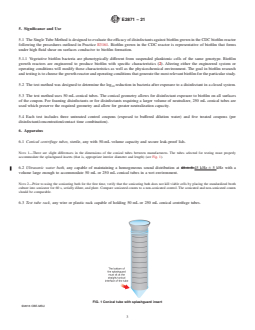
6.1 Conical centrifuge tubes, sterile, any with 50-mL vol-
time. A combination of vortexing and sonication is used to
ume capacity and secure leak-proof lids.
remove the biofilm from the coupon and disaggregate the
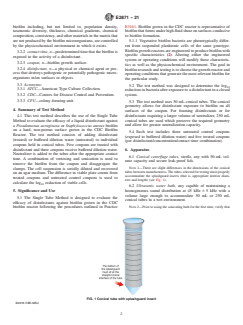
NOTE 1—There are slight differences in the dimensions of the conical
clumps. The cell suspension is serially diluted and recovered
tubesbetweenmanufacturers.Thetubesselectedfortestingmustproperly
on an agar medium.The difference in viable plate counts from
accommodate the splashguard inserts (that is, appropriate interior diam-
treated coupons and untreated control coupons is used to
eter and length) (see Fig. 1).
calculate the log reduction of viable cells.
6.2 Ultrasonic water bath, any capable of maintaining a
homogeneous sound distribution at 45 kHz 65 kHz with a
5. Significance and Use
volume large enough to accommodate 50 mL or 250 mL
5.1 The Single Tube Method is designed to evaluate the
conical tubes in a wet environment.
efficacy of disinfectants against biofilm grown in the CDC
biofilm reactor following the procedures outlined in Practice NOTE 2—Prior to using the sonicating bath for the first time, verify that
FIG. 1Conical tube with splashguard insert
©2016 CBE-MSU
E2871−21
the sonicating bath does not kill viable cells by placing the standardized
splashguards (2.54 cm tapered to 2.39 cm (outer diameter) ×
broth culture into sonicator for 60 s, serially dilute, and plate. Compare
10.48 cm long for the 50 mLconical tubes and 2.50 cm (outer
sonicated counts to a non-sonicated control. The sonicated and non-
diameter) × 14.80 cm long for the 250 mLconical tubes) from
sonicated counts should be comparable.
other suppliers may also be used.
6.3 Test tube rack, any wire or plastic rack capable of
holding 50 mL or 250 mL conical centrifuge tubes.
7. Reagents and Materials
6.4 Calibrated micropipettes, continuously adjustable pi-
7.1 Purity of Water—all references to water as diluent or
pettes with volume capacity of 100 µL and 1000 µL.
reagent shall mean distilled water or water of equal purity.
6.5 Sterile pipette tips, 100 µL and 1000 µL volumes.
7.2 Bacterial Plating Medium—R2Aagarfor P. aeruginosa,
6.6 Bunsen burner, used to flame-sterilize Allen wrench, tryptic soy agar (TSA) for S. aureus.
forceps, and plate spreader.
7.3 BufferedWater—Preparestockphosphatebuffersolution
6.7 95 % Ethanol, used to flame-sterilizeAllen wrench and by dissolving 34.0 g KH PO in 500 mL reagent-grade water,
2 4
plate spreader.
adjust to pH 7.2 60.5 with 1 N NaOH, and dilute to 1 Lwith
reagent-grade water. Prepare stock magnesium chloride solu-
6.8 Small Allen wrench, (1.27 mm, hex) for loosening set
tion:81.1gMgCl ·6H O/Lreagent-gradewater.Filter-sterilize
2 2
screws and pushing coupons out of reactor rods.
both stock solutions. Prepare buffered dilution water by com-
6.9 Timer, any that can display time in seconds.
bining 1.25 mL KH PO stock solution and 5.0 mL
2 4
6.10 Vortex mixer,anyvortexthatwillensurepropermixing MgCl ·6H O, dilute to 1 L with reagent-grade water (for final
2 2
of tubes.
concentrations of 0.0425 g KH PO /L and 0.405 g
2 4
MgCl ·6H O/L) and sterilize (1). Alternatively, phosphate
2 2
6.11 Serological pipettes, sterile single-use pipettes with
buffered dilution water (PBDW) or phosphate buffered saline
volume capacity of 1 mL, 5 mL, 10 mL, 25 mL, and 50 mL.
(PBS) may be used for rinse tubes (with 30 mL), control
6.12 Plate spreader, for spreading aliquots of dilutions on
coupon exposure fluid, dilution blanks, and filtration fluid,
agar plates.
provided that the same buffer is used for each step.
6.13 Water bath, any capable of maintaining a constant
7.4 Disinfectant—antimicrobial test substance to be tested
temperature of 21°C 6 2°C.
(see 3.2.4).
6.14 Sterilizer,anysteamsterilizercapableofproducingthe
7.5 Neutralizer—One specific to the disinfectant being
conditions of sterilization.
evaluated as determined for effectiveness and toxicity; see
6.15 Colony counter, any one of several types may be used. Annex A1 for suggested procedure.
A hand tally for recording of the bacterial count is recom-
7.6 Detergent—laboratory detergent for cleaning coupons
mended if manual counting is done.
and reactor parts.
6.16 Environmental incubator,anycapableofmaintaininga
temperature of 36°C 6 2°C.
8. Culture/Inoculum Preparation
6.17 Appropriate glassware/plasticware, as required to
8.1 Coupons with mature Pseudomonas aeruginosa ATCC
make media and agar plates.
15442 or Staphylococcus aureus ATCC 6538 biofilm grown
according to Practice E3161.
6.18 Magnetic stir bars, sterile, for mixing prepared disin-
8.1.1 Biofilms are to be grown according to Practice E3161
fectant.
10.2 through 10.6.
6.19 Magnetic stir plate, any capable of mixing.
8.1.2 Amature P. aeruginosabiofilmwillhaveameanlog
6.20 Polyethersulfone (PES) filter membranes, sterile 47
density (LD) of 8.0 to 9.5 CFU/coupon, with each coupon
mm diameter membranes with 0.45 µm pore size for microbe exhibiting a LD of 8.0 to 9.5.
recovery from treated coupons. Filtration units (reusable or
8.1.3 Amature S. aureusbiofilmwillhaveameanLDof7.5
disposable) may be used. to 9.0 CFU/coupon, with each coupon exhibiting a LD of 7.5
to 9.0.
6.21 Vacuum source,in-houselineorsuitablevacuumpump
for filtering.
9. Procedure
6.22 Forceps, any appropriate for handling membrane fil-
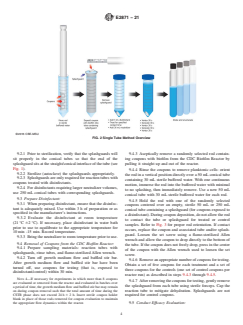
9.1 Thetestisconductedwithfivetreatedcouponsandthree
ters.
untreated control coupons. An overview of the procedure is
6.23 Splashguard inserts,twosizestofitthe50mLand250
shown in Fig. 2.
mL conical tubes used during coupon deposition. Equivalent
NOTE3—Priortoperformingtheassayforthefirsttime,microscopyor
asimilarapproachmaybeusedtoconfirmthattheequipmentusedinthis
method is capable of harvesting and disaggregating the biofilm from the
The sole source of supply of the splashguard known to the committee at this
coupon surface (3). This should be done using the same conical tubes,
time is BioSurface Technologies, Corp. www.biofilms.biz. If you are aware of
neutralized treatment volume, and number of tubes placed in the sonicat-
alternative suppliers, please provide this information to ASTM International
ing bath to replicate the actual test conditions as closely as possible.
Headquarters.Your comments will receive careful consideration at a meeting of the
responsible technical committee which you may attend. 9.2 Reaction tube preparation:
E2871−21
©2016 CBE-MSU
FIG. 2Single Tube Method Overview
9.2.1 Prior to sterilization, verify that the splashguards will 9.4.3 Aseptically remove a randomly selected rod contain-
sit properly in the conical tubes so that the end of the ing coupons with biofilm from the CDC Biofilm Reactor by
splashguardsitsatthestraight/conicalinterfaceofthetube(see
pulling it straight up and out of the reactor.
Fig. 1).
9.4.4 Rinse the coupons to remove planktonic cells: orient
9.2.2 Sterilize (autoclave) the splashguards appropriately.
therodinaverticalpositiondirectlyovera50mLconicaltube
9.2.3 Splashguardsareonlyrequiredforreactiontubeswith
containing 30 mL sterile buffered water. With one continuous
coupons treated with disinfectants.
motion, immerse the rod into the buffered water with minimal
9.2.4 For disinfectants requiring larger neutralizer volumes,
to no splashing, then immediately remove. Use a new 50 mL
use 250 mL conical tubes with corresponding splashguards.
conical tube with 30 mL sterile buffered water for each rod.
9.3 Prepare Disinfectant:
9.4.5 Hold the rod with one of the randomly selected
9.3.1 When preparing disinfectant, ensure that the disinfec-
coupons centered over an empty, sterile 50 mL or 250 mL
tant is adequately mixed. Use within3hof preparation or as
conical tube containing a splashguard (for coupons exposed to
specified in the manufacturer’s instructions.
adisinfectant).Duringcoupondeposition,donotallowtherod
9.3.2 Evaluate the disinfectant at room temperature
to contact the tube or splashguard for treated or control
(21°C 62°C). If necessary, place disinfectant in water bath
samples. Refer to Fig. 3 for proper rod orientation. If contact
prior to use to equilibrate to the appropriate temperature for
occurs, replace the coupon and associated tube and/or splash-
10min -15 min. Record temperature.
guard. Loosen the set screw using a flame-sterilized Allen
9.3.3 Bringtheneutralizertoroomtemperaturepriortouse.
wrench and allow the coupon to drop directly to the bottom of
9.4 Removal of Coupons from the CDC Biofilm Reactor:
the tube. If the coupon does not freely drop, press in the center
9.4.1 Prepare sampling materials: reaction tubes with
of the coupon with the Allen wrench used to loosen the set
splashguards, rinse tubes, and flame-sterilized Allen wrench.
screw.
9.4.2 Turn off growth medium flow and baffled stir bar.
9.4.6 Removeanappropriatenumberofcouponsfortesting.
After growth medium flow and baffled stir bar have been
Obtain a set of five coupons for each treatment and a set of
turned off, use coupons for testing (that is, exposed to
three coupons for the controls (one set of control coupons per
disinfectant/control) within 30 min.
reactor run) as described in steps 9.4.3 through 9.4.5.
NOTE 4—If necessary for experiments in which more than 8 coupons
9.4.7 Afterremovingthecouponsfortesting,gentlyremove
are evaluated or removed from the reactor and evaluated in batches over
the splashguard from each tube using sterile forceps. Cap the
a period of time, the growth medium flow and baffled stir bar may remain
reaction tube to mitigate dehydration. Splashguards are not
on during coupon removal such that the total amount of time during the
CSTR phase does not exceed 24h 62 h. Insert sterile coupon holder
required for control coupons.
blank in place of those rods removed for coupon evaluation to maintain
the appropriate flow dynamics within the reactor. 9.5 Conduct Effıcacy Evaluation:
E2871−21
FIG. 3Proper rod placement during coupon deposition.
©2016 CBE-MSU
9.5.1 Slowly pipette 4 mL of previously prepared disinfec- bubbles; replace with new coupon and tube if this occurs. For
tant (treatment) or buffered dilution water (untreated control) those test substances that cause effervescence, the presence of
down the side of each of the conical tubes containing the the effervescence does not invalidate the coupon
coupons, avoiding direct contact with the coupon during 9.5.3 Allow tubes to remain at room temperature
application and being careful to completely cover the coupon. (21°C 62°C) for the duration of the contact time.
Record the time of coupon exposure and the room temperature
...
This document is not an ASTM standard and is intended only to provide the user of an ASTM standard an indication of what changes have been made to the previous version. Because
it may not be technically possible to adequately depict all changes accurately, ASTM recommends that users consult prior editions as appropriate. In all cases only the current version
of the standard as published by ASTM is to be considered the official document.
Designation: E2871 − 19 E2871 − 21
Standard Test Method for
Determining Disinfectant Efficacy Against Biofilm Grown in
the CDC Biofilm Reactor Using the Single Tube Method
This standard is issued under the fixed designation E2871; the number immediately following the designation indicates the year of
original adoption or, in the case of revision, the year of last revision. A number in parentheses indicates the year of last reapproval. A
superscript epsilon (´) indicates an editorial change since the last revision or reapproval.
1. Scope Scope*
1.1 This test method specifies the operational parameters required to perform a quantitative liquid disinfectant efficacy test against
bacterial biofilm.
1.2 The test method was optimized and validated for a Pseudomonas aeruginosa or Staphylococcus aureus biofilm grown in the
CDC Biofilm Reactor (E3161). The method is suitable for evaluating additional bacteria grown using the procedures outlined in
methods with comparable coupon dimensions such as Practice E3161, Test Method E2562, or Test Method E2196.
1.3 Disinfectant preparation and contact time are used in the assessment according to the manufacturer’s instructions for use.
1.4 The test method uses a closed system to treat biofilm. A coupon is placed in a single tube for the treatment, neutralization,
and harvesting steps to prevent the loss of cells.
1.5 This test method describes a harvesting and analysis procedure which includes vortexing and sonicating treated and untreated
control biofilm, and recovery of culturable cells using filtration to lower the limit of detection. Biofilm population density is
recorded as log colony-forming units per coupon. Efficacy is reported as a log reduction of culturable cells.
10 10
1.6 Basic microbiology training is required to perform this assay.
1.7 The values stated in SI units are to be regarded as standard. No other units of measurement are included in this standard.
1.8 This standard does not purport to address all of the safety concerns, if any, associated with its use. It is the responsibility
of the user of this standard to establish appropriate safety, health, and environmental practices and determine the applicability of
regulatory limitations prior to use.
1.9 This international standard was developed in accordance with internationally recognized principles on standardization
established in the Decision on Principles for the Development of International Standards, Guides and Recommendations issued
by the World Trade Organization Technical Barriers to Trade (TBT) Committee.
This test method is under the jurisdiction of ASTM Committee E35 on Pesticides, Antimicrobials, and Alternative Control Agents and is the direct responsibility of
Subcommittee E35.15 on Antimicrobial Agents.
Current edition approved Jan. 1, 2019Nov. 1, 2021. Published February 2019January 2022. Originally approved in 2012. Last previous edition approved in 20132019 as
E2871–13.–19. DOI: 10.1520/E2871–19.10.1520/E2871–21.
*A Summary of Changes section appears at the end of this standard
Copyright © ASTM International, 100 Barr Harbor Drive, PO Box C700, West Conshohocken, PA 19428-2959. United States
E2871 − 21
2. Referenced Documents
2.1 ASTM Standards:
E1054 Practices for Evaluation of Inactivators of Antimicrobial Agents
E2196 Test Method for Quantification of Pseudomonas aeruginosa Biofilm Grown with Medium Shear and Continuous Flow
Using Rotating Disk Reactor
E2562 Test Method for Quantification of Pseudomonas aeruginosa Biofilm Grown with High Shear and Continuous Flow using
CDC Biofilm Reactor
E2756 Terminology Relating to Antimicrobial and Antiviral Agents
E3161 Practice for Preparing a Pseudomonas aeruginosa or Staphylococcus aureus Biofilm using the CDC Biofilm Reactor
2.2 Other Standards:
Method 9050 C.1.a Buffered Dilution Water Preparation according to Eaton et al (1)
3. Terminology
3.1 For definitions of terms used in this test method refer to Terminology E2756.
3.2 Definitions:
3.2.1 biofilm, n—microorganisms living in a self-organized community attached to surfaces, interfaces, or each other, embedded
in a matrix of extracellular polymeric substances of microbial origin, while exhibiting altered phenotypes with respect to growth
rate and gene transcription.
3.2.1.1 Discussion—
Biofilm may be comprised of bacteria, fungi, algae, protozoa, viruses, or infinite combinations of these microorganisms. The
qualitative characteristics of a biofilm including, but not limited to, population density, taxonomic diversity, thickness, chemical
gradients, chemical composition, consistency, and other materials in the matrix that are not produced by the biofilm
microorganisms, are controlled by the physicochemical environment in which it exists.
3.2.2 contact time, n—predetermined time that the biofilm is exposed to the activity of a disinfectant.
3.2.3 coupon, n—biofilm growth surface.
3.2.4 disinfectant, n—a physical or chemical agent or process that destroys pathogenic or potentially pathogenic microorganisms
in/on surfaces or objects.
3.3 Acronyms:
3.3.1 ATCC—American Type Culture Collection.
3.3.2 CDC—Centers for Disease Control and Prevention.
3.3.3 CFU—colony-forming unit.
4. Summary of Test Method
4.1 This test method describes the use of the Single Tube Method to evaluate the efficacy of a liquid disinfectant against a
Pseudomonas aeruginosa or Staphylococcus aureus biofilm on a hard, non-porous surface grown in the CDC Biofilm Reactor. The
test method consists of adding disinfectant (treated) or buffered dilution water (untreated) to individual coupons held in conical
tubes. Five coupons are treated with disinfectant and three coupons receive buffered dilution water. Neutralizer is added to the
tubes after the appropriate contact time. A combination of vortexing and sonication is used to remove the biofilm from the coupon
and disaggregate the clumps. The cell suspension is serially diluted and recovered on an agar medium. The difference in viable
plate counts from treated coupons and untreated control coupons is used to calculate the log reduction of viable cells.
For referenced ASTM standards, visit the ASTM website, www.astm.org, or contact ASTM Customer Service at service@astm.org. For Annual Book of ASTM Standards
volume information, refer to the standard’s Document Summary page on the ASTM website.
The boldface numbers in parentheses refer to a list of references at the end of this standard.
E2871 − 21
5. Significance and Use
5.1 The Single Tube Method is designed to evaluate the efficacy of disinfectants against biofilm grown in the CDC biofilm reactor
following the procedures outlined in Practice E3161. Biofilm grown in the CDC reactor is representative of biofilm that forms
under high fluid shear on surfaces conducive to biofilm formation.
5.1.1 Vegetative biofilm bacteria are phenotypically different from suspended planktonic cells of the same genotype. Biofilm
growth reactors are engineered to produce biofilm with specific characteristics (2). Altering either the engineered system or
operating conditions will modify those characteristics as well as the physicochemical environment. The goal in biofilm research
and testing is to choose the growth reactor and operating conditions that generate the most relevant biofilm for the particular study.
5.2 The test method was designed to determine the log reduction in bacteria after exposure to a disinfectant in a closed system.
5.3 The test method uses 50 mL conical tubes. The conical geometry allows for disinfectant exposure to biofilm on all surfaces
of the coupon. For foaming disinfectants or for disinfectants requiring a larger volume of neutralizer, 250 mL conical tubes are
used which preserve the required geometry and allow for greater neutralization capacity.
5.4 Each test includes three untreated control coupons (exposed to buffered dilution water) and five treated coupons (per
disinfectant/concentration/contact time combination).
6. Apparatus
6.1 Conical centrifuge tubes, sterile, any with 50-mL volume capacity and secure leak-proof lids.
NOTE 1—There are slight differences in the dimensions of the conical tubes between manufacturers. The tubes selected for testing must properly
accommodate the splashguard inserts (that is, appropriate interior diameter and length) (see Fig. 1).
6.2 Ultrasonic water bath, any capable of maintaining a homogeneous sound distribution at 45 6 5 45 kHz 6 5 kHz with a
volume large enough to accommodate 50 mL or 250 mL conical tubes in a wet environment.
NOTE 2—Prior to using the sonicating bath for the first time, verify that the sonicating bath does not kill viable cells by placing the standardized broth
culture into sonicator for 60 s, serially dilute, and plate. Compare sonicated counts to a non-sonicated control. The sonicated and non-sonicated counts
should be comparable.
6.3 Test tube rack, any wire or plastic rack capable of holding 50 mL or 250 mL conical centrifuge tubes.
FIG. 1 Conical tube with splashguard insert
©2016 CBE-MSU
E2871 − 21
6.4 Calibrated micropipettes, continuously adjustable pipettes with volume capacity of 100 μL and 1000 μL.
6.5 Sterile pipette tips, 100 μL and 1000 μL volumes.
6.6 Bunsen burner, used to flame-sterilize Allen wrench, forceps, and plate spreader.
6.7 95 % Ethanol, used to flame-sterilize Allen wrench and plate spreader.
6.8 Small Allen wrench, (1.27 mm, hex) for loosening set screws and pushing coupons out of reactor rods.
6.9 Timer, any that can display time in seconds.
6.10 Vortex mixer, any vortex that will ensure proper mixing of tubes.
6.11 Serological pipettes, sterile single-use pipettes with volume capacity of 1, 5, 10, 25, 1 mL, 5 mL, 10 mL, 25 mL, and 50 mL.
6.12 Plate spreader, for spreading aliquots of dilutions on agar plates.
6.13 Water bath, any capable of maintaining a constant temperature of 2121 °C 6 2 °C.
6.14 Sterilizer, any steam sterilizer capable of producing the conditions of sterilization.
6.15 Colony counter, any one of several types may be used. A hand tally for recording of the bacterial count is recommended if
manual counting is done.
6.16 Environmental incubator, any capable of maintaining a temperature of 3636 °C 6 2°C.2 °C.
6.17 Appropriate glassware/plasticware, as required to make media and agar plates.
6.18 Magnetic stir bars, sterile, for mixing prepared disinfectant.
6.19 Magnetic stir plate, any capable of mixing.
6.20 Polyethersulfone (PES) filter membranes, sterile 47 mm diameter membranes with 0.45 μm pore size for microbe recovery
from treated coupons. Filtration units (reusable or disposable) may be used.
6.21 Vacuum source, in-house line or suitable vacuum pump for filtering.
6.22 Forceps, any appropriate for handling membrane filters.
6.23 Splashguard inserts, two sizes to fit the 50 mL and 250 mL conical tubes used during coupon deposition. Equivalent
splashguards (2.54 cm tapered to 2.39 cm (outer diameter) × 10.48 cm long for the 50 mL conical tubes and 2.50 cm (outer
diameter) × 14.80 cm long for the 250 mL conical tubes) from other suppliers may also be used.
7. Reagents and Materials
7.1 Purity of Water—all references to water as diluent or reagent shall mean distilled water or water of equal purity.
The sole source of supply of the splashguard known to the committee at this time is BioSurface Technologies, Corp. www.biofilms.biz. If you are aware of alternative
suppliers, please provide this information to ASTM International Headquarters. Your comments will receive careful consideration at a meeting of the responsible technical
committee which you may attend.
E2871 − 21
7.2 Bacterial Plating Medium—R2A agar for P. aeruginosa, tryptic soy agar (TSA) for S. aureus.
7.3 Buffered Water—Prepare stock phosphate buffer solution by dissolving 34.0 g KH PO in 500 mL reagent-grade water, adjust
2 4
to pH 7.2 6 0.5 with 1 N NaOH, and dilute to 1 L with reagent-grade water. Prepare stock magnesium chloride solution: 81.1 g
MgCl ·6H O/L reagent-grade water. Filter-sterilize both stock solutions. Prepare buffered dilution water by combining 1.25 mL
2 2
KH PO stock solution and 5.0 mL MgCl ·6H O, dilute to 1 L with reagent-grade water (for final concentrations of 0.0425 g
2 4 2 2
KH PO /L and 0.405 g MgCl ·6H O/L) and sterilize (1). Alternatively, phosphate buffered dilution water (PBDW) or phosphate
2 4 2 2
buffered saline (PBS) may be used for rinse tubes (with 30 mL), control coupon exposure fluid, dilution blanks, and filtration fluid,
provided that the same buffer is used for each step.
7.4 Disinfectant—antimicrobial test substance to be tested (see 3.2.4).
7.5 Neutralizer—Dey/Engley Neutralizing Broth or one One specific to the disinfectant being evaluated as determined for
effectiveness and toxicity according to Test Method toxicity; see E1054 per Section 8Annex A1 or 10; use a 24 h culture of TSB
inoculated with 10 μL of frozen stock culture as the test culture inoculum. Conduct neutralization testing to confirm and document
the neutralizer’s effectiveness for the disinfectant. Some treatments may require additional neutralizer volume (for example, up to
196 mL). In these instances, use 250 mL conical tubes.for suggested procedure.
7.6 Detergent—laboratory detergent for cleaning coupons and reactor parts.
8. Culture/Inoculum Preparation
8.1 Coupons with mature Pseudomonas aeruginosa ATCC 15442 or Staphylococcus aureus ATCC 6538 biofilm grown according
to Practice E3161.
8.1.1 Biofilms are to be grown according to Practice E3161 10.2 through 10.6.
8.1.2 A mature P. aeruginosa biofilm will have a mean log density (LD) of 8.0 to 9.5 CFU/coupon, with each coupon exhibiting
a LD of 8.0 to 9.5.
8.1.3 A mature S. aureus biofilm will have a mean LD of 7.5 to 9.0 CFU/coupon, with each coupon exhibiting a LD of 7.5 to 9.0.
9. Procedure
9.1 The test is conducted with five treated coupons and three untreated control coupons. An overview of the procedure is shown
in Fig. 2.
NOTE 3—Prior to performing the assay for the first time, microscopy or a similar approach may be used to confirm that the equipment used in this method
is capable of harvesting and disaggregating the biofilm from the coupon surface (3). This should be done using the same conical tubes, neutralized
treatment volume, and number of tubes placed in the sonicating bath to replicate the actual test conditions as closely as possible.
9.2 Reaction tube preparation:
9.2.1 Prior to sterilization, verify that the splashguards will sit properly in the conical tubes so that the end of the splashguard sits
at the straight/conical interface of the tube (see Fig. 1).
9.2.2 Sterilize (autoclave) the splashguards appropriately.
9.2.3 Splashguards are only required for reaction tubes with coupons treated with disinfectants.
9.2.4 For disinfectants requiring larger neutralizer volumes, use 250 mL conical tubes with corresponding splashguards.
9.3 Prepare Disinfectant:
E2871 − 21
©2016 CBE-MSU
FIG. 2 Single Tube Method Overview
9.3.1 When preparing disinfectant, ensure that the disinfectant is adequately mixed. Use within 3 h of preparation or as specified
in the manufacturer’s instructions.
9.3.2 Evaluate the disinfectant at room temperature (21 62 °C).(21 °C 62 °C). If necessary, place disinfectant in water bath prior
to use to equilibrate to the appropriate temperature for 10-15 10 min -15 min. Record temperature.
9.3.3 Bring the neutralizer to room temperature prior to use.
9.4 Removal of Coupons from the CDC Biofilm Reactor:
9.4.1 Prepare sampling materials: reaction tubes with splashguards, rinse tubes, and flame-sterilized Allen wrench.
9.4.2 Turn off growth medium flow and baffled stir bar. After growth medium flow and baffled stir bar have been turned off, use
coupons for testing (that is, exposed to disinfectant/control) within 30 min.
NOTE 4—If necessary for experiments in which more than 8 coupons are evaluated or removed from the reactor and evaluated in batches over a period
of time, the growth medium flow and baffled stir bar may remain on during coupon removal such that the total amount of time during the CSTR phase
does not exceed 24 6 2 hours.24 h 6 2 h. Insert sterile coupon holder blank in place of those rods removed for coupon evaluation to maintain the
appropriate flow dynamics within the reactor.
9.4.3 Aseptically remove a randomly selected rod containing coupons with biofilm from the CDC Biofilm Reactor by pulling it
straight up and out of the reactor.
9.4.4 Rinse the coupons to remove planktonic cells: orient the rod in a vertical position directly over a 50 mL conical tube
containing 30 mL sterile buffered water. With one continuous motion, immerse the rod into the buffered water with minimal to no
splashing, then immediately remove. Use a new 50 mL conical tube with 30 mL sterile buffered water for each rod.
9.4.5 Hold the rod with one of the randomly selected coupons centered over an empty, sterile 50 mL or 250 mL conical tube
containing a splashguard (for coupons exposed to a disinfectant). During coupon deposition, do not allow the rod to contact the
tube or splashguard for treated or control samples. Refer to Fig. 3 for proper rod orientation. If contact occurs, replace the coupon
E2871 − 21
FIG. 3 Proper rod placement during coupon deposition.
©2016 CBE-MSU
and associated tube and/or splashguard. Loosen the set screw using a flame-sterilized Allen wrench and allow the coupon to drop
directly to the bottom of the tube. If the coupon does not freely drop, press in the center of the coupon with the Allen wrench used
to loosen the set screw.
9.4.6 Remove an appropriate number of coupons for testing. Obtain a set of five coupons for each treatment and a set of three
coupons for the controls (one set of control coupons per reactor run) as described in steps 9.4.3 through 9.4.5.
9.4.7 After removing the coupons for testing, gently remove the splashguard from each tube using sterile forceps. Cap the reaction
tube to mitigate dehydration. Splashguards are not required for control coupons.
9.5 Conduct Effıcacy Evaluation:
9.5.1 Slowly pipette 4 mL of previously prepared disinfectant (treatment) or buffered dilution water (untreated control) down the
side of each of the conical tubes containing the coupons, avoiding direct contact with the coupon during application and being
careful to completely cover the coupon. Record the time of coupon exposure and the room temperature
(21 6 2 °C).(21 °C 6 2 °C). Refer to Fig. 4 for proper treatment application posi
...