

ASTM F1908-08(2018)
(Guide)Standard Guide for Fences for Residential Outdoor Swimming Pools, Hot Tubs, and Spas
General Information
- Abstract
SIGNIFICANCE AND USE
5.1 This guide sets forth minimum standard requirements for use in local codes and ordinances relating to residential outdoor swimming pools, hot tubs, and spas.
5.2 This guide does not have the effect of law, nor is it intended to supersede local codes and ordinances of a more restrictive nature.
5.3 Studies, as listed in Annex A1, have been referenced as the bases for certain recommendations in this guide and will assist those who intend to provide protection against drownings and near-drownings by restricting access to children under the age of five years in residential swimming pools, spas, and hot tubs. This would include, but not be limited to, state and local governments, model code organizations, building code groups, and consumers. It is understood that the format will vary depending upon the specific use and local conditions.
SCOPE
1.1 This guide provides recommended minimum requirements for various types of fences for residential outdoor swimming pools, hot tubs, and spas.
1.2 The values stated in inch-pound units are to be regarded as standard. The values stated in parentheses are for information only.
1.3 This international standard was developed in accordance with internationally recognized principles on standardization established in the Decision on Principles for the Development of International Standards, Guides and Recommendations issued by the World Trade Organization Technical Barriers to Trade (TBT) Committee.
- Status
- Published
- Publication Date
- 31-Jul-2018
- Technical Committee
- F14 - Fences
- Drafting Committee
- F14.10 - Specific Applications and Other Fence Systems and Components
Overview
ASTM F1908-08(2018), Standard Guide for Fences for Residential Outdoor Swimming Pools, Hot Tubs, and Spas, specifies recommended minimum requirements for barriers and fences designed to restrict access to residential outdoor swimming pools, hot tubs, and spas. Developed by ASTM International, this guide helps provide a benchmark for state and local building codes and ordinances aiming to improve residential pool safety. The primary objective is to reduce the risk of drowning or near-drowning, particularly among children under five years old, by restricting unsupervised access through effective installation of fences and barriers.
Key Topics
- Minimum Fence Requirements: The guide sets forth critical construction requirements, such as minimum heights, visibility, and barrier integrity, for various fence types surrounding swimming pools, spas, and hot tubs.
- Types of Barriers: Includes specifications for chain link, solid, picket/ornamental, and lattice fences, covering requirements for both permanent and portable pools and spas.
- Access Gates and Ladders: Outlines the criteria for self-closing and self-latching gates, securing of ladders or steps, and prohibitions against structures or objects that could enable fence climbing.
- Safety Rationale: Uses studies and recommendations from authoritative bodies (such as the U.S. Consumer Product Safety Commission) as a basis for guidance, focusing on preventing children’s unsupervised entry by considering children’s physical abilities and behavioral tendencies.
- Installation and Maintenance: Provides practical guidelines about installing fence sections, ensuring proper grounding for metal fences, and recommendations for maintenance and safety signage placement.
Applications
- For Regulators and Code Authorities: ASTM F1908-08(2018) serves as a resource for state and local governments, code organizations, and building inspectors when developing or updating residential pool safety regulations.
- For Homeowners and Contractors: Offers direction on selecting, installing, and maintaining compliant barriers that enhance pool safety and help prevent unauthorized or unsupervised pool access.
- Accident Prevention: By following these guidelines, property owners can significantly reduce the risk of accidental drowning, especially among children, by ensuring fences cannot be climbed and access points are safely controlled.
- Building Code Compliance: The standard is intended to supplement local codes, not replace stricter regulations, ensuring safety measures meet at least the minimum suggested criteria.
Related Standards
- ASTM F2286 – Design and Performance Specification for Removable Mesh Fencing for Swimming Pools, Hot Tubs, and Spas
- ASTM F1346 – Performance Specification for Safety Covers and Labeling Requirements for All Covers for Swimming Pools, Spas, and Hot Tubs
- ANSI/APSP-7 – Model Barrier Code for Residential Swimming Pools, Spas and Hot Tubs
- CPSC Recommendations – Staff Recommendations, Barriers for Residential Swimming Pools, Spas, and Hot Tubs
- International Building Code (IBC) – Provides building code requirements for pool safety barriers
- SBCCI Bluebook and ANSI Z535.4 – Additional related guidance for pool safety codes and required safety signage
Practical Value
This ASTM pool fence standard provides critical guidance for reducing accidental drownings in residential swimming pools, spas, and hot tubs. Its recommendations support effective physical barriers, maintenance, and clear zones around the pool area, and stress the importance of adult supervision and regular inspection. Compliance with ASTM F1908-08(2018) helps homeowners, builders, and code officials create safer environments for families and communities, promoting responsible pool ownership and public safety.
Keywords: pool fence standard, residential pool safety, ASTM F1908, pool barrier requirements, drowning prevention, spa fence installation, hot tub safety fencing, swimming pool codes, gate security, pool safety compliance
Relations
- Effective Date
- 01-Aug-2018
- Effective Date
- 01-Mar-2015
- Effective Date
- 15-Sep-2014
- Effective Date
- 01-Mar-2013
- Effective Date
- 15-Feb-2013
- Effective Date
- 01-Jun-2011
- Effective Date
- 01-Jun-2011
- Effective Date
- 01-Jun-2011
- Effective Date
- 01-Jun-2011
- Effective Date
- 01-Feb-2011
- Effective Date
- 01-Sep-2010
- Effective Date
- 01-Aug-2010
- Effective Date
- 01-Jul-2010
- Effective Date
- 01-Jul-2010
- Effective Date
- 01-Jun-2008
Get Certified
Connect with accredited certification bodies for this standard

DIBt (Deutsches Institut für Bautechnik)
German Institute for Building Technology.
DIN CERTCO
DIN Group product certification.

Aboma Certification B.V.
Specialized in construction, metal, and transport sectors.
Sponsored listings
Frequently Asked Questions
ASTM F1908-08(2018) is a guide published by ASTM International. Its full title is "Standard Guide for Fences for Residential Outdoor Swimming Pools, Hot Tubs, and Spas". This standard covers: SIGNIFICANCE AND USE 5.1 This guide sets forth minimum standard requirements for use in local codes and ordinances relating to residential outdoor swimming pools, hot tubs, and spas. 5.2 This guide does not have the effect of law, nor is it intended to supersede local codes and ordinances of a more restrictive nature. 5.3 Studies, as listed in Annex A1, have been referenced as the bases for certain recommendations in this guide and will assist those who intend to provide protection against drownings and near-drownings by restricting access to children under the age of five years in residential swimming pools, spas, and hot tubs. This would include, but not be limited to, state and local governments, model code organizations, building code groups, and consumers. It is understood that the format will vary depending upon the specific use and local conditions. SCOPE 1.1 This guide provides recommended minimum requirements for various types of fences for residential outdoor swimming pools, hot tubs, and spas. 1.2 The values stated in inch-pound units are to be regarded as standard. The values stated in parentheses are for information only. 1.3 This international standard was developed in accordance with internationally recognized principles on standardization established in the Decision on Principles for the Development of International Standards, Guides and Recommendations issued by the World Trade Organization Technical Barriers to Trade (TBT) Committee.
SIGNIFICANCE AND USE 5.1 This guide sets forth minimum standard requirements for use in local codes and ordinances relating to residential outdoor swimming pools, hot tubs, and spas. 5.2 This guide does not have the effect of law, nor is it intended to supersede local codes and ordinances of a more restrictive nature. 5.3 Studies, as listed in Annex A1, have been referenced as the bases for certain recommendations in this guide and will assist those who intend to provide protection against drownings and near-drownings by restricting access to children under the age of five years in residential swimming pools, spas, and hot tubs. This would include, but not be limited to, state and local governments, model code organizations, building code groups, and consumers. It is understood that the format will vary depending upon the specific use and local conditions. SCOPE 1.1 This guide provides recommended minimum requirements for various types of fences for residential outdoor swimming pools, hot tubs, and spas. 1.2 The values stated in inch-pound units are to be regarded as standard. The values stated in parentheses are for information only. 1.3 This international standard was developed in accordance with internationally recognized principles on standardization established in the Decision on Principles for the Development of International Standards, Guides and Recommendations issued by the World Trade Organization Technical Barriers to Trade (TBT) Committee.
ASTM F1908-08(2018) is classified under the following ICS (International Classification for Standards) categories: 91.090 - External structures. The ICS classification helps identify the subject area and facilitates finding related standards.
ASTM F1908-08(2018) has the following relationships with other standards: It is inter standard links to ASTM F1908-08(2013), ASTM F1345-10a(2015), ASTM F552-14, ASTM F552-02(2013), ASTM F2286-05(2013), ASTM F668-11, ASTM A392-11a, ASTM F1183-96(2011), ASTM A491-11, ASTM A392-11, ASTM F1346-91(2010), ASTM F1345-10a, ASTM F1345-10, ASTM A491-10, ASTM F1345-96(2008). Understanding these relationships helps ensure you are using the most current and applicable version of the standard.
ASTM F1908-08(2018) is available in PDF format for immediate download after purchase. The document can be added to your cart and obtained through the secure checkout process. Digital delivery ensures instant access to the complete standard document.
Standards Content (Sample)
This international standard was developed in accordance with internationally recognized principles on standardization established in the Decision on Principles for the
Development of International Standards, Guides and Recommendations issued by the World Trade Organization Technical Barriers to Trade (TBT) Committee.
Designation:F1908 −08 (Reapproved 2018)
Standard Guide for
Fences for Residential Outdoor Swimming Pools, Hot Tubs,
and Spas
This standard is issued under the fixed designation F1908; the number immediately following the designation indicates the year of
original adoption or, in the case of revision, the year of last revision. A number in parentheses indicates the year of last reapproval. A
superscript epsilon (´) indicates an editorial change since the last revision or reapproval.
1. Scope F2518 Guide for Use of a Residential Swimming Pool, Spa,
and Hot Tub Safety Audit to Prevent Unintentional
1.1 This guide provides recommended minimum require-
Drowning (Withdrawn 2015)
ments for various types of fences for residential outdoor
2.2 CPSC Document:
swimming pools, hot tubs, and spas.
CPSC Staff Recommendations, Barriers for Residential
1.2 The values stated in inch-pound units are to be regarded
Swimming Pools, Spas, and Hot Tubs (March 1992)
as standard. The values stated in parentheses are for informa-
2.3 APSP Document:
tion only.
ANSI/APSP-7 Model Barrier Code for Residential Swim-
1.3 This international standard was developed in accor-
ming Pools, Spas and Hot Tubs
dance with internationally recognized principles on standard-
2.4 ICC Document:
ization established in the Decision on Principles for the
International Building Code—2006
Development of International Standards, Guides and Recom-
mendations issued by the World Trade Organization Technical 2.5 SBCCI Document:
1993 SBCCI Bluebook, Standard Swimming Pool Code
Barriers to Trade (TBT) Committee.
2.6 ANSI Standards:
2. Referenced Documents
Z535.4 Product Safety Signs and Labels
2.1 ASTM Standards:
3. Terminology
A392 Specification for Zinc-Coated Steel Chain-Link Fence
Fabric
3.1 See Terminology F552 for definitions of terms relating
A491 Specification for Aluminum-Coated Steel Chain-Link
to chain link fencing.
Fence Fabric
3.2 Definitions of Terms Specific to This Standard:
F552 Terminology Relating to Chain Link Fencing
3.2.1 fence, n—atypeofbarrierthatsurroundsandobstructs
F668 Specification for Polyvinyl Chloride (PVC), Polyolefin
access to the pool, tub, or spa.
and Other Polymer-Coated Steel Chain Link Fence Fabric
3.2.2 grade, n—the finished elevation at any specified point
F1183 Specification for Aluminum Alloy Chain Link Fence
of the ground or pavement outside the pool area.
Fabric
F1345 Specification for Zinc-5 % Aluminum-Mischmetal
3.2.3 hot tub, n—See spa.
Alloy-Coated Steel Chain-Link Fence Fabric
3.2.4 outdoor, adj—located outside of a completely en-
F1346 Performance Specification for Safety Covers and
closed building or other structure.
Labeling Requirements for All Covers for Swimming
3.2.5 residential, adj—situated on the premises of a de-
Pools, Spas and Hot Tubs
tachedone-ortwo-familydwellingoraone-familytownhouse
F2286 DesignandPerformanceSpecificationforRemovable
not more than three stories in height.
Mesh Fencing for Swimming Pools, Hot Tubs, and Spas
1 3
This guide is under the jurisdiction ofASTM Committee F14 on Fences and is The last approved version of this historical standard is referenced on
thedirectresponsibilityofSubcommitteeF14.10onSpecificApplicationsandOther www.astm.org.
Fence Systems and Components. Available from U.S. Consumer Product Safety Commission (CPSC), 4330 East
Current edition approved Aug. 1, 2018. Published August 2018. Originally West Hwy., Bethesda, MD 20814, http://www.cpsc.gov.
approved in 1998. Last previous edition approved in 2013 as F1908 – 08(2013). Available from The Association of Pool and Spa Professionals (APSP), 2111
DOI: 10.1520/F1908-08R18. Eisenhower Avenue, Alexandria, VA 22314, http://www.asps.org.
2 6
For referenced ASTM standards, visit the ASTM website, www.astm.org, or Available from International Code Council (ICC), 5203 Leesburg Pike, Suite
contact ASTM Customer Service at service@astm.org. For Annual Book of ASTM 600, Falls Church, VA 22041-3401, http://www.intlcode.org.
Standards volume information, refer to the standard’s Document Summary page on Available fromAmerican National Standards Institute (ANSI), 25 W. 43rd St.,
the ASTM website. 4th Floor, New York, NY 10036, http://www.ansi.org.
Copyright © ASTM International, 100 Barr Harbor Drive, PO Box C700, West Conshohocken, PA 19428-2959. United States
F1908−08 (2018)
3.2.6 spa (nonportable), n—a permanent structure contain- openareatoallowvisibilityfromadesignatedsupervisingarea
ing water over 24 in. (610 mm) deep, in which the water- outside the pool area to inside the pool area.
heating and water-circulating equipment are not an integral
6.3 Ground Clearance— The maximum vertical clearance
part of the product, intended for recreational bathing.
between grade and the bottom of the fence shall be 4 in. (102
3.2.7 spa (portable), n—a nonpermanent structure contain-
mm) measured on the side of the fence that faces away from
ing water over 24 in. (610 mm) deep, in which all controls,
the swimming pool. Where the top of the pool structure is
water-heating, and water-circulating equipment are an integral
above grade, such as an above ground pool, the fence may be
part of the product, intended for recreational bathing.
at ground level or mounted on top of the pool structure. Where
the fence is mounted on top of the pool structure, the space
3.2.8 swimming pool, n—an in-ground, on-ground, or
between the top of the pool structure and the bottom of the
above-ground structure of a permanent, semi-permanent, or
fence shall be no greater than 4 in. (102 mm) in any direction.
portable fabrication containing water over 24 in. (610 mm)
deep and designed and constructed in accordance with local
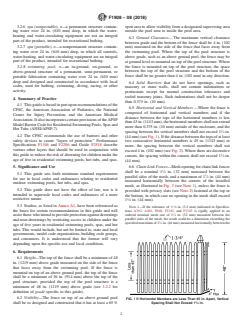
6.4 Solid Barriers that do not have openings, such as
codes, used for bathing, swimming, diving, racing, or other
masonry or stone walls, shall not contain indentations or
activity.
protrusions except for normal construction tolerances and
tooled masonry joints. Such indentations shall not be deeper
4. Summary of Practice
than 0.375 in. (10 mm).
4.1 Thisguideisbasedinpartuponrecommendationsofthe
6.5 Horizontal and Vertical Members —Where the fence is
CPSC, the American Association of Pediatrics, the National
composed of horizontal and vertical members and if the
Center for Injury Prevention, and the American Medical
distance between the tops of the horizontal members is less
Association.ItalsoincorporatescertainprovisionsoftheAPSP
than45in.(1143mm),thehorizontalmembersshallnotextend
ModelBarrierCodeforResidentialSwimmingPools,Spasand
more than 0.375 in. (10 mm) outside of the enclosure, and the
Hot Tubs (ANSI/APSP-7).
spacing between the vertical members shall not exceed 1 ⁄4 in.
4.2 The CPSC recommends the use of barriers and other
(44mm)(seeFig.1).Ifthedistancebetweenthetopsofatleast
safety devices to create “layers of protection.” Performance
two consecutive horizontal members is 45 in. (1143 mm) or
Specifications F1346 and F2286 and Guide F2518 describe
more, the spacing between the vertical members shall not
various other layers that should be used in conjunction with
exceed 4 in. (102 mm) (see Fig. 2). Where there are decorative
this guide to reduce the risk of drowning for children under the 3
cutouts, the spacing within the cutouts shall not exceed 1 ⁄4 in.
age of five in residential swimming pools, hot tubs, and spas.
(44 mm).
6.6 Chain Link Fences—Mesh opening for chain link fences
5. Significance and Use
shall be a nominal 1 ⁄4 in. (32 mm) measured between the
5.1 This guide sets forth minimum standard requirements
parallel sides of the mesh, and a maximum of 1 ⁄4 in. (44 mm)
for use in local codes and ordinances relating to residential
measured horizontally between the corners of the installed
outdoor swimming pools, hot tubs, and spas.
mesh, as illustrated in Fig. 3 (see Note 1), unless the fence is
5.2 This guide does not have the effect of law, nor is it
provided with privacy slats (see Note 2) fastened at the top or
intended to supersede local codes and ordinances of a more
the bottom, in which case no opening in the mesh shall exceed
restrictive nature.
1 ⁄4 in. (44 mm).
5.3 Studies, as listed in AnnexA1, have been referenced as
NOTE 1—If the tolerance of 6 ⁄8 in. (3.2 mm) indicated in Specifica-
the bases for certain recommendations in this guide and will
tions A392, A491, F668, F1183, and F1345 is rigidly applied to an
ordered nominal mesh size of 1 ⁄4 in. (32 mm) measured between the
assistthosewhointendtoprovideprotectionagainstdrownings
parallel sides of the mesh, the result could be a dimension exceeding the
and near-drownings by restricting access to children under the
specifiedmaximumof1 ⁄4in.(44mm)measuredhorizontallybetweenthe
age of five years in residential swimming pools, spas, and hot
tubs. This would include, but not be limited to, state and local
governments, model code organizations, building code groups,
and consumers. It is understood that the format will vary
depending upon the specific use and local conditions.
6. Requirements
6.1 Height—The top of the fence shall be a minimum of 48
in. (1219 mm) above grade measured on the side of the fence
that faces away from the swimming pool. If the fence is
mounted on top of an above ground pool, the top of the fence
shall be a minimum of 36 in. (914 mm) above the top of the
pool structure, provided the top of the pool structure is a
minimum of 48 in. (1219 mm) above grade (see 3.2.2 for
definition of grade specific to this guide).
6.2 Visibility—The fence on top of an above ground pool
FIG. 1 If Horizontal Members are Less Than 45 in. Apart, Vertical
shall be so designed and constructed that it has at least a 65 % Spacing Shall Not Exceed 1 ⁄4 in.
F1908−08 (2018)
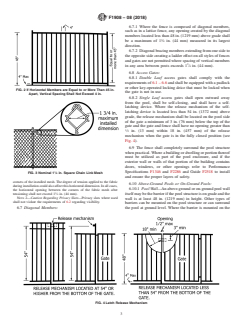
6.7.1 Where the fence is composed of diagonal members,
such as in a lattice fence, any opening created by the diagonal
members located less than 48 in. (1219 mm) above grade shall
be a maximum of 1 ⁄4 in. (44 mm) measured in its largest
direction.
6.7.2 Diagonal bracing members extending from one side to
the opposite side creating a ladder effect on all styles of fences
and gates are not permitted where spacing of vertical members
in any area between posts exceeds 1 ⁄4 in. (44 mm).
6.8 Access Gates:
6.8.1 Double Leaf access gates shall comply with the
requirements of 6.1 – 6.6 and shall be equipped with a padlock
or other key-operated locking deice that must be locked when
FIG. 2 If Horizontal Members are Equal to or More Than 45 in.
the gate is not in use.
Apart, Vertical Spacing Shall Not Exceed 4 in.
6.8.2 Single Leaf access gates shall open outward away
from the pool, shall be self-closing, and shall have a self-
latching device. Where the release mechanism of the self-
latching device is located less than 54 in. (1372 mm) above
grade, the release mechanism shall be located on the pool side
of the gate a minimum of 3 in. (76 mm) below the top of the
gate and the gate and fence shall have no opening greater than
⁄2 in. (13 mm) within 18 in. (457 mm) of the release
mechanism when the gate is in the fully closed position (see
Fig. 4).
6.9 The fence shall completely surround the pool structure
whenpractical.Whereabuildingordwellingorportionthereof
must be utilized as part of the pool
...