

ASTM D3376-18
(Test Method)Standard Test Methods of Sampling and Testing Pulps to be Used in the Manufacture of Electrical Insulation
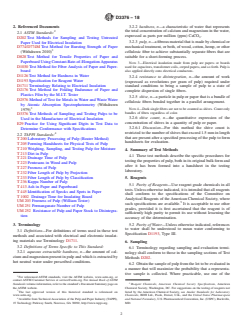
General Information
- Abstract
SIGNIFICANCE AND USE
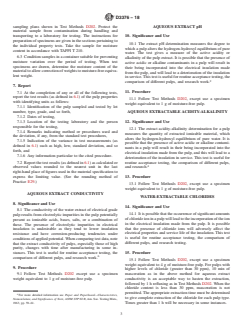
8.1 The conductivity of the water extract of electrical grade pulp results from electrolytic impurities in the pulp potentially present as ionizable acids, bases, salts, or a combination of these. The presence of electrolytic impurities in electrical insulation is undesirable as they tend to lower insulation resistance and have corrosion-producing tendencies under conditions of applied potential. When comparing test data, note that the extract conductivity of pulps, especially those of high purity, changes with time after manufacturing in some instances. This test is useful for routine acceptance testing, the comparison of different pulps, and research work.6
SCOPE
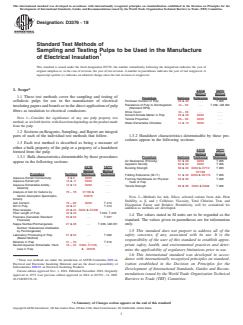
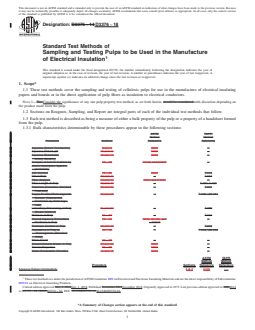
1.1 These test methods cover the sampling and testing of cellulosic pulps for use in the manufacture of electrical insulating papers and boards or in the direct application of pulp fibers as insulation to electrical conductors.
Note 1: Consider the significance of any one pulp property test method, as set forth herein, with discretion depending on the product made from the pulp.
1.2 Sections on Reagents, Sampling, and Report are integral parts of each of the individual test methods that follow.
1.3 Each test method is described as being a measure of either a bulk property of the pulp or a property of a handsheet formed from the pulp.
1.3.1 Bulk characteristics determinable by these procedures appear in the following sections:
Procedure
Sections
ASTM
Method
Reference
TAPPI
Method
Reference
Aqueous Extract Conductivity
8 & 9
D202
. . .
Aqueous Extract pH
10 & 11
D202
. . .
Aqueous Extractable Acidity-
Alkalinity
12 & 13
D202
. . .
Analysis of Ash for Cations by
Atomic Absorption Spectrophotometry
70 – 78
D1193 & D2576
. . .
Ash Content
79 – 82
D202
T 413
Dirt in Pulp
40 & 41
. . .
T 213
Fiber Analysis
23 & 24
D202 & D1030
. . .
Fiber Length of Pulp
42 & 43
. . .
T 232, T 233
Freeness (Canadian Standard
Freeness)
53 & 54
. . .
T 227
Kappa Number/Permanganate
Number (Substances Oxidizable
by Permanganate)
27 & 28
. . .
T 236, UM 251
Laboratory Processing of Pulp
(Beater Method)
51 & 52
. . .
T 200
Moisture in Pulp
31 – 33
. . .
T 210
Neutral Aqueous Extractable Hard-
ness in Pulp
16 – 22
D202, D1126, & D2576
. . .
Pentosan Content of Pulp
29 & 30
. . .
T 223
Resistance of Pulp to Disintegration
(Standard RPG)
44 – 50
. . .
T 239, UM 252
Shive Count
34 – 39
. . .
. . .
Solvent-Soluble Matter in Pulp
25 & 26
D202
. . .
Tensile Properties
65 – 69
D202
. . .
Water-Extractable Chlorides
14 & 15
D202
. . .
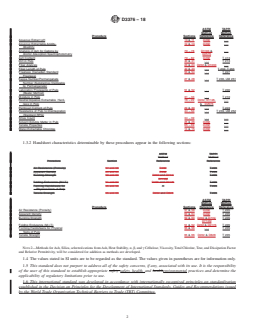
1.3.2 Handsheet characteristics determinable by these procedures appear in the following sections:
Procedure
Sections
ASTM
Method
Reference
TAPPI
Method
Reference
Air Resistance (Porosity)
57 & 58
D202
T 205
Apparent Density
63 & 64
D202
T 205
Bursting Strength
59 & 60
D202 & D774/D774M
T 205
Folding Endurance (M.I.T.)
51 & 52
D202 & D2176
T 205
Forming Handsheets for Physical
Tests of Pulp
55 & 56
. . .
T 205
Tensile Strength
65 & 66
D202 & D828
T 205
Note 2: Methods for Ash, Silica, selected cations from Ash, Heat Stability, α, β, and γ Cellulose, Viscosity, Total Chlorine, Tear, and Dissipation Factor and Relative Permittivity, will be considered for addition as methods are developed.
1.4 The values stated in SI units are to be regarded as the standard. The values given in parentheses are for information only.
1.5 This standard does not purport to address all of the safety concerns, if any, associated with its use. It is the responsibility of the user of this standard to establish appropriate safety, health, and environm...
- Status
- Published
- Publication Date
- 31-Oct-2018
- Technical Committee
- D09 - Electrical and Electronic Insulating Materials
- Drafting Committee
- D09.01 - Electrical Insulating Products
Buy Documents
ASTM D3376-18 - Standard Test Methods of Sampling and Testing Pulps to be Used in the Manufacture of Electrical Insulation
REDLINE ASTM D3376-18 - Standard Test Methods of Sampling and Testing Pulps to be Used in the Manufacture of Electrical Insulation
Overview
ASTM D3376-18 is a standard developed by ASTM International for the sampling and testing of cellulosic pulps used in the manufacture of electrical insulating papers, boards, and for direct application as electrical insulation on conductors. This standard outlines test methods for evaluating pulp properties that are critical to the performance and safety of electrical insulation materials, especially where high levels of electrical resistance and minimal contamination are required. ASTM D3376-18 supports manufacturers, quality assurance teams, and researchers in ensuring that pulps meet stringent criteria for use in sensitive electrical applications.
Key Topics
Critical Testing Methods Covered:
Bulk Properties of Pulp:
- Aqueous Extract Conductivity
- Aqueous Extract pH
- Aqueous Extractable Acidity-Alkalinity
- Water-Extractable Chlorides
- Neutral Aqueous Extractable Hardness
- Moisture Content
- Fiber Analysis and Fiber Length
- Dirt and Shive Count
- Solvent-Soluble Matter
- Ash Content and Cation Analysis
- Kappa Number/Permanganate Number
- Pentosan Content
- Resistance to Disintegration
- Freeness (Canadian Standard Freeness)
Handsheet (Laboratory Sheet) Properties:
- Air Resistance (Porosity)
- Apparent Density
- Bursting Strength
- Folding Endurance (M.I.T.)
- Tensile Strength
Significance and Use:
Testing these properties is vital because impurities such as electrolytes, acids, bases, and salts in pulp can degrade the electrical insulation's performance, increasing the risk of corrosion, lowering insulation resistance, and impacting the longevity of electrical equipment. Monitoring and controlling these characteristics help manufacturers produce stable, high-purity insulation materials compliant with industry standards.
Sampling and Reporting:
The standard includes guidance on proper sampling techniques to ensure representative pulp samples, preparation for laboratory testing, and standardized reporting of results for traceability and consistency in quality assurance.
Applications
Industries such as electrical equipment manufacturing, power distribution, and high-voltage insulation rely on ASTM D3376-18 to:
- Qualify and accept bulk cellulosic pulps from suppliers for further processing into insulation papers and boards.
- Perform comparative analysis of different pulp batches or suppliers, ensuring only high-quality pulp enters the manufacturing process.
- Support R&D activities focused on new insulation materials or improved pulping processes.
- Demonstrate compliance with international requirements for electrical insulation, an essential aspect for global trade and safety certifications.
- Ensure product reliability by minimizing risks associated with contaminants that could compromise insulation performance or lifespan.
By applying the methods in this standard, organizations can verify pulp suitability for critical insulation applications, directly impacting equipment safety and operational efficiency.
Related Standards
Several ASTM and TAPPI standards support or reference ASTM D3376-18:
- ASTM D202: Sampling and Testing Untreated Paper Used for Electrical Insulation
- ASTM D1030: Fiber Analysis of Paper and Paperboard
- ASTM D1126: Hardness in Water
- ASTM D1193: Specification for Reagent Water
- ASTM D2176: Folding Endurance of Paper and Plastics Film (M.I.T. Tester)
- ASTM D2576: Metals in Water and Wastewater by Atomic Absorption Spectrophotometry
- ASTM D828: Tensile Properties of Paper and Paperboard
- TAPPI T 205: Forming Handsheets for Physical Tests of Pulp
- TAPPI T 210: Weighing, Sampling, and Testing Pulp for Moisture
- TAPPI T 227, T 213, T 232, T 223, and others
Referencing related standards ensures harmonized procedures across the pulp and paper sector, facilitating interoperability and confidence in test results worldwide.
By adhering to ASTM D3376-18, professionals in electrical insulation material supply chains uphold industry best practices, support compliance with international regulations, and ensure the production of safe, high-performance insulating products.
Relations
- Effective Date
- 01-Mar-2024
- Effective Date
- 01-Nov-2018
- Effective Date
- 01-Nov-2016
- Effective Date
- 01-Nov-2015
- Effective Date
- 01-Nov-2014
- Effective Date
- 01-Nov-2014
- Effective Date
- 01-May-2014
- Effective Date
- 01-Nov-2013
- Effective Date
- 01-Mar-2012
- Effective Date
- 01-Aug-2011
- Effective Date
- 01-Oct-2009
- Effective Date
- 01-Oct-2008
- Effective Date
- 01-May-2008
- Effective Date
- 01-May-2008
- Effective Date
- 01-Aug-2007
Buy Documents
ASTM D3376-18 - Standard Test Methods of Sampling and Testing Pulps to be Used in the Manufacture of Electrical Insulation
REDLINE ASTM D3376-18 - Standard Test Methods of Sampling and Testing Pulps to be Used in the Manufacture of Electrical Insulation
Get Certified
Connect with accredited certification bodies for this standard

Control Union Certifications
Global certification for agriculture and sustainability.

Gozdarski inštitut Slovenije
Slovenian Forestry Institute. Forest management certification support, timber testing.
Sponsored listings
Frequently Asked Questions
ASTM D3376-18 is a standard published by ASTM International. Its full title is "Standard Test Methods of Sampling and Testing Pulps to be Used in the Manufacture of Electrical Insulation". This standard covers: SIGNIFICANCE AND USE 8.1 The conductivity of the water extract of electrical grade pulp results from electrolytic impurities in the pulp potentially present as ionizable acids, bases, salts, or a combination of these. The presence of electrolytic impurities in electrical insulation is undesirable as they tend to lower insulation resistance and have corrosion-producing tendencies under conditions of applied potential. When comparing test data, note that the extract conductivity of pulps, especially those of high purity, changes with time after manufacturing in some instances. This test is useful for routine acceptance testing, the comparison of different pulps, and research work.6 SCOPE 1.1 These test methods cover the sampling and testing of cellulosic pulps for use in the manufacture of electrical insulating papers and boards or in the direct application of pulp fibers as insulation to electrical conductors. Note 1: Consider the significance of any one pulp property test method, as set forth herein, with discretion depending on the product made from the pulp. 1.2 Sections on Reagents, Sampling, and Report are integral parts of each of the individual test methods that follow. 1.3 Each test method is described as being a measure of either a bulk property of the pulp or a property of a handsheet formed from the pulp. 1.3.1 Bulk characteristics determinable by these procedures appear in the following sections: Procedure Sections ASTM Method Reference TAPPI Method Reference Aqueous Extract Conductivity 8 & 9 D202 . . . Aqueous Extract pH 10 & 11 D202 . . . Aqueous Extractable Acidity- Alkalinity 12 & 13 D202 . . . Analysis of Ash for Cations by Atomic Absorption Spectrophotometry 70 – 78 D1193 & D2576 . . . Ash Content 79 – 82 D202 T 413 Dirt in Pulp 40 & 41 . . . T 213 Fiber Analysis 23 & 24 D202 & D1030 . . . Fiber Length of Pulp 42 & 43 . . . T 232, T 233 Freeness (Canadian Standard Freeness) 53 & 54 . . . T 227 Kappa Number/Permanganate Number (Substances Oxidizable by Permanganate) 27 & 28 . . . T 236, UM 251 Laboratory Processing of Pulp (Beater Method) 51 & 52 . . . T 200 Moisture in Pulp 31 – 33 . . . T 210 Neutral Aqueous Extractable Hard- ness in Pulp 16 – 22 D202, D1126, & D2576 . . . Pentosan Content of Pulp 29 & 30 . . . T 223 Resistance of Pulp to Disintegration (Standard RPG) 44 – 50 . . . T 239, UM 252 Shive Count 34 – 39 . . . . . . Solvent-Soluble Matter in Pulp 25 & 26 D202 . . . Tensile Properties 65 – 69 D202 . . . Water-Extractable Chlorides 14 & 15 D202 . . . 1.3.2 Handsheet characteristics determinable by these procedures appear in the following sections: Procedure Sections ASTM Method Reference TAPPI Method Reference Air Resistance (Porosity) 57 & 58 D202 T 205 Apparent Density 63 & 64 D202 T 205 Bursting Strength 59 & 60 D202 & D774/D774M T 205 Folding Endurance (M.I.T.) 51 & 52 D202 & D2176 T 205 Forming Handsheets for Physical Tests of Pulp 55 & 56 . . . T 205 Tensile Strength 65 & 66 D202 & D828 T 205 Note 2: Methods for Ash, Silica, selected cations from Ash, Heat Stability, α, β, and γ Cellulose, Viscosity, Total Chlorine, Tear, and Dissipation Factor and Relative Permittivity, will be considered for addition as methods are developed. 1.4 The values stated in SI units are to be regarded as the standard. The values given in parentheses are for information only. 1.5 This standard does not purport to address all of the safety concerns, if any, associated with its use. It is the responsibility of the user of this standard to establish appropriate safety, health, and environm...
SIGNIFICANCE AND USE 8.1 The conductivity of the water extract of electrical grade pulp results from electrolytic impurities in the pulp potentially present as ionizable acids, bases, salts, or a combination of these. The presence of electrolytic impurities in electrical insulation is undesirable as they tend to lower insulation resistance and have corrosion-producing tendencies under conditions of applied potential. When comparing test data, note that the extract conductivity of pulps, especially those of high purity, changes with time after manufacturing in some instances. This test is useful for routine acceptance testing, the comparison of different pulps, and research work.6 SCOPE 1.1 These test methods cover the sampling and testing of cellulosic pulps for use in the manufacture of electrical insulating papers and boards or in the direct application of pulp fibers as insulation to electrical conductors. Note 1: Consider the significance of any one pulp property test method, as set forth herein, with discretion depending on the product made from the pulp. 1.2 Sections on Reagents, Sampling, and Report are integral parts of each of the individual test methods that follow. 1.3 Each test method is described as being a measure of either a bulk property of the pulp or a property of a handsheet formed from the pulp. 1.3.1 Bulk characteristics determinable by these procedures appear in the following sections: Procedure Sections ASTM Method Reference TAPPI Method Reference Aqueous Extract Conductivity 8 & 9 D202 . . . Aqueous Extract pH 10 & 11 D202 . . . Aqueous Extractable Acidity- Alkalinity 12 & 13 D202 . . . Analysis of Ash for Cations by Atomic Absorption Spectrophotometry 70 – 78 D1193 & D2576 . . . Ash Content 79 – 82 D202 T 413 Dirt in Pulp 40 & 41 . . . T 213 Fiber Analysis 23 & 24 D202 & D1030 . . . Fiber Length of Pulp 42 & 43 . . . T 232, T 233 Freeness (Canadian Standard Freeness) 53 & 54 . . . T 227 Kappa Number/Permanganate Number (Substances Oxidizable by Permanganate) 27 & 28 . . . T 236, UM 251 Laboratory Processing of Pulp (Beater Method) 51 & 52 . . . T 200 Moisture in Pulp 31 – 33 . . . T 210 Neutral Aqueous Extractable Hard- ness in Pulp 16 – 22 D202, D1126, & D2576 . . . Pentosan Content of Pulp 29 & 30 . . . T 223 Resistance of Pulp to Disintegration (Standard RPG) 44 – 50 . . . T 239, UM 252 Shive Count 34 – 39 . . . . . . Solvent-Soluble Matter in Pulp 25 & 26 D202 . . . Tensile Properties 65 – 69 D202 . . . Water-Extractable Chlorides 14 & 15 D202 . . . 1.3.2 Handsheet characteristics determinable by these procedures appear in the following sections: Procedure Sections ASTM Method Reference TAPPI Method Reference Air Resistance (Porosity) 57 & 58 D202 T 205 Apparent Density 63 & 64 D202 T 205 Bursting Strength 59 & 60 D202 & D774/D774M T 205 Folding Endurance (M.I.T.) 51 & 52 D202 & D2176 T 205 Forming Handsheets for Physical Tests of Pulp 55 & 56 . . . T 205 Tensile Strength 65 & 66 D202 & D828 T 205 Note 2: Methods for Ash, Silica, selected cations from Ash, Heat Stability, α, β, and γ Cellulose, Viscosity, Total Chlorine, Tear, and Dissipation Factor and Relative Permittivity, will be considered for addition as methods are developed. 1.4 The values stated in SI units are to be regarded as the standard. The values given in parentheses are for information only. 1.5 This standard does not purport to address all of the safety concerns, if any, associated with its use. It is the responsibility of the user of this standard to establish appropriate safety, health, and environm...
ASTM D3376-18 is classified under the following ICS (International Classification for Standards) categories: 85.040 - Pulps. The ICS classification helps identify the subject area and facilitates finding related standards.
ASTM D3376-18 has the following relationships with other standards: It is inter standard links to ASTM D1711-24, ASTM D3376-18, ASTM D828-16, ASTM D1711-15, ASTM D1711-14a, ASTM D3376-14, ASTM D1711-14, ASTM D1711-13, ASTM D1126-12, ASTM D1711-11a, ASTM D3376-88(2009), ASTM E29-08, ASTM D1711-08, ASTM D202-08, ASTM D1126-02(2007)e1. Understanding these relationships helps ensure you are using the most current and applicable version of the standard.
ASTM D3376-18 is available in PDF format for immediate download after purchase. The document can be added to your cart and obtained through the secure checkout process. Digital delivery ensures instant access to the complete standard document.
Standards Content (Sample)
This international standard was developed in accordance with internationally recognized principles on standardization established in the Decision on Principles for the
Development of International Standards, Guides and Recommendations issued by the World Trade Organization Technical Barriers to Trade (TBT) Committee.
Designation: D3376 − 18
Standard Test Methods of
Sampling and Testing Pulps to be Used in the Manufacture
of Electrical Insulation
This standard is issued under the fixed designation D3376; the number immediately following the designation indicates the year of
original adoption or, in the case of revision, the year of last revision.Anumber in parentheses indicates the year of last reapproval.A
superscript epsilon (´) indicates an editorial change since the last revision or reapproval.
1. Scope*
ASTM TAPPI
Method Method
1.1 These test methods cover the sampling and testing of
Procedure Sections Reference Reference
Pentosan Content of Pulp 29 & 30 . T223
cellulosic pulps for use in the manufacture of electrical
Resistance of Pulp to Disintegration 44 – 50 . . . T 239, UM 252
insulatingpapersandboardsorinthedirectapplicationofpulp
(Standard RPG)
fibers as insulation to electrical conductors.
Shive Count 34 – 39 . .
Solvent-Soluble Matter in Pulp 25 & 26 D202 .
NOTE 1—Consider the significance of any one pulp property test
Tensile Properties 65 – 69 D202 .
method,assetforthherein,withdiscretiondependingontheproductmade
Water-Extractable Chlorides 14 & 15 D202 .
from the pulp.
1.2 SectionsonReagents,Sampling,andReportareintegral
1.3.2 Handsheet characteristics determinable by these pro-
parts of each of the individual test methods that follow.
cedures appear in the following sections:
1.3 Each test method is described as being a measure of
either a bulk property of the pulp or a property of a handsheet
ASTM TAPPI
formed from the pulp.
Method Method
1.3.1 Bulk characteristics determinable by these procedures Procedure Sections Reference Reference
Air Resistance (Porosity) 57 & 58 D202 T 205
appear in the following sections:
Apparent Density 63 & 64 D202 T 205
ASTM TAPPI
Bursting Strength 59 & 60 D202 & D774/ T 205
Method Method
D774M
Procedure Sections Reference Reference
Folding Endurance (M.I.T.) 51 & 52 D202 & D2176 T 205
Aqueous Extract Conductivity 8 & 9 D202 .
Forming Handsheets for Physical 55 & 56 . T205
Aqueous Extract pH 10 & 11 D202 .
Tests of Pulp
Aqueous Extractable Acidity- 12 & 13 D202 .
Tensile Strength 65 & 66 D202 & D828 T 205
Alkalinity
Analysis of Ash for Cations by 70 – 78 D1193 & .
Atomic Absorption Spectropho- D2576
NOTE 2—Methods for Ash, Silica, selected cations from Ash, Heat
tometry
Stability, α, β, and γ Cellulose, Viscosity, Total Chlorine, Tear, and
Ash Content 79 – 82 D202 T 413
Dissipation Factor and Relative Permittivity, will be considered for
Dirt in Pulp 40 & 41 . T213
addition as methods are developed.
Fiber Analysis 23 & 24 D202 & D1030 .
Fiber Length of Pulp 42 & 43 . . . T 232, T 233
1.4 The values stated in SI units are to be regarded as the
Freeness (Canadian Standard 53 & 54 . T227
standard. The values given in parentheses are for information
Freeness)
Kappa Number/Permanganate 27 & 28 . . . T 236, UM 251 only.
Number (Substances Oxidizable
1.5 This standard does not purport to address all of the
by Permanganate)
Laboratory Processing of Pulp 51 & 52 . T200
safety concerns, if any, associated with its use. It is the
(Beater Method)
responsibility of the user of this standard to establish appro-
Moisture in Pulp 31 – 33 . T210
priate safety, health, and environmental practices and deter-
Neutral Aqueous Extractable Hard- 16 – 22 D202, D1126, .
ness in Pulp & D2576
mine the applicability of regulatory limitations prior to use.
1.6 This international standard was developed in accor-
dance with internationally recognized principles on standard-
These test methods are under the jurisdiction of ASTM Committee D09 on
Electrical and Electronic Insulating Materials and are the direct responsibility of
ization established in the Decision on Principles for the
Subcommittee D09.01 on Electrical Insulating Products.
Development of International Standards, Guides and Recom-
Current edition approved Nov. 1, 2018. Published November 2018. Originally
mendations issued by the World Trade Organization Technical
approved in 1975. Last previous edition approved in 2014 as D3376–14. DOI:
10.1520/D3376-18. Barriers to Trade (TBT) Committee.
*A Summary of Changes section appears at the end of this standard
Copyright © ASTM International, 100 Barr Harbor Drive, PO Box C700, West Conshohocken, PA 19428-2959. United States
D3376 − 18
2. Referenced Documents 3.2.2 hardness, n—a characteristic of water that represents
2 thetotalconcentrationofcalciumandmagnesiuminthewater,
2.1 ASTM Standards:
expressed as parts per million (ppm) CaCO .
D202Test Methods for Sampling and Testing Untreated
3.2.3 pulp,n—afibrousmaterialthatismadebychemicalor
Paper Used for Electrical Insulation
mechanical treatment, or both, of wood, cotton, hemp, or other
D774/D774MTest Method for Bursting Strength of Paper
cellulosic fiber to achieve substantially separate fibers that are
(Withdrawn 2010)
suitable for a sheet-forming process.
D828Test Method for Tensile Properties of Paper and
PaperboardUsingConstant-Rate-of-ElongationApparatus
NOTE 3—Electrical insulation made from pulp are papers or boards
D1030Test Method for Fiber Analysis of Paper and Paper-
used for capacitors, transformer coils, creped papers, and so forth. Pulp is
board also applied directly onto electrical conductors.
D1126Test Method for Hardness in Water
3.2.4 resistance to disintegration, n—the amount of work
D1193Specification for Reagent Water
(expressed as revolutions per gram of pulp) required under
D1711Terminology Relating to Electrical Insulation
standard conditions to bring a sample of pulp to a state of
D2176Test Method for Folding Endurance of Paper and
complete dispersion of single fibers.
Plastics Film by the M.I.T. Tester
3.2.5 shive, n—a particle in pulp or paper that is a bundle of
D2576Method of Test for Metals in Water and Waste Water
cellulosic fibers bonded together in a parallel arrangement.
by Atomic Absorption Spectrophotometry (Withdrawn
NOTE 4—Dark single fibers are not to be counted as shives. Count only
1979)
bundles of fibers regardless of color.
D3376Test Methods of Sampling and Testing Pulps to be
3.2.6 shive count, n—the quantitative expression of the
Used in the Manufacture of Electrical Insulation
concentration of shives in a quantity of pulp or paper.
E29Practice for Using Significant Digits in Test Data to
3.2.6.1 Discussion—For this method the shive count is
Determine Conformance with Specifications
4 restrictedtothenumberofshivesthatexceed1.5mminlength
2.2 TAPPI Standards:
that are present after a specified processing of the pulp to form
T200Laboratory Processing of Pulp (Beater Method)
handsheets for evaluation.
T205Forming Handsheets for Physical Tests of Pulp
T210Weighing, Sampling, and Testing Pulp for Moisture
4. Summary of Test Methods
T213Dirt in Pulp
4.1 These test methods describe the specific procedures for
T221Drainage Time of Pulp
testingthepropertiesofpulp,bothinitsoriginalbulkformand
T223Pentosans in Wood and Pulp
after it has been formed into a handsheet in the testing
T227Freeness of Pulp
laboratory.
T232Fiber Length of Pulp by Projection
T233Fiber Length of Pulp by Classification
5. Reagents
T236Kappa Number of Pulp
5.1 Purity of Reagents—Use reagent grade chemicals in all
T413Ash in Paper and Paperboard
tests.Unlessotherwiseindicated,itisintendedthatallreagents
T445Identification of Specks and Spots in Paper
shall conform to the specifications of the Committee on
T1002 Drainage Time for Insulating Board
Analytical Reagents of theAmerican Chemical Society, where
UM203Freeness of Pulp (William Tester)
such specifications are available. It is acceptable to use other
UM251Permanganate Number of Pulp
grades, provided it is first ascertained that the reagent is of
UM252 Resistance of Pulp and Paper Stock to Disintegra-
sufficiently high purity to permit its use without lessening the
tion
accuracy of the determination.
5.2 Purity of Water—Unless otherwise indicated, references
3. Terminology
to water shall be understood to mean water conforming to
3.1 Definitions—For definitions of terms used in these test
Specification D1193, Type III.
methods and associated with electrical and electronic insulat-
ing materials use Terminology D1711.
6. Sampling
3.2 Definitions of Terms Specific to This Standard:
6.1 Terminology regarding sampling and evaluation termi-
3.2.1 aqueous extractable hardness, n—the amount of cal-
nology shall conform to those in the sampling sections of Test
ciumandmagnesiumpresentinpulpandwhichisextractedby
Methods D202.
hot neutral water under prescribed conditions.
6.2 Obtainthesampleofpulpfromthelottobeevaluatedin
a manner that will maximize the probability that a representa-
tive sample is collected. Where practicable, use one of the
For referenced ASTM standards, visit the ASTM website, www.astm.org, or
contact ASTM Customer Service at service@astm.org. For Annual Book of ASTM
Standards volume information, refer to the standard’s Document Summary page on Reagent Chemicals, American Chemical Society Specifications, American
the ASTM website. Chemical Society, Washington, DC. For suggestions on the testing of reagents not
The last approved version of this historical standard is referenced on listed by the American Chemical Society, see Analar Standards for Laboratory
www.astm.org. Chemicals, BDH Ltd., Poole, Dorset, U.K., and the United States Pharmacopeia
Available from TechnicalAssociation of the Pulp and Paper Industry (TAPPI), and National Formulary, U.S. Pharmaceutical Convention, Inc. (USPC), Rockville,
15 Technology Parkway South, Norcross, GA 30092, http://www.tappi.org. MD.
D3376 − 18
sampling plans shown in Test Methods D202. Protect the AQUEOUS EXTRACT pH
material sample from contamination during handling and
transporting to a laboratory for testing. The instructions for
10. Significance and Use
preparationofspecimensaregiveninthesectionspertainingto
10.1 The extract pH determination measures the degree to
the individual property tests. Take the sample for moisture
which a pulp alters the hydrogen-hydroxyl equilibrium of pure
content in accordance with TAPPI T210.
water. The test gives a measure of the active acidity or
6.3 Conditionsamplesinacontainersuitableforpreventing
alkalinity of the pulp extract. It is possible that the presence of
moisture variation over the period of testing. When test
active acidic or alkaline contaminants in a pulp will result in
specimens are drawn, determine the moisture content of the
their being incorporated into the electrical insulation made
materialtoallowcorrectionofweightstomoisture-freeequiva-
from the pulp, and will lead to a deterioration of the insulation
lent weight.
inservice.Thistestisusefulforroutineacceptancetesting,the
comparison of different pulps, and research work.
7. Report
11. Procedure
7.1 At the completion of any or all of the following tests,
report the test results (as defined in 6.1) of the pulp properties
11.1 Follow Test Methods D202, except use a specimen
with identifying units as follows:
weight equivalent to1gof moisture-free pulp.
7.1.1 Identification of the pulp sampled and tested by lot
number, type, grade, and so forth,
AQUEOUS EXTRACTABLE ACIDITY-ALKALINITY
7.1.2 Dates of testing,
7.1.3 Location of the testing laboratory and the person 12. Significance and Use
responsible for the testing,
12.1 The extract acidity-alkalinity determination for a pulp
7.1.4 Remarks indicating method or procedures used and
measures the quantity of extracted ionizable material, which
the deviation, if any, from the standard test procedures,
alters the hydrogen-hydroxyl equilibrium of pure water. It is
7.1.5 Indication of the variance in test measurements (as
possible that the presence of active acidic or alkaline contami-
defined in 6.1) such as high, low, standard deviation, and so
nants in a pulp will result in their being incorporated into the
forth, and
electrical insulation made from the pulp, and this will lead to a
7.1.6 Any information particular to the cited procedure.
deterioration of the insulation in service. This test is useful for
7.2 Reportthetestresults(asdefinedin6.1)ascalculatedor routine acceptance testing, the comparison of different pulps,
observed values rounded to the nearest unit in the last and research.
right-hand place of figures used in the material specification to
express the limiting value. (See the rounding method of
13. Procedure
Practice E29.)
13.1 Follow Test Methods D202, except use a specimen
weight equivalent to1gof moisture-free pulp.
AQUEOUS EXTRACT CONDUCTIVITY
WATER-EXTRACTABLE CHLORIDES
8. Significance and Use
14. Significance and Use
8.1 The conductivity of the water extract of electrical grade
14.1 Itispossiblethattheoccurrenceofsignificantamounts
pulp results from electrolytic impurities in the pulp potentially
ofchlorideioninapulpwillleadtotheincorporationoftheion
present as ionizable acids, bases, salts, or a combination of
in the electrical insulation made from the pulp. It is possible
these. The presence of electrolytic impurities in electrical
that the presence of chloride ions will adversely affect the
insulation is undesirable as they tend to lower insulation
electrical properties and service life of the insulation. This test
resistance and have corrosion-producing tendencies under
is useful for routine acceptance testing, the comparison of
conditionsofappliedpotential.Whencomparingtestdata,note
different pulps, and research testing.
that the extract conductivity of pulps, especially those of high
purity, changes with time after manufacturing in some in-
15. Procedure
stances. This test is useful for routine acceptance testing, the
comparison of different pulps, and research work.
15.1 Follow Test Methods D202, except use a specimen
weight equivalent to4gof moisture-free pulp. For pulps with
9. Procedure
higher levels of chloride (greater than 30 ppm), 10 min of
masceration as in the above method for aqueous extract
9.1 Follow Test Methods D202 except use a specimen
weight equivalent to1gof moisture-free pulp. conductivity is an acceptable way to hasten the extraction,
followed by 1 h refluxing as in Test Methods D202. When the
chloride content is less than 30 ppm, masceration is not
permitted.The appropriate extraction time must be determined
For more detailed information see Paper and Paperboard—Characteristics,
to give complete extraction of the chloride for each pulp type.
Nomenclature, and Significance of Tests, ASTM STP 60 B,Am. Soc. Testing Mats.,
1963, pp. 59–61. Times greater than 1 h will be necessary in some instances.
D3376 − 18
NEUTRAL AQUEOUS EXTRACTABLE HARDNESS where:
PULP
V = standard EDTA solution for titration of first aliquot of
extract, mL,
16. Significance and Use
V = standard EDTA solution for titration of second aliquot
of extract, mL,
16.1 Cellulose pulps contain varying amounts of aqueous
V = standard EDTA solution for titration of first blank
a
extractable hardness as supplied to the purchaser. It is possible
aliquot, mL, and
that the dissolved hardness from the pulp will accumulate in
V = standard EDTA solution for titration of second blank
b
process water used in wet-forming methods and will interfere
aliquot, mL.
with the action of process additives and affect product quality
adversely.
21. Report
16.2 MethodAisthepreferredmethodandshallbeusedfor
21.1 Report the results as neutral aqueous extractable
reference purposes.
hardness, ppm, expressed as calcium carbonate according to
the appropriate method of Test Methods D3376.
METHOD A
22. Precision and Bias
17. Procedure
22.1 The precision of this test has not been determined. No
17.1 Extraction:
statementcanbemadeaboutthebiasofthistestsincestandard
17.1.1 Prepare extracts of the pulp specimens in accordance
material is not available.
with the Test Methods D202 method for aqueous extract
FIBER ANALYSIS
conductivity, except:
17.1.2 Use a specimen weight equivalent to 2.0 g of
23. Significance and Use
moisture-free pulp. Determine the moisture content of the pulp
23.1 The fiber composition of a pulp (fiber source and
sample on a separate specimen taken at the same time as the
pulping treatment) strongly affects the ultimate product char-
test specimen.
acteristics. Fiber analysis is useful both as a specification and
17.1.3 The extraction volume shall be 200 mL.
asacontroltest,andisacceptableinrefereetestingorresearch.
17.1.4 Run a blank determination concurrently with the test
specimen determination.
NOTE 5—For accurate results the analyst must have considerable
training and experience. It is recommended the analyst make frequent use
17.1.5 Following extraction and filtration, collect the clear
of standard fiber sources of known composition, or of authentic fiber
filtrate and adjust the volume to exactly 200 mL.
samples, and be thoroughly familiar with different fibers and their
behavior when treated with the various stains.
17.2 Determine the calcium and magnesium concentration
of the extract in accordance with Test Method D2576.
24. Procedure
24.1 Follow Test Methods D202 and D1030 using a speci-
18. Calculation
menweightof0.2gofpulpdrawnfromacompositesampleof
18.1 Calculate the hardness of the extracts as follows:
pulp, equivalent to 30 g of moisture-free pulp disintegrated in
Hardness, ppm 5 100 2.497 P 2 P 14.117 P 2 P (1) 2 Lof water, as inTest Method D1030 and the section on fiber
@ ~ ! ~ !#
1 a 2 b
analysis in Test Methods D202.
where:
SOLVENT-SOLUBLE MATTER IN PULP
P = ppm calcium in the pulp extract,
P = ppm calcium in the blank,
a
25. Significance and Use
P = ppm magnesium in the pulp extract, and
P = ppm magnesium in the blank.
b
25.1 Since pulping processes usually remove most water-
solubleandvolatilecompoundsthatarealsosolubleinorganic
METHOD B
solvents, consider the solvent extractives in pulp to consist
primarily of resin and fatty acids, their esters, waxes, and
19. Procedure
unsaponifiablesubstances.Nosingleorganicsolventiscapable
19.1 Follow the procedure of MethodAfor the preparation
ofremovingallthesesubstances,anddifferentsolventsremove
of the extract.
differentcombinations.Themixtureofonepart(byvolume)of
95% ethanol and two parts of benzene appears to provide the
19.2 Take two 100-mLaliquots of the extract and titrate for
most complete removal of all solvent-extractable substances in
total hardness, following the “low total hardness” procedure of
pulp.
the nonreferee volumetric method of Test Method D1126.
25.2 Solvent-extractable materials, if present in sufficient
quantity in electrical insulation, will lower the quality of the
20. Calculation
insulation or have a deleterious effect on the liquid compounds
20.1 Calculate the hardness of the specimen extract as
used in contact with insulation in various types of apparatus.
follows:
Ethanol-soluble materials in capacitor paper have been found
Hardness, ppm 5 500 V 1V 2 V 2 V (2)
~ !
1 2 a b toincreasetheconductivityofchlorinatedorganiccompounds,
D3376 − 18
which are used as impregnants in capacitors.Acombination of SHIVE COUNT
ether and alcohol-benzene extractives is reported to represent
34. Significance and Use
the quantity of pitch in wood pulp. Pitch in pulp will, in some
instances, cause operating problems in the paper mill, such as
34.1 Several grades of electrical insulating paper are most
the plugging of felts, wires, and so forth.
effectivelymanufacturedusingpulpshavingalowshivecount.
Shives in wood pulp to be used for direct application to
25.3 This method, with solvent or solvents specified, is
electricalconductorsispotentiallydetrimentaltotheinsulating
acceptable for routine acceptance testing, comparing different
characteristics and strength of the insulating wall. This test is
pulps, and research tests.
useful for control purposes, specifications, and the comparison
26. Procedure
of different pulps.
26.1 Test for solvent-soluble matter in accordance withTest
35. Apparatus
Methods D202.
35.1 Disintegrator, Sheet Machine, Press, Blotters, and so
KAPPA NUMBER/PERMANGANATE NUMBER
forth, in accordance with TAPPI T205.
(SUBSTANCES OXIDIZABLE BY PERMANGANATE)
35.2 Steel Rule, graduated in 0.5 mm.
27. Significance and Use
35.3 Balance, to weigh up to 100 g with 0.1-g accuracy.
27.1 The permanganate consumption of a pulp is a measure
35.4 Specimen Viewer with white opaque glass and a
ofitslignincontentandisacceptableasameasureoflot-to-lot
fluorescent or incandescent light source.
uniformity. For a given species of wood or other fibers, the
35.5 Transparent Cylinder, 0.6 L.
permanganate consumption is a measure of the degree of
cooking to which the fiber has been subjected, and relates to
36. Procedure
theeaseofrefiningofthepulpproducedfromthecookedfiber.
This test is useful for control purposes, specifications, and the 36.1 From the sample obtained as specified in Section 6,
comparison of different pulps. takeaquantityofpulpequivalentto30gofmoisture-freepulp.
Soak this pulp in 0.5 Lof water for4hata temperature of 20
28. Procedure
to 30°C.
28.1 Kappa Number—Follow TAPPI T236.
36.2 Tear the pulp into smaller pieces (approximately 1 in.
28.2 Permanganate Number—Follow TAPPI UM251. or 25 mm square) and dilute to 2.0 L. Warning—Tear,donot
cut the pulp.
PENTOSAN CONTENT OF PULP
36.3 Using the TAPPI disintegrator, disintegrate for 10
29. Significance and Use minuteminimum.Thistimeislikelytobesufficienttodisperse
thepulpcompletely.Atechniqueforcheckingthedispersionis
29.1 The pentosan content of a pulp strongly affects the
as follows:
dissipation factor-temperature relationship of electrical insula-
36.3.1 Take a small sample of the slurry from the disinte-
tion made from it. It is also a potential indicator of lot-to-lot
grator (about 2 or 3 mL) and dilute to 0.6 Lin a clear cylinder.
uniformity and is one of several factors related to the bonding
Stopper the cylinder and mix the suspension by rotating the
power of a pulp, and the amount of energy required to refine
cylinder end over end. Observe the suspension by looking
the pulp.
throughittowardastronglightsource.Thesuspensionshallbe
free of clumps or agglomerates of fibers, but is allowed to
30. Procedure
contain shives. If the suspension contains clumps or
30.1 Follow TAPPI T223.
agglomerates, subject the pulp to additional 5-min periods of
disintegration until it is free of clumps
...
This document is not an ASTM standard and is intended only to provide the user of an ASTM standard an indication of what changes have been made to the previous version. Because
it may not be technically possible to adequately depict all changes accurately, ASTM recommends that users consult prior editions as appropriate. In all cases only the current version
of the standard as published by ASTM is to be considered the official document.
Designation: D3376 − 14 D3376 − 18
Standard Test Methods of
Sampling and Testing Pulps to be Used in the Manufacture
of Electrical Insulation
This standard is issued under the fixed designation D3376; the number immediately following the designation indicates the year of
original adoption or, in the case of revision, the year of last revision. A number in parentheses indicates the year of last reapproval. A
superscript epsilon (´) indicates an editorial change since the last revision or reapproval.
1. Scope*
1.1 These test methods cover the sampling and testing of cellulosic pulps for use in the manufacture of electrical insulating
papers and boards or in the direct application of pulp fibers as insulation to electrical conductors.
NOTE 1—The Consider the significance of any one pulp property test method, as set forth herein, should be considered with discretion depending on
the product made from the pulp.
1.2 Sections on Reagents, Sampling, and Report are integral parts of each of the individual test methods that follow.
1.3 Each test method is described as being a measure of either a bulk property of the pulp or a property of a handsheet formed
from the pulp.
1.3.1 Bulk characteristics determinable by these procedures appear in the following sections:
ASTM TAPPI
Method Method
Procedure Sections Reference Reference
Aqueous Extract Conductivity 8 and 9 D202 .
Aqueous Extract pH 10 and 11 D202 .
Aqueous Extractable 12 and 13 D202 .
Acidity-Alkalinity
Analysis of Ash for Cations by 70 – 78 D1193 and D2576 .
Atomic Absorption Spectro-
photometry
Ash Content 79 – 82 D202 T 413
Dirt in Pulp 40 and 41 . T 213
Fiber Analysis 23 and 24 D202 and D1030 .
Fiber Length of Pulp 42 and 43 . T 232, T 233
Freeness (Canadian Standard 53 and 54 . T 227
Freeness)
Kappa Number/Permanganate 27 and 28 . T 236, UM 251
Number (Substances
Oxidizable by Permanga-
nate)
Laboratory Processing of Pulp 51 and 52 . T 200
(Beater Method)
Moisture in Pulp 31 – 33 . T 210
Neutral Aqueous Extractable 16 – 22 D202, D1126, and .
Hardness in Pulp D2576
Pentosan Content of Pulp 29 and 30 . T 223
Resistance of Pulp to 44 – 50 . T 239, UM 252
Disintegration (Standard
RPG)
Shive Count 34 – 39 . .
Solvent-Soluble Matter in Pulp 25 and 26 D202 .
Tensile Properties 65 – 69 D202 .
Water-Extractable Chlorides 14 and 15 D202 .
ASTM TAPPI
Method Method
Procedure Sections Reference Reference
Aqueous Extract Conductivity 8 & 9 D202 . . .
These test methods are under the jurisdiction of ASTM Committee D09 on Electrical and Electronic Insulating Materials and are the direct responsibility of Subcommittee
D09.01 on Electrical Insulating Products.
Current edition approved Nov. 1, 2014Nov. 1, 2018. Published November 2014November 2018. Originally approved in 1975. Last previous edition approved in 20092014
as D3376 – 88 (2009).D3376 – 14. DOI: 10.1520/D3376–14.10.1520/D3376-18.
*A Summary of Changes section appears at the end of this standard
Copyright © ASTM International, 100 Barr Harbor Drive, PO Box C700, West Conshohocken, PA 19428-2959. United States
D3376 − 18
ASTM TAPPI
Method Method
Procedure Sections Reference Reference
Aqueous Extract pH 10 & 11 D202 . . .
Aqueous Extractable Acidity- 12 & 13 D202 . . .
Alkalinity
Analysis of Ash for Cations by 70 – 78 D1193 & . . .
Atomic Absorption Spectrophotometry D2576
Ash Content 79 – 82 D202 T 413
Dirt in Pulp 40 & 41 . . . T 213
Fiber Analysis 23 & 24 D202 & D1030 . . .
Fiber Length of Pulp 42 & 43 . . . T 232, T 233
Freeness (Canadian Standard 53 & 54 . . . T 227
Freeness)
Kappa Number/Permanganate 27 & 28 . . . T 236, UM 251
Number (Substances Oxidizable
by Permanganate)
Laboratory Processing of Pulp 51 & 52 . . . T 200
(Beater Method)
Moisture in Pulp 31 – 33 . . . T 210
Neutral Aqueous Extractable Hard- 16 – 22 D202, D1126, . . .
ness in Pulp & D2576
Pentosan Content of Pulp 29 & 30 . . . T 223
Resistance of Pulp to Disintegration 44 – 50 . . . T 239, UM 252
(Standard RPG)
Shive Count 34 – 39 . . . . . .
Solvent-Soluble Matter in Pulp 25 & 26 D202 . . .
Tensile Properties 65 – 69 D202 . . .
Water-Extractable Chlorides 14 & 15 D202 . . .
1.3.2 Handsheet characteristics determinable by these procedures appear in the following sections:
ASTM TAPPI
Method Method
Procedure Section Reference Reference
Air Resistance (Porosity) 57 and 58 D202 T 205
Apparent Density 63 and 64 D202 T 205
Bursting Strength 59 and 60 D202 and D774/ T 205
D774M
Folding Endurance (M.I.T.) 51 and 52 D202 and D2176 T 205
Forming Handsheets for 55 and 56 . T 205
Physical Tests of Pulp
Tensile Strength 65 and 66 D202 and D828 T 205
ASTM TAPPI
Method Method
Procedure Sections Reference Reference
Air Resistance (Porosity) 57 & 58 D202 T 205
Apparent Density 63 & 64 D202 T 205
Bursting Strength 59 & 60 D202 & D774/ T 205
D774M
Folding Endurance (M.I.T.) 51 & 52 D202 & D2176 T 205
Forming Handsheets for Physical 55 & 56 . . . T 205
Tests of Pulp
Tensile Strength 65 & 66 D202 & D828 T 205
NOTE 2—Methods for Ash, Silica, selected cations from Ash, Heat Stability, α, β, and γ Cellulose, Viscosity, Total Chlorine, Tear, and Dissipation Factor
and Relative Permittivity, will be considered for addition as methods are developed.
1.4 The values stated in SI units are to be regarded as the standard. The values given in parentheses are for information only.
1.5 This standard does not purport to address all of the safety concerns, if any, associated with its use. It is the responsibility
of the user of this standard to establish appropriate safety safety, health, and healthenvironmental practices and determine the
applicability of regulatory limitations prior to use.
1.6 This international standard was developed in accordance with internationally recognized principles on standardization
established in the Decision on Principles for the Development of International Standards, Guides and Recommendations issued
by the World Trade Organization Technical Barriers to Trade (TBT) Committee.
D3376 − 18
2. Referenced Documents
2.1 ASTM Standards:
D202 Test Methods for Sampling and Testing Untreated Paper Used for Electrical Insulation
D774/D774M Test Method for Bursting Strength of Paper (Withdrawn 2010)
D828 Test Method for Tensile Properties of Paper and Paperboard Using Constant-Rate-of-Elongation Apparatus
D1030 Test Method for Fiber Analysis of Paper and Paperboard
D1126 Test Method for Hardness in Water
D1193 Specification for Reagent Water
D1711 Terminology Relating to Electrical Insulation
D2176 Test Method for Folding Endurance of Paper and Plastics Film by the M.I.T. Tester
D2576 Method of Test for Metals in Water and Waste Water by Atomic Absorption Spectrophotometry (Withdrawn 1979)
D3376 Test Methods of Sampling and Testing Pulps to be Used in the Manufacture of Electrical Insulation
E29 Practice for Using Significant Digits in Test Data to Determine Conformance with Specifications
2.2 TAPPI Standards:
T 200 Laboratory Processing of Pulp (Beater Method)
T 205 Forming Handsheets for Physical Tests of Pulp
T 210 Weighing, Sampling, and Testing Pulp for Moisture
T 213 Dirt in Pulp
T 221 Drainage Time of Pulp
T 223 Pentosans in Wood and Pulp
T 227 Freeness of Pulp
T 232 Fiber Length of Pulp by Projection
T 233 Fiber Length of Pulp by Classification
T 236 Kappa Number of Pulp
T 413 Ash in Paper and Paperboard
T 445 Identification of Specks and Spots in Paper
T 1002 Drainage Time for Insulating Board
UM 203 Freeness of Pulp (William Tester)
UM 251 Permanganate Number of Pulp
UM 252 Resistance of Pulp and Paper Stock to Disintegration
3. Terminology
3.1 Definitions—For definitions of terms used in these test methods and associated with electrical and electronic insulating
materials use Terminology D1711.
3.2 Definitions of Terms Specific to This Standard:
3.2.1 aqueous extractable hardness, n—the amount of calcium and magnesium present in pulp and which may be is extracted
by hot neutral water under prescribed conditions.
3.2.2 hardness, n—a characteristic of water that represents the total concentration of calcium and magnesium in the water,
expressed as parts per million (ppm) CaCO .
3.2.3 pulp, n—a fibrous material that is made by chemical or mechanical treatment, or both, of wood, cotton, hemp, or other
cellulosic fiber to achieve substantially separate fibers that are suitable for a sheet-forming process.
NOTE 3—Electrical insulation made from pulp may be are papers or boards used for capacitors, transformer coils, creped papers, and so forth. It may
also be pulp Pulp is also applied directly onto electrical conductors.
3.2.4 resistance to disintegration, n—the amount of work (expressed as revolutions per gram of pulp) required under standard
conditions to bring a sample of pulp to a state of complete dispersion of single fibers.
3.2.5 shive, n—a particle in pulp or paper that is a bundle of cellulosic fibers bonded together in a parallel arrangement.
NOTE 4—Dark single fibers are not to be counted as shives. Count only bundles of fibers regardless of color.
3.2.6 shive count, n—the quantitative expression of the concentration of shives in a quantity of pulp or paper.
3.2.6.1 Discussion—
For referenced ASTM standards, visit the ASTM website, www.astm.org, or contact ASTM Customer Service at service@astm.org. For Annual Book of ASTM Standards
volume information, refer to the standard’s Document Summary page on the ASTM website.
The last approved version of this historical standard is referenced on www.astm.org.
Available from Technical Association of the Pulp and Paper Industry (TAPPI), 15 Technology Parkway South, Norcross, GA 30092, http://www.tappi.org.
D3376 − 18
For this method the shive count is restricted to the number of shives that exceed 1.5 mm in length that are present after a specified
processing of the pulp to form handsheets for evaluation.
4. Summary of Test Methods
4.1 These test methods describe the specific procedures for testing the properties of pulp, both in its original bulk form and after
it has been formed into a handsheet in the testing laboratory.
5. Reagents
5.1 Purity of Reagents—Use reagent grade chemicals in all tests. Unless otherwise indicated, it is intended that all reagents shall
conform to the specifications of the Committee on Analytical Reagents of the American Chemical Society, where such
specifications are available. It is acceptable to use other grades, provided it is first ascertained that the reagent is of sufficiently
high purity to permit its use without lessening the accuracy of the determination.
5.2 Purity of Water—Unless otherwise indicated, references to water shall be understood to mean water conforming to
Specification D1193, Type III.
6. Sampling
6.1 Terminology regarding sampling and evaluation terminology shall conform to those in the sampling sections of Test
Methods D202.
6.2 Obtain the sample of pulp from the lot to be evaluated in a manner that will maximize the probability that a representative
sample is collected. Where practicable, use one of the sampling plans shown in Test Methods D202. Protect the material sample
from contamination during handling and transporting to a laboratory for testing. The instructions for preparation of specimens are
given in the sections pertaining to the individual property tests. Take the sample for moisture content in accordance with TAPPI
T 210.
6.3 Condition samples in a container suitable for preventing moisture variation over the period of testing. When test specimens
are drawn, determine the moisture content of the material to allow correction of weights to moisture-free equivalent weight.
7. Report
7.1 At the completion of any or all of the following tests, report the test results (as defined in 6.1) of the pulp properties with
identifying units as follows:
7.1.1 Identification of the pulp sampled and tested by lot number, type, grade, and so forth,
7.1.2 Dates of testing,
7.1.3 Location of the testing laboratory and the person responsible for the testing,
7.1.4 Remarks indicating method or procedures used and the deviation, if any, from the standard test procedures,
7.1.5 Indication of the variance in test measurements (as defined in 6.1) such as high, low, standard deviation, and so forth, and
7.1.6 Any information particular to the cited procedure.
7.2 Report the test results (as defined in 6.1) as calculated or observed values rounded to the nearest unit in the last right-hand
place of figures used in the material specification to express the limiting value. (See the rounding method of Practice E29.)
AQUEOUS EXTRACT CONDUCTIVITY
8. Significance and Use
8.1 The conductivity of the water extract of electrical grade pulp results from electrolytic impurities in the pulp potentially
present as ionizable acids, bases, salts, or a combination of these. The presence of electrolytic impurities in electrical insulation
is undesirable as they tend to lower insulation resistance and have corrosion-producing tendencies under conditions of applied
potential. When comparing test data, note that the extract conductivity of pulps, especially those of high purity, changes with time
after manufacturing in some instances. This test is useful for routine acceptance testing, the comparison of different pulps, and
research work.
9. Procedure
9.1 Follow Test Methods D202 except use a specimen weight equivalent to 1 g of moisture-free pulp.
Reagent Chemicals, American Chemical Society Specifications, American Chemical Society, Washington, DC. For suggestions on the testing of reagents not listed by
the American Chemical Society, see Analar Standards for Laboratory Chemicals, BDH Ltd., Poole, Dorset, U.K., and the United States Pharmacopeia and National
Formulary, U.S. Pharmaceutical Convention, Inc. (USPC), Rockville, MD.
For more detailed information see Paper and Paperboard—Characteristics,Nomenclature, and Significance of Tests, ASTM STP 60 B, Am. Soc. Testing Mats., 1963, pp.
59–61.
D3376 − 18
AQUEOUS EXTRACT pH
10. Significance and Use
10.1 The extract pH determination measures the degree to which a pulp alters the hydrogen-hydroxyl equilibrium of pure water.
The test gives a measure of the active acidity or alkalinity of the pulp extract. It is possible that the presence of active acidic or
alkaline contaminants in a pulp will result in their being incorporated into the electrical insulation made from the pulp, and canwill
lead to a deterioration of the insulation in service. This test is useful for routine acceptance testing, the comparison of different
pulps, and research work.
11. Procedure
11.1 Follow Test Methods D202, except use a specimen weight equivalent to 1 g of moisture-free pulp.
AQUEOUS EXTRACTABLE ACIDITY-ALKALINITY
12. Significance and Use
12.1 The extract acidity-alkalinity determination for a pulp measures the quantity of extracted ionizable material, which alters
the hydrogen-hydroxyl equilibrium of pure water. It is possible that the presence of active acidic or alkaline contaminants in a pulp
will result in their being incorporated into the electrical insulation made from the pulp, and this canwill lead to a deterioration of
the insulation in service. This test is useful for routine acceptance testing, the comparison of different pulps, and research.
13. Procedure
13.1 Follow Test Methods D202, except use a specimen weight equivalent to 1 g of moisture-free pulp.
WATER-EXTRACTABLE CHLORIDES
14. Significance and Use
14.1 It is possible that the occurrence of significant amounts of chloride ion in a pulp will lead to the incorporation of the ion
in the electrical insulation made from the pulp. It is possible that the presence of chloride ions will adversely affect the electrical
properties and service life of the insulation. This test is useful for routine acceptance testing, the comparison of different pulps,
and research testing.
15. Procedure
15.1 Follow Test Methods D202, except use a specimen weight equivalent to 4 g of moisture-free pulp. For pulps with higher
levels of chloride (greater than 30 ppm), 10 min of masceration as in the above method for aqueous extract conductivity is an
acceptable way to hasten the extraction, followed by 1 h refluxing as in Test Methods D202. When the chloride content is less than
30 ppm, masceration is not permitted. The appropriate extraction time must be determined to give complete extraction of the
chloride for each pulp type. Times greater than 1 h will be necessary in some instances.
NEUTRAL AQUEOUS EXTRACTABLE HARDNESS PULP
16. Significance and Use
16.1 Cellulose pulps contain varying amounts of aqueous extractable hardness as supplied to the purchaser. It is possible that
the dissolved hardness from the pulp will accumulate in process water used in wet-forming methods and will interfere with the
action of process additives and affect product quality adversely.
16.2 Method A is the preferred method and shall be used for reference purposes.
METHOD A
17. Procedure
17.1 Extraction:
17.1.1 Prepare extracts of the pulp specimens in accordance with the Test Methods D202 method for aqueous extract
conductivity, except:
17.1.2 Use a specimen weight equivalent to 2.0 g of moisture-free pulp. Determine the moisture content of the pulp sample on
a separate specimen taken at the same time as the test specimen.
17.1.3 The extraction volume shall be 200 mL.
17.1.4 Run a blank determination concurrently with the test specimen determination.
17.1.5 Following extraction and filtration, collect the clear filtrate and adjust the volume to exactly 200 mL.
17.2 Determine the calcium and magnesium concentration of the extract in accordance with Test Method D2576.
D3376 − 18
18. Calculation
18.1 Calculate the hardness of the extracts as follows:
Hardness, ppm 5 100 2.497 P 2 P 14.117 P 2 P (1)
@ #
~ 1 a! ~ 2 b!
where:
P = ppm calcium in the pulp extract,
P = ppm calcium in the blank,
a
P = ppm magnesium in the pulp extract, and
P = ppm magnesium in the blank.
b
METHOD B
19. Procedure
19.1 Follow the procedure of Method A for the preparation of the extract.
19.2 Take two 100-mL aliquots of the extract and titrate for total hardness, following the “low total hardness” procedure of the
nonreferee volumetric method of Test Method D1126.
20. Calculation
20.1 Calculate the hardness of the specimen extract as follows:
Hardness, ppm 5 500 V 1V 2 V 2 V (2)
~ !
1 2 a b
where:
V = standard EDTA solution for titration of first aliquot of extract, mL,
V = standard EDTA solution for titration of second aliquot of extract, mL
V = standard EDTA solution for titration of second aliquot of extract, mL,
V = standard EDTA solution for titration of first blank aliquot, mL, and
a
V = standard EDTA solution for titration of second blank aliquot, mL.
b
21. Report
21.1 Report the results as neutral aqueous extractable hardness, ppm, expressed as calcium carbonate according to the
appropriate method of Test Methods D3376.
22. Precision and Bias
22.1 The precision of this test has not been determined. No statement can be made about the bias of this test since standard
material is not available.
FIBER ANALYSIS
23. Significance and Use
23.1 The fiber composition of a pulp (fiber source and pulping treatment) strongly affects the ultimate product characteristics.
Fiber analysis is useful both as a specification and as a control test, and is acceptable in referee testing or research.
NOTE 5—For accurate results the analyst shouldmust have considerable training and experience. The analyst should It is recommended the analyst make
frequent use of standard fiber sources of known composition, or of authentic fiber samples, and be thoroughly familiar with different fibers and their
behavior when treated with the various stains.
24. Procedure
24.1 Follow Test Methods D202 and D1030 using a specimen weight of 0.2 g of pulp drawn from a composite sample of pulp,
equivalent to 30 g of moisture-free pulp disintegrated in 2 L of water, as in Test Method D1030 and the section on fiber analysis
in Test Methods D202.
SOLVENT-SOLUBLE MATTER IN PULP
25. Significance and Use
25.1 Since pulping processes usually remove most water-soluble and volatile compounds that are also soluble in organic
solvents, consider the solvent extractives in pulp to consist primarily of resin and fatty acids, their esters, waxes, and unsaponifiable
substances. No single organic solvent is capable of removing all these substances, and different solvents remove different
combinations. The mixture of one part (by volume) of 95 % ethanol and two parts of benzene appears to provide the most complete
removal of all solvent-extractable substances in pulp.
D3376 − 18
25.2 Solvent-extractable materials, if present in sufficient quantity in electrical insulation, will lower the quality of the insulation
or have a deleterious effect on the liquid compounds used in contact with insulation in various types of apparatus. Ethanol-soluble
materials in capacitor paper have been found to increase the conductivity of chlorinated organic compounds, which are used as
impregnants in capacitors. A combination of ether and alcohol-benzene extractives is reported to represent the quantity of pitch
in wood pulp. Pitch in pulp will, in some instances, cause operating problems in the paper mill, such as the plugging of felts, wires,
and so forth.
25.3 This method, with solvent or solvents specified, is acceptable for routine acceptance testing, comparing different pulps, and
research tests.
26. Procedure
26.1 Test for solvent-soluble matter in accordance with Test Methods D202.
KAPPA NUMBER/PERMANGANATE NUMBER
(SUBSTANCES OXIDIZABLE BY PERMANGANATE)
27. Significance and Use
27.1 The permanganate consumption of a pulp is a measure of its lignin content and is acceptable as a measure of lot-to-lot
uniformity. For a given species of wood or other fibers, the permanganate consumption is a measure of the degree of cooking to
which the fiber has been subjected, and can relate relates to the ease of refining of the pulp produced from the cooked fiber. This
test is useful for control purposes, specifications, and the comparison of different pulps.
28. Procedure
28.1 Kappa Number—Follow TAPPI T 236.
28.2 Permanganate Number—Follow TAPPI UM 251.
PENTOSAN CONTENT OF PULP
29. Significance and Use
29.1 The pentosan content of a pulp strongly affects the dissipation factor-temperature relationship of electrical insulation made
from it. It is also a potential indicator of lot-to-lot uniformity and is one of several factors related to the bonding power of a pulp,
and the amount of energy required to refine the pulp.
30. Procedure
30.1 Follow TAPPI T 223.
MOISTURE IN PULP
31. Significance and Use
31.1 Pulp is purchased on the basis of moisture content. In addition, the moisture content is acceptable for consistency control.
It is possible that the moisture content will affect the energy of repulping and the biological degradation of the pulp. This test is
useful for control purposes and specifications.
32. Procedure
32.1 Follow TAPPI T 210.
33. Report
33.1 This method gives the percentage moisture content of the pulp. Report percent water and percent moisture-free fiber (equal
to 100 minus percent water).
SHIVE COUNT
34. Significance and Use
34.1 Several grades of electrical insulating paper are most effectively manufactured using pulps having a low shive count.
Shives in wood pulp to be used for direct application to electrical conductors can beis potentially detrimental to the insulating
characteristics and strength of the insulating wall. This test is useful for control purposes, specifications, and the comparison of
different pulps.
D3376 − 18
35. Apparatus
35.1 Disintegrator, Sheet Machine, Press, Blotters, and so forth, in accordance with TAPPI T 205.
35.2 Steel Rule, graduated in 0.5 mm.
35.3
...