

ASTM A1023/A1023M-21
(Specification)Standard Specification for Carbon Steel Wire Ropes for General Purposes
General Information
- Abstract
ABSTRACT
This specification covers stranded steel wire ropes of various grades and constructions manufactured from uncoated or metallic coated wire and cord products manufactured from metallic coated wire. Dimensional characteristics include the diameter and lay length of the rope. Mechanical property requirements include: rope breaking force, spinning loss factor, and stretch; and wire torsions, tensile strength, tensile grade, and level. Cores of stranded ropes shall normally either be of steel or fiber composition. All wire ropes shall be lubricated and impregnated in the manufacturing process. Wire finish may be final-galvanized rope or drawn-galvanized (zinc coated) rope. Rope workmanship and finish; testing and compliance; acceptance tests; and packaging and identification are also detailed.
SCOPE
1.1 This specification covers the general requirements for the more common types of steel wire ropes. Included in this specification are wire ropes in various grades and constructions from 1/4 to 31/2 in. [6 to 89 mm] manufactured from uncoated or metallic coated wire. Also included are cord products from 1/32 to 3/8 in. [0.8 to 10 mm] manufactured from metallic coated wire. For specific applications, additional or alternative requirements may apply.
1.2 The values stated in either inch-pounds or SI units are to be regarded separately as standard. Within the text, the SI units are shown in brackets. The values stated in each system are not exact equivalents; therefore, each system shall be used independently of the other. Combining values from the two systems may result in nonconformance with the specification.
1.3 This international standard was developed in accordance with internationally recognized principles on standardization established in the Decision on Principles for the Development of International Standards, Guides and Recommendations issued by the World Trade Organization Technical Barriers to Trade (TBT) Committee.
- Status
- Published
- Publication Date
- 31-Aug-2021
- Technical Committee
- A01 - Steel, Stainless Steel and Related Alloys
- Drafting Committee
- A01.03 - Steel Rod and Wire
Buy Documents
ASTM A1023/A1023M-21 - Standard Specification for Carbon Steel Wire Ropes for General Purposes
REDLINE ASTM A1023/A1023M-21 - Standard Specification for Carbon Steel Wire Ropes for General Purposes
Overview
ASTM A1023/A1023M-21 is the standard specification developed by ASTM International for carbon steel wire ropes intended for general purpose applications. This comprehensive standard outlines requirements for the manufacturing, classification, and testing of stranded steel wire ropes made from uncoated or metallic coated wire. It covers a broad range of wire rope grades, constructions, and diameters, ensuring these products are suitable for diverse industrial needs. The standard also specifies mechanical properties, dimensions, rope lay characteristics, core constructions, wire finishes, and essential performance requirements for safety and reliability.
Key Topics
Wire Rope Types and Constructions
- Includes ropes from 1/4 to 3-1/2 inches (6 to 89 mm) and cord products from 1/32 to 3/8 inches (0.8 to 10 mm).
- Covers various core types: fiber core (FC), solid polymer core, and steel core (IWRC or WSC).
- Considers both single-layer and multi-layer rope constructions.
Mechanical Properties and Testing
- Requirements for minimum breaking force, spinning loss factor, wire torsion, tensile strength, and rope stretch.
- Testing standards such as ASTM A931 ensure ropes meet safety and performance expectations.
- Use of both inch-pound and SI measurement units, ensuring international applicability.
Coatings and Lubrication
- Options for uncoated (“bright”) or metallic coated (zinc, zinc alloy) wires.
- Final-galvanized or drawn-galvanized finishes for enhanced corrosion resistance.
- All ropes must be lubricated during manufacturing for durability.
Dimensional Characteristics
- Specifies diameter tolerances and permissible variations to ensure proper fit and function.
- Lay length definitions for both strands and ropes, ensuring correct construction.
Packaging and Identification
- Standardized requirements for packaging, marking, and information provided to the end user.
Applications
ASTM A1023/A1023M-21 wire ropes are essential in industries where reliable load-bearing and resistance to wear are critical. Common areas of application include:
- Construction - Hoisting, lifting, and rigging operations where safety and strength are vital.
- Mining - Haulage ropes and support systems requiring durable and robust wire ropes.
- Marine and Offshore - Mooring lines, winches, and other equipment exposed to corrosive environments.
- Industrial Machinery - Cranes, elevators, and conveyors utilizing general purpose wire ropes for movement and control.
- Transportation - Cableways and bridges often employ these ropes for support and operation.
The versatility of the standard ensures it is suitable for both standard and specialized applications, depending on construction type, grade, and finish selected by the purchaser.
Related Standards
To ensure quality and compatibility, ASTM A1023/A1023M-21 refers to other key standards in wire rope manufacturing and testing:
- ASTM A931 - Test Method for Tension Testing of Wire Ropes and Strand
- ASTM A1007 - Specification for Carbon Steel Wire for Wire Rope
- ISO 2232 - Round Drawn Wire for General-Purpose Non-Alloy Steel Wire Ropes
- ISO 3108 - Steel Wire Ropes for General Purposes-Determination of Actual Breaking Force
- MIL-DTL-5688 - Wire Rope Assemblies: Aircraft, Proof Testing, and Prestretching
By aligning with international standards and test methods, ASTM A1023/A1023M-21 helps ensure global interoperability, quality assurance, and safety for users of carbon steel wire ropes in general purpose roles.
Keywords: ASTM A1023, carbon steel wire rope, general purpose wire ropes, wire rope standards, mechanical testing, steel wire rope specification, wire rope applications, international standards, galvanized wire rope, industrial wire rope.
Relations
- Effective Date
- 01-Sep-2018
- Effective Date
- 01-Apr-2013
- Effective Date
- 01-Oct-2008
- Effective Date
- 01-Mar-2008
- Effective Date
- 01-Sep-2007
- Effective Date
- 10-Mar-2002
- Effective Date
- 10-Mar-2002
- Effective Date
- 10-Mar-1996
- Effective Date
- 10-Mar-1996
Buy Documents
ASTM A1023/A1023M-21 - Standard Specification for Carbon Steel Wire Ropes for General Purposes
REDLINE ASTM A1023/A1023M-21 - Standard Specification for Carbon Steel Wire Ropes for General Purposes
Get Certified
Connect with accredited certification bodies for this standard

Element Materials Technology
Materials testing and product certification.

Inštitut za kovinske materiale in tehnologije
Institute of Metals and Technology. Materials testing, metallurgical analysis, NDT.
Sponsored listings
Frequently Asked Questions
ASTM A1023/A1023M-21 is a technical specification published by ASTM International. Its full title is "Standard Specification for Carbon Steel Wire Ropes for General Purposes". This standard covers: ABSTRACT This specification covers stranded steel wire ropes of various grades and constructions manufactured from uncoated or metallic coated wire and cord products manufactured from metallic coated wire. Dimensional characteristics include the diameter and lay length of the rope. Mechanical property requirements include: rope breaking force, spinning loss factor, and stretch; and wire torsions, tensile strength, tensile grade, and level. Cores of stranded ropes shall normally either be of steel or fiber composition. All wire ropes shall be lubricated and impregnated in the manufacturing process. Wire finish may be final-galvanized rope or drawn-galvanized (zinc coated) rope. Rope workmanship and finish; testing and compliance; acceptance tests; and packaging and identification are also detailed. SCOPE 1.1 This specification covers the general requirements for the more common types of steel wire ropes. Included in this specification are wire ropes in various grades and constructions from 1/4 to 31/2 in. [6 to 89 mm] manufactured from uncoated or metallic coated wire. Also included are cord products from 1/32 to 3/8 in. [0.8 to 10 mm] manufactured from metallic coated wire. For specific applications, additional or alternative requirements may apply. 1.2 The values stated in either inch-pounds or SI units are to be regarded separately as standard. Within the text, the SI units are shown in brackets. The values stated in each system are not exact equivalents; therefore, each system shall be used independently of the other. Combining values from the two systems may result in nonconformance with the specification. 1.3 This international standard was developed in accordance with internationally recognized principles on standardization established in the Decision on Principles for the Development of International Standards, Guides and Recommendations issued by the World Trade Organization Technical Barriers to Trade (TBT) Committee.
ABSTRACT This specification covers stranded steel wire ropes of various grades and constructions manufactured from uncoated or metallic coated wire and cord products manufactured from metallic coated wire. Dimensional characteristics include the diameter and lay length of the rope. Mechanical property requirements include: rope breaking force, spinning loss factor, and stretch; and wire torsions, tensile strength, tensile grade, and level. Cores of stranded ropes shall normally either be of steel or fiber composition. All wire ropes shall be lubricated and impregnated in the manufacturing process. Wire finish may be final-galvanized rope or drawn-galvanized (zinc coated) rope. Rope workmanship and finish; testing and compliance; acceptance tests; and packaging and identification are also detailed. SCOPE 1.1 This specification covers the general requirements for the more common types of steel wire ropes. Included in this specification are wire ropes in various grades and constructions from 1/4 to 31/2 in. [6 to 89 mm] manufactured from uncoated or metallic coated wire. Also included are cord products from 1/32 to 3/8 in. [0.8 to 10 mm] manufactured from metallic coated wire. For specific applications, additional or alternative requirements may apply. 1.2 The values stated in either inch-pounds or SI units are to be regarded separately as standard. Within the text, the SI units are shown in brackets. The values stated in each system are not exact equivalents; therefore, each system shall be used independently of the other. Combining values from the two systems may result in nonconformance with the specification. 1.3 This international standard was developed in accordance with internationally recognized principles on standardization established in the Decision on Principles for the Development of International Standards, Guides and Recommendations issued by the World Trade Organization Technical Barriers to Trade (TBT) Committee.
ASTM A1023/A1023M-21 is classified under the following ICS (International Classification for Standards) categories: 77.140.65 - Steel wire, wire ropes and link chains. The ICS classification helps identify the subject area and facilitates finding related standards.
ASTM A1023/A1023M-21 has the following relationships with other standards: It is inter standard links to ASTM A931-18, ASTM A931-08(2013), ASTM A931-08, ASTM A931-96(2008), ASTM A1007-07, ASTM A1007-02, ASTM A1007-00, ASTM A931-96, ASTM A931-96(2002). Understanding these relationships helps ensure you are using the most current and applicable version of the standard.
ASTM A1023/A1023M-21 is available in PDF format for immediate download after purchase. The document can be added to your cart and obtained through the secure checkout process. Digital delivery ensures instant access to the complete standard document.
Standards Content (Sample)
This international standard was developed in accordance with internationally recognized principles on standardization established in the Decision on Principles for the
Development of International Standards, Guides and Recommendations issued by the World Trade Organization Technical Barriers to Trade (TBT) Committee.
Designation:A1023/A1023M −21
Standard Specification for
Carbon Steel Wire Ropes for General Purposes
This standard is issued under the fixed designation A1023/A1023M; the number immediately following the designation indicates the
year of original adoption or, in the case of revision, the year of last revision. A number in parentheses indicates the year of last
reapproval. A superscript epsilon (´) indicates an editorial change since the last revision or reapproval.
1. Scope* ISO 3108 Steel Wire Ropes for General Purposes—
Determination of Actual Breaking
1.1 This specification covers the general requirements for
2.3 Military Standards:
the more common types of steel wire ropes. Included in this
MIL-DTL-5688WireRopeAssemblies:Aircraft,ProofTest-
specificationarewireropesinvariousgradesandconstructions
ing and Prestretching
1 1
from ⁄4to3 ⁄2in.[6to89mm]manufacturedfromuncoatedor
metallic coated wire.Also included are cord products from ⁄32
3. Terminology
to ⁄8 in. [0.8 to 10 mm] manufactured from metallic coated
wire. For specific applications, additional or alternative re- Definitions of Terms Specific to This Standard:
quirements may apply.
3.1 inserts, n—fiber or solid polymer so positioned as to
1.2 Thevaluesstatedineitherinch-poundsorSIunitsareto separate adjacent strands or wires in the same or overlying
layers or to fill interstices of the rope.
beregardedseparatelyasstandard.Withinthetext,theSIunits
areshowninbrackets.Thevaluesstatedineachsystemarenot
3.2 Lubrication:
exact equivalents; therefore, each system shall be used inde-
3.2.1 impregnating compound, n—material used in the
pendentlyoftheother.Combiningvaluesfromthetwosystems
manufacture of natural fiber cores, covers, or inserts for the
may result in nonconformance with the specification.
purpose of providing protection against rotting and decay of
1.3 This international standard was developed in accor-
the fiber material.
dance with internationally recognized principles on standard- 3.2.2 preservation compound, n—material, usually contain-
ization established in the Decision on Principles for the
ing some form of blocking agent, applied during, after, or both
Development of International Standards, Guides and Recom- duringandaftermanufactureoftheropetofiberinserts,fillers,
mendations issued by the World Trade Organization Technical
and coverings for the purpose of providing protection against
Barriers to Trade (TBT) Committee. corrosion.
3.2.3 rope lubricant, n—general term used to signify mate-
2. Referenced Documents
rial applied during the manufacture of a strand, core, or rope
for the purpose of reducing internal friction, providing protec-
2.1 ASTM Standards:
tion against corrosion, or both.
A931Test Method for Tension Testing of Wire Ropes and
Strand
3.3 rope cores, n—central element, usually of fiber or steel
A1007Specification for Carbon Steel Wire for Wire Rope
(but may be a combination of both), of a round rope around
which are laid helically the strands of a wire rope or the unit
2.2 ISO Standards:
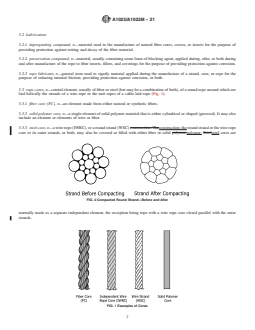
ropes of a cable-laid rope (Fig. 1).
ISO 2232Round Drawn Wire for General-Purpose Non-
3.3.1 fiber core (FC), n—an element made from either
alloySteelWireRopesandforLargeDiameterSteelWire
natural or synthetic fibers.
Ropes
3.3.2 solid polymer core, n—a single element of solid
polymer material that is either cylindrical or shaped (grooved).
It may also include an element or elements of wire or fiber.
This specification is under the jurisdiction ofASTM Committee A01 on Steel,
3.3.3 steel core, n—a wire rope (IWRC), or a round strand
Stainless Steel and RelatedAlloys and is the direct responsibility of Subcommittee
A01.03 on Steel Rod and Wire.
(WSC) construction; the round strand or the wire rope core or
Current edition approved Sept. 1, 2021. Published October 2021. Originally
its outer strands, or both, may also be covered or filled with
approved in 2002. Last previous edition approved in 2019 as A1023/A1023M–19.
either fiber or solid polymer; steel cores are normally made as
DOI: 10.1520/A1023_A1023M-21.
For referenced ASTM standards, visit the ASTM website, www.astm.org, or a separate independent element, the exception being rope with
contact ASTM Customer Service at service@astm.org. For Annual Book of ASTM
a wire rope core closed parallel with the outer strands.
Standards volume information, refer to the standard’s Document Summary page on
the ASTM website.
Available from International Organization for Standardization (ISO), 1 rue de Available from DLA Document Services, Building 4/D, 700 Robbins Ave.,
Varembé, Case postale 56, CH-1211, Geneva 20, Switzerland, http://www.iso.ch. Philadelphia, PA 19111-5094, http://quicksearch.dla.mil.
*A Summary of Changes section appears at the end of this standard
Copyright © ASTM International, 100 Barr Harbor Drive, PO Box C700, West Conshohocken, PA 19428-2959. United States
A1023/A1023M−21
FIG. 1Examples of Cores
FIG. 2Compacted Round Strand—Before and After
3.4 strand, n—an element of rope normally consisting of an (a)Style B—Solid center wire.
assembly of wires of appropriate shape and dimensions laid (b)Style G—3×2 or 3×2+3F center.
helically in one or more layers around a center; the center may (c)Style H—3 or 3+3F center.
consist of one round or shaped wire, of several round wires (d)Style V—1×7 center.
forming a built-up center, or of fiber or some other material; if
3.4.2 strand lay direction, n—the direction right (z) or left
multiplewiresareusedinastrandcenter,theymaybecounted (s) corresponding to the direction of lay of the outer wires in
as one wire.
relation to the longitudinal axis of the strand (Fig. 5).
3.4.1 Cross-section Shape:
3.4.3 Type and Constructions:
3.4.1.1 compacted strand, n—a strand that has been sub-
3.4.3.1 multiple operation lay, n—constructioncontainingat
jected to a compacting process such as drawing, rolling, or
least two layers of wires in which successive layers are laid in
swaging (Fig. 2).
more than one operation, with different lay lengths; there are
3.4.1.2 round strand, n—strand having a perpendicular
two basic types of multiple operation strand:
cross-section that is approximately the shape of a circle (Fig.
(a) compound lay, n—strand that contains a minimum of
3).
three layers of wires where a minimum of one layer is laid in
3.4.1.3 triangular strand, n—strand having a perpendicular
a separate operation, but in the same direction, over a parallel
cross-section that is approximately the shape of a triangle
lay center.
(formerly referred to as flattened strand) (Fig. 4).
(b) cross-lay, n—strand in which the wires are laid in the
same direction. The wires of superimposed wire layers cross
one another and make point contact.
3.4.3.2 parallel lay, n—strand that contains at least two
layers of wires, all of which are laid in one operation (in the
same direction); the lay length of all the wire layers is equal,
and the wires of any two superimposed layers are parallel to
each other, resulting in linear contact; there are four types of
parallel lay constructions:
(a) combined, adj—describes a parallel lay construction
FIG. 3Round Strand having three or more layers laid in one operation and formed
A1023/A1023M−21
3.4.3.3 single lay, n—strand that contains only one layer of
wires.
3.5 wire rope, n—an assembly of strands laid helically in
one or more layers around a core; exceptions are wire ropes
consistingofthreeorfourouterstrandsthatmayormaynotbe
laid around a core; elements of wire rope are shown in Fig. 7.
3.5.1 Discussion—The term rope can be substituted or be
used interchangeably with wire rope.
FIG. 4Triangular Strand
3.6 Galvanized Wire Rope:
3.6.1 final-galvanized rope, n—a wire rope in which all
outer wires are supplied as final-galvanized; inner, filler, and
center wires are supplied as either final-galvanized or drawn-
galvanized.
3.6.2 drawn-galvanized rope, n—a wire rope in which all
the wires are galvanized, including those of any steel core.
3.7 Wires:
3.7.1 finish and quality of coating, n—the condition of the
surface finish of the wire, that is, uncoated or metallic coated
(zinc or zinc alloy).
3.7.1.1 metallic coated wire, n—carbon steel wire that has a
metallic coating.
(a) drawn-galvanized wire, n—coated carbon steel wire
with a zinc coating applied prior to the final wire drawing
operation, that is, galvanized in process.
FIG. 5Lay Direction of Strands for Wire Ropes
(b) drawn-Zn-5Al-MM wire, n—coated carbon steel wire
with a zinc-aluminum alloy (mischmetal) coating applied prior
from a combination of the above, for example, Warrington-
to the final wire drawing operation.
Seale construction (Fig. 6a).
(c) final-coated Zn-5Al-MM wire, n—coated carbon steel
(b) filler (F), adj—describes a construction having outer
wire with a zinc-aluminum alloy (mischmetal) coating applied
layercontainingtwicethenumberofwiresthantheinnerlayer,
after the final wire drawing operation.
with filler wires laid in the interstices between the layers; filler
(d) final-galvanized wire, n—coated carbon steel wire with
wires are designated with the letter “F” (Fig. 6b).
a zinc coating applied after the final wire drawing operation,
(c) Seale (S), adj—describes a construction having same
that is, galvanized at finished size.
number of wires in each layer, for example, 9-9-1 (Fig. 6c).
3.7.1.2 uncoated wire, n—carbon steel wire that does not
(d) Warrington (W), adj—describes a construction having
have a metallic coating; commonly referred to as bright wire.
outer (Warrington) layer containing alternately large and small
3.7.2 Function:
wires and twice the number of wires as the inner layer;
3.7.2.1 filler wires, n—comparatively small wires used in
Warringtonlayersaredesignatedbylistingthenumberoflarge
certain constructions of parallel lay ropes to create the neces-
andsmallwireswitha+signinbetweenandbracketing()the
sary number of interstices for supporting the next layer of
layer, for example, (6+6) (Fig. 6d).
covering wires.
3.7.2.2 load-bearing wires (main wires), n—thosewiresina
NOTE 1—Strand construction is designated by listing the number of
rope that are considered as contributing toward the breaking
wires, beginning with the outer wires, with each layer separated by a
hyphen. force of the rope.
A—Example of Combined Parallel Lay ex. 31WS, 12-(6+6)-6-1
B—Filler Construction ex. 25F, 12-6F-6-1
C—Seale Construction ex. 19S, 9-9-1
D—Warrington Construction ex. 19W, (6+6)-6-1
FIG. 6Parallel Lay Constructions
A1023/A1023M−21
FIG. 8Diameter of Round Rope
3.8.1 diameter of plastic-coated rope, n—the diameter that
circumscribes the overall rope cross-section including the
cover followed by the diameter, which circumscribes the
3 5
underlying rope (for example, ⁄4 × ⁄8 in.).
3.8.2 diameter of round rope, n—the diameter (d) that
circumscribes the rope cross-section. Diameter is expressed in
inches or millimeters (Fig. 8).
FIG. 7Elements of Wire Rope
3.9 Lay Length:
3.9.1 rope lay length, n—that distance measured parallel to
3.7.2.3 non-load-bearing wires, n—those wires in a rope
the longitudinal rope axis in which the outer strands of a wire
that are considered as not contributing toward the breaking
rope or the component ropes of a cable-laid rope make one
force of the rope.
complete turn (or helix) about the axis of the rope (Fig. 9).
3.7.2.4 seizing (serving) wires or strands, n—singlewiresor
3.9.2 strand lay length, n—that distance measured parallel
strandsusedformakingaclose-woundhelicalservingtoretain
to the longitudinal strand axis, in which the wire in the strand
the elements of a rope in their assembled position.
makesonecompleteturn(orhelix)abouttheaxisofthestrand;
3.7.3 layer of wires, n—an assembly of wires having one
the lay length of a strand is that corresponding to the outer
pitch diameter; the exception is a Warrington layer comprising
layers of wires (Fig. 9).
largeandsmallwireswherethesmallerwiresarepositionedon
alargerpitchcirclethanthelargerwires;thefirstlayerofwires
Manufacture (Rope)
is that which is laid over the strand center; filler wires do not
3.10 Preformation:
constitute a separate layer.
3.10.1 non-preformed rope, n—rope in which the wires and
3.7.4 Position:
strands in the rope will, after removal of any seizing (serving),
3.7.4.1 center wires, n—wires positioned at the center of a
spring out of the rope formation.
strand of a wire rope.
3.10.2 preformed rope, n—rope in which the wires and
3.7.4.2 core wires, n—all wires comprising the core of a
strands in the rope will not, after removal of any seizing
wire rope.
(serving), spring out of the rope formation.
3.7.4.3 inner wires, n—all wires except center, filler, core,
and outer wires in a wire rope. 3.11 prestretching, n—the name given to a process that
3.7.4.4 outer wires, n—all wires in the outer layer of the results in the removal of a limited amount of constructional
outer strands of a wire rope. stretch.
Dimensional Characteristics Mechanical Properties
3.8 Diameter of Rope: 3.12 Rope:
FIG. 9Lay Lengths
A1023/A1023M−21
TABLE 1 Wire Tensile Strength Grades or Levels for Given Rope
3.12.1 actual (measured) breaking force, n—breaking force
Grades
obtainedusingtheprescribedtestmethodinTestMethodA931
Wire Tensile Strength Grade or Level
or ISO 3108.
Rope Grade
Minimum Maximum
3.12.2 calculated breaking force, n—valueofbreakingforce
IPS Level 2 / 1570 Level 4 / 1960
obtained from the sum of the measured breaking forces of the
EIP Level 3 / 1770 Level 5 / 2160
EEIP Level 4 / 1960 Level 5 / 2160
wires in the rope, before rope making, multiplied by the
1770 1570 / Level 2 1960 / Level 4
measured spinning loss factor as determined by the rope
1960 1770 / Level 3 2160 / Level 5
manufacturer’s design. 2160 1960 / Level 4 2160 / Level 5
3.12.3 measured spinning loss factor, n—ratio between the
measured breaking force of the rope and the sum of the
TABLE 2 Classification
measured breaking forces of the wires, before rope making.
Table
3.12.4 minimum breaking force, n—specified value that the
Diameter Diameter
Classification
(in.) [mm]
actual (measured) breaking force shall meet or exceed in a SC FC
3×7 CORD 7 ⁄32 0.8
prescribed test.
3 3
7×7 CORD 7 ⁄64 – ⁄8 1.2–9.5
3 3
3.13 Rope Stretch (Extension):
7×19 CORD 7 ⁄64 – ⁄8 1.2–9.5
1 1
6×7 8 9 ⁄4 –1 ⁄2 6–36
3.13.1 constructional stretch (extension), n—amount of ex-
1 1
6×19 10 11 ⁄4 –3 ⁄2 6–88.9
tension that is attributed to the initial bedding down of wires
1 1
6×36 12 13 ⁄4 –3 ⁄2 6–88.9
within the strands and the strands within the rope due to 1 3
7×19 14 ⁄4 –2 ⁄8 6–60
1 3
7×36 15 ⁄4 –2 ⁄8 6–60
loading. Initial extension cannot be determined by calculation.
1 3
8×19 16 ⁄4 –2 ⁄8 6–60
3.13.2 elastic stretch (extension), n—amount of recoverable
1 3
8×36 17 ⁄4 –2 ⁄8 8–60
1 1
extensionthatfollowsHooke’slawwithincertainlimitsdueto
8×19 SR 18 ⁄4 –1 ⁄2 6.3–38.1
1 3
19×7 19 ⁄4 –1 ⁄4 6–44.5
application of a load.
1 5
34×7 20 ⁄4 –1 ⁄8 6.3–41.3
3.13.3 permanent stretch (extension), n—non-elastic exten-
3 5
35×7 21 ⁄8 –1 ⁄8 9–40
sion.
6×12 22 ⁄16 –1 7.9–25.4
3 1
6×24 23 ⁄8 –2 ⁄16 9.5–51
3.14 Wire: 3 3
6×25 TS 25 24 ⁄8 –2 ⁄4 9.5–69.8
3 1
3.14.1 torsions, n—a measure of wire ductility normally 6×19 CS 26 ⁄8 –2 ⁄4 10–56
3 1
6×36 CS 27 ⁄8 –2 ⁄4 10–56
expressed as the number of 360° revolutions that a wire can
1 1
6×19 SW 28 ⁄2 –1 ⁄2 12.7–38.1
withstand before breakage occurs, using a prescribed test
1 1
6×36 SW 29 ⁄2 –1 ⁄2 12.7–38.1
19×7 CS 30 ⁄4 –1 6–24
method; torsion requirements are based on the wire diameter
3 5
19×19 31 ⁄8 –1 ⁄8 10–40
and either the wire level, as specified in Specification A1007,
7 5
35×7 CS 32 ⁄16 –1 ⁄8 10–40
or the tensile strength grade, as specified in ISO 2232.
3.14.2 wire tensile strength, n—ratio between the maximum
Designation key:
SR = spin resistant
force obtained in a tensile test and the nominal cross-sectional
TS = triangular strand
areaofthetestpiece;requirementsforwiretensilestrengthare
CS = compacted strand
determined by either the wire level, as specified in Specifica-
SW = swaged rope
CORD = small diameter specialty wire rope
tionA1007,orbythetensilestrengthgrade,asspecifiedinISO
SC = steel core
2232.
FC = fiber core
3.14.2.1 tensile strength grade, n—a level of requirement
for tensile strength based on the SI system of units; it is
designated by a value according to the lower limit of tensile
3.15.2 rope construction, n—detail and arrangement of the
strength and is used when specifying wire; values are ex-
2 variouselementsoftherope,takingintoaccountthenumberof
pressed in N/mm (for example, 1960).
strands, and the number of wires in the strand; for construction
3.14.2.2 wire level, n—a level of requirement for tensile
details, refer to Tables 7-32.
strengthbasedontheinch-poundsystemofunits(forexample,
3.15.2.1 Discussion—Rope construction is designated by
Level 3).
listing the number of outer strands followed by the number of
Terminology Relating to Ropes wires in each strand and the designation for the type of
construction, for example, 6×25F. The “×” symbol is read as
3.15 Rope Classification and Construction:
“by.”
3.15.1 rope classification, n—a grouping of wire ropes of
similarcharacteristicsonthebasisofthenumberofstrandsand 3.16 rope grade, n—a level of requirement for breaking
forcethatisdesignatedeitherbyanumber(forexample,1770,
theirshape,thenumberofstrandlayers,thenumberofwiresin
one strand, the number of outer wires in one strand, and the 1960) or a series of letters (for example, IPS, EIP); see 6.3;
ropegradedoesnotimplythattheactualtensilestrengthofthe
number of wire layers in one strand; for classification details,
refer to Table 2. wires in the rope is necessarily of this grade.
A1023/A1023M−21
TABLE 3 Tolerances on Rope Diameter (Wire Rope)
3.17.2.4 regular (ordinary), adj—describes wire rope in
(Inch-Pound Units)
which the direction of lay of the wires in the outer strands is in
Diameter Tolerancesas a
theoppositedirectiontothelayoftheouterstrandsintherope.
Nominal Rope
Percentage of Nominal
Diameter (d), in.
3.17.2.5 Discussion—The lower case letter denotes strand
Diameter
direction; the upper case letter denotes rope direction.
thru ⁄8 -0, +8 %
1 3
over ⁄8 thru ⁄16 -0, +7 %
3.18 Rope Types:
3 5
over ⁄16 thru ⁄16 -0, +6 %
A
over ⁄16 and larger -0, +5 %
3.18.1 cable-laid rope, n—an assembly of several (usually
A
6×12 and 6×24 classifications -0, +7 % (Tables 22 and 23) six) round wire ropes laid helically over a core (usually a
seventhrope);requirementsforcable-laidropearenotcovered
in this specification.
TABLE 4 Tolerances on Rope Diameter (Wire Rope)
3.18.2 Ropes Incorporating Filling and Covering Materi-
[SI Units]
als:
Diameter Tolerances as a
Nominal Rope 3.18.2.1 cushioned rope, n—rope in which the inner layers,
Percentage of Nominal
Diameter (d), [mm]
innerstrandsorcorestrandsarecoveredwithsolidpolymersor
Diameter
fibers to form a cushion between adjacent strands or overlying
from2to<4 -0, +8%
from4to<6 -0, +7%
layers.
from6to<8 -0, +6%
3.18.2.2 plastic-coated core rope, n—ropeinwhichthecore
8 and greater -0, +5 %
is covered, or filled and covered, with a solid polymer.
3.18.2.3 plastic-coated rope, n—rope in which the exterior
TABLE 5 Permissible Differences in Rope Diameter
surface is coated (covered) with a solid polymer.
(Inch-Pound Units)
3.18.2.4 plastic-filled rope, n—ropeinwhichthefreespaces
Nominal Rope Percentage Allowable
up to the diameter of the rope are filled with a solid polymer.
Diameter (d), in. Difference (%)
3.18.3 rotation-resistant rope, n—wire ropes designed to
⁄8 and smaller 7
generatereducedlevelsoftorqueandrotationwhenloadedand
1 3
over ⁄8 thru ⁄16 6
3 5
over ⁄16 thru ⁄16 5
comprising an assembly of two or more layers of strands laid
over ⁄16 and larger 4
helically around a center, the direction of lay of the outer
strands being opposite to that of the underlying layer; there are
three categories of rotation-resistant rope:
TABLE 6 Permissible Differences in Rope Diameter [SI Units]
3.18.3.1 category 1, adj—describesropeconstructedinsuch
Nominal Rope Percentage Allowable
a manner that it displays little or no tendency to rotate, or, if
Diameter (d), [mm] Difference (%)
guided, transmits little or no torque, has at least fifteen outer
from2to<4 7
from4to<6 6 strands and comprises an assembly of at least three layers of
from6to<8 5
strands laid helically over a center in two operations, the
8 and greater 4
directionoflayoftheouterstrandsbeingoppositetothatofthe
underlying layer.
3.18.3.2 category 2, adj—ropeconstructedinsuchamanner
that it has significant resistance to rotation, has at least ten
outerstrands,andcomprisesanassemblyoftwoormorelayers
3.17 Rope Lay:
of strands laid helically over a center in two or three
3.17.1 lay direction of rope, n—thedirectionright(Z)orleft
operations, the direction of lay of the outer strands being
(S) corresponding to the direction of lay of the outer strands in
opposite to that of the underlying layer.
a wire rope or the unit ropes in a cable laid rope in relation to
3.18.3.3 category 3, adj—ropeconstructedinsuchamanner
the longitudinal axis of the rope.
that it has limited resistance to rotation, has no more than nine
3.17.2 Lay Types:
outer strands, and comprises an assembly of two layers of
3.17.2.1 alternate lay, adj—describeswireropeinwhichthe
strands laid helically over a center in two operations, the
type of lay of the outer strands is alternately regular (ordinary)
directionoflayoftheouterstrandsbeingoppositetothatofthe
lay followed by lang lay such that half of the outer strands are
underlying layer.
regular (ordinary) lay and the other half are lang lay; the lay
3.18.3.4 Discussion—Rotation resistant ropes have previ-
direction of the rope will be either right (AZ) or left (AS);
ously been referred to as multi-strand and non-rotating ropes.
alternate lay can also be supplied with two lang lay strands
3.18.3.5 Discussion—Ropes having three or four strands
followed by one regular (ordinary) lay strand in a repeating
can also be designed to exhibit rotational resistant properties.
pattern.
3.18.4 Wire Rope Types:
3.17.2.2 contra-lay, adj—describes wire rope in which at
3.18.4.1 compacted strand rope, n—rope in which the
least one layer of strands is laid in the opposite direction to the
other layers. strands, prior to closing of the rope, are subjected to a
compacting process such as drawing, rolling, or swaging.
3.17.2.3 lang lay, adj—describes wire rope in which the
direction of lay of the wires in the outer strands is the same 3.18.4.2 multi-layer, adj—describes an assembly of two or
direction as that of the outer wires in the rope (Fig. 10). more layers of strands laid helically around a core, the
A1023/A1023M−21
TABLE 7 Classification 7×7 and 7×19 Small Diameter (Galvanized) Specialty Cord
Construction of Rope Construction of Strand
Cross Section
Examples
Item Quantity Item Quantity
A
Strands 7 Wires 7 or 19
Outer Strands 6 Outer Wires 6 or 12
Layer of Strands 2 Layer of Wires 1 or 2
A
Wires in Rope 42 or 114
(excluding core strand)
7×7
Typical Examples Number of Outer Wires
Rope Strand Total Per Strand
3×7 1–6 18 6
7×7 1–6 36 6
7×19 1–6/12 72 12
7×19
A
Diameter Approx. Mass Minimum Breaking Force Diameter Range
7×7 7×19 7×7 7×19 Min. Max.
in. [mm]
lb/100 ft [kg/30.5 m] lb/100 ft [kg/30.5 m] lbs [kN] lbs [kN] in. in.
1 A
⁄32 0.79 0.16 0.07 110 0.49 0.031 0.037
⁄64 1.19 0.42 0.19 270 1.2 0.047 0.055
⁄16 1.59 0.75 0.34 0.75 0.34 480 2.1 480 2.1 0.063 0.073
⁄64 1.98 1.1 0.50 650 2.9 0.078 0.089
⁄32 2.38 1.6 0.73 1.7 0.77 920 4.1 1000 4.4 0.094 0.106
⁄64 2.78 2.2 1.0 1260 5.6 0.109 0.122
⁄8 3.18 2.8 1.3 2.9 1.3 1700 7.6 2000 8.9 0.125 0.139
⁄32 3.97 4.3 2.0 4.5 2.0 2600 11.6 2800 12.5 0.156 0.172
⁄16 4.76 6.2 2.8 6.5 3.0 3700 16.5 4200 18.7 0.188 0.206
⁄32 5.56 8.3 3.8 8.6 3.9 4800 21.4 5600 24.9 0.219 0.237
⁄4 6.35 10.6 4.8 11.0 5.0 6100 27.1 7000 31.1 0.250 0.268
⁄32 7.14 13.4 6.1 13.9 6.3 7600 33.8 8000 35.6 0.281 0.301
⁄16 7.94 16.7 7.6 17.3 7.9 9200 40.9 9800 43.6 0.313 0.335
⁄32 8.73 20.1 9.1 20.7 9.4 11 100 49.4 12 500 55.6 0.344 0.368
⁄8 9.53 23.6 10.7 24.3 11.0 13 100 58.3 14 400 64.1 0.375 0.401
A
⁄32 construction is 3×7.
direction of the lay of the outer strands being opposite (that is, specification. Such requirements may include, but are not
contra-lay) to that of the underlying layer. limited to, the following:
3.18.4.3 single layer, adj—describes rope consisting of one
Examples
Item
inch-pound [SI]
layer of strands laid helically around a core.
Length 500 ft 175 m
3.18.4.4 swaged (compacted) rope, n—ropethatissubjected
Size (diameter) ⁄4 in. 16 mm
toacompactingprocessafterclosingtherope,thusreducingits Rope classification or construction 6×36 6×36
(if known)
diameter.
Preformed or non-preformed Preformed Preformed
Lay direction and type Right regular sZ
Values
Wire finish (uncoated or metallic uncoated drawn-
coated and type) galvanized
3.19 actual (measured) value, n—value derived from direct
Rope Grade EIP 1960
measurement in a prescribed manner.
Core Type FC (fiber) SC
Applicable specification ASTM A1023 ASTM A1023
3.20 maximum value, n—specifiedvaluethatanactualvalue
Special requirements
shall not exceed.
Termination of rope ends
Special length tolerance
3.21 minimum value, n—specifiedvaluethatanactualvalue
Type of certificate
shall meet or exceed. Special packaging and identification
Lubrication, other than as noted in 5.3
3.22 nominal value, n—the conventional value by which a
Prestretching
physical characteristic is designated.
4. Ordering Information
4.1 It is the responsibility of the purchaser to specify all
requirements that are necessary for material ordered under this
A1023/A1023M−21
TABLE 8 Classification 6×7 Steel Core
Construction of Rope Construction of Strand
Cross Section
Examples
Item Quantity Item Quantity
Strands 6 Wires 5 to 9
Outer Strands 6 Outer Wires 4 to 8
Layer of Strands 1 Layer of Wires 1
Wires in Rope 30 to 54
Typical Examples Number of Outer Wires
6×7 Rope Strand Total Per Strand
SC 6×7 1–6 36 6
A
Diameter Approx. Mass Minimum Breaking Force Diameter Range
IPS 1770 EIP 1960 Min. Max.
in. [mm] lb/ft [kg/m]
Tons [kN] Tons [kN] in. in.
6 0.10 0.144 22.9 25.3 0.236 0.250
⁄4 0.11 0.161 2.84 3.12 0.250 0.265
7 0.13 0.196 31.1 34.5 0.276 0.292
⁄16 0.17 0.252 4.41 4.85 0.313 0.331
8 0.17 0.256 40.7 45.0 0.315 0.331
9 0.22 0.324 51.5 57.0 0.354 0.372
⁄8 0.24 0.363 6.30 6.93 0.375 0.394
10 0.27 0.400 63.5 70.4 0.394 0.413
11 0.33 0.484 76.9 85.1 0.433 0.455
⁄16 0.33 0.494 8.52 9.37 0.438 0.459
12 0.39 0.576 91.5 101 0.472 0.496
⁄2 0.43 0.645 11.1 12.2 0.500 0.525
13 0.45 0.676 107 119 0.512 0.537
14 0.53 0.784 125 138 0.551 0.579
⁄16 0.55 0.817 14.0 15.4 0.563 0.591
⁄8 0.68 1.008 17.1 18.8 0.625 0.656
16 0.69 1.024 163 180 0.630 0.661
18 0.87 1.296 206 228 0.709 0.744
19 0.97 1.444 229 254 0.748 0.785
⁄4 0.98 1.452 24.4 26.8 0.750 0.788
20 1.08 1.600 254 281 0.787 0.827
22 1.30 1.936 308 341 0.866 0.909
⁄8 1.33 1.976 33.0 36.3 0.875 0.919
24 1.55 2.304 366 405 0.945 0.992
1 1.73 2.581 42.7 47.0 1.000 1.050
26 1.82 2.704 430 476 1.024 1.075
28 2.11 3.136 498 552 1.102 1.157
1 ⁄8 2.19 3.266 53.5 58.9 1.125 1.181
1 ⁄4 2.71 4.032 65.6 72.2 1.250 1.313
32 2.75 4.096 651 721 1.260 1.323
1 ⁄8 3.28 4.879 78.6 86.5 1.375 1.444
36 3.48 5.184 824 912 1.417 1.488
1 ⁄2 3.90 5.806 92.7 102 1.500 1.575
A
Minimum breaking force for final-galvanized ropes 10 % lower than values listed.
Note—To convert to kilonewtons (kN), multiply tons by 8.896.
4.2 Certification of Conformance and Test: tion or if they are taken from a completed rope. The following
4.2.1 A certificate of conformance and test shall confirm additional information can be supplied under agreement be-
compliance with this standard. It shall contain the following tween purchaser and supplier. These items shall be completed
information items: as agreed between the supplier and the purchaser.
4.2.1.1 Certificate number, 4.2.2.1 Quality system registration number of the rope
4.2.1.2 Purchaser’s name and address, manufacturer, if applicable;
4.2.1.3 Purchaser’s order number, 4.2.2.2 Approximate mass in lb/ft [kg/m];
4.2.1.4 Rope supplier’s name and address, 4.2.2.3 Wire standard used;
4.2.1.5 Supplier’s order number, 4.2.2.4 Number of wires tested;
4.2.1.6 Number traceable to manufacturer’s production 4.2.2.5 Nominal dimensions of wire;
length, 4.2.2.6 Measured dimensions of wire;
4.2.1.7 Nominal length(s) of rope, 4.2.2.7 Breaking force of wire;
4.2.1.8 Rope designation (nominal diameter, construction 4.2.2.8 Tensile strength of wire;
and core, lay and grade), and 4.2.2.9 Number of torsions completed (and test length);
4.2.1.9 Minimum breaking force in tons (short tons) or 4.2.2.10 Mass of zinc (or zinc alloy);
kilonewtons. 4.2.2.11 Actual (measured) diameter of rope; and
4.2.2 Tests on Wires and Rope—If wire tests are required, 4.2.2.12 Actual (measured) breaking force of rope.
indicate if the wire samples are taken before the rope fabrica- 4.2.3 Additional Information and Certification:
A1023/A1023M−21
TABLE 9 Classification 6×7 Fiber Core
Construction of Rope Construction of Strand
Cross Section
Examples
Item Quantity Item Quantity
Strands 6 Wires 5 to 9
Outer Strands 6 Outer Wires 4 to 8
Layer of Strands 1 Layer of Wires 1
Wires in Rope 30 to 54
Typical Examples Number of Outer Wires
Rope Strand Total Per Strand
6×7
6×7 1–6 36 6
FC
A
Diameter Approx. Mass Minimum Breaking Force Diameter Range
IPS 1770 EIP 1960 Min. Max.
in. [mm] lb/ft [kg/m]
Tons [kN] Tons [kN] in. in.
6 0.08 0.124 21.2 23.4 0.236 0.248
⁄4 0.09 0.139 2.64 2.90 0.250 0.263
7 0.11 0.169 28.8 31.9 0.276 0.289
⁄16 0.15 0.217 4.10 4.51 0.313 0.328
8 0.15 0.221 37.6 41.6 0.315 0.331
9 0.19 0.279 47.6 52.7 0.354 0.372
⁄8 0.21 0.313 5.86 6.45 0.375 0.394
10 0.23 0.345 58.8 65.1 0.394 0.413
11 0.28 0.417 71.1 78.7 0.433 0.455
⁄16 0.29 0.426 7.93 8.72 0.438 0.459
12 0.33 0.497 84.6 93.7 0.472 0.496
⁄2 0.37 0.556 10.3 11.3 0.500 0.525
13 0.39 0.583 99.3 110 0.512 0.537
14 0.45 0.676 115 128 0.551 0.579
⁄16 0.47 0.704 13.0 14.3 0.563 0.591
⁄8 0.58 0.869 15.9 0.625 0.656
16 0.59 0.883 150 167 0.630 0.661
18 0.75 1.118 190 211 0.709 0.744
19 0.84 1.245 212 235 0.748 0.785
⁄4 0.84 1.252 22.7 25.0 0.750 0.788
20 0.93 1.380 235 260 0.787 0.827
22 1.12 1.670 284 315 0.866 0.909
⁄8 1.15 1.704 30.7 33.8 0.875 0.919
24 1.34 1.987 338 375 0.945 0.992
1 1.50 2.226 39.7 43.7 1.000 1.050
26 1.57 2.332 397 440 1.024 1.075
28 1.82 2.705 461 510 1.102 1.157
1 ⁄8 1.89 2.817 49.8 54.8 1.125 1.181
1 ⁄4 2.34 3.478 61.0 67.1 1.250 1.313
32 2.37 3.533 602 666 1.260 1.323
1 ⁄8 2.83 4.208 73.1 80.4 1.375 1.444
36 3.00 4.471 762 843 1.417 1.488
1 ⁄2 3.37 5.008 86.2 94.8 1.500 1.575
A
Minimum breaking force for final-galvanized ropes 10 % lower than values listed.
Note—To convert to kilonewtons (kN), multiply tons by 8.896.
4.2.3.1 Space for additional information, and 5.1.3 The manufacturer shall have the option to adopt a
single wire level or tensile strength grade throughout the rope,
4.2.3.2 Space for certification with provision for certifying
or decide on a combination of wire levels or tensile strength
the foregoing, name and position held, signature, and date.
grades.
5. Material 5.1.4 Wire diameters shall be selected by the manufacturer
in accordance with applicable wire rope design requirements.
5.1 Wire—Thewiresusedinropemakingshallcomplywith
the appropriate requirements of Specification A1007 or ISO
5.2 Core—Coresofwireropesshallnormallybeeithersteel
2232. The manufacturer, subject to the limits in Table 1, shall or fiber composition.
determine the tensile strength grade so that the minimum
5.2.1 Fiber Core—All fiber cores shall be natural fiber (for
breaking force of the rope is achieved.
example,sisal),polypropylene,orothersuitablesyntheticfiber.
5.1.1 Wire tensile limitations in Table 1 do not apply to
The cores shall be of uniform hardness, effectively supporting
center, filler, and core wires.
the strands. Natural fiber cores shall be treated with an
5.1.2 Wire tensile limitations do not apply to compacted impregnatingcompoundfreefromacid.Fibercoreslargerthan
ropes, or compacted strand ropes. ⁄32-in. (4 mm) diameter shall be doubly closed.
A1023/A1023M−21
TABLE 10 Classification 6×19 Steel Core
Cross Section Construction of Rope Construction of Strand
Examples Item Quantity Item Quantity
Strands 6 Wires 15 to 26
Outer Strands 6 Outer Wires 7 to 12
Layer of Strands 1 Layer of Wires 2 to 3
Wires in Rope 90 to 156
6×19 Seale
IWRC
Typical Examples Number of Outer Wires
Per
Rope Strand Total
Strand
6×19S 1–9–9 54 9
6×21F 1–5–5F–10 60 10
6×26WS 1–5–(5+5)–10 60 10
6×19W 1–6–(6+6) 72 12
6×25F 1–6–6F–12 72 12
6×25 filler wire
IWRC
A
Diameter Approx. Mass Minimum Breaking Force Diameter Range
IPS 1770 EIP 1960 EEIP 2160 Min. Max.
in. [mm] lb/ft [kg/m]
Tons [kN] Tons [kN] Tons [kN] in. in.
6 0.10 0.153 22.7 25.1 27.7 0.236 0.250
⁄4 0.12 0.172 2.94 3.40 0.250 0.265
7 0.14 0.209 30.9 34.2 37.7 0.276 0.292
⁄16 0.18 0.268 4.58 5.27 0.313 0.331
8 0.18 0.273 40.3 44.7 49.2 0.315 0.331
9 0.23 0.345 51.0 56.5 62.3 0.354 0.372
⁄8 0.26 0.386 6.56 7.55 8.30 0.375 0.394
10 0.29 0.426 63.0 69.8 76.9 0.394 0.413
11 0.35 0.515 76.2 84.4 93.0 0.433 0.455
⁄16 0.35 0.526 8.89 10.2 11.2 0.438 0.459
12 0.41 0.613 90.7 100 111 0.472 0.496
⁄2 0.46 0.687 11.5 13.3 14.6 0.500 0.525
13 0.48 0.720 106 118 130 0.512 0.537
14 0.56 0.835 124 137 151 0.551 0.579
⁄16 0.58 0.870 14.5 16.8 18.5 0.563 0.591
⁄8 0.72 1.074 17.7 20.6 22.7 0.625 0.656
16 0.73 1.091 161 179 197 0.630 0.661
18 0.93 1.380 204 226 249 0.709 0.744
19 1.03 1.538 227 252 278 0.748 0.785
⁄4 1.04 1.546 25.6 29.4 32.4 0.750 0.788
20 1.15 1.704 252 279 308 0.787 0.827
22 1.39 2.062 305 338 372 0.866 0.909
⁄8 1.41 2.104 34.6 39.8 43.8 0.875 0.919
24 1.65 2.454 363 402 443 0.945 0.992
1 1.85 2.748 44.9 51.7 56.9 1.000 1.050
26 1.94 2.880 426 472 520 1.024 1.075
28 2.24 3.340 494 547 603 1.102 1.157
1 ⁄8 2.34 3.478 56.5 65.0 71.5 1.125 1.181
1 ⁄4 2.89 4.294 69.4 79.9 87.9 1.250 1.313
32 2.93 4.362 645 715 787 1.260 1.323
1 ⁄8 3.49 5.196 83.5 96.0 106 1.375 1.444
36 3.71 5.521 817 904 997 1.417 1.488
1 ⁄2 4.16 6.184 98.9 114 125 1.500 1.575
40 4.58 6.816 1008 1116 1230 1.575 1.654
1 ⁄8 4.88 7.257 115 132 146 1.625 1.706
44 5.54 8.247 1220 1351 1489 1.732 1.819
1 ⁄4 5.66 8.417 133 153 169 1.750 1.838
1 ⁄8 6.49 9.662 152 174 192 1.875 1.969
48 6.60 9.815 1452 1608 1772 1.890 1.984
2 7.39 10.994 172 198 217 2.000 2.100
52 7.74 11.519 1704 1887 2079 2.047 2.150
2 ⁄8 8.34 12.411 192 221 243 2.125 2.231
56 8.98 13.359 1976 2188 2411 2.205 2.315
2 ⁄4 9.35 13.914 215 247 272 2.250 2.363
60 10.31 15.336 2268 2512 2768 2.362 2.480
2 ⁄8 10.42 15.503 239 274 301 2.375 2.494
2 ⁄2 11.6 17.261 262 302 332 2.500 2.625
2 ⁄8 12.8 19.046 288 331 364 2.625 2.756
2 ⁄4 14.0 20.832 314 361 397 2.750 2.888
A1023/A1023M−21
TABLE10 Continued
A
Diameter Approx. Mass Minimum Breaking Force Diameter Range
IPS 1770 EIP 1960 EEIP 2160 Min. Max.
in. [mm] lb/ft [kg/m]
Tons [kN] Tons [kN] Tons [kN] in. in.
2 ⁄8 15.3 22.766 341 392 432 2.875 3.019
3 16.6 24.701 370 425 468 3.000 3.150
3 ⁄8 18.1 26.933 399 458 504 3.125 3.281
3 ⁄4 19.5 29.016 429 492 543 3.250 3.413
3 ⁄8 21.0 31.248 459 529 582 3.375 3.544
3 ⁄2 22.7 33.778 491 564 621 3.500 3.675
A
Minimum breaking force for final-galvanized ropes 10 % lower than values listed.
Note—To convert to kilonewtons (kN), multiply tons by 8.896.
5.2.2 Steel Core—Steel main cores shall be either an inde- galvanized in accordance with Specification A1007 for A1023
pendentwirerope(IWRC)orawirestrand(WSC).Steelcores wire rope; for A1023M wire rope, wires shall be galvanized in
of single layer ropes larger than ⁄16-in. (12mm) diameter shall accordance with ISO 2332.
beindependentwireropes(IWRC),unlessspecifiedotherwise.
6.4.1 Final-galvanizedropeshallbesuppliedwithminimum
Steel cores shall be lubricated. Cores closed in one operation
breaking forces 10% lower than those listed in Tables 7-32,
(parallel lay) with the outer strands of the rope may be
except for Tables 22 and 23.
specifiedbyagreementbetweenthesupplierandthepurchaser.
6.4.1.1 At the discretion of the manufacturer, final-coated
5.3 Lubricant—All wire rope, unless otherwise specified, Zn-5Al-MM wires may be used in place of final-galvanized
shall be lubricated and impregnated in the manufacturing wires, but final-galvanized wires may not be used in place of
process with a suitable lubricant selected by the manufacturer. final-coated Zn-5Al-MM wires.
Stranding lubricants used for fiber core ropes shall be compat-
6.4.2 Drawn-galvanized rope shall be supplied with mini-
ible with the impregnating compound of the fiber core.
mumbreakingforcesnotlessthanthoselistedinTablesTables
7-32.
6. Rope Properties and Tolerances
6.4.2.1 At the discretion of the manufacturer, drawn-coated
6.1 Classification—Theropeclassificationshallbespecified
Zn-5Al-MM wires may be used in place of drawn-galvanized
by the purchaser and shall normally be one of those covered in
wires, but drawn-galvanized wires may not be used in place of
Table 2 although other classifications and constructions are
drawn-coated Zn-5Al-MM wires.
available by agreement between the supplier and purchaser.
6.5 Direction and Type of Rope Lay—Thedirectionandtype
6.1.1 Where only the rope classification is specified by the
of rope lay shall be as specified by the purchaser and shall be
purchaser, the manufacturer shall determine the construction.
one of the following:
6.2 Rope Core—Steel core (SC) shall be supplied unless
Right regular (ordinary) lay (sZ)
otherwise specified. The manufacturer shall determine core
Left regular (ordinary) lay (zS)
construction. Cores with inserts or solid polymer cores are
Right lang lay (zZ)
Left lang lay (sS)
subject to agreement between the supplier and purchaser.
Right alternate lay (AZ)
6.3 Rope Grade—The rope grade shall be one of the Left alternate lay (AS)
following although other grades are available by agreement
Right regular (ordinary) lay will be supplied for six, seven,
between the supplier and purchaser.
and eight-strand constructions unless otherwise specified by
6.3.1 The listed rope grades for the following inch-pound
the purchaser.
units are shown in the indicated tables:
6.6 Dimensions:
6.3.1.1 IPS—Tables 8-19, Tables 22-25.
6.3.1.2 EIP—Tables 8-19, Tables 24-31. 6.6.1 Rope Diameter—The nominal diameter shall be as
6.3.1.3 EEIP—Tables 10-18, Tables 24-27, Tables 30 and specifiedbythepurchaserandshallbethedimensionbywhich
31.
the rope is designated.
6.3.2 Rope Grades for the following SI units are shown in
6.6.1.1 Tolerance on Rope Diameter—When measured in
the indicated tables:
accordance with 8.6.1, the actual diameter shall not vary from
6.3.2.1 1770—Tables 8-17, Tables 19-21.
the nominal diameter by more than the tolerances specified in
6.3.2.2 1960—Tables 8-17, Tables 19-21, Tables 26 and 27,
Table 3 or Table 4. For small diameter specialty cord with
1 3
Tables 30-32.
diameters from ⁄32 in. [0.8 mm] to ⁄8in. [10 mm] inclusive,
6.3.2.3 2160—Tables 10-17, Table 21, Tables 26 and 27,
diameter tolerances shall be as specified in Table 7.
and Tables 30-32.
6.6.1.2 Permissible Differences in Diameter—The differ-
6.4 Wire Finish—Unless otherwise specified, wire ropes ence between any two of the four measurements taken in
will be furnished with uncoated wires. For wire ropes re- accordance with 8.6.1, and expressed as a percentage of the
quested with metallic coated wires, unless specified other than nominal diameter, shall not exceed the values given in Table 5
zinc or zinc alloys in the purchase order, wires shall be or Table 6.
A1023/A1023M−21
TABLE 11 Classification 6×19 Fiber Core
Cross Section Construction of Rope Construction of Strand
Examples Item Quantity Item Quantity
Strands 6 Wires 15 to 26
Outer Strands 6 Outer Wires 7 to 12
Layer of Strands 1 Layer of Wires 2 to 3
6×21 Wires in Rope 90 to 156
fiber wire
FC
Typical Examples Number of Outer Wires
Rope Strand Total Per Strand
6×19S 1–9–9 54 9
6×21F 1–5–5F–10 60 10
6×26WS 1–5–(5+5)–10 60 10
6×19W 1–6–(6+6) 72 12
6×25
6×25F 1–6–6F–12 72 12
fiber wire
FC
A
Diameter Approx. Mass Minimum Breaking Force Diameter Range
IPS 1770 EIP 1960 EEIP 2160 Min. Max.
in. [mm] lb/ft [kg/m]
Tons [kN] Tons [kN] Tons [kN] in. in.
6 0.09 0.140 21.0 23.3 25.7 0.236 0.250
⁄4 0.11 0.156 2.74 3.01 0.250 0.265
7 0.13 0.190 28.6 31.7 34.9 0.276 0.292
⁄16 0.16 0.244 4.26 4.69 0.313 0.331
8 0.17 0.248 37.4 41.4 45.6 0.315 0.331
9 0.21 0.314 47.3 52.4 57.7 0.354 0.372
⁄8 0.24 0.352 6.10 6.71 7.38 0.375 0.394
10 0.26 0.388 58.4 64.7 71.3 0.394 0.413
11 0.32 0.469 70.7 78.3 86.2 0.433 0.455
⁄16 0.32 0.479 8.27 9.10 10.0 0.438 0.459
12 0.38 0.559 84.1 93.1 103 0.472 0.496
⁄2 0.42 0.626 10.7 11.8 12.9 0.500 0.525
13 0.44 0.656 98.7 109 120 0.512 0.537
14 0.51 0.760 114 127 140 0.551 0.579
⁄16 0.53 0.792 13.5 14.9 16.3 0.563 0.591
⁄8 0.66 0.978 16.7 18.3 20.2 0.625 0.656
16 0.67 0.993 150 166 182 0.630 0.661
18 0.84 1.257 189 210 231 0.709 0.744
19 0.94 1.401 211 233 257 0.748 0.785
⁄4 0.95 1.408 23.8 26.2 28.8 0.750 0.788
20 1.04 1.552 234 259 285 0.787 0.827
22 1.26 1.878 283 313 345 0.866 0.909
⁄8 1.29 1.917 32.2 35.4 39.0 0.875 0.919
24 1.50 2.235 336 373 411 0.945 0.992
1 1.68 2.503 41.8 46.0 50.6 1.000 1.050
26 1.76 2.623 395 437 482 1.024 1.075
28 2.04 3.042 458 507 559 1.102 1.157
1 ⁄8 2.13 3.168 52.6 57.9 63.6 1.125 1.181
1 ⁄4 2.63 3.911 64.6 71.1 78.2 1.250 1.313
32 2.67 3.973 598 662 730 1.260 1.323
1 ⁄8 3.18 4.733 77.7 85.5 94.0 1.375 1.444
36 3.38 5.028 757 838 924 1.417 1.488
1 ⁄2 3.78 5.632 92.0 101 111 1.500 1.575
40 4.17 6.208 935 1035 1140 1.575 1.654
1 ⁄8 4.44 6.610 107 118 129 1.625 1.706
44 5.05 7.512 1131 1252 1380 1.732 1.819
1 ⁄4 5.15 7.666 124 136 150 1.750 1.838
1 ⁄8 5.91 8.800 141 155 171 1.875 1.969
48 6.01 8.940 1346 1490 1642 1.890 1.984
2 6.73 10.013 160 176 194 2.000 2.100
52 7.05 10.492 1579 1749 1927 2.047 2.150
2 ⁄8 7.60 11.304 179 197 217 2.125 2.231
56 8.18 12.168 1832 2028 2235 2.205 2.315
2 ⁄4 8.52 12.673 200 220 242 2.250 2.363
60 9.39 13.968 2103 2328 2566 2.362 2.480
2 ⁄8 9.49 14.120 222 244 269 2.375 2.494
2 ⁄2 10.5 15.624 244 269 295 2.500 2.625
A1023/A1023M−21
TABLE11 Continued
A
Diameter Approx. Mass Minimum Breaking Force Diameter Range
IPS 1770 EIP 1960 EEIP 2160 Min. Max.
in. [mm] lb/ft [kg/m]
Tons [kN] Tons [kN] Tons [kN] in. in.
2 ⁄8 11.6 17.261 268 294 324 2.625 2.756
2 ⁄4 12.7 18.898 292 321 353 2.750 2.888
2 ⁄8 13.9 20.683 317 349 384 2.875 3.019
3 15.1 22.469 344 378 416 3.000 3.150
3 ⁄8 16.4 24.403 371 408 448 3.125 3.281
3 ⁄4 17.7 26.338 399 438 483 3.250 3.413
3 ⁄8 19.1 28.421 427 470 518 3.375 3.544
3 ⁄2 20.6 30.653 457 503 552 3.500 3.675
A
Minimum breaking force for final-galvanized ropes 10 % lower than values listed.
Note—To convert to kilonewtons (kN), multiply tons by 8.896.
6.6.2 Lay Length: 7.1.2 Center wires and fiber centers of strands shall be of a
6.6.2.1 For single layer ropes of 6×7 class, the lay length of size to provide sufficient support to enable the covering wires
the finish rope shall not exceed eight times the nominal rope to be evenly laid.
diameter.
7.2 Rope—The rope shall be uniformly made and the
6.6.2.2 For other single layer ropes with round strands,
strands shall lie tightly on the core or the underlying strands.
exceptfor3or4strandropes,andmulti-layerropeswithround
7.2.1 The core of a wire rope, except for swaged (com-
or shaped strands, the length of lay of the finished rope shall
pacted) ropes, shall be designed so that in a new rope under no
not exceed 7.25 times the nominal rope diameter.
load there is clearance between the outer strands.
6.6.2.3 For single layer ropes with shaped strands, for
7.2.2 Ropeendsthathavenoendfittingsshallbesosecured
example, flattened (triangular) strand, the length of lay of the
as to maintain the integrity of the rope and prevent its
finished rope shall not exceed ten times the nominal rope
unraveling.
diameter.
7.3 Wire Joints:
6.7 Mechanical Properties:
7.3.1 Wires over 0.
...
This document is not an ASTM standard and is intended only to provide the user of an ASTM standard an indication of what changes have been made to the previous version. Because
it may not be technically possible to adequately depict all changes accurately, ASTM recommends that users consult prior editions as appropriate. In all cases only the current version
of the standard as published by ASTM is to be considered the official document.
Designation: A1023/A1023M − 19 A1023/A1023M − 21
Standard Specification for
Carbon Steel Wire Ropes for General Purposes
This standard is issued under the fixed designation A1023/A1023M; the number immediately following the designation indicates the
year of original adoption or, in the case of revision, the year of last revision. A number in parentheses indicates the year of last
reapproval. A superscript epsilon (´) indicates an editorial change since the last revision or reapproval.
1. Scope*
1.1 This specification covers the general requirements for the more common types of steel wire ropes. Included in this
1 1
specification are wire ropes in various grades and constructions from ⁄4 in. [6 mm] to 3 ⁄2 in. [89 [6 to 89 mm] manufactured from
1 3
uncoated or metallic coated wire. Also included are cord products from ⁄32 in. [0.8 mm] to ⁄8 in. [10 [0.8 to 10 mm] manufactured
from metallic coated wire. For specific applications, additional or alternative requirements may apply.
1.2 The values stated in either inch-pounds or SI units are to be regarded separately as standard. Within the text, the SI units are
shown in brackets. The values stated in each system are not exact equivalents; therefore, each system shall be used independently
of the other. Combining values from the two systems may result in nonconformance with the specification.
1.3 This international standard was developed in accordance with internationally recognized principles on standardization
established in the Decision on Principles for the Development of International Standards, Guides and Recommendations issued
by the World Trade Organization Technical Barriers to Trade (TBT) Committee.
2. Referenced Documents
2.1 ASTM Standards:
A931 Test Method for Tension Testing of Wire Ropes and Strand
A1007 Specification for Carbon Steel Wire for Wire Rope
2.2 ISO Standards:
ISO 2232 Round Drawn Wire for General-Purpose Non-alloy Steel Wire Ropes and for Large Diameter Steel Wire Ropes
ISO 3108 Steel Wire Ropes for General Purposes—Determination of Actual Breaking
2.3 Military Standards:
MIL-DTL-5688 Wire Rope Assemblies: Aircraft, Proof Testing and Prestretching
3. Terminology
DescriptionDefinitions of Terms Specific to this SpecificationThis Standard:
3.1 inserts, n—fiber or solid polymer so positioned as to separate adjacent strands or wires in the same or overlying layers or to
fill interstices of the rope.
This specification is under the jurisdiction of ASTM Committee A01 on Steel, Stainless Steel and Related Alloys and is the direct responsibility of Subcommittee A01.03
on Steel Rod and Wire.
Current edition approved March 1, 2019Sept. 1, 2021. Published March 2019October 2021. Originally approved in 2002. Last previous edition approved in 20152019 as
A1023/A1023M – 15.A1023/A1023M – 19. DOI: 10.1520/A1023_A1023M-19.10.1520/A1023_A1023M-21.
For referenced ASTM standards, visit the ASTM website, www.astm.org, or contact ASTM Customer Service at service@astm.org. For Annual Book of ASTM Standards
volume information, refer to the standard’s Document Summary page on the ASTM website.
Available from International Organization for Standardization (ISO), 1 rue de Varembé, Case postale 56, CH-1211, Geneva 20, Switzerland, http://www.iso.ch.
Available from Standardization Documents Order Desk, DODSSP, Bldg. 4, Section D, DLA Document Services, Building 4/D, 700 Robbins Ave., Philadelphia, PA
19111-5098, http:// quicksearch.dla.mil.19111-5094, http://quicksearch.dla.mil.
*A Summary of Changes section appears at the end of this standard
Copyright © ASTM International, 100 Barr Harbor Drive, PO Box C700, West Conshohocken, PA 19428-2959. United States
A1023/A1023M − 21
3.2 Lubrication:
3.2.1 impregnating compound, n—material used in the manufacture of natural fiber cores, covers, or inserts for the purpose of
providing protection against rotting and decay of the fiber material.
3.2.2 preservation compound, n—material, usually containing some form of blocking agent, applied during, after, or both during
and after manufacture of the rope to fiber inserts, fillers, and coverings for the purpose of providing protection against corrosion.
3.2.3 rope lubricant, n—general term used to signify material applied during the manufacture of a strand, core, or rope for the
purpose of reducing internal friction, providing protection against corrosion, or both.
3.3 rope cores, n—central element, usually of fiber or steel (but may be a combination of both), of a round rope around which are
laid helically the strands of a wire rope or the unit ropes of a cable-laid rope (Fig. 1).
3.3.1 fiber core (FC), n—an element made from either natural or synthetic fibers.
3.3.2 solid polymer core, n—a single element of solid polymer material that is either cylindrical or shaped (grooved). It may also
include an element or elements of wire or fiber.
3.3.3 steel core, n—a wire rope (IWRC), or a round strand (WSC) construction. Theconstruction; the round strand or the wire rope
core or its outer strands, or both, may also be covered or filled with either fiber or solid polymer.polymer; Steelsteel cores are
FIG. 2 Compacted Round Strand—Before and After
normally made as a separate independent element, the exception being rope with a wire rope core closed parallel with the outer
strands.
FIG. 1 Examples of Cores
A1023/A1023M − 21
3.4 strand, n—an element of rope normally consisting of an assembly of wires of appropriate shape and dimensions laid helically
in one or more layers around a center. Thecenter; the center may consist of one round or shaped wire, of several round wires
forming a built-up center, or of fiber or some other material. Ifmaterial; if multiple wires are used in a strand center, they may be
counted as one wire.
3.4.1 Cross-SectionCross-section Shape:
3.4.1.1 compacted strand, n—a strand that has been subjected to a compacting process such as drawing, rolling, or swaging (Fig.
2).
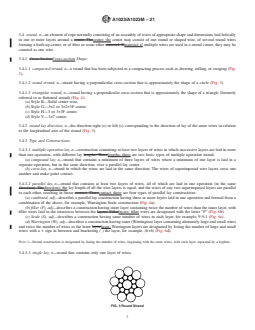
3.4.1.2 round strand, n—strand having a perpendicular cross-section that is approximately the shape of a circle (Fig. 3).
3.4.1.3 triangular strand, n—strand having a perpendicular cross-section that is approximately the shape of a triangle (formerly
referred to as flattened strand) (Fig. 4).
(a) Style B—Solid center wire.
(b) Style G—3×2 or 3×2+3F center.
(c) Style H—3 or 3+3F center.
(d) Style V—1×7 center.
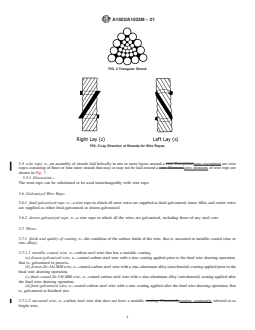
3.4.2 strand lay direction, n—the direction right (z) or left (s) corresponding to the direction of lay of the outer wires in relation
to the longitudinal axis of the strand (Fig. 5).
3.4.3 Type and Constructions:
3.4.3.1 multiple operation lay, n—construction containing at least two layers of wires in which successive layers are laid in more
than one operation, with different lay lengths. Therelengths; there are two basic types of multiple operation strand:
(a) compound lay, n—strand that contains a minimum of three layers of wires where a minimum of one layer is laid in a
separate operation, but in the same direction, over a parallel lay center.
(b) cross-lay, n—strand in which the wires are laid in the same direction. The wires of superimposed wire layers cross one
another and make point contact.
3.4.3.2 parallel lay, n—strand that contains at least two layers of wires, all of which are laid in one operation (in the same
direction). Thedirection); the lay length of all the wire layers is equal, and the wires of any two superimposed layers are parallel
to each other, resulting in linear contact. Therecontact; there are four types of parallel lay constructions:
(a) combined, adj—describes a parallel lay construction having three or more layers laid in one operation and formed from a
combination of the above, for example, Warrington-Seale construction (Fig. 6a).
(b) filler (F), adj—describes a construction having outer layer containing twice the number of wires than the inner layer, with
filler wires laid in the interstices between the layers. Fillerlayers; filler wires are designated with the letter “F” (Fig. 6b).
(c) Seale (S), adj—describes a construction having same number of wires in each layer, for example, 9-9-1 (Fig. 6c).
(d) Warrington (W), adj—describes a construction having outer (Warrington) layer containing alternately large and small wires
and twice the number of wires as the inner layer.layer; Warrington layers are designated by listing the number of large and small
wires with a + sign in between and bracketing ( ) the layer, for example, (6+6) (Fig. 6d).
NOTE 1—Strand construction is designated by listing the number of wires, beginning with the outer wires, with each layer separated by a hyphen.
3.4.3.3 single lay, n—strand that contains only one layer of wires.
FIG. 3 Round Strand
A1023/A1023M − 21
FIG. 4 Triangular Strand
FIG. 5 Lay Direction of Strands for Wire Ropes
3.5 wire rope, n—an assembly of strands laid helically in one or more layers around a core. Exceptionscore; exceptions are wire
ropes consisting of three or four outer strands that may or may not be laid around a core. Elementscore; elements of wire rope are
shown in Fig. 7.
3.5.1 Discussion—
The term rope can be substituted or be used interchangeably with wire rope.
3.6 Galvanized Wire Rope:
3.6.1 final-galvanized rope, n—a wire rope in which all outer wires are supplied as final-galvanized; inner, filler, and center wires
are supplied as either final-galvanized or drawn-galvanized.
3.6.2 drawn-galvanized rope, n—a wire rope in which all the wires are galvanized, including those of any steel core.
3.7 Wires:
3.7.1 finish and quality of coating, n—the condition of the surface finish of the wire, that is, uncoated or metallic coated (zinc or
zinc alloy).
3.7.1.1 metallic coated wire, n—carbon steel wire that has a metallic coating.
(a) drawn-galvanized wire, n—coated carbon steel wire with a zinc coating applied prior to the final wire drawing operation,
that is, galvanized in process.
(b) drawn-Zn-5Al-MM wire, n—coated carbon steel wire with a zinc-aluminum alloy (mischmetal) coating applied prior to the
final wire drawing operation.
(c) final-coated Zn-5Al-MM wire, n—coated carbon steel wire with a zinc-aluminum alloy (mischmetal) coating applied after
the final wire drawing operation.
(d) final-galvanized wire, n—coated carbon steel wire with a zinc coating applied after the final wire drawing operation, that
is, galvanized at finished size.
3.7.1.2 uncoated wire, n—carbon steel wire that does not have a metallic coating. Commonlycoating; commonly referred to as
bright wire.
A1023/A1023M − 21
A—Example of Combined Parallel Lay ex. 31WS, 12-(6+6)-6-1
B—Filler Construction ex. 25F, 12-6F-6-1
C—Seale Construction ex. 19S, 9-9-1
D—Warrington Construction ex. 19W, (6+6)-6-1
FIG. 6 Parallel Lay Constructions
FIG. 7 Elements of Wire Rope
3.7.2 Function:
3.7.2.1 filler wires, n—comparatively small wires used in certain constructions of parallel lay ropes to create the necessary number
of interstices for supporting the next layer of covering wires.
3.7.2.2 load-bearing wires (main wires), n—those wires in a rope that are considered as contributing toward the breaking force
of the rope.
3.7.2.3 non-load-bearing wires, n—those wires in a rope that are considered as not contributing toward the breaking force of the
rope.
3.7.2.4 seizing (serving) wires or strands, n—single wires or strands used for making a close-wound helical serving to retain the
elements of a rope in their assembled position.
3.7.3 layer of wires, n—an assembly of wires having one pitch diameter. Thediameter; the exception is a Warrington layer
comprising large and small wires where the smaller wires are positioned on a larger pitch circle than the larger wires. Thewires;
the first layer of wires is that which is laid over the strand center. Fillercenter; filler wires do not constitute a separate layer.
A1023/A1023M − 21
3.7.4 Position:
3.7.4.1 center wires, n—wires positioned at the center of a strand of a wire rope.
3.7.4.2 core wires, n—all wires comprising the core of a wire rope.
3.7.4.3 inner wires, n—all wires except center, filler, core, and outer wires in a wire rope.
3.7.4.4 outer wires, n—all wires in the outer layer of the outer strands of a wire rope.
Dimensional Characteristics
3.8 Diameter of Rope:
3.8.1 diameter of plastic-coated rope, n—the diameter that circumscribes the overall rope cross-section including the cover
3 5
followed by the diameter, which circumscribes the underlying rope (for example, ⁄4 × ⁄8 in.).
3.8.2 diameter of round rope, n—the diameter (d) that circumscribes the rope cross-section. Diameter is expressed in inches or
millimeters (Fig. 8).
3.9 Lay Length:
3.9.1 rope lay length, n—that distance measured parallel to the longitudinal rope axis in which the outer strands of a wire rope
or the component ropes of a cable-laid rope make one complete turn (or helix) about the axis of the rope (Fig. 9).
3.9.2 strand lay length, n—that distance measured parallel to the longitudinal strand axis, in which the wire in the strand makes
one complete turn (or helix) about the axis of the strand. Thestrand; the lay length of a strand is that corresponding to the outer
layers of wires (Fig. 9).
Manufacture (Rope)
3.10 Preformation:
3.10.1 non-preformed rope, n—rope in which the wires and strands in the rope will, after removal of any seizing (serving), spring
out of the rope formation.
3.10.2 preformed rope, n—rope in which the wires and strands in the rope will not, after removal of any seizing (serving), spring
out of the rope formation.
3.11 prestretching, n—the name given to a process that results in the removal of a limited amount of constructional stretch.
FIG. 8 Diameter of Round Rope
A1023/A1023M − 21
FIG. 9 Lay Lengths
Mechanical Properties
3.12 Rope:
3.12.1 actual (measured) breaking force, n—breaking force obtained using the prescribed test method in Test Method A931 or ISO
3108.
3.12.2 calculated breaking force, n—value of breaking force obtained from the sum of the measured breaking forces of the wires
in the rope, before rope making, multiplied by the measured spinning loss factor as determined by the rope manufacturer’s design.
3.12.3 measured spinning loss factor, n—ratio between the measured breaking force of the rope and the sum of the measured
breaking forces of the wires, before rope making.
3.12.4 minimum breaking force, n—specified value that the actual (measured) breaking force mustshall meet or exceed in a
prescribed test.
3.13 Rope Stretch (Extension):
3.13.1 constructional stretch (extension), n—amount of extension that is attributed to the initial bedding down of wires within the
strands and the strands within the rope due to loading. Initial extension cannot be determined by calculation.
3.13.2 elastic stretch (extension), n—amount of recoverable extension that follows Hooke’s law within certain limits due to
application of a load.
3.13.3 permanent stretch (extension), n—non-elastic extension.
3.14 Wire:
3.14.1 torsions, n—a measure of wire ductility normally expressed as the number of 360° revolutions that a wire can withstand
before breakage occurs, using a prescribed test method. Torsionmethod; torsion requirements are based on the wire diameter and
either the wire level, as specified in Specification A1007, or the tensile strength grade, as specified in ISO 2232.
3.14.2 wire tensile strength, n—ratio between the maximum force obtained in a tensile test and the nominal cross-sectional area
of the test piece. Requirementspiece; requirements for wire tensile strength are determined by either the wire level, as specified
in Specification A1007, or by the tensile strength grade, as specified in ISO 2232.
3.14.2.1 tensile strength grade, n—a level of requirement for tensile strength based on the SI system of units. Itunits; it is
designated by a value according to the lower limit of tensile strength and is used when specifying wire. Valueswire; values are
expressed in N/mm (for example, 1960).
3.14.2.2 wire level, n—a level of requirement for tensile strength based on the inch-pound system of units (for example, Level 3).
Terminology Relating to Ropes
3.15 Rope Classification and Construction:
A1023/A1023M − 21
TABLE 1 Wire Tensile Strength Grades or Levels for Given Rope
Grades
Wire Tensile Strength Grade or Level
Rope Grade
Minimum Maximum
IPS Level 2 / 1570 Level 4 / 1960
EIP Level 3 / 1770 Level 5 / 2160
EEIP Level 4 / 1960 Level 5 / 2160
1770 1570 / Level 2 1960 / Level 4
1960 1770 / Level 3 2160 / Level 5
2160 1960 / Level 4 2160 / Level 5
3.15.1 rope classification, n—a grouping of wire ropes of similar characteristics on the basis of, for wire ropes, of the number of
strands and their shape, the number of strand layers, the number of wires in one strand, the number of outer wires in one strand,
and the number of wire layers in one strand. Forstrand; for classification details, refer to Table 2.
3.15.2 rope construction, n—detail and arrangement of the various elements of the rope, taking into account the number of strands,
and the number of wires in the strand. Forstrand; for construction details, refer to Tables 7-32.
3.15.2.1 Discussion—Rope construction is designated by listing the number of outer strands followed by the number of wires in
each strand and the designation for the type of construction, for example, 6×25F. The “×” symbol is read as “by.”
3.16 rope grade, n—a level of requirement for breaking force that is designated either by a number (for example, 1770, 1960) or
a series of letters (for example, IPS, EIP). SeeEIP); see 6.3. Rope; rope grade does not imply that the actual tensile strength of the
wires in the rope is necessarily of this grade.
TABLE 2 Classification
Table
Diameter Diameter
Classification
(in.) [mm]
SC FC
3×7 CORD 7 ⁄32 0.8
3 3
7×7 CORD 7 ⁄64 – ⁄8 1.2–9.5
3 3
7×19 CORD 7 ⁄64 – ⁄8 1.2–9.5
1 1
6×7 8 9 ⁄4 –1 ⁄2 6–36
1 1
6×19 10 11 ⁄4 –3 ⁄2 6–88.9
1 1
6×36 12 13 ⁄4 –3 ⁄2 6–88.9
1 3
7×19 14 ⁄4 –2 ⁄8 6–60
1 3
7×36 15 ⁄4 –2 ⁄8 6–60
1 3
8×19 16 ⁄4 –2 ⁄8 6–60
1 3
8×36 17 ⁄4 –2 ⁄8 8–60
1 1
8×19 SR 18 ⁄4 –1 ⁄2 6.3–38.1
1 3
19×7 19 ⁄4 –1 ⁄4 6–44.5
1 5
34×7 20 ⁄4 –1 ⁄8 6.3–41.3
3 5
35×7 21 ⁄8 –1 ⁄8 9–40
6×12 22 ⁄16 –1 7.9–25.4
3 1
6×24 23 ⁄8 –2 ⁄16 9.5–51
3 3
6×25 TS 25 24 ⁄8 –2 ⁄4 9.5–69.8
3 1
6×19 CS 26 ⁄8 –2 ⁄4 10–56
3 1
6×36 CS 27 ⁄8 –2 ⁄4 10–56
1 1
6×19 SW 28 ⁄2 –1 ⁄2 12.7–38.1
1 1
6×36 SW 29 ⁄2 –1 ⁄2 12.7–38.1
19×7 CS 30 ⁄4 –1 6–24
3 5
19×19 31 ⁄8 –1 ⁄8 10–40
7 5
35×7 CS 32 ⁄16 –1 ⁄8 10–40
Designation key:
SR = spin resistant
TS = triangular strand
CS = compacted strand
SW = swaged rope
CORD = small diameter specialty wire rope
SC = steel core
FC = fiber core
A1023/A1023M − 21
TABLE 3 Tolerances on Rope Diameter (Wire Rope)
(Inch-Pound Units)
Diameter Tolerancesas a
Nominal Rope
Percentage of Nominal
Diameter (d), in.
Diameter
thru ⁄8 -0, +8 %
1 3
over ⁄8 thru ⁄16 -0, +7 %
3 5
over ⁄16 thru ⁄16 -0, +6 %
A
over ⁄16 and larger -0, +5 %
A
6×12 and 6×24 classifications -0, +7 % (Tables 22 and 23)
TABLE 4 Tolerances on Rope Diameter (Wire Rope)
[SI Units]
Diameter Tolerances as a
Nominal Rope
Percentage of Nominal
Diameter (d), [mm]
Diameter
from 2 to <4 -0, +8 %
from 4 to <6 -0, +7 %
from 6 to <8 -0, +6 %
8 and greater -0, +5 %
TABLE 5 Permissible Differences in Rope Diameter
(Inch-Pound Units)
Nominal Rope Percentage Allowable
Diameter (d), in. Difference (%)
⁄8 and smaller 7
1 3
over ⁄8 thru ⁄16 6
3 5
over ⁄16 thru ⁄16 5
over ⁄16 and larger 4
TABLE 6 Permissible Differences in Rope Diameter [SI Units]
Nominal Rope Percentage Allowable
Diameter (d), [mm] Difference (%)
from 2 to <4 7
from 4 to <6 6
from 6 to <8 5
8 and greater 4
3.17 Rope Lay:
3.17.1 lay direction of rope, n—the direction right (Z) or left (S) corresponding to the direction of lay of the outer strands in a wire
rope or the unit ropes in a cable laid rope in relation to the longitudinal axis of the rope.
3.17.2 Lay Types:
3.17.2.1 alternate lay, adj—describes wire rope in which the type of lay of the outer strands is alternately regular (ordinary) lay
followed by lang lay such that half of the outer strands are regular (ordinary) lay and the other half are lang lay. Thelay; the lay
direction of the rope will be either right (AZ) or left (AS). Alternate(AS); alternate lay can also be supplied with two lang lay
strands followed by one regular (ordinary) lay strand in a repeating pattern.
3.17.2.2 contra-lay, adj—describes wire rope in which at least one layer of strands is laid in the opposite direction to the other
layers.
3.17.2.3 lang lay, adj—describes wire rope in which the direction of lay of the wires in the outer strands is the same direction as
that of the outer wires in the rope (Fig. 10).
3.17.2.4 regular (ordinary), adj—describes wire rope in which the direction of lay of the wires in the outer strands is in the
opposite direction to the lay of the outer strands in the rope.
A1023/A1023M − 21
TABLE 7 Classification 7×7 and 7×19 Small Diameter (Galvanized) Specialty Cord
Construction of Rope Construction of Strand
Cross Section
Examples
Item Quantity Item Quantity
A
Strands 7 Wires 7 or 19
Outer Strands 6 Outer Wires 6 or 12
Layer of Strands 2 Layer of Wires 1 or 2
A
Wires in Rope 42 or 114
(excluding core strand)
7×7
Typical Examples Number of Outer Wires
Rope Strand Total Per Strand
3×7 1–6 18 6
7×7 1–6 36 6
7×19 1–6/12 72 12
7×19
A
Diameter Approx. Mass Minimum Breaking Force Diameter Range
7×7 7×19 7×7 7×19 Min. Max.
in. [mm]
lb/100 ft [kg/30.5 m] lb/100 ft [kg/30.5 m] lbs [kN] lbs [kN] in. in.
A
⁄32 0.79 0.16 0.07 110 0.49 0.031 0.037
⁄64 1.19 0.42 0.19 270 1.2 0.047 0.055
⁄16 1.59 0.75 0.34 0.75 0.34 480 2.1 480 2.1 0.063 0.073
⁄64 1.98 1.1 0.50 650 2.9 0.078 0.089
⁄32 2.38 1.6 0.73 1.7 0.77 920 4.1 1000 4.4 0.094 0.106
⁄64 2.78 2.2 1.0 1260 5.6 0.109 0.122
⁄8 3.18 2.8 1.3 2.9 1.3 1700 7.6 2000 8.9 0.125 0.139
⁄32 3.97 4.3 2.0 4.5 2.0 2600 11.6 2800 12.5 0.156 0.172
⁄16 4.76 6.2 2.8 6.5 3.0 3700 16.5 4200 18.7 0.188 0.206
⁄32 5.56 8.3 3.8 8.6 3.9 4800 21.4 5600 24.9 0.219 0.237
⁄4 6.35 10.6 4.8 11.0 5.0 6100 27.1 7000 31.1 0.250 0.268
⁄32 7.14 13.4 6.1 13.9 6.3 7600 33.8 8000 35.6 0.281 0.301
⁄16 7.94 16.7 7.6 17.3 7.9 9200 40.9 9800 43.6 0.313 0.335
⁄32 8.73 20.1 9.1 20.7 9.4 11 100 49.4 12 500 55.6 0.344 0.368
⁄8 9.53 23.6 10.7 24.3 11.0 13 100 58.3 14 400 64.1 0.375 0.401
A
⁄32 construction is 3×7.
3.17.2.5 Discussion—The lower case letter denotes strand direction; the upper case letter denotes rope direction.
3.18 Rope Types:
3.18.1 cable-laid rope, n—an assembly of several (usually six) round wire ropes laid helically over a core (usually a seventh rope).
Requirementsrope); requirements for cable-laid rope are not covered in this standard.specification.
3.18.2 Ropes incorporating filling and covering materials:Incorporating Filling and Covering Materials:
3.18.2.1 cushioned rope, n—rope in which the inner layers, inner strands or core strands are covered with solid polymers or fibers
to form a cushion between adjacent strands or overlying layers.
3.18.2.2 plastic-coated core rope, n—rope in which the core is covered, or filled and covered, with a solid polymer.
3.18.2.3 plastic-coated rope, n—rope in which the exterior surface is coated (covered) with a solid polymer.
3.18.2.4 plastic-filled rope, n—rope in which the free spaces up to the diameter of the rope are filled with a solid polymer.
3.18.3 rotation-resistant rope, n—wire ropes designed to generate reduced levels of torque and rotation when loaded and
comprising an assembly of two or more layers of strands laid helically around a center, the direction of lay of the outer strands
being opposite to that of the underlying layer. Therelayer; there are three categories of rotation-resistant rope:
A1023/A1023M − 21
TABLE 8 Classification 6×7 Steel Core
Construction of Rope Construction of Strand
Cross Section
Examples
Item Quantity Item Quantity
Strands 6 Wires 5 to 9
Outer Strands 6 Outer Wires 4 to 8
Layer of Strands 1 Layer of Wires 1
Wires in Rope 30 to 54
Typical Examples Number of Outer Wires
6×7 Rope Strand Total Per Strand
SC 6×7 1–6 36 6
A
Diameter Approx. Mass Minimum Breaking Force Diameter Range
IPS 1770 EIP 1960 Min. Max.
in. [mm] lb/ft [kg/m]
Tons [kN] Tons [kN] in. in.
6 0.10 0.144 22.9 25.3 0.236 0.250
⁄4 0.11 0.161 2.84 3.12 0.250 0.265
7 0.13 0.196 31.1 34.5 0.276 0.292
⁄16 0.17 0.252 4.41 4.85 0.313 0.331
8 0.17 0.256 40.7 45.0 0.315 0.331
9 0.22 0.324 51.5 57.0 0.354 0.372
⁄8 0.24 0.363 6.30 6.93 0.375 0.394
10 0.27 0.400 63.5 70.4 0.394 0.413
11 0.33 0.484 76.9 85.1 0.433 0.455
⁄16 0.33 0.494 8.52 9.37 0.438 0.459
12 0.39 0.576 91.5 101 0.472 0.496
⁄2 0.43 0.645 11.1 12.2 0.500 0.525
13 0.45 0.676 107 119 0.512 0.537
14 0.53 0.784 125 138 0.551 0.579
⁄16 0.55 0.817 14.0 15.4 0.563 0.591
⁄8 0.68 1.008 17.1 18.8 0.625 0.656
16 0.69 1.024 163 180 0.630 0.661
18 0.87 1.296 206 228 0.709 0.744
19 0.97 1.444 229 254 0.748 0.785
⁄4 0.98 1.452 24.4 26.8 0.750 0.788
20 1.08 1.600 254 281 0.787 0.827
22 1.30 1.936 308 341 0.866 0.909
⁄8 1.33 1.976 33.0 36.3 0.875 0.919
24 1.55 2.304 366 405 0.945 0.992
1 1.73 2.581 42.7 47.0 1.000 1.050
26 1.82 2.704 430 476 1.024 1.075
28 2.11 3.136 498 552 1.102 1.157
1 ⁄8 2.19 3.266 53.5 58.9 1.125 1.181
1 ⁄4 2.71 4.032 65.6 72.2 1.250 1.313
32 2.75 4.096 651 721 1.260 1.323
1 ⁄8 3.28 4.879 78.6 86.5 1.375 1.444
36 3.48 5.184 824 912 1.417 1.488
1 ⁄2 3.90 5.806 92.7 102 1.500 1.575
A
Minimum breaking force for final-galvanized ropes 10 % lower than values listed.
Note—To convert to kilonewtons (kN), multiply tons by 8.896.
3.18.3.1 category 1, adj—describes rope constructed in such a manner that it displays little or no tendency to rotate, or, if guided,
transmits little or no torque, has at least fifteen outer strands and comprises an assembly of at least three layers of strands laid
helically over a center in two operations, the direction of lay of the outer strands being opposite to that of the underlying layer.
3.18.3.2 category 2, adj—rope constructed in such a manner that it has significant resistance to rotation, has at least ten outer
strands, and comprises an assembly of two or more layers of strands laid helically over a center in two or three operations, the
direction of lay of the outer strands being opposite to that of the underlying layer.
3.18.3.3 category 3, adj—rope constructed in such a manner that it has limited resistance to rotation, has no more than nine outer
strands, and comprises an assembly of two layers of strands laid helically over a center in two operations, the direction of lay of
the outer strands being opposite to that of the underlying layer.
3.18.3.4 Discussion—Rotation resistant ropes have previously been referred to as multi-strand and non-rotating ropes.
3.18.3.5 Discussion—Ropes having three or four strands can also be designed to exhibit rotational resistant properties.
3.18.4 Wire Rope Types:
A1023/A1023M − 21
TABLE 9 Classification 6×7 Fiber Core
Construction of Rope Construction of Strand
Cross Section
Examples
Item Quantity Item Quantity
Strands 6 Wires 5 to 9
Outer Strands 6 Outer Wires 4 to 8
Layer of Strands 1 Layer of Wires 1
Wires in Rope 30 to 54
Typical Examples Number of Outer Wires
Rope Strand Total Per Strand
6×7
6×7 1–6 36 6
FC
A
Diameter Approx. Mass Minimum Breaking Force Diameter Range
IPS 1770 EIP 1960 Min. Max.
in. [mm] lb/ft [kg/m]
Tons [kN] Tons [kN] in. in.
6 0.08 0.124 21.2 23.4 0.236 0.248
⁄4 0.09 0.139 2.64 2.90 0.250 0.263
7 0.11 0.169 28.8 31.9 0.276 0.289
⁄16 0.15 0.217 4.10 4.51 0.313 0.328
8 0.15 0.221 37.6 41.6 0.315 0.331
9 0.19 0.279 47.6 52.7 0.354 0.372
⁄8 0.21 0.313 5.86 6.45 0.375 0.394
10 0.23 0.345 58.8 65.1 0.394 0.413
11 0.28 0.417 71.1 78.7 0.433 0.455
⁄16 0.29 0.426 7.93 8.72 0.438 0.459
12 0.33 0.497 84.6 93.7 0.472 0.496
⁄2 0.37 0.556 10.3 11.3 0.500 0.525
13 0.39 0.583 99.3 110 0.512 0.537
14 0.45 0.676 115 128 0.551 0.579
⁄16 0.47 0.704 13.0 14.3 0.563 0.591
⁄8 0.58 0.869 15.9 0.625 0.656
16 0.59 0.883 150 167 0.630 0.661
18 0.75 1.118 190 211 0.709 0.744
19 0.84 1.245 212 235 0.748 0.785
⁄4 0.84 1.252 22.7 25.0 0.750 0.788
20 0.93 1.380 235 260 0.787 0.827
22 1.12 1.670 284 315 0.866 0.909
⁄8 1.15 1.704 30.7 33.8 0.875 0.919
24 1.34 1.987 338 375 0.945 0.992
1 1.50 2.226 39.7 43.7 1.000 1.050
26 1.57 2.332 397 440 1.024 1.075
28 1.82 2.705 461 510 1.102 1.157
1 ⁄8 1.89 2.817 49.8 54.8 1.125 1.181
1 ⁄4 2.34 3.478 61.0 67.1 1.250 1.313
32 2.37 3.533 602 666 1.260 1.323
1 ⁄8 2.83 4.208 73.1 80.4 1.375 1.444
36 3.00 4.471 762 843 1.417 1.488
1 ⁄2 3.37 5.008 86.2 94.8 1.500 1.575
A
Minimum breaking force for final-galvanized ropes 10 % lower than values listed.
Note—To convert to kilonewtons (kN), multiply tons by 8.896.
3.18.4.1 compacted strand rope, n—rope in which the strands, prior to closing of the rope, are subjected to a compacting process
such as drawing, rolling, or swaging.
3.18.4.2 multi-layer, adj—describes an assembly of two or more layers of strands laid helically around a core, the direction of the
lay of the outer strands being opposite (that is, contra-lay) to that of the underlying layer.
3.18.4.3 single layer, adj—describes rope consisting of one layer of strands laid helically around a core.
3.18.4.4 swaged (compacted) rope, n—rope that is subjected to a compacting process after closing the rope, thus reducing its
diameter.
Values
3.19 actual (measured) value, n—value derived from direct measurement in a prescribed manner.
A1023/A1023M − 21
TABLE 10 Classification 6×19 Steel Core
Cross Section Construction of Rope Construction of Strand
Examples Item Quantity Item Quantity
Strands 6 Wires 15 to 26
Outer Strands 6 Outer Wires 7 to 12
Layer of Strands 1 Layer of Wires 2 to 3
Wires in Rope 90 to 156
6×19 Seale
IWRC
Typical Examples Number of Outer Wires
Per
Rope Strand Total
Strand
6×19S 1–9–9 54 9
6×21F 1–5–5F–10 60 10
6×26WS 1–5–(5+5)–10 60 10
6×19W 1–6–(6+6) 72 12
6×25F 1–6–6F–12 72 12
6×25 filler wire
IWRC
A
Diameter Approx. Mass Minimum Breaking Force Diameter Range
IPS 1770 EIP 1960 EEIP 2160 Min. Max.
in. [mm] lb/ft [kg/m]
Tons [kN] Tons [kN] Tons [kN] in. in.
6 0.10 0.153 22.7 25.1 27.7 0.236 0.250
⁄4 0.12 0.172 2.94 3.40 0.250 0.265
7 0.14 0.209 30.9 34.2 37.7 0.276 0.292
⁄16 0.18 0.268 4.58 5.27 0.313 0.331
8 0.18 0.273 40.3 44.7 49.2 0.315 0.331
9 0.23 0.345 51.0 56.5 62.3 0.354 0.372
⁄8 0.26 0.386 6.56 7.55 8.30 0.375 0.394
10 0.29 0.426 63.0 69.8 76.9 0.394 0.413
11 0.35 0.515 76.2 84.4 93.0 0.433 0.455
⁄16 0.35 0.526 8.89 10.2 11.2 0.438 0.459
12 0.41 0.613 90.7 100 111 0.472 0.496
⁄2 0.46 0.687 11.5 13.3 14.6 0.500 0.525
13 0.48 0.720 106 118 130 0.512 0.537
14 0.56 0.835 124 137 151 0.551 0.579
⁄16 0.58 0.870 14.5 16.8 18.5 0.563 0.591
⁄8 0.72 1.074 17.7 20.6 22.7 0.625 0.656
16 0.73 1.091 161 179 197 0.630 0.661
18 0.93 1.380 204 226 249 0.709 0.744
19 1.03 1.538 227 252 278 0.748 0.785
⁄4 1.04 1.546 25.6 29.4 32.4 0.750 0.788
20 1.15 1.704 252 279 308 0.787 0.827
22 1.39 2.062 305 338 372 0.866 0.909
⁄8 1.41 2.104 34.6 39.8 43.8 0.875 0.919
24 1.65 2.454 363 402 443 0.945 0.992
1 1.85 2.748 44.9 51.7 56.9 1.000 1.050
26 1.94 2.880 426 472 520 1.024 1.075
28 2.24 3.340 494 547 603 1.102 1.157
1 ⁄8 2.34 3.478 56.5 65.0 71.5 1.125 1.181
1 ⁄4 2.89 4.294 69.4 79.9 87.9 1.250 1.313
32 2.93 4.362 645 715 787 1.260 1.323
1 ⁄8 3.49 5.196 83.5 96.0 106 1.375 1.444
36 3.71 5.521 817 904 997 1.417 1.488
1 ⁄2 4.16 6.184 98.9 114 125 1.500 1.575
40 4.58 6.816 1008 1116 1230 1.575 1.654
1 ⁄8 4.88 7.257 115 132 146 1.625 1.706
44 5.54 8.247 1220 1351 1489 1.732 1.819
1 ⁄4 5.66 8.417 133 153 169 1.750 1.838
1 ⁄8 6.49 9.662 152 174 192 1.875 1.969
48 6.60 9.815 1452 1608 1772 1.890 1.984
2 7.39 10.994 172 198 217 2.000 2.100
52 7.74 11.519 1704 1887 2079 2.047 2.150
2 ⁄8 8.34 12.411 192 221 243 2.125 2.231
56 8.98 13.359 1976 2188 2411 2.205 2.315
2 ⁄4 9.35 13.914 215 247 272 2.250 2.363
60 10.31 15.336 2268 2512 2768 2.362 2.480
2 ⁄8 10.42 15.503 239 274 301 2.375 2.494
2 ⁄2 11.6 17.261 262 302 332 2.500 2.625
2 ⁄8 12.8 19.046 288 331 364 2.625 2.756
2 ⁄4 14.0 20.832 314 361 397 2.750 2.888
A1023/A1023M − 21
TABLE 10 Continued
A
Diameter Approx. Mass Minimum Breaking Force Diameter Range
IPS 1770 EIP 1960 EEIP 2160 Min. Max.
in. [mm] lb/ft [kg/m]
Tons [kN] Tons [kN] Tons [kN] in. in.
2 ⁄8 15.3 22.766 341 392 432 2.875 3.019
3 16.6 24.701 370 425 468 3.000 3.150
3 ⁄8 18.1 26.933 399 458 504 3.125 3.281
3 ⁄4 19.5 29.016 429 492 543 3.250 3.413
3 ⁄8 21.0 31.248 459 529 582 3.375 3.544
3 ⁄2 22.7 33.778 491 564 621 3.500 3.675
A
Minimum breaking force for final-galvanized ropes 10 % lower than values listed.
Note—To convert to kilonewtons (kN), multiply tons by 8.896.
3.20 maximum value, n—specified value that an actual value mustshall not exceed.
3.21 minimum value, n—specified value that an actual value mustshall meet or exceed.
3.22 nominal value, n—the conventional value by which a physical characteristic is designated.
4. Ordering Information
4.1 It is the responsibility of the purchaser to specify all requirements that are necessary for material ordered under this
specification. Such requirements may include, but are not limited to, the following:
A1023/A1023M − 21
TABLE 11 Classification 6×19 Fiber Core
Cross Section Construction of Rope Construction of Strand
Examples Item Quantity Item Quantity
Strands 6 Wires 15 to 26
Outer Strands 6 Outer Wires 7 to 12
Layer of Strands 1 Layer of Wires 2 to 3
6×21 Wires in Rope 90 to 156
fiber wire
FC
Typical Examples Number of Outer Wires
Rope Strand Total Per Strand
6×19S 1–9–9 54 9
6×21F 1–5–5F–10 60 10
6×26WS 1–5–(5+5)–10 60 10
6×19W 1–6–(6+6) 72 12
6×25
6×25F 1–6–6F–12 72 12
fiber wire
FC
A
Diameter Approx. Mass Minimum Breaking Force Diameter Range
IPS 1770 EIP 1960 EEIP 2160 Min. Max.
in. [mm] lb/ft [kg/m]
Tons [kN] Tons [kN] Tons [kN] in. in.
6 0.09 0.140 21.0 23.3 25.7 0.236 0.250
⁄4 0.11 0.156 2.74 3.01 0.250 0.265
7 0.13 0.190 28.6 31.7 34.9 0.276 0.292
⁄16 0.16 0.244 4.26 4.69 0.313 0.331
8 0.17 0.248 37.4 41.4 45.6 0.315 0.331
9 0.21 0.314 47.3 52.4 57.7 0.354 0.372
⁄8 0.24 0.352 6.10 6.71 7.38 0.375 0.394
10 0.26 0.388 58.4 64.7 71.3 0.394 0.413
11 0.32 0.469 70.7 78.3 86.2 0.433 0.455
⁄16 0.32 0.479 8.27 9.10 10.0 0.438 0.459
12 0.38 0.559 84.1 93.1 103 0.472 0.496
⁄2 0.42 0.626 10.7 11.8 12.9 0.500 0.525
13 0.44 0.656 98.7 109 120 0.512 0.537
14 0.51 0.760 114 127 140 0.551 0.579
⁄16 0.53 0.792 13.5 14.9 16.3 0.563 0.591
⁄8 0.66 0.978 16.7 18.3 20.2 0.625 0.656
16 0.67 0.993 150 166 182 0.630 0.661
18 0.84 1.257 189 210 231 0.709 0.744
19 0.94 1.401 211 233 257 0.748 0.785
⁄4 0.95 1.408 23.8 26.2 28.8 0.750 0.788
20 1.04 1.552 234 259 285 0.787 0.827
22 1.26 1.878 283 313 345 0.866 0.909
⁄8 1.29 1.917 32.2 35.4 39.0 0.875 0.919
24 1.50 2.235 336 373 411 0.945 0.992
1 1.68 2.503 41.8 46.0 50.6 1.000 1.050
26 1.76 2.623 395 437 482 1.024 1.075
28 2.04 3.042 458 507 559 1.102 1.157
1 ⁄8 2.13 3.168 52.6 57.9 63.6 1.125 1.181
1 ⁄4 2.63 3.911 64.6 71.1 78.2 1.250 1.313
32 2.67 3.973 598 662 730 1.260 1.323
1 ⁄8 3.18 4.733 77.7 85.5 94.0 1.375 1.444
36 3.38 5.028 757 838 924 1.417 1.488
1 ⁄2 3.78 5.632 92.0 101 111 1.500 1.575
40 4.17 6.208 935 1035 1140 1.575 1.654
1 ⁄8 4.44 6.610 107 118 129 1.625 1.706
44 5.05 7.512 1131 1252 1380 1.732 1.819
1 ⁄4 5.15 7.666 124 136 150 1.750 1.838
1 ⁄8 5.91 8.800 141 155 171 1.875 1.969
48 6.01 8.940 1346 1490 1642 1.890 1.984
2 6.73 10.013 160 176 194 2.000 2.100
52 7.05 10.492 1579 1749 1927 2.047 2.150
2 ⁄8 7.60 11.304 179 197 217 2.125 2.231
56 8.18 12.168 1832 2028 2235 2.205 2.315
2 ⁄4 8.52 12.673 200 220 242 2.250 2.363
60 9.39 13.968 2103 2328 2566 2.362 2.480
2 ⁄8 9.49 14.120 222 244 269 2.375 2.494
2 ⁄2 10.5 15.624 244 269 295 2.500 2.625
A1023/A1023M − 21
TABLE 11 Continued
A
Diameter Approx. Mass Minimum Breaking Force Diameter Range
IPS 1770 EIP 1960 EEIP 2160 Min. Max.
in. [mm] lb/ft [kg/m]
Tons [kN] Tons [kN] Tons [kN] in. in.
2 ⁄8 11.6 17.261 268 294 324 2.625 2.756
2 ⁄4 12.7 18.898 292 321 353 2.750 2.888
2 ⁄8 13.9 20.683 317 349 384 2.875 3.019
3 15.1 22.469 344 378 416 3.000 3.150
3 ⁄8 16.4 24.403 371 408 448 3.125 3.281
3 ⁄4 17.7 26.338 399 438 483 3.250 3.413
3 ⁄8 19.1 28.421 427 470 518 3.375 3.544
3 ⁄2 20.6 30.653 457 503 552 3.500 3.675
A
Minimum breaking force for final-galvanized ropes 10 % lower than values listed.
Note—To convert to kilonewtons (kN), multiply tons by 8.896.
Examples
Item
inch-pound [SI]
Length 500 ft 175 m
Size (diameter) ⁄4 in. 16 mm
Rope classification or construction 6×36 6×36
(if known)
Preformed or non-preformed Preformed Preformed
Lay direction and type Right regular sZ
Wire finish (uncoated or metallic uncoated drawn-galvanized
coated and type)
Rope Grade EIP 1960
Core Type FC (fiber) SC
Applicable specification ASTM A1023 ASTM A1023
Special requirements
Termination of rope ends
Special length tolerance
Type of certificate
Special packaging and identification
Lubrication, other than as noted in 5.3
Prestretching
A1023/A1023M − 21
TABLE 12 Classification 6×36 Steel Core
Cross Section Construction of Rope Construction of Strand
Examples Item Quantity Item Quantity
Strands 6 Wires 27 to 49
Outer Strands 6 Outer Wires 12 to 18
Layer of Strands 1 Layer of Wires 3 to 4
Wires in Rope 156 to 276
6×31
(excluding steel core)
Warrington Seale
IWRC
Typical Examples Number of Outer Wires
Rope Strand Total Per Strand
6×31WS 1–6–(6+6)–12 72 12
6×36WS 1–7–(7+7)–14 84 14
6×41WS 1–8–(8+8)–16 96 16
6×41SF 1–8–8–8F–16 96 16
6×49SWS 1–8–8–(8+8)–16 96 16
6×41
Warrington Seale 6×46WS 1–9–(9+9)–18 108 18
IWRC
A
Diameter Approx. Mass Minimum Breaking Force Diameter Range
IPS 1770 EIP 1960 EEIP 2160 Min. Max.
in. [mm] lb/ft [kg/m]
Tons [kN] Tons [kN] Tons [kN] in. in.
6 0.10 0.153 22.7 25.1 27.7 0.236 0.250
⁄4 0.12 0.172 2.94 3.40 0.250 0.265
7 0.14 0.209 30.9 34.2 37.7 0.276 0.292
⁄16 0.18 0.268 4.58 5.27 0.313 0.331
8 0.18 0.273 40.3 44.7 49.2 0.315 0.331
9 0.23 0.345 51.0 56.5 62.3 0.354 0.372
⁄8 0.26 0.386 6.56 7.55 8.30 0.375 0.394
10 0.29 0.426 63.0 69.8 76.9 0.394 0.413
11 0.35 0.515 76.2 84.4 93.0 0.433 0.455
⁄16 0.35 0.526 8.89 10.2 11.2 0.438 0.459
12 0.41 0.613 90.7 100 111 0.472 0.496
⁄2 0.46 0.687 11.5 13.3 14.6 0.500 0.525
13 0.48 0.720 106 118 130 0.512 0.537
14 0.56 0.835 124 137 151 0.551 0.579
⁄16 0.58 0.870 14.5 16.8 18.5 0.563 0.591
⁄8 0.72 1.074 17.7 20.6 22.7 0.625 0.656
16 0.73 1.091 161 179 197 0.630 0.661
18 0.93 1.380 204 226 249 0.709 0.744
19 1.03 1.538 227 252 278 0.748 0.785
⁄4 1.04 1.546 25.6 29.4 32.4 0.750 0.788
20 1.15 1.704 252 279 308 0.787 0.827
22 1.39 2.062 305 338 372 0.866 0.909
⁄8 1.41 2.104 34.6 39.8 43.8 0.875 0.919
24 1.65 2.454 363 402 443 0.945 0.992
1 1.85 2.748 44.9 51.7 56.9 1.000 1.050
26 1.94 2.880 426 472 520 1.024 1.075
28 2.24 3.340 494 547 603 1.102 1.157
1 ⁄8 2.34 3.478 56.5 65.0 71.5 1.125 1.181
1 ⁄4 2.89 4.294 69.4 79.9 87.9 1.250 1.313
32 2.93 4.362 645 715 787 1.260 1.323
1 ⁄8 3.49 5.196 83.5 96.0 106 1.375 1.444
36 3.71 5.521 817 904 997 1.417 1.488
1 ⁄2 4.16 6.184 98.9 114 125 1.500 1.575
40 4.58 6.816 1008 1116 1230 1.575 1.654
1 ⁄8 4.88 7.257 115 132 146 1.625 1.706
44 5.54 8.247 1220 1351 1489 1.732 1.819
1 ⁄4 5.66 8.417 133 153 169 1.750 1.838
1 ⁄8 6.49 9.662 152 174 192 1.875 1.969
48 6.60 9.815 1452 1608 1772 1.890 1.984
2 7.39 10.994 172 198 217 2.000 2.100
52 7.74 11.519 1704 1887 2079 2.047 2.150
2 ⁄8 8.34 12.411 192 221 243 2.125 2.231
56 8.98 13.359 1976 2188 2411 2.205 2.315
2 ⁄4 9.35 13.914 215 247 272 2.250 2.363
60 10.31 15.336 2268 2512 2768 2.362 2.480
2 ⁄8 10.42 15.503 239 274 301 2.375 2.494
2 ⁄2 11.6 17.261 262 302 332 2.500 2.625
A1023/A1023M − 21
TABLE 12 Continued
A
Diameter Approx. Mass Minimum Breaking Force Diameter Range
IPS 1770 EIP 1960 EEIP 2160 Min. Max.
in. [mm] lb/ft [kg/m]
Tons [kN] Tons [kN] Tons [kN] in. in.
2 ⁄8 12.8 19.046 288 331 364 2.625 2.756
2 ⁄4 14.0 20.832 314 361 397 2.750 2.888
2 ⁄8 15.3 22.766 341 392 432 2.875 3.019
3 16.6 24.701 370 425 468 3.000 3.150
3 ⁄8 18.1 26.933 399 458 504 3.125 3.281
3 ⁄4 19.5 29.016 429 492 543 3.250 3.413
3 ⁄8 21.0 31.248 459 529 582 3.375 3.544
3 ⁄2 22.7 33.778 491 564 621 3.500 3.675
A
Minimum breaking force for final-galvanized ropes 10 % lower than values listed.
Note—To convert to kilonewtons (kN), multiply tons by 8.896.
4.2 Certification of Conformance and Test:
4.2.1 A certificate of conformance and test shall confirm compliance with this standard. It shall contain the following information
items:
4.2.1.1 Certificate number,
4.2.1.2 Purchaser’s name and address,
4.2.1.3 Purchaser’s order number,
4.2.1.4 Rope supplier’s name and address,
4.2.1.5 Supplier’s order number,
4.2.1.6 Number traceable to manufacturer’s production length,
4.2.1.7 Nominal length(s) of rope,
4.2.1.8 Rope designation (nominal diameter, construction and core, lay and grade), and
4.2.1.9 Minimum breaking force in tons (short tons) or kilonewtons.
4.2.2 Tests on Wires and Rope—If wire tests are required, indicate if the wire samples are taken before the rope fabrication or if
they are taken from a completed rope. The following additional information can be supplied under agreement between purchaser
and supplier. These items shall be completed as agreed between the supplier and the purchaser.
4.2.2.1 Quality system registration number of the rope manufacturer, if applicable;
4.2.2.2 Approximate mass in lb/ft [kg/m];
4.2.2.3 Wire standard used;
4.2.2.4 Number of wires tested;
4.2.2.5 Nominal dimensions of wire;
4.2.2.6 Measured dimensions of wire;
4.2.2.7 Breaking force of wire;
4.2.2.8 Tensile strength of wire;
A1023/A1023M − 21
TABLE 13 Classification 6×36 Fiber Core
Construction of Rope Construction of Strand
Cross Section
Examples
Item Quantity Item Quantity
Strands 6 Wires 27 to 49
Outer Strands 6 Outer Wires 12 to 18
Layer of Strands 1 Layer of Wires 3 to 4
Wires in Rope 156 to 276
Typical Examples Number of Outer Wires
Per
Rope Strand Total
Strand
6×31WS 1–6–(6+6)–12 72 12
6×36WS 1–7–(7+7)–14 84 14
6×36
6×41WS 1–8–(8+8)–16 96 16
Warrington Seale
6×41SF 1–8–8–8F–16 96 16
FC
6×49SWS 1–8–8–(8+8)–16 96 16
6×46WS 1–9–(9+9)–18 108 18
A
Diameter Approx. Mass Minimum Breaking Force Diameter Range
IPS 1770 EIP 1960 EEIP 2160 Min. Max.
in. [mm] lb/ft [kg/m]
Tons [kN] Tons [kN] Tons [kN] in. in.
6 0.09 0.140 21.0 23.3 25.7 0.236 0.250
⁄4 0.11 0.156 2.74 3.01 0.250 0.265
7 0.13 0.190 28.6 31.7 34.9 0.276 0.292
⁄16 0.16 0.244 4.26 4.69 0.313 0.331
8 0.17 0.248 37.4 41.4 45.6 0.315 0.331
9 0.21 0.314 47.3 52.4 57.7 0.354 0.372
⁄8 0.24 0.352 6.10 6.71 7.38 0.375 0.394
10 0.26 0.388 58.4 64.7 71.3 0.394 0.413
11 0.32 0.469 70.7 78.3 86.2 0.433 0.455
⁄16 0.32 0.479 8.27 9.10 10.0 0.438 0.459
12 0.38 0.559 84.1 93.1 103 0.472 0.496
⁄2 0.42 0.626 10.7 11.8 12.9 0.500 0.525
13 0.44 0.656 98.7 109 120 0.512 0.537
14 0.51 0.760 114 127 140 0.551 0.579
⁄16 0.53 0.792 13.5 14.9 16.3 0.563 0.591
⁄8 0.66 0.978 16.7 18.3 20.2 0.625 0.656
16 0.67 0.993 150 166 182 0.630 0.661
18 0.84 1.257 189 210 231 0.709 0.744
19 0.94 1.401 211 233 257 0.748 0.785
⁄4 0.95 1.408 23.8 26.2 28.8 0.750 0.788
20 1.04 1.552 234 259 285 0.787 0.827
22 1.26 1.878 283 313 345 0.866 0.909
⁄8 1.29 1.917 32.2 35.4 39.0 0.875 0.919
24 1.50 2.235 336 373 411 0.945 0.992
1 1.68 2.503 41.8 46.0 50.6 1.000 1.050
26 1.76 2.623 395 437 482 1.024 1.075
28 2.04 3.042 458 507 559 1.102 1.157
1 ⁄8 2.13 3.168 52.6 57.9 63.6 1.125 1.181
1 ⁄4 2.63 3.911 64.6 71.1 78.2 1.250 1.313
32 2.67 3.973 598 662 730 1.260 1.323
1 ⁄8 3.18
...