

ASTM E2298-18
(Test Method)Standard Test Method for Instrumented Impact Testing of Metallic Materials
General Information
- Abstract
SIGNIFICANCE AND USE
5.1 Instrumented impact testing provides an independent measurement of the absorbed energy associated with fracturing CVN or MCVN specimens for test machines equipped with a dial or optical encoder, or both.
5.2 Instrumented impact testing is particularly effective in MCVN testing since the resolution of a calibrated strain-gaged striker does not necessarily decrease with the magnitude of the measured force.
5.3 In addition to providing a measure of instrumented absorbed energy (Wt), instrumented testing enables the determination of characteristic force, partial instrumented absorbed energy, and displacement parameters. Depending on the material and test temperature, these parameters can provide very useful information (in addition to instrumented absorbed energy) on the fracture behavior of materials such as: the temperature which corresponds to the onset of the lower shelf; the temperature which corresponds to the onset of the upper shelf; partial instrumented absorbed energy up to the maximum force (Wm); partial instrumented absorbed energy up to the force at brittle fracture initiation (Wbf); the partial instrumented absorbed energy after the maximun force (Wt–Wm); the general yield force (Fgy); the force at brittle fracture initiation (Fbf); the arrest force (Fa). The instrumented data may also be used to highlight test results which should be discarded on the basis of misalignment or other critical test factors.
SCOPE
1.1 This test method establishes the requirements for performing instrumented Charpy V-notch (CVN) and instrumented miniaturized Charpy V-notch (MCVN) impact tests on metallic materials. This method, which is based on experience developed testing steels, provides further information (in addition to the absorbed energy) on the fracture behavior of the tested materials. Minimum requirements are given for measurement and recording equipment such that similar sensitivity and comparable absorbed energy measurements to those obtained in Test Methods E23 and E2248 are achieved.
1.2 The values stated in SI units are to be regarded as standard. No other units of measurement are included in this standard.
1.3 This standard does not purport to address all of the safety concerns, if any, associated with its use. It is the responsibility of the user of this standard to establish appropriate safety, health, and environmental practices and determine the applicability of regulatory limitations prior to use.
1.4 This international standard was developed in accordance with internationally recognized principles on standardization established in the Decision on Principles for the Development of International Standards, Guides and Recommendations issued by the World Trade Organization Technical Barriers to Trade (TBT) Committee.
- Status
- Published
- Publication Date
- 31-May-2018
- Technical Committee
- E28 - Mechanical Testing
- Drafting Committee
- E28.07 - Impact Testing
Overview
ASTM E2298-18: Standard Test Method for Instrumented Impact Testing of Metallic Materials establishes consistent procedures for performing instrumented Charpy V-notch (CVN) and miniaturized Charpy V-notch (MCVN) impact tests on metallic materials. Developed by ASTM International, this method enhances traditional impact testing by using instrumented strikers to provide detailed force-displacement data, enabling a more thorough understanding of material fracture behavior-critical in many engineering and quality assurance applications.
Instrumented impact testing delivers independent measurements of absorbed energy and characterizes forces, displacements, and partial energies during fracture events. By capturing high-resolution data throughout the impact event, this standard supports improved evaluation of the mechanical and fracture properties of metals under dynamic loading conditions.
Key Topics
- Instrumented Impact Testing: This method measures absorbed energy, force, and displacement using high-frequency data acquisition systems during CVN and MCVN impact testing. Instrumentation (such as strain-gaged or piezoelectric strikers) enables capture of the force-displacement curve, yielding more granular data than traditional dial or encoder readings.
- Absorbed Energy and Characteristic Parameters: Beyond total absorbed energy, the method enables determination of:
- Onset temperatures for ductile-to-brittle transition
- Maximum and general yield forces
- Energy up to maximum force and brittle fracture initiation
- Arrest force and post-maximum force energy
- Data Quality and Calibration: Precision in measurement is ensured by established calibration methods for instrumented strikers and data acquisition systems. Requirements are defined for equipment sensitivity, data fidelity, and calibration procedures.
- Force-Displacement Analysis: Characteristic forces (yield, maximum, initiation of brittle fracture, arrest) and corresponding displacements are used to partition the force-displacement curve into phases, providing insight into the ductile or brittle nature of fracture.
- Shear Fracture Appearance (SFA): The standard includes methods for assessing percent shear area-an important indicator of fracture mode-using both physical and instrumented data.
Applications
- Material Characterization: Instrumented impact data is essential for assessing the fracture toughness, energy absorption, and transition behavior of metallic materials-including steels and alloys-used in construction, transportation, energy, and manufacturing industries.
- Quality Assurance: The test is instrumental for ensuring compliance with material specifications and for validating the toughness and resilience of products, especially those subject to dynamic or impact loads.
- Failure Analysis: Detailed force-displacement profiles reveal the progression of fracture and allow engineers to diagnose failure mechanisms in service or during product development.
- Research and Development: Enhanced data granularity supports material development, process optimization, and the creation of more durable metallic components by allowing for a better understanding of fracture dynamics.
Related Standards
ASTM E2298-18 is used in conjunction with and references several related standards, including:
- ASTM E23: Test Methods for Notched Bar Impact Testing of Metallic Materials - the foundational method for CVN impact tests.
- ASTM E2248: Test Method for Impact Testing of Miniaturized Charpy V-notch Specimens.
- ASTM E4: Practices for Force Verification of Testing Machines.
- ASTM A370: Test Methods and Definitions for Mechanical Testing of Steel Products.
- ISO 14556: Steel-Charpy V-notch Pendulum Impact Tests-Instrumented Test Method.
Summary
By providing a detailed methodology for instrumented impact testing, ASTM E2298-18 enables more accurate and insightful analysis of metallic material toughness and fracture characteristics. Its adoption facilitates improved safety, product quality, and material selection across sectors reliant on metallic components subjected to impact forces.
Keywords: instrumented impact testing, Charpy V-notch, CVN, MCVN, metallic materials, fracture appearance, absorbed energy, impact test, ASTM E2298-18, force-displacement curve, shear fracture, mechanical testing, material toughness.
Relations
- Effective Date
- 01-Apr-2024
- Refers
ASTM E2248-18 - Standard Test Method for Impact Testing of Miniaturized Charpy V-notch Specimens - Effective Date
- 01-Jun-2018
- Effective Date
- 01-Apr-2016
- Effective Date
- 01-Jan-2016
- Refers
ASTM E2248-15 - Standard Test Method for Impact Testing of Miniaturized Charpy V-Notch Specimens - Effective Date
- 01-Oct-2015
- Effective Date
- 01-Jun-2014
- Effective Date
- 01-May-2014
- Effective Date
- 01-May-2013
- Effective Date
- 01-May-2013
- Refers
ASTM E2248-13 - Standard Test Method for Impact Testing of Miniaturized Charpy V-Notch Specimens - Effective Date
- 01-Apr-2013
- Effective Date
- 15-Nov-2012
- Effective Date
- 01-Jul-2012
- Effective Date
- 01-Jun-2012
- Effective Date
- 15-May-2012
- Refers
ASTM E2248-12 - Standard Test Method for Impact Testing of Miniaturized Charpy V-Notch Specimens - Effective Date
- 01-Apr-2012
Get Certified
Connect with accredited certification bodies for this standard

Element Materials Technology
Materials testing and product certification.

Inštitut za kovinske materiale in tehnologije
Institute of Metals and Technology. Materials testing, metallurgical analysis, NDT.
Sponsored listings
Frequently Asked Questions
ASTM E2298-18 is a standard published by ASTM International. Its full title is "Standard Test Method for Instrumented Impact Testing of Metallic Materials". This standard covers: SIGNIFICANCE AND USE 5.1 Instrumented impact testing provides an independent measurement of the absorbed energy associated with fracturing CVN or MCVN specimens for test machines equipped with a dial or optical encoder, or both. 5.2 Instrumented impact testing is particularly effective in MCVN testing since the resolution of a calibrated strain-gaged striker does not necessarily decrease with the magnitude of the measured force. 5.3 In addition to providing a measure of instrumented absorbed energy (Wt), instrumented testing enables the determination of characteristic force, partial instrumented absorbed energy, and displacement parameters. Depending on the material and test temperature, these parameters can provide very useful information (in addition to instrumented absorbed energy) on the fracture behavior of materials such as: the temperature which corresponds to the onset of the lower shelf; the temperature which corresponds to the onset of the upper shelf; partial instrumented absorbed energy up to the maximum force (Wm); partial instrumented absorbed energy up to the force at brittle fracture initiation (Wbf); the partial instrumented absorbed energy after the maximun force (Wt–Wm); the general yield force (Fgy); the force at brittle fracture initiation (Fbf); the arrest force (Fa). The instrumented data may also be used to highlight test results which should be discarded on the basis of misalignment or other critical test factors. SCOPE 1.1 This test method establishes the requirements for performing instrumented Charpy V-notch (CVN) and instrumented miniaturized Charpy V-notch (MCVN) impact tests on metallic materials. This method, which is based on experience developed testing steels, provides further information (in addition to the absorbed energy) on the fracture behavior of the tested materials. Minimum requirements are given for measurement and recording equipment such that similar sensitivity and comparable absorbed energy measurements to those obtained in Test Methods E23 and E2248 are achieved. 1.2 The values stated in SI units are to be regarded as standard. No other units of measurement are included in this standard. 1.3 This standard does not purport to address all of the safety concerns, if any, associated with its use. It is the responsibility of the user of this standard to establish appropriate safety, health, and environmental practices and determine the applicability of regulatory limitations prior to use. 1.4 This international standard was developed in accordance with internationally recognized principles on standardization established in the Decision on Principles for the Development of International Standards, Guides and Recommendations issued by the World Trade Organization Technical Barriers to Trade (TBT) Committee.
SIGNIFICANCE AND USE 5.1 Instrumented impact testing provides an independent measurement of the absorbed energy associated with fracturing CVN or MCVN specimens for test machines equipped with a dial or optical encoder, or both. 5.2 Instrumented impact testing is particularly effective in MCVN testing since the resolution of a calibrated strain-gaged striker does not necessarily decrease with the magnitude of the measured force. 5.3 In addition to providing a measure of instrumented absorbed energy (Wt), instrumented testing enables the determination of characteristic force, partial instrumented absorbed energy, and displacement parameters. Depending on the material and test temperature, these parameters can provide very useful information (in addition to instrumented absorbed energy) on the fracture behavior of materials such as: the temperature which corresponds to the onset of the lower shelf; the temperature which corresponds to the onset of the upper shelf; partial instrumented absorbed energy up to the maximum force (Wm); partial instrumented absorbed energy up to the force at brittle fracture initiation (Wbf); the partial instrumented absorbed energy after the maximun force (Wt–Wm); the general yield force (Fgy); the force at brittle fracture initiation (Fbf); the arrest force (Fa). The instrumented data may also be used to highlight test results which should be discarded on the basis of misalignment or other critical test factors. SCOPE 1.1 This test method establishes the requirements for performing instrumented Charpy V-notch (CVN) and instrumented miniaturized Charpy V-notch (MCVN) impact tests on metallic materials. This method, which is based on experience developed testing steels, provides further information (in addition to the absorbed energy) on the fracture behavior of the tested materials. Minimum requirements are given for measurement and recording equipment such that similar sensitivity and comparable absorbed energy measurements to those obtained in Test Methods E23 and E2248 are achieved. 1.2 The values stated in SI units are to be regarded as standard. No other units of measurement are included in this standard. 1.3 This standard does not purport to address all of the safety concerns, if any, associated with its use. It is the responsibility of the user of this standard to establish appropriate safety, health, and environmental practices and determine the applicability of regulatory limitations prior to use. 1.4 This international standard was developed in accordance with internationally recognized principles on standardization established in the Decision on Principles for the Development of International Standards, Guides and Recommendations issued by the World Trade Organization Technical Barriers to Trade (TBT) Committee.
ASTM E2298-18 is classified under the following ICS (International Classification for Standards) categories: 77.040.10 - Mechanical testing of metals. The ICS classification helps identify the subject area and facilitates finding related standards.
ASTM E2298-18 has the following relationships with other standards: It is inter standard links to ASTM E23-24, ASTM E2248-18, ASTM E23-16a, ASTM E23-16, ASTM E2248-15, ASTM E4-14, ASTM E177-14, ASTM E177-13, ASTM E691-13, ASTM E2248-13, ASTM E23-12c, ASTM E23-12b, ASTM E23-12a, ASTM E23-12, ASTM E2248-12. Understanding these relationships helps ensure you are using the most current and applicable version of the standard.
ASTM E2298-18 is available in PDF format for immediate download after purchase. The document can be added to your cart and obtained through the secure checkout process. Digital delivery ensures instant access to the complete standard document.
Standards Content (Sample)
This international standard was developed in accordance with internationally recognized principles on standardization established in the Decision on Principles for the
Development of International Standards, Guides and Recommendations issued by the World Trade Organization Technical Barriers to Trade (TBT) Committee.
Designation: E2298 − 18
Standard Test Method for
Instrumented Impact Testing of Metallic Materials
This standard is issued under the fixed designation E2298; the number immediately following the designation indicates the year of
original adoption or, in the case of revision, the year of last revision.Anumber in parentheses indicates the year of last reapproval.A
superscript epsilon (´) indicates an editorial change since the last revision or reapproval.
1. Scope* E691Practice for Conducting an Interlaboratory Study to
Determine the Precision of a Test Method
1.1 This test method establishes the requirements for per-
E2248Test Method for Impact Testing of Miniaturized
forming instrumented Charpy V-notch (CVN) and instru-
Charpy V-notch Specimens
mented miniaturized CharpyV-notch (MCVN) impact tests on
2.2 ISO Standard:
metallic materials. This method, which is based on experience
ISO 14556 Steel—Charpy V-notch Pendulum Impact
developed testing steels, provides further information (in
Tests—Instrumented Test Method
additiontotheabsorbedenergy)onthefracturebehaviorofthe
tested materials. Minimum requirements are given for mea-
3. Terminology
surementandrecordingequipmentsuchthatsimilarsensitivity
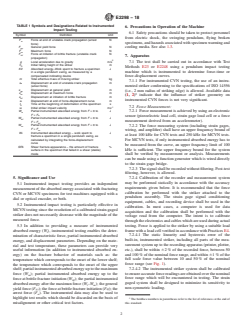
3.1 Definitions—The symbols and definitions applicable to
and comparable absorbed energy measurements to those ob-
instrumented impact testing are indicated in Table 1.
tained in Test Methods E23 and E2248 are achieved.
1.2 The values stated in SI units are to be regarded as
4. Summary of Test Method
standard. No other units of measurement are included in this
4.1 This test method prescribes the requirements for instru-
standard.
mented CVN and MCVN impact tests in accordance withTest
1.3 This standard does not purport to address all of the
Methods E23 and E2248. The E23 and E2248 tests consist of
safety concerns, if any, associated with its use. It is the
breaking by one blow from a swinging pendulum, under
responsibility of the user of this standard to establish appro-
conditions defined hereafter, a specimen notched in the middle
priate safety, health, and environmental practices and deter-
and supported at each end. In order to establish the impact
mine the applicability of regulatory limitations prior to use.
force-displacement diagram, it is necessary to instrument the
1.4 This international standard was developed in accor-
strikerwithstraingages andmeasurethevoltageasafunction
dance with internationally recognized principles on standard-
of time during the impact event. The voltage-time curve is
ization established in the Decision on Principles for the
converted to the force-time curve through a suitable static
Development of International Standards, Guides and Recom-
calibration. The force-displacement relationship is then ob-
mendations issued by the World Trade Organization Technical
tained by double integration of the force-time curve. The area
Barriers to Trade (TBT) Committee.
under the force-displacement curve corresponds to the instru-
mented absorbed energy of the broken specimen.
2. Referenced Documents
4.2 Force-displacement curves for different steels and dif-
2.1 ASTM Standards:
ferent temperatures can vary even though the areas under the
E4Practices for Force Verification of Testing Machines
curves and the absorbed energies are identical. If the force-
E23Test Methods for Notched Bar Impact Testing of Me-
displacementcurvesaredividedintoanumberofcharacteristic
tallic Materials
parts, various phases of the test with characteristic forces,
E177Practice for Use of the Terms Precision and Bias in
displacements, and partial instrumented absorbed energies can
ASTM Test Methods
be deduced. These characteristic values provide additional
information about the fracture behavior of the specimen.
4.3 Application of instrumented test data to the evaluation
This test method is under the jurisdiction of ASTM Committee E28 on
ofmaterialbehavioristheresponsibilityoftheuserofthistest
Mechanical Testing and is the direct responsibility of Subcommittee E28.07 on
Impact Testing. method.
Current edition approved June 1, 2018. Published September 2018. Originally
approved in 2009. Last previous edition approved in 2015 as E2298–15. DOI:
10.1520/E2298-18. Available fromAmerican National Standards Institute (ANSI), 25 W. 43rd St.,
For referenced ASTM standards, visit the ASTM website, www.astm.org, or 4th Floor, New York, NY 10036, http://www.ansi.org.
contact ASTM Customer Service at service@astm.org. For Annual Book of ASTM Thistestmethodreferstostrikersinstrumentedwithstraingages.However,the
Standards volume information, refer to the standard’s Document Summary page on use of piezoelectric load cells or accelerometers is not excluded, provided their
the ASTM website. temperature sensitivity is properly accounted for.
*A Summary of Changes section appears at the end of this standard
Copyright © ASTM International, 100 Barr Harbor Drive, PO Box C700, West Conshohocken, PA 19428-2959. United States
E2298 − 18
TABLE 1 Symbols and Designations Related to Instrumented
6. Precautions in Operation of the Machine
Impact Testing
6.1 Safety precautions should be taken to protect personnel
Symbol Definition Unit
from electric shock, the swinging pendulum, flying broken
F Force at end of unstable crack propagation (arrest N
a
specimens,andhazardsassociatedwithspecimenwarmingand
force)
F General yield force N cooling media. See also 1.3.
gy
F Maximum force N
m
F Force at initiation of brittle fracture (unstable crack N
bf
7. Apparatus
propagation)
g Local acceleration due to gravity m/s
7.1 The test shall be carried out in accordance with Test
h Initial falling height of the striker m
Methods E23 or E2248 using a pendulum impact testing
KV Absorbed energy–Work spent to fracture a specimen J
machine which is instrumented to determine force-time or
in a single pendulum swing, as measured by a
compensated indicating device
force-displacement curves.
m Total effective mass of moving striker kg
7.1.1 For instrumented CVN testing, the use of an instru-
s Displacement at end of unstable crack propagation m
a
mented striker conforming to the specifications of ISO 14556
(arrest force)
s Displacement at general yield m
gy (i.e., 2 mm radius of striking edge) is allowed. Available data
s Displacement at maximum force m 5
m
(1, 2) indicate that the influence of striker geometry on
s Displacement at initiation of brittle fracture m
bf
instrumented CVN forces is not very significant.
s Displacement at end of force-displacement curve m
t
t Time at the beginning of deformation of the specimen s
-1 7.2 Force Measurement:
v Initial striker impact velocity ms
W Partial instrumented absorbed energy from F=0to J 7.2.1 Force measurement is achieved by using an electronic
a
F = F
a
sensor (piezoelectric load cell, strain gage load cell or a force
W Partial instrumented absorbed energy from F=0to J
bf
measurement derived from an accelerometer).
F = F
bf
W Partial instrumented absorbed energy from F=0to J 7.2.2 The force measuring system (including strain gages,
m
F = F
m
wiring, and amplifier) shall have an upper frequency bound of
W Instrumented absorbed energy – work spent to J
t
at least 100 kHz for CVN tests and 250 kHz for MCVN tests.
fracture a specimen in a single pendulum swing, as
calculated by integrating the force-displacement
For MCVN tests, if only instrumented absorbed energy has to
curve
be measured from the curve, an upper frequency limit of 100
SFA Shear fracture appearance – the amount of fracture %
kHz is sufficient. The upper frequency bound for the system
surface in the specimen that failed in a shear (stable)
mode
shall be verified by measurement or analysis. Measurements
canbemadeusingafunctiongeneratorwhichiswireddirectly
to the strain gage bridge.
7.2.3 Thesignalshallberecordedwithoutfiltering.Post-test
filtering, however, is allowed.
5. Significance and Use
7.2.4 Calibration of the recorder and measurement system
may be performed statically in accordance with the accuracy
5.1 Instrumented impact testing provides an independent
requirements given below. It is recommended that the force
measurementoftheabsorbedenergyassociatedwithfracturing
calibration be performed with the striker attached to the
CVN or MCVN specimens for test machines equipped with a
pendulum assembly. The strain gage signal conditioning
dial or optical encoder, or both.
equipment, cables, and recording device shall be used in the
5.2 Instrumented impact testing is particularly effective in
calibration. In most cases, a computer is used for data
MCVNtestingsincetheresolutionofacalibratedstrain-gaged
acquisition and the calibration shall be performed with the
striker does not necessarily decrease with the magnitude of the
voltage read from the computer. The intent is to calibrate
measured force.
throughtheelectronicsandcableswhichareusedduringactual
testing. Force is applied to the striker by using a suitable load
5.3 In addition to providing a measure of instrumented
framewithaloadcellverifiedinaccordancewithPracticesE4.
absorbed energy (W), instrumented testing enables the deter-
t
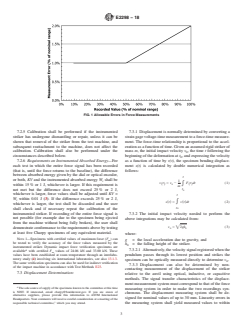
7.2.4.1 The static linearity and hysteresis error of the
mination of characteristic force, partial instrumented absorbed
built-in, instrumented striker, including all parts of the mea-
energy, and displacement parameters. Depending on the mate-
surementsystemuptotherecordingapparatus(printer,plotter,
rial and test temperature, these parameters can provide very
etc.), shall be within 62% of the recorded force, between 50
useful information (in addition to instrumented absorbed en-
and100%ofthenominalforcerange,andwithin 61%ofthe
ergy) on the fracture behavior of materials such as: the
full scale force value between 10 and 50% of the nominal
temperature which corresponds to the onset of the lower shelf;
force range (see Fig. 1).
the temperature which corresponds to the onset of the upper
7.2.4.2 The instrumented striker system shall be calibrated
shelf;partialinstrumentedabsorbedenergyuptothemaximum
toensureaccurateforcereadingsareobtainedoverthenominal
force (W ); partial instrumented absorbed energy up to the
m
force range which will be encountered in testing. The strain
forceatbrittlefractureinitiation(W );thepartialinstrumented
bf
gaged system shall be designed to minimize its sensitivity to
absorbedenergyafterthemaximunforce(W–W );thegeneral
t m
non-symmetric loading.
yieldforce(F );theforceatbrittlefractureinitiation(F );the
gy bf
arrest force (F ). The instrumented data may also be used to
a
highlight test results which should be discarded on the basis of
Theboldfacenumbersinparenthesesrefertothelistofreferencesattheendof
misalignment or other critical test factors. this standard.
E2298 − 18
FIG. 1 Allowable Errors in Force Measurements
7.2.5 Calibration shall be performed if the instrumented 7.3.1 Displacement is normally determined by converting a
striker has undergone dismantling or repair, unless it can be straingagevoltage-timemeasurementtoaforce-timemeasure-
shown that removal of the striker from the test machine, and ment. The force-time relationship is proportional to the accel-
subsequent reattachment to the machine, does not affect the erationasafunctionoftime.Givenanassumedrigidstrikerof
calibration. Calibration shall also be performed under the mass m, the initial impact velocity v , the time t following the
circumstances described below. beginning of the deformation at t , and expressing the velocity
7.2.6 Requirements on Instrumented Absorbed Energy—For as a function of time by v(t), the specimen bending displace-
each test in which the entire force signal has been recorded ment s(t) is calculated by double numerical integration as
(that is, until the force returns to the baseline), the difference follows:
between absorbed energy given by the dial or optical encoder,
t
or both, KV and the instrumented absorbed energy W shall be
t
v t 5 v 2 F t dt (1)
~ ! * ~ !
within 15% or 1 J, whichever is larger. If this requirement is
m
t
not met but the difference does not exceed 25% or 2 J,
whichever is larger, force values shall be adjusted until KV =
t
W within 0.01 J (3). If the difference exceeds 25% or 2 J,
t
s t 5 v t dt (2)
~ ! * ~ !
whichever is larger, the test shall be discarded and the user
t
shall check and if necessary repeat the calibration of the
instrumented striker. If recording of the entire force signal is
7.3.2 The initial impact velocity needed to perform the
not possible (for example due to the specimen being ejected
above integrations may be calculated from:
from the machine without being fully broken), the user shall
v 5 =2gh (3)
demonstrateconformancetotherequirementsabovebytesting 0 0
at least five Charpy specimens of any equivalent material.
where:
NOTE 1—Specimens with certified values of maximum force (F ) can g = the local acceleration due to gravity, and
m
be tested to verify the accuracy of the force values measured by the
h = the falling height of the striker.
instrumented striker. Dynamic impact force verification specimens are
7.3.2.1 Alternatively,thevelocitysignalregisteredwhenthe
available with certified F values of 24.06 kN and 33.00 kN. These
m
pendulum passes through its lowest position and strikes the
values have been established at room temperature through an interlabo-
ratory study (4) involving six international laboratories, see also 13.1.3.
specimen can be optically measured directly to determine v .
The same verification specimens can also be used for indirect verification
7.3.3 Displacement can also be determined by non-
of the impact machine in accordance with Test Methods E23.
contacting measurement of the displacement of the striker
7.3 Displacement Determination:
relative to the anvil using optical, inductive, or capacitive
methods. The signal transfer characteristics of the displace-
mentmeasurementsystemmustcorrespondtothatoftheforce
Thesolesourceofsupplyofthespecimensknowntothecommitteeatthistime
measuring system in order to make the two recordings syn-
is NIST. If interested, email charpy@boulder.nist.gov. If you are aware of
chronous. The displacement measuring system shall be de-
alternative suppliers, please provide this information to ASTM International
signed for nominal values of up to 30 mm. Linearity errors in
Headquarters.Your comments will receive careful consideration at a meeting of the
responsible technical committee, which you may attend. the measuring system shall yield measured values to within
E2298 − 18
+2% in the range 1–30 mm. Measurements between zero and 10.3 Characteristic Values of Displacement—The forces
1 mm may not be sufficiently accurate to determine the defined in 10.2 have corresponding displacements which are
displacement. In such cases, it is recommended that the giventhesamesubscriptsastheforces.Inaddition,adisplace-
displacement of the specimen be determined from time mea- mentcorrespondingtotheendoftheforce-displacementcurve,
surement and the striker impact velocity as indicated in Eq 1 s, is defined.
t
and 2. 10.3.1 The displacement at the onset of general yielding of
the ligament is s .
gy
7.4 Recording Apparatus:
10.3.2 The displacement at maximum force is s .
m
7.4.1 The minimum data acquisition requirement is a 10-bit
10.3.3 The displacement at the initiation of unstable crack
analog-digitalconverterwithaminimumsamplingrateof1000
propagation is s .
bf
data points per millisecond. However, 12-bit or more is
10.3.4 Thedisplacementattheend(arrest)ofunstablecrack
recommended. A minimum storage capacity of 8000 data
propagation is s (generally, s is approximately equal to s
a a bf
points is required.
due to the steep drop in the force-displacement curve between
7.4.2 The instrumented absorbed energy shall be compared
F and F ).
bf a
withtheabsorbedenergyshownbythemachinedialoroptical
10.3.5 The displacement at the end of the force-
encoder, or both. For requirements on the comparison between
displacement curve is s. This point is defined as the displace-
t
KV and W, refer to 7.2.6.
t
ment at which the force has decreased to the pre-test baseline
8. Test Specimens value.
8.1 The CVN specimens shall be in accordance with Test
10.4 Characteristic Values of Partial Instumented Absorbed
Methods E23. The MCVN specimens shall be in accordance Energy:
with Test Method E2248.
10.4.1 Given the force definitions in 10.1, the force-
displacement curve may be partitioned and corresponding
9. Procedure
partialinstrumentedabsorbedenergiesmaybedetermined.The
9.1 Specimen Testing—Thetestisperformedusingthesame
values of the partial instrumented absorbed energies are given
procedure as the CVN or MCVN impact test according toTest
thesamesubscriptastheforceattheendoftheappropriatepart
Methods E23 or E2248, respectively. In addition, the voltage-
of the force-displacement curve.
time curve is measured and evaluated to give the force-
10.4.2 The area under the complete force-displacement
displacementcurve.Theforce-displacementcurveisevaluated
curve up to s is the instrumented absorbed energy with the
t
withrespecttothecharacteristicphasesofthedeformationand
abbreviation W.
t
fracture stages.
10.4.3 The partial instrumented absorbed energy up to
maximum force is W .
9.2 Data Acquisition—The high speed acquisition system m
10.4.4 The partial instrumented absorbed energy up to the
(the portion of the system which is capable of storing the
force at the initiation of unstable crack propagation is W .
dynamic response signal) shall be triggered such that baseline bf
10.4.5 The partial instrumented absorbed energy up to the
data before loading and after fracture (or release of the
force at the arrest of unstable crack propagation is W (on
specimen from the anvils) is retained in computer memory. a
account of the steep drop in the force-displacement curve
10. Characteristics of the Force-Displacement Curve
between F and F , it is generally the case that W is
bf a bf
approximately equal to W ).
10.1 Type of Force-Displacement Curve—Representative a
force-displacement curves and their characteristic force value
...
This document is not an ASTM standard and is intended only to provide the user of an ASTM standard an indication of what changes have been made to the previous version. Because
it may not be technically possible to adequately depict all changes accurately, ASTM recommends that users consult prior editions as appropriate. In all cases only the current version
of the standard as published by ASTM is to be considered the official document.
Designation: E2298 − 15 E2298 − 18
Standard Test Method for
Instrumented Impact Testing of Metallic Materials
This standard is issued under the fixed designation E2298; the number immediately following the designation indicates the year of
original adoption or, in the case of revision, the year of last revision. A number in parentheses indicates the year of last reapproval. A
superscript epsilon (´) indicates an editorial change since the last revision or reapproval.
1. Scope*
1.1 This test method establishes the requirements for performing instrumented Charpy V-NotchV-notch (CVN) and
instrumented Miniaturizedminiaturized Charpy V-NotchV-notch (MCVN) impact tests on metallic materials. This method, which
is based on experience developed testing steels, provides further information (in addition to the total absorbed energy) on the
fracture behavior of the tested materials. Minimum requirements are given for measurement and recording equipment such that
similar sensitivity and comparable total absorbed energy measurements to those obtained in Test Methods E23 and E2248 are
achieved.
1.2 The values stated in SI units are to be regarded as standard. No other units of measurement are included in this standard.
1.3 This standard does not purport to address all of the safety concerns, if any, associated with its use. It is the responsibility
of the user of this standard to establish appropriate safety safety, health, and healthenvironmental practices and determine the
applicability of regulatory limitations prior to use.
1.4 This international standard was developed in accordance with internationally recognized principles on standardization
established in the Decision on Principles for the Development of International Standards, Guides and Recommendations issued
by the World Trade Organization Technical Barriers to Trade (TBT) Committee.
2. Referenced Documents
2.1 ASTM Standards:
A370 Test Methods and Definitions for Mechanical Testing of Steel Products
E4 Practices for Force Verification of Testing Machines
E23 Test Methods for Notched Bar Impact Testing of Metallic Materials
E177 Practice for Use of the Terms Precision and Bias in ASTM Test Methods
E691 Practice for Conducting an Interlaboratory Study to Determine the Precision of a Test Method
E2248 Test Method for Impact Testing of Miniaturized Charpy V-notch Specimens
2.2 ISO Standard:
ISO 14556 Steel—Charpy V-notch Pendulum Impact Tests—Instrumented Test Method
3. Terminology
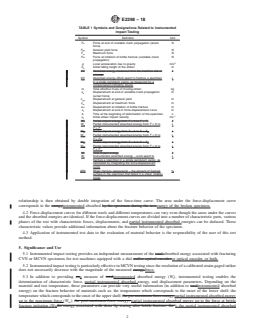
3.1 Definitions—The symbols and definitions applicable to instrumented impact testing are indicated in Table 1.
4. Summary of Test Method
4.1 This test method prescribes the requirements for instrumented CVN and MCVN impact tests in accordance with Test
Methods E23 and E2248. The E23 and E2248 tests consist of breaking by one blow from a swinging pendulum, under conditions
defined hereafter, a specimen notched in the middle and supported at each end. In order to establish the impact force-displacement
diagram, it is necessary to instrument the striker with strain gages and measure the voltage as a function of time during the impact
event. The voltage-time curve is converted to the force-time curve through a suitable static calibration. The force-displacement
This test method is under the jurisdiction of ASTM Committee E28 on Mechanical Testing and is the direct responsibility of Subcommittee E28.07 on Impact Testing.
Current edition approved Oct. 1, 2015June 1, 2018. Published December 2015September 2018. Originally approved in 2009. Last previous edition approved in 20132015
as E2298–13a.–15. DOI: 10.1520/E2298-15.10.1520/E2298-18.
For referenced ASTM standards, visit the ASTM website, www.astm.org, or contact ASTM Customer Service at service@astm.org. For Annual Book of ASTM Standards
volume information, refer to the standard’s Document Summary page on the ASTM website.
Available from American National Standards Institute (ANSI), 25 W. 43rd St., 4th Floor, New York, NY 10036, http://www.ansi.org.
This test method refers to strikers instrumented with strain gages. However, the use of piezoelectric load cells or accelerometers is not excluded, provided their
temperature sensitivity is properly accounted for.
*A Summary of Changes section appears at the end of this standard
Copyright © ASTM International, 100 Barr Harbor Drive, PO Box C700, West Conshohocken, PA 19428-2959. United States
E2298 − 18
TABLE 1 Symbols and Designations Related to Instrumented
Impact Testing
Symbol Definition Unit
F Force at end of unstable crack propagation (arrest N
a
force)
F General yield force N
gy
F Maximum force N
m
F Force at initiation of brittle fracture (unstable crack N
bf
propagation)
g Local acceleration due to gravity m/s
h Initial falling height of the striker m
KV Absorbed energy measured from the machine dial or J
encoder
KV Absorbed energy–Work spent to fracture a specimen J
in a single pendulum swing, as measured by a
compensated indicating device
m Total effective mass of moving striker kg
s Displacement at end of unstable crack propagation m
a
(arrest force)
s Displacement at general yield m
gy
s Displacement at maximum force m
m
s Displacement at initiation of brittle fracture m
bf
s Displacement at end of force-displacement curve m
t
t Time at the beginning of deformation of the specimen s
-1
v Initial striker impact velocity ms
W Partial impact energy from F = 0 to F = F J
a a
W Partial instrumented absorbed energy from F = 0 to J
a
F = F
a
W Partial impact energy from F = 0 to F = F J
bf bf
W Partial instrumented absorbed energy from F = 0 to J
bf
F = F
bf
W Partial impact energy from F = 0 to F = F J
m m
W Partial instrumented absorbed energy from F = 0 to J
m
F = F
m
W Total impact energy J
t
W Instrumented absorbed energy – work spent to J
t
fracture a specimen in a single pendulum swing, as
calculated by integrating the force-displacement
curve
SFA Shear fracture appearance – the amount of fracture %
surface in the specimen that failed in a shear (stable)
mode
relationship is then obtained by double integration of the force-time curve. The area under the force-displacement curve
corresponds to the energyinstrumented absorbed by the specimen during the test.energy of the broken specimen.
4.2 Force-displacement curves for different steels and different temperatures can vary even though the areas under the curves
and the absorbed energies are identical. If the force-displacement curves are divided into a number of characteristic parts, various
phases of the test with characteristic forces, displacements, and partial instrumented absorbed energies can be deduced. These
characteristic values provide additional information about the fracture behavior of the specimen.
4.3 Application of instrumented test data to the evaluation of material behavior is the responsibility of the user of this test
method.
5. Significance and Use
5.1 Instrumented impact testing provides an independent measurement of the total absorbed energy associated with fracturing
CVN or MCVN specimens for test machines equipped with a dial and/or optical encoder.or optical encoder, or both.
5.2 Instrumented impact testing is particularly effective in MCVN testing since the resolution of a calibrated strain-gaged striker
does not necessarily decrease with the magnitude of the measured energy.force.
5.3 In addition to providing ana measure of totalinstrumented absorbed energy (W ), instrumented testing enables the
t
determination of characteristic force, partial instrumented absorbed energy, and displacement parameters. Depending on the
material and test temperature, these parameters can provide very useful information (in addition to totalinstrumented absorbed
energy) on the fracture behavior of materials such as: the temperature which corresponds to the onset of the lower shelf; the
temperature which corresponds to the onset of the upper shelf; the pre-maximum force energy partial instrumented absorbed energy
up to the maximum force (W ); the post-maximum force energy; partial instrumented absorbed energy up to the force at brittle
m
fracture initiation (W the energy associated with shear lip tearing after brittle fracture; the ); the partial instrumented absorbed
bf
E2298 − 18
energy after the maximun force (W –W ); the general yield force (F ); the force at brittle fracture initiation (F ); the arrest force
t m gy bf
(F ). The instrumented data may also be used to highlight test results which should be discarded on the basis of misalignment or
a
other critical test factors.
6. Precautions in Operation of the Machine
6.1 Safety precautions should be taken to protect personnel from electric shock, the swinging pendulum, flying broken
specimens, and hazards associated with specimen warming and cooling media. See also 1.3.
7. Apparatus
7.1 The test shall be carried out in accordance with Test Methods E23 or E2248 using a pendulum impact testing machine which
is instrumented to determine force-time or force-displacement curves.
7.1.1 For instrumented CVN testing, the use of an instrumented striker conforming to the specifications of ISO 14556 (i.e., 2
mm radius of striking edge) is allowed. Available data (1, 2) indicate that the influence of striker geometry on instrumented CVN
forces is not very significant.
7.2 Force Measurement:
7.2.1 Force measurement is achieved by using an electronic sensor (piezoelectric load cell, strain gage load cell or a force
measurement derived from an accelerometer).
7.2.2 The force measuring system (including strain gages, wiring, and amplifier) shall have an upper frequency bound of at least
100 kHz for CVN tests and 250 kHz for MCVN tests. For MCVN tests, if only instrumented absorbed energy has to be measured
from the curve, an upper frequency limit of 100 kHz is sufficient. The upper frequency bound for the system shall be verified by
measurement or analysis. Measurements can be made using a function generator which is wired directly to the strain gage bridge.
7.2.3 The signal shall be recorded without filtering. Post-test filtering, however, is allowed.
7.2.4 Calibration of the recorder and measurement system may be performed statically in accordance with the accuracy
requirements given below. It is recommended that the force calibration be performed with the striker attached to the pendulum
assembly. The strain gage signal conditioning equipment, cables, and recording device shall be used in the calibration. In most
cases, a computer is used for data acquisition and the calibration shall be performed with the voltage read from the computer. The
intent is to calibrate through the electronics and cables which are used during actual testing. Force is applied to the striker by using
a suitable load frame with a load cell verified in accordance with Practices E4.
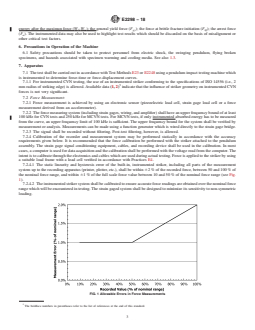
7.2.4.1 The static linearity and hysteresis error of the built-in, instrumented striker, including all parts of the measurement
system up to the recording apparatus (printer, plotter, etc.), shall be within 62 % of the recorded force, between 50 and 100 % of
the nominal force range, and within 61 % of the full scale force value between 10 and 50 % of the nominal force range (see Fig.
1).
7.2.4.2 The instrumented striker system shall be calibrated to ensure accurate force readings are obtained over the nominal force
range which will be encountered in testing. The strain gaged system shall be designed to minimize its sensitivity to non-symmetric
loading.
FIG. 1 Allowable Errors in Force Measurements
The boldface numbers in parentheses refer to the list of references at the end of this standard.
E2298 − 18
7.2.5 Calibration shall be performed if the instrumented striker has undergone dismantling or repair, unless it can be shown that
removal of the striker from the test machine, and subsequent reattachment to the machine, does not affect the calibration.
Calibration shall also be performed under the circumstances described below.
7.2.6 Requirements on Instrumented Absorbed Energy—For each test in which the entire force signal has been recorded (i.e.,
(that is, until the force returns to the baseline), the difference between absorbed energy given by the dial and/or optical encoder
or optical encoder, or both, KV and the total impactinstrumented absorbed energy W shall be within 15 % or 1 J, whichever is
t
larger. If this requirement is not met but the difference does not exceed 25 % or 2 J, whichever is larger, force values shall be
adjusted until KV = W within 0.01 J (3). If the difference exceeds 25 % or 2 J, whichever is larger, the test shall be discarded and
t
the user shall check and if necessary repeat the calibration of the instrumented striker. If recording of the entire force signal is not
possible (for example due to the specimen being ejected from the machine without being fully broken), the user shall demonstrate
conformance to the requirements above by testing at least five Charpy specimens of any equivalent material.
NOTE 1—Specimens with certified values of maximum force (F ) can be tested to verify the accuracy of the force values measured by the instrumented
m
striker. Dynamic impact force verification specimens are available with certified F values of 24.06 kN and 33.00 kN. These values have been established
m
at room temperature through an interlaboratory study (4) involving six international laboratories, see also 13.1.3. The same verification specimens can
also be used to verify the absorbed energy scale for indirect verification of the impact machine in accordance with Test Methods E23 at either -40 °C
6 1 °C or room temperature (21 °C 6 1 °C).
7.3 Displacement Determination:
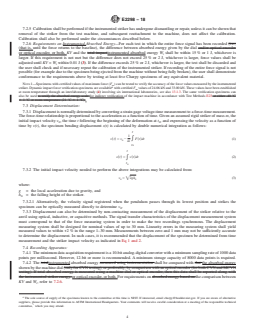
7.3.1 Displacement is normally determined by converting a strain gage voltage-time measurement to a force-time measurement.
The force-time relationship is proportional to the acceleration as a function of time. Given an assumed rigid striker of mass m, the
initial impact velocity v , the time t following the beginning of the deformation at t , and expressing the velocity as a function of
0 0
time by v(t), the specimen bending displacement s(t) is calculated by double numerical integration as follows:
t
v t 5 v 2 F t dt (1)
~ ! * ~ !
m
t
t
s t 5 v t dt (2)
~ ! * ~ !
t
7.3.2 The initial impact velocity needed to perform the above integrations may be calculated from:
v 5=2gh (3)
0 0
where:
g = the local acceleration due to gravity, and
h = the falling height of the striker.
7.3.2.1 Alternatively, the velocity signal registered when the pendulum passes through its lowest position and strikes the
specimen can be optically measured directly to determine v .
7.3.3 Displacement can also be determined by non-contacting measurement of the displacement of the striker relative to the
anvil using optical, inductive, or capacitive methods. The signal transfer characteristics of the displacement measurement system
must correspond to that of the force measuring system in order to make the two recordings synchronous. The displacement
measuring system shall be designed for nominal values of up to 30 mm. Linearity errors in the measuring system shall yield
measured values to within +2 % in the range 1–30 mm. Measurements between zero and 1 mm may not be sufficiently accurate
to determine the displacement. In such cases, it is recommended that the displacement of the specimen be determined from time
measurement and the striker impact velocity as indicated in Eq 1 and 2.
7.4 Recording Apparatus:
7.4.1 The minimum data acquisition requirement is a 10-bit analog-digital converter with a minimum sampling rate of 1000 data
points per millisecond. However, 12-bit or more is recommended. A minimum storage capacity of 8000 data points is required.
7.4.2 The totalinstrumented absorbed energy measured using instrumentation shall be compared with that the absorbed energy
shown by the machine dial (only for CVN testing), or preferably, by comparison with an optical encoder (for both CVN and MCVN
testing). If total absorbed energy is measured using a machine dial or optical encoder, then this data shall be reported along with
the instrumented striker energy. or optical encoder, or both. For requirements on absorbed energy based on the comparison between
KV and W , refer to 7.2.6.
t
The sole source of supply of the specimens known to the committee at this time is NIST. If interested, email charpy@boulder.nist.gov. If you are aware of alternative
suppliers, please provide this information to ASTM International Headquarters. Your comments will receive careful consideration at a meeting of the responsible technical
committee, which you may attend.
E2298 − 18
8. Test Specimens
8.1 The CVN specimens shall be in accordance with Test MethodMethods E23. The MCVN specimens shall be in accordance
with Test Method E2248.
9. Procedure
9.1 Specimen Testing—The test is performed inusing the same wayprocedure as the CVN or MCVN impact test according to
Test Methods E23 or E2248, respectively. In addition, the voltage-time curve is measured and evaluated to give the
force-displacement curve. The force-displacement curve is evaluated with respect to the characteristic phases of the deformation
and fracture stages.
9.2 Data Acquisition—The high speed acquisition system (the portion of the system which is capable of storing the dynamic
response signal) shall be triggered such that baseline data before loading and after fracture (or release of the specimen from the
anvils) is retained in computer memory.
10. Characteristics of the Force-Displacement Curve
10.1 Type of Force-Displacement Curve—Representative force-displacement curves and their characteristic force values are
illustrated in Fig. 2.
10.2 Characteristic Values of Force:
10.2.1 The general yield force F is the force at the transition point from the initial linear elastic part, discarding the inertia
gy
peaks (normally one, unless the specimen was not fully in contact with the anvils), to the curved increasing part of the
force-displacement curve. It serves, to a first approximation, as an indication of yielding across the entire ligament.
10.2.2 The maximum force F corresponds to the maximum value of the curve fitted through the oscillations of the
m
force-displacement curve following the onset of yield of the entire ligament.
10.2.3 The force at the initiation of unstable crack propagation F is the force at the beginning of the steep drop in the
bf
force-displacement curve. It characterizes the beginning of unstable crack propagation.
10.2.4 The force at the end (arrest) of unstable crack propagation is F .
a
10.3 Characteristic Values of Displacement—The forces defined in 10.2 have corresponding displacements which are given the
same subscripts as the forces. In addition, a displacement corresponding to the end of the force-displacement curve, s , is defined.
t
10.3.1 The displacement at the onset of general yielding of the ligament is s .
gy
10.3.2 The displacement at maximum force is s .
m
10.3.3 The displacement at the initiation of unstable crack propagation is s .
bf
10.3.4 The displacement at the end (arrest) of unstable crack propagation is s (generally, s is approximately equal to s due
a a bf
to the steep drop in the force-displacement curve between F and F ).
bf a
10.3.5 The displacement at the end of the force-displacement curve is s . This point is defined a
...