

ASTM D2386-19
(Test Method)Standard Test Method for Freezing Point of Aviation Fuels
General Information
- Abstract
SIGNIFICANCE AND USE
4.1 The freezing point of an aviation fuel is the lowest temperature at which the fuel remains free of solid hydrocarbon crystals that can restrict the flow of fuel through filters if present in the fuel system of the aircraft. The temperature of the fuel in the aircraft tank normally falls during flight depending on aircraft speed, altitude, and flight duration. The freezing point of the fuel must always be lower than the minimum operational tank temperature.
4.2 Freezing point is a requirement in Specifications D910 and D1655.
SCOPE
1.1 This test method covers the determination of the temperature below which solid hydrocarbon crystals may form in aviation turbine fuels and aviation gasoline. If no crystallization point or freezing point can be measured, this test can be used to report the lowest measurable temperature reached before the crystallization point.
Note 1: The interlaboratory program that generated the precisions for this test method did not include aviation gasoline.
1.2 The values stated in SI units are to be regarded as standard. No other units of measurement are included in this standard.
1.3 This standard does not purport to address all of the safety concerns, if any, associated with its use. It is the responsibility of the user of this standard to establish appropriate safety, health, and environmental practices and determine the applicability of regulatory limitations prior to use. For specific warning statements, see 5.4, Section 6, and 8.3.
1.4 This international standard was developed in accordance with internationally recognized principles on standardization established in the Decision on Principles for the Development of International Standards, Guides and Recommendations issued by the World Trade Organization Technical Barriers to Trade (TBT) Committee.
- Status
- Published
- Publication Date
- 30-Apr-2019
- Technical Committee
- D02 - Petroleum Products, Liquid Fuels, and Lubricants
- Drafting Committee
- D02.07 - Flow Properties
Overview
ASTM D2386-19: Standard Test Method for Freezing Point of Aviation Fuels is a widely recognized standard published by ASTM International. This method outlines a laboratory procedure for determining the freezing point of aviation turbine fuels and aviation gasoline. The freezing point is critical for aircraft operations, as fuels must remain free of solid hydrocarbon crystals under all expected operating temperatures to ensure safe and reliable flow through aircraft fuel systems.
The test method aids in preventing operational problems arising from fuel solidification during flight, especially at high altitudes or extended durations. Compliance with this standard is integral to meeting the requirements set forth in other aviation fuel specifications such as ASTM D910 and ASTM D1655.
Key Topics
- Freezing Point Determination: The procedure specifies how to identify the lowest temperature at which aviation fuel remains unfrozen and free of solid hydrocarbon crystals.
- Solid Hydrogen Crystal Formation: Defines critical temperatures where solid hydrocarbon crystals appear (crystallization point) and disappear, marking the freezing point-a key performance characteristic of aviation fuels.
- Applicable to Jet Fuels and Aviation Gasoline: The standard covers both aviation turbine fuels and aviation gasoline, impacting a broad spectrum of fuel products in the aviation sector.
- Precision and Repeatability: Specifies that the standard utilizes SI units and defines repeatability (typically within 1.5°C) and reproducibility (typically within 2.5°C) between laboratories.
- Significance for Aircraft Safety: Emphasizes that fuel freezing points must always be lower than the minimum operational temperature of aircraft tanks to avoid fuel blockages during flight.
- Health and Safety Considerations: The standard highlights the importance of following safety, health, and environmental practices during sampling, specimen preparation, and testing.
Applications
ASTM D2386-19 is essential across multiple aspects of the aviation and petroleum industries:
- Fuel Quality Assurance: Ensures that aviation fuels supplied to aircraft meet stringent low temperature flow characteristics for operational reliability and safety.
- Compliance for Manufacturers and Suppliers: Adoption of this test method is often required by regulatory bodies and specifies within aviation fuel contracts.
- Laboratory Analysis: Used in fuel testing laboratories worldwide for both routine quality control and during product certification.
- Regulatory Certification: Required for compliance with international aviation fuel specifications, underpinning certifications for jet fuels and aviation gasoline.
- Field Investigations: Supports troubleshooting and failure analysis in situations where suspected low temperature fuel flow problems arise.
Related Standards
ASTM D2386-19 references and relates to the following standards, supporting comprehensive fuel quality testing and specification compliance:
- ASTM D910: Specification for Leaded Aviation Gasolines
- ASTM D1655: Specification for Aviation Turbine Fuels
- ASTM D4057: Practice for Manual Sampling of Petroleum and Petroleum Products
- ASTM D4177: Practice for Automatic Sampling of Petroleum and Petroleum Products
- ASTM E1: Specification for ASTM Liquid-in-Glass Thermometers
- ASTM E77: Test Method for Inspection and Verification of Thermometers
For laboratories and fuel suppliers, ensuring conformity with ASTM D2386-19 and its related standards is critical for maintaining fuel safety, aircraft performance, and regulatory compliance in the global aviation industry.
Keywords: ASTM D2386-19, freezing point of aviation fuels, aviation turbine fuel test, jet fuel quality, aviation gasoline, hydrocarbon crystal formation, aviation fuel safety, low temperature fuel flow, fuel quality control, aircraft fuel standards.
Relations
- Effective Date
- 15-Mar-2024
- Effective Date
- 01-Mar-2024
- Effective Date
- 01-Oct-2023
- Effective Date
- 01-Dec-2019
- Effective Date
- 01-Jan-2018
- Effective Date
- 01-Dec-2017
- Effective Date
- 01-Oct-2017
- Effective Date
- 01-May-2017
- Effective Date
- 01-Dec-2016
- Effective Date
- 01-Oct-2016
- Effective Date
- 01-Sep-2016
- Effective Date
- 01-Jun-2016
- Effective Date
- 01-Apr-2016
- Effective Date
- 01-Oct-2015
- Effective Date
- 15-Jul-2015
Get Certified
Connect with accredited certification bodies for this standard

Element Materials Technology
Materials testing and product certification.

ABS Group Brazil
ABS Group certification services in Brazil.

ABS Quality Evaluations Inc.
American Bureau of Shipping quality certification.
Sponsored listings
Frequently Asked Questions
ASTM D2386-19 is a standard published by ASTM International. Its full title is "Standard Test Method for Freezing Point of Aviation Fuels". This standard covers: SIGNIFICANCE AND USE 4.1 The freezing point of an aviation fuel is the lowest temperature at which the fuel remains free of solid hydrocarbon crystals that can restrict the flow of fuel through filters if present in the fuel system of the aircraft. The temperature of the fuel in the aircraft tank normally falls during flight depending on aircraft speed, altitude, and flight duration. The freezing point of the fuel must always be lower than the minimum operational tank temperature. 4.2 Freezing point is a requirement in Specifications D910 and D1655. SCOPE 1.1 This test method covers the determination of the temperature below which solid hydrocarbon crystals may form in aviation turbine fuels and aviation gasoline. If no crystallization point or freezing point can be measured, this test can be used to report the lowest measurable temperature reached before the crystallization point. Note 1: The interlaboratory program that generated the precisions for this test method did not include aviation gasoline. 1.2 The values stated in SI units are to be regarded as standard. No other units of measurement are included in this standard. 1.3 This standard does not purport to address all of the safety concerns, if any, associated with its use. It is the responsibility of the user of this standard to establish appropriate safety, health, and environmental practices and determine the applicability of regulatory limitations prior to use. For specific warning statements, see 5.4, Section 6, and 8.3. 1.4 This international standard was developed in accordance with internationally recognized principles on standardization established in the Decision on Principles for the Development of International Standards, Guides and Recommendations issued by the World Trade Organization Technical Barriers to Trade (TBT) Committee.
SIGNIFICANCE AND USE 4.1 The freezing point of an aviation fuel is the lowest temperature at which the fuel remains free of solid hydrocarbon crystals that can restrict the flow of fuel through filters if present in the fuel system of the aircraft. The temperature of the fuel in the aircraft tank normally falls during flight depending on aircraft speed, altitude, and flight duration. The freezing point of the fuel must always be lower than the minimum operational tank temperature. 4.2 Freezing point is a requirement in Specifications D910 and D1655. SCOPE 1.1 This test method covers the determination of the temperature below which solid hydrocarbon crystals may form in aviation turbine fuels and aviation gasoline. If no crystallization point or freezing point can be measured, this test can be used to report the lowest measurable temperature reached before the crystallization point. Note 1: The interlaboratory program that generated the precisions for this test method did not include aviation gasoline. 1.2 The values stated in SI units are to be regarded as standard. No other units of measurement are included in this standard. 1.3 This standard does not purport to address all of the safety concerns, if any, associated with its use. It is the responsibility of the user of this standard to establish appropriate safety, health, and environmental practices and determine the applicability of regulatory limitations prior to use. For specific warning statements, see 5.4, Section 6, and 8.3. 1.4 This international standard was developed in accordance with internationally recognized principles on standardization established in the Decision on Principles for the Development of International Standards, Guides and Recommendations issued by the World Trade Organization Technical Barriers to Trade (TBT) Committee.
ASTM D2386-19 is classified under the following ICS (International Classification for Standards) categories: 75.160.20 - Liquid fuels. The ICS classification helps identify the subject area and facilitates finding related standards.
ASTM D2386-19 has the following relationships with other standards: It is inter standard links to ASTM D1655-24, ASTM D910-24, ASTM D1655-23a, ASTM D910-19, ASTM D1655-18, ASTM D1655-17a, ASTM D910-17a, ASTM D910-17, ASTM D1655-16c, ASTM D910-16a, ASTM D1655-16b, ASTM D1655-16, ASTM D910-16, ASTM D1655-15d, ASTM D1655-15b. Understanding these relationships helps ensure you are using the most current and applicable version of the standard.
ASTM D2386-19 is available in PDF format for immediate download after purchase. The document can be added to your cart and obtained through the secure checkout process. Digital delivery ensures instant access to the complete standard document.
Standards Content (Sample)
This international standard was developed in accordance with internationally recognized principles on standardization established in the Decision on Principles for the
Development of International Standards, Guides and Recommendations issued by the World Trade Organization Technical Barriers to Trade (TBT) Committee.
Designation: D2386 − 19
Designation: 16/15
Standard Test Method for
Freezing Point of Aviation Fuels
This standard is issued under the fixed designation D2386; the number immediately following the designation indicates the year of
original adoption or, in the case of revision, the year of last revision.Anumber in parentheses indicates the year of last reapproval.A
superscript epsilon (´) indicates an editorial change since the last revision or reapproval.
This standard has been approved for use by agencies of the U.S. Department of Defense.
1. Scope* Fuels (Withdrawn 2010)
D4057Practice for Manual Sampling of Petroleum and
1.1 This test method covers the determination of the tem-
Petroleum Products
perature below which solid hydrocarbon crystals may form in
D4177Practice for Automatic Sampling of Petroleum and
aviation turbine fuels and aviation gasoline. If no crystalliza-
Petroleum Products
tion point or freezing point can be measured, this test can be
E1Specification for ASTM Liquid-in-Glass Thermometers
used to report the lowest measurable temperature reached
E77Test Method for Inspection and Verification of Ther-
before the crystallization point.
mometers
NOTE 1—The interlaboratory program that generated the precisions for
2.2 Energy Institute Standard:
this test method did not include aviation gasoline. 4
IP Standards for Petroleum and Its Products IP 16/15
1.2 The values stated in SI units are to be regarded as
3. Terminology
standard. No other units of measurement are included in this
standard.
3.1 Definitions of Terms Specific to This Standard:
3.1.1 freezing point, n—in aviation fuels, the fuel tempera-
1.3 This standard does not purport to address all of the
ture at which solid hydrocarbon crystals, formed on cooling,
safety concerns, if any, associated with its use. It is the
disappear when the temperature of the fuel is allowed to rise
responsibility of the user of this standard to establish appro-
under specified conditions of test.
priate safety, health, and environmental practices and deter-
mine the applicability of regulatory limitations prior to use.
3.1.2 crystallization point, n—the temperature at which
For specific warning statements, see 5.4, Section 6, and 8.3.
crystals of hydrocarbons first appear when the test sample is
1.4 This international standard was developed in accor-
cooled.
dance with internationally recognized principles on standard-
4. Significance and Use
ization established in the Decision on Principles for the
Development of International Standards, Guides and Recom-
4.1 The freezing point of an aviation fuel is the lowest
mendations issued by the World Trade Organization Technical
temperature at which the fuel remains free of solid hydrocar-
Barriers to Trade (TBT) Committee.
bon crystals that can restrict the flow of fuel through filters if
presentinthefuelsystemoftheaircraft.Thetemperatureofthe
2. Referenced Documents
fuel in the aircraft tank normally falls during flight depending
on aircraft speed, altitude, and flight duration. The freezing
2.1 ASTM Standards:
D910Specification for Leaded Aviation Gasolines point of the fuel must always be lower than the minimum
operational tank temperature.
D1655Specification for Aviation Turbine Fuels
D3117Test Method for Wax Appearance Point of Distillate
4.2 Freezing point is a requirement in Specifications D910
and D1655.
This test method is under the jurisdiction of ASTM Committee D02 on
5. Apparatus
Petroleum Products, Liquid Fuels, and Lubricants and is the direct responsibility of
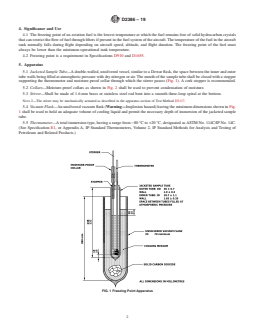
5.1 Jacketed Sample Tube—A double-walled, unsilvered
Subcommittee D02.07 on Flow Properties.
Current edition approved May 1, 2019. Published June 2019. Originally
vessel, similar to a Dewar flask, the space between the inner
approved in 1965. Last previous edition approved in 2018 as D2386–18. DOI:
10.1520/D2386-19.
2 3
For referenced ASTM standards, visit the ASTM website, www.astm.org, or The last approved version of this historical standard is referenced on
contact ASTM Customer Service at service@astm.org. For Annual Book of ASTM www.astm.org.
Standards volume information, refer to the standard’s Document Summary page on Available from Energy Institute, 61 New Cavendish St., London, WIG 7AR,
the ASTM website. U.K., http://www.energyinst.org.
*A Summary of Changes section appears at the end of this standard
Copyright © ASTM International, 100 Barr Harbor Drive, PO Box C700, West Conshohocken, PA 19428-2959. United States
D2386 − 19
accordance with Test Method E77, at temperatures of 0°C, −40°C,
and outer tube walls being filled at atmospheric pressure with
−60°C, and −75°C.
dry nitrogen or air. The mouth of the sample tube shall be
closed with a stopper supporting the thermometer and
6. Reagents and Materials
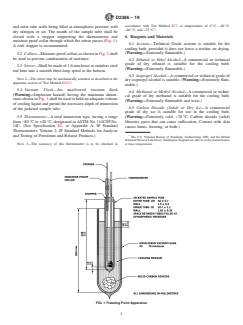
moisture-proof collar through which the stirrer passes (Fig. 1).
6.1 Acetone—Technical Grade acetone is suitable for the
A cork stopper is recommended.
cooling bath, provided it does not leave a residue on drying.
(Warning—Extremely flammable.)
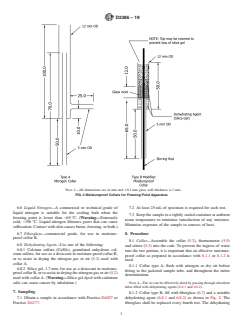
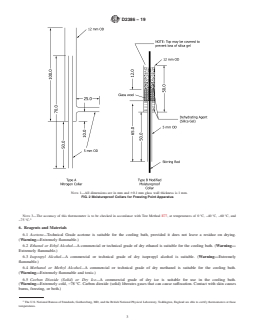
5.2 Collars—Moisture-proofcollarsasshowninFig.2shall
be used to prevent condensation of moisture.
6.2 Ethanol or Ethyl Alcohol—A commercial or technical
grade of dry ethanol is suitable for the cooling bath.
5.3 Stirrer—Shallbemadeof1.6mmbrassorstainlesssteel
(Warning—Extremely flammable.)
rod bent into a smooth three-loop spiral at the bottom.
6.3 Isopropyl Alcohol—Acommercial or technical grade of
NOTE 2—The stirrer may be mechanically actuated as described in the
dry isopropyl alcohol is suitable. (Warning—Extremely flam-
apparatus section of Test Method D3117.
mable.)
5.4 Vacuum Flask—An unsilvered vacuum flask
6.4 Methanol or Methyl Alcohol—A commercial or techni-
(Warning—Implosion hazard) having the minimum dimen-
cal grade of dry methanol is suitable for the cooling bath.
sionsshowninFig.1shallbeusedtoholdanadequatevolume
(Warning—Extremely flammable and toxic.)
of cooling liquid and permit the necessary depth of immersion
6.5 Carbon Dioxide (Solid) or Dry Ice—A commercial
of the jacketed sample tube.
grade of dry ice is suitable for use in the cooling bath.
5.5 Thermometer—A total immersion type, having a range
(Warning—Extremely cold, −78°C. Carbon dioxide (solid)
from −80°C to +20°C, designated asASTM No. 114C/IPNo.
liberates gases that can cause suffocation. Contact with skin
14C. (See Specification E1, or Appendix A, IP Standard
causes burns, freezing, or both.)
Thermometers, Volume 2, IP Standard Methods for Analysis
and Testing of Petroleum and Related Products.)
The U.S. National Bureau of Standards, Gaithersburg, MD, and the British
NationalPhysicalLaboratory,Teddington,Englandareabletocertifythermometers
NOTE 3—The accuracy of this thermometer is to be checked in
at these temperatures.
FIG. 1 Freezing Point Apparatus
D2386 − 19
NOTE 1—All dimensions are in mm and 60.1mm glass wall thickness is 1mm.
FIG. 2 Moistureproof Collars for Freezing Point Apparatus
6.6 Liquid Nitrogen—A commercial or technical grade of 7.2 At least 25mL of specimen is required for each test.
liquid nitrogen is suitable for the cooling bath when the
7.3 Keep the sample in a tightly sealed container at ambient
freezing point is lower than −65°C. (Warning—Extremely
room temperature to minimize introduction of any moisture.
cold, −196°C. Liquid nitrogen liberates gases that can cause
Minimize exposure of the sample to sources of heat.
suffocation. Contact with skin causes burns, freezing, or both.)
6.7 Fiberglass—commercial grade, for use in moisture-
8. Procedure
proof collar B.
8.1 Collar—Assemble the collar (5.2), thermometer (5.5)
6.8 Dehydrating Agent—Use one of the following:
and stirrer (5.3) into the cork. To prevent the ingress of water
6.8.1 Calcium sulfate (CaS0 ), granulated anhydrous cal-
into the test portion, it is important that an effective moisture-
cium sulfate, for use as a desiccant in moisture-proof collar B,
proof collar as prepared in accordance with 8.1.1 or 8.1.2 is
or to assist in drying the nitrogen gas or air (5.2) used with
used.
collar A.
8.1.1 Collar type A, flush with nitrogen or dry air before
6.8.2 Silica gel, 1.7mm, for use as a desiccant in moisture-
fitting to the jacketed sample tube, and throughout the entire
proofcollarB,ortoassistindryingthenitrogengasorair(5.2)
determination.
used with collarA. (Warning—Silica gel dyed with cadmium
salts can cause cancer by inhalation.) NOTE 4—The air can be effectively dried by passing through absorbent
tubes filled with dehydrating agents (6.8.1 and 6.8.2).
7. Sampling
8.1.2 Collar type B, fill with fiberglass (6.7) and a suitable
7.1 Obtain a sample in accordance with Practice D4057 or dehydrating agent (6.8.1 and 6.8.2) as shown in Fig. 2. The
Practice D4177. fiberglass shall be replaced every fourth test. The dehydrating
D2386 − 19
observations, the sample tube can be removed from the coolant for
agentshouldberenewedatintervalsofnotmorethan3months
observations. The tube can be removed for periods no longer than 10s. If
or when a color change shows it to be ineffective
crystals are ob
...
This document is not an ASTM standard and is intended only to provide the user of an ASTM standard an indication of what changes have been made to the previous version. Because
it may not be technically possible to adequately depict all changes accurately, ASTM recommends that users consult prior editions as appropriate. In all cases only the current version
of the standard as published by ASTM is to be considered the official document.
Designation: D2386 − 18 D2386 − 19
Designation: 16/15
Standard Test Method for
Freezing Point of Aviation Fuels
This standard is issued under the fixed designation D2386; the number immediately following the designation indicates the year of
original adoption or, in the case of revision, the year of last revision. A number in parentheses indicates the year of last reapproval. A
superscript epsilon (´) indicates an editorial change since the last revision or reapproval.
This standard has been approved for use by agencies of the U.S. Department of Defense.
1. Scope*
1.1 This test method covers the determination of the temperature below which solid hydrocarbon crystals may form in aviation
turbine fuels and aviation gasoline. If no crystallization point or freezing point can be measured, this test can be used to
determinereport the lowest measurable temperature reached before the crystallization point.
NOTE 1—The interlaboratory program that generated the precisions for this test method did not include aviation gasoline.
1.2 The values stated in SI units are to be regarded as standard. No other units of measurement are included in this standard.
1.3 This standard does not purport to address all of the safety concerns, if any, associated with its use. It is the responsibility
of the user of this standard to establish appropriate safety, health, and environmental practices and determine the applicability of
regulatory limitations prior to use. For specific warning statements, see 5.4, Section 6, and 8.3.
1.4 This international standard was developed in accordance with internationally recognized principles on standardization
established in the Decision on Principles for the Development of International Standards, Guides and Recommendations issued
by the World Trade Organization Technical Barriers to Trade (TBT) Committee.
2. Referenced Documents
2.1 ASTM Standards:
D910 Specification for Leaded Aviation Gasolines
D1655 Specification for Aviation Turbine Fuels
D3117 Test Method for Wax Appearance Point of Distillate Fuels (Withdrawn 2010)
D4057 Practice for Manual Sampling of Petroleum and Petroleum Products
D4177 Practice for Automatic Sampling of Petroleum and Petroleum Products
E1 Specification for ASTM Liquid-in-Glass Thermometers
E77 Test Method for Inspection and Verification of Thermometers
2.2 Energy Institute Standard:
IP Standards for Petroleum and Its Products IP 16/15
3. Terminology
3.1 Definitions of Terms Specific to This Standard:
3.1.1 freezing point, n—in aviation fuels, the fuel temperature at which solid hydrocarbon crystals, formed on cooling, disappear
when the temperature of the fuel is allowed to rise under specified conditions of test.
3.1.2 crystallization point, n—the temperature at which crystals of hydrocarbons first appear when the test sample is cooled.
This test method is under the jurisdiction of ASTM Committee D02 on Petroleum Products, Liquid Fuels, and Lubricants and is the direct responsibility of Subcommittee
D02.07 on Flow Properties.
Current edition approved Dec. 1, 2018May 1, 2019. Published January 2019June 2019. Originally approved in 1965. Last previous edition approved in 20152018 as
ɛ1
D2386 – 15D2386 – 18. . DOI: 10.1520/D2386-18.10.1520/D2386-19.
For referenced ASTM standards, visit the ASTM website, www.astm.org, or contact ASTM Customer Service at service@astm.org. For Annual Book of ASTM Standards
volume information, refer to the standard’s Document Summary page on the ASTM website.
The last approved version of this historical standard is referenced on www.astm.org.
Available from Energy Institute, 61 New Cavendish St., London, WIG 7AR, U.K., http://www.energyinst.org.
*A Summary of Changes section appears at the end of this standard
Copyright © ASTM International, 100 Barr Harbor Drive, PO Box C700, West Conshohocken, PA 19428-2959. United States
D2386 − 19
4. Significance and Use
4.1 The freezing point of an aviation fuel is the lowest temperature at which the fuel remains free of solid hydrocarbon crystals
that can restrict the flow of fuel through filters if present in the fuel system of the aircraft. The temperature of the fuel in the aircraft
tank normally falls during flight depending on aircraft speed, altitude, and flight duration. The freezing point of the fuel must
always be lower than the minimum operational tank temperature.
4.2 Freezing point is a requirement in Specifications D910 and D1655.
5. Apparatus
5.1 Jacketed Sample Tube—A double-walled, unsilvered vessel, similar to a Dewar flask, the space between the inner and outer
tube walls being filled at atmospheric pressure with dry nitrogen or air. The mouth of the sample tube shall be closed with a stopper
supporting the thermometer and moisture-proof collar through which the stirrer passes (Fig. 1). A cork stopper is recommended.
5.2 Collars—Moisture-proof collars as shown in Fig. 2 shall be used to prevent condensation of moisture.
5.3 Stirrer—Shall be made of 1.6 mm brass or stainless steel rod bent into a smooth three-loop spiral at the bottom.
NOTE 2—The stirrer may be mechanically actuated as described in the apparatus section of Test Method D3117.
5.4 Vacuum Flask—An unsilvered vacuum flask (Warning—Implosion hazard) having the minimum dimensions shown in Fig.
1 shall be used to hold an adequate volume of cooling liquid and permit the necessary depth of immersion of the jacketed sample
tube.
5.5 Thermometer—A total immersion type, having a range from −80 °C to +20 °C, designated as ASTM No. 114C/IP No. 14C.
(See Specification E1, or Appendix A, IP Standard Thermometers, Volume 2, IP Standard Methods for Analysis and Testing of
Petroleum and Related Products.)
FIG. 1 Freezing Point Apparatus
D2386 − 19
NOTE 1—All dimensions are in mm and 60.1 mm glass wall thickness is 1 mm.
FIG. 2 Moistureproof Collars for Freezing Point Apparatus
NOTE 3—The accuracy of this thermometer is to be checked in accordance with Test Method E77, at temperatures of 0 °C, −40 °C, −60 °C, and
−75 °C.
6. Reagents and Materials
6.1 Acetone—Technical Grade acetone is suitable for the cooling bath, provided it does not leave a residue on drying.
(Warning—Extremely flammable.)
6.2 Ethanol or Ethyl Alcohol—A commercial or technical grade of dry ethanol is suitable for the cooling bath. (Warning—
Extremely flammable.)
6.3 Isopropyl Alcohol—A commercial or technical grade of dry isopropyl alcohol is suitable. (Warning—Extremely
flammable.)
6.4 Methanol or Methyl Alcohol—A commercial or technical grade of dry methanol is suitable for the cooling bath.
(Warning—Extremely flammable and toxic.)
6.5 Carbon Dioxide (Solid) or Dry Ice—A commercial grade of dry ice is suitable for use in the cooling bath.
(Warning—Extremely cold, −78 °C. Carbon dioxide (solid) liberates gases that can cause suffocation. Contact with skin causes
burns, freezing, or both.)
The U.S. National Bureau of Standards, Gaithersburg, MD, and the British National Physical Laboratory, Teddington, England are able to certify thermometers at these
temperatures.
D2386 − 19
6.6 Liquid Nitrogen—A commercial or technical grade of liquid nitrogen is suitable for the cooling bath when the freezing point
is lower than −65 °C. (Warning—Extremely cold, −196 °C. Liquid nitrogen liberates gases that can cause suffocation. Contact
with skin causes burns, freezing, or both.)
6.7 Fiberglass—commercial grade, for use in moisture-proof collar B.
6.8 Dehydrating Agent—Use one of the following:
6.8.1 Calcium sulfate (CaS0 ), granulated anhydrous calcium sulfate, for use as a desiccant in moisture-proof collar B, or to
assist in drying the nitrogen gas or air (5.2) used with collar A.
6.8.2 Silica gel, 1.7 mm, for use as a desiccant in moisture-proof collar B, or to assist in drying the nitrogen gas or air (5.2) used
with collar A. (Warning—Silica gel dyed with cadmium salts can cause cancer by inhalation.)
7. Sampling
7.1 Obtain a sample in accordance with Practice D4057 or Practice D4177.
7.2 At least 25 mL of specimen is required for each test.
7.3 Keep the sample in a tightly sealed container at ambient room temperature to minimize introduction of any moisture.
Minimize exposure of the sample to sources of heat.
8. Procedure
8.1 Collar—Assemble the collar (5.2), thermometer (5.5) and stirrer (5.3) into the cork. To prevent the ingress of water into the
test portion, it is important that an effective moisture-proof collar as prepared in accordance with 8.1.1 or 8.1.2 is used.
8.1.1 Collar type A, flush with nitrogen or dry air before fitting to the jacketed sample tube, and throughout the entire
determination.
NOTE 4—The air can be effectively dried by passing through absorbent tubes filled with dehydrating agents (6.8.1 and 6.8.2).
8.1.2 Collar type B, fill with fiberglass (6.7) and a suitable dehydrating agent (6.8.1 and 6.8.2) as shown in Fig. 2. The fiberglass
shall be replaced every fourth test. The dehydrating agent should be renewed at intervals of not more than 3 months or when a
color change shows it to be ineffective
8.2 Measure out 25 mL 6 1 mL of the fuel and transfer it to the clean, dry, jacketed sample tube. Close the tube tightly with
the cork holding the stirrer, thermometer, and moisture proof collar and
...