


ASTM E1774-17(2022)
(Guide)Standard Guide for Electromagnetic Acoustic Transducers (EMATs)
Standard Guide for Electromagnetic Acoustic Transducers (EMATs)
SIGNIFICANCE AND USE
4.1 General—Ultrasonic testing is a widely used nondestructive method for the examination of a material. The majority of ultrasonic examinations are performed using transducers that directly convert electrical energy into acoustic energy through the use of piezoelectric crystals. This guide describes an alternate technique in which electromagnetic energy is used to produce acoustic energy inside an electrically conductive or ferromagnetic material. EMATs have unique characteristics when compared to conventional piezoelectric ultrasonic search units, making them a significant tool for some ultrasonic examination applications.
4.2 Principle—An electromagnetic acoustic transducer (EMAT) generates and receives ultrasonic waves without the need to contact the material in which the acoustic waves are traveling. The use of an EMAT requires that the material to be examined be electrically conductive or ferromagnetic, or both. There are two basic components of an EMAT system, a magnet and a coil. The magnet may be an electromagnet or a permanent magnet, which is used to produce a magnetic field in the material under test. The coil is driven using alternating current at the desired ultrasonic frequency. The coil and AC current also induce a surface magnetic field in the material under test. In the presence of the static magnetic field, the surface current experiences Lorentz forces that produce the desired ultrasonic waves. Upon reception of an ultrasonic wave, the surface of the conductor oscillates in the presence of a magnetic field, thus inducing a voltage in the coil. The transduction process occurs within an electromagnetic skin depth. The EMAT forms the basis for a very reproducible noncontact system for generating and detecting ultrasonic waves.
4.3 Specific Advantages—Since an EMAT technique does not have to be in contact with the material under examination, no fluid couplant is required. Important consequences of this include applications to moving objects, in...
SCOPE
1.1 This guide is intended primarily for tutorial purposes. It provides an overview of the general principles governing the operation and use of electromagnetic acoustic transducers (EMATs) for ultrasonic examination.
1.2 This guide describes a non-contact technique for coupling ultrasonic energy into an electrically conductive or ferromagnetic material, or both, through the use of electromagnetic fields. This guide describes the theory of operation and basic design considerations as well as the advantages and limitations of the technique.
1.3 This guide is intended to serve as a general reference to assist in determining the usefulness of EMATs for a given application as well as provide fundamental information regarding their design and operation. This guide provides guidance for the generation of longitudinal, shear, Rayleigh, and Lamb wave modes using EMATs.
1.4 This guide does not contain detailed procedures for the use of EMATs in any specific applications; nor does it promote the use of EMATs without thorough testing prior to their use for examination purposes. Some applications in which EMATs have been applied successfully are outlined in Section 9.
1.5 Units—The values stated in inch-pound units are to be regarded as the standard. The SI values given in parentheses are for information only.
1.6 This standard does not purport to address all of the safety concerns, if any, associated with its use. It is the responsibility of the user of this standard to establish appropriate safety, health, and environmental practices and determine the applicability of regulatory limitations prior to use.
1.7 This international standard was developed in accordance with internationally recognized principles on standardization established in the Decision on Principles for the Development of International Standards, Guides and Recommendations issued by the World Trade Organization Technical Barriers to Trade (TBT) Co...
General Information
- Status
- Published
- Publication Date
- 31-May-2022
- Technical Committee
- E07 - Nondestructive Testing
- Drafting Committee
- E07.06 - Ultrasonic Method
Relations
- Effective Date
- 01-Feb-2024
- Effective Date
- 01-Dec-2019
- Effective Date
- 01-Mar-2019
- Effective Date
- 01-Jan-2018
- Effective Date
- 15-Jun-2017
- Effective Date
- 01-Feb-2017
- Effective Date
- 01-Aug-2016
- Effective Date
- 01-Feb-2016
- Effective Date
- 01-Dec-2015
- Effective Date
- 01-Sep-2015
- Effective Date
- 01-Jun-2014
- Effective Date
- 01-Jun-2014
- Effective Date
- 01-Dec-2013
- Effective Date
- 15-Jun-2013
- Effective Date
- 01-Jun-2013
Overview
ASTM E1774-17(2022), Standard Guide for Electromagnetic Acoustic Transducers (EMATs), provides a comprehensive framework for understanding and applying EMAT technology for ultrasonic examination. Developed by ASTM International, this standard serves as a tutorial and general reference to the principles, operational theory, and practical considerations when using EMATs as a non-contact method for injecting ultrasonic energy into electrically conductive or ferromagnetic materials.
EMATs offer unique advantages over conventional piezoelectric transducers. Instead of requiring physical contact or couplants, EMATs generate and receive ultrasonic waves using electromagnetic fields. This non-contact property expands their application range, notably in environments where access is limited, surfaces are rough or hot, or continuous movement occurs.
Key Topics
- Fundamental Operation: Explains how EMATs utilize a magnet and a coil to induce ultrasonic waves in electrically conductive or ferromagnetic materials, relying on Lorentz and magnetostrictive forces.
- Non-contact Technique: Highlights the core benefit that no direct contact or fluid couplant is required, making EMATs especially valuable for applications involving moving parts or elevated temperatures.
- Wave Mode Generation: Describes the capability of EMATs to generate various ultrasonic wave modes, including longitudinal, shear, Rayleigh, and Lamb waves, through appropriate coil and magnet configurations.
- Design Considerations: Presents high-level guidance on EMAT design, including coil type (meander or spiral), system “lift-off,” frequency selection, and matching to material properties.
- Advantages and Limitations: Discusses increased inspection speed, repeatable signals, and suitability for challenging environments, as well as limitations like lower efficiency compared to conventional methods and limitations to conductive or ferromagnetic materials.
- Personnel and Agency Qualification: Stresses the need for operator qualification under recognized NDT certification standards and for agency accreditation where required.
Applications
The adaptability and non-contact operation of EMAT-based ultrasonic testing makes it suitable for a wide spectrum of industrial applications, including:
- Flaw Detection: EMATs are widely used to detect seams, laps, and internal defects in steel bars, rails, welds (including those in challenging materials like austenitic stainless steel), and pipelines-even at high temperatures.
- Weld Inspection: EMATs can simultaneously assess the surface and subsurface integrity of welds in sectors ranging from aerospace (e.g. NASA fuel tanks) to energy pipelines, using both Rayleigh and shear wave techniques.
- Thickness Gaging: Ideal for rapid, high-temperature or in-process thickness measurements of metal strips, tubes, and sheets, even those thinner than 1 mm.
- Rail and Wheel Testing: Their non-contact nature allows for effective inspection of railroad rails and wheels, including high-speed, in-motion assessment.
- Bond Inspection: EMATs are suited for examining bonded layers in both metal-to-metal and metal-to-composite applications without surface preparation or couplant.
- Material Property Measurement: Capable of measuring elastic constants in thin metal sheets, supporting quality assurance in materials processing.
Related Standards
- ASTM E127: Practice for Fabrication and Control of Flat Bottomed Hole Ultrasonic Standard Reference Blocks
- ASTM E428: Practice for Fabrication and Control of Metal, Other than Aluminum, Reference Blocks Used in Ultrasonic Testing
- ASTM E543: Specification for Agencies Performing Nondestructive Testing
- ASTM E1065: Practice for Evaluating Characteristics of Ultrasonic Search Units
- ASTM E1316: Terminology for Nondestructive Examinations
- ASNT SNT-TC-1A, ANSI/ASNT CP-189, NAS-410: Personnel qualification standards for NDT
- ISO 9712: Qualification and certification of NDT personnel
Practical Value
Implementing ASTM E1774-17(2022) ensures safe, efficient, and repeatable use of EMAT technology in ultrasonic testing. The standard supports industries in enhancing inspection efficiency, minimizing environmental impact, and expanding inspection capabilities into scenarios where conventional ultrasonic methods are impractical. By adhering to its guidance, organizations can improve the reliability of their nondestructive evaluation processes and fulfill regulatory or customer requirements for quality and safety.
Keywords: electromagnetic acoustic transducer, EMAT, nondestructive testing (NDT), ultrasonic inspection, non-contact ultrasonic testing, flaw detection, weld inspection, material thickness gaging, ASTM E1774, Lorentz force, rail inspection, wave modes, personnel qualification.
Get Certified
Connect with accredited certification bodies for this standard

Element Materials Technology
Materials testing and product certification.

Inštitut za kovinske materiale in tehnologije
Institute of Metals and Technology. Materials testing, metallurgical analysis, NDT.
Sponsored listings
Frequently Asked Questions
ASTM E1774-17(2022) is a guide published by ASTM International. Its full title is "Standard Guide for Electromagnetic Acoustic Transducers (EMATs)". This standard covers: SIGNIFICANCE AND USE 4.1 General—Ultrasonic testing is a widely used nondestructive method for the examination of a material. The majority of ultrasonic examinations are performed using transducers that directly convert electrical energy into acoustic energy through the use of piezoelectric crystals. This guide describes an alternate technique in which electromagnetic energy is used to produce acoustic energy inside an electrically conductive or ferromagnetic material. EMATs have unique characteristics when compared to conventional piezoelectric ultrasonic search units, making them a significant tool for some ultrasonic examination applications. 4.2 Principle—An electromagnetic acoustic transducer (EMAT) generates and receives ultrasonic waves without the need to contact the material in which the acoustic waves are traveling. The use of an EMAT requires that the material to be examined be electrically conductive or ferromagnetic, or both. There are two basic components of an EMAT system, a magnet and a coil. The magnet may be an electromagnet or a permanent magnet, which is used to produce a magnetic field in the material under test. The coil is driven using alternating current at the desired ultrasonic frequency. The coil and AC current also induce a surface magnetic field in the material under test. In the presence of the static magnetic field, the surface current experiences Lorentz forces that produce the desired ultrasonic waves. Upon reception of an ultrasonic wave, the surface of the conductor oscillates in the presence of a magnetic field, thus inducing a voltage in the coil. The transduction process occurs within an electromagnetic skin depth. The EMAT forms the basis for a very reproducible noncontact system for generating and detecting ultrasonic waves. 4.3 Specific Advantages—Since an EMAT technique does not have to be in contact with the material under examination, no fluid couplant is required. Important consequences of this include applications to moving objects, in... SCOPE 1.1 This guide is intended primarily for tutorial purposes. It provides an overview of the general principles governing the operation and use of electromagnetic acoustic transducers (EMATs) for ultrasonic examination. 1.2 This guide describes a non-contact technique for coupling ultrasonic energy into an electrically conductive or ferromagnetic material, or both, through the use of electromagnetic fields. This guide describes the theory of operation and basic design considerations as well as the advantages and limitations of the technique. 1.3 This guide is intended to serve as a general reference to assist in determining the usefulness of EMATs for a given application as well as provide fundamental information regarding their design and operation. This guide provides guidance for the generation of longitudinal, shear, Rayleigh, and Lamb wave modes using EMATs. 1.4 This guide does not contain detailed procedures for the use of EMATs in any specific applications; nor does it promote the use of EMATs without thorough testing prior to their use for examination purposes. Some applications in which EMATs have been applied successfully are outlined in Section 9. 1.5 Units—The values stated in inch-pound units are to be regarded as the standard. The SI values given in parentheses are for information only. 1.6 This standard does not purport to address all of the safety concerns, if any, associated with its use. It is the responsibility of the user of this standard to establish appropriate safety, health, and environmental practices and determine the applicability of regulatory limitations prior to use. 1.7 This international standard was developed in accordance with internationally recognized principles on standardization established in the Decision on Principles for the Development of International Standards, Guides and Recommendations issued by the World Trade Organization Technical Barriers to Trade (TBT) Co...
SIGNIFICANCE AND USE 4.1 General—Ultrasonic testing is a widely used nondestructive method for the examination of a material. The majority of ultrasonic examinations are performed using transducers that directly convert electrical energy into acoustic energy through the use of piezoelectric crystals. This guide describes an alternate technique in which electromagnetic energy is used to produce acoustic energy inside an electrically conductive or ferromagnetic material. EMATs have unique characteristics when compared to conventional piezoelectric ultrasonic search units, making them a significant tool for some ultrasonic examination applications. 4.2 Principle—An electromagnetic acoustic transducer (EMAT) generates and receives ultrasonic waves without the need to contact the material in which the acoustic waves are traveling. The use of an EMAT requires that the material to be examined be electrically conductive or ferromagnetic, or both. There are two basic components of an EMAT system, a magnet and a coil. The magnet may be an electromagnet or a permanent magnet, which is used to produce a magnetic field in the material under test. The coil is driven using alternating current at the desired ultrasonic frequency. The coil and AC current also induce a surface magnetic field in the material under test. In the presence of the static magnetic field, the surface current experiences Lorentz forces that produce the desired ultrasonic waves. Upon reception of an ultrasonic wave, the surface of the conductor oscillates in the presence of a magnetic field, thus inducing a voltage in the coil. The transduction process occurs within an electromagnetic skin depth. The EMAT forms the basis for a very reproducible noncontact system for generating and detecting ultrasonic waves. 4.3 Specific Advantages—Since an EMAT technique does not have to be in contact with the material under examination, no fluid couplant is required. Important consequences of this include applications to moving objects, in... SCOPE 1.1 This guide is intended primarily for tutorial purposes. It provides an overview of the general principles governing the operation and use of electromagnetic acoustic transducers (EMATs) for ultrasonic examination. 1.2 This guide describes a non-contact technique for coupling ultrasonic energy into an electrically conductive or ferromagnetic material, or both, through the use of electromagnetic fields. This guide describes the theory of operation and basic design considerations as well as the advantages and limitations of the technique. 1.3 This guide is intended to serve as a general reference to assist in determining the usefulness of EMATs for a given application as well as provide fundamental information regarding their design and operation. This guide provides guidance for the generation of longitudinal, shear, Rayleigh, and Lamb wave modes using EMATs. 1.4 This guide does not contain detailed procedures for the use of EMATs in any specific applications; nor does it promote the use of EMATs without thorough testing prior to their use for examination purposes. Some applications in which EMATs have been applied successfully are outlined in Section 9. 1.5 Units—The values stated in inch-pound units are to be regarded as the standard. The SI values given in parentheses are for information only. 1.6 This standard does not purport to address all of the safety concerns, if any, associated with its use. It is the responsibility of the user of this standard to establish appropriate safety, health, and environmental practices and determine the applicability of regulatory limitations prior to use. 1.7 This international standard was developed in accordance with internationally recognized principles on standardization established in the Decision on Principles for the Development of International Standards, Guides and Recommendations issued by the World Trade Organization Technical Barriers to Trade (TBT) Co...
ASTM E1774-17(2022) is classified under the following ICS (International Classification for Standards) categories: 77.040.20 - Non-destructive testing of metals. The ICS classification helps identify the subject area and facilitates finding related standards.
ASTM E1774-17(2022) has the following relationships with other standards: It is inter standard links to ASTM E1316-24, ASTM E1316-19b, ASTM E1316-19, ASTM E1316-18, ASTM E1316-17a, ASTM E1316-17, ASTM E1316-16a, ASTM E1316-16, ASTM E1316-15a, ASTM E1316-15, ASTM E1316-14e1, ASTM E1316-14, ASTM E1316-13d, ASTM E1316-13c, ASTM E428-08(2013). Understanding these relationships helps ensure you are using the most current and applicable version of the standard.
ASTM E1774-17(2022) is available in PDF format for immediate download after purchase. The document can be added to your cart and obtained through the secure checkout process. Digital delivery ensures instant access to the complete standard document.
Standards Content (Sample)
This international standard was developed in accordance with internationally recognized principles on standardization established in the Decision on Principles for the
Development of International Standards, Guides and Recommendations issued by the World Trade Organization Technical Barriers to Trade (TBT) Committee.
Designation: E1774 − 17 (Reapproved 2022)
Standard Guide for
Electromagnetic Acoustic Transducers (EMATs)
This standard is issued under the fixed designation E1774; the number immediately following the designation indicates the year of
original adoption or, in the case of revision, the year of last revision. A number in parentheses indicates the year of last reapproval. A
superscript epsilon (´) indicates an editorial change since the last revision or reapproval.
1. Scope* 2. Referenced Documents
1.1 This guide is intended primarily for tutorial purposes. It 2.1 ASTM Standards:
provides an overview of the general principles governing the E127 Practice for Fabrication and Control of Flat Bottomed
operation and use of electromagnetic acoustic transducers Hole Ultrasonic Standard Reference Blocks
(EMATs) for ultrasonic examination. E428 Practice for Fabrication and Control of Metal, Other
than Aluminum, Reference Blocks Used in Ultrasonic
1.2 This guide describes a non-contact technique for cou-
Testing (Withdrawn 2019)
pling ultrasonic energy into an electrically conductive or
E543 Specification forAgencies Performing Nondestructive
ferromagneticmaterial,orboth,throughtheuseofelectromag-
Testing
netic fields. This guide describes the theory of operation and
E1065 Practice for Evaluating Characteristics of Ultrasonic
basic design considerations as well as the advantages and
Search Units
limitations of the technique.
E1316 Terminology for Nondestructive Examinations
1.3 This guide is intended to serve as a general reference to
2.2 ASNT Documents:
assist in determining the usefulness of EMATs for a given
SNT-TC-1A Recommended Practice for Personnel Qualifi-
application as well as provide fundamental information regard-
cations and Certification in Nondestructive Testing
ing their design and operation. This guide provides guidance
ANSI/ASNT CP-189 Standard for Qualification and Certifi-
for the generation of longitudinal, shear, Rayleigh, and Lamb
cation for Nondestructive Testing Personnel
wave modes using EMATs.
2.3 Aerospace Industries Association Standard:
1.4 This guide does not contain detailed procedures for the
NAS-410 Certification and Qualification of Nondestructive
use of EMATs in any specific applications; nor does it promote
Test Personnel
the use of EMATs without thorough testing prior to their use
2.4 ISO Standard:
for examination purposes. Some applications in which EMATs
ISO 9712 Non-Destructive Testing: Qualification and Certi-
have been applied successfully are outlined in Section 9.
fication of NDT Personnel
1.5 Units—The values stated in inch-pound units are to be
regarded as the standard. The SI values given in parentheses 3. Terminology
are for information only.
3.1 Definitions—Related terminology is defined in Termi-
1.6 This standard does not purport to address all of the
nology E1316.
safety concerns, if any, associated with its use. It is the
3.2 Definitions of Terms Specific to This Standard:
responsibility of the user of this standard to establish appro-
3.2.1 bulk wave—an ultrasonic wave, either longitudinal or
priate safety, health, and environmental practices and deter-
shear mode, used in nondestructive testing to interrogate the
mine the applicability of regulatory limitations prior to use.
volume of a material.
1.7 This international standard was developed in accor-
dance with internationally recognized principles on standard-
For referenced ASTM standards, visit the ASTM website, www.astm.org, or
ization established in the Decision on Principles for the
contact ASTM Customer Service at service@astm.org. For Annual Book of ASTM
Development of International Standards, Guides and Recom-
Standards volume information, refer to the standard’s Document Summary page on
mendations issued by the World Trade Organization Technical
the ASTM website.
Barriers to Trade (TBT) Committee. The last approved version of this historical standard is referenced on
www.astm.org.
AvailablefromAmericanSocietyforNondestructiveTesting(ASNT),P.O.Box
This guide is under the jurisdiction of ASTM Committee E07 on Nondestruc- 28518, 1711 Arlingate Ln., Columbus, OH 43228-0518, http://www.asnt.org.
tive Testing and is the direct responsibility of Subcommittee E07.06 on Ultrasonic Available fromAerospace IndustriesAssociation ofAmerica, Inc. (AIA), 1000
Method. WilsonBlvd.,Suite1700,Arlington,VA22209-3928,http://www.aia-aerospace.org.
CurrenteditionapprovedJune1,2022.PublishedJuly2022.Originallyapproved Available from International Organization for Standardization (ISO), ISO
in 1995. Last previous edition approved in 2017 as E1774 – 17. DOI: 10.1520/ Central Secretariat, BIBC II, Chemin de Blandonnet 8, CP 401, 1214 Vernier,
E1774-17R22. Geneva, Switzerland, http://www.iso.org.
*A Summary of Changes section appears at the end of this standard
Copyright © ASTM International, 100 Barr Harbor Drive, PO Box C700, West Conshohocken, PA 19428-2959. United States
E1774 − 17 (2022)
3.2.2 electromagnetic acoustic transducer (EMAT)—an nents having complex geometries. EMAT signals are highly
electromagnetic device for converting electrical energy into reproducible as a consequence of the manner in which the
acoustical energy in the presence of a magnetic field. acoustic waves are generated. EMATs can also produce hori-
zontally polarized shear (SH) waves without mode conversion
3.2.3 Lorentz forces—forces applied to electric currents
and can accommodate scanning while using SH waves. (Note
when placed in a magnetic field. Lorentz forces are perpen-
that in order to produce this wave mode by conventional
dicular to the direction of both the magnetic field and the
ultrasonic techniques, either an epoxy or a highly viscous
current direction.
couplant is required. Thus, conventional ultrasonic techniques
3.2.4 magnetostrictive forces—forces arising from magnetic
donotlendthemselveseasilytoscanningwhenusingSHwave
domain wall movements within a magnetic material during
modes.) Additionally, EMATs can allow the user to electroni-
magnetization, where magnetostrictive materials will undergo
cally steer shear waves.
a strain in the presence of a magnetic field.
4.4 Specific Limitations—EMATs have very low efficiency
3.2.5 meander coil—an EMAT coil consisting of periodic,
as compared with conventional ultrasonic methods, with inser-
winding, non-intersecting, and usually evenly-spaced conduc-
tionlossesof40dBormore.TheEMATtechniquecanbeused
tors.
only on materials that are electrical conductors or are ferro-
3.2.6 pancake coil (spiral)—an EMAT coil consisting of
magnetic. Highly corroded surfaces, especially inner surfaces,
spirally-wound, usually evenly-spaced conductors.
may render EMATunsuitable for use if the surface disturbs the
generation of the Lorentz forces. The design of EMAT probes
4. Significance and Use
is usually more complex than comparable piezoelectric search
4.1 General—Ultrasonic testing is a widely used nonde-
units, and are usually relatively large in size. Due to their low
structive method for the examination of a material. The
efficiency, EMATs usually require more specialized instrumen-
majority of ultrasonic examinations are performed using trans-
tation for the generation and detection of ultrasonic signals.
ducers that directly convert electrical energy into acoustic
High transmitting currents, low-noise receivers, and careful
energy through the use of piezoelectric crystals. This guide
electricalmatchingareimperativeinsystemdesign.Ingeneral,
describes an alternate technique in which electromagnetic
EMAT probes are application-specific, in the same way as are
energy is used to produce acoustic energy inside an electrically
piezoelectric transducers.
conductive or ferromagnetic material. EMATs have unique
characteristics when compared to conventional piezoelectric
5. Basis of Application
ultrasonicsearchunits,makingthemasignificanttoolforsome
5.1 The following items are subject to contractual agree-
ultrasonic examination applications.
ment between the parties using or referencing this guide.
4.2 Principle—An electromagnetic acoustic transducer
5.2 Personnel Qualification:
(EMAT) generates and receives ultrasonic waves without the
need to contact the material in which the acoustic waves are
5.2.1 If specified in the contractual agreement, personnel
traveling. The use of an EMAT requires that the material to be performing examinations to this standard shall be qualified in
examined be electrically conductive or ferromagnetic, or both.
accordance with a nationally or internationally recognized
TherearetwobasiccomponentsofanEMATsystem,amagnet NDT personnel qualification practice or standard such as
and a coil. The magnet may be an electromagnet or a
ANSI/ASNT-CP-189, SNT-TC-1A, NAS-410, ISO 9712, or a
permanent magnet, which is used to produce a magnetic field similar document and certified by the employer or certifying
in the material under test. The coil is driven using alternating
agency, as applicable. The practice or standard used and its
current at the desired ultrasonic frequency. The coil and AC applicable revision shall be identified in the contractual agree-
current also induce a surface magnetic field in the material ment between the using parties.
under test. In the presence of the static magnetic field, the
5.3 Qualification of Nondestructive Agencies—If specified
surface current experiences Lorentz forces that produce the
in the contractual agreement, NDT agencies shall be qualified
desired ultrasonic waves. Upon reception of an ultrasonic
and evaluated as described in Practice E543. The applicable
wave, the surface of the conductor oscillates in the presence of
edition of Practice E543 shall be specified in the contractual
a magnetic field, thus inducing a voltage in the coil. The
agreement.
transduction process occurs within an electromagnetic skin
depth. The EMAT forms the basis for a very reproducible 5.4 Procedures and Techniques—The procedures and tech-
niques to be utilized shall be as specified in the contractual
noncontact system for generating and detecting ultrasonic
waves. agreement.
4.3 Specific Advantages—Since an EMAT technique does
5.5 Surface Preparation—The pre-examination surface
not have to be in contact with the material under examination,
preparation criteria shall be as specified in the contractual
no fluid couplant is required. Important consequences of this
agreement.
include applications to moving objects, in remote or hazardous
5.6 Timing of Examination—The timing of examination
locations,toobjectsatelevatedtemperatures,ortoobjectswith
shall be as specified in the contractual agreement.
rough surfaces. The EMAT technique is environmentally safe
since it does not use potentially polluting or hazardous chemi- 5.7 Extent of Examination—The extent of the examination
cals. The technique facilitates the rapid scanning of compo- shall be as specified in the contractual agreement.
E1774 − 17 (2022)
5.8 Reporting Criteria/Acceptance Criteria—Reporting cri- Lorentz force 5 F 5 qv 3 B (1)
L
teriafortheexaminationresultsshallbeinaccordancewiththe
where:
contractual agreement. Since acceptance criteria (e.g. for
v = velocity of electrons, and
referenceradiographs)arenotspecifiedinthisguide,theyshall
B = static magnetic inductor vector.
be stated in the contractual agreement.
Since the electrons are free to move and the ions are bound
5.9 Reexamination of Repaired/Reworked Items—
tothelattice,theLorentzforceontheelectronsismuchgreater
Reexamination of repaired/reworked items is not addressed in
due to its velocity dependence, and this force is transmitted to
this guide and if required shall be specified in the contractual
the ions in the lattice via the collision process.
agreement.
7.2 Magnetic Conducting Materials—For magnetic
6. Standardization conductors, other forces such as magnetostrictive forces, in
additiontotheLorentzforce,influenceionmotion.Inmagnetic
6.1 Reference Standards—As with conventional piezoelec-
materials, the electromagnetic field can modulate the magne-
tric ultrasonic examinations, it is imperative that a set of
tization in the material to produce periodic magnetostrictive
reference samples exhibiting the full range of expected mate-
stresses that must be added to the stresses caused by the
rial defect states be acquired or fabricated and consequently
Lorentz force. The magnetostrictive stresses are complicated
examined by the technique to establish sensitivity (see Prac-
and depend on the magnetic domain distribution, which also
tices E127 and E428 for descriptions of standard configuration
depends on the strength and direction of the applied static
and fabrication).
magnetic field.Although the magnetostrictive forces present in
6.2 Transducer Characterization—Many of the conven-
magnetic conductors may complicate the theoretical analysis,
tional contact piezoelectric search unit characterization proce-
this additional coupling can be an asset because it can
dures are generally adaptable to EMAT transducers with
significantly increase the signal strength compared to that
appropriate modifications (see Guide E1065 for such trans-
obtained by the Lorentz force alone.At high applied magnetic
ducer characterization procedures). Specific characterization
field strengths above the magnetic saturation of the material,
procedures for EMATs are not available and are beyond the
the Lorentz force is the only source of acoustic wave genera-
scope of this document.
tion. The magnetostrictive force dominates at low field
7 strengths, however, and the acoustic energy can be much
7. Theory (1-3)
greater than for corresponding field strengths with only the
7.1 Nonmagnetic Conducting Materials—The mechanisms
Lorentz mechanism. Therefore, a careful examination of the
responsible for the generation of elastic waves in a conducting
relationship at low applied field strengths should be made in
material are dependent on the characteristics of that material.
order to take full advantage of the magnetostrictive effort in
The generation of acoustic waves in a nonmagnetic conductive
magnetic materials.
material is a result of the Lorentz force acting on the lattice of
7.3 Wave Modes—With the proper combination of magnet
thematerial.InanefforttounderstandtheactionoftheLorentz
and coil design, EMATs can produce a longitudinal, shear,
force, one can use the free electron model of solids.According
Rayleigh, SH-Plate, or Lamb wave mode (2-4). The direction
to the free electron model of conductors, the outer valence
of the applied magnetic field, geometry of the coil, and
electrons have been stripped from the atomic lattice, leaving a
frequency of the electromagnetic field will determine the type
lattice of positively charged ions in a sea of free electrons. In
of wave mode generated with EMATs.
order to generate elastic waves in a material, a net force must
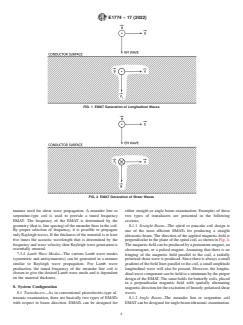
7.3.1 Longitudinal Wave Mode—Fig. 1 illustrates how the
be transmitted to the lattice of the material. If only an
direction of the applied static magnetic field in a conductor and
electromagnetic field is generated in a conductor (via an eddy
the resultant direction of the Lorentz force can produce
current-type coil), the net force on the lattice is zero because
longitudinal elastic waves. For longitudinal wave generation,
the forces on the electrons and ions are equal and opposite. For
the Lorentz force and thus ion displacement is perpendicular to
example:
the surface of the conductor. The efficiency of longitudinal
force on electrons52qE
wave generation, as compared with other modes excited in
force on ions51qE
ferromagnetic materials, is very low.
where: 7.3.2 Shear Wave Modes—Fig.2showshowthedirectionof
the applied static magnetic field in a conductor and the
q = electron charge, and
resultant direction of the Lorentz force can produce shear
E = electric field vector of EMAT wave.
elasticwaves.Forshearwavegeneration,theLorentzforceand
However, if the same electromagnetic field is generated in
thus ion displacement is parallel to the surface of the conduc-
the presence of an applied static magnetic field, a net force is
tor. EMATs are also capable of producing shear wave modes
transmitted to the lattice and results in the generation of elastic
with both vertical and horizontal polarizations. The distinction
waves. The reason for this net force is the Lorentz force acting
between these two shear wave polarization modes is illustrated
on the electrons and ions.
in Fig. 3.
7.3.3 Rayleigh Wave Mode—In general, for Rayleigh wave
generation, the applied static magnetic field will be oriented
The boldface numbers in parentheses refer to the list of references at the end of
this guide. perpendicular to the surface of the conductor in the same
E1774 − 17 (2022)
FIG. 1 EMAT Generation of Longitudinal Waves
FIG. 2 EMAT Generation of Shear Waves
manner used for shear wave propagation. A meander line or either straight or angle beam examination. Examples of these
serpentine-type coil is used to provide a tuned frequency two types of transducers are presented in the following
EMAT. The frequency of the EMAT is determined by the sections.
geometry(thatis,linespacing)ofthemeanderlinesinthecoil.
8.1.1 Straight Beam—The spiral or pancake coil design is
By proper selection of frequency, it is possible to propagate
one of the most efficient EMATs for producing a straight
only Rayleigh waves. If the thickness of the material is at least
ultrasonic beam. The direction of the applied magnetic field is
five times the acoustic wavelength that is determined by the
perpendicular to the plane of the spiral coil, as shown in Fig. 4.
frequencyandwavevelocity,thenRayleighwavegenerationis
Themagneticfieldcanbeproducedbyapermanentmagnet,an
essentially ensured.
electromagnet, or a pulsed magnet. Assuming that there is no
7.3.4 Lamb Wave Modes—The various L
...
Questions, Comments and Discussion
Ask us and Technical Secretary will try to provide an answer. You can facilitate discussion about the standard in here.
Loading comments...