

ASTM D2419-22
(Test Method)Standard Test Method for Sand Equivalent Value of Soils and Fine Aggregate
General Information
- Abstract
SIGNIFICANCE AND USE
5.1 This test method assigns an empirical value to the relative amount, fineness, and character of clay-like material present in the test specimen.
5.2 A minimum sand equivalent value may be specified to limit the permissible quantity of clay-like or clay-size fines in an aggregate.
5.3 This test method provides a rapid field method for determining changes in the quality of aggregates during production or placement.
Note 3: The quality of the results produced by this standard are dependent upon the competence of the personnel performing the procedure and the capability, calibration, and the maintenance of the equipment used. Agencies that meet the criteria of Specification D3666 are generally considered capable of competent and objective testing, sampling, inspection, etc. Users of this standard are cautioned that compliance with Specification D3666 alone does not completely ensure reliable results. Reliable results depend on many factors; following the suggestions of Specification D3666 or similar acceptable guideline provides a means of evaluating and controlling some of those factors.
SCOPE
1.1 This test method is intended to serve as a rapid field correlation test. The purpose of this test method is to indicate, under standard conditions, the relative proportions of clay-size or plastic fines and dust in granular soils and fine aggregates that pass the 4.75 mm (No. 4) sieve. The term “sand equivalent” expresses the concept that most granular soils and some fine aggregates are mixtures of desirable coarse particles, sand-size particles, and generally undesirable clay or plastic fines and dust.
Note 1: For fine aggregates containing clean dust of fracture (clay-size particles that are not clay minerals), test results will depend on the amount of fines present in the material. In this case, other tests such as Methylene Blue Value (AASHTO T 330) or X-ray diffraction (XRD) may be needed to determine if the fines are deleterious.
Note 2: Some agencies perform the test on material with a top size smaller than the 4.75 mm (No. 4) sieve. This is done to avoid trapping the clay-size or plastic fines and dust below flaky shaped 4.75 to 2.36 mm (No. 4 to 8) sized particles. Testing smaller top sized material may lower the numerical results of the test.
1.2 The values stated in inch-pound units are to be regarded as standard. The values given in parentheses are mathematical conversions to SI units that are provided for information only and are not considered standard.
1.2.1 Regarding sieves, per Specification E11 subsection 1.3, “the values stated in SI units shall be considered standard for the dimensions of the sieve cloth openings and the wire diameter used in the sieve cloth. The values stated in inch-pound units shall be considered standard with regard to the sieve frames, pans, and covers.” When sieve mesh sizes are referenced, the alternate inch-pound designations are provided for information purposes and enclosed in parentheses.
1.3 The text of this standard references notes and footnotes which provide explanatory material. These notes and footnotes (excluding those in tables and figures) shall not be considered as requirements of the standard.
1.4 This standard does not purport to address all of the safety concerns, if any, associated with its use. It is the responsibility of the user of this standard to establish appropriate safety, health, and environmental practices and determine the applicability of regulatory limitations prior to use.
1.5 This international standard was developed in accordance with internationally recognized principles on standardization established in the Decision on Principles for the Development of International Standards, Guides and Recommendations issued by the World Trade Organization Technical Barriers to Trade (TBT) Committee.
- Status
- Published
- Publication Date
- 14-Sep-2022
- Technical Committee
- D04 - Road and Paving Materials
- Drafting Committee
- D04.51 - Aggregate Tests
Overview
ASTM D2419-22: Standard Test Method for Sand Equivalent Value of Soils and Fine Aggregate is a critical test standard developed by ASTM International. This standard provides a rapid field method for determining the relative proportions of clay-like or plastic fines and dust in granular soils and fine aggregates passing the 4.75 mm (No. 4) sieve. The sand equivalent test is extensively used in construction, civil engineering, and quality control of road and paving materials to assess aggregate cleanliness and help ensure performance compliance.
The sand equivalent value is an empirical metric, serving as an indicator of the fineness and character of clay-like materials within a sample. Aggregates with lower sand equivalent values usually have excessive clay or plastic fines, which can adversely affect the durability and stability of concrete, asphalt, and other civil engineering structures.
Key Topics
Purpose of the Test:
- Assigns an empirical value to the relative amount and characteristics of clay-like materials.
- Indicates the cleanliness and suitability of fine aggregate or soil for use in construction.
Testing Approach:
- Measures the ratio of sand to clay by shaking a sample in a flocculating solution and observing sedimentation behavior.
- The sand equivalent is calculated as the height ratio of sand to suspended clay/fines, multiplied by 100.
Interpretation of Results:
- A higher sand equivalent value suggests the material is cleaner and contains fewer undesirable fines.
- Specifications may set minimum sand equivalent requirements to control aggregate quality.
Field Use and Sensitivity:
- Enables rapid field checks to monitor aggregate quality changes during production, delivery, and placement.
- Results are sensitive to operator technique, equipment condition, and environmental factors.
Sample Preparation:
- Samples are reduced and sieved to ensure only relevant fines and aggregates are evaluated.
- Careful moisture control and homogeneous mixing are essential for representative results.
Applications
Road and Paving Materials:
The sand equivalent test is widely specified for evaluating aggregate quality in asphalt and concrete mixes, ensuring pavement materials are durable, stable, and meet regulatory standards.Aggregate Production Quality Control:
Producers monitor sand equivalent values to detect changes in raw material sources or processing techniques that might introduce unwanted clay or dust.Construction Site Verification:
Field engineers use the test to quickly verify delivered soil and aggregate quality, helping prevent the use of substandard materials.Specification Compliance:
Sand equivalent values are often part of contract requirements and regulatory codes for transportation infrastructure, airport runways, and municipal projects.Material Research and Development:
Laboratories and researchers utilize the method for aggregate characterization, quality improvement, and comparative studies alongside tests such as Methylene Blue Value or X-ray diffraction when more information about fines content is needed.
Related Standards
- ASTM C702/C702M – Reducing Samples of Aggregate to Testing Size
- ASTM D75/D75M – Sampling Aggregates
- ASTM D653 – Terminology Relating to Soil, Rock, and Contained Fluids
- ASTM D3666 – Agency Requirements for Road and Paving Materials Testing
- ASTM E11 – Specification for Woven Wire Test Sieve Cloth and Test Sieves
- AASHTO T 176 – Standard Method for Plastic Fines in Aggregates and Soils by Sand Equivalent Test
By following ASTM D2419-22, agencies, contractors, and laboratories can reliably assess the sand equivalent value of soils and fine aggregates, playing a crucial role in quality assurance for civil engineering and construction projects. For optimal and reliable results, adherence to standardized procedures, qualified personnel, and well-maintained equipment is essential.
Relations
- Effective Date
- 01-Feb-2024
- Effective Date
- 01-Jan-2024
- Effective Date
- 01-Nov-2019
- Effective Date
- 01-Oct-2016
- Effective Date
- 01-Aug-2014
- Effective Date
- 15-Dec-2013
- Effective Date
- 01-Dec-2013
- Effective Date
- 01-Oct-2013
- Effective Date
- 01-Jul-2013
- Effective Date
- 01-Dec-2011
- Effective Date
- 01-Sep-2011
- Effective Date
- 01-Aug-2011
- Effective Date
- 01-Oct-2010
- Effective Date
- 01-Dec-2009
- Effective Date
- 01-May-2009
Get Certified
Connect with accredited certification bodies for this standard

Zavod za gradbeništvo Slovenije (ZAG) - Inšpekcija
ZAG inspection body for construction products, structures, and materials.
Sponsored listings
Frequently Asked Questions
ASTM D2419-22 is a standard published by ASTM International. Its full title is "Standard Test Method for Sand Equivalent Value of Soils and Fine Aggregate". This standard covers: SIGNIFICANCE AND USE 5.1 This test method assigns an empirical value to the relative amount, fineness, and character of clay-like material present in the test specimen. 5.2 A minimum sand equivalent value may be specified to limit the permissible quantity of clay-like or clay-size fines in an aggregate. 5.3 This test method provides a rapid field method for determining changes in the quality of aggregates during production or placement. Note 3: The quality of the results produced by this standard are dependent upon the competence of the personnel performing the procedure and the capability, calibration, and the maintenance of the equipment used. Agencies that meet the criteria of Specification D3666 are generally considered capable of competent and objective testing, sampling, inspection, etc. Users of this standard are cautioned that compliance with Specification D3666 alone does not completely ensure reliable results. Reliable results depend on many factors; following the suggestions of Specification D3666 or similar acceptable guideline provides a means of evaluating and controlling some of those factors. SCOPE 1.1 This test method is intended to serve as a rapid field correlation test. The purpose of this test method is to indicate, under standard conditions, the relative proportions of clay-size or plastic fines and dust in granular soils and fine aggregates that pass the 4.75 mm (No. 4) sieve. The term “sand equivalent” expresses the concept that most granular soils and some fine aggregates are mixtures of desirable coarse particles, sand-size particles, and generally undesirable clay or plastic fines and dust. Note 1: For fine aggregates containing clean dust of fracture (clay-size particles that are not clay minerals), test results will depend on the amount of fines present in the material. In this case, other tests such as Methylene Blue Value (AASHTO T 330) or X-ray diffraction (XRD) may be needed to determine if the fines are deleterious. Note 2: Some agencies perform the test on material with a top size smaller than the 4.75 mm (No. 4) sieve. This is done to avoid trapping the clay-size or plastic fines and dust below flaky shaped 4.75 to 2.36 mm (No. 4 to 8) sized particles. Testing smaller top sized material may lower the numerical results of the test. 1.2 The values stated in inch-pound units are to be regarded as standard. The values given in parentheses are mathematical conversions to SI units that are provided for information only and are not considered standard. 1.2.1 Regarding sieves, per Specification E11 subsection 1.3, “the values stated in SI units shall be considered standard for the dimensions of the sieve cloth openings and the wire diameter used in the sieve cloth. The values stated in inch-pound units shall be considered standard with regard to the sieve frames, pans, and covers.” When sieve mesh sizes are referenced, the alternate inch-pound designations are provided for information purposes and enclosed in parentheses. 1.3 The text of this standard references notes and footnotes which provide explanatory material. These notes and footnotes (excluding those in tables and figures) shall not be considered as requirements of the standard. 1.4 This standard does not purport to address all of the safety concerns, if any, associated with its use. It is the responsibility of the user of this standard to establish appropriate safety, health, and environmental practices and determine the applicability of regulatory limitations prior to use. 1.5 This international standard was developed in accordance with internationally recognized principles on standardization established in the Decision on Principles for the Development of International Standards, Guides and Recommendations issued by the World Trade Organization Technical Barriers to Trade (TBT) Committee.
SIGNIFICANCE AND USE 5.1 This test method assigns an empirical value to the relative amount, fineness, and character of clay-like material present in the test specimen. 5.2 A minimum sand equivalent value may be specified to limit the permissible quantity of clay-like or clay-size fines in an aggregate. 5.3 This test method provides a rapid field method for determining changes in the quality of aggregates during production or placement. Note 3: The quality of the results produced by this standard are dependent upon the competence of the personnel performing the procedure and the capability, calibration, and the maintenance of the equipment used. Agencies that meet the criteria of Specification D3666 are generally considered capable of competent and objective testing, sampling, inspection, etc. Users of this standard are cautioned that compliance with Specification D3666 alone does not completely ensure reliable results. Reliable results depend on many factors; following the suggestions of Specification D3666 or similar acceptable guideline provides a means of evaluating and controlling some of those factors. SCOPE 1.1 This test method is intended to serve as a rapid field correlation test. The purpose of this test method is to indicate, under standard conditions, the relative proportions of clay-size or plastic fines and dust in granular soils and fine aggregates that pass the 4.75 mm (No. 4) sieve. The term “sand equivalent” expresses the concept that most granular soils and some fine aggregates are mixtures of desirable coarse particles, sand-size particles, and generally undesirable clay or plastic fines and dust. Note 1: For fine aggregates containing clean dust of fracture (clay-size particles that are not clay minerals), test results will depend on the amount of fines present in the material. In this case, other tests such as Methylene Blue Value (AASHTO T 330) or X-ray diffraction (XRD) may be needed to determine if the fines are deleterious. Note 2: Some agencies perform the test on material with a top size smaller than the 4.75 mm (No. 4) sieve. This is done to avoid trapping the clay-size or plastic fines and dust below flaky shaped 4.75 to 2.36 mm (No. 4 to 8) sized particles. Testing smaller top sized material may lower the numerical results of the test. 1.2 The values stated in inch-pound units are to be regarded as standard. The values given in parentheses are mathematical conversions to SI units that are provided for information only and are not considered standard. 1.2.1 Regarding sieves, per Specification E11 subsection 1.3, “the values stated in SI units shall be considered standard for the dimensions of the sieve cloth openings and the wire diameter used in the sieve cloth. The values stated in inch-pound units shall be considered standard with regard to the sieve frames, pans, and covers.” When sieve mesh sizes are referenced, the alternate inch-pound designations are provided for information purposes and enclosed in parentheses. 1.3 The text of this standard references notes and footnotes which provide explanatory material. These notes and footnotes (excluding those in tables and figures) shall not be considered as requirements of the standard. 1.4 This standard does not purport to address all of the safety concerns, if any, associated with its use. It is the responsibility of the user of this standard to establish appropriate safety, health, and environmental practices and determine the applicability of regulatory limitations prior to use. 1.5 This international standard was developed in accordance with internationally recognized principles on standardization established in the Decision on Principles for the Development of International Standards, Guides and Recommendations issued by the World Trade Organization Technical Barriers to Trade (TBT) Committee.
ASTM D2419-22 is classified under the following ICS (International Classification for Standards) categories: 93.020 - Earthworks. Excavations. Foundation construction. Underground works. The ICS classification helps identify the subject area and facilitates finding related standards.
ASTM D2419-22 has the following relationships with other standards: It is inter standard links to ASTM C670-24a, ASTM C670-24, ASTM D75/D75M-19, ASTM D3666-16, ASTM D653-14, ASTM D75/D75M-13, ASTM D3666-13, ASTM E11-13, ASTM C670-13, ASTM D3666-11, ASTM D653-11, ASTM C702/C702M-11, ASTM C670-10, ASTM D3666-09a, ASTM E11-09e1. Understanding these relationships helps ensure you are using the most current and applicable version of the standard.
ASTM D2419-22 is available in PDF format for immediate download after purchase. The document can be added to your cart and obtained through the secure checkout process. Digital delivery ensures instant access to the complete standard document.
Standards Content (Sample)
This international standard was developed in accordance with internationally recognized principles on standardization established in the Decision on Principles for the
Development of International Standards, Guides and Recommendations issued by the World Trade Organization Technical Barriers to Trade (TBT) Committee.
Designation: D2419 − 22
Standard Test Method for
Sand Equivalent Value of Soils and Fine Aggregate
This standard is issued under the fixed designation D2419; the number immediately following the designation indicates the year of
original adoption or, in the case of revision, the year of last revision. A number in parentheses indicates the year of last reapproval. A
superscript epsilon (´) indicates an editorial change since the last revision or reapproval.
This standard has been approved for use by agencies of the U.S. Department of Defense.
1. Scope 1.4 This standard does not purport to address all of the
safety concerns, if any, associated with its use. It is the
1.1 This test method is intended to serve as a rapid field
responsibility of the user of this standard to establish appro-
correlation test. The purpose of this test method is to indicate,
priate safety, health, and environmental practices and deter-
under standard conditions, the relative proportions of clay-size
mine the applicability of regulatory limitations prior to use.
or plastic fines and dust in granular soils and fine aggregates
1.5 This international standard was developed in accor-
that pass the 4.75 mm (No. 4) sieve. The term “sand equiva-
dance with internationally recognized principles on standard-
lent” expresses the concept that most granular soils and some
ization established in the Decision on Principles for the
fine aggregates are mixtures of desirable coarse particles,
Development of International Standards, Guides and Recom-
sand-size particles, and generally undesirable clay or plastic
mendations issued by the World Trade Organization Technical
fines and dust.
Barriers to Trade (TBT) Committee.
NOTE1—Forfineaggregatescontainingcleandustoffracture(clay-size
particles that are not clay minerals), test results will depend on the amount
2. Referenced Documents
of fines present in the material. In this case, other tests such as Methylene
Blue Value (AASHTO T 330) or X-ray diffraction (XRD) may be needed
2.1 ASTM Standards:
to determine if the fines are deleterious.
C670 Practice for Preparing Precision and Bias Statements
NOTE 2—Some agencies perform the test on material with a top size
for Test Methods for Construction Materials
smaller than the 4.75 mm (No. 4) sieve.This is done to avoid trapping the
C702/C702M Practice for Reducing Samples of Aggregate
clay-size or plastic fines and dust below flaky shaped 4.75 to 2.36 mm
to Testing Size
(No. 4 to 8) sized particles. Testing smaller top sized material may lower
the numerical results of the test.
D75/D75M Practice for Sampling Aggregates
D653 Terminology Relating to Soil, Rock, and Contained
1.2 The values stated in inch-pound units are to be regarded
Fluids
as standard. The values given in parentheses are mathematical
D3666 Specification for Minimum Requirements for Agen-
conversions to SI units that are provided for information only
cies Testing and Inspecting Road and Paving Materials
and are not considered standard.
E11 Specification for Woven Wire Test Sieve Cloth and Test
1.2.1 Regarding sieves, per Specification E11 subsection
Sieves
1.3, “the values stated in SI units shall be considered standard
for the dimensions of the sieve cloth openings and the wire
2.2 AASHTO Standard:
diameter used in the sieve cloth. The values stated in inch-
T 176 Standard Method of Test for Plastic Fines in Graded
pound units shall be considered standard with regard to the
Aggregates and Soils by Use of Sand Equivalent Test
sieve frames, pans, and covers.” When sieve mesh sizes are
referenced, the alternate inch-pound designations are provided
3. Terminology
for information purposes and enclosed in parentheses.
3.1 Definitions:
1.3 The text of this standard references notes and footnotes
3.1.1 clay size—that portion of the soil or aggregate finer
which provide explanatory material. These notes and footnotes
than 0.002 mm (0.005 mm in some cases) (see Terminology
(excluding those in tables and figures) shall not be considered
D653).
as requirements of the standard.
For referenced ASTM standards, visit the ASTM website, www.astm.org, or
This test method is under the jurisdiction of ASTM Committee D04 on Road contact ASTM Customer Service at service@astm.org. For Annual Book of ASTM
and Paving Materials and is the direct responsibility of Subcommittee D04.51 on Standards volume information, refer to the standard’s Document Summary page on
Aggregate Tests. the ASTM website.
Current edition approved Sept. 15, 2022. Published September 2022. Originally Available from American Association of State Highway and Transportation
approved in 1965. Last previous edition approved in 2014 as D2419 – 14. DOI: Officials (AASHTO), 444 N. Capitol St., NW, Suite 249, Washington, DC 20001,
10.1520/D2419-22. http://www.transportation.org.
Copyright © ASTM International, 100 Barr Harbor Drive, PO Box C700, West Conshohocken, PA 19428-2959. United States
D2419 − 22
3.1.2 sand—particles of rock that will pass the 4.75 mm 6.2 Perform the test at a location free from vibration.
(No. 4) sieve and be retained on the 0.075 mm (No. 200) sieve Excessive vibration may cause the suspended material to settle
(see Terminology D653). at a greater rate than normal.
3.1.3 sand equivalent—a measure of the amount of silt, clay 6.3 Donotexposetheplasticcylinderstodirectsunlightany
contamination, or clay-size aggregate particles in the fine
more than is necessary.
aggregate (or soil) as determined by test (see Terminology
6.4 Occasionally it may be necessary to remove a fungus
D653). (For further explanation, see Sections 4 and 5.)
growth from the working calcium chloride solution container
3.1.4 soil—sediments or other unconsolidated accumula-
and from the inside of the flexible tubing and irrigator tube.
tions of solid particles produced by the physical and chemical
This fungus can easily be seen as a slimy substance in the
disintegration of rocks which may or may not contain organic
solution, or as a mold growing on the inside of the container.
matter (see Terminology D653).
6.4.1 To remove this growth, prepare a cleaning solvent by
diluting sodium hypochlorite solution (household chlorine
4. Summary of Test Method
bleach) with an equal quantity of water.
6.4.2 After discarding the contaminated solution, fill the
4.1 Ameasured volume of soil or fine aggregate and a small
solution container with the prepared cleaning solvent: allow
quantity of flocculating solution are poured into a graduated
about 1 L of the cleaning solvent to flow through the siphon
plasticcylinderandareagitatedtoloosentheclay-likecoatings
assembly and irrigator tube, then place the pinch clamp on the
or clay-size particles from the sand particles in the test
end of the tubing to cut off the flow of solvent and to hold the
specimen. The specimen is then “irrigated” using additional
solvent in the tube. Refill the container and allow to stand
flocculating solution forcing the clay-like or clay-size material
overnight.
into suspension above the sand. After a prescribed sedimenta-
6.4.3 After soaking, allow the cleaning solvent to flow out
tion period, the height of flocculated material is read and the
through the siphon assembly and irrigator tube.
height of sand in the cylinder is determined. The sand
6.4.4 Remove the siphon assembly from the solution con-
equivalent is the ratio of the height of sand to the height of
tainer and rinse both with clear water. The irrigator tube and
flocculated material multiplied by 100.
siphon assembly can be rinsed easily by attaching a hose
between the tip of the irrigator tube and water faucet and
5. Significance and Use
backwashing fresh water through the tube.
5.1 This test method assigns an empirical value to the
6.5 Occasionally the holes in the tip of the irrigator tube
relative amount, fineness, and character of clay-like material
may become clogged by a particle of sand. If the obstruction
present in the test specimen.
cannot be freed by any other method, use a pin or other sharp
5.2 A minimum sand equivalent value may be specified to
object to force it out using extreme care not to enlarge the size
limit the permissible quantity of clay-like or clay-size fines in
of the opening.
an aggregate.
6.6 Working solution which is more than two weeks old
5.3 This test method provides a rapid field method for
shall be discarded.
determining changes in the quality of aggregates during
6.7 Mixing and storage container(s) for solutions shall be
production or placement.
thoroughly rinsed prior to mixing a fresh batch of solution.
NOTE 3—The quality of the results produced by this standard are
6.8 Fresh solution shall not be added to old solution
dependent upon the competence of the personnel performing the proce-
regardless of age.
dure and the capability, calibration, and the maintenance of the equipment
used.Agencies that meet the criteria of Specification D3666 are generally
considered capable of competent and objective testing, sampling,
7. Apparatus
inspection, etc. Users of this standard are cautioned that compliance with
Specification D3666 alone does not completely ensure reliable results.
7.1 A graduated transparent acrylic plastic cylinder, rubber
Reliable results depend on many factors; following the suggestions of
stopper, irrigator tube, weighted foot assembly, and siphon
Specification D3666 or similar acceptable guideline provides a means of
assembly all conforming to the respective specifications and
evaluating and controlling some of those factors.
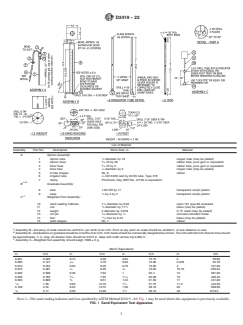
dimensions shown in Fig. 1. See Annex A1 for alternative
apparatus.
6. Interferences
7.2 Measuring Tin—A cylindrical tin approximately 2 ⁄4 in.
6.1 Maintain the temperature of the working solution at 72
(57 mm) in diameter having a capacity of 85 6 5 mL.
6 5 °F (22 6 3 °C) during the performance of this test.
7.3 4.75 mm (No. 4) Sieve, conforming to the requirements
NOTE 4—If field conditions preclude the maintenance of the tempera-
of Specification E11.
ture range, frequent referee samples should be submitted to a laboratory
where proper temperature control is possible. It is also possible to
7.4 Funnel,wide-mouth,fortransferringtestspecimensinto
establish temperature correction curves for each material being tested
the graduated cylinder.
where proper temperature control is not possible. However, no general
correction should be utilized for several materials even within a narrow
7.5 Bottles, two, 1.0 gal (3.8 L), to store stock solution and
range of sand equivalent values. Samples that meet the minimum sand
working solution.
equivalent requirement at a working solution temperature below the
recommended range need not be subject to referee testing. 7.6 Flat Pan, for mixing.
D2419 − 22
List of Material
Assembly Part No. Description Stock Size, in. Material
A Siphon Assembly:
1 siphon tube ⁄4 diameter by 16 copper tube (may be plated)
2 siphon hose ⁄16 ID by 48 rubber tube, pure gum or equivalent
3 blow hose ⁄16 ID by 2 rubber tube, pure gum or equivalent
4 blow tube ⁄4 diameter by 2 copper tube (may be plated)
5 2-hole stopper No. 6 rubber
6 irrigator tube ⁄4 OD 0.035 wall by 20 SS tube, Type 316
7 clamp Pinchcock, Day, BKH No. 21730 or equivalent
A,B
B Graduate Assembly:
8 tube 1.50 OD by 17 transparent acrylic plastic
9 base ⁄4by4by4 transparent acrylic plastic
C
C Weighted Foot Assembly:
10 sand reading indicator 1 ⁄4 diameter by 0.59 nylon 101 type 66 annealed
1 1
11 rod ⁄4 diameter by 17 ⁄2 brass (may be plated)
12 weight 2 diameter by 2.078 C. R. steel (may be plated)
1 1
13 roll pin ⁄16 diameter by ⁄2 corrosion-resistant metal
14 foot ⁄16 hex by 0.54 brass (may be plated)
15 solid stopper No. 7 rubber
A
Assembly B—Accuracy of scale should be ±0.010 in. per tenth of an inch. Error at any point on scale should be ±0.030 in. of true distance to zero.
B
AssemblyB—Graduationsongraduateshouldbeintenthsofaninch.Inchmarksshouldbenumericallydesignatedasshown.Theinchandhalf-inchdivisionlinesshould
be approximately ⁄4 in. long. All division lines should be 0.015 in. deep with width across top 0.030 in.
C
Assembly C—Weighted foot assembly should weigh 1000±5g.
Metric Equivalents
in. mm in. mm in. mm in. mm
0.001 0.025 0.13 3.30 0.62 15.75 2 50.80
0.005 0.127 ⁄16 4.76 0.63 16.00 2.078 52.78
0.010 0.254 0.25 6.35 0.75 19.05 4 101.60
1 3
0.015 0.381 ⁄4 6.35 ⁄4 19.05 10.10 256.54
0.020 0.508 0.30 7.62 1 25.4 15 381.00
5 1
0.030 0.762 ⁄16 7.94 1 ⁄16 26.99 16 406.40
0.035 0.889 ⁄8 9.51 1.24 31.50 17 431.80
1 1
⁄16 1.59 0.50 12.70 1 ⁄4 31.75 17.5 444.50
0.100 2.54 0.54 13.72 1.50 38.10 20 508.00
1 1
⁄8 3.17 0.59 14.99 1 ⁄2 38.10 48 1219.2
NOTE1—ThesandreadingindicatorandfootspecifiedbyASTMMethodD2419 – 69.Fig.1maybeusedwherethisequipmentispreviouslyavailable.
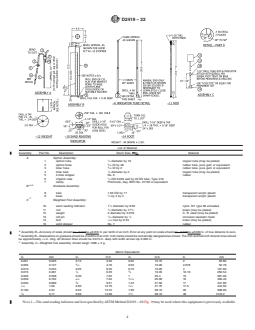
FIG. 1 Sand Equivalent Test Apparatus
D2419 − 22
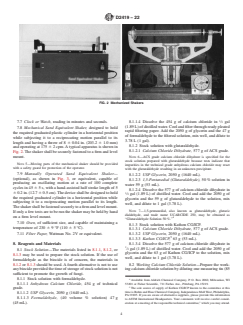
FIG. 2 Mechanized Shakers
7.7 Clock or Watch, reading in minutes and seconds. 8.1.1.4 Dissolve the 454 g of calcium chloride in ⁄2 gal
(1.89L)ofdistilledwater.Coolandfilterthroughreadypleated
7.8 Mechanical Sand Equivalent Shaker, designed to hold
rapid filtering paper. Add the 2050 g of glycerin and the 47 g
the required graduated plastic cylinder in a horizontal position
of formaldehyde to the filtered solution, mix well, and dilute to
while subjecting it to a reciprocating motion parallel to its
3.78 L (1 gal).
length and having a throw of 8 6 0.04 in. (203.2 6 1.0 mm)
8.1.2 Stock solution with glutaraldehyde.
and operating at 175 6 2 cpm.Atypical apparatus is shown in
8.1.2.1 Calcium Chloride Dihydrate, 577 g of ACS grade.
Fig. 2.The shaker shall be securely fastened to a firm and level
mount.
NOTE 6—ACS grade calcium chloride dihydrate is specified for the
stock solution prepared with glutaraldehyde because tests indicate that
NOTE 5—Moving parts of the mechanical shaker should be provided
impurities in the technical grade anhydrous calcium chloride may react
with a safety guard for protection of the operator.
with the glutaraldehyde resulting in an unknown precipitate.
7.9 Manually Operated Sand Equivalent Shaker—
8.1.2.2 USP Glycerin, 2050 g (1640 mL).
(optional), as shown in Fig. 3, or equivalent, capable of
8.1.2.3 1,5-Pentanedial (Glutaraldehyde), 50 % solution in
producing an oscillating motion at a rate of 100 complete
water 59 g (53 mL).
cycles in 45 6 5 s, with a hand-assisted half stroke length of 5
8.1.2.4 Dissolve the 577 g of calcium chloride dihydrate in
60.2in.(12.7 60.5cm).Thedeviceshallbedesignedtohold
⁄2 gal (1.89 L) of distilled water. Cool and add the 2050 g of
the required graduated cylinder in a horizontal position while
glycerin and the 59 g of glutaraldehyde to the solution, mix
subjecting it to a reciprocating motion parallel to its length.
well, and dilute to 1 gal (3.78 L).
Theshakershallbefastenedsecurelytoafirmandlevelmount.
NOTE 7—1,5-pentanedial, also known as glutaraldehyde, glutaric
Ifonlyafewtestsaretoberuntheshakermaybeheldbyhand
dialdehyde, and trade name UCARCIDE 250, may be obtained as
on a firm level mount.
“Glutaraldehyde Solution 50 %.”
7.10 Oven, of sufficient size, and capable of maintaining a
8.1.3 Stock solution with Kathon CG/ICP.
temperature of 230 69°F(110 6 5 °C).
8.1.3.1 Calcium Chloride Dihydrate, 577 g of ACS grade.
8.1.3.2 USP Glycerin, 2050 g (1640 mL).
7.11 Filter Paper, Wattman No. 2V or equivalent.
8.1.3.3 Kathon CG/ICP, 63 g (53 mL).
8. Reagents and Materials 8.1.3.4 Dissolve the 577 g of calcium chloride dihydrate in
⁄2 gal (1.89 L) of distilled water. Cool and add the 2050 g of
8.1 Stock Solution—The materials listed in 8.1.1, 8.1.2,or
glycerin and the 63 g of Kathon CG/ICP to the solution, mix
8.1.3 may be used to prepare the stock solution. If the use of
well, and dilute to 1 gal (3.78 L).
formaldehyde as the biocide is of concern, the materials in
8.1.2 or 8.1.3 should be used.Afourth alternative is not to use 8.2 Working Calcium Chloride Solution—Prepare the work-
ingcalciumchloridesolutionbydilutingonemeasuringtin(85
anybiocideprovidedthetimeofstorageofstocksolutionisnot
sufficient to promote the growth of fungi.
8.1.1 Stock solution with formaldehyde.
Available from Aldrich Chemical Company, P. O. Box 2060, Milwaukee, WI
8.1.1.1 Anhydrous Calcium Chloride, 454 g of technical
53201 or Fisher Scientific, 711 Forbes Ave., Pittsburg, PA 15219.
The sole source of supply of Kathon CG/ICP known to the committee at this
grade.
time is Rohm and Hass Chemical Company, Independence MallWest, Philadelphia,
8.1.1.2 USP Glycerin, 2050 g (1640 mL).
PA19105. If you are aware of alternative suppliers, please provide this information
8.1.1.3 Formaldehyde, (40 volume % solution) 47 g
to ASTM International Headquarters. Your comments will receive careful consid-
(45 mL). eration at a meeting of the responsible technical committee, which you may attend.
D2419 − 22
FIG. 3 Manually Operated Shaker
6 5 mL) full of the stock calcium chloride solution to 1.0 gal 9.3.4 Add the material passing the sieve obtained in 9.3.2
(3.8 L) with water. Use distilled or demineralized water for the and 9.3.3 to the separated fine portion of the sample.
normal preparation of the working solution. However, if it is
9.4 Prepare test specimens from the material passing the
determined that the local tap water is of such purity that it does
4.75 mm (No. 4) sieve portion of the sample by either the
not affect the test results, it is permissible to use it instead of
procedure described in 9.4.1 or 9.4.2.
distilled or demineralized water except in the event of dispute.
NOTE 9—Experiments show that as the amount of material being
NOTE 8—The effect of local tap water on sand equivalent test results
reduced by splitting or quartering is decreased, the accuracy of providing
may be determined by comparing the results of three sand equivalent tests
representative portions is decreased. For this reason, it is imperative that
using distilled water with the results of three sand equivalent tests using
extreme care be exercised when preparing the test specimens.
the local tap water. The six
...
This document is not an ASTM standard and is intended only to provide the user of an ASTM standard an indication of what changes have been made to the previous version. Because
it may not be technically possible to adequately depict all changes accurately, ASTM recommends that users consult prior editions as appropriate. In all cases only the current version
of the standard as published by ASTM is to be considered the official document.
Designation: D2419 − 14 D2419 − 22
Standard Test Method for
Sand Equivalent Value of Soils and Fine Aggregate
This standard is issued under the fixed designation D2419; the number immediately following the designation indicates the year of
original adoption or, in the case of revision, the year of last revision. A number in parentheses indicates the year of last reapproval. A
superscript epsilon (´) indicates an editorial change since the last revision or reapproval.
This standard has been approved for use by agencies of the U.S. Department of Defense.
1. Scope
1.1 This test method is intended to serve as a rapid field-correlation field correlation test. The purpose of this test method is to
indicate, under standard conditions, the relative proportions of clay-size or plastic fines and dust in granular soils and fine
aggregates that pass the 4.75-mm 4.75 mm (No. 4) sieve. The term “sand equivalent” expresses the concept that most granular soils
and some fine aggregates are mixtures of desirable coarse particles, sand-size particles, and generally undesirable clay or plastic
fines and dust.
NOTE 1—For fine aggregates containing clean dust of fracture (clay-size particles that are not clay minerals), test results will depend on the amount of
fines present in the material. In this case, other tests such as Methylene Blue Value (AASHTO T330) or X-Ray DiffractionT 330) or X-ray diffraction
(XRD) may be needed to determine if the fines are deleterious.
NOTE 2—Some agencies perform the test on material with a top size smaller than the 4.75-mm 4.75 mm (No. 4) sieve. This is done to avoid trapping
the clay-size or plastic fines and dust below flaky shaped 4.75 to 2.36 mm (No. 4 to 8) sized particles. Testing smaller top sized material may lower the
numerical results of the test.
1.2 The values stated in inch-pound units are to be regarded as standard. The values given in parentheses are mathematical
conversions to SI units that are provided for information only and are not considered standard.
1.2.1 Regarding sieves, per Specification E11 Section 1.2,subsection 1.3, “the values stated in SI units shall be considered standard
for the dimensions of the wiresieve cloth openings and the diameter of the wires wire diameter used in the wiresieve cloth. The
values stated in inchpoundinch-pound units shall be considered standard with regard to the sieve frames.” frames, pans, and
covers.” When sieve mesh sizes are referenced, the alternate inch-pound designations are provided for information purposes and
enclosed in parentheses.
1.3 The text of this standard references notes and footnotes which provide explanatory material. These notes and footnotes
(excluding those in tables and figures) shall not be considered as requirements of the standard.
1.4 This standard does not purport to address all of the safety concerns, if any, associated with its use. It is the responsibility
of the user of this standard to establish appropriate safety safety, health, and healthenvironmental practices and determine the
applicability of regulatory limitations prior to use.
1.5 This international standard was developed in accordance with internationally recognized principles on standardization
established in the Decision on Principles for the Development of International Standards, Guides and Recommendations issued
by the World Trade Organization Technical Barriers to Trade (TBT) Committee.
This test method is under the jurisdiction of ASTM Committee D04 on Road and Paving Materials and is the direct responsibility of Subcommittee D04.51 on Aggregate
Tests.
Current edition approved June 1, 2014Sept. 15, 2022. Published September 2014September 2022. Originally approved in 1965. Last previous edition approved in 20092014
as D2419 – 09.D2419 – 14. DOI: 10.1520/D2419-14.10.1520/D2419-22.
Copyright © ASTM International, 100 Barr Harbor Drive, PO Box C700, West Conshohocken, PA 19428-2959. United States
D2419 − 22
2. Referenced Documents
2.1 ASTM Standards:
C670 Practice for Preparing Precision and Bias Statements for Test Methods for Construction Materials
C702C702/C702M Practice for Reducing Samples of Aggregate to Testing Size
D8 Terminology Relating to Materials for Roads and Pavements
D75D75/D75M Practice for Sampling Aggregates
D653 Terminology Relating to Soil, Rock, and Contained Fluids
D3666 Specification for Minimum Requirements for Agencies Testing and Inspecting Road and Paving Materials
E11 Specification for Woven Wire Test Sieve Cloth and Test Sieves
2.2 AASHTO Standard:
T 176 Standard Method of Test for Plastic Fines in Graded Aggregates and Soils by Use of Sand Equivalent Test
3. Terminology
3.1 Definitions:
3.1.1 clay size—that portion of the soil or aggregate finer than 0.002 mm (0.005 mm in some cases) (see Terminology D653).
3.1.2 fine aggregate—aggregate passing the 9.5-mm ( ⁄8-in.) sieve and almost entirely passing the 4.75-mm (No. 4) sieve and
predominantly retained on the 75-μm (No. 200) sieve (see Terminology D8).
3.1.2 sand—particles of rock that will pass the 4.75 mm (No. 4) sieve and be retained on the 0.075 mm (No. 200) sieve (see
Terminology D653).
3.1.3 sand equivalent—a measure of the amount of silt, clay contamination, or clay-size aggregate particles in the fine aggregate
(or soil) as determined by test (see Terminology D653). (For further explanation, see SectionSections 4 and Section 5.)
3.1.4 soil—sediments or other unconsolidated accumulations of solid particles produced by the physical and chemical
disintegration of rocks which may or may not contain organic matter (see Terminology D653).
4. Summary of Test Method
4.1 A measured volume of soil or fine aggregate and a small quantity of flocculating solution are poured into a graduated plastic
cylinder and are agitated to loosen the claylikeclay-like coatings or clay size clay-size particles from the sand particles in the test
specimen. The specimen is then “irrigated” using additional flocculating solution forcing the claylikeclay-like or clay size clay-size
material into suspension above the sand. After a prescribed sedimentation period, the height of flocculated material is read and the
height of sand in the cylinder is determined. The sand equivalent is the ratio of the height of sand to the height of flocculated
material times multiplied by 100.
5. Significance and Use
5.1 This test method assigns an empirical value to the relative amount, fineness, and character of claylikeclay-like material present
in the test specimen.
5.2 A minimum sand equivalent value may be specified to limit the permissible quantity of claylikeclay-like or clay size clay-size
fines in an aggregate.
5.3 This test method provides a rapid field method for determining changes in the quality of aggregates during production or
placement.
NOTE 3—The quality of the results produced by this standard are dependantdependent upon the competence of the personnel performing the procedure
For referenced ASTM standards, visit the ASTM website, www.astm.org, or contact ASTM Customer Service at service@astm.org. For Annual Book of ASTM Standards
volume information, refer to the standard’s Document Summary page on the ASTM website.
Available from American Association of State Highway and Transportation Officials (AASHTO), 444 N. Capitol St., NW, Suite 249, Washington, DC 20001,
http://www.transportation.org.
D2419 − 22
and the capability, calibration, and the maintenance of the equipment used. Agencies that meet the criteria of PracticeSpecification D3666 are generally
considered capable of competent and objective testing/sampling/inspection/etc. testing, sampling, inspection, etc. Users of this standard are cautioned that
compliance with PracticeSpecification D3666 alone does not completely assureensure reliable results. Reliable results depend on many factors:factors;
following the suggestions of PracticeSpecification D3666 or similar acceptable guideline provides a means of evaluating and controlling some of those
factors.
6. Interferences
6.1 Maintain the temperature of the working solution at 72 6 5°F5 °F (22 6 3°C)3 °C) during the performance of this test.
NOTE 4—If field conditions preclude the maintenance of the temperature range, frequent referee samples should be submitted to a laboratory where proper
temperature control is possible. It is also possible to establish temperature correction curves for each material being tested where proper temperature
control is not possible. However, no general correction should be utilized for several materials even within a narrow range of sand equivalent values.
Samples that meet the minimum sand equivalent requirement at a working solution temperature below the recommended range need not be subject to
referee testing.
6.2 Perform the test at a location free from vibration. Excessive vibration may cause the suspended material to settle at a greater
rate than normal.
6.3 Do not expose the plastic cylinders to direct sunlight any more than is necessary.
6.4 Occasionally it may be necessary to remove a fungus growth from the working calcium chloride solution container and from
the inside of the flexible tubing and irrigator tube. This fungus can easily be seen as a slimy substance in the solution, or as a mold
growing on the inside of the container.
6.4.1 To remove this growth, prepare a cleaning solvent by diluting sodium hypochlorite solution (household chlorine bleach) with
an equal quantity of water.
6.4.2 After discarding the contaminated solution, fill the solution container with the prepared cleaning solvent: allow about 1 L
of the cleaning solvent to flow through the siphon assembly and irrigator tube, then place the pinch clamp on the end of the tubing
to cut off the flow of solvent and to hold the solvent in the tube. Refill the container and allow to stand overnight.
6.4.3 After soaking, allow the cleaning solvent to flow out through the siphon assembly and irrigator tube.
6.4.4 Remove the siphon assembly from the solution container and rinse both with clear water. The irrigator tube and siphon
assembly can be rinsed easily by attaching a hose between the tip of the irrigator tube and water faucet and backwashing fresh
water through the tube.
6.5 Occasionally the holes in the tip of the irrigator tube may become clogged by a particle of sand. If the obstruction cannot be
freed by any other method, use a pin or other sharp object to force it out using extreme care not to enlarge the size of the opening.
6.6 Working solution which is more than two weeks old shall be discarded.
6.7 Mixing and storage container(s) for solutions shall be thoroughly rinsed prior to mixing a fresh batch of solution.
6.8 Fresh solution shall not be added to old solution regardless of age.
7. Apparatus
7.1 A graduated transparent acrylic plastic cylinder, rubber stopper, irrigator tube, weighted foot assembly, and siphon assembly
all conforming to the respective specifications and dimensions shown in Fig. 1. See Annex A1 for alternative apparatus.
7.2 Measuring Tin—A cylindrical tin approximately 2 ⁄4 in. (57 mm) in diameter having a capacity of 85 6 5 mL.
7.3 4.75-mm 4.75 mm (No. 4) Sieve, conforming to the requirements of Specification E11.
D2419 − 22
List of Material
Assembly Part No. Description Stock Size, In.in. Material
A Siphon Assembly:
1 siphon tube ⁄4 diameter by 16 copper tube (may be plated)
2 siphon hose ⁄16 ID by 48 rubber tube, pure gum or equivalent
3 blow hose ⁄16 ID by 2 rubber tube, pure gum or equivalent
4 blow tube ⁄4 diameter by 2 copper tube (may be plated)
5 2-hole stopper No. 6 rubber
6 irrigator tube ⁄4 OD 0.035 wall by 20 SS tube, Type 316
7 clamp Pinchcock, Day, BKH No. 21730 or equivalent
A,B
B Graduate Assembly:
8 tube 1.50 OD by 17 transparent acrylic plastic
9 base ⁄4 by 4 by 4 transparent acrylic plastic
C
C Weighted Foot Assembly:
10 sand reading indicator 1 ⁄4 diameter by 0.59 nylon 101 type 66 annealed
1 1
11 rod ⁄4 diameter by 17 ⁄2 brass (may be plated)
12 weight 2 diameter by 2.078 C. R. steel (may be plated)
1 1
13 roll pin ⁄16 diameter by ⁄2 corrosion-resistant metal
14 foot ⁄16 hex by 0.54 brass (may be plated)
15 solid stopper No. 7 rubber
A
Assembly B—Accuracy of scale should be± 0.010be ±0.010 in. per tenth of an inch. Error at any point on scale should be± 0.030be ±0.030 in. of true distance to zero.
B
Assembly B—Graduations on graduate should be in tenths of an inch. Inch marks should be numerically designated as shown. The inch and half-inch division lines should
be approximately ⁄4 in. long. All division lines should be 0.015 in. deep with width across top 0.030 in.
C
Assembly C—Weighted foot assembly should weigh 1000 ± 5 g.
Metric Equivalents
in. mm in. mm in. mm in. mm
0.001 0.025 0.13 3.30 0.62 15.75 2 50.80
0.005 0.127 ⁄16 4.76 0.63 16.00 2.078 52.78
0.010 0.254 0.25 6.35 0.75 19.05 4 101.60
1 3
0.015 0.381 ⁄4 6.35 ⁄4 19.05 10.10 256.54
0.020 0.508 0.30 7.62 1 25.4 15 381.00
5 1
0.030 0.762 ⁄16 7.94 1 ⁄16 26.99 16 406.40
0.035 0.889 ⁄8 9.51 1.24 31.50 17 431.80
1 1
⁄16 1.59 0.50 12.70 1 ⁄4 31.75 17.5 444.50
0.100 2.54 0.54 13.72 1.50 38.10 20 508.00
1 1
⁄8 3.17 0.59 14.99 1 ⁄2 38.10 48 1219.2
NOTE 1—The sand reading indicator and foot specified by ASTM Method D2419 – 69.Fig. 1, may be used where this equipment is previously available.
D2419 − 22
FIG. 1 Sand Equivalent Test Apparatus
7.4 Funnel, wide-mouth, for transferring test specimens into the graduated cylinder.
7.5 Bottles, two 1.0-gal (3.8-L) two, 1.0 gal (3.8 L), to store stock solution and working solution.
7.6 Flat Pan, for mixing.
7.7 Clock or Watch, reading in minutes and seconds.
7.8 Mechanical Sand Equivalent Shaker, designed to hold the required graduated plastic cylinder in a horizontal position while
subjecting it to a reciprocating motion parallel to its length and having a throw of 8 6 0.04 in. (203.2 6 1.0 mm) and operating
at 175 6 2 cpm. A typical apparatus is shown in Fig. 2. The shaker shall be securely fastened to a firm and level mount.
NOTE 5—Moving parts of the mechanical shaker should be provided with a safety guard for protection of the operator.
7.9 Manually Operated Sand Equivalent Shaker—(optional), as shown in Fig. 3, or equivalent, capable of producing an oscillating
motion at a rate of 100 complete cycles in 45 6 5 s, with a hand-assisted half stroke length of 5 6 0.2 in. (12.7 6 0.5 cm). The
device shall be designed to hold the required graduated cylinder in a horizontal position while subjecting it to a reciprocating
motion parallel to its length. The shaker shall be fastened securely to a firm and level mount. If only a few tests are to be run the
shaker may be held by hand on a firm level mount.
7.10 Oven, of sufficient size, and capable of maintaining a temperature of 230 6 9°F9 °F (110 6 5°C).5 °C).
7.11 Filter Paper, WatmanWattman No. 2V or equivalent.
8. Reagents and Materials
8.1 Stock Solution—The materials listed in 8.1.1, 8.1.2, or 8.1.3 may be used to prepare the stock solution. If the use of
formaldehyde as the biocide is of concern, the materials in 8.1.2 or 8.1.3 should be used. A fourth alternative is not to use any
biocide provided the time of storage of stock solution is not sufficient to promote the growth of fungi.
8.1.1 Stock solution with formaldehyde.
8.1.1.1 Anhydrous Calcium Chloride, 454 g of technical grade.
8.1.1.2 USP Glycerin, 2050 g (1640 mL).
8.1.1.3 Formaldehyde, (40 volume % solution) 47 g (45 mL).47 g (45 mL).
8.1.1.4 Dissolve the 454 g of calcium chloride in ⁄2 gal (1.89 L) of distilled water. Cool and filter through ready pleated rapid
filtering paper. Add the 2050 g of glycerin and the 47 g of formaldehyde to the filtered solution, mix well, and dilute to 3.78 L
(1 gal).
8.1.2 Stock solution with glutaraldehyde.
8.1.2.1 Calcium Chloride Dihydrate, 577 g of A. C. S. ACS grade.
NOTE 6—ACS grade calcium chloride dihydrate is specified for the stock solution prepared with glutaraldehyde because tests indicate that impurities in
the technical grade anhydrous calcium chloride may react with the glutaraldehyde resulting in an unknown precipitate.
8.1.2.2 USP Glycerin, 2050 g (1640 mL).
8.1.2.3 1,5-Pentanedial (Glutaraldehyde), 50 % solution in water 59 g (53 mL).
D2419 − 22
FIG. 2 Mechanized Shakers
FIG. 3 Manually Operated Shaker
8.1.2.4 Dissolve the 577 g of calcium chloride dihydrate in ⁄2 gal (1.89 L) of distilled water. Cool and add the 2050 g of glycerin
and the 59 g of glutaraldehyde to the solution, mix well, and dilute to 1 gal (3.78 L).
NOTE 7—1,5-pentanedial, also known as glutaraldehyde, glutaric dialdehyde, and trade name UCARCIDE 250, may be obtained as “Glutaraldehyde
Solution 50 %.”
8.1.3 Stock solution with Kathon CG/ICP.
8.1.3.1 Calcium Chloride Dihydrate, 577 g of A. C. S. ACS grade.
8.1.3.2 USP Glycerin, 2050 g (1640 mL).
Available from Aldrich Chemical Company, P. O. Box 2060, Milwaukee, WI 53201 or Fisher Scientific, 711 Forbes Ave., Pittsburg, PA 15219.
D2419 − 22
8.1.3.3 Kathon CG/ICPCG/ICP, , 63 63 g (53 mL).
8.1.3.4 Dissolve the 577 g of calcium chloride dihydrate in ⁄2 gal (1.89 L) of distilled water. Cool and add the 2050 g of glycerin
and the 63 g of Kathon CG/ICP to the solution, mix well, and dilute to 1 gal (3.78 L).
8.2 Working Calcium Chloride Solution—Prepare the working calcium chloride solution by diluting one measuring tin (85 6 5
mL) full of the stock calcium chloride solution to 1.0 gal (3.8 L) with water. Use distilled or demineralized water for the normal
preparation of the working solution. However, if it is determined that the local tap water is of such purity that it does not affect
the test results, it is permissible to use it instead of distilled or demineralized water except in the event of dispute.
NOTE 8—The effect of local tap water on sand equivalent test results may be determined by comparing the results of three sand equivalent tests using
distilled water with the results of three sand equivalent tests using the local tap water. The six test specimens required for this comparison shall be prepared
from the sample of material and oven-dried as prescribed in this test method.
9. Sample Preparation
9.1 Sample the material to be tested in accordance with Practice D75D75/D75M.
9.2 Thoroughly mix the sample and reduce it as necessary using the applicable procedures in Practice C702C702/C702M.
9.3 Obtain at least 1500 g of material passing the 4.75-mm 4.75 mm (No. 4) sieve in the following manner:
9.3.1 Separate the sample on the 4.75-mm 4.75 mm (No. 4) sieve by means of a lateral and vertical motion of the sieve,
accompanied by a jarring action so as to keep the sample moving continuously over the surface of the sieve. Continue the sieving
until not more than 1 weight %1 % by mass of the residue passes the sieve during 1 min.
...