

ASTM D2036-09(2022)
(Test Method)Standard Test Methods for Cyanides in Water
General Information
- Abstract
SIGNIFICANCE AND USE
5.1 Cyanide is highly toxic. Regulations have been established to require the monitoring of cyanide in industrial and domestic wastes and in surface waters (Appendix X1).
5.2 Test Method D is applicable for natural water and clean metal finishing or heat treatment effluents. It may be used for process control in wastewater treatment facilities providing its applicability has been validated by Test Method B or C.
5.3 The spot test outlined in Annex A1 can be used to detect cyanide and thiocyanate in water or wastewater, and to approximate its concentration.
SCOPE
1.1 These test methods cover the determination of cyanides in water. The following test methods are included:
Sections
Test Method A
Total Cyanides after Distillation
12 – 18
Test Method B
Cyanides Amenable to Chlorination2
by Difference
19 – 25
Test Method C
Weak Acid Dissociable Cyanides
26 – 32
Test Method D
Cyanides Amenable to Chlorination without
Distillation (Short-Cut Method)
33 – 39
1.2 Cyanogen halides may be determined separately.
Note 1: Cyanogen chloride is the most common of the cyanogen halide complexes as it is a reaction product and is usually present when chlorinating cyanide-containing industrial waste water. For the presence or absence of CNCl, the spot test method given in Annex A1 can be used.
1.3 These test methods do not distinguish between cyanide ions and metallocyanide compounds and complexes. Furthermore, they do not detect the cyanates. Cyanates can be determined using ion chromatography without digestion.
Note 2: The cyanate complexes are decomposed when the sample is acidified in the distillation procedure.
1.4 The cyanide in cyanocomplexes of gold, platinum, cobalt and some other transition metals is not completely recovered by these test methods. Refer to Test Method D6994 for the determination of cyanometal complexes.
1.5 Cyanide from only a few organic cyanides are recovered, and those only to a minor extent.
1.6 Part or all of these test methods have been used successfully with reagent water and various waste waters. It is the user's responsibility to assure the validity of the test method for the water matrix being tested.
1.7 The values stated in SI units are to be regarded as standard. No other units of measurement are included in this standard.
1.8 This standard does not purport to address all of the safety concerns, if any, associated with its use. It is the responsibility of the user of this standard to establish appropriate safety, health, and environmental practices and determine the applicability of regulatory limitations prior to use. Specific hazard statements are given in 5.1, 8.8, 8.18, Section 9, 11.3, and 16.1.9.
1.9 This international standard was developed in accordance with internationally recognized principles on standardization established in the Decision on Principles for the Development of International Standards, Guides and Recommendations issued by the World Trade Organization Technical Barriers to Trade (TBT) Committee.
- Status
- Published
- Publication Date
- 30-Apr-2022
- Technical Committee
- D19 - Water
- Drafting Committee
- D19.06 - Methods for Analysis for Organic Substances in Water
Overview
ASTM D2036-09(2022): Standard Test Methods for Cyanides in Water defines procedures for determining cyanide concentrations in various water matrices. Cyanides are highly toxic and pose significant risks to public health and ecosystems. As a result, regulatory authorities require regular monitoring in industrial, municipal, and surface waters. This ASTM International standard supports environmental compliance, water quality assessment, and process control in industries releasing or handling cyanide compounds.
The standard outlines several analytical methods-including distillation, colorimetry, titration, ion-selective electrode measurement, and ion chromatography-for quantifying different forms of cyanide. It is applicable to a wide range of water types, from reagent water to industrial effluents. Safety, sample handling, and interference elimination are emphasized due to the hazardous nature of cyanide and its analytical complexity.
Key Topics
- Test Methods Covered:
- Total Cyanides after Distillation (Method A)
- Cyanides Amenable to Chlorination by Difference (Method B)
- Weak Acid Dissociable Cyanides (Method C)
- Cyanides Amenable to Chlorination without Distillation (Short-Cut Method D)
- Significance of Cyanide Monitoring:
Cyanides are toxic, requiring strict monitoring to comply with water quality regulations and to protect human health and the environment. - Matrix Applicability:
Applicable to natural waters, industrial wastewaters, clean metal finishing/heat treatment effluents, and process control at wastewater treatment plants. - Detection and Spot-Testing:
Annexed spot tests provide rapid field detection and concentration estimation for cyanides and thiocyanate in water and wastewater. - Interferences:
The standard details potential analytical interferences from compounds such as oxidizers, sulfides, thiocyanates, and metals. Guidance on mitigating these interferences is provided through recommended sample pretreatment and reagent use. - Safety and Compliance:
Emphasizes the importance of safe handling, health precautions, and regulatory compliance for operators due to cyanide’s toxicity.
Applications
- Environmental Monitoring:
Enables routine testing of lakes, rivers, and reservoirs for regulatory compliance and ecosystem protection. - Industrial Wastewater Control:
Essential for industries such as metal plating, mining, chemical manufacturing, and heat treatment to monitor and control cyanide discharge in effluents. - Process Optimization:
Supports process control and optimization in treatment plants by allowing accurate validation of cyanide removal or destruction efficiency. - Field Screening:
The spot test method allows for quick, on-site screening of cyanide contamination, aiding in rapid response or preliminary assessments. - Regulatory Reporting:
Facilitates accurate and traceable data collection for submission to environmental authorities, ensuring adherence to national and international water quality standards.
Related Standards
- ASTM D6888: Test Method for Available Cyanides in Water by Flow Injection Analysis with Amperometric Detection.
- ASTM D6994: Test Method for Determination of Metal Cyanide Complexes in Various Water Matrices Using Anion Exchange Chromatography.
- ASTM D7365: Practice for Sampling, Preservation, and Mitigating Interferences in Water Samples for Analysis of Cyanide.
- ASTM D1193: Specification for Reagent Water.
- ASTM D1129: Terminology Relating to Water.
- ISO 6703-1: Water Quality-Determination of Cyanide-Part 1: Determination of Total Cyanide.
- EPA Methods: Various EPA test methods for cyanides in environmental samples.
Keywords: ASTM D2036, cyanide in water, cyanide analysis, wastewater monitoring, total cyanide, chlorination amenable cyanides, water quality standards, cyanide test methods, environmental compliance, industrial effluent, cyanide pollution, ion chromatography, colorimetric cyanide test.
Relations
- Effective Date
- 01-Apr-2024
- Effective Date
- 15-Nov-2023
- Effective Date
- 15-Nov-2023
- Effective Date
- 01-Aug-2020
- Effective Date
- 01-May-2020
- Effective Date
- 15-Dec-2017
- Effective Date
- 15-Jul-2017
- Effective Date
- 01-Apr-2016
- Effective Date
- 01-Oct-2015
- Effective Date
- 01-Jan-2014
- Effective Date
- 15-Jun-2013
- Effective Date
- 15-Jun-2012
- Effective Date
- 01-May-2011
- Effective Date
- 15-Sep-2010
- Effective Date
- 01-Jun-2010
Get Certified
Connect with accredited certification bodies for this standard

CIS Institut d.o.o.
Personal Protective Equipment (PPE) certification body. Notified Body NB-2890 for EU Regulation 2016/425 PPE.

Kiwa BDA Testing
Building and construction product certification.
Kmetijski inštitut Slovenije
Agricultural Institute of Slovenia. Soil testing, plant health, agricultural product analysis.
Sponsored listings
Frequently Asked Questions
ASTM D2036-09(2022) is a standard published by ASTM International. Its full title is "Standard Test Methods for Cyanides in Water". This standard covers: SIGNIFICANCE AND USE 5.1 Cyanide is highly toxic. Regulations have been established to require the monitoring of cyanide in industrial and domestic wastes and in surface waters (Appendix X1). 5.2 Test Method D is applicable for natural water and clean metal finishing or heat treatment effluents. It may be used for process control in wastewater treatment facilities providing its applicability has been validated by Test Method B or C. 5.3 The spot test outlined in Annex A1 can be used to detect cyanide and thiocyanate in water or wastewater, and to approximate its concentration. SCOPE 1.1 These test methods cover the determination of cyanides in water. The following test methods are included: Sections Test Method A Total Cyanides after Distillation 12 – 18 Test Method B Cyanides Amenable to Chlorination2 by Difference 19 – 25 Test Method C Weak Acid Dissociable Cyanides 26 – 32 Test Method D Cyanides Amenable to Chlorination without Distillation (Short-Cut Method) 33 – 39 1.2 Cyanogen halides may be determined separately. Note 1: Cyanogen chloride is the most common of the cyanogen halide complexes as it is a reaction product and is usually present when chlorinating cyanide-containing industrial waste water. For the presence or absence of CNCl, the spot test method given in Annex A1 can be used. 1.3 These test methods do not distinguish between cyanide ions and metallocyanide compounds and complexes. Furthermore, they do not detect the cyanates. Cyanates can be determined using ion chromatography without digestion. Note 2: The cyanate complexes are decomposed when the sample is acidified in the distillation procedure. 1.4 The cyanide in cyanocomplexes of gold, platinum, cobalt and some other transition metals is not completely recovered by these test methods. Refer to Test Method D6994 for the determination of cyanometal complexes. 1.5 Cyanide from only a few organic cyanides are recovered, and those only to a minor extent. 1.6 Part or all of these test methods have been used successfully with reagent water and various waste waters. It is the user's responsibility to assure the validity of the test method for the water matrix being tested. 1.7 The values stated in SI units are to be regarded as standard. No other units of measurement are included in this standard. 1.8 This standard does not purport to address all of the safety concerns, if any, associated with its use. It is the responsibility of the user of this standard to establish appropriate safety, health, and environmental practices and determine the applicability of regulatory limitations prior to use. Specific hazard statements are given in 5.1, 8.8, 8.18, Section 9, 11.3, and 16.1.9. 1.9 This international standard was developed in accordance with internationally recognized principles on standardization established in the Decision on Principles for the Development of International Standards, Guides and Recommendations issued by the World Trade Organization Technical Barriers to Trade (TBT) Committee.
SIGNIFICANCE AND USE 5.1 Cyanide is highly toxic. Regulations have been established to require the monitoring of cyanide in industrial and domestic wastes and in surface waters (Appendix X1). 5.2 Test Method D is applicable for natural water and clean metal finishing or heat treatment effluents. It may be used for process control in wastewater treatment facilities providing its applicability has been validated by Test Method B or C. 5.3 The spot test outlined in Annex A1 can be used to detect cyanide and thiocyanate in water or wastewater, and to approximate its concentration. SCOPE 1.1 These test methods cover the determination of cyanides in water. The following test methods are included: Sections Test Method A Total Cyanides after Distillation 12 – 18 Test Method B Cyanides Amenable to Chlorination2 by Difference 19 – 25 Test Method C Weak Acid Dissociable Cyanides 26 – 32 Test Method D Cyanides Amenable to Chlorination without Distillation (Short-Cut Method) 33 – 39 1.2 Cyanogen halides may be determined separately. Note 1: Cyanogen chloride is the most common of the cyanogen halide complexes as it is a reaction product and is usually present when chlorinating cyanide-containing industrial waste water. For the presence or absence of CNCl, the spot test method given in Annex A1 can be used. 1.3 These test methods do not distinguish between cyanide ions and metallocyanide compounds and complexes. Furthermore, they do not detect the cyanates. Cyanates can be determined using ion chromatography without digestion. Note 2: The cyanate complexes are decomposed when the sample is acidified in the distillation procedure. 1.4 The cyanide in cyanocomplexes of gold, platinum, cobalt and some other transition metals is not completely recovered by these test methods. Refer to Test Method D6994 for the determination of cyanometal complexes. 1.5 Cyanide from only a few organic cyanides are recovered, and those only to a minor extent. 1.6 Part or all of these test methods have been used successfully with reagent water and various waste waters. It is the user's responsibility to assure the validity of the test method for the water matrix being tested. 1.7 The values stated in SI units are to be regarded as standard. No other units of measurement are included in this standard. 1.8 This standard does not purport to address all of the safety concerns, if any, associated with its use. It is the responsibility of the user of this standard to establish appropriate safety, health, and environmental practices and determine the applicability of regulatory limitations prior to use. Specific hazard statements are given in 5.1, 8.8, 8.18, Section 9, 11.3, and 16.1.9. 1.9 This international standard was developed in accordance with internationally recognized principles on standardization established in the Decision on Principles for the Development of International Standards, Guides and Recommendations issued by the World Trade Organization Technical Barriers to Trade (TBT) Committee.
ASTM D2036-09(2022) is classified under the following ICS (International Classification for Standards) categories: 13.060.50 - Examination of water for chemical substances. The ICS classification helps identify the subject area and facilitates finding related standards.
ASTM D2036-09(2022) has the following relationships with other standards: It is inter standard links to ASTM D5788-95(2024), ASTM D6888-16(2023), ASTM D6696-16(2023), ASTM D7284-20, ASTM D1129-13(2020)e2, ASTM D5788-95(2017), ASTM D7284-13(2017), ASTM D6696-16, ASTM D6994-15, ASTM D6696-14, ASTM D7284-13, ASTM D2777-12, ASTM D5788-95(2011), ASTM D6994-10, ASTM D6696-10. Understanding these relationships helps ensure you are using the most current and applicable version of the standard.
ASTM D2036-09(2022) is available in PDF format for immediate download after purchase. The document can be added to your cart and obtained through the secure checkout process. Digital delivery ensures instant access to the complete standard document.
Standards Content (Sample)
This international standard was developed in accordance with internationally recognized principles on standardization established in the Decision on Principles for the
Development of International Standards, Guides and Recommendations issued by the World Trade Organization Technical Barriers to Trade (TBT) Committee.
Designation: D2036 − 09 (Reapproved 2022)
Standard Test Methods for
Cyanides in Water
This standard is issued under the fixed designation D2036; the number immediately following the designation indicates the year of
original adoption or, in the case of revision, the year of last revision.Anumber in parentheses indicates the year of last reapproval.A
superscript epsilon (´) indicates an editorial change since the last revision or reapproval.
This standard has been approved for use by agencies of the U.S. Department of Defense.
1. Scope the user’s responsibility to assure the validity of the test
method for the water matrix being tested.
1.1 These test methods cover the determination of cyanides
in water. The following test methods are included: 1.7 The values stated in SI units are to be regarded as
standard. No other units of measurement are included in this
Sections
Test Method A 12–18
standard.
Total Cyanides after Distillation
1.8 This standard does not purport to address all of the
Test Method B 19–25
Cyanides Amenable to Chlorination
safety concerns, if any, associated with its use. It is the
by Difference
responsibility of the user of this standard to establish appro-
Test Method C 26–32
priate safety, health, and environmental practices and deter-
Weak Acid Dissociable Cyanides
Test Method D 33–39
mine the applicability of regulatory limitations prior to use.
Cyanides Amenable to Chlorination without
Specific hazard statements are given in 5.1, 8.8, 8.18, Section
Distillation (Short-Cut Method)
9, 11.3, and 16.1.9.
1.2 Cyanogen halides may be determined separately.
1.9 This international standard was developed in accor-
NOTE 1—Cyanogen chloride is the most common of the cyanogen dance with internationally recognized principles on standard-
halide complexes as it is a reaction product and is usually present when
ization established in the Decision on Principles for the
chlorinating cyanide-containing industrial waste water. For the presence
Development of International Standards, Guides and Recom-
or absence of CNCl, the spot test method given in AnnexA1 can be used.
mendations issued by the World Trade Organization Technical
1.3 These test methods do not distinguish between cyanide
Barriers to Trade (TBT) Committee.
ions and metallocyanide compounds and complexes.
Furthermore, they do not detect the cyanates. Cyanates can be
2. Referenced Documents
determined using ion chromatography without digestion.
2.1 ASTM Standards:
NOTE 2—The cyanate complexes are decomposed when the sample is D1129Terminology Relating to Water
acidified in the distillation procedure.
D1193Specification for Reagent Water
D2777Practice for Determination of Precision and Bias of
1.4 The cyanide in cyanocomplexes of gold, platinum,
cobalt and some other transition metals is not completely Applicable Test Methods of Committee D19 on Water
D5788Guide for Spiking Organics into Aqueous Samples
recovered by these test methods. Refer to Test Method D6994
for the determination of cyanometal complexes. D5847Practice for Writing Quality Control Specifications
for Standard Test Methods for Water Analysis
1.5 Cyanide from only a few organic cyanides are
D6696Guide for Understanding Cyanide Species
recovered, and those only to a minor extent.
D6888Test Method for Available Cyanides with Ligand
1.6 Part or all of these test methods have been used
DisplacementandFlowInjectionAnalysis(FIA)Utilizing
successfully with reagent water and various waste waters. It is
Gas Diffusion Separation and Amperometric Detection
D6994Test Method for Determination of Metal Cyanide
Complexes in Wastewater, Surface Water, Groundwater
and Drinking Water Using Anion Exchange Chromatog-
These test methods are under the jurisdiction of ASTM Committee D19 on
Water and are the direct responsibility of Subcommittee D19.06 on Methods for
raphy with UV Detection
Analysis for Organic Substances in Water.
D7284Test Method for Total Cyanide in Water by Micro
Current edition approved May 1, 2022. Published May 2022. Originally
approved in 1964. Last previous edition approved in 2015 as D2036–09(2015).
DOI: 10.1520/D2036-09R22.
2 3
For an explanation of the term cyanides amenable to alkaline chlorination, see For referenced ASTM standards, visit the ASTM website, www.astm.org, or
Lancy, L. E. and Zabban, W., “Analytical Methods and Instrumentation for contact ASTM Customer Service at service@astm.org. For Annual Book of ASTM
Determining Cyanogen Compounds,” Papers on Industrial Water and Industrial Standards volume information, refer to the standard’s Document Summary page on
Waste Water, ASTM STP 337, 1962, pp. 32–45. the ASTM website.
Copyright © ASTM International, 100 Barr Harbor Drive, PO Box C700, West Conshohocken, PA 19428-2959. United States
D2036 − 09 (2022)
Distillation followed by Flow InjectionAnalysis with Gas 4.7 Round-robin data indicate the following minimum con-
Diffusion Separation and Amperometric Detection centrations: colorimetric 0.03 mg/L; titration 1.0 mg/L; and
D7365Practice for Sampling, Preservation and Mitigating selective ion electrode 0.03 mg/L. Ion chromatography and
Interferences in Water Samples for Analysis of Cyanide Test Method D6888 have a minimum levels equal to approxi-
E60Practice for Analysis of Metals, Ores, and Related mately 0.002 mg/L.
Materials by Spectrophotometry
5. Significance and Use
E275PracticeforDescribingandMeasuringPerformanceof
Ultraviolet and Visible Spectrophotometers
5.1 Cyanide is highly toxic. Regulations have been estab-
lished to require the monitoring of cyanide in industrial and
3. Terminology
domestic wastes and in surface waters (Appendix X1).
3.1 Definitions:
5.2 Test Method D is applicable for natural water and clean
3.1.1 For definitions of terms used in this standard, refer to
metal finishing or heat treatment effluents. It may be used for
Terminology D1129 and Guide D6696.
process control in wastewater treatment facilities providing its
applicability has been validated by Test Method B or C.
3.2 Acronyms:
3.2.1 FIA, n—flow injection analysis
5.3 ThespottestoutlinedinAnnexA1canbeusedtodetect
cyanide and thiocyanate in water or wastewater, and to
3.2.2 HPLC, n—high performance liquid chromatography
approximate its concentration.
3.2.3 IC, n—ion chromatography
3.2.4 PAD, n—pulsed amperometric detection 6. Interferences
6.1 Common interferences in the analysis for cyanide in-
4. Summary of Test Method
clude oxidizing agents, sulfides, aldehydes, glucose and other
4.1 The cyanide as hydrocyanic acid (HCN) is released sugars, high concentration of carbonate, fatty acids,
from compounds by means of reflux distillation and absorbed thiocyanate, and other sulfur containing compounds.
in sodium hydroxide solution. The conditions used for the
6.2 It is beyond the scope of these test methods to describe
distillationdistinguishthetypeofcyanide.Thesodiumcyanide
proceduresforovercomingallofthepossibleinterferencesthat
in the absorbing solution can be determined colorimetrically,
may be encountered. Refer to Practice D7365 for potential
by ion chromatography, titration, by selective ion electrode, or
interferences for the analysis of cyanide in water.
as described in Test Method D6888 using flow injection with
amperometric detection.
7. Apparatus
4.2 Test MethodA, Total Cyanides, is based on the decom-
7.1 Distillation Apparatus—The reaction vessel shall be a
position of nearly all cyanides in the presence of strong acid,
1L round bottom flask, with provision for an inlet tube and a
magnesium chloride catalyst, and heat during a 1-h reflux
condenser. The inlet tube shall be a funnel with an 8mm
distillation.
diameterstemthatextendstowithin6mmofthebottomofthe
flask. The condenser, which is recommended, shall be a
4.3 Test Method B, Cyanide Amenable to Chlorination, is
reflux-type, cold finger, or Allihn. The condenser shall be
based on chlorinating a portion of the sample under controlled
connected to a vacuum-type absorber which shall be in turn
conditions followed by the determination of total cyanide in
connected to a vacuum line which has provision for fine
both the original and chlorinated samples. Cyanides amenable
control. The flask shall be heated with an electric heater.
to chlorination are calculated by difference.
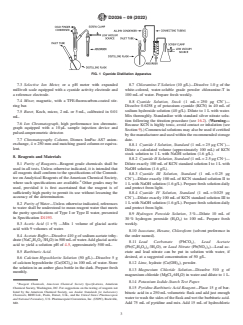
Examples of the apparatus are shown in Fig. 1. Equivalent
4.3.1 This test method can be affected by compounds that
apparatus is acceptable provided cyanide recoveries of 100%
are converted during chlorination to color-producing com-
6 4% are documented.
pounds or react with the reagents used, and cause interference
7.1.1 Smallerdistillationtubessuchas50mLMIDItubesor
in the procedure employed to determine cyanide in the absorp-
6mLMicroDist (trademarked) tubes described inTest Method
tion solution.
D7284 can be used if the quality control requirements in
4.4 Test Method C, Weak Acid Dissociable Cyanides, is
Section 40 are satisfied. The reagents should be added propor-
based on the decomposition of cyanides in the presence of
tionately to those specified in this test method for smaller
weakacid,zincacetateandheatduringa1-hrefluxdistillation.
sample sizes. While the use of smaller distillation tubes is
4.5 Test Method D, Cyanide Amenable to Chlorination generally accepted, the interlaboratory study was conducted
without Distillation, is a direct colorimetric procedure. with 500mL samples; therefore, the user is responsible to
determine the actual precision and bias when using a different
4.6 In the absence of interference, the minimum concentra-
type of distillation apparatus.
tionofcyanideintheabsorptionsolutionthatcanbeaccurately
determined colorimetrically is 0.005 mg/L, ion chromatogra- 7.2 Spectrophotometer or Filter Photometer, suitable for
phy and Test Method D6888 are 0.002 mg/L, titration is 0.4 measurement in the region of 578 nm, using 1.0cm, 2.0cm,
mg/Landbyselectiveionelectrodeis0.05mg/L.Pretreatment 5.0cm, and 10.0cm absorption cells. Filter photometers and
including distillation tends to increase these concentrations to photometric practices used in these test methods shall conform
a degree determined by the amount of manipulation required to Practice E60. Spectrophotometers shall conform to Practice
and the type of sample. E275.
D2036 − 09 (2022)
FIG. 1 Cyanide Distillation Apparatus
7.3 Selective Ion Meter, or a pH meter with expanded 8.7 Chloramine-T Solution (10 g/L)—Dissolve 1.0 g of the
millivolt scale equipped with a cyanide activity electrode and white-colored, water-soluble grade powder chloramine-T in
a reference electrode. 100 mL of water. Prepare fresh weekly.
−
7.4 Mixer, magnetic, with a TFE-fluorocarbon-coated stir-
8.8 Cyanide Solution, Stock (1 mL = 250 µg CN )—
ring bar.
Dissolve 0.6258 g of potassium cyanide (KCN) in 40 mL of
sodium hydroxide solution (40 g/L). Dilute to 1 L with water.
7.5 Buret, Koch, micro, 2mL or 5mL, calibrated in 0.01
Mix thoroughly. Standardize with standard silver nitrate solu-
mL.
tion following the titration procedure (see 16.2). (Warning—
7.6 Ion Chromatograph, high performance ion chromato-
Because KCN is highly toxic, avoid contact or inhalation (see
graph equipped with a 10µL sample injection device and
Section9).)Commercialsolutionsmayalsobeusedifcertified
pulsed-amperometric detector.
bythemanufacturerandusedwithintherecommendedstorage
7.7 Chromatography Column, Dionex IonPac AS7 anion- date.
−
exchange, 4×250 mm and matching guard column or equiva-
8.8.1 Cyanide I Solution, Standard(1mL=25µgCN )—
lent.
Dilute a calculated volume (approximately 100 mL) of KCN
stock solution to 1 L with NaOH solution (1.6 g/L).
8. Reagents and Materials −
8.8.2 Cyanide II Solution, Standard (1 mL=2.5 µg CN )—
8.1 Purity of Reagents—Reagent grade chemicals shall be
Dilute exactly 100 mLof KCN standard solution I to 1 Lwith
used in all tests. Unless otherwise indicated, it is intended that NaOH solution (1.6 g/L).
all reagents shall conform to the specifications of the Commit-
8.8.3 Cyanide III Solution, Standard (1 mL=0.25 µg
−
tee onAnalytical Reagents of theAmerican Chemical Society,
CN )—Dilute exactly 100 mL of KCN standard solution II to
where such specifications are available. Other grades may be
1 Lwith NaOH solution (1.6 g/L). Prepare fresh solution daily
used, provided it is first ascertained that the reagent is of
and protect from light.
sufficiently high purity to permit its use without lessening the
8.8.4 Cyanide IV Solution, Standard (1 mL=0.025 µg
−
accuracy of the determination.
CN )—Dilute exactly 100 mLof KCN standard solution III to
1 Lwith NaOH solution (1.6 g/L). Prepare fresh solution daily
8.2 Purity of Water—Unless otherwise indicated, references
and protect from light.
to water shall be understood to mean reagent water that meets
the purity specifications of Type I or Type II water, presented
8.9 Hydrogen Peroxide Solution,3%—Dilute 10 mL of
in Specification D1193.
30% hydrogen peroxide (H O ) to 100 mL. Prepare fresh
2 2
weekly.
8.3 Acetic Acid (1+9) —Mix 1 volume of glacial acetic
acid with 9 volumes of water.
8.10 Isooctane, Hexane, Chloroform (solvent preference in
the order named).
8.4 Acetate Buffer—Dissolve 410 g of sodium acetate trihy-
drate(NaC H O ·3H O)in500mLofwater.Addglacialacetic
2 3 2 2
8.11 Lead Carbonate (PbCO ), Lead Acetate
acid to yield a solution pH of 4.5, approximately 500 mL.
(Pb(C H O ) ·3H O), or Lead Nitrate (Pb(NO ) )—Lead ac-
2 3 2 2 2 3 2
8.5 Barbituric Acid.
etate and lead nitrate can be put in solution with water, if
desired, at a suggested concentration of 50 g/L.
8.6 Calcium Hypochlorite Solution (50 g/L)—Dissolve 5 g
of calcium hypochlorite (Ca(OCl) ) in 100 mL of water. Store
8.12 Lime, hydrate (Ca(OH) ), powder.
the solution in an amber glass bottle in the dark. Prepare fresh
8.13 Magnesium Chloride Solution—Dissolve 510 g of
monthly.
magnesium chloride (MgCl ·6H O) in water and dilute to 1 L.
2 2
8.14 Potassium Iodide-Starch Test Paper.
Reagent Chemicals, American Chemical Society Specifications, American
Chemical Society, Washington, DC. For suggestions on the testing of reagents not
8.15 Pyridine-Barbituric Acid Reagent—Place 15 g of bar-
listed by the American Chemical Society, see Analar Standards for Laboratory
bituric acid in a 250mL volumetric flask and add just enough
Chemicals, BDH Ltd., Poole, Dorset, U.K., and the United States Pharmacopeia
watertowashthesidesoftheflaskandwetthebarbituricacid.
and National Formulary, U.S. Pharmacopeial Convention, Inc. (USPC), Rockville,
MD. Add 75 mL of pyridine and mix. Add 15 mL of hydrochloric
D2036 − 09 (2022)
acid (sp gr 1.19), mix, and cool to room temperature. Dilute to solutionsproducestoxichydrocyanicacid(HCN).Allmanipu-
volume with water and mix until all of the barbituric acid is lations must be done in the hood so that any HCN gas that
dissolved. This solution is usable for about 6 months if stored might escape is safely vented.
in a cold dark place. Commercially prepared solutions may be
9.2 Warning—Many of the reagents used in these test
available; follow the manufacturer’s expiration date.
methods are highly toxic. These reagents and their solutions
8.16 Rhodanine Indicator Solution (0.2 g/L)—Dissolve
must be disposed of properly.
0.02gof(p-dimethylaminobenzylidene)in100mLofacetone.
9.3 All reagents and standards should be prepared in vol-
8.17 Silver Nitrate Solution, Standard (0.01 N)—Dissolve
umesconsistentwithlaboratoryusetominimizethegeneration
1.6987 g of silver nitrate (AgNO ) in water and dilute to 1 L.
of waste.
Mix thoroughly. Commerical solutions that are certified at the
10. Sample and Sample Preservation
designated normality are suitable if used within the manufac-
turer’s recommended storage date. Store in a dark container.
10.1 CollectthesampleinaccordancewithPracticeD7365.
This standard practice is applicable for the collection and
8.18 Sodium Arsenite Solution (20 g/L)—Dissolve2gof
preservation of water samples for the analysis of cyanide.
NaAsO in 100 mL of water. (Warning—This material has
Responsibilities of field sampling personnel and the laboratory
appeared on lists of suspected and known carcinogens. Avoid
are indicated.
contact with skin.)
8.19 Sodium Hydroxide Solution(40g/L)—Dissolve40gof
11. Elimination of Interferences
sodium hydroxide (NaOH) in water and dilute to 1 L with
11.1 Refer to Practice D7365 for mitigating interferences
water.
for the analysis of cyanide in water.
8.20 SodiumHydroxideSolution(1.6g/L)—Dilute40mLof
11.2 The following treatments are specific for the removal
NaOH solution (40 g/L) to 1 L.
or reduction of substances that can interfere in the various
8.21 Sulfamic Acid Solution (133 g/L)—Dissolve 133 g of
methods of this test method. Care must be taken to keep time
sulfamic acid in water and dilute to 1 L.
of pretreatment at a minimum to avoid loss of cyanide.
8.22 Sodium Thiosulfate Solution (500 g/L)—Dissolve 785
11.3 Fattyacidsthatdistillandformsoapsintheabsorption
g of sodium thiosulfate (Na S O ·5H O) in water and dilute to
2 2 3 2
solutioncanberemovedbyextraction.Acidifythesamplewith
1L.
dilute (1+9) acetic acid to a pH 6 to 7 (perform this operation
8.23 Sulfuric Acid (1+1) —Slowly and carefully add 1 in the hood and leave the sample there until it is made alkaline
after the extraction). Extract with isooctane, hexane or chloro-
volume of sulfuric acid (H SO , sp gr 1.84) to 1 volume of
2 4
water, stirring and cooling the solution during the addition. form(preferenceinordernamed),withasolventvolumeequal
to 20% of the sample volume. One extraction is usually
8.24 Zinc Acetate Solution (100 g/L)—Dissolve 120 g of
sufficient to reduce the fatty acids below the interference level.
zinc acetate [Zn(C H O ) ·2H ] in 500 mL of water. Dilute to
2 3 2 2 2
Avoid multiple extractions or a long contact time at low pH in
1L.
order to keep the loss of HCN to a minimum. When the
8.25 IC Eluent Solutions, (75 mM sodium hydroxide, 250
extraction is complete, immediately raise the pH of the sample
mM sodium acetate, and 0.05% (v/v) ethylenediamine)
to 12 to 12.5 with NaOH solution.
8.25.1 Eluent Preparation—Weigh 20.50 g of anhydrous
11.4 Aldehydes combine with cyanides to form cyanohy-
NaOAc and dissolve it in 500–600 g of 18 MΩ-cm water. Fill
drins which can hydrolyze to acids under distillation condi-
up to ~980 g with 18 MΩ-cm water. Stir thoroughly and filter
tions. Glucose and other sugars, if present in the sample, can
through a 0.2 µm Nylon filter. Add 5.97 g (3.9 mL) of 50%
alsoformcyanohydrinswithcyanideatthepHofpreservation.
NaOH and 0.4495 g (0.50 mL) of ethylendiamine. Fill up to
Aldehydes can be removed as described in Practice D7365.
1015 g (1.0 L) with 18 MΩ-cm water in the bottom container
of the filtration unit. Transfer the solution immediately to the
11.5 Carbonate in high concentration can affect the distilla-
eluent container, which is connected to nitrogen. Adjust the tionprocedurebycausingtheviolentreleaseofcarbondioxide
flow rate at 0.25 mL/min (for a 2-mm ID column) or 1.00 withexcessivefoamingwhenacidisaddedpriortodistillation,
mL/min (for a 4-mm ID column).
and by lowering the pH of the absorption solution.
8.26 Ethylene diamine.
11.6 Nitrite and nitrate in the sample can react under
conditionsofthedistillationwithothercontaminantspresentto
8.27 Sodium Hydroxide Solution (50 % W/W). It is essential
form cyanides. The addition of an excess of sulfamic acid to
to use high quality 50% (w/w) sodium hydroxide solution for
thesamplepriortotheadditionofsulfuricacidwillreducethis
eluent and diluent preparation for use in ion chromatography.
interference. For example, if samples are known or suspected
Sodium hydroxide pellets are coated with sodium carbonate
to contain nitrate or nitrite, add 50 mL of 0.4 N sulfamic acid
and, therefore, are not acceptable for this application.
solution (40 g/L) per 500 mL sample, then proceed with
8.28 Sodium Acetate.
distillation after 3 minutes.
9. Hazards
11.7 Thiocyanate and other sulfur containing compounds
9.1 Warning—Because of the toxicity of cyanide, great can decompose during distillation. Sulfur, hydrogen sulfide,
caremustbeexercisedinitshandling.Acidificationofcyanide sulfur dioxide, etc., formed can be distilled into the absorption
D2036 − 09 (2022)
solution. The addition of lead ion to the absorption solution parameters such as the cyanide concentration in suspended
before distillation followed by filtration of the solution before solids, ionic strength of the sample, sample temperature, acid
thetitrationorthecolorimetricprocedureisusedwillminimize digestion times, and so forth.
sulfur and sulfide interference. Absorbed sulfur dioxide forms
sodium sulfite which reacts with chloramine-T in the colori- 13. Interferences
metricdetermination.Testforthepresenceofchloramine-Tby
13.1 All the chemical compounds listed in Section 6 can
placing a drop of solution on a strip of potassium iodide test
interfere.
paperpreviouslymoistenedwithdiluteaceticacid.Ifthetestis
13.2 For the removal of these interferences, proceed as
negative, add chloramine-T until a positive test is obtained.
instructed in Sections 10 and 11.
11.7.1 Cyanide can be measured in the presence of sulfur
containingcompoundsbyusingICtoseparatetheinterferences
14. Apparatus
fromthecyanide(16.5).Samplesordistillatescontainingupto
14.1 Theschematicarrangementofthedistillationsystemis
50 mg/L sulfide can be analyzed with sulfide abatement
shown in Fig. 1.
acidification reagent as described in Test Method D6888.
11.7.2 False positive results have been observed for total
14.2 For the required apparatus, refer to Section 7.
cyanide in samples containing thiocyanate in the presence of
ammonia and nitrate. To avoid this interference, use a method
15. Reagents and Materials
that does not require distillation such as Test Method D6888.
15.1 Refer to Section 8.
Adding 0.6 g/L ascorbic acid prior to distillation may also
reduce the interference; treated samples should be analyzed
16. Procedure
within 24 hours.
16.1 Distillation Procedure:
11.7.3 Separationofthecyanidefrominterferingsubstances
16.1.1 Set up the apparatus as shown in Fig. 1.
prior to electrochemical determination (see 16.5 for ion chro-
16.1.2 Add 10.0 mLof 1 M NaOH solution to the absorber.
matography procedure) should be conducted when using Test
Dilutewithwatertoobtainanadequatedepthofliquid.Donot
Method A—Total Cyanides After Distillation, or Test Method
use more than 225 mL of total volume in the absorber.
B—Cyanides Amenable to Chlorination by the Difference
16.1.3 Attachtheabsorbertothevacuumandconnecttothe
whensulfur,thiocyanate,orothersulfurcontainingcompounds
condenser.
are present.
16.1.4 Place 500 mL of the sample in the flask. If cyanide
11.8 Thiocyanate in the presence of ferric ion is quantita-
contentissuspectedtobemorethan10mg/L,useanaliquotso
tively determined by the colorimetric procedure. Test Method
that no more than 5 mg of cyanide is in the distilling flask and
D outlines a procedure for masking any cyanide amenable to
dilute to 500 mL with water. AnnexA1 describes a procedure
chlorination in order to determine thiocyanate by difference.
for establishing the approximate cyanide content. Verify a
11.9 Substanceswhichcontributecolororturbidityinterfere
negative reaction in the spot-plate technique by using 500 mL
with Test Method D.
of the sample.
16.1.5 Connect the flask to the condenser.
TEST METHOD A—TOTAL CYANIDES
16.1.6 Turn on the vacuum and adjust the air flow to
AFTER DISTILLATION
approximately 1 bubble per second entering the boiling flask
through the air-inlet tube.
12. Scope
16.1.7 Add 20 mL of magnesium chloride solution (8.13)
12.1 This test method covers the determination of cyanides
through the air inlet tube. If the sample contains nitrite or
in water, including the iron cyanide complexes (total cyanide).
nitrate, add 15 mL of sulfamic acid solution (8.21).
12.2 The cyanide in some cyano complexes of transition
16.1.8 Rinse the air-inlet tube with a few mL of water and
metals, for example, cobalt, gold, platinum, etc., is not deter-
allow the air flow to mix the content of the flask for
mined. approximately 3 min.
16.1.9 Carefully add 50 mL of H SO solution (1+1)
2 4
12.3 The cyanide concentration can be determined with
through the air-inlet tube. (Warning—Add slowly; heat is
titration, IC-PAD, colorimetric, selective ion electrode
generated and foaming may occur.)
procedure, or flow injection analysis with gas diffusion sepa-
16.1.10 Turn on the condenser cooling water. Heat the
rationandamperometricdetectionasdescribedinTestMethod
solution to boiling, taking care to prevent the solution from
D6888.
backing into the air-inlet tube.
12.4 Thistestmethodhasbeenusedsuccessfullyonreagent
16.1.11 Maintain the air flow as in 16.1.6.
and surface water and coke plant, refinery, and sanitary waste
16.1.12 Reflux for 1 h.
waters. It is the user’s responsibility to assure the validity of
16.1.13 Turn off the heat, but maintain the air flow for at
the test method for the water matrix being tested.
least an additional 15 min.
12.5 Because of the sample preservation, certain suspended 16.1.14 For 500 mL macro distillations, quantitatively
and/or colloidal forms of metal cyanide complexes such as transfertheabsorptionsolutionintoa250mLvolumetricflask.
thosefromironandcopperwilldissolvepriortothedistillation Rinse absorber and its connecting tubes sparingly with water
step. The recovery of this cyanide may depend on solution and add to the volumetric flask.
D2036 − 09 (2022)
TABLE 1 Guide for Selection of Appropriate Cell Paths
16.3.2.5 Add 5 mL of pyridine-barbituric acid reagent,
Millitres of dilutetovolumewithwater,mixthoroughly,andallowtostand
Final
Cell Length,
Standard
Standard
Concen-
exactly 8 min for color development.
cm
Solution
Solution
tration, µg
No. 16.3.2.6 Measure at the absorbance maximum at 578 nm.
CN/mL
50 mL 1.0 5.0 10.0
Measure absorbance (A) versus water.
IV 5.0 0.0025 X
16.3.2.7 Calculate the concentration of cyanide (mg CN/L)
IV 10.0 0.0050 X X
IV 15.0 0.0075 X X
in the original sample following equations given in 17.2.
IV 20.0 0.0100 X X
IV 25.0 0.0125 X X
16.4 Selective Ion Electrode Procedure:
IV 30.0 0.0150 X X
16.4.1 Standardization:
IV 40.0 0.0200 X
16.4.1.1 Place 100-mL aliquots of standard solutions I, II,
III 5.0 0.0250 X X
III 10.0 0.0500 X
III, and IV in 250-mL beakers.
III 15.0 0.0750 X
16.4.1.2 Follow 16.4.2.2 and 16.4.2.3.
III 20.0 0.1000 X
III 25.0 0.1250 X
16.4.1.3 Pipet 10mL and 50mL aliquots of standard solu-
III 30.0 0.1500 X
tion IV into 250mLbeakers and dilute to 100 mLwith NaOH
0.0 (blank) X X X
solution (1.6 g/L).
16.4.1.4 Follow 16.4.2.2 and 16.4.2.3 of the procedure,
starting with the lowest concentration.
16.1.15 Dilute to volume with water and mix thoroughly.
16.4.1.5 Plot concentration values of the standardizing so-
16.1.16 Determine the concentration of cyanide in the
lutions on the logarithmic axis of semilogarithmic graph paper
absorption solution by one of the procedures—titration (Sec-
versus the potentials developed in the standardizing solutions
tion 16.2), colorimetric (16.3), selective ion electrode (16.4),
on the linear axis. Follow manufacturer’s instructions for
ionchromatography(16.5),orflowinjectionwithgasdiffusion
direct-reading ion meters.
separation with amperometric detection as described in Test
16.4.2 Procedure:
Method D6888 (16.6). See 4.6 and 4.7 for minimum concen-
16.4.2.1 Place 100 mL of the absorption solution (or an
tration levels for each procedure prior to choosing a determi-
accurately measured aliquot diluted to 100 mL with NaOH
native step.
solution (1.6 g/L)) in a 250mL beaker.
16.2 Titration Procedure:
16.2.1 Place 100 mL of the absorption solution or an
NOTE 3—Check a small portion of the solution for sulfide. If it is
present, add either the PbCO or Pb(C H O ) immediately before
accurately measured aliquot diluted to 100 mL with NaOH 3 2 3 2 2
inserting the electrodes.
solution (1.6 g/L) in a flask or beaker.
16.2.2 Add 0.5 mL of rhodanine indicator solution. 16.4.2.2 Place the beaker on a magnetic stirrer, place a
16.2.3 Titrate with standard silver nitrate solution (8.17)
TFE-fluorocarbon-coated stirring bar in the solution, stir at a
using a microburet to the first change from yellow to salmon predetermined constant rate, and maintain constant tempera-
pink.
ture.
16.2.4 Titrateablankof100mLofNaOHsolution(1.6g/L)
16.4.2.3 Insert the cyanide specific ion electrode and the
(8.20).
referenceelectrodeinthesolutionandmeasurepotentialorthe
16.2.5 Record the results of the titration and calculate the
cyanide concentration following the manufacturer’s instruc-
cyanide concentration in the original samples according to Eq
tions.
1 (17.1).
16.4.2.4 Use values found from the graph or direct-reading
ion meter to calculate the concentration in the original sample
16.3 Colorimetric Procedure:
following Eq 5 (17.3).
16.3.1 Standardization:
16.3.1.1 Prepare a series of cyanide standards based on the
16.5 Ion Chromatography Procedure:
cell path which is used (Table 1). For this purpose use 50mL
16.5.1 Standardization:
glass-stoppered volumetric flasks or graduated cylinders.
16.5.1.1 Place 2mL of standard solutions I, II, III, and IV
16.3.1.2 Follow 16.3.2.2 through 16.3.2.6 of the procedure.
into HPLC autosampler vials if using an autosampler, or other
16.3.1.3 Calculate the absorption factor (17.2.1).
capped glass vial if using a manual injector.
16.3.2 Procedure:
16.5.1.2 Follow16.5.2.1through16.5.2.4tostandardizethe
16.3.2.1 Pipet an aliquot of the absorption liquid, such that
IC detector response by injection of 10 µL of each standard
the concentration falls within the standardization range, into a
solution.
50-mL glass-stoppered volumetric flask or graduated cylinder.
16.3.2.2 If necessary, dilute to 40 mL with the NaOH NOTE 4—A 10µL injection was used for the interlaboratory study.
Other levels can be used provided the analyst confirms the precision and
solution used in the absorber solution.
bias is equivalent with that generated using the 10µL injection.
16.3.2.3 Place 40 mL of the NaOH solution used in the
16.5.1.3 Measure the area under the cyanide peak. This is
absorber solutions in a flask or cylinder for a blank. (Carry out
the detector response.
the following steps of the procedure on the blank also.)
16.3.2.4 Add 1 mL of chloramine-T solution and 1 mL of 16.5.1.4 Plot concentration values of the standard solution
acetatebuffer,stopper,mixbyinversiontwoorthreetimes,and versusdetectorresponse.Followmanufacturer’sinstructionfor
IC systems with computer controlled data stations.
allow to stand for exactly 2 min.
D2036 − 09 (2022)
TABLE 2 Waveform for Analysis of Cyanide by Ion
n ca 2 c a
( ( (
Chromatography m 5 (2)
n a 2 ~ a!
( (
Potential (V) vs.
Time (sec) Integration
Ag/AgCl, 3 M KCl
a c 2 a ac
( ( ( (
0.00 –0.10 - b 5 (3)
n a 2 ~ a!
0.20 –0.10 Start ( (
0.90 –0.10 End
where:
0.91 –1.00 -
0.93 –0.30 -
a = absorbance of standard solution,
1.00 –0.30 -
−
c = concentration of CN in standard, mg/L, and
n = number of standard solutions.
−
17.2.1.1 the blank concentration, 0.0 mg CN /L, and the
absorbance of the blank must be included in the calculation of
16.5.2 Procedure:
slope and intercept.
16.5.2.1 Settheionchromatographtooperateatthefollow-
17.2.2 Concentration—Calculate the concentration of cya-
ing conditions or as required for instrument being used:
nides using Eq 4:
(a) Flow Rate: 1.0 mL/min.
40 250
(b) PAD operated in a dc amperometric mode with a
CN, mg/L 5 ~ma 1b! X X (4)
X Y
silver-working-electrodesetat–0.05Vinrelationtoastandard
Ag/AgCl-reference electrode or an equivalent detector. Other
where:
working electrodes such as platinum or boron-doped diamond
a = absorbance of sample solution,
electrodes have also been shown to be effective. Optimize the
X = aliquot of absorbance solution, mL, and
waveform based on the electrode used.
Y = original sample, mL.
(c) Column, Dionex IonPac AS 7 anion-exchange,
17.3 Selective-Ion Electrode and Ion Chromatography
4×250 mm and matching guard column or equivalent.
Procedures—Calculate the concentration in milligrams of CN
(d) Temperature: Ambient.
per litre using Eq 5:
(e) Sample size: 10 µL.
16.5.2.2 Prime the IC pump and ensure that the flow rate is
CN, mg/L 5CNmg/L fromgraphormeter (5)
1.0 mL/min. Allow the detector to warm up for 30-60 min to
3 100/aliquot 3 250/mLoriginalsample
stabilize the baseline. ~ ! ~ !
16.5.2.3 Inject 10µLof sample solution into the IC system.
18. Precision and Bias
ApplythewaveformfromTable2.A10µLinjectionof50ppb
standard of cyanide should result in a well-defined peak with
18.1 Precision: All methods have met the requirements for
anarea>1.0nCminandwithasymmetryintherangeof0.9to
Practice D2777 for Determination of Precision and Bias of
2.0 for 2mm ID column set. With a 4mm ID column set a
Applicable Test Methods of Committee D19 on Water.
50µL injection of the same standard should generate a peak
18.1.1 Colorimetric—Based on the results of nine operators
area >0.8 nC min in the same range of asymmetry values.
in nine laboratories, the overall and single-operator precision
16.5.2.4 Use values found from the graph or data station to
of this test method within its designated range may be
calculatetheconcentrationintheoriginalsamplefollowingEq
expressed as follows:
5 (17.3).
Reagent Water S = 0.06x + 0.003
T
16.6 Flow Injection Analysis with Gas Diffusion Separation
S = 0.11x + 0.010
o
Selected Water Matrices S = 0.04x + 0.018
and Amperometric Detection Procedure:
T
S =0.04x+0.008
o
16.6.1 Fortotalcyanide,testthesampledistillateswithTest
Method D6888.
18.1.2 Electrode—Based on the results of six operators in
five laboratories, the overall and single-operator precision of
17. Calculation
this test method within its designated range may be expressed
as follows:
17.1 Titration Procedure—Calculate the concentration in
Reagent Water S = 0.06x + 0.003
milligrams of CN per litre in the original sample using Eq 1:
T
S = 0.03x + 0.008
o
mgCN/L 5 A 2 B 3N AgNO 30.052/mLoriginalsample
@~ ! #
Selected Water Matrices S = 0.05x + 0.008
3 T
S =0.03x+0.012
o
3 250/mLaliquotused 310 (1)
~ !
18.1.3 Titrimetric—Based on the results of six operators in
where:
three laboratories, the overall and single-operator precision of
A = AgNO solution to titrate sample, mL, and
this test method within its designated range may be expressed
B = AgNO solution to titrate blank, mL.
as follows:
17.2 Colorimetric Procedure—Calculate the concentration
in milligrams of CN per litre as follows:
17.2.1 Slope and Intercept of Standard Curve—Calculate
Supporting data have been filed atASTM International Headquarters and may
the slope on the standard curve, m, and the intercept on c-axis,
beobtainedbyrequestingResearchReportRR:D19-1131.ContactASTMCustomer
b, using Eq 2 and Eq 3, respectively: Service at service@astm.org.
D2036 − 09 (2022)
TABLE 3 Reagent Water (Test Method A)
Statistical
Amount Added, Amount Found,
Technique nS Bias %Bias Significance,
t
mg/L mg/L
95 % CL
Colorimetric 0.060 0.060 26 0.0101 0.000 0 No
0.500 0.480 23 0.0258 −0.020 −4 No
0.900 0.996 27 0.0669 0.096 11 Yes
Electrode 0.060 0.059 18 0.0086 −0.001 2 No
0.500 0.459 18 0.0281 −0.041 −8 Yes
0.900 0.911 18 0.0552 0.011 1 No
5.00 5.07 18 0.297 0.07 1 No
Titrimetric 2.00 2.10 18 0.1267 0.10 5 Yes
5.00 4.65 18 0.2199 −0.35 −7 Yes
5.00 5.18 18 0.2612 0.18 4 Yes
18.3 The bias for Test Method D6888 was determined for
Reagent Water S = 0.04x + 0.038
T
S = 0.01x + 0.018
o available cyanide in a synthetic wastewater in accordance with
Selected Water Matrices S = 0.06x +0.711
T
Practice D2777. This test method can also be used as a
S =0.04x+0.027
o
determinative step for total cyanide after distillation.
18.1.4 Ion Chromatography Procedure—The precision was
18.4 The precision and bias information given in this
determined in accordance with Practice D2777. Based on the
section may not apply to waters of untested matrices.
results of eight operators in eight laboratories, the overall and
single-operator precision of this test method within its desig-
TEST METHOD B—CYANIDES AMENABLE TO
nated range may be expressed as follows:
CHLORINATION (CATC) BY THE DIFFERENCE
xbar 51.04x10.35
19. Scope
S 50.057x13.19
T
19.1 This test method covers the determination of cyanides
S 50.020x13.90
o
amenable to chlorination in water.
18.1.5 A weighted linear regression was used since the
19.2 Iron cyanides are the most commonly encountered
absolute error increased with concentration. More weight was
compounds not amenable to chlorination.
given to the smaller (lower error) concentrations than to the
larger (higher error) ones. The weighting factor used was
19.3 Thistestmethodhasbeenusedonreagent,surface,and
2 6
1/s.d. for each of the concentration levels (1). industrial waste waters. It is the user’s responsibility to assure
thevalidityofthetestmethodforthewatermatrixbeingtested.
where:
S = overall precision,
T
20. Interferences
S = single operator precision, and
o
20.1 All the chemical compounds listed in Section 6 can
X = cyanide concentration, mg/L.
interfere. See Practice D7365 for further discussion on inter-
18.1.6 The precision and bias for Test Method D6888 was
ferences. Alternatively, analyze the samples for available
determined in accordance with Practice D2777. Based on the
cyanide as described in Test Method D6888, which is less
resultsof10operatorsin10laboratories,theoverallandsingle
susceptible to interference than this method.
operator precision and method bias data are shown in Table 2
20.2 For the removal of these interferences, proceed as
of Test Method D6888. The precision and bias were deter-
instructed in Practice D7365 and Sections 10 and 11.
mined for available cyanide using a synthetic wastewater
matrix. 20.3 Thistestmethodcanbeaffectedbycompoundsthatare
convertedduringchlorinationtovolatilecompoundswhichare
18.2 Bias:
collected in the absorption solution and can interfere in the
18.2.1 Recoveries of known amounts of cyanide from
final determination.
Reagent Water Type II and selected water matrices are shown
in Table 3 and Table 4. 20.4 If the calculated result is significantly negative, inter-
18.2.2 Bias was determined in alkaline reagent water
ferences are present. In this case, Test Method D6888 can be
(0.25M NaOH) for ion chromatography as the determinative used to determine available cyanide.
step during an interlaboratory study in accordance with
21. Apparatus
Practice D2777. The statistical summary for ion chromatogra-
phy as the determinative step is shown in Table 5.
21.1 Theschematicarrangementofthedistillationsystemis
shown in Fig. 1.
21.2 For the required apparatus, refer to Section 7.
Theboldfacenumbersinparenthesesrefertothelistofreferencesattheendof
this standard.
Supporting data have been filed atASTM International Headquarters and may
22. Reagents and Materials
beobtainedbyrequestingResearchReportRR:D19-1161.ContactASTMCustomer
Service at service@astm.org. 22.1 Refer to Section 8.
D2036 − 09 (2022)
TABLE 4 Selected Water Matrices (Test Method A)
Statistical
Amount Added, Amount Found,
Technique nS Bias %Bias Significance,
t
mg/L mg/L
95 % CL
Colorimetric 0.060 0.060 25 0.0145 0.000 0 No
0.500 0.489 26 0.0501 −0.011 −3 No
0.900 0.959 24 0.0509 0.059 7 Yes
Electrode 0.060 0.058 14 0.0071 −0.002 −3 No
0.500 0.468 21 0.0414 −0.032 −6 No
0.900 0.922 19 0.0532 0.022 2 No
5.00 5.13 20 0.2839 0.13 3 No
Titrimetric 2.00 2.80 18 0.8695 0.80 40 Yes
5.00 5.29 18 1.1160 0.29 6 No
5.00 5.75 18 0.9970 0.75 15 Yes
TABLE 5 Final Statistical Summary for Ion Chromatography as the Determinative Step
Sample A Sample D Sample B Sample E Sample C Sample F A + Sulfide D + Sulfide
Number of retained values 7 7 7 7 7 7 7 7
True Concentration (C),µ g/L 251 217 866 736 43.3 34.6 251 217
Mean Recovery (XBAR) 250 222 958 801 44 39 248 221
Percent Recovery 99.5 10.2 111 109 100 110 99.0 102
Overall Standard Deviation, 17.8 20.1 58.8 41.7 7.3 4.6 18.4 13.2
(st)
Overall Relative Standard 7.10 9.08 6.14 5.21 16 12 7.39 5.95
Deviation,%
Number of retained pairs 7 7777 7 7 7
Single-Operator Standard 9.35 18.0 4.6 8.54
Deviation, (so)
Analyst Relative Deviation,% 4.01 2.12 11 3.72
Bias −0.46 2.11 10.61 8.83 2.6 13 −1.02 2.04
NOTE 1—Samples prepared in alkaline reagent water (0.25M NaoH). Samples A+Sulfide and D+Suflide contain 1 mg/L sulfide to test for potential
interference.
23. Procedure 24. Calculation
24.1 Calculate the total cyanide in each portion of the
23.1 SamplePreparation—Dividethesampleintotwoequal
portions of 500 mLor less. Determine the total cyanide in one sample following Eq 1, Eq 4,or Eq 5.
portion as indicated in 23.2. Place the other portion in a 1L
24.2 Calculate the concentration of cyanide amenable to
beaker and chlorinate as outlined in the following steps.
chlorination using Eq 6:
NOTE5—Protectthesolutioninthebeakerfromultravioletradiationby
CN, mg/L 5 G 2 H (6)
wrapping the beaker with aluminum foil or black paper and cover with a
wrapped watch glass during chlorination. where:
G = cyanide, determined in the unchlorinated portion of the
23.1.1 Place the beaker on a magnetic stirrer, insert a TFE
sample, mg/L, and
fluorocarbon-coatedstirringbarinthebeaker,andstartstirring.
H = cyanide determined in the chlorinated portion of the
23.1.2 Ifnecessary,adjustthepHtobetween11and12with
sample, mg/L.
NaOH solution (40 g/L).
23.1.3 Add Ca(OCl) solution (50 g/L) 3 drops at a time
25. Precision and Bias
until there is an excess of chlorine indicated on a strip of
potassium iodide-starch test paper previously moistened with 25.1 Precision:
acetic acid solution. 25.1.1 Colorimetric—Basedontheresultsofeightoperators
in seven laboratories, the overall and single-operator precision
23.1.4 Maintain the pH and excess chlorine for 1 h while
of this test method within its designated range may be
stirring. Add Ca(OCl) solution or NaOH solution, or both, 2
expressed as follows:
drops at a time when necessary.
Reagent Water S = 0.18x + 0.005
23.1.5 At the end of the hour remove any residual chlorine
T
S = 0.06x + 0.003
o
by the dropwise addition of NaAsO solution (2 g/100 mL) or
Selected Water Matrices S = 0.20x + 0.009
T
by adding 8 drops of H O solution (3%) followed by 4 drops
2 2 S = 0.05x + 0.005
o
of Na S O solution (500 g/L). Test with potassium iodide-
2 2 3
25.1.2 Titrimetric—Based on the results of six operators in
starch test paper.
three laboratories, the overall and single-operator precision of
23.2 Follow steps 16.1.1 through 16.1.16 for Test Method this test method within its designated range may be expressed
A. as follows:
D2036 − 09 (2022)
TABLE 6 Reagent Water (Test Method B)
Statistical
Amount Added, Amount Found, n
Technique S Bias % Bias Significance,
t
mg/L mg/L
95 % CL
0.008 0.009 21 0.0033 0.001 13 No
Colorimetric 0.019 0.023 20 0.0070 0.004 21 Yes
0.080 0.103 20 0.0304 0.018 23 Yes
0.191 0.228 21 0.0428 0.037 19 Yes
1.00 0.73 18 0.350 −0.27 −27 Yes
Titrimetric 1.00 0.81 18 0.551 −0.19 −19 No
4.00 3.29 18 0.477 −0.71 −18 Yes
28.2 The required equipment, instruments, and parts are
Reagent Water S = 0.01x + 0.439
T
S = 0.241 − 0.03x
o
listed in Section 7.
Selected Water Matrices S = 0.12x + 0.378
T
S = 0.209 − 0.01x
o
29. Reagents and Materials
25.1.3
29.1 Refer to Section 8.
where:
29.2 Methyl Red Indicator Solution.
S = overall precision,
T
S = single operator precision, and
o
30. Procedure
x = cyanide concentration, mg/L.
30.1 Distillation Procedure:
25.2 Bias—Recoveries of known amounts of cyanide ame-
30.1.1 Set up the apparatus as shown in Fig. 1.
nable to chlorination from reagent water Type II and selected
30.1.2 Add 10.0 mL of NaOH solution (40 g/L) to the
water matrices were as shown in Table 6 and Table 7.
absorber. Dilute with water to obtain an adequate depth of
25.3 The precision and bias information given in this
liquid. Do not use more than 225 mL of total volume in the
section may not apply to waters of untested matrices.
absorber.
30.1.3 Attachtheabsorbertothevacuumandconnecttothe
TEST METHOD C—WEAK ACID
condenser.
DISSOCIABLE CYANIDES
30.1.4 Place 500 mL of sample in the flask. If cyanide
contentissuspectedtobemorethan10mg/L,useanaliquotso
26. Scope
that no more than 5 mg of cyanide are in the fl
...