

ASTM C1214-19
(Test Method)Standard Test Method for Concrete Pipe Sewerlines by Negative Air Pressure (Vacuum) Test Method
General Information
- Abstract
SIGNIFICANCE AND USE
5.1 This is not a routine test. The values recorded are applicable only to the sewer being tested and at the time of testing.
SCOPE
1.1 This test method covers procedures for testing concrete pipe sewerlines, when using the negative air pressure (vacuum) test method to demonstrate the integrity of the installed material and the construction procedures. This test method covers testing of 4 to 36-in. diameter circular concrete pipe sewerlines utilizing gasketed joints.
Note 1: The user of this test method is advised that methods described herein may also be used as a preliminary test to enable the manufacturer or installer to demonstrate the condition of sewer pipe prior to delivery or backfill. Minimum test times presented in Table 1 are for pipelines. Holding times for testing an individual pipe may have to be increased to allow for the accumulation of leakage when the tested pipe are incorporated into a continuous pipeline.
Note 2: The user of this test method is advised that the negative air pressure (vacuum) test criteria presented in this test method are similar to those in general use. The test and criteria have been used widely and successfully in testing smaller diameter pipe. Larger pipe will be accepted more conveniently by visual inspection and individual joint testing.
Note 3: Test times tabulated and the rate of air loss in this standard are based on successful testing of installed pipelines. However, since air and water have different physical properties, retests of some pipelines not meeting field air tests have been successful when tested with water.
1.2 This test method is the inch-pound companion to Test Method C1214M; therefore, no SI equivalents are presented in the test method.
1.3 This standard does not purport to address all of the safety concerns, if any, associated with its use. It is the responsibility of the user of this standard to establish appropriate safety, health, and environmental practices and determine the applicability of regulatory limitations prior to use. See Section 6 for specific safety precautions.
1.4 This international standard was developed in accordance with internationally recognized principles on standardization established in the Decision on Principles for the Development of International Standards, Guides and Recommendations issued by the World Trade Organization Technical Barriers to Trade (TBT) Committee.
- Status
- Published
- Publication Date
- 31-Dec-2018
- Technical Committee
- C13 - Concrete Pipe
- Drafting Committee
- C13.09 - Methods of Test
Buy Documents
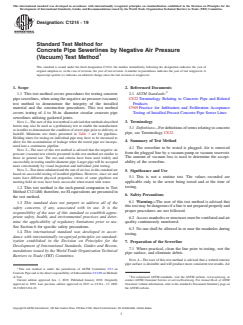
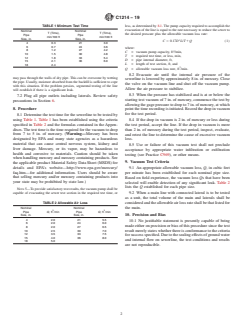
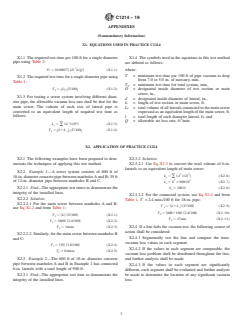

ASTM C1214-19 - Standard Test Method for Concrete Pipe Sewerlines by Negative Air Pressure (Vacuum) Test Method
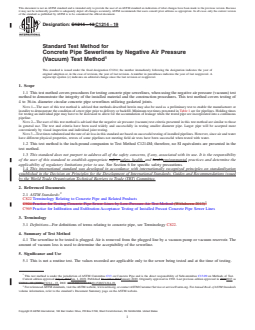
REDLINE ASTM C1214-19 - Standard Test Method for Concrete Pipe Sewerlines by Negative Air Pressure (Vacuum) Test Method
Overview
ASTM C1214-19: Standard Test Method for Concrete Pipe Sewerlines by Negative Air Pressure (Vacuum) Test Method provides a procedure for evaluating the integrity of installed concrete pipe sewerlines using the negative air pressure (vacuum) test. Developed by ASTM International, this standard addresses the specific needs of sewerline quality control, particularly for systems using 4 to 36-inch diameter gasketed circular concrete pipe. The vacuum test verifies both material soundness and proper construction methods, ensuring reliability and compliance with project specifications.
This test method is not routine and is applicable only to the specific sewerline at the time of testing. It is recognized for its value in assessing newly installed pipelines either before or after backfill, supporting both manufacturers and installers in demonstrating the condition of sewer pipes upon delivery and installation.
Key Topics
Test Method Scope
- Applies to concrete sewer pipes with internal diameters of 4 to 36 inches and gasketed joints.
- Focuses on in-field integrity testing using a negative air (vacuum) pressure approach.
Testing Procedure
- The pipeline is cleaned, wetted, and all outlets are securely plugged.
- Air is evacuated from the test section to create a vacuum.
- The test measures how much vacuum is lost over a specified period, which indicates leakage or defects.
- Acceptance criteria are based on allowable air loss and minimum test times provided in tabulated format.
Safety Precautions
- Strict requirements for personal safety during vacuum testing, including access controls and air quality monitoring.
- Prohibits unauthorized personnel near manholes during testing.
Test Limitations
- Values obtained are only valid for the specific line and test moment.
- The test may serve as a preliminary or supplementary assessment, and lines failing the vacuum test may require alternative evaluation like water infiltration tests.
Applications
The ASTM C1214-19 vacuum test method is used in a range of scenarios within municipal infrastructure, civil engineering, and precast concrete manufacturing:
Municipal Sewer System Projects
- Provides a reliable method to ensure sewerline sections are watertight and structurally sound prior to acceptance and backfill.
Quality Assurance for Manufacturers and Installers
- Enables pre-delivery or pre-installation testing to detect manufacturing defects, joint incompatibilities, or damage sustained during transport.
Construction Quality Control
- Supports contractors and inspection agencies in verifying proper installation practices to prevent costly leaks, environmental contamination, and future maintenance.
Supplementing Other Test Methods
- Used in conjunction with water-based infiltration/exfiltration tests or low-pressure air methods to provide a comprehensive assessment of sewer pipe systems.
Related Standards
Multiple ASTM standards relate to the testing and terminology of concrete pipe sewerlines:
- ASTM C822 - Terminology Relating to Concrete Pipe and Related Products
- ASTM C924 - Practice for Testing Concrete Pipe Sewer Lines by Low-Pressure Air Test Method (Withdrawn 2013, but referenced for historical context)
- ASTM C969 - Practice for Infiltration and Exfiltration Acceptance Testing of Installed Precast Concrete Pipe Sewer Lines
These related standards provide additional guidance on testing procedures and acceptance criteria, helping project teams select the most appropriate method for their specific requirements.
Keywords: ASTM C1214-19, concrete pipe sewerline testing, vacuum test method, negative air pressure, sewer pipe integrity, leak detection, gasketed joints, municipal infrastructure standards, construction quality control, ASTM concrete pipe standards.
Relations
- Effective Date
- 01-Jan-2019
- Effective Date
- 01-Jan-2018
- Effective Date
- 15-Apr-2017
- Effective Date
- 01-Feb-2013
- Effective Date
- 01-Nov-2011
- Effective Date
- 01-Dec-2010
- Effective Date
- 01-Jun-2009
- Effective Date
- 01-Nov-2008
- Effective Date
- 02-Jul-2008
- Effective Date
- 15-Feb-2006
- Effective Date
- 01-Oct-2005
- Effective Date
- 15-May-2005
- Effective Date
- 01-Feb-2005
- Effective Date
- 01-Jul-2004
- Effective Date
- 01-Dec-2003
Buy Documents
ASTM C1214-19 - Standard Test Method for Concrete Pipe Sewerlines by Negative Air Pressure (Vacuum) Test Method
REDLINE ASTM C1214-19 - Standard Test Method for Concrete Pipe Sewerlines by Negative Air Pressure (Vacuum) Test Method
Get Certified
Connect with accredited certification bodies for this standard

Institut za varilstvo d.o.o. (Welding Institute)
Slovenia's leading welding institute since 1952. ISO 3834, EN 1090, pressure equipment certification, NDT personnel, welder qualification. Only IIW Au
Sponsored listings
Frequently Asked Questions
ASTM C1214-19 is a standard published by ASTM International. Its full title is "Standard Test Method for Concrete Pipe Sewerlines by Negative Air Pressure (Vacuum) Test Method". This standard covers: SIGNIFICANCE AND USE 5.1 This is not a routine test. The values recorded are applicable only to the sewer being tested and at the time of testing. SCOPE 1.1 This test method covers procedures for testing concrete pipe sewerlines, when using the negative air pressure (vacuum) test method to demonstrate the integrity of the installed material and the construction procedures. This test method covers testing of 4 to 36-in. diameter circular concrete pipe sewerlines utilizing gasketed joints. Note 1: The user of this test method is advised that methods described herein may also be used as a preliminary test to enable the manufacturer or installer to demonstrate the condition of sewer pipe prior to delivery or backfill. Minimum test times presented in Table 1 are for pipelines. Holding times for testing an individual pipe may have to be increased to allow for the accumulation of leakage when the tested pipe are incorporated into a continuous pipeline. Note 2: The user of this test method is advised that the negative air pressure (vacuum) test criteria presented in this test method are similar to those in general use. The test and criteria have been used widely and successfully in testing smaller diameter pipe. Larger pipe will be accepted more conveniently by visual inspection and individual joint testing. Note 3: Test times tabulated and the rate of air loss in this standard are based on successful testing of installed pipelines. However, since air and water have different physical properties, retests of some pipelines not meeting field air tests have been successful when tested with water. 1.2 This test method is the inch-pound companion to Test Method C1214M; therefore, no SI equivalents are presented in the test method. 1.3 This standard does not purport to address all of the safety concerns, if any, associated with its use. It is the responsibility of the user of this standard to establish appropriate safety, health, and environmental practices and determine the applicability of regulatory limitations prior to use. See Section 6 for specific safety precautions. 1.4 This international standard was developed in accordance with internationally recognized principles on standardization established in the Decision on Principles for the Development of International Standards, Guides and Recommendations issued by the World Trade Organization Technical Barriers to Trade (TBT) Committee.
SIGNIFICANCE AND USE 5.1 This is not a routine test. The values recorded are applicable only to the sewer being tested and at the time of testing. SCOPE 1.1 This test method covers procedures for testing concrete pipe sewerlines, when using the negative air pressure (vacuum) test method to demonstrate the integrity of the installed material and the construction procedures. This test method covers testing of 4 to 36-in. diameter circular concrete pipe sewerlines utilizing gasketed joints. Note 1: The user of this test method is advised that methods described herein may also be used as a preliminary test to enable the manufacturer or installer to demonstrate the condition of sewer pipe prior to delivery or backfill. Minimum test times presented in Table 1 are for pipelines. Holding times for testing an individual pipe may have to be increased to allow for the accumulation of leakage when the tested pipe are incorporated into a continuous pipeline. Note 2: The user of this test method is advised that the negative air pressure (vacuum) test criteria presented in this test method are similar to those in general use. The test and criteria have been used widely and successfully in testing smaller diameter pipe. Larger pipe will be accepted more conveniently by visual inspection and individual joint testing. Note 3: Test times tabulated and the rate of air loss in this standard are based on successful testing of installed pipelines. However, since air and water have different physical properties, retests of some pipelines not meeting field air tests have been successful when tested with water. 1.2 This test method is the inch-pound companion to Test Method C1214M; therefore, no SI equivalents are presented in the test method. 1.3 This standard does not purport to address all of the safety concerns, if any, associated with its use. It is the responsibility of the user of this standard to establish appropriate safety, health, and environmental practices and determine the applicability of regulatory limitations prior to use. See Section 6 for specific safety precautions. 1.4 This international standard was developed in accordance with internationally recognized principles on standardization established in the Decision on Principles for the Development of International Standards, Guides and Recommendations issued by the World Trade Organization Technical Barriers to Trade (TBT) Committee.
ASTM C1214-19 is classified under the following ICS (International Classification for Standards) categories: 23.040.50 - Pipes and fittings of other materials. The ICS classification helps identify the subject area and facilitates finding related standards.
ASTM C1214-19 has the following relationships with other standards: It is inter standard links to ASTM C1214-13, ASTM C822-18, ASTM C969-17, ASTM C822-13, ASTM C822-11, ASTM C822-10, ASTM C969-02(2009), ASTM C822-08b, ASTM C822-08a, ASTM C822-06, ASTM C822-05b, ASTM C822-05a, ASTM C822-05, ASTM C822-04, ASTM C822-03. Understanding these relationships helps ensure you are using the most current and applicable version of the standard.
ASTM C1214-19 is available in PDF format for immediate download after purchase. The document can be added to your cart and obtained through the secure checkout process. Digital delivery ensures instant access to the complete standard document.
Standards Content (Sample)
This international standard was developed in accordance with internationally recognized principles on standardization established in the Decision on Principles for the
Development of International Standards, Guides and Recommendations issued by the World Trade Organization Technical Barriers to Trade (TBT) Committee.
Designation: C1214 − 19
Standard Test Method for
Concrete Pipe Sewerlines by Negative Air Pressure
(Vacuum) Test Method
This standard is issued under the fixed designation C1214; the number immediately following the designation indicates the year of
original adoption or, in the case of revision, the year of last revision. A number in parentheses indicates the year of last reapproval. A
superscript epsilon (´) indicates an editorial change since the last revision or reapproval.
1. Scope 2. Referenced Documents
1.1 This test method covers procedures for testing concrete 2.1 ASTM Standards:
pipesewerlines,whenusingthenegativeairpressure(vacuum) C822 Terminology Relating to Concrete Pipe and Related
test method to demonstrate the integrity of the installed Products
material and the construction procedures. This test method C969 Practice for Infiltration and Exfiltration Acceptance
covers testing of 4 to 36-in. diameter circular concrete pipe Testing of Installed Precast Concrete Pipe Sewer Lines
sewerlines utilizing gasketed joints.
3. Terminology
NOTE 1—The user of this test method is advised that methods described
herein may also be used as a preliminary test to enable the manufacturer
3.1 Definitions—Fordefinitionsoftermsrelatingtoconcrete
or installer to demonstrate the condition of sewer pipe prior to delivery or
pipe, see Terminology C822.
backfill. Minimum test times presented in Table 1 are for pipelines.
Holding times for testing an individual pipe may have to be increased to
4. Summary of Test Method
allow for the accumulation of leakage when the tested pipe are incorpo-
rated into a continuous pipeline.
4.1 The sewerline to be tested is plugged. Air is removed
NOTE 2—The user of this test method is advised that the negative air
from the plugged line by a vacuum pump or vacuum reservoir.
pressure (vacuum) test criteria presented in this test method are similar to
The amount of vacuum loss is used to determine the accept-
those in general use. The test and criteria have been used widely and
successfully in testing smaller diameter pipe. Larger pipe will be accepted
ability of the sewerline.
more conveniently by visual inspection and individual joint testing.
NOTE 3—Test times tabulated and the rate of air loss in this standard are
5. Significance and Use
based on successful testing of installed pipelines. However, since air and
5.1 This is not a routine test. The values recorded are
water have different physical properties, retests of some pipelines not
meeting field air tests have been successful when tested with water. applicable only to the sewer being tested and at the time of
testing.
1.2 This test method is the inch-pound companion to Test
Method C1214M; therefore, no SI equivalents are presented in
6. Safety Precautions
the test method.
6.1 Warning—The user of this test method is advised that
1.3 This standard does not purport to address all of the
thistestmaybedangerousifalineisnotpreparedproperlyand
safety concerns, if any, associated with its use. It is the
proper procedures are not followed.
responsibility of the user of this standard to establish appro-
priate safety, health, and environmental practices and deter- 6.2 Accessmanholesorstructuresmustbeventilatedandair
mine the applicability of regulatory limitations prior to use.
quality continuously monitored.
See Section 6 for specific safety precautions.
6.3 No one shall be allowed in or near the manholes during
1.4 This international standard was developed in accor-
testing.
dance with internationally recognized principles on standard-
ization established in the Decision on Principles for the
7. Preparation of the Sewerline
Development of International Standards, Guides and Recom-
7.1 Where practical, clean the line prior to testing, wet the
mendations issued by the World Trade Organization Technical
pipe surface, and eliminate debris.
Barriers to Trade (TBT) Committee.
NOTE 4—The user of this test method is advised that a wetted exterior
pipe surface is desirable and will produce more consistent test results.Air
This test method is under the jurisdiction of ASTM Committee C13 on
Concrete Pipe and is the direct responsibility of Subcommittee C13.09 on Methods
of Test. For referenced ASTM standards, visit the ASTM website, www.astm.org, or
Current edition approved Jan. 1, 2019. Published January 2019. Originally contact ASTM Customer Service at service@astm.org. For Annual Book of ASTM
approved in 1992. Last previous edition approved in 2013 as C1214 – 13. DOI: Standards volume information, refer to the standard’s Document Summary page on
10.1520/C1214-19. the ASTM website.
Copyright © ASTM International, 100 Barr Harbor Drive, PO Box C700, West Conshohocken, PA 19428-2959. United States
C1214 − 19
TABLE 1 Minimum Test Time less, as determined by 8.1. The pump capacity required to accomplish the
evacuation of the line is equal to the rate necessary to reduce the sewer to
Nominal Nominal
T (Time), T (Time),
the desired pressure plus the allowable vacuum loss rate:
Pipe Pipe
min/100 ft min/100 ft
Size, in. Size, in.
C 5 0.17D L/T1Q (1)
4 0.3 21 3.0
6 0.7 24 3.6
where:
8 1.2 27 4.2
C = vacuum pump capacity, ft /min,
10 1.5 30 4.8
T = required test time, or less, min,
12 1.8 33 5.4
D = pipe internal diameter, ft,
15 2.1 36 6.0
L = length of test section, ft, and
18 2.4
Q = allowable vacuum loss rate, ft /min.
8.2 Evacuate air until the internal air pressure of the
may pass through the walls of dry pipe. This can be overcome by wetting
sewerline is lowered by approximately 8 in. of mercury. Close
the pipe. Usually, moisture absorbed from the backfill is sufficient to cope
the valve on the vacuum line and shut off the vacuum pump.
with this situation. If the problem persists, segmental testing of the line
Allow the air pressure to stabilize.
will establish if there is a significant leak.
8.3 When the pressure has stabilized and is at or below the
7.2 Plug all pipe outlets including laterals. Review safety
starting test vacuum of 7 in. of mercury, commence the test by
precautions in Section 6.
allowing the gage pressure to drop to 7 in. of mercury, at which
8. Procedure
pointthetimerecordingisinitiated.Recordthedropinvacuum
for the test period.
8.1 Determine the test time for the sewerline to be tested by
using Table 1. Table 1 has been established using the criteria 8.4 If the drop in vacuum is 2 in. of mercury or less during
specified in Table 2 and the formulas contained in the Appen-
the test period, accept the line. If the drop in va
...
This document is not an ASTM standard and is intended only to provide the user of an ASTM standard an indication of what changes have been made to the previous version. Because
it may not be technically possible to adequately depict all changes accurately, ASTM recommends that users consult prior editions as appropriate. In all cases only the current version
of the standard as published by ASTM is to be considered the official document.
Designation: C1214 − 13 C1214 − 19
Standard Test Method for
Concrete Pipe Sewerlines by Negative Air Pressure
(Vacuum) Test Method
This standard is issued under the fixed designation C1214; the number immediately following the designation indicates the year of
original adoption or, in the case of revision, the year of last revision. A number in parentheses indicates the year of last reapproval. A
superscript epsilon (´) indicates an editorial change since the last revision or reapproval.
1. Scope
1.1 This test method covers procedures for testing concrete pipe sewerlines, when using the negative air pressure (vacuum) test
method to demonstrate the integrity of the installed material and the construction procedures. This test method covers testing of
4 to 36-in. diameter circular concrete pipe sewerlines utilizing gasketed joints.
NOTE 1—The user of this test method is advised that methods described herein may also be used as a preliminary test to enable the manufacturer or
installer to demonstrate the condition of sewer pipe prior to delivery or backfill. Minimum test times presented in Table 1 are for pipelines. Holding times
for testing an individual pipe may have to be increased to allow for the accumulation of leakage when the tested pipe are incorporated into a continuous
pipeline.
NOTE 2—The user of this test method is advised that the negative air pressure (vacuum) test criteria presented in this test method are similar to those
in general use. The test and criteria have been used widely and successfully in testing smaller diameter pipe. Larger pipe will be accepted more
conveniently by visual inspection and individual joint testing.
NOTE 3—Test times tabulated and the rate of air loss in this standard are based on successful testing of installed pipelines. However, since air and water
have different physical properties, retests of some pipelines not meeting field air tests have been successful when tested with water.
1.2 This test method is the inch-pound companion to Test Method C1214M; therefore, no SI equivalents are presented in the
test method.
1.3 This standard does not purport to address all of the safety concerns, if any, associated with its use. It is the responsibility
of the user of this standard to establish appropriate safety safety, health, and healthenvironmental practices and determine the
applicability of regulatory limitations prior to use. See Section 6 for specific safety precautions.
1.4 This international standard was developed in accordance with internationally recognized principles on standardization
established in the Decision on Principles for the Development of International Standards, Guides and Recommendations issued
by the World Trade Organization Technical Barriers to Trade (TBT) Committee.
2. Referenced Documents
2.1 ASTM Standards:
C822 Terminology Relating to Concrete Pipe and Related Products
C924 Practice for Testing Concrete Pipe Sewer Lines by Low-Pressure Air Test Method (Withdrawn 2013)
C969 Practice for Infiltration and Exfiltration Acceptance Testing of Installed Precast Concrete Pipe Sewer Lines
3. Terminology
3.1 Definitions—For definitions of terms relating to concrete pipe, see Terminology C822.
4. Summary of Test Method
4.1 The sewerline to be tested is plugged. Air is removed from the plugged line by a vacuum pump or vacuum reservoir. The
amount of vacuum loss is used to determine the acceptability of the sewerline.
5. Significance and Use
5.1 This is not a routine test. The values recorded are applicable only to the sewer being tested and at the time of testing.
This test method is under the jurisdiction of ASTM Committee C13 on Concrete Pipe and is the direct responsibility of Subcommittee C13.09 on Methods of Test.
Current edition approved July 1, 2013Jan. 1, 2019. Published December 2013January 2019. Originally approved in 1992. Last previous edition approved in 20092013 as
C1214 – 02 (2009).C1214 – 13. DOI: 10.1520/C1214-13.10.1520/C1214-19.
For referenced ASTM standards, visit the ASTM website, www.astm.org, or contact ASTM Customer Service at service@astm.org. For Annual Book of ASTM Standards
volume information, refer to the standard’s Document Summary page on the ASTM website.
Copyright © ASTM International, 100 Barr Harbor Drive, PO Box C700, West Conshohocken, PA 19428-2959. United States
C1214 − 19
TABLE 1 Minimum Test Time
Nominal Nominal
T (Time), T (Time),
Pipe Pipe
min/100 ft min/100 ft
Size, in. Size, in.
4 0.3 21 3.0
6 0.7 24 3.6
8 1.2 27 4.2
10 1.5 30 4.8
12 1.8 33 5.4
15 2.1 36 6.0
18 2.4
6. Safety Precautions
6.1 Warning—The user of this test method is advised that this test may be dangerous if a line is not prepared properly and
proper procedures are not followed.
6.2 Access manholes or structures must be ventilated and air quality continuously monitored.
6.3 No one shall be allowed in or near the manholes during testing.
7. Preparation of the Sewerline
7.1 Where practical, clean the line prior to testing, wet the pipe surface, and eliminate debris.
NOTE 4—The user of this test method is advised that a wetted exterior pipe surface is desirable and will produce more consistent test results. Air may
pass through the walls of dry pipe. This can be overcome by wetting the pipe. Usually, moisture absorbed from the backfill is sufficient to cope with this
situation. If the problem persists, segmental testing of the line will establish if there is a significant leak.
7.2 Plug all pipe outlets including laterals. Review safety precautions in Section 6.
8. Procedure
8.1 Determine the test time for the sewerline to be tested by using Table 1. Table 1 has been established using the criteria
specified in Table 2 and the formulas contained in the Appendixes. The test time is the time required for the vacuum to drop from
7 to 5 in. of mercury. (Warning—Mercury has been designated by EPA and many state agencies as a hazardous material that can
cause central nervous system, kidney and liver damage. Mercury, or its vapor, may be hazardous to health and corrosive to
materials. Caution should be taken when handling mercury and mercury containing products. See the applicable product Material
Safety Data Sheet (MSDS) for details and EPA’s website—http://www.epa.gov/mercury/faq.htm—for additional information.
Users should be aware that selling mercury and/or mercury containing products into your state may be prohibited by state law.)
NOTE 5—To provide satisfactory test results, the vacuum pump shall be capable of evacuating the sewer test section in the required test time, or less,
as determined by 8.1. The pump capacity required to accomplish the evacuation of the line is equal to the rate necessary to reduce the sew
...